







Abstract

Dear editor,
Gestural communication is important in stroke patients with moderate to severe aphasia to express their needs. 1 The negative impact of apraxia on spontaneous use of gestural communication in left hemispheric stroke (LHS) was suggested previously.2,3 Rapid and valid assessment of everyday gestural communication is therefore paramount for the care of aphasic stroke patients. The aim of the present study was to evaluate the reliability and validity of a short scale for gestural communication (SGC) in stroke patients.
Sixty left (LHS, n = 30) and right (RHS, n = 30) hemispheric stroke patients in an inpatient rehabilitation setting were included in this study. Spontaneous gestural communication was rated using SGC (see supplementary figure, available online with this letter.) by professional caregivers. Upper limb apraxia was assessed by a standardized apraxia screening of TULIA (AST).
4
Aphasia was measured by the Token test.
5
Scale for Gestural Communication (SGC).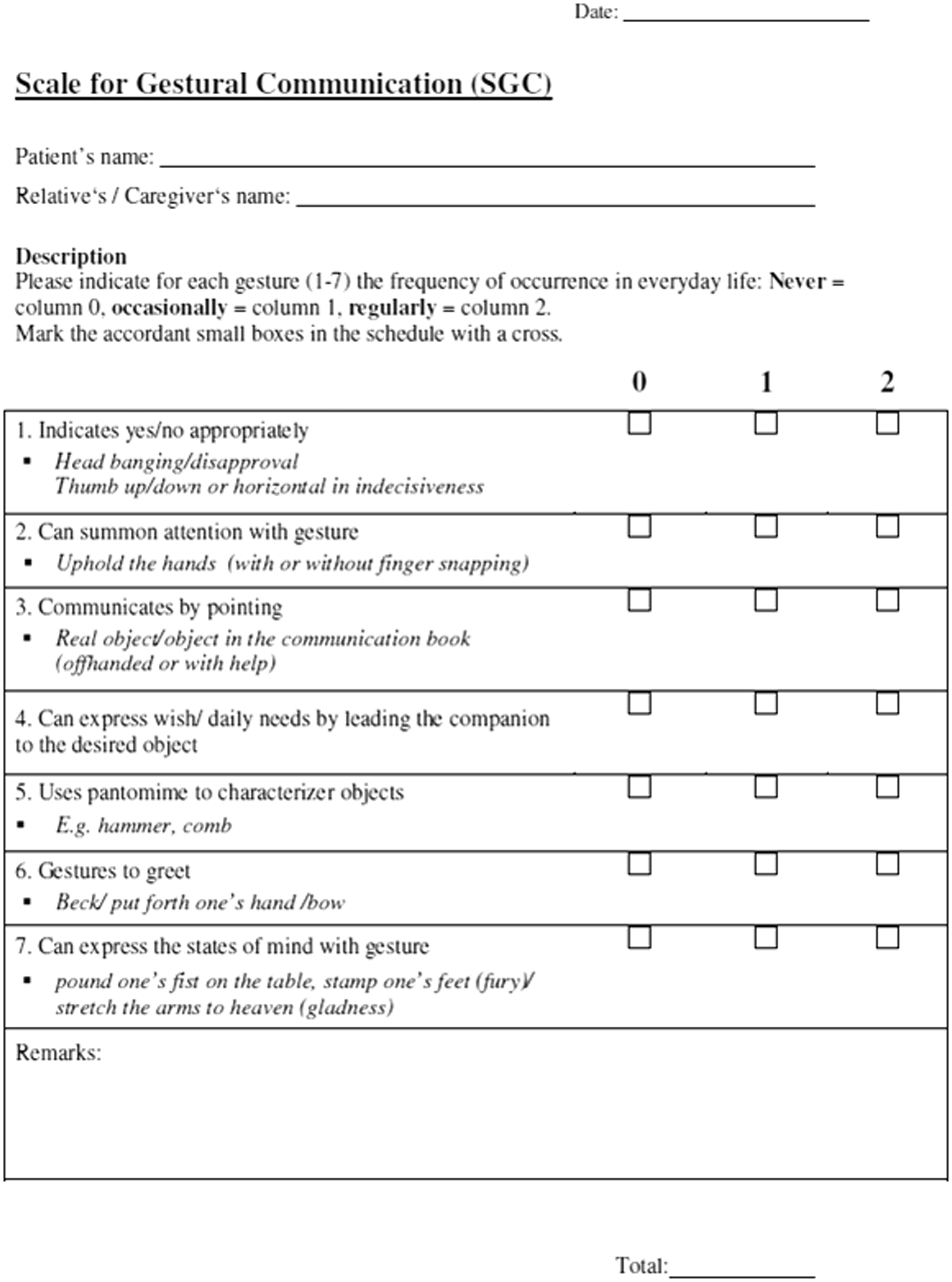
The internal consistency of the total scale of SGC was good (Cronbach’s α = 0.85). At item level, the SGC demonstrated good to excellent interrater reliability. Compared to RHS patients, LHS patients peformed significantly worse on both the AST as well as the SGC (F = 19.99, p < 0.0001, η2 = 0.26). Furthermore, a significant correlation was found between the SGC and AST (r = 0.63; p < 0.001) in LHS, which was independent of the severity of aphasia, indicating good criterion validity of the SGC. No correlation (r = 0. 07, p = 0.70) was found between the SGC and AST for RHS patients.
Our findings demonstrate that the SGC is a reliable and valid short scale to assess impaired spontaneous gestural communication in stroke patients with aphasia. The study shows that apraxia impedes everyday gestural communication.
Footnotes
Acknowledgment
We are thankful to Susanne Zürrer for her expertise regarding the development of the SGC.
Declaration of conflicting interests
The author(s) declared no potential conflicts of interest with respect to the research, authorship, and/or publication of this article.
Funding
The author(s) received no financial support for the research, authorship, and/or publication of this article.
References
Supplementary Material
Please find the following supplemental material available below.
For Open Access articles published under a Creative Commons License, all supplemental material carries the same license as the article it is associated with.
For non-Open Access articles published, all supplemental material carries a non-exclusive license, and permission requests for re-use of supplemental material or any part of supplemental material shall be sent directly to the copyright owner as specified in the copyright notice associated with the article.
