







Abstract

Dear editor,
Hematologic malignancies increase the risk of ischemic or hemorrhagic stroke and lead to co-morbidities. 1 Mycosis fungoides (MF) is a rare malignant T-cell lymphoma that primarily involves skin and commonly disseminates to internal organs.2,3 As MF involving the central nervous system is rare, only few studies to date have examined the neurological consequences of MF on these patients.4,5 Moreover, the incidence and risk of stroke in MF patients remain unknown.
Incidence rates and risk of stroke stratified by sex, age, and co-morbidity in a multivariate Cox proportional hazards regression model for patients with mycosis fungoides compared to those without mycosis fungoides
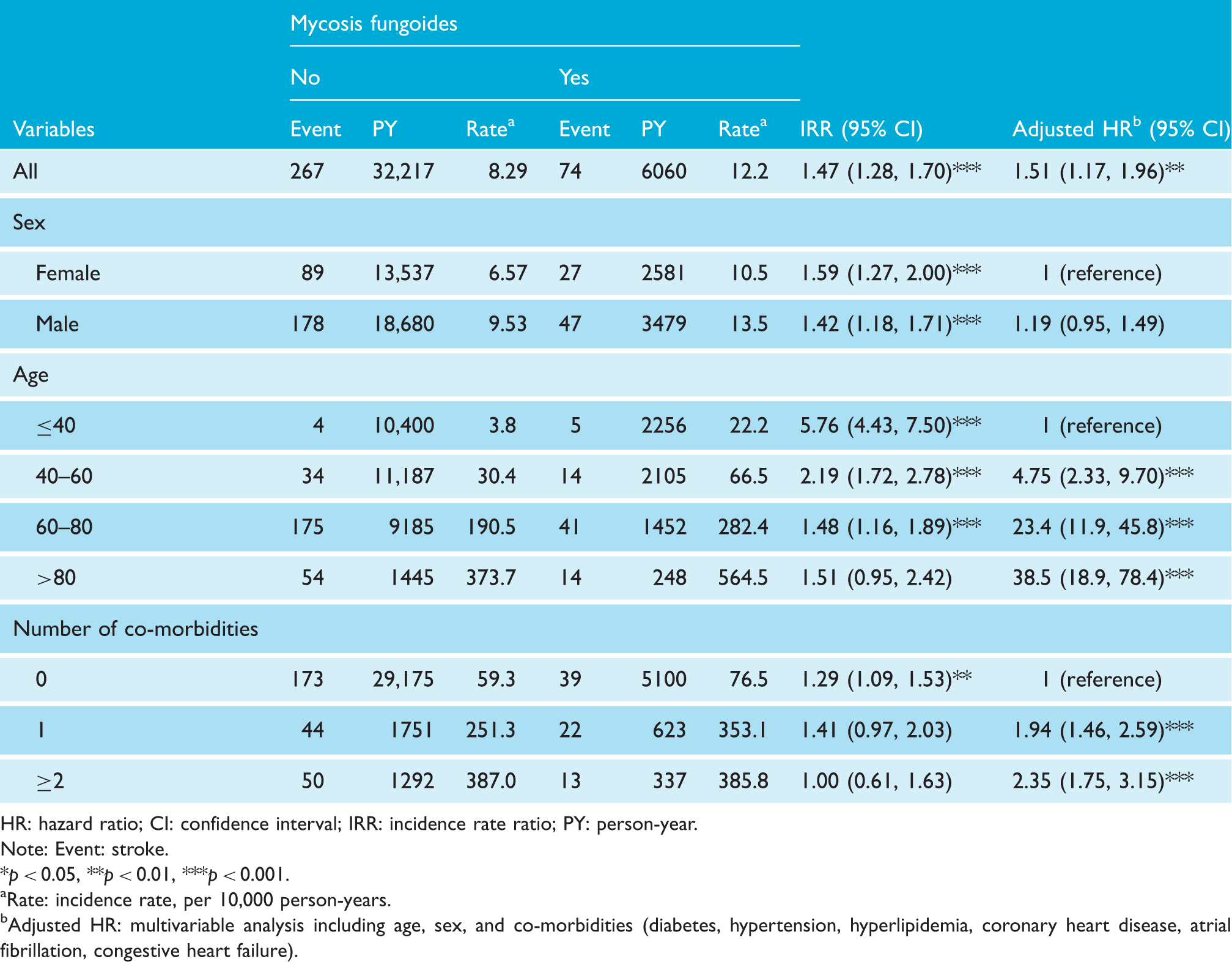
HR: hazard ratio; CI: confidence interval; IRR: incidence rate ratio; PY: person-year.
Note: Event: stroke.
p < 0.05, **p < 0.01, ***p < 0.001.
Rate: incidence rate, per 10,000 person-years.
Adjusted HR: multivariable analysis including age, sex, and co-morbidities (diabetes, hypertension, hyperlipidemia, coronary heart disease, atrial fibrillation, congestive heart failure).
Footnotes
Patients with MF have a higher risk of stroke, especially ischemic stroke. Physicians should be more aware of the possibility of cerebrovascular disease in cancer patient with neurologic signs and symptoms and establish stroke-related intervention programs for patients with MF to improve their long-term outcomes.
Authors’ contributions
Jeng-Dau Tsai, Yu-Ping Hsiao, and Chang-Ching Wei conceptualized and designed the study, drafted the initial manuscript, and approved the final manuscript as submitted.
Cheng-Li Lin and Henry J Tsai carried out the initial analysis, reviewed and revised the manuscript, and approved the final manuscript as submitted.
Chang-Ching Wei coordinated and supervised data collection, critically reviewed the manuscript, and approved the final manuscript as submitted.
Declaration of conflicting interests
The author(s) declared no potential conflicts of interest with respect to the research, authorship, and/or publication of this article.
Funding
The author(s) disclosed receipt of the following financial support for the research, authorship, and/or publication of this article: The study was supported in part by Taiwan Ministry of Health and Welfare Clinical Trial and Research Center of Excellence (MOHW105-TDU-B-212-133019), China Medical University Hospital, Academia Sinica Taiwan Biobank, Stroke Biosignature Project (BM104010092), NRPB Stroke Clinical Trial Consortium (MOST 103-2325-B-039-006), Tseng-Lien Lin Foundation, Taichung, Taiwan, Taiwan Brain Disease Foundation, Taipei, Taiwan, and Katsuzo and Kiyo Aoshima Memorial Funds, Japan.