






Abstract
Rationale/Aim:
Many patients undergoing successful recanalization after endovascular thrombectomy (EVT) do not have a good outcome; additional neuroprotection might benefit this group. Remote ischemic conditioning (RIC) stimulates endogenous protective mechanisms and may have a neuroprotective in acute brain ischemia. The safety and efficacy of RIC combined with endovascular thrombectomy (SERIC-EVT) trial is investigating the safety and efficacy of RIC for patients with acute ischemic stroke (AIS) who underwent EVT due to large vessel occlusion of the anterior circulation.
Methods:
SERIC-EVT is a multicenter, randomized, parallel-controlled, and blinded endpoint clinical trial. Patients are recruited from 10 hospitals in Jilin Province, Northeast China. Patients with anterior circulation AIS undergoing EVT due to large vessel occlusion are randomized in a 1:1 ratio to RIC or sham-RIC. Participants will receive standard medical treatment and an inflation pressure of 200 mmHg (RIC group) or 60 mmHg (sham-RIC group) twice daily for seven consecutive days.
Study outcomes:
The primary outcome is the proportion of patients with modified Rankin Scale (mRS) score of 0–2 on day 90. Secondary outcome measures include the National Institute of Health Stroke Scale, Barthel Index, and mRS scores obtained at 24 h, 7 days, 30 ± 3 days, and 90 ± 3 days post-EVT, recanalization rate, expanded Thrombolysis in Cerebral Infarction score, and symptomatic intracranial hemorrhage post-EVT. Mortality and all adverse events, including skin changes and pain scores, within the first 90 days will be used as safety outcome measures.
Sample size estimates:
Based on previous studies, we estimate a 14% difference in functional independence (the mRS ⩽2) between RIC and sham-RIC groups. Considering a significance level of 5% and power of 80%, and one-fifth of patients lost to follow up, the planned sample size is 498 patients (249 per group).
Discussion:
RIC might be a strategy that improves 3-month clinical outcomes in AIS patients who have undergone EVT due to large vessel occlusion of anterior circulation. SERIC-EVT will determine whether this is the case.
Introduction
For patients of acute ischemic stroke (AIS) with large vessel occlusion of the anterior circulation, meta-analysis studies have shown that endovascular thrombectomy (EVT), when compared to standard medical care, leads to better clinical functional outcomes. 1 EVT has been documented in some guidelines as the first-line approach for the early management of patients with AIS.2–4 Although nearly 80% of occluded arteries were recanalized successfully after EVT, only 46% of patients achieved favorable prognosis after 90 days (modified Rankin Scale (mRS) = 0–2).5,6 The significant mismatch of recanalization and favorable prognosis merits further study. Therefore, it is important to identify strategies to improve the proportion of favorable prognosis in patients undergoing EVT.
Recently, remote ischemic conditioning (RIC), a method that involves inducing multiple brief episodes of ischemia and reperfusion in the limbs, has been studied for AIS treatment for its ability to promote resistance to ischemic brain injury. 7 Previous studies have reported that RIC stimulates endogenous protective mechanisms and has a protective role particularly in brain tissue.8–10 In an experimental ischemia–reperfusion model, RIC has been shown to reduce cerebral ischemia–reperfusion injury, inflammatory substances, brain edema, and neuronal apoptosis.11,12 Thus, RIC might be beneficial for patients who have undergone EVT treatment because cerebral recanalization after ischemia is similar to ischemia–reperfusion models.
A previous study suggested that RIC is safe and feasible for patients with AIS who were treated with EVT, but its effectiveness remains to be determined. 13 Therefore, we designed a multicenter, randomized controlled clinical trial to assess the efficacy and safety of RIC in AIS patients who received EVT due to large vessel occlusion of anterior circulation.
Methods
Design
Safety and efficacy of remote ischemic conditioning combined with endovascular thrombectomy (SERIC-EVT) is a multicenter, randomized, parallel-controlled, and blinded endpoint clinical trial that evaluates the efficacy and safety of RIC in patients with AIS who underwent EVT. This study was approved by the ethics committee of the First Hospital of Jilin University and each study center involved. The trial is conducted in compliance with the International Council for Harmonization of Technical Requirements for Pharmaceuticals for Human Use-Good Clinical Practice Guidelines (ICH-GCP) and the Declaration of Helsinki (revised 2013).
Patient population
All 498 patients, 249 in the control group and another 249 in the treatment group, will be recruited from 10 hospitals that are qualified to perform EVT from the Jilin Province Stroke Emergency Maps in Jilin Province, Northeast China. 14 Investigators from the 10 hospitals will be informed of the study design and flow of our trial prior to enrollment. Figure 1 shows the flow of patient enrollment. The inclusion and exclusion criteria are presented in Table 1. All participants or their legal representatives will provide written informed consent.
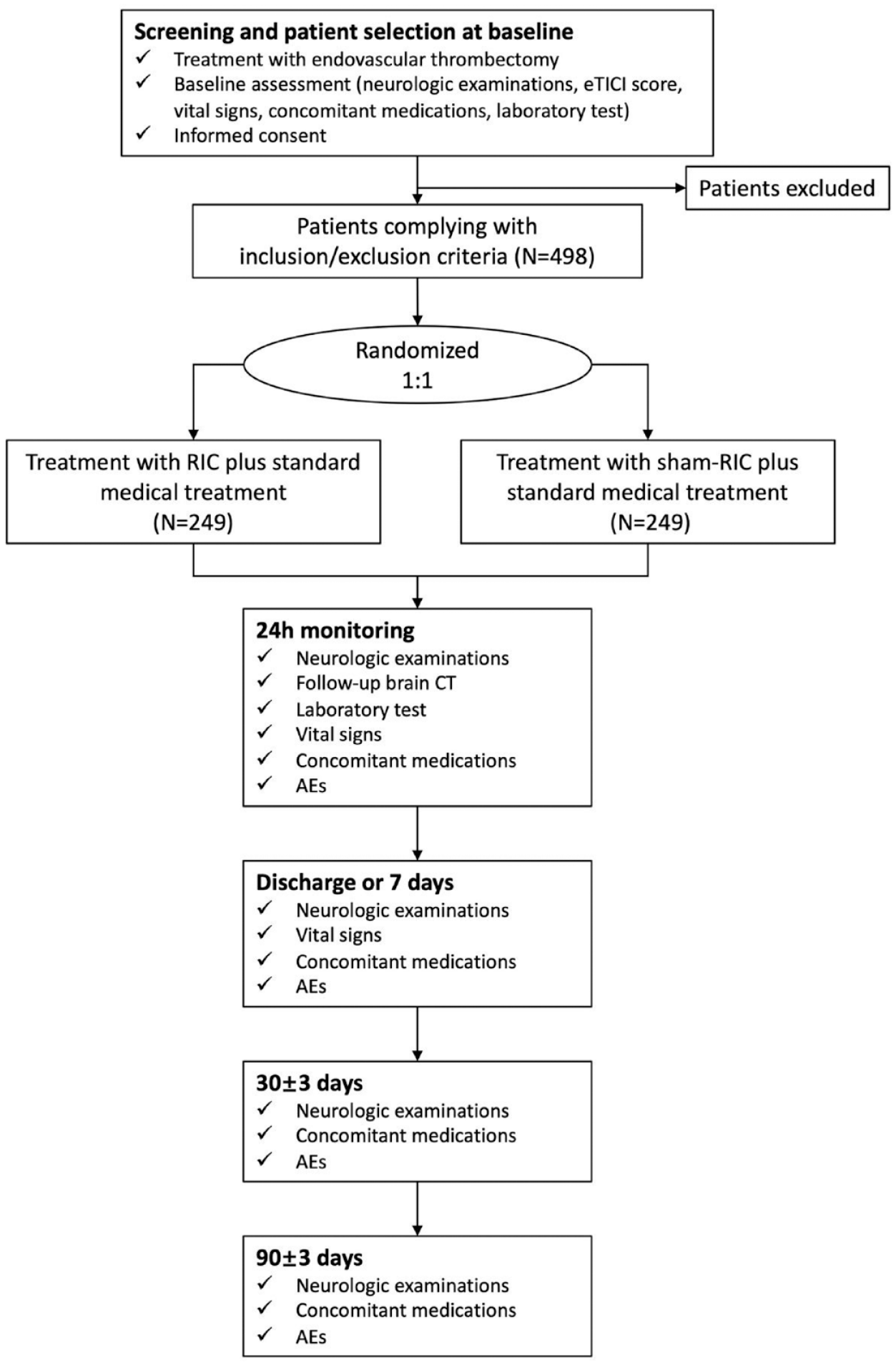
Patient enrollment flowchart. eTICI: the expanded Thrombolysis in Cerebral Infarction; RIC: remote ischemic conditioning; CT: computed tomography; AEs: adverse events.
Patient inclusion and exclusion criteria.
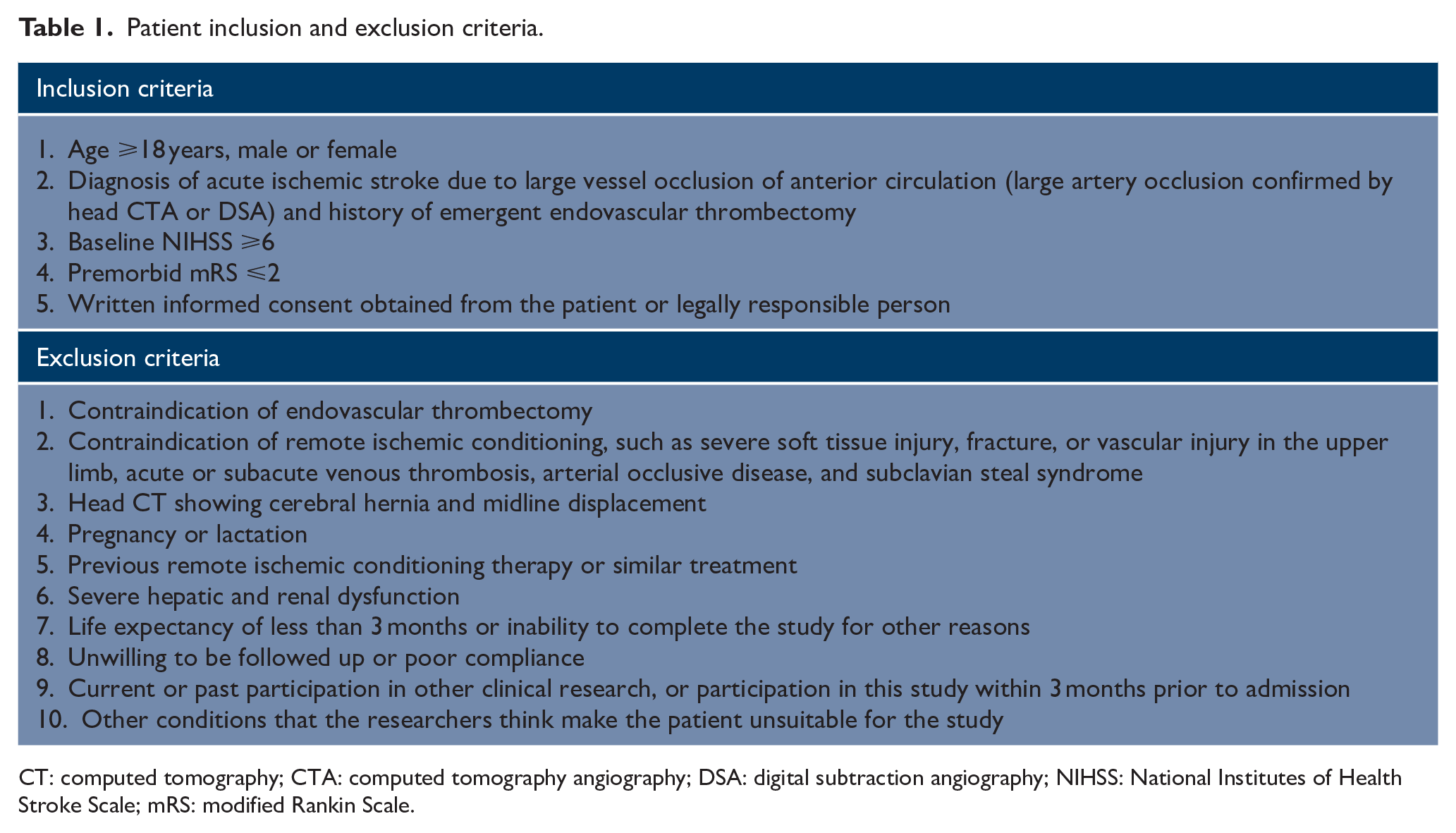
CT: computed tomography; CTA: computed tomography angiography; DSA: digital subtraction angiography; NIHSS: National Institutes of Health Stroke Scale; mRS: modified Rankin Scale.
Randomization
Participants will be randomized in a 1:1 ratio to the RIC or sham-RIC groups following a computer-generated block randomization sequence stratified by each study center. The block sizes will randomly vary between 4, 6, and 8. Random numbers will be stored in opaque envelopes. Randomized envelopes will be assigned to each center in advance. Each patient will provide written informed consent in the center and receive a random treatment number based on the chronological enrollment order. Treatment allocation will be determined based on the envelope’s randomization results, which are blinded to the outcome observers.
RIC procedure
RIC will be performed on the upper arm of the unaffected side using an automatic device (BB-RIC-D5/LAPUL Medical Devices Co., Ltd, Beijing, China) with an inflation pressure of 200 mmHg (RIC group) or 60 mmHg (sham-RIC group) during ischemia. Patients will undergo RIC after EVT. During the preparation stage of this experiment, it was determined the device should be programmed to run automatically for 40 min (ischemia for 5 min, reperfusion for 5 min, and repeat for four cycles) after starting up. Participants will receive RIC twice daily for seven consecutive days from the first day of hospitalization.
During the administration of RIC, nurses will assist in performing RIC intervention and recording the local changes in skin appearance on the upper arm. Depending on the patient’s condition, the numeric rating scale (scale range, 0–10, with 0 indicating no pain and 10 indicating maximum pain) will be used to evaluate discomfort and pain. Standard medical treatment in both groups will follow the Chinese guidelines for the diagnosis and treatment of acute ischemic stroke (2018). 2
Outcomes
The primary outcome is the proportion of patients with an mRS score of 0–2 on day 90. The National Institutes of Health Stroke Scale (NIHSS), Barthel Index, and mRS scores at 24 h, 7 days, 30 ± 3 days, and 90 ± 3 days post-EVT will be used as secondary outcome measures. Secondary outcome measures also include the recanalization rate, expanded Thrombolysis in Cerebral Infarction score (eTICI score, ranges from 0 (no reperfusion) to 3 (full reperfusion in the distribution of the occluded artery)), and rate of symptomatic intracranial hemorrhage post-EVT. Mortality and all adverse events, including skin changes and pain scores, within the first 90 days will be used as safety outcome measures.
Outcome measures will be monitored at baseline, 24 h, 7 days, 30 days, and 90 days. One to two professional clinical observers in each center will perform face-to-face visits at baseline, 24 h, and 7 days. Professionally qualified observers from our stroke center will conduct all participants’ follow-ups at 30 ± 3 days and 90 ± 3 days by phone call or video call. To maintain anonymity, all observers will be unaware of the patients’ assignments or treatments.
Data Monitoring and Safety Committee
An independent Data Monitoring and Safety Committee (DMSC) has been established to ensure patient safety. The DMSC supervises the progress and data collection of the trial, primarily focusing on the feasibility and safety of the RIC procedure in every center.
Sample size estimates
In a previous study, the proportion of patients with favorable functional outcomes at 90 days (mRS ⩽2) in the thrombectomy-alone group was 36.4% (36.8% in the combined intravenous alteplase and EVT group). 15 Another meta-analysis showed that 46% of patients who received EVT plus intravenous alteplase treatment achieved functional independence at 90 days (mRS ⩽2). 1 Based on the aforementioned studies, we estimate that 41% of patients with AIS who undergo EVT therapy will have favorable functional outcomes at 90 days. However, in an exploratory study that assessed the safety and feasibility of RIC for AIS patients undergoing EVT, 55% of subjects (11/20) achieved functional independence (mRS ⩽2). 13 Consequently, we estimate a 14% difference in functional independence (mRS ⩽2) between RIC and control groups. Considering a significance level of 5% and power of 80%, we computed a sample size of 398 patients (199 per group). We have accounted for a one-fifth of patients might be lost to follow-up; therefore, 498 patients (249 per group) will be recruited.
Data analysis
We will use the intention-to-treat analysis set in all randomized patients for efficacy analyses. The safety analysis set, which includes patients who receive at least one RIC, will be used for the safety analyses. Continuous variables with normal distribution will be represented as mean value ± standard deviation, whereas the median and quartile will represent continuous variables with a non-normal distribution. Categorical variables will be presented as frequencies and percentages. Multiple imputations will be used to identify the missing values of the baseline variables.
The primary outcome, which is a categorical variable, will be analyzed using an unadjusted logistic regression analysis. A multivariable model will be used to conduct a secondary analysis of the primary outcome, which will include age, baseline NIHSS, mRS score before stroke, and stroke onset-to-treatment time. With the inclusion of multiplicative interaction factors, subgroup analyses will be conducted to assess the effect modification (heterogeneity of the treatment effect).
Secondary outcomes will be analyzed using linear or logistic regression models (binary or ordinal regression as appropriate) with the same adjustment as the primary outcome. SPSS 19.0 software will be used for statistical data analysis. Statistical significance was set at P < 0.05.
Current status
This study was registered on 13 July 2021. The first patient was enrolled on 26 August 2021, and all study sites are still recruiting the participants. At the time of the first submission of this article, the DMSC has been established and 92 patients have been recruited into SERIC-EVT. Recruitment will continue until the complete sample size is achieved.
Discussion
The primary purpose of the SERIC-EVT study is to investigate the safety and efficacy of RIC in patients with AIS who have undergone EVT due to large vessel occlusion of anterior circulation. To our knowledge, several ongoing randomized clinical trials are investigating the efficacy of RIC in patients with AIS who received intravenous alteplase or did not receive recanalization therapies and in intracerebral hemorrhage.16–19 However, studies on the efficacy of RIC in patients with AIS who underwent EVT remain scarce and inconclusive; hence, further studies are warranted.
In the past years, RIC was applied in patients with ST-segment elevation myocardial infarction undergoing percutaneous coronary intervention (PCI), but the results were inconsistent. For example, there was strong evidence that RIC mitigates myocardial reperfusion injury and reduces myocardial infarct size due to its endogenous protective mechanisms.20,21 However, the Phase III CONDI-2/ERIC-PPCI trial did not find that RIC reduced myocardial infarct size and improved clinical outcomes in patients with ST-elevation myocardial infarction undergoing PCI.22,23 In addition, a substudy of the CONDI-2/ERIC-PPCI trial found that RIC might reduce platelet reactivity, thus reducing the occurrence of acute stent thrombosis. 24 In this sense, in terms of cerebrovascular disease, 25 whether RIC might benefit patients with cerebral infarction undergoing EVT is unclear and worthy of further study.
Generally, a large cerebral artery occlusion of anterior circulation leads to a massive hemispheric infarction and subsequently poor outcomes. Previous studies have demonstrated that RIC can relieve cerebral ischemia–reperfusion injury in stroke models in animals; however, some researchers believe that the neuroprotective strength of RIC may be inadequate, so it is unclear whether it improves outcomes in patients with EVT. 9 Therefore, we aim to monitor three types of neurological deficit scores (NIHSS, Barthel Index, and mRS) at different follow-up periods to predict outcomes more accurately. The results of this SERIC-EVT study will provide valuable information for further studies.
In addition, we will focus on the safety outcome measures during follow-up. A proof-of-concept trial showed that RIC is safe for patients undergoing carotid artery stenting and that it has the ability to decrease ischemic brain injury. 26 In addition, a previous study suggested that RIC is safe and feasible for patients with AIS who were treated with EVT. 13 Therefore, we anticipate the present study will establish that RIC is safe for patients undergoing EVT.
Summary and conclusion
RIC might be a strategy that improves 3-month clinical outcomes in AIS patients who have undergone EVT due to large vessel occlusion of anterior circulation. SERIC-EVT will determine whether this is the case.
Footnotes
Acknowledgements
The authors are very grateful to the Data Monitoring and Safety Committee for their contributions to this study. The authors thank Professor Yanhua Wu (Department of Clinical Research, the First Hospital of Jilin University) for guidance with the statistics.
Author contributions
Y.Y. and Z.-N.G. designed the study and revised the article. All authors contributed to the critical revision of the manuscript and approved the final manuscript for submission.
Declaration of conflicting interests
The author(s) declared no potential conflicts of interest with respect to the research, authorship, and/or publication of this article.
Funding
The author(s) disclosed receipt of the following financial support for the research, authorship, and/or publication of this article: This study was supported by the National Natural Science Foundation of China (no. 82071291), the Science and Technology Department of Jilin Province (20180623052TC), and the Jilin Provincial Key Laboratory (20190901005JC) to Y.Y.
