







Abstract
This study investigated whether adding a maximal voluntary isometric contraction to developing snowboard and ski cross athletes’ warm-up could reduce start time. A secondary aim was to assess the appropriateness of start performance as a talent identification tool for junior athletes by determining whether differences in time could be explained by participant age and anthropometry. Twenty sub-elite athletes (male: n = 11, female: n = 9, age: 15.0 ± 1.4 years) participated. No differences were found for start time (7.5 m) between maximal voluntary isometric contraction and standardised (no-maximal voluntary isometric contraction) warm-up or gender (maximal voluntary isometric contraction; males: 1.36 ± 0.07 s, females: 1.41 ± 0.03 s, no-maximal voluntary isometric contraction; males: 1.35 ± 0.01 s, females: 1.38 ± 0.10 s, P > 0.05). A strong relationship between body mass and start time to 7.5 m (r = −0.78, r2 = 0.61, P < 0.05) was observed. Use of maximal voluntary isometric contraction-based warm-ups with developing snowboard cross and ski cross athletes may not be beneficial to improving performance.
Introduction
The snowboard (SBX) and ski (SKIX) cross events are relatively new Olympic winter sports, with SBX making an Olympic debut in 2006, and SKIX four years later in 2010. For both sports, the ability of the participant to accelerate out of the drop down gates has been identified as an important factor in producing a high level of performance.1–4 Specifically, moderate to strong correlations (r = 0.47–0.73) have been noted between start time over the first 7.5 m of a course and an athlete’s qualifying time in elite SKIX.1,2 Improving start performance can also provide an advantage over fellow competitors during the head-to-head racing phase, as leading the other racers allows athletes to choose the most appropriate racing line while avoiding the need to overtake competitors. 1
Race performance of SBX and SKIX athletes has been found to be strongly associated with maximal push-off speed, bench press and pull strength, core power, and muscle pre-activation prior to start performance.5,6 Therefore, warm-up practices of SBX and SKIX athletes should physically prepare them for the explosive start essential to success in these events. Despite this, previous observational studies investigating competition practices of SBX and SKIX athletes have suggested that current warm-up practices may be less than ideal. 7 The negative effects of these practices may be further exacerbated when combined with the environmental constraints of sub-zero temperatures. Further, information relating to current warm-up practices and their effect on start performance is not available. Therefore, it is important to determine whether improving current warm-up practices may offer an acute improvement in start time.
It is well established that the implementation of a maximal voluntary isometric contraction (MVIC) pull exercise prior to exercise can exert acute performance effects on dynamic sporting movements, maximal force output and acceleration.8–11 This predominantly occurs as a result of muscle post-activation potentiation (PAP), as MVICs allow for the recruitment of higher order motor units, as well as myosin regulatory light chain phosphorylation. 12 Further, maximal isometric strength has been found to be related to elite performance measures in several sports such as cross country and Nordic combined skiing, 13 tennis, 14 and rowing. 15 Despite limited information available relating to the PAP response in developing athletes, the addition of an MVIC to warm-up prior to competition could potentially improve time out of the start gates, thus improving overall race performance in SBX and SKIX competition.6,9,10
In developing athletes, certain anthropometric measures have also been found to have moderate to strong relationships with performance, particularly in sports such as alpine skiing, 16 soccer, 17 tennis, 18 American football, 17 and basketball. 19 Further, for athletes between the ages of 14 and 21 years, body mass and height have been shown to be higher in nationally selected snow sport athletes of the same competition age group. 16 Despite this, some studies have noted that chronological age exerts a minimal effect on performance measures within competition age groups less than 18 years.17,19 However, the influence of chronological age and anthropometric measures on start performance in developing SBX and SKIX athletes has yet to be established.
The aims of this study were to determine whether the addition of an MVIC pull exercise to the warm-up of developing SBX and SKIX athletes could improve start performance. This study also aimed to investigate the relationship between chronological age, height and body mass and start performance in this same sample population.
Method
Participants
Developing SBX and SKIX athletes (n = 20) were recruited from the Mount Buller Race Club, Victoria, Australia. Participant inclusion criteria were set for age (13–18 years), level of involvement in the sport (at least 5 h of training per week), familiarity with the start gate pull/push technique, no serious injuries in the last six months, and able to participate in two testing sessions 24 h apart. The study protocol was approved by the relevant university human ethics advisory group and written consent was obtained from all participants/guardians.
Participants were informed about the purpose of the study and then completed a 15 min warm-up familiarisation session prior to testing. During this session, participants received visual and verbal instructions in regards to the warm-up and expected start performance effort. Following this, participant standing height was measured prior to the first testing session using a stadiometer (Model 220, Seca, Hamburg, Germany), with body mass also recorded using electronic scales (Model UC-321, A&D Engineering Inc., San Jose, USA). Both measures were taken without shoes or snow clothing and measured to the nearest 0.1 cm and 0.1 kg.
Warm-up test development
The standardised (no-MVIC) warm-up protocol was adapted from the protocol presented by McMillian, Moore. 20 This consisted of a six-minute general aerobic warm-up followed by body-weight squats, lunges, push-ups, leg swings (hip abduction/adduction/flexion/ extension) and arm swings (forward and backward rotation). Total time for both the no-MVIC and MVIC warm-up protocols was 27 min. The no-MVIC protocol included an 11 min rest following the general warm-up with the participant coached to remain stationary until instructed to prepare for the gate start. The MVIC pull warm-up was undertaken by each participant five minutes following completion of the standardised warm-up. This time interval was based on information received from SBX and SKIX coaches in that it most closely simulated competition scheduling procedures. The specific MVIC pull technique was based on the findings of Haff et al. 21 and Kawamori et al. 22 who found the isometric mid-thigh pull and isometric upper body conditioning exercises produces greater peak force (N) and peak power (W) output when compared to dynamic exercises. Participants placed a TRX Suspension Trainer (TRX Training, Leader Enterprises Inc., USA) under each foot with the handles adjusted to mid-thigh height once their knees and hips were bent slightly.21–23 They were then instructed to pull upward on the TRX maximally for 3 × 3 s repetitions, with a three-minute rest between repetition as outlined by French et al. 9 and Güllich and Schmidtbleicher. 10 The start gate performance was then undertaken within one minute of completing the MVIC pull.9,10
Warm-up testing
Environmental and slope variables of testing sessions 1 and 2.
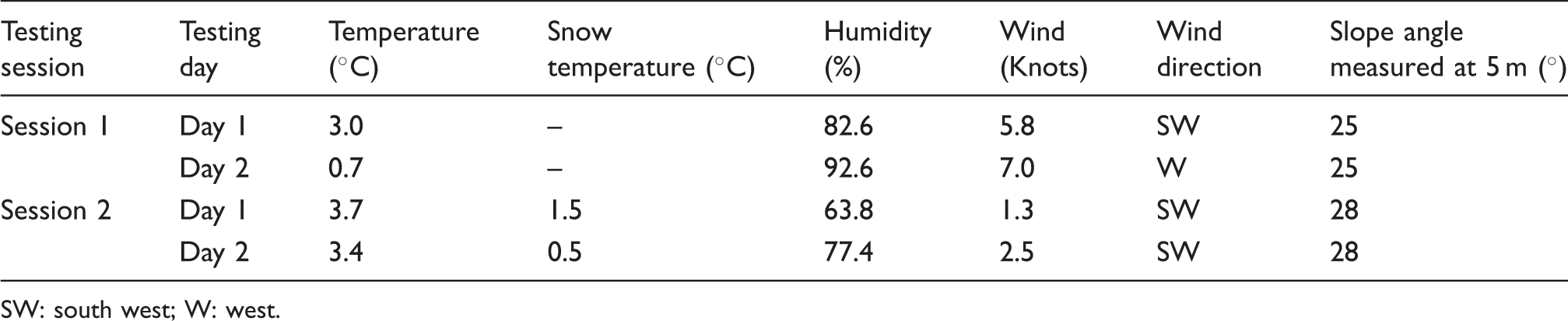
SW: south west; W: west.
Start time data collection
Speedlight V2 (Swift Performance Equipment, Carole Park, Australia) timing gates were used to collect split time (± 0.01 s) data of participants as they exited the start gate. Time was measured from the moment participants exited the gate, and then at 5.0 m, 7.5 m and 10.0 m. The effect of participant reaction time to a start signal was accounted for, with the first timing gate placed directly next to the start gate handles and time starting once the participant’s torso crossed the beam.
Statistical analysis
Descriptive statistics (mean ± SD) were obtained for participant age, gender, body mass and height. Cumulative times for 5.0 m, 7.5 m and 10.0 m for both the MVIC and no-MVIC warm-up protocols were also obtained. Prior to the main analyses, a Pearson’s correlation coefficient matrix was generated in order to compare the cumulative start times at 5.0 m and 10.0 m to the time at 7.5 m for both the MVIC and no-MVIC warm-ups. Results showed that the 7.5 m time was strongly associated with 10.0 m time for both MVIC (r = 0.92, P < 0.01) and no-MVIC (r = 0.97, P < 0.01), with strong correlations also noted between 5.0 m and 7.5 m cumulative time for MVIC (r = 0.94, P < 0.01), and no-MVIC (r = 0.97, P < 0.01). As a result of these comparisons, subsequent analyses were undertaken using only the 7.5 m as the dependent variable for start time. Also prior to undertaking main analyses, two exploratory analyses were conducted to determine whether differences for start time existed for ‘Day’ (Day 1 v Day 2) and ‘Sport’ (SBX v SKIX). A paired t-test was run for ‘Day’, with Mann–Whitney-tests conducted for ‘Sport’. Neither comparison revealed any differences (P > 0.05) for start time, and thus these groups were pooled for further analyses.
A two-way repeated-measures ANOVA was then conducted to determine the effects of (a) the MVIC compared to no-MVIC warm-up protocols, and (b) gender on start time to 7.5 m. To determine the strength of the relationships between start time and participant chronological age and anthropometric characteristics (body mass and height), separate correlation and a multiple linear regression analyses were undertaken. IBM SPSS Statistics version 22 (Version 22.0, IBM Corporation, USA) was used for all analyses, with statistical significance set at P < 0.05 unless otherwise indicated.
Results
Summary of results: MVIC versus no-MVIC (pooled genders and sports) warm-up protocol effects on start time (s) to 7.5 m.
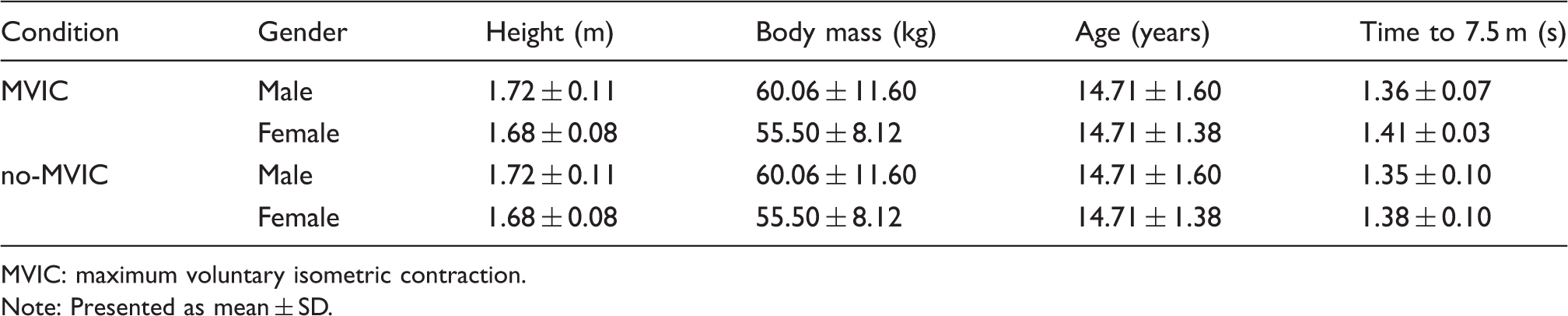
MVIC: maximum voluntary isometric contraction.
Note: Presented as mean ± SD.
The results between MVIC start performance and participant anthropometric characteristics and age showed a strong relationship for body mass (r = −0.78, P < 0.05), a moderate relationship (r = −0.53, P < 0.05) for participant height, and a slightly lower relationship was noted for age (r = −0.39, P < 0.05). The multiple regression for height, body mass and chronological age found these variables combined accounted for 65.2% (r2 = 0.65) of the variance in MVIC start performance. From this, only participant body mass was found to be a significant contributor (P < 0.05) to start time performance to 7.5 m. Therefore, a second linear regression for body mass and MVIC start time to 7.5 m was consequently conducted, with a similarly strong relationship (r2 = 0.61, P < 0.05) between body mass and start time to 7.5 m observed (Figure 1). This final parsimonious regression equation is shown in Figure 1.
Start time (s) to 7.5 m based on participant’s body mass (kg).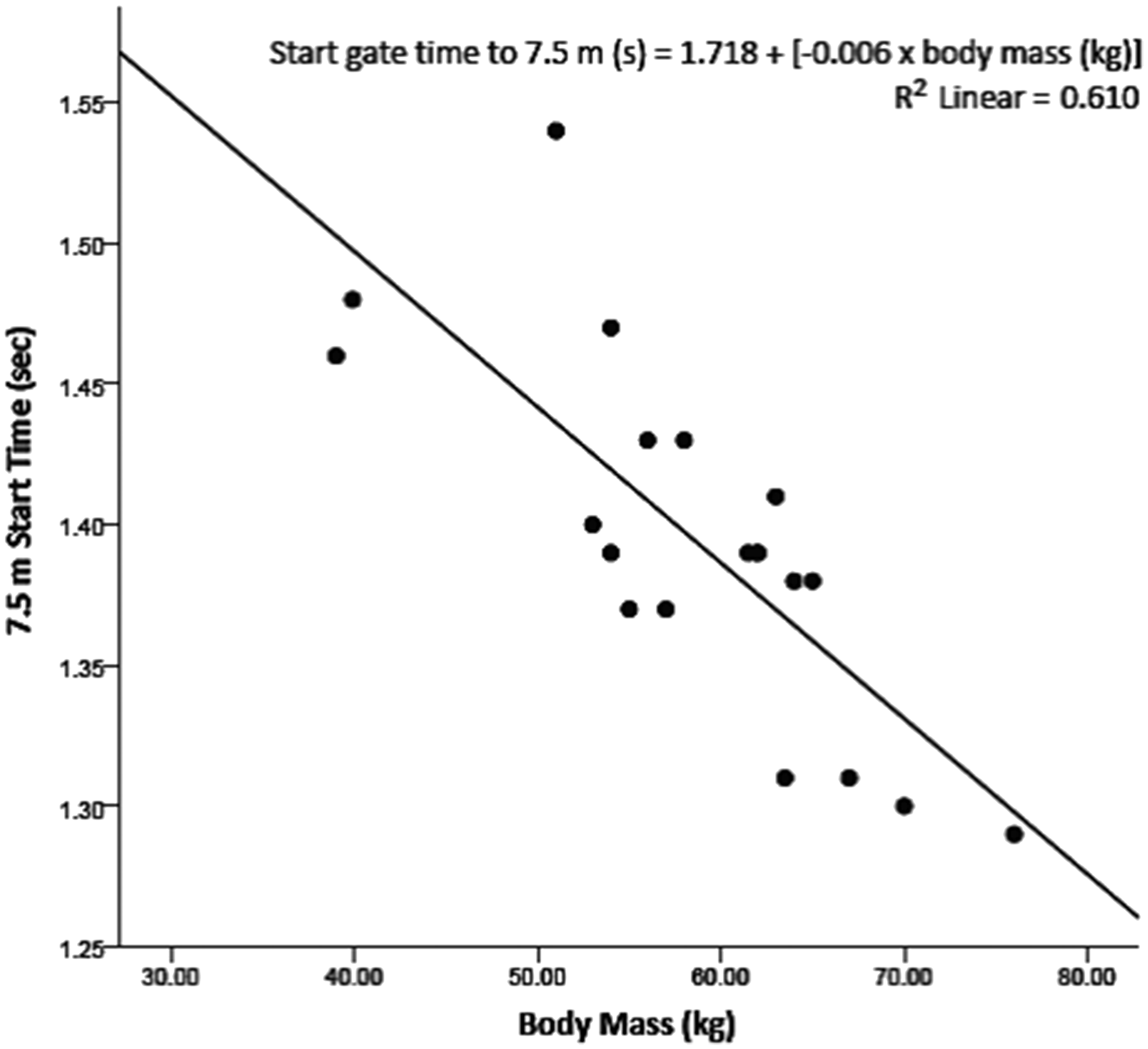
Discussion
This study aimed to investigate whether the addition of an MVIC to an athlete’s warm-up practice prior to competition could improve start time in SBX and SKIX. Despite previous evidence linking the use of MVIC to improved acute performance, results revealed no differences for start times for either MVIC or no-MVIC warm-up.
Descriptive characteristics of the participants such as age, body size, biological maturation, and training experience may in part explain the lack of differences observed in start performance.25,26 The mechanism behind the use of an MVIC’s pre-start performance is that it may induce muscular PAP by allowing the recruitment of higher order motor units and phosphorylation of myosin regulatory light chain. 12 However, these participants may not have fully developed the musculature and corresponding strength and power for an MVIC to exert a PAP response that influenced start performance.25,27 Additionally, it has been shown that elite and near-elite athletes across multiple sports (including skiing) specialise and increase sport-specific practice hours after the age of 18 years. 28 Therefore, it could be hypothesised that the participants included in this study did not possess the refined gross motor skills needed to utilise the PAP response from the MVIC warm-up and thus improve their start performance.12,26 While the MVIC proved to exert no influence on start time in this developing athlete cohort, these findings need to be confirmed in older, elite SBX and SKIX athletic populations.
Gender was also not shown to exert a meaningful effect on start performance times for either MVIC or no-MVIC warm-up protocol. Previous work has shown that developing male alpine skiers perform better than their female counterparts in the Swiss cross run test for change of direction speed. 16 However, no on-snow physiological speed tests exist which would allow a similar comparison under the conditions experienced in this study. The findings in this study may also suggest that the SBX and SKIX start performance on-snow in this age group may be affected more so by the participants’ age and body size rather than gender.29,30 The strong relationships noted in the linear regression analyses between body mass, height and start time support this hypothesis. The above-mentioned study also showed that anthropometric measures (body mass and height) display moderate to strong relationships with performance in 14 to 21 year old alpine skiers. 16 These findings combined with those noted in this study have practical applications for the current age structure of competitions and talent identification of developing SBX and SKIX athletes, as smaller and lighter athletes may be at a disadvantage in regards to their start performance. 16 The higher body mass of these athletes results in greater momentum and ability to overcome resistance out of the start gate. 31 However, these inequalities in athlete size are transient and generally resolve with maturation. 32 Therefore, coaches and team selectors need to consider this if using start time as a measure for SBX and SKIX talent identification to ensure that talented, late developing athletes are not overlooked because of body size.
While the MVIC proved to have no effect on start time to 7.5 m in this developing athlete cohort, this finding needs to be confirmed in elite SBX and SKIX athletic populations. It has been noted that athlete characteristics have an effect on the PAP-fatigue response to an MVIC conditioning contraction. 25 These include muscular strength, muscle fibre type distribution, individual’s training level, and type of subsequent explosive activity. 12 It should also be noted that the use of a TRX device to induce the MVIC may not have exerted the identical effect as that of a stationary squat rack bar, which has been used previously for such purposes. 33 However, environmental constraints would not allow for a squat rack to be used for on-snow testing. Environmental constraints (temperature, terrain, snow conditions) also make on-snow research difficult to control; therefore, the reported changes in environmental conditions are a limitation of this research.4,6,34,35 Furthermore, while participants used the same equipment each testing session, the waxing and tuning of equipment was not controlled and is another limitation of this research.34,36,37 These limitations need to be taken into consideration when interpreting results as changes in equipment or environmental conditions can impact on-snow performance.4,6,34–37 Finally, another possible contributor to the lack of MVIC effects could have related to the attentional demands of the MVIC warm-up itself. Specifically, given the young age of the participants the MVIC may have become the primary focus during testing, which may have moved participant attentional focus away from the task itself.38,39 Also, the relatively small sample size used in the study means that further confirmation of these results in larger, elite level sample populations is required.
The findings of this present study suggest the use of MVIC has no meaningful effect on start performance in developing SBX and SKIX participants. Consequently, it can be surmised that the use of such a protocol as part of the warm up in these sports shows little value for this age group. The results also indicate that use of 7.5 m start time is limited as a performance measure and talent identification tool in isolation for adolescent athletes due to its strong relationship with body mass and height. However, start time may still be a viable tool for talent identification when modelled with other race performance measures such as: time to first turn, course section (turns and air) split times, and subjective athlete measures such as overtaking ability.1–3,5,34,37,40,41 This has practical applications for talent identification and age structured competitions for developing SBX and SKIX athletes, as taller and heavier athletes may have an advantage in regards to their start performance. Future research should assess the magnitude by which the anthropometry of junior SBX and SKIX influences all race performance measures to ensure equal competition for all athletes, regardless of their maturity.
Conclusion
The implementation of an MVIC prior to competition in developing SBX and SKIX athletes does not appear to improve start time to 7.5 m. Factors such as age, body size and biological maturation in developing athletes may diminish the potential for PAP to enhance performance. Start time in SBX and SKIX is limited in isolation as a measure of performance in developing athletes, due to the positive influence of body mass and height on start time. This study has implications for start performance time as a talent identification tool for developing SBX and SKIX athletes.
Footnotes
Acknowledgments
The authors would like thank the Mount Buller Race Club and Coaches that allowed for a testing location to be organised for this study.
Declaration of Conflicting Interests
The author(s) declared no potential conflicts of interest with respect to the research, authorship, and/or publication of this article.
Funding
The author(s) received no financial support for the research, authorship, and/or publication of this article.