







Abstract
Running symmetry is important for performance, injury prevention or rehabilitation in many sports. However, current methods for measuring running symmetry are expensive, time consuming and must typically be constrained to a non-task representative laboratory setting. The aim of this study was to validate a method that used accelerometry data to determine running symmetry during maximal over ground sprinting for abled bodied athletes. Thirteen elite male athletes performed three 40 m maximal sprints on an indoor running track while data were collected from eight force plates and an accelerometer positioned between the scapulae against the spine. Correlations and Bland–Altman analyses were used to assess validity. Time spent either side of the vertical axis was compared to maximal medio-lateral force from either side of the body using a symmetry index approach. Results revealed only a trivial relationship (r = 0.088, p = 0.616) and poor agreement (bias = 0.189, p = 0.000). Likewise, stride time from the accelerometer and force plates exhibited a small relationship (rs = −0.177, p = 0.310) and significant bias (bias = −0.026, p = 0.000), yet showed smaller limits of agreement. It was concluded that both of the methods for measuring sprinting asymmetry using accelerometer data had poor internal validity. However, of these measures, stride time showed the best capacity to calculate running symmetry during maximal effort sprints. Overall, it is suggested that coaches exhibit caution when interpreting running symmetry measures from accelerometers, and also carefully consider where the accelerometer is placed on the body.
Introduction
The use of accelerometers to quantify human movement is becoming increasingly popular. While earlier research has commonly utilized global positioning system (GPS) coordinate data, the accuracy of velocities and accelerations calculated over short distances has been questioned.1,2 Therefore, inertial measures such as accelerometry are becoming more commonly used for analysis in elite sport.3,4
Accelerometers measure accelerations in one to three orthogonal planes, vertical, anteroposterior, and medio-lateral. 5 They are commonly used to analyze impacts, and are used in the analysis of various elite sports, including rugby, 6 rowing, 7 soccer, 8 and volleyball. 9 The data provided by accelerometers can be used to assist in performance enhancement, injury prevention and monitoring of athletes. In recent years, the reliability of these devices has been established,10,11 and their validity debated.10,12 However, the use of accelerometers to measure asymmetries during running is still an emerging area of research.
Running symmetry measures have been used to help guide injury rehabilitation, and there is evidence to support this among previous literature. Researchers 13 have reported significant and meaningful tibiofemoral shear force asymmetries using electromyography in individuals who failed a return to sport (RTS) readiness test 6 months post anterior cruciate ligament reconstruction. This was significantly different to those who passed the RTS test, indicating that symmetry measures are valuable for coaches to consider when rehabilitating an athlete. This is further supported by Brughelli et al., 14 who reported greater asymmetry in horizontal component of ground reaction force for athletes with previous hamstring injury, compared to previously uninjured athletes, during submaximal running. Other research has linked running symmetry to performance. Both occasional and skilled runners were shown to be more symmetrical when compared to untrained runners, and this difference was especially evident as velocity increased. 15 Therefore, it is apparent that running symmetry is important for various aspects of an athlete’s performance and rehabilitation from injury.
While it is clear that measurement of running symmetry is valuable for coaches and rehabilitation staff to consider, most studies have calculated running symmetry from differences in ground reaction forces16,17 or kinematic angular displacements at the knee and hip. 18 Force plates and three-dimensional (3D) motion capture systems are expensive and typically constrain data collection to a non-ecologically valid laboratory setting; making it only possible to imply running symmetry or asymmetry in the field. Data collection and analysis are also labor intensive and therefore time consuming. The use of accelerometers for measuring running symmetry is more practical for coaches in an applied sport setting, as they are relatively inexpensive, portable, and allow for multiple athletes to be tested simultaneously in all environments. 19
Within the literature, there have been several studies that have successfully used a single accelerometer to identify gait parameters during running. These have ranged from centre of mass vertical displacements and oscillations, step frequencies, stride times, and foot contacts on both able bodied and lower limb amputees during walking and sub maximal running tasks.20–24 While discrepancies between methodologies exist, all abled bodied subjects had accelerometers placed at or near the sacrum, representing an approximation of the body’s centre of mass. Exceptions to this were two studies conducted on lower limb amputees, by the same author who placed the accelerometers on the anterior side of the thorax at the xiphoid process.23,24 Another limitation within the current body of research is that the majority of data has been collected using treadmills, with very few research groups adopting a more task representative over ground running approach. 25 However, two studies conducted on a treadmill compared their results to that of a gold standard 3D motion analysis system,20,22 with high levels of agreement between vertical acceleration and displacement of the centre of mass being reported. To date, no literature validating maximal over ground running (sprinting) exists with an accelerometer placed on the upper back, as is commonly mandated in team based impact sports such as rugby, Australian rules football, and rugby league.
There is also a trend for increased automation of measures, with some manufacturers including a built in symmetry calculation. However, there is very limited knowledge surrounding these new measures. Catapult (Catapult, Melbourne, Australia; GPS, 10 Hz; Accelerometer, 100 Hz) units include “IMA” (inertial movement analysis) technology, allowing quantification of symmetry via inertial sensors. While GPSports 26 (GPSports, Canberra, Australia; GPS, 15 Hz; Accelerometer, 100 Hz) provides a running symmetry measure that claims to quantify and compare forces on the left and right sides at ground contact over a series of foot strikes, however, to our knowledge this remains un-validated within the literature. The system uses a “black box” algorithm to calculate running symmetry, which is kept unknown for intellectual property purposes; however, discussions with the manufacturer revealed that algorithms are applied to excursions on the medial-lateral axis to establish left and right foot strikes, and subsequently, asymmetry (GPSports, 2015, personal communication). Thus, if excursions in the medial-lateral axis are inaccurate, then the running symmetry must be inaccurate. Furthermore, the system claims to measure ground reaction forces. However, it is important to note that accelerometers cannot measure forces applied to the system it is attached to, rather, force production is assumed as the accelerometer can only measure the accelerations recorded at the unit during impact. For the medio-lateral axis, ultimately the accelerometer only details differences from the segment the unit is attached to. This could be driven by kinetic or kinematic differences throughout the body or by artefact introduced by the units moving independently to the body. It must be noted, that, amongst the current gait based literature, the most commonly used variables to calculate running symmetry are the discrete variables of step and stride time.
Therefore, the purpose of the study presented in this article was to determine whether an accelerometer placed high on the thorax at the level of the scapulae can accurately predict running asymmetries in maximal over ground sprinting in able bodied athletes. More specifically, there were two main aims:
1. First, to compare the asymmetry calculated from time spent on either side of the vertical axis as calculated from the acceleration data in the medio-lateral axis, to maximum medio-lateral forces from the force plate. This variable and methodology were chosen due to its similarity to those employed when calculating the commercially available IMA measure. 2. Second, to compare the asymmetry calculated from stride time from the accelerometer and also ground reaction force data. This variable was chosen as to replicate a more traditional measure of gait symmetry and explore the possibility of more accurate measures of symmetry while still adopting methodologies that are specific to contact based sports.
It was hypothesized that a relationship would exist between time spent on either side of the vertical axis and maximum medio-lateral forces, however a stronger relationship and greater agreement between methods was expected for stride time variables.
Methods
Experimental approach to the problem
A cross-sectional design was used to determine the validity of accelerometers for measuring running symmetry during maximal sprints. Data were collected simultaneously from both an accelerometer and force plates, whereby the force plate data were used as a gold standard measure to compare to the accelerometer data, and consequently establish validity.
Subjects
Thirteen male professional rugby union players (mean age, height and weight 23.8 ± 2.4 years, 186.6 ± 8.4 cm, and 102.5 ± 12.2 kg, respectively (mean ± SD)) were conveniently sampled for this study. All were recruited from a single team in an international Super Rugby competition made up of provincial teams from Australia, New Zealand, South Africa, Japan, and Argentina. Participants were healthy and free of injury, as confirmed by the team doctor and physiotherapist. Ethical approval to conduct this research was granted by a university human research ethics committee and participants provided informed consent prior to testing.
Procedures
Participants performed a standardized warm up before completing three maximal 40 m sprints on an indoor synthetic running track in the Biomechanics Laboratory at the Australian Institute of Sport. Participants ran over eight 600 mm × 900 mm contiguous force plates (Kistler, Amherst, MA, USA) sampling at 1000 Hz, located between 25 and 32.2 m points of the 40 m effort. Each participant wore a tight fitting vest with a single tri-axial 16 G accelerometer (housed within a GPS unit; GPSports, Canberra, Australia) sampling at 100 Hz, which was inserted in a pouch and positioned between the scapulae against the spine, as worn in collision based sports. The same unit was used for each participant for each trial. Each trial was filmed using multiple stationary machine vision cameras sampling at 100 Hz (Allied Vision Technologies, Burnaby, BC, Canada) that were laced together to make a continuous moving image in custom designed software, allowing synchronization of ground reaction force and accelerometer data.
Un-filtered acceleration data were uploaded to the Spi-IQ (GPSports, Canberra, Australia) software for analysis. Each trial was treated individually, and after erroneous trials were removed, a total of 35 trials were recorded and the data were exported to Microsoft Excel. Analogue data were filtered using a low-pass Butterworth filter at a cut-off frequency of 100 Hz. The cut-off frequency was determined following a residual analysis and visual inspection of the data and accounted for environmental noise. In Microsoft Excel, data from the vertical axis was plotted in a basic line graph. Each relative minima in the wave of the line graph was considered mid-stance and the turning point from weight acceptance to force production, therefore each minima signified a foot contact. The video footage for each trial was reviewed to identify the number of steps prior to contact with the first force plate. This allowed the acceleration data from the time on the force plates to be identified, and only these data were used for further analysis. To calculate the time spent either side of the vertical axis, negative samples in the medio-lateral axis data indicated time on the left of the vertical axis, and positive samples time on the right (Figure 1). This resulted in a value for time spent on the left of the axis, and time spent on the right. Stride time was calculated using the data from the vertical axis, measured from the first minimum in the graph to two minima’s later, as to measure from contact of one foot to the next contact of the same foot. One left and one right stride time was calculated for each trial. For both variables, the number of data samples on the left and right were multiplied by 0.01 due to the sampling rate of 100 Hz. Excursions from the left side were then divided by excursions from the right side to give a symmetry index for each of the two variables of interest.
27
Data from the force plates were also exported to Microsoft Excel, and two variables of interest were identified, maximum medio-lateral force (Fx Max) and stride time. Left and right foot strikes were identified by reviewing the video footage and symmetry was then calculated by averaging force values for left and right foot strikes, respectively, for each trial. As for the acceleration data, values taken from the left foot were divided by values from the right foot to again produce a symmetry index.
Example of an accelerometer trace with data above the x-axis indicating the right side of the vertical axis and data below indicating the left side of the vertical axis. The turning points on the graph represent mid-stance and were used to define foot contact. Stride time was calculated between the first and third turning point and the second and fourth turning point.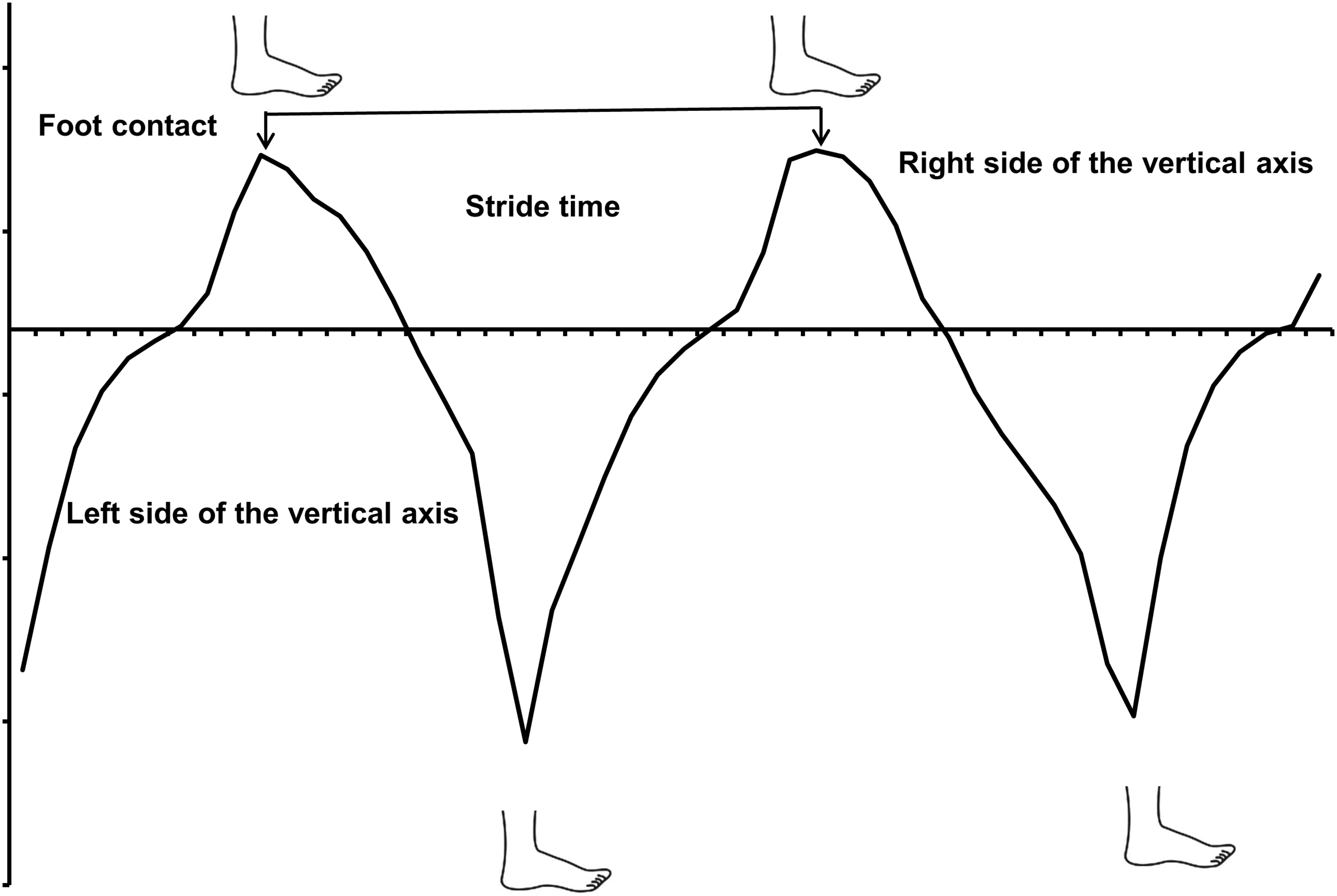
Statistical analyses
Symmetry indexes from the accelerometer and the force plates were compiled and exported to SPSS (Version 19.0.0; SPSS, Inc., Chicago, IL) for analysis. Pearson’s correlation coefficient was calculated for the symmetry of excursions left and right of the vertical axis from the accelerometer and the symmetry of Fx Max for left and right foot strikes. As data were not normally distributed, Spearman’s correlation was performed between the symmetry of stride time calculated from the accelerometer and the symmetry of stride time from the force plate. Strength of relationships was defined as follows: trivial (less than 0.1), small (0.1–0.3), moderate (0.3–0.5), large (0.5–0.7), very large (0.7–0.9), nearly perfect (0.9–1), and perfect (1). 28 The Bland–Altman method 29 was then used to assess the agreement between the same variables, allowing for repeated measures on all participants. A one-sample t test was conducted to determine if mean differences in symmetry were significantly different to zero, indicating significant disagreement. A linear regression of the difference between the two methods was then used to determine the presence of proportional bias, as indicated by a significant gradient of the regression line (slope coefficient significantly different to zero). The significance level was set at p ≤ 0.05 for all statistical analyses.
Results
Validity of running symmetry from the accelerometer.

Significant differences are set at p ≤ 0.05.
LoA+: upper limit of agreement; LoA−: lower limit of agreement; r: Pearson’s correlation coefficient; rs: Spearman correlation coefficient.
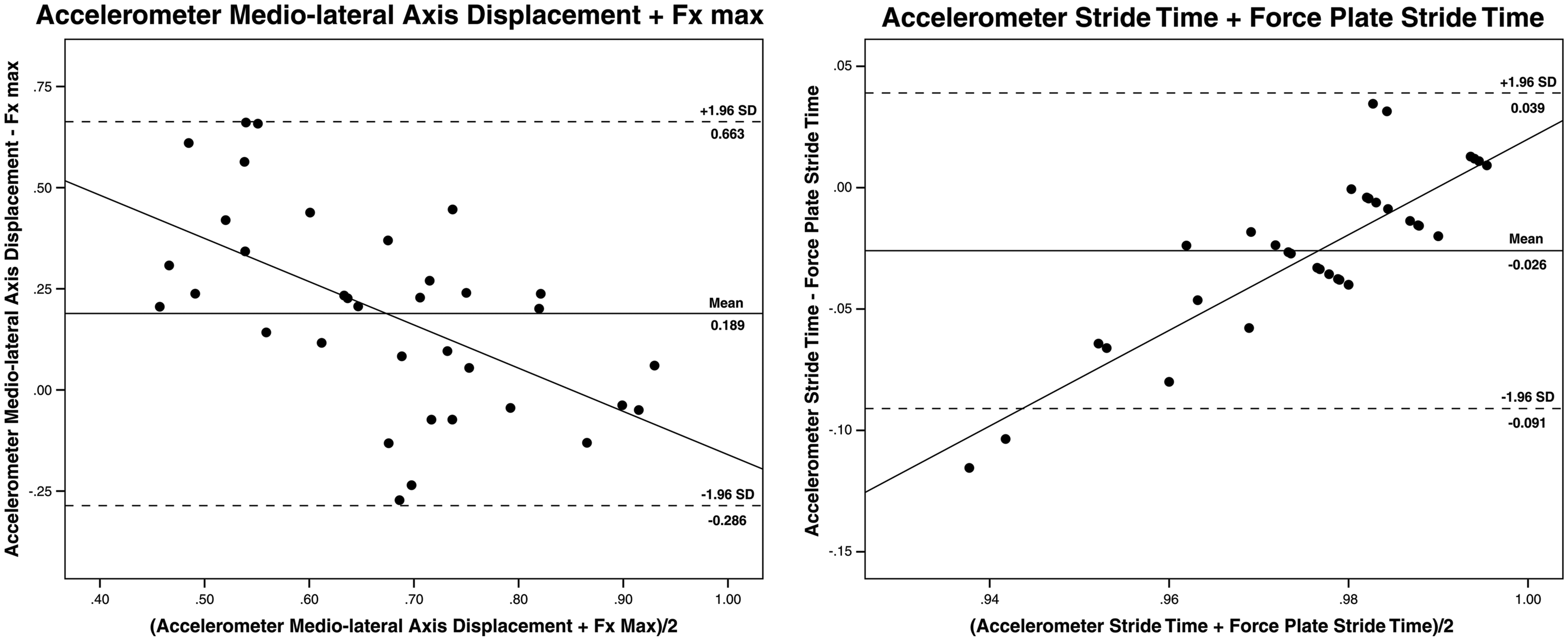
Bland–Altman analyses of the agreement between symmetry measures from the accelerometer and ground reaction force data, including limits of agreement, mean bias, and regression lines illustrating proportional bias.
Discussion
The aim of this study was to determine the validity of using accelerometry data collected from high on the thorax during maximal over ground running for measuring symmetry. This was achieved through two methods; first, we calculated running symmetry using time spent on either side of the vertical axis from the accelerometer and compared this to the symmetry index measured from maximum medio-lateral forces from the data collected via force plates. Our results revealed only a trivial insignificant relationship and poor agreement. In fact, the analysis of data using methods described by Bland and Altman showed that mean differences from the accelerometer and force plates were too widely distributed to be clinically relevant. Finally, proportional bias was also evident in the Bland–Altman plot (Figure 2), indicating that the two methods do not agree equally throughout the range of measurements.
The second method used to calculate running symmetry was stride time, as this is a more commonly used measure in gait analysis. When stride time symmetry from the accelerometer data was compared to the gold standard of stride time from the force plate, an insignificant small negative relationship was evident. Significant bias was also present, however it is worth noting that this was less than the bias reported for time spent either side of the vertical axis. Furthermore, the limits of agreement were narrower, and hence more applicable to the measurement of running symmetry. While stride time still seems to have validity issues when measuring running symmetry from the accelerometer, it appears to be a better alternative to the vertical axis measure. This is consistent with the hypothesis proposed by the authors of this article. While outside the scope of the current study, when comparing stride times in isolation between the two methods before the differentiation process calculated symmetry, a stronger correlation existed (0.628; p < 0.05), which is consistent with other non-sprinting based literature. 30 It is recommended that future research should aim to explore how subsequent calculated symmetry indexes reduce the relationship between the two measures. Overall, these results demonstrate poor validity of using accelerometry based on these methods for calculating running symmetry. This has obvious implications for coaching and rehabilitation staff that may be using such measures to gauge performance or readiness to RTS post injury. Therefore, coaching and support staff should exhibit caution when interpreting running symmetry measures from accelerometers.
This study has shown stride time as a more valid measure of running symmetry when using accelerometry, which is not surprising as it is a more relevant measure of running gait. While bias was observed, this may be influenced by the position of the accelerometer. In the current study, the unit was placed at the manufacturer-recommended site, in a vest between the scapulae. While this holds relevance to current practice in collision based sports, it may influence the strength of any relationship between impact forces and impact accelerations. As the site of the device is relatively far from the site of impact, shock attenuation may reduce accelerations recorded. 31 Therefore, it may be beneficial to consider other placement sites for the accurate measurement of running symmetry using accelerometry. In the context of this study, placement on the shank may better capture data related to loading or forces, whereas placement near the pelvis has been previously used for measures of center of mass. 22 It is important for users to consider the requirements of the activity and the data when positioning an accelerometer.
It is difficult to compare the results of the current study to previous findings due to the differences in methodologies employed. Good validity of running symmetry measures based on vertical accelerations has been reported for an accelerometer when compared to a six camera infrared system 22 as well as various other gait parameters being successfully identified and validated.20,21,23,24 While these results contrast to that of the current study, the initial aim was based on, and looked to replicate how the commercially available IMA calculated symmetry rather than matching the methods of others. Therefore, direct comparisons with the current study are of limited relevance as they are effectively measuring different aspects of running gait. Other studies have compared acceleration data to ground reaction force variables, however have not considered symmetry.32,33 Nevertheless, while they did not consider symmetry, it is worth noting that Zijlstra and Hof 33 reported that stride time could be obtained from lower trunk accelerations. The accelerometer was placed at the second sacral vertebrae, closer to the site of impact compared to the current study. This may explain this discrepancy in results, as placement between the scapulae in the current study, as recommended by the manufacturer and commonly seen in collision based sports, may have compromised the ability to accurately identify the stride cycle.
Most studies assessing the validity of accelerometry have performed testing on a treadmill.22,32 Treadmill and over-ground running have been shown to produce kinetic and kinematic differences 34 and consequently any symmetry measures based on kinetic or kinematic characteristics of gait may not be generalizable outside the setting in which the data were collected. As the basis of most sports is over-ground, rather than treadmill running, analysis based on over-ground gait is likely to be more task representative. For this reason, a strength of the current study was that it was based on analysis of over ground gait. Furthermore, it is also one of very few studies to investigate the symmetry of maximal efforts, rather than walking or submaximal running. This is significant as levels of symmetry have been shown to change with velocity. 35
It would have also been valuable to directly compare the “automated black box” method used by the GPS manufacturer to a gold standard; however, this was not possible as the measure has several limitations that prevented the output for the testing conducted in the current study. The measure requires several stride cycles at a constant velocity, which is defined as above approximately 2.5 m.s−1, but not changing by greater than 5% between foot strikes. Therefore, when performing maximal efforts or intermittent bursts of activity, it is highly unlikely that enough foot strikes at constant velocity will be achieved. Realistically, the application of this measure is limited to unidirectional submaximal running, rather than specific game intensities or movements. Consequently, the accuracy of this measure was unable to be directly determined from this study. While the findings of this have shown accelerometer data to be largely inaccurate for calculating running symmetry using this methodology, the black box calculation used by the manufacturers has a set of rules and controls built into algorithms that claim to overcome these errors (GPSports, 2015, personal communication). It is possible that running symmetry could be predicted from these methods; however, it would be valuable if the manufacturer disclosed the details of how running symmetry is calculated and for further research to be conducted to support their claims.
Practical applications
It has been shown that using an accelerometer to measure gait parameters in walking and sub-maximal running is a valid and reliable method. However, time spent on either side of the vertical axis from an accelerometer placed high on the thorax during over ground maximal sprinting shows minimal relationship with medio-lateral forces measured by a force plate. Therefore, coaching and support staff should exhibit caution when interpreting running symmetry measures from accelerometers based on data that may potentially use the medio-lateral axis. Stride time symmetry also exhibited issues with validity; however, the smaller limits of agreement suggested it may be a better measure for calculating symmetry from this accelerometry method. The bias present could be due to device placement, and therefore it is important to ensure appropriate device placement for the requirements of a specific session. It is recommended that future testing should use 3D motion analysis technology to better explore how the placement of the accelerometer and measures such as those used in the IMA influence symmetry in maximal sprinting.
Footnotes
Acknowledgements
The authors would like to thanks Trent Hopkinson for assistance in data collection and participants for agreeing to take part in the study. No financial assistance was received for this study, and the authors have no conflicts of interests to disclose. The results of the present study do not constitute endorsement of the product by the authors or the NSCA.
Declaration of Conflicting Interests
The author(s) declared no potential conflicts of interest with respect to the research, authorship, and/or publication of this article.
Funding
The author(s) received no financial support for the research, authorship, and/or publication of this article.