







Abstract
The capacity for storing and manipulating information (a function of working memory) is not fully developed until adulthood, so children are not always able to process explicit instructions when learning a new skill. A teaching method that may solve this problem is analogy learning, which compares the to-be-learned skill with a well-known concept by way of a single metaphorical instruction. In adults, analogy learning has been shown to lead to lower load on working memory by reducing the need for conscious processing; however, the effects are unclear in children. If analogy instructions work similarly in children, the propensity to consciously control movements may affect how well children learn by analogy. It is in the interest of coaches and teachers to determine whether analogy instructions can be used to reduce conscious processing in children, and whether propensity for conscious control of movements (movement specific reinvestment) predicts benefits from analogy learning. Thirteen-year-old golf novices (n = 44) were pre-tested and post-tested after practicing a golf-chipping task using explicit rules. One week later, an analogy for learning the golf chip was introduced, and an identical set of post-tests was repeated. Propensity for conscious control/reinvestment predicted improvement in accuracy after the analogy was introduced. Children's motor learning by analogy may be affected by their propensity for conscious control of movements, which suggests that coaches should adapt instructions to individual differences between learners.
Introduction
Coaches and teachers often face the problem of how best to convey information to novices, especially if the novices are children. The usefulness of instructions for learning depends partly on how they are taken up and processed by the learner. 1 Processing of movement information during motor performance may differ between different stages in the lifespan, 2 which makes it hard to generalize principles from adults to children. Although cognitive processes accompanying motor learning by adults have been scrutinized for decades, factors that help or hinder children's motor learning are less clear.3,4
Children's capacity to consciously process complex movement information is a function of their ongoing cognitive development. 5 Working memory (WM), the mental domain for short-term information storage and processing, is accessed differently at different stages of development. Children begin to use verbal processing and phonological loop aspects of WM at about 8 or 9 years of age6,7 but Piaget 8 believed that the ability to formulate and test hypotheses is unlikely to develop until the “formal operational” stage of childhood, which generally begins around the age of 11 years. When investigating cognitive processes during children's motor learning, it makes sense to investigate age groups that are in the process of cognitive development, such as during the early formal operational stage, i.e., 11–14 years. 8
When receiving instructions for motor skill learning, children struggle to process large amounts of explicit information, preferring instead to deal with images and metaphors. 9 Indeed, evidence suggests that children tend to process information in an implicit form and in visual areas of WM when learning.2,10 Presenting a learner with many instructions may lead to a high load on WM and have detrimental effects for performance under pressure or when decision making.11–13 These considerations call for teaching methods that avoid high cognitive load. Analogy learning, for example, belongs to a family of implicit learning techniques, which have been shown to reduce reliance on cognitive information processes during acquisition of a motor skill. Learning by analogy involves the translation of information associated with a well-known (but independent) concept to the concept to be learned. 14 In motor learning, task-relevant knowledge is represented by a single analogy instruction.1,15 The analogy can be described using a verbal description (e.g., “float like a butterfly, sting like a bee”), but it often evokes a visually salient mental image, which may make it suitable for children. Analogy learning has been shown to lead to stable performance under pressure,12,16,17 in dual task conditions18–24 and when high-complexity decisions have to be made concurrently.25–27 Few studies to date have investigated analogy learning by children, although Tse e al. 22 taught children how to skip a rope either by explicit instructions or by explicit and analogy instructions combined. Analogy learners performed better in normal rope skipping (max. number of skips) and in a multitasking test. The authors concluded that analogy learning may help children's motor learning, potentially by reducing cognitive processing requirements during learning. a
It has previously been suggested that analogy instructions may work by reducing a learner's reliance on conscious control processes during movement.1,19,28 Therefore, differences in tendency to consciously process movement-related information might affect how children interact with analogies. A child's propensity to consciously monitor and control their movements may therefore be a factor that influences the efficacy of analogy instructions. A person's propensity to consciously control their movements can be assessed using the Movement Specific Reinvestment Scale (MSRS), a 10-item questionnaire.29,30 Ling e al. 31 found a weak positive relationship between (subjective measures of) performance and reinvestment in children. Since most studies of adults have shown a negative relationship,29,30 Ling et al. 29 argued that age might be an important moderator of the relationship between conscious motor processing and motor performance. Similarly, the degree to which children benefit from analogy instructions may be a function of their tendency to consciously control their movements, reflected by movement specific reinvestment. Children with a high propensity to consciously monitor or control their movements may habitually engage in verbal processes such as self-talk or hypothesis testing. 32 While explicit instructions may be more suited to learners with a high propensity for reinvestment as they might be used to verbally controlling their movements, learners who have a lower propensity for consciously controlling movements may prefer fewer explicit instructions.
Research has not shown enough evidence to support the use of analogy instructions in children's motor learning. We aimed to address this gap in our current understanding of analogy motor learning by investigating (1) whether analogy instructions can generally be used to reduce cognitive load during learning in children, and (2) whether the benefits of analogy learning depend on a child's propensity to consciously control their movements.
To examine these questions, we conducted a field study in which children were taught how to execute a golf chip shot by established instructions (explicit learning), following which their performance of the shot was assessed in single and dual task tests. Subsequently, they were provided with an analogy instruction that was assumed to encompass the same information as the explicit rules, following which their performance of the shot was again assessed. Performance in a dual task was assumed to be an indirect indicator of conscious processing load. 33 Dual task performance was expected to be inferior to single-task performance after explicit instructions as WM is required to consciously process explicit instructions. However, the dual task effect was expected to dissipate when the analogy was introduced, consistent with reduced demands on WM. 1 Propensity for movement specific reinvestment was expected to negatively predict performance improvement when the analogy was presented to the child.
Method
Participants
Forty-four students from a local school (30 female, 14 male, M = 13.02 years, SD = .34) participated in the experiment. The participants had no golf experience (i.e., no reported golf lessons, fewer than three games on a golf course, and pre-test error higher than 15 m). b Three participants were left handed and 10 showed mixed responses on the Chapman and Chapman (1987) Hand Usage Questionnaire. Informed consent was obtained and parental consent was acquired via an opt-out information letter sent to parents of all participants. Participation in the experiment was part of a sports lesson. Participants were treated in accordance with the local institution's ethical guidelines.
Apparatus
All participants used a traditional 9-iron golf club appropriate to their height and handedness. Further equipment included standard golf balls, practice balls (N = 50), a standard Sony HDR video camera shooting at 920 × 1080/60p (NTSC)/50p (PAL) resolution (Sony Corp., Tokyo, JAP), plastic markers and a 1.5 m long pole to mark the target. Additional materials included a smart phone with a recorded succession of dual task tones, and speakers. The testing area consisted of a marked starting position with a white target pole positioned 15 m from the starting position. A measuring tape was attached to the target pole for measurement of accuracy. A bar was placed horizontally on the ground 4 m from the starting position, perpendicular to the chipping direction (see Figure 1). A camera was set up facing the participant frontally, and speakers were positioned near the camera, for use during the dual task condition. The practice area was a simple patch of golf green with a rope marking the starting line, another rope marking the 4 m-line, and a small pole to mark the target for each participant. Labview Application Builder 2010 (National Instruments, Inc., Austin, TX) was used to create a tone counting task in which high (1000 Hz) and low pitch tones (500 Hz) were played in a randomized order at one-second intervals.
Experimental set-up for pre-test, pre-analogy and post-analogy test sessions. A bar was laid on the ground at a distance of 4 m over which each of the four balls had to be chipped, rolling toward the target at 15 m distance.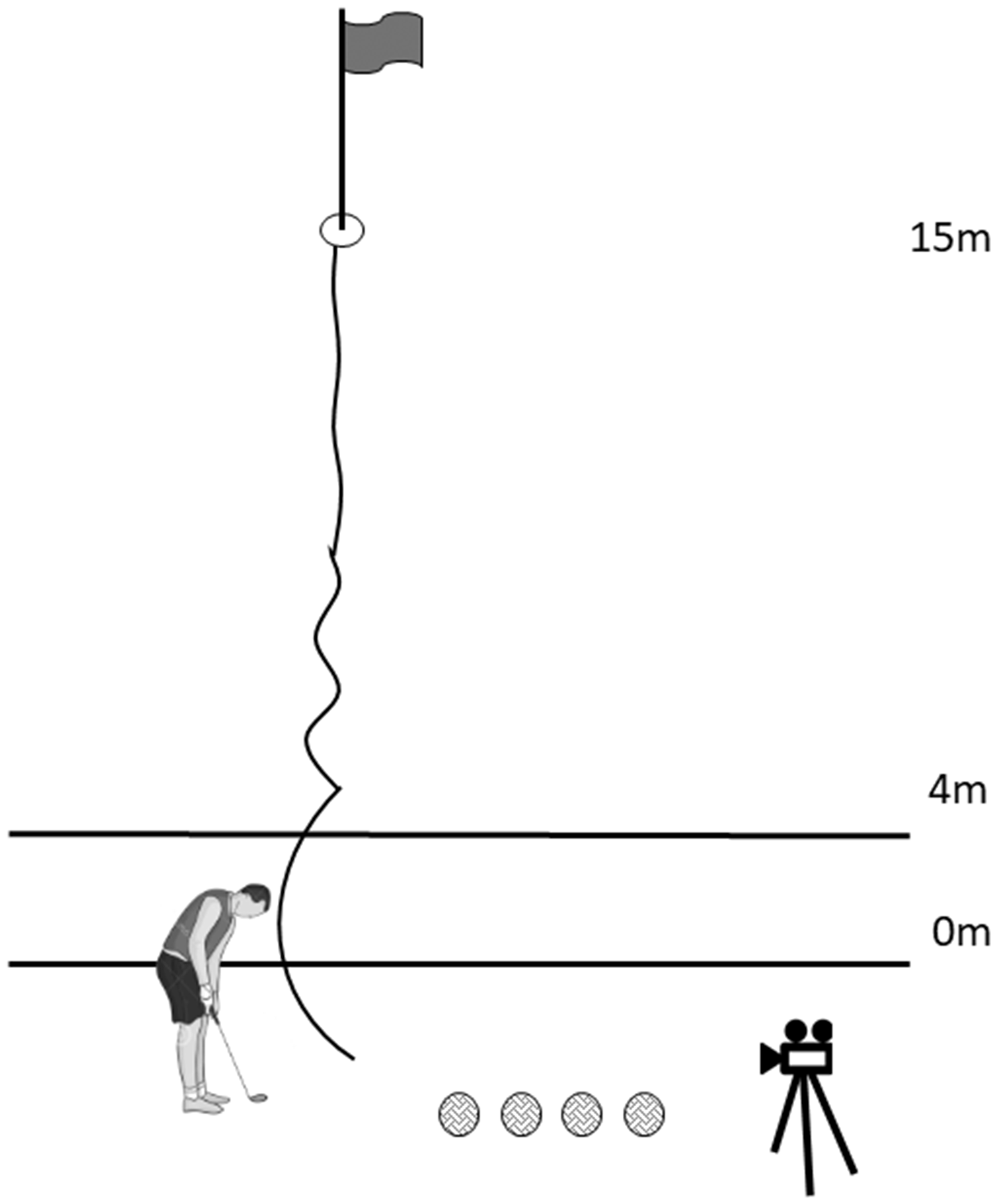
Procedure
The experiment took place during four consecutive weekly PE classes and included a pre-test session (week 1), a practice session (week 2), a pre-analogy session (week 3) and a post-analogy session (week 4). During the pre-test session (week 1), participants provided demographic information and completed the MSRS 34 . The MSRS assesses the propensity that a person has to consciously monitor and control their movements. The Scale consists of 10 items, such as “I am self-conscious about the way I look when I am moving” and “I am aware of the way my body works when I am carrying out a movement”. Participants indicated to what extent each statement described them using a six-point Likert-type scale ranging from “strongly disagree” to “strongly agree” (max. 60 points in total). Participants performed two warm-up trials and a pre-test of four trials without instructions. Trials were video recorded and were performed at the participant's own speed.
Rules for three instruction conditions.
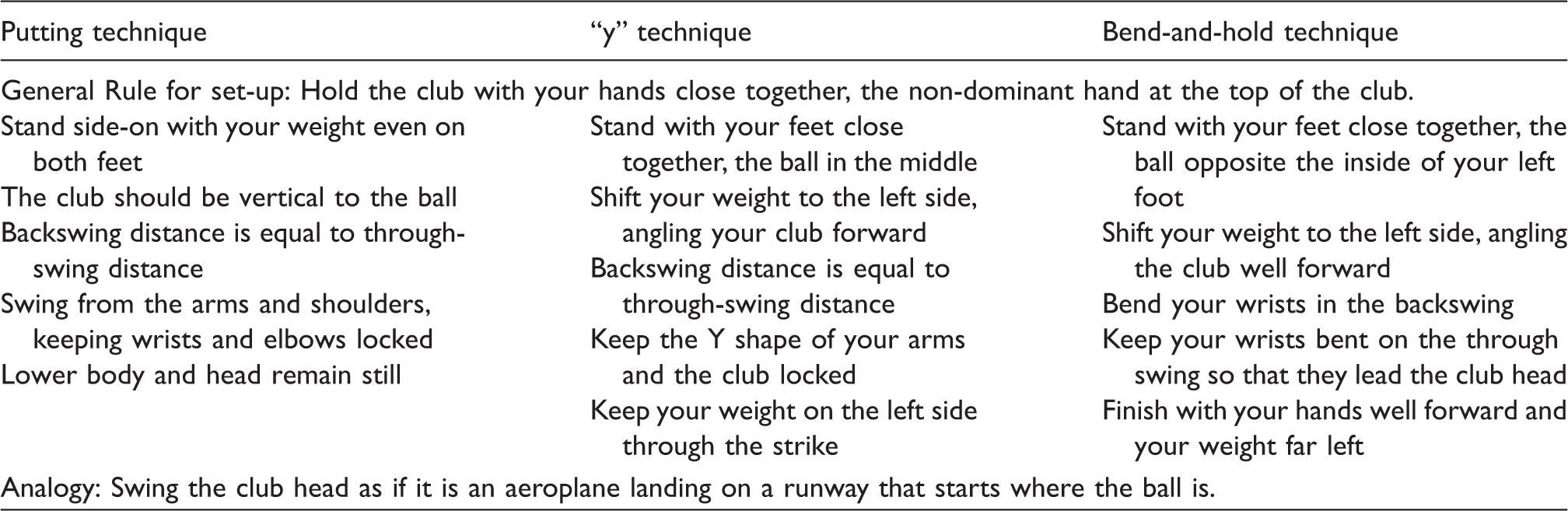
Following practice, in a pre-analogy test session (week 3), participants performed a retention test, followed by a dual task test (concurrent tone counting) and then a further retention test. For all of the tests, participants were required to hit the ball so it would land beyond a bar laid out at a distance of 4 m and then roll towards the target (a vertical white pole at a distance of 15 m, see Figure 1). The ball was to stop as close to the pole as possible. Participants completed four trials and were allowed to take as much time for each chip as they needed. If a participant failed to hit the ball, the trial was repeated. The dual task test required participants to listen to high pitched (1000 Hz) and low pitched (500 Hz) tones presented in a random order at 1 s intervals, while completing four further trials. They were asked to report the exact number of high-pitched tones that occurred during the test. After each test, participants rested for 2 min. The test sessions were conducted with each participant separately, away from the school class, in order to prevent confounding effects of peer pressure, anxiety and social learning.
In the week following the pre-analogy test session (week 4), participants were presented with an analogy instruction: “Swing the club head as if it is an airplane landing on a runway that starts where the ball is”. In a post-analogy test session identical to the pre-analogy test session, participants then performed a retention test, followed by a dual task test (concurrent tone counting) and then a further retention test. Participants did not practice the golf chip between the practice session and the post-analogy test session.
Dependent variables and data analyses
Accuracy
Performance in the tests was measured as distance to the target in meters (accurate to 2 decimals). A high value indicated poor performance and vice versa. All trials in which the ball did not clear the bar received a standard maximum error score of 22 m. Accuracy measurements were obtained for retention 1, dual task and retention 2 in both the pre-analogy and post-analogy test sessions.
Dual task performance
Counting performance represents the percentage disparity between the reported number of tones and the presented number of tones.
Data analysis
A one-way analysis of variance (ANOVA) was conducted to compare performance in the three instruction conditions at pre-test, before the instructions had been provided (no differences were expected). In order to examine performance before and after the analogy was presented, a Session (pre-analogy, post-analogy) by Test (retention, dual task, retention) × Instruction condition (putting, “y”, bend and hold) repeated measures ANOVA was conducted.
Effect sizes were calculated using partial eta squared (
Accuracy in the pre-analogy and post-analogy retention tests and score on the MSRS were correlated using Pearson product-moment correlations. In order to investigate whether instruction condition moderated the effect of MSRS on pre-analogy or post-analogy performance, two separate regression analyses with moderation were conducted using MSRS as a predictor, performance as a dependent variable, and instruction condition as a moderator.
Results
Figure 2 displays means and standard deviations for accuracy measured as radial error (in meters) over pre-analogy and post-analogy sessions, for each instruction type separately.
Accuracy measured as mean radial error (m) in each instruction condition during the pre-analogy and post-analogy tests. Error bars represent one standard error.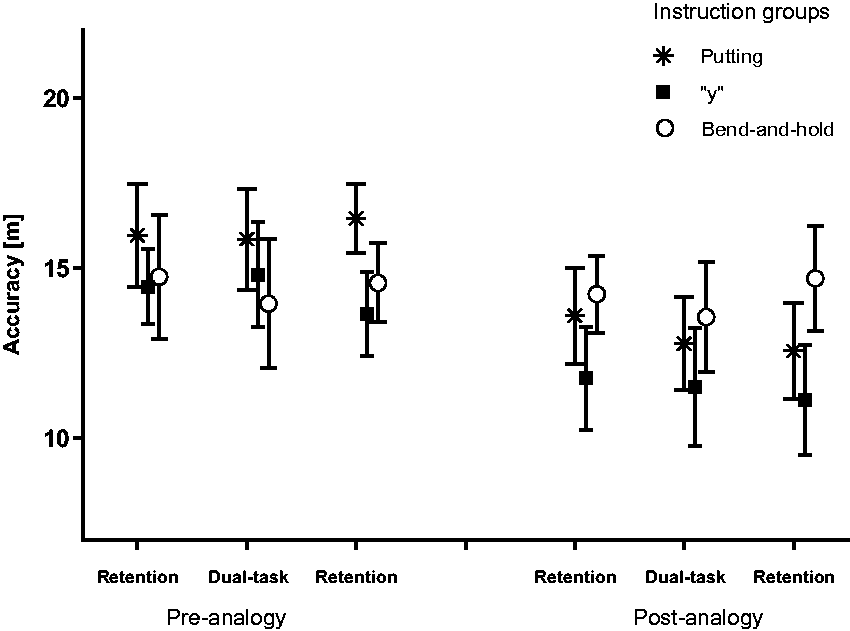
Pre-test accuracy
One-way analysis of variance (ANOVA) showed no significant accuracy differences between the instruction conditions (putting, “y”, bend-and-hold) prior to presentation of the instructions (F(2,41) = .175, p = .840,
Performance in pre-analogy and post-analogy test sessions
Session (pre-analogy, post-analogy) × Test (retention, dual task, retention) × Instruction condition (putting, “y”, bend-and-hold) repeated measures ANOVA revealed a significant main effect of Session, (F (1,41) = 7.40, p = .01,
These results indicate that the different instruction groups did not benefit from the analogy to different extents. The nonsignificant main effect for Test indicates that the dual task was not effective as a cognitive load, as it is did not disrupt performance. Participants made over 31.6% counting errors during the dual task test in the pre-analogy session (SD = 28%) and 18% (SD = 20%) during the post-analogy session, indicating that participants may have prioritized motor performance over counting performance. Therefore, these variables will not be analyzed further. Since the repeated measures ANOVA showed no effect of Test, both retention tests in each session were collapsed for further analysis.
Role of reinvestment in predicting performance
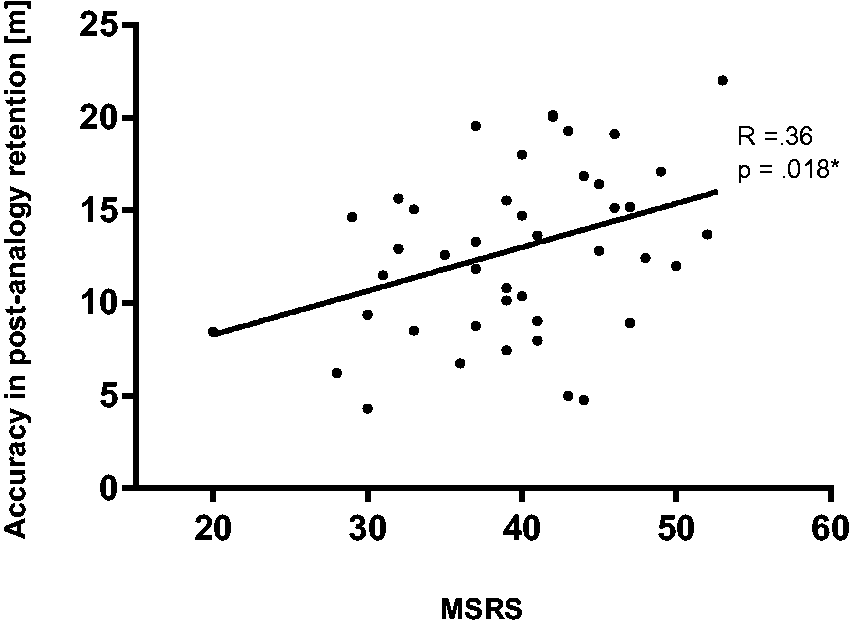
Pearson product-moment correlation analyses were conducted to test the association between score on the MSRS and both pre-analogy accuracy and post-analogy accuracy. Dual task performance was not included. The correlation between score on the MSRS and pre-analogy accuracy was negative, but non-significant, r(44) = −.09, p = .57. The correlation between score on the MSRS and post-analogy accuracy was positive and significant, r(44) = .36, p = .018, suggesting that higher MSRS scores were associated with less accuracy (greater radial error) after introduction of the analogy. Figures 3 and 4 display a scatter plot of accuracy and MSRS values.
Scatterplot showing score on the MSRS (x-axis) and pre-analogy retention accuracy (y-axis). Scatterplot showing score on the MSRS (x-axis) and post-analogy retention accuracy (y-axis).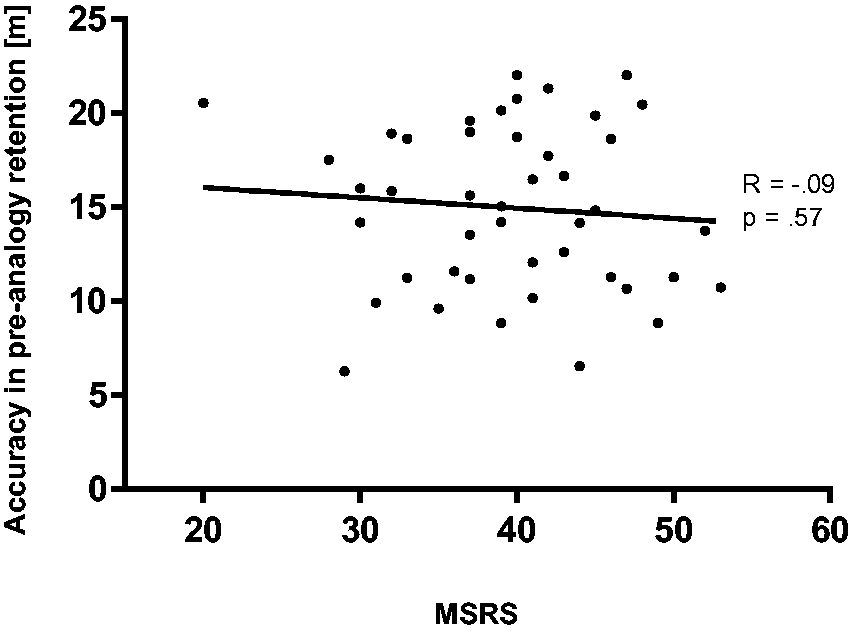
Moderated regression analysis testing the interaction between effects of instruction condition and reinvestment on performance.
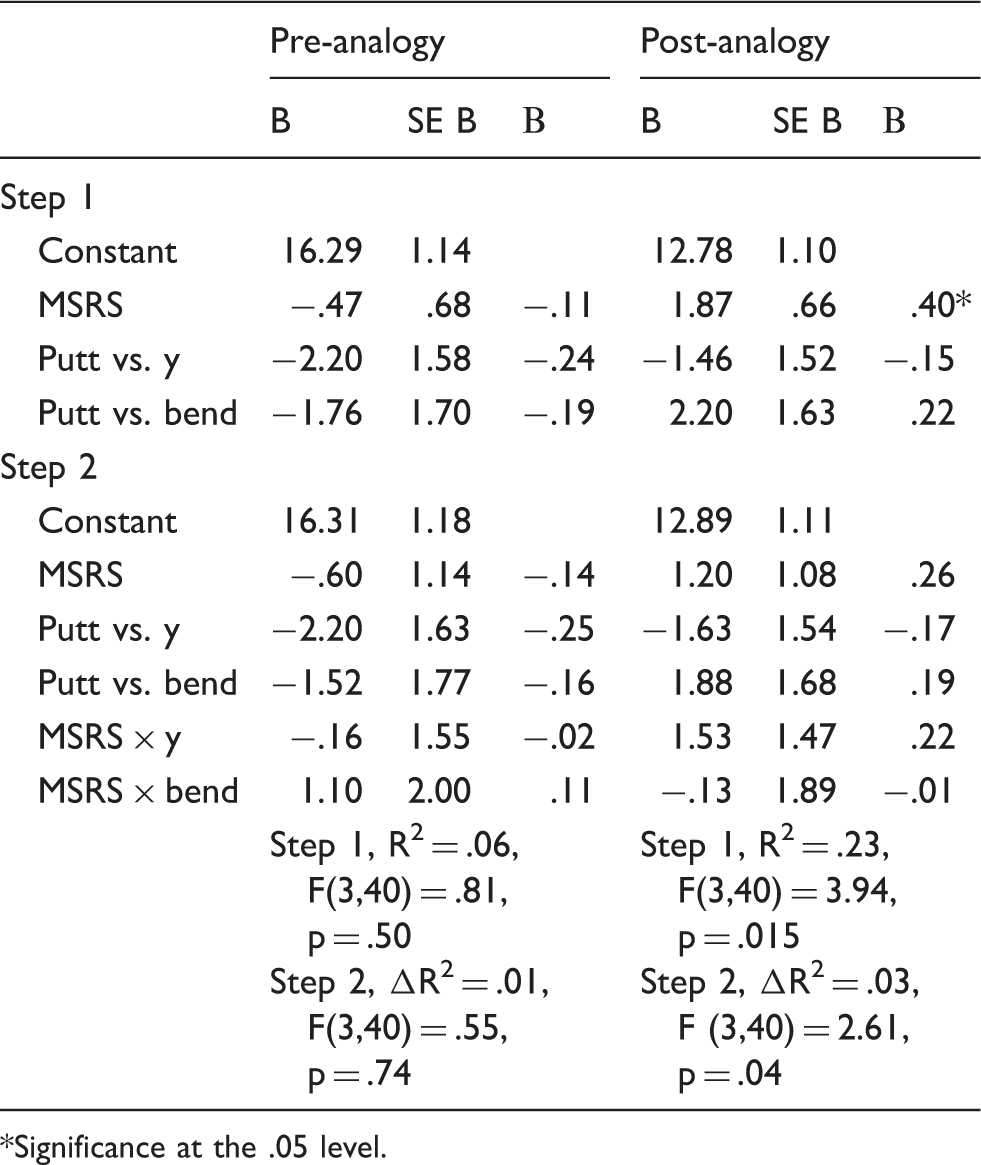
Significance at the .05 level.
Results indicated that for pre-analogy accuracy, the first model did not account for a significant amount of variance in the outcome variable, R2 = .06, R2adj = −.01, F(3,40) = .81, p = .50. Adding an interaction term between MSRS and instruction condition did not increase the quality of the model, ΔR2 = .01, Δ F = .22, p = .80, F(3,40) = .55, p = .74.
For post-analogy accuracy, the first model accounted for a significant amount of variance, R2 = .23, R2adj = .17, F(3,40) = 3.94, p = .015. Adding the two interaction terms (one for each dummy variable) did not account for a significantly higher proportion of the variance in accuracy, ΔR2 = .03, Δ F = .71, p = .50, although the model remained significant, F(3,40) = 2.61, p = .040.
Discussion
We investigated whether analogy instructions were beneficial for motor learning by children, and whether their effect depended on a child's propensity to consciously control their movements.
Research has shown a benefit of analogy instructions on dual task performance while single task performance usually remains unaffected.1,18 Therefore, we did not expect that introduction of an analogy instruction after explicitly instructed practice would facilitate performance of the single task. A significant session effect in the present study indicates that participants improved significantly between the pre-analogy and post-analogy session. Children did not practice during that time, so these changes in performance are, in our view, attributable to introduction of the analogy. f
After explicit instruction, remembering and applying the instructions might have led to the same effects in children as a cognitively challenging secondary task would in adults – that is, overloaded working memory, which may have reduced children's capacity for movement adjustments 37 and thus depressed motor performance. After introduction of the analogy, the necessity to hold each of the six rules in mind became dispensable, since the analogy contained all movement-specific knowledge packaged into one simple unit of information. 25 This may have freed WM resources for correction of movements, resulting in better performance.
As shown by Poolton et al. 20 in a similar design, a cognitively demanding secondary task increases the load on processing resources required for conscious control, leading to performance decrements in explicitly learned tasks, but it does not disrupt motor skill performance after analogy learning. The analogy was expected to reduce the load on WM and thus allow dual task performance to remain stable. However, the underlying assumption that performance after explicit instruction (pre-analogy session) would be disrupted by the secondary task was not confirmed. It is possible that the instructions were not followed strictly by all children, but, qualitative inspection of video footage showed that children were using the chipping techniques described by the rules. Alternatively, as stated previously, performance may already have been compromised by WM overload due to processing explicit instructions. The effect of adding a second task would then only have been very small. High error rates in the tone counting component of the dual task support this claim, suggesting that either the task was too difficult to perform correctly, or that the children prioritized the chipping task over the counting task, bypassing the bottleneck problem. If a concurrently performed secondary task is too difficult and exceeds attention resources, preference is given to the motor task, leading to poor performance of the cognitive task.38,39 This would effectively explain why motor performance remained almost unchanged in our dual task paradigm.
Not all children benefited from the analogy. While there was significant improvement overall, variability in the performance change between pre-analogy to post-analogy sessions was high. This difference might reflect individual differences related to conscious processing. For example, the interactive specialization theory 40 proposes that minor differences in activation of brain regions (activity dependent interactions between regions) early in life can cause children's cortical functions and response properties to develop in different directions. Children's brain characteristics may therefore diverge during childhood, leading to significant inter-individual differences later in life. An implication of this view is that the effects of analogy instruction may therefore depend on how well the cognitive system of a child is aligned with the method of instruction (i.e., analogy).
The design of analogy instructions that are suitable to learn a specific motor task is difficult, especially if the task is complex. Furthermore, cultural and other individual differences mean that an analogy that is useful for one individual may not work for another. g
A potential predictor of performance after analogy learning was found in movement specific reinvestment. Reinvestment played no role in performance prior to the introduction of the analogy (i.e., when participants were encouraged to use explicit instructions during the chipping task). However, score on the MSRS negatively predicted performance when the children were asked to use the analogy. That is, during post-analogy performance, participants who had a lower propensity for conscious control of their movements displayed more accurate chipping when the analogy was presented. There are two possible reasons for this relationship. First, it is possible that children with a low propensity for conscious control of their movements found it easier to process information that was presented in a less explicit (more visual) form. Such an explanation is consistent with claims that children tend to store information in visual areas of WM when learning. 2 Children with a high propensity for conscious control of their movements, on the other hand, may have found explicitly presented information easier to deal with and thus not benefited from the analogy. For these children, who presumably relied on higher amounts of explicit information during motor planning and execution,41–43 adding even more information (i.e., the analogy) may not have been helpful.44,45 Second, we speculate that WM and its capacity limits might be an important factor underpinning the mechanism by which analogy learning works. Processing of rules during motor performance depends on the capacity of working memory, which, like any aspect of memory, differs among children at different stages of mental development.46,47 WM capacity limits have been shown to affect learning (e.g., categorization tasks and math problem solving48,49 and motor sequences 47 ). If WM is overloaded, no cognitive resources are available to perform the task at hand, if that task relies on cognitive processes.9,50,51 This leads to a breakdown in performance of motor and cognitive tasks.52,53 Thus, when the number of rules processed by a child reaches their individual capacity limit, adding just one additional instruction can lead to performance breakdown.46,54 In our study, high reinvesting children, who were more likely to consciously process movement-related information, may have reached their capacity limit in the pre-analogy session. Adding the analogy instruction might have been the straw that broke the camel's back, overloading their WM and leading to performance breakdown. We did not include a test of WM in this experiment, so we cannot directly support this argument. However, in a study in tennis, working memory was highly correlated with Movement Specific Reinvestment in children as well as adults. 55
The reason why children may differ in their ability to process explicit information may also lie in their development.56,57 Brain and behavior undergo dynamic organization and reorganization across development. 56 The sensorimotor hypothesis 57 proposes that in early childhood learning depends on sensorimotor processing, while learning later in childhood may rely more on cognitive (i.e., explicit) processes. It may be that at the time of testing some children were still in a sensorimotor stage of development, while others were already able to process more complex information. These developmental models fit well with our finding that differences in movement specific reinvestment were related to differences in the ability to learn by analogy. The model also adds to understanding of how differences in movement specific reinvestment and working memory are caused. Although none of the suggested explanations fully account for the results in this study, it is clear that the effects of analogy may differ for children, depending on a multitude of factors, such as age, differences in brain function, preference and personality. Further research is needed to disentangle the effects that these factors have.
Limitations
The main limitation of the present study is the lack of a control group that did not receive analogy instruction. This limits the conclusions that can be drawn from the results as we are not able to attribute the changes in performance between pre- and post-analogy test sessions to the analogy instruction alone.
A further limitation is that gender was not accounted for when participants were allocated to groups. Based on previous research in children's motor learning, 58 gender differences might be expected in motor learning, which may have affected the three groups differentially. Nevertheless, the correlations between MSRS and performance after analogy instruction remain meaningful. Further research should attempt to replicate the current study with an added control group and randomized allocation of participants to the experimental groups. Additionally, a dual-task that is adapted to the cognitive level of children at this age might provide more insight into children's information processing, and therefore allow better understanding of the effect of analogy instructions.
Conclusion
The present study showed that children's motor learning by analogy might be influenced by their propensity to consciously control movements. Although analogies seem to be a promising tool for teaching children, coaches may improve their pupils' skill learning even more by adjusting instruction styles to individual differences related to conscious processing.
Footnotes
Acknowledgement
We would like to thank St Peters School and St Peters Golf Academy in Cambridge, New Zealand for providing the facilities and participants for the project, and for valuable insight into golf coaching.
Declaration of conflicting interests
The author(s) declared no potential conflicts of interest with respect to the research, authorship, and/or publication of this article.
Funding
The author(s) received no financial support for the research, authorship, and/or publication of this article.