






Abstract
Our aim was to determine the relationships between three different training ages – TA domains (Rugby League specific – RLTA; Resistance training – RTA; Cardiovascular training – CVTA) on injury risk in junior elite rugby league players. Participants were 147 developmental rugby league players (mean age = 15.8 ± 1.1 years) playing for one rugby league club. Logistic regression with RLTA, CVTA and RTA as independent predictors was modelled on injured/uninjured outcomes. Relationships between TA and injury characteristics were examined using linear regression. CVTA was positively associated with absolute injury risk (odds ratio – OR 1.65, p = 0.02) and injury characteristics (muscle strain OR 1.12, p = 0.05) and ankle injuries (OR 1.24, p = 0.05). A positive association was demonstrated between RTA and high-intensity running injuries (OR 1.31, p = 0.01), and hamstring injuries (OR 1.66, p = 0.01). Our results suggest that a higher pre-study CVTA and RTA was associated with increased injury risk in an elite development rugby league team.
Introduction
Rugby league (RL) is a popular contact sport played at representative levels in Australia from the age of 14 years onwards. 1 Potentially high injury incidences are associated with RL, given participation rates and game exposure time when compared to other sporting contexts.2,3 The injuries most commonly observed include injuries to the lower limb (e.g. ankle, knee, hamstring) 4 in the form of muscular strain, ligament sprain and contusions. 5 Injury incidence typically increases with higher playing levels and intensities. 6 However, previous studies have demonstrated that higher playing levels, 7 higher pre-season training load (TL) 8 and increased aerobic capacity (VO2 max) 9 have been associated with reduced injury risk at various ages and playing levels. 10 These findings potentially suggest that training and physical preparation experience may help reduce the likelihood of lower limb injury risk.
Injury risk is of particular concern during the developmental stages of an athlete’s playing career due to under developed musculoskeletal physiology (bone, connective tissue), and the repeated injury risk following an initial occurrence of many common injuries sustained in contact sports. 11 Recent studies have suggested relationships between relative age, maturation and physiological characteristics. 12 During these developmental years, players’ also commonly begin to enter structured training programs according to chronological age-related playing groups and more frequent competitive schedules at representative playing levels involving higher physical playing intensities. Further, as prior injury is one of the greatest predictors of subsequent injury, 11 it can be hypothesised that developing athletes may benefit from structured progressive training experience which potentially reduces the likelihood of injury. However, very little research has examined such possible relationships between prior training history and injury risk.
Developing athletes require years of structured, progressive and intense training incorporating a multidisciplinary approach. In particular, increasing physical TLs over extended time periods are required to provide adequate stimulus to attain the desired performance enhancements. 1 However, high progressive TL can be accompanied by increased exposure to negative outcomes, such as injury and illness. 13 At the crucial developmental level, TL must increase to elicit adaptations that match the requirements of higher performance levels. 14 Therefore, TL must be carefully monitored in order to minimize exposure to negative outcomes.
Training age (TA) is defined as the number of formalized years of strength and conditioning training 15 and is an often overlooked measure of an athlete’s ability to tolerate prescribed TLs and intensities. Little is known about the potential benefit from TA and the length of time spent in a training modality to injury risk. TA could be a potentially useful measure of training experience in youth athlete assessment when precise measurements of TL are considered. For instance, indirectly related studies have shown higher degrees of performance enhancement in maximal strength at lower resistance TAs in RL players, 16 while soccer players with a lower playing age have demonstrated more asymmetrical lower limb strength, 17 a known predictor of injury in sporting populations. At the junior elite level, RL players are exposed to three fundamental training modalities; RL training (skills based training), cardiovascular training (energy systems conditioning) and resistance training (strength based training). In this study, we examined whether these three different TA domains, Rugby League Training Age (RLTA), Cardiovascular Training Age (CVTA) and Resistance Training Age (RTA) were associated with injury risk in a sample of junior elite RL players.
Materials and methods
A multi-season prospective cohort design was conducted at one elite RL club at two representative levels (U16 and U18) over two seasons (2015–2016). Binary logistic regression with RLTA, CVTA and RTA as independent predictors were modelled on injury/no injury outcomes. Relationships between TA and injury characteristics were also examined using linear regression. Previous injury was also modelled in a binary logistic fashion.
Subjects
Research ethics approval was granted by The University of Sydney Human Ethics Committee (Protocol No: 2015/415). Participant and or parental consent was obtained from a total of 147 adolescent to young adult developmental RL players (mean age = 15.8 ± 1.1 years; U16, n = 86; U18, n = 81), playing for one elite RL club, at two representative levels (U16 and U18) over two seasons (2015–2016). Players were registered with New South Wales Rugby League. Players’ field training (51 sessions per player per season) and competitive involvement (9 matches per player per season) were tracked prospectively over two seasons. Each season was comprised of the junior elite level standard of an 11-week pre-season period, followed by nine consecutive weeks of competition. Twenty-two (15%) participants competed across two seasons, while 125 (85%) competed for one season. In total, 169 training seasons were analysed. Over the two years, 109 players progressed from initial training trial squads to be selected for the final playing squads.
Procedures
TA data were collected prior to the commencement of pre-season training via the use of a standardised questionnaire. Each player was provided detailed instructions on how to complete the questionnaire which requested detailed information on the players’ medical history and previous training history, including details and examples of RLTA, CVTA and RTA. Each domain was defined as the period in which the participant had previously engaged in consistent structured training for that training modality and was reported in the number of years and months.
Each training session and competitive match was attended by the lead researcher, and all relevant training and injury data were documented at the time of occurrence. Overall TLs were assessed using both external (Global Positioning System technology (GPS)), variables measured included total distance (m), high-speed distance (<18 km/h), very high speed distance (<28 km/h), total number of accelerations and decelerations (>2.78 m/s–2) and total sprint (>1s above 5 m/s–1) distance (m), 18 and internal (session rate of perceived exertion (sRPE)) 19 measures. Thirty GPS units (SPI HPU 15Hz position sampling, 100 Hz, 16 G tri axial accelerometer) were randomly allocated (15 per playing group, per session) evenly among positional groups (forwards and backs) across both squads (U16 and U18) at each training session by the lead researcher. A total of 86.9 ± 3.7 observations per player were analysed. All players reported an RPE score (0–10)20 within 30 min of training session cessation. sRPE was calculated as RPE×session duration (min) and expressed as arbitrary units (AU). Session and weekly mean ± SD were calculated for all external and internal TL variables. Weekly mean ± SD were also calculated for pre-season and in-season training phases.
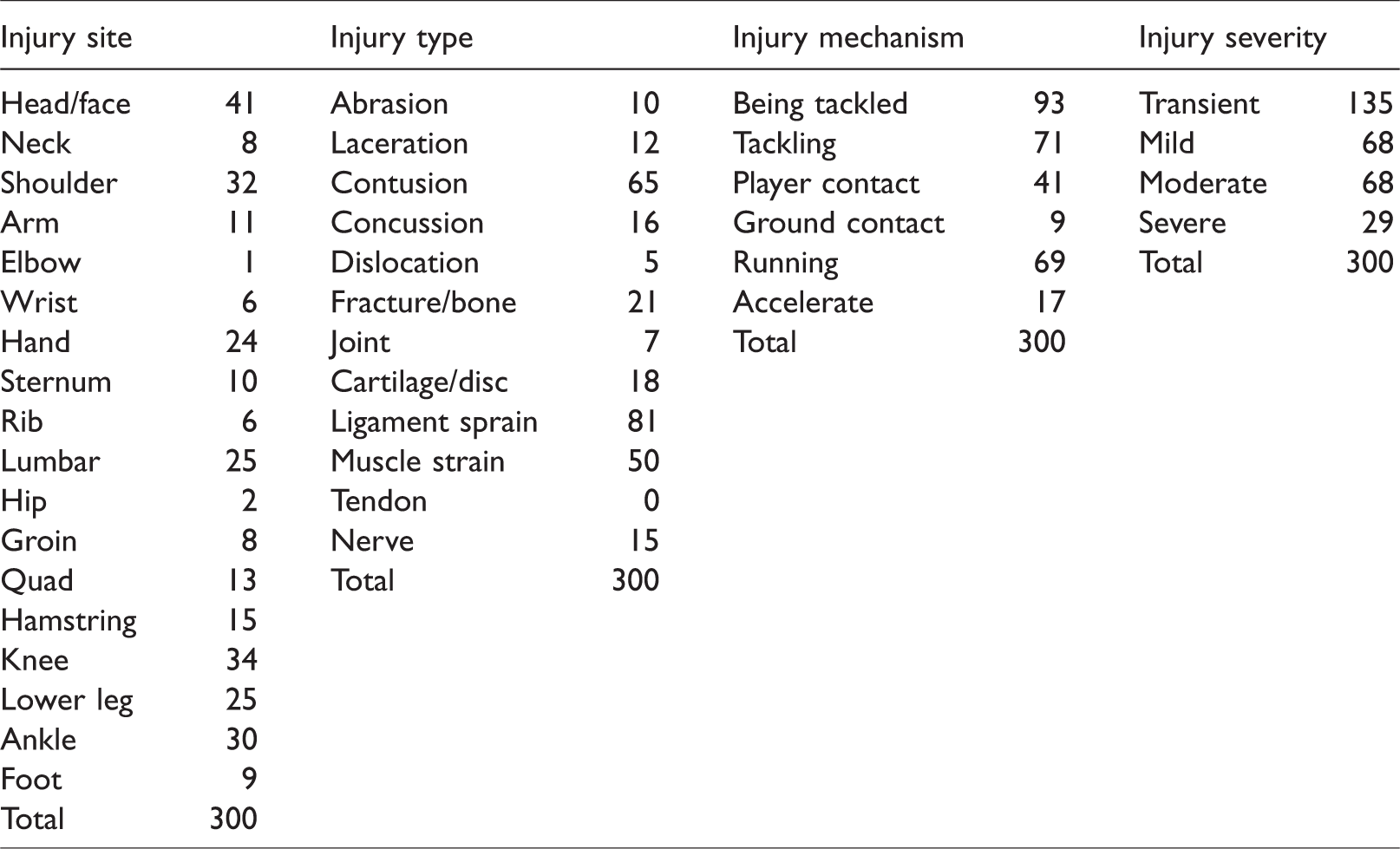
Injury was defined as “the loss of bodily function or structure that is the object of observations in clinical examinations or any immediate sensation of pain, discomfort or loss of functioning that is the object of athlete self-evaluations”. 21 Injury occurrences were recorded at the time of occurrence (if a player was unable to continue playing or training or voluntarily left the field) directly by the lead researcher or the club physiotherapists. Only injuries sustained during training or matches related to these specific playing squads were included in the analyses. Injuries were categorised as incidence, site, type and mechanism (Table 1) according to categories defined in the standardised injury recording template and previous RL studies. 1 Overall injury incidence was reported as number of injuries/1000 training hours. Injury characteristics were dichotomised according to whether or not each individual player sustained an injury of that specific type, site or mechanism. Previous relevant injuries were then dichotomised per individual participant in the same manner.
Mean weekly training load variables.
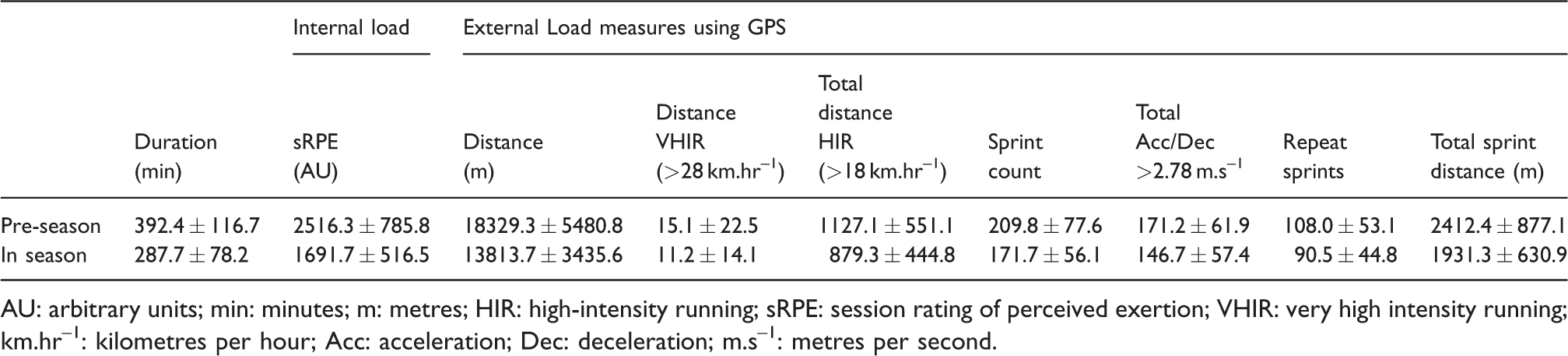
AU: arbitrary units; min: minutes; m: metres; HIR: high-intensity running; sRPE: session rating of perceived exertion; VHIR: very high intensity running; km.hr–1: kilometres per hour; Acc: acceleration; Dec: deceleration; m.s–1: metres per second.
Statistical analysis
An anonymised dataset containing each player’s TA, injury incidence and TL data was then analysed. Data were systematically screened for data entry accuracy and errors. Initially, descriptive trends (frequency histograms) related to domains of TA (RLTA, RTA and CVTA), team selection, TL (GPS and SRPE), injury incidence rates and injury characteristics were calculated. Weekly mean training session values were recorded for both external and internal TLs and then analysed for trends between the pre- and in-season periods where TL typically demonstrates its greatest fluctuations.
Standard tests for normality were conducted and the risk of injury was calculated for each additional year of RLTA, RTA and CVTA using logistic regression. To determine whether TA was related to injury incidence, RLTA, CVTA, RTA and previous injury were independently modelled as predictor variables with injured/non-injured as the dependent variable. To determine whether domains of TA were related to the incidence of specific injury characteristics, a linear regression model was applied. Here, RLTA, CVTA and RTA were modelled as predictors against the incidence of specific injury sites, types and mechanisms. A follow-up confirmatory analysis was also conducted using Poisson regression, based on count data, to confirm primary results. These were consistent with primary analysis steps and so only logistic regression results are reported. All statistical analyses were performed using IBM statistical software package (SPSS version 24), and statistical significance was set at p < 0.05.
Results
TA at the beginning of the study was reported as RLTA (9.1 ± 2.8 years), RTA (1.64 ± 1.38 years) and CVTA (2.4 ± 2.3 years).
Weekly mean TL decreased from the pre-season training phase to the in-season training phase for both internal and external measures (see Table 1). sRPE decreased over the same period by 32.7% from an average of 2516.3 AU to 1691.7 AU per week. Weekly external measures also showed a reduction from pre- to in-season in total distance (–24.6%), total high intensity running >18 km/h distance (–22%) and total very high intensity running >28 km/h (–25.8%).
Total injuries sustained over the two seasons were 300 (Table 2). Injury incidence over the two seasons of tracking was 4.03/1000 h. There were 163 match injuries with an incidence of 35.67/1000 match hours and 137 training injuries with an incidence of 3.82/1000 training hours. Overall match and training injury incidences increased from 2016 to 2017, as match injury incidence increased from 33.7 to 37.64/1000 match hours, while training injury incidence increased from 3.22 to 4.47/1000 training hours.
Injury characteristics.
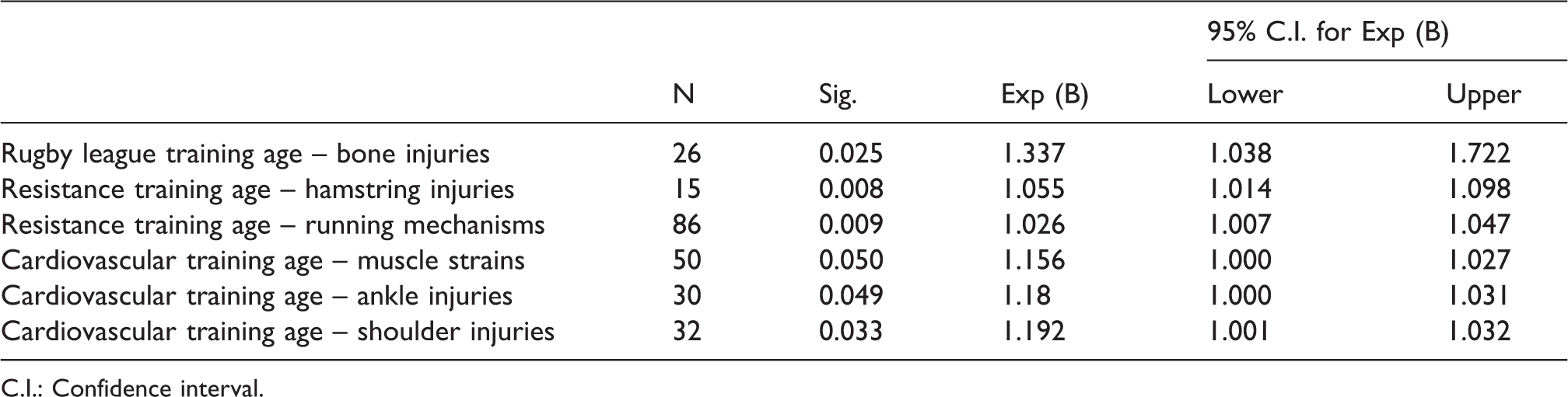
RLTA was positively associated with risk of bone-related injuries (Table 3) (e.g. fracture, stress fracture and shin splints). RLTA explained 4.7–9.6% of the variance in 89.3% cases of bone injury (OR 1.34, p = 0.03). This equated to a 33.7% increase in the risk of bone injury per year of RL training previously accumulated.
Relationship between training age and injury characteristics.
C.I.: Confidence interval.
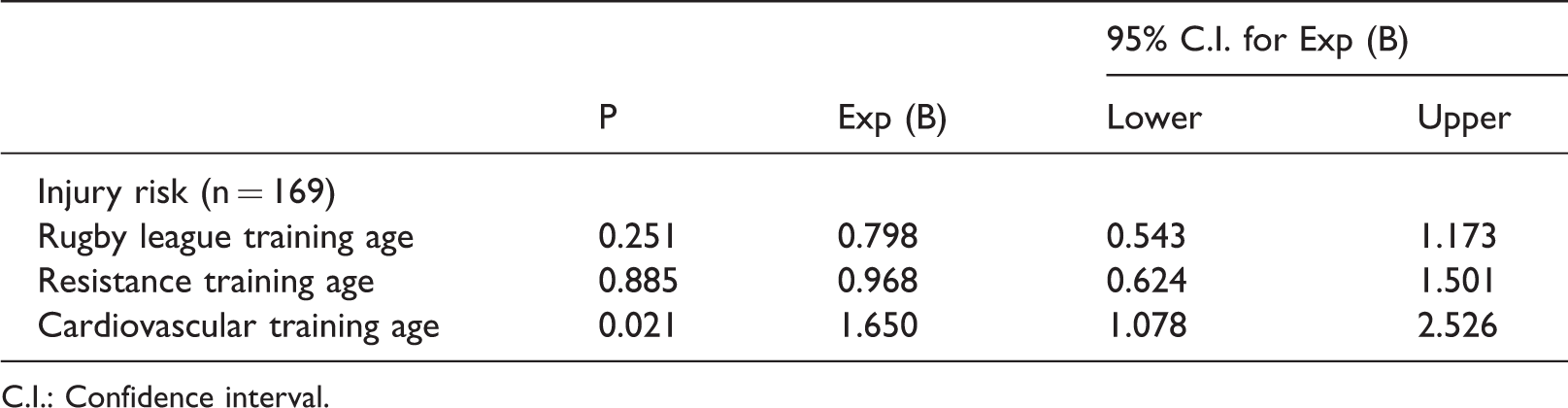
CVTA was positively associated with injury including absolute risk of injury (OR 1.65, p = 0.02), suggesting a 65% increase in absolute injury risk per year of CVTA previously undertaken (Table 4). Between 4.3 and 5.8% of variance in overall injury risk in 56.5% cases was accounted for by player CVTA. CVTA also showed several positive relationships with injury characteristics (Table 3), specifically, muscle strains, ankle and shoulder injuries. Between 7.4 and 11.2% of variance in 74.6% cases of muscular strain was identified (OR 1.16, p = 0.05), suggesting 15.6% increase in injury risk per additional year of CVTA previously conducted. Between 5.2 and 9.1% variance in 85.2% cases of ankle injuries (OR 1.18, p = 0.05) and between 4.3 and 7.8% variance in 85.8% cases of shoulder injuries (OR 1.19, p = 0.03) were also attributed to increased CVTA.
The relationship between training age and injury risk.
C.I.: Confidence interval.
RTA identified a positive relationship with injuries sustained during high-intensity running mechanisms (sprinting/accelerating) and hamstring injuries (Table 3). RTA accounted for between 4.1 and 5.6% of variance in 65.7% cases of injuries sustained during explosive running activities (OR 1.31, p = 0.01), suggesting a 31.2% increase in the risk of this type of injury per additional year of prior resistance training undertaken. Between 5.6 and 12.9% of variance in 91.7% cases of hamstring injury was also accounted for by RTA. A binary regression identified 66% increase in the risk of hamstring injury per additional year of resistance training previously undertaken (OR 1.66, p = 0.01). No significant relationships were defined between previous injury and injuries sustained during the course of this study.
Discussion
To our knowledge, this is the first study to investigate the effect of TA types on injury characteristics in junior elite RL players. Our findings indicated there was no attenuated (protective) effect from higher TA against injury risk. While a protective effect may indeed exist, it was not apparent based on our sample, methodological approach and analysis. Instead, our findings illustrated a positive association between higher RLTA and bone-related injury; a positive association between CVTA and increased overall risk of injury and increased risk of specific injury characteristics (ankle and shoulder injuries and muscle strains); and, a positive relationship between RTA and risk of specific injury characteristics (hamstring, sprinting/accelerating). To potentially account for these unexpected findings, it is suggested that training intensities and loads experienced at the junior developmental level may have advanced at such a pace (as may have occurred in our sample) to have negated any protective effect of higher TAs (i.e. non-functional overreaching).
Weekly TL (both internal and external) followed a trend consistent with previous studies. 22 While these values do not appear abnormal, when considered according to developmental stage, and compared to elite level RL players, they could still be considered excessive. 8 The developmental players in this study undertook an average external TL of 18,329 m per week over an 11-week pre-season. By comparison, chronic weekly TL of >16,095 m has been classified as a high TL in elite level populations. Weekly internal TL has shown elite level RL players engage in between 2665.4 and 2890.4 AU, 23 sub-elite senior players between 1345.0 and 1891.0 AU22 and junior elite players between 643.0 and 711.8 AU. 22 The developmental players tracked in our study engaged in between 1691.7 and 2516.3 AU per week. Given that TLs should be progressive over time to elicit desired positive adaptations, the sample (and developing athletes generally) may require a slower progression of TL over a greater length of time (or other progressive adaptation strategies) to better help develop tolerances to a given stimulus load. As our study indicates, observed developmental athletes experienced a faster progression of TL and intensities over a shorter pre-season period, potentially counteracting protective benefits of increased TA previously accrued by more experienced junior elite players.
Overall, injury incidence was lower than previously observed in RL populations. 1 Recent studies have observed similar incidence of injury for developmental RL players to senior professional RL. 24 Positive relationships were identified between CVTA, overall injury risk and muscular strains and ankle injuries. These relationships between CVTA, overall injury risk and risk of muscular strain may be due to players with higher cardiovascular capacities potentially engaging in greater overall TL and intensities through increased ability to maintain distances and speeds at higher thresholds during conditioning drills. Such positive relationships were also apparent for RTA, with increased risk of any injury sustained via high-intensity running mechanisms and hamstring injuries. A greater engagement in structured resistance training sessions by these more well-trained athletes due to selection in school representative teams may lead to higher off-field TL and partially account for present findings.
The unexpected findings from our study point toward the need for accurate monitoring of TL and intensities, particularly at developmental stages of an athlete’s career. A model for systematic TL monitoring and progression in developmental athletes was recently proposed, highlighting how TL could be better matched with player TA. Such considerations may better inform TL prescription and monitoring to avoid non-functional overreaching and injury risk in developmental athletes. 25 When considered within such a model, present findings highlight the possibility of adverse events and increased injuries when TL and intensities are excessive given an individual TA.
Several limitations exist within our study. The study population monitored reflected the training practices specific to one RL club. Training practices more broadly across clubs would need to be assessed to draw more extensive conclusions. Our study examined relationships between TA, injury during a specific developmental window. Further research examining different ages, stages and skill levels of players/athletes is required to enhance present understanding. Developing athletes often participate in multiple competitions (e.g. school RL) and/or playing additional sports (e.g. rugby union, touch rugby), and so data on training practices for additional sporting commitments would help ascertain a better picture of the relationships between TA, TL and injury. Individualised GPS TL data – as opposed to team averages – would also provide a more accurate methodology and data for analysis. Such an approach would provide clarity regarding individual aerobic capacities and high-speed running thresholds, and thus provide valuable insight into acceptable TL for an individual athletes TA in order to minimise injury risk.
Conclusions
Findings related to TA and injury risk contrasted with our hypothesis that higher TA would, in part, attenuate injury risk. Rather, a positive association between CVTA and RTA with overall injury risk and certain injury characteristics (e.g. injuries sustained through running mechanisms, muscle strains, hamstring and ankle injuries) were identified. Present findings may be explained – in part – due to the high accumulations and progression of TL which may have negated any protective effect forms facets of RL specific, cardiovascular and resistance TA experience.
Footnotes
Declaration of conflicting interests
The author(s) declared no potential conflicts of interest with respect to the research, authorship, and/or publication of this article.
Funding
The author(s) received no financial support for the research, authorship, and/or publication of this article.