







Abstract
Video Assistant Referee (VAR) was officially introduced into Association Football (Soccer) regulations in 2018. The aim of this study was to examine how the implementation of this technology has modified the play in elite soccer. The sample consists of all 760 matches played in the Spanish LaLiga during the seasons before and after the implementation of the VAR system. The following variables were recorded for each match and half: Fouls, Goals, Offsides, Penalties, Playing time, Red cards and Yellow cards. Match statistics were retrieved from the website of “Whoscored” (www.whoscored.com). A Mann-Whitney U test and Generalized linear model were used to compare seasons before and after the implementation of VAR. Overall, the findings of the present study showed that the VAR system does not dramatically change the play in elite soccer. Nevertheless: (i) there was a significant decrease in the number of offside after the implementation of VAR; (ii) there was a slight increase in the number of minutes added to the playing time in the first and second half and the full game; and (iii) in most of 70% of all matches, the checks of the match-changing incidents did not lead to review. Moreover, the impact of the VAR system on the game decreases with VAR-only reviews, where the final decision was only based on the communication with the VAR, compared to matches with on-field reviews, where the main referee reviewed the footage on a monitor near the pitch. These findings suggest that to reduce time-wasting and speed up the match, the number of on-field reviews should be reduced.
Introduction
During matches opposing teams have to abide by the rules of the sport. In soccer these are interpreted and enforced by a main referee and two assistant referees who try to ensure a fair match. In this context, referees can be affected by internal and external factors leading to biased decisions. These include crowd noise, fan pressure, match criticality, match importance or even favouring the best teams. 1 , 2 In addition, the referees can be biased in some decisions which are open to subjective interpretation, such as the stoppage time added after the second half or the fouls called and penalized with yellow/red cards. 3 , 4 For example, referees viewing videotaped potential fouls with crowd noise called significantly fewer fouls (15.5%) for the away team than those presented with only the video. 5 The so-called ±1 bias, or extra time bias, of soccer referees has been extensively examined. 6 Garicano et al. 7 showed that referees added significantly more extra time after the second half when the home team was behind by one goal than when it was ahead by one goal. Referees have to make more than 100 decisions during official matches with positive and negative judgements that can have a direct impact on match outcome. 5 Some psychological constraints may affect the referee’s job during matches: the flash-lag effect (the difficulty of perceiving the position of an object when something else is happening at the same time) in the case of mistakes made in offside decisions, 8 or players comments on judgements about the seriousness of a foul. 9
Technology devices are on the increase in soccer as a way to support and help referees to make better and unbiased decisions. These devices can be classified into those focused on: 1 (i) supporting the decision making process (e.g. the Video Assistant Referee (VAR) system), (ii) replacing specific referee’s decisions (e.g. football sensor for goal line), and (iii) helping referees to enforce rules of the sport (e.g. vanishing spray). Specifically, the VAR system is increasing its presence in elite soccer worldwide as a way to minimize wrong decisions by the referee, and thus reduce subjective error when an action is unclear or needs to be rechecked. The use of the VAR system should therefore be studied to improve the impact on playing variables, and thus be used and controlled for by coaches and players minimizing its impact during match competitions. 6
Only five studies have analysed the impact of VAR on team performance. Lago-Peñas et al. 10 studied the effect of the VAR system on 1,024 matches from the Italian (Serie A) and German (Bundesliga) professional leagues during the 2016-17 and 2017-2018 seasons. Their main results showed that the playing time during both the first half and the full match increased, while the variables offside, fouls and yellow cards decreased after the VAR system was implemented. Similarly, Han et al. 11 found in the Chinese Super League that after the introduction of VAR there was a significant increase in the playing time of both the first half and second half, as well as for the whole match. They also found that the number of offsides and fouls dropped significantly. However, they did not find differences in the number of fouls, yellow cards, red cards and penalties. Petty 12 investigated the extent to which the VAR system could affect home advantage in the Italian Serie A and the U.S. Major League Soccer (MLS). His findings over the 2017–2018 season, reflected that the VAR system changed, on average, one decision every 3.29 matches (including 59 penalties, 16 red cards and 42 goals) in Serie A. Additionally, the ratio of home penalties to away penalties declined sharply in each league after the introduction of VAR, suggesting that a penalty awarded by the referee to a home team was more likely to be overturned as a result of VAR than a penalty awarded to the away team. Spitz et al. 13 found that in 2195 matches across 13 countries, the VAR conducted 9732 checks for potential match-changing incidents, with the median duration of a check being 22 seconds. The checks resulted in a total of 795 reviews, with a median duration of 62.0 seconds for on-field reviews (N = 534) and 15.0 seconds for a VAR-only reviews (N = 261). There was a significant increase in the decision accuracy after VAR intervention for situations that required rule interpretation. The decision accuracy improved from 92.1% to 98.3% after intervention using VAR. Errekagorri et al. 14 examined the impact of the VAR system in 375 matches according to the number of VAR interventions per match: none (VAR0), one (VAR1), and two or more (VAR2). They found that there was a slight increase in the playing time in VAR2 compared to VAR1 and VAR0 (99.1 seconds vs. 96.0 vs 95.1, respectively). No differences were found in the number of fouls, corners, shots, crosses, dribbles or passes. However, no distinction was made between a VAR-only review, where the final decision is only based on the silent check by referees in the VAR booth, and an on-field review, where VAR alerts referee to a potential issue with his/her decisions and the main referee reviews the footage on a monitor near the pitch.
Based on those previous studies more research is needed in order to quantity the effect of the VAR system on football matches and on referees’ performance. Thus, the current study aim is twofold: (i) to compare the impact of VAR on different metrics directly influenced by this system such as time duration, offside, yellow and red cards, fouls and goals during each half and for the total match; and (ii) to investigate differences between a VAR-only review and on-field review on these same variables. The hypothesis of the study predicts that (i) there is an increase in the number of minutes added to the playing time in the first and the second half as well as in the number of red and yellow cards after the implementation of the VAR system in matches with the VAR system; and (ii) there is more effect on these variables in matches with on-field review compared to matches with a VAR-only review.
Methods
Sample
The sample consisted of760 matches played in the Spanish LaLiga(380 without VAR and 380 with VAR) during the 2017/18 and 2018/19 seasons. The Video Assistant Referee (VAR) system was introduced in LaLiga at the start of the 2018/19 season. Consequently, the seasons immediately before and after the implementation of the VAR system were analyzed. The VAR intervened 121 times (once in 86 matches, twice in 13 matches and three times in 3 matches) in 102 matches (27% of the matches played), with 55 VAR-only review (45.5%) and 66 on-field review (54.5%).
Procedures
The following variables were gathered for each match: Fouls, Goals, Offsides, Penalties, Playing time, Red cards and Yellow cards in the first and the second half and in the full match. Match statistics were retrieved from the website of “Whoscored” (www.whoscored.com). The inter-operator reliability of the company’s observational system (OPTA Client System) used to collect football match statistics was identified as reliable reaching an acceptable level of Kappa, ICC, r and SEM values. 15 Ethics committee approval of the current study was gained from the local University. A written permission from Whoscored and OPTASPORTS was obtained to use the data. The Referees’ Technical Committee of the Royal Spanish Federation provided the information about the matches in which the Video Assistant Referee (VAR) intervened in the Spanish LaLiga during 2018-2019 season.
Statistical analyses
Descriptive statistics (mean, median and IQR: inter-quartile range) were presented. The comparison between no VAR and VAR seasons were run using the Mann-Whitney U test because of the non-normal distribution of match statistics (Shapiro-Wilk test for all variables produced values with p < 0.05). The effect size (ES) estimates were calculated using the eta squared statistic (η2 = Z2/(N−1)) with three ranges of interpretation: small = 0.01; medium = 0.06; and large = 0.14.
The generalized linear model (linear scale response) was run to analyse the influence of three covariates (VAR-only review, on-field review and ranking difference between teams) on the performance indicators (total match values). The goodness of fit was calculated using the Bayesian information criterion (BIC) and the results were presented including the B and the 95%CI.
Results
The descriptive statistics and the comparison of all the studied variables between the no VAR and VAR seasons are presented in Table 1. The main differences between the no VAR and VAR seasons were identified for offsides in the second half (Z = 3.293; p = 0.001; ES = 0.03; small effect size), offside full match (Z = 3.163; p = 0.002; ES = 0.03. small effect size), time duration in the first half (Z = 6.059; p = 0.001; ES = 0.10 medium effect size), second half (Z = 6.713; p = 0.001; ES = 0.12 medium effect size) and full match (Z = 8.530; p = 0.001; ES = 0.19. large effect). The number of offsides was higher during the no VAR period and the time duration was shorter in the no VAR period compared to the VAR period.
Descriptive statistics (median and IQR) and results of Mann-Whitney U test for no VAR and VAR match-statistics.a
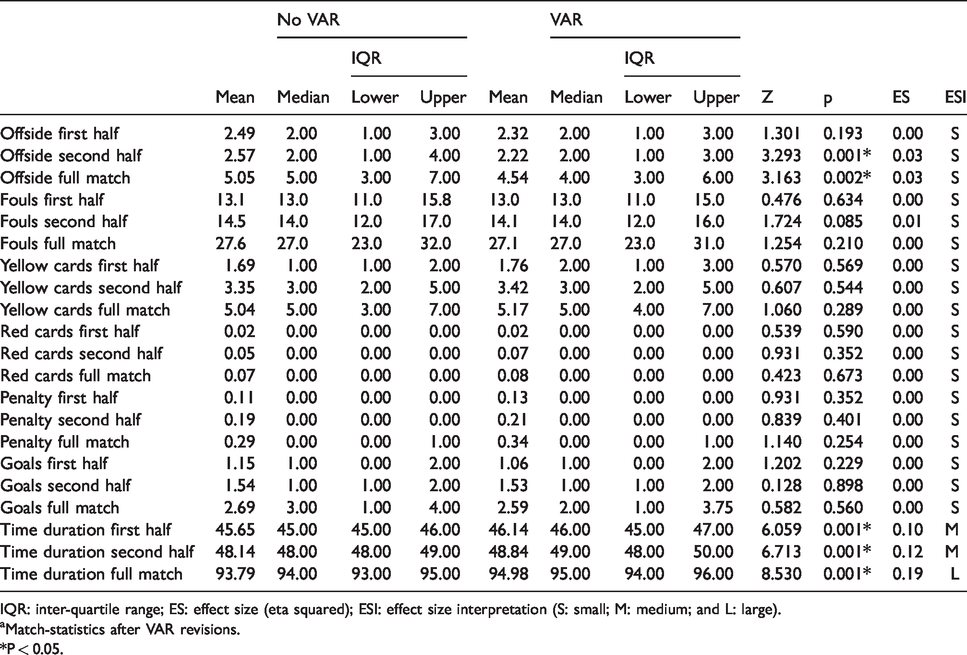
IQR: inter-quartile range; ES: effect size (eta squared); ESI: effect size interpretation (S: small; M: medium; and L: large).
Match-statistics after VAR revisions.
*P < 0.05.
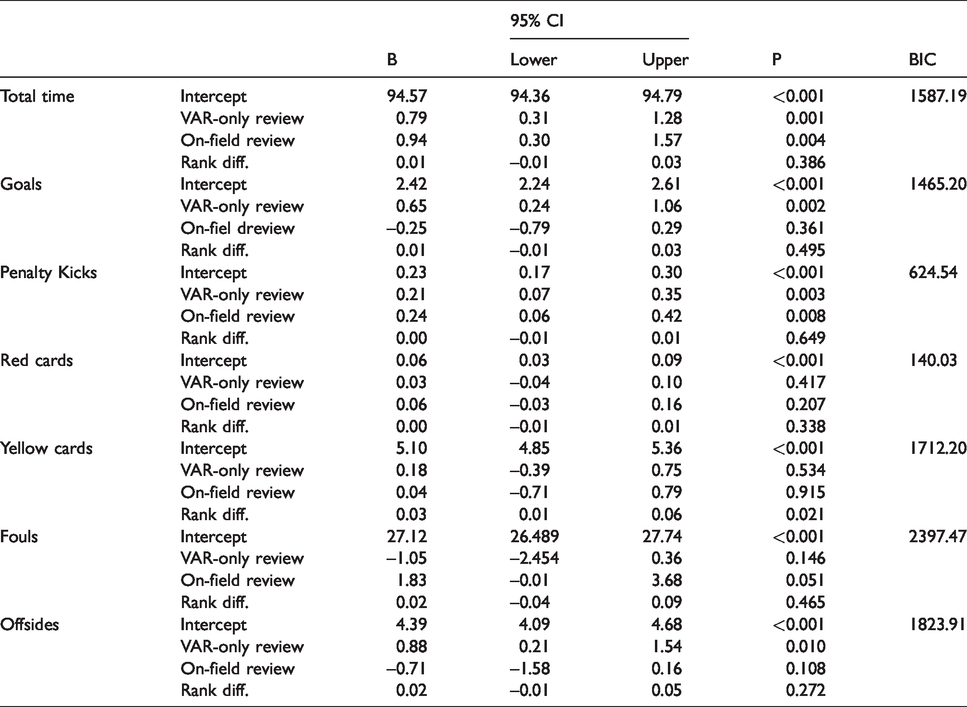
The results of the Generalized Linear Model (linear scale response) for each variable according to the effect of covariates VAR-only review and on-field review, and ranking differences between teams are presented in Table 2. The results showed that the number of VAR interventions significantly affected the total time (p = 0.001), the goals scored (p = 0.002), and the offsides (p = 0.010); the number of VAR on-field reviews affected the total time (p = 0.004) and penalty kicks (p = 0.008); and the ranking difference between teams significantly had a significant effect on yellow cards (p = 0.021).
Results of the Generalized Linear Model (linear scale response) for each variable according to the effect of covariates VAR-only review, on-field review and Ranking differences between teams.
Discussion
The current study may help coaches, players and managers to better understand the effects of the VAR system on elite soccer. The VAR system was introduced in soccer in 2018, 16 in order to allow referees to review decisions made during a game by checking the video footage. However, the available research about its influence on teams during games is scarce.10–14 Research focussing on this issue is therefore of extreme importance in order to examine the impact of this technological officiating aid.
The current study identified three main findings: (i) there was a significant increase in the number of minutes added to the playing time in both the first and the second half, as well as the full match after the implementation of VAR; (ii) there was a significant decrease in the number of offsides in the second half and the full match; and (iii) these variables are more affected in matches with on-field review compared to matches with VAR-only review.
One of the main criticisms of real-time video-replay devices like VAR is the possible disruption to the flow and pace of the match due to the stopping and starting, which might be especially disruptive in matches played in cool weather. 17 In this study there is a significant increase in the number of minutes added to the playing time in the first and in the second half, and the full match. This extra time is not very long: only 30 seconds in the first half, 40 seconds in the second half, and approximately 70 seconds in the full match. These results are similar to those provided by Han et al. 11 in the Chinese Super League. However, Lago-Peñas et al. 10 found that the median durations of the second half and of the full game in the Italian Serie A and the German Bundesliga were 15 and 20 seconds higher after the implementation of the VAR, respectively. This fact may be due to individual differences between the Spanish LaLiga and both the other leagues. Consequently, our findings suggest that the VAR system does not increase dramatically the duration of the match.
After the implementation of the VAR system, there was a significant decrease in the number of offsides in the second half and in the full match. These results are similar to those provided by Han et al. 11 and Lago-Peñas et al. 10 who suggested that players may act with more caution which will lead to fewer offsides given that the VAR will review the action if play leads to a goal being scored. For example, it has been demonstrated that the use of vanishing spray, which helps referees to enforce the rules of the match, reduces the extent of rule violations. 2 On the other hand, no differences were found in the number of fouls, yellow cards and red cards. These results are similar to those provided by Han et al. 11 but different to those found by Lago et al. 10 These differences may reflect that the culture of a national league has its own idiosyncrasies with different degrees of overlap and distinctiveness. This may explain why Lago et al. 10 found some specific differences in the effects of the VAR system in the Italian Serie A and the German Bundesliga. For example, the number of extra minutes added during the first half and for the full match increased in the Bundesliga, but not in Serie A. The number of goals, fouls and yellow cards decreased in Serie A, while the number of offsides and yellow cards as well as the amount of stoppage time added during the first half and for the full match were more affected by the VAR system in the Bundesliga. As a result of these tentative findings, further research is needed to clarify the effects of the VAR system on events relevant to the outcome of the match and also on player behaviour.
Our results also found that the number of VAR interventions significantly affected the total time, goals scored and offside decisions and that the total time increased significantly in matches with on-field reviews compared to VAR-only reviews. Every time a review takes place, the referee has to indicate this by outlining a TV signal and the matchhas to be interrupted. These results are similar to those provided by Spitz et al. 13 They found that the median duration of an on-field review is 62.0 seconds (IQR: 48.0 – 86.8 seconds) compared with 15.0 seconds for a VAR-only review (IQR 3.0 – 32.0 seconds).
The current study has some limitations that need to be addressed by future research. Firstly, the stage in the league competition should be considered since, as the season goes on, the matches tend to be more important than those at the beginning of the year. Secondly, Garicano et al. 7 demonstrated that from the beginning to the end of the season, the added time bias increased by almost 40 seconds in close matches. As a consequence, this variable should be included in future studies. Thirdly, other competitions and national leagues should be assessed to verify the robustness of this result. Fourthly, the rank of the teams was defined as the end-of-season ranking; however, teams’ performances have variations with plateaus, peaks or lows through the season, so that a variable representing current form might be more appropriate. Lastly, Boyko et al. 3 suggested that different referees provide significantly different levels of home advantage and show that variations in the home bias of subjective officiating is likely responsible. This variable should be included in the future.
Concerning the practical applications, the current findings show the reduced impact of the VAR system on the match and consequently strongly support the use of this video-replay technology across other sports and professional domains. In nearly of 70% of all matches, the checks on the match-changing incidents did not lead to review. However, the results also demonstrated that the impact of the VAR system on the match decreases with VAR-only reviews compared to matches with on-field reviews. To reduce time-wasting and speed up the match, probably the number of on-field reviews should be reduced by considering perhaps just the VAR only reviews.
In conclusion, the findings of the present study showed that the VAR system does not dramatically change the match in Spanish professional soccer. More specifically: (i) there was a significant decrease in the number of offsides in the second half and the full match after the implementation of the VAR system; (ii) there was a slight increase in the number of minutes added to the playing time in the first and second half and in the full match after the implementation of the VAR system; and (iii) these variables are more affected in matches with on-field review compared to matches with a VAR-only review.
Footnotes
Declaration of conflicting interests
The author(s) declared no potential conflicts of interest with respect to the research, authorship, and/or publication of this article.
Funding
The author(s) received no financial support for the research, authorship, and/or publication of this article.
