







Abstract
The objective of this study was to analyse the effectiveness of finishing actions in men’s and women’s professional padel. To do this, the category, the type of finishing actions, the type of shot and the number of shots in 5513 points from five World Padel Tour tournaments were analysed. The results showed that men made more winners and fewer errors than women (p < 0.001); with smashes usually being the most frequently used shots to make winners, also highlighting the forehand off the wall smash in women's padel. The back wall shots and forehand or backhand shots without a wall appear as the most frequent errors in these finishing actions. Also, while men tend to make more errors with forehand volleys, women hit more winners with this shot. Men and women padel players make more errors (CSR = 6.7; CSR = 5.5) and fewer winners (CSR = −6.7; CSR = −5.5) in the first five shots of each point. However, they make fewer errors and more winning shots as the number of shots per point increases. These findings are highly relevant, since the style of play differs according to the gender of the players.
Introduction
Padel has gone from being a minority sport to being one of the most popular sports in the world, and this growth has led to an increase in championships, clubs, sponsors, and sports licenses. 1 The interest in this sports modality has also been reflected in an increase in scientific publications, 2 with game analysis being the most studied and characteristic topic, based on the provision of objective data through observational methodology. 3 Specifically, the participants of the World Padel Tour (WPT), the most established professional men's and women's circuit in the world that organises tournaments in different countries worldwide each season, have been the object of study in several of these investigations, determining the differences that exist according to the gender of the participating players and between winning and losing teams.
Previous studies have observed that the duration of the points is longer in women's professional padel, and the number of shots per match or per point is greater.4,5 The participation of the players on the left side of the court is greater in the men's category, while in women's padel the participation of the player on the right side is greater. 6 In addition, considering the types of shots, men make more backhand volleys, flat or topspin smashes and, in general, more shots close to the net; while women make more lobs, trays, and shots from the middle and back of the court.4,7–9 For their part, while women make a higher percentage of unforced errors, men make a higher percentage of winners.6,10 However, although men are more effective on serve, 11 women are more effective on return. 10 Finally, in the women's circuit, it is more characteristic that the games end with a golden point, 12 a WPT rule that consists of playing a point that will decide the game when the score is deuce.
Winning teams tend to score long-lasting points (more than 11 s), make no errors in the first four seconds of the point, and are very effective on break points.13–15 In addition, they perform more attacking actions in 85% of the points, spend more time in net zones and perform more smashes. In contrast, losing pairs tend to lose more long-duration points, take fewer attacking actions per point per game, hit more groundstrokes with or without a wall during the match, and make more trays. Thus, there is a relationship between earning points and occupying areas close to the net. 16 Finally, Muñoz et al., 12 indicate in their study that the golden point is an indicator of performance, with the winning pairs being the ones that achieve the most of these types of points.
Research on padel takes into account different contextual or situational variables which determine differences during the game. Examples of these contextual variables are the set number,12,14 the round,12,14,17 the season, 10 the type of tournament, master or open, 17 match status,18,19 key points, or point duration intervals.16,20 However, to the best of our knowledge, there are no studies in the scientific literature that analyse the effectiveness of finishing points according to the number of shots in men’s and women’s professional padel, analysing the type of shots, the way of finishing (winner or error) and the possible differences between the men's and women's categories.
Therefore, the objective of this study was to analyse the effectiveness of finishing actions in men’s and women’s padel according to the type of shot and the number of shots per point. Given the objective, the hypothesis was that padel players would make more winners in areas close to the net and that the finishing actions would be different in men and women.
Material and methods
Research design
The design of this research follows empirical methodology, and more specifically a descriptive strategy. In addition, it is included within the observational category, being nomothetic, longitudinal, or monitoring and multidimensional.21,22
Sample
Based on the ethical provisions of the Declaration of Helsinki, 23 the analysis included a total of 5513 points (2645 men's points and 2868 women's points), from 91 sets (44 men's sets and 47 women's sets) out of a total of 38 matches in the quarterfinals, semi-finals, and finals corresponding to five WPT tournaments in the 2019 and 2020 seasons. The tournaments corresponded to Open and Master, to ensure the participation of the best pairs in the world, with 18 women (age 31.12 ± 6.06) and 21 men (age 28.66 ± 6.10) being analysed.
The variables analysed were the following:
- Category: the men's and women's categories were established to discover the possible differences between them.
- Type of finishing actions: a distinction was made between a winner (the player wins the point with a direct shot) and an error (the player misses the last shot), following Courel–Ibáñez and Sánchez–Alcaraz. 16
- Type of shot: according to the classification established by Almonacid,, 24 we distinguish a total of 18 types of shots, which occur during the game in padel.
- Number of shots: the number of shots in each of the points was quantified, establishing a group of them, following the duration intervals of the point according to Courel–Ibáñez and Sánchez–Alcaraz 16 and Sánchez–Alcaraz, Jiménez et al.. 20
Process
The analysed matches were broadcast in streaming and later hosted on the WPT website, from where they were downloaded for data observation, collection and analysis. For this data collection process (data were collected from February 2022 to July 2022), an ad-hoc instrument was designed with the aim of analysing the variables under study: category, type of finishing actions, type and number of shots.
An intra-observer reliability analysis was performed to ensure the veracity of the data collected. The observer analysed a sample of 650 points to guarantee a relevant amount of data, between 10% and 20% of the study sample. 25 The mean reliability of the analysis test was 0.98. 26
Statistical analysis
All data were analysed with the statistical package IBM SPPS 26.0 for Windows. First, the calculation of frequencies (n) and percentages (%) of the variables under study was performed. Pearson's chi-square tests were carried out to make the comparison between genders of the finishing actions and the type of shot. The strength of the relationships was interpreted using the corrected standardised residuals (CSR), considering values from 1.96 to 2.58 as small; 2.58 to 3.29 as medium, and more than 3.29 as strong. 27 The effect size was calculated from Crammer's V (Vc), where values of 0.1 represented a small effect, 0.3 a medium effect and from 0.5 a large effect. A significance level of p < 0.05 was established.
Results
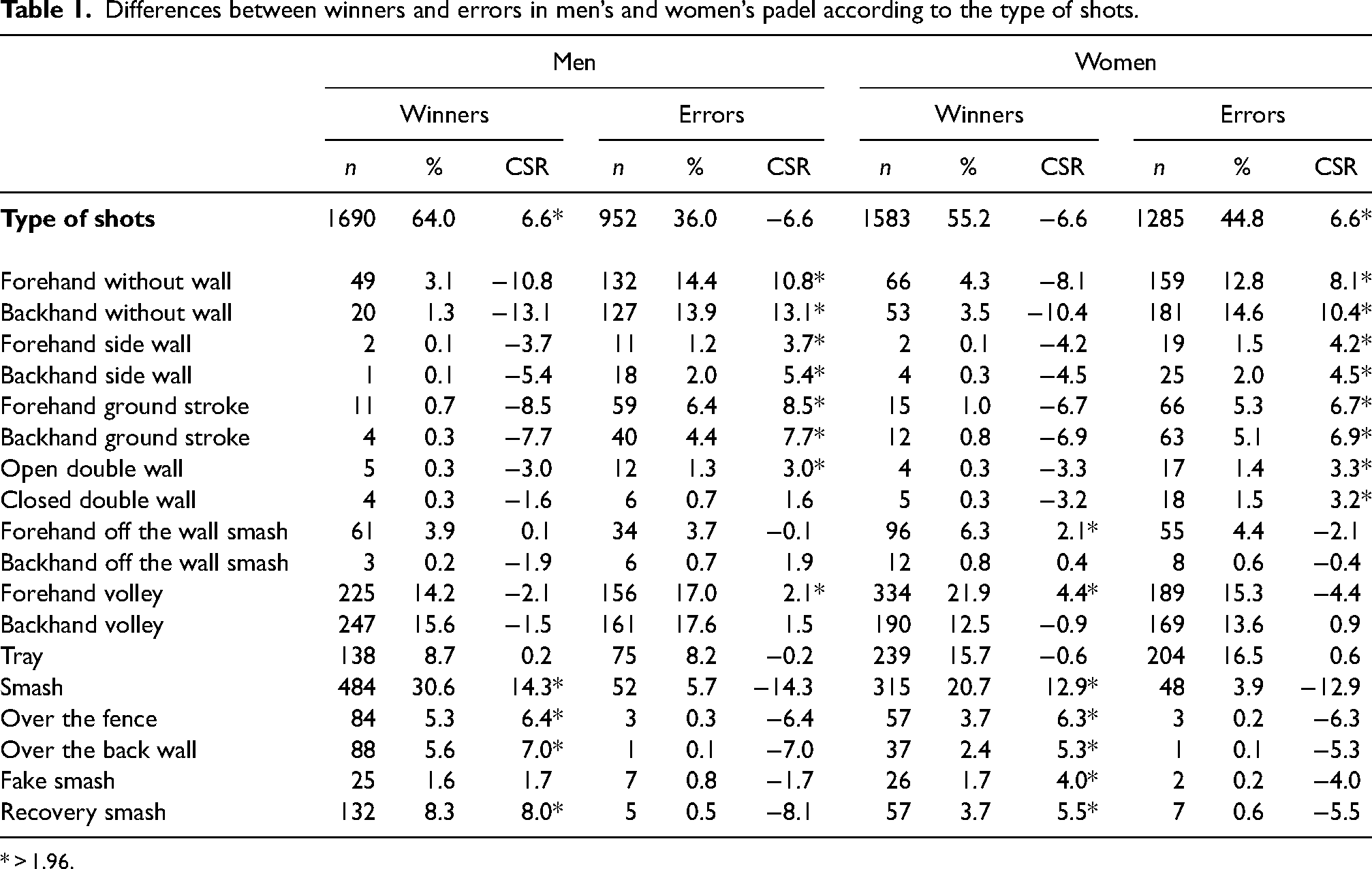
Table 1 shows the results obtained in the finishing actions according to the men's and women's categories. In addition, the types of shots are reflected based on the finishing actions (winners and errors), in both categories. The results show that the effectiveness of the last shot of the points is associated with the type of shot in women (χ2 (17) = 601.410; p = 0.000; Vc = 0.458) and in men’s padel (χ2(17) = 824.008, p = 0.000, Vc = 0.558).
Differences between winners and errors in men’s and women’s padel according to the type of shots.
* > 1.96.
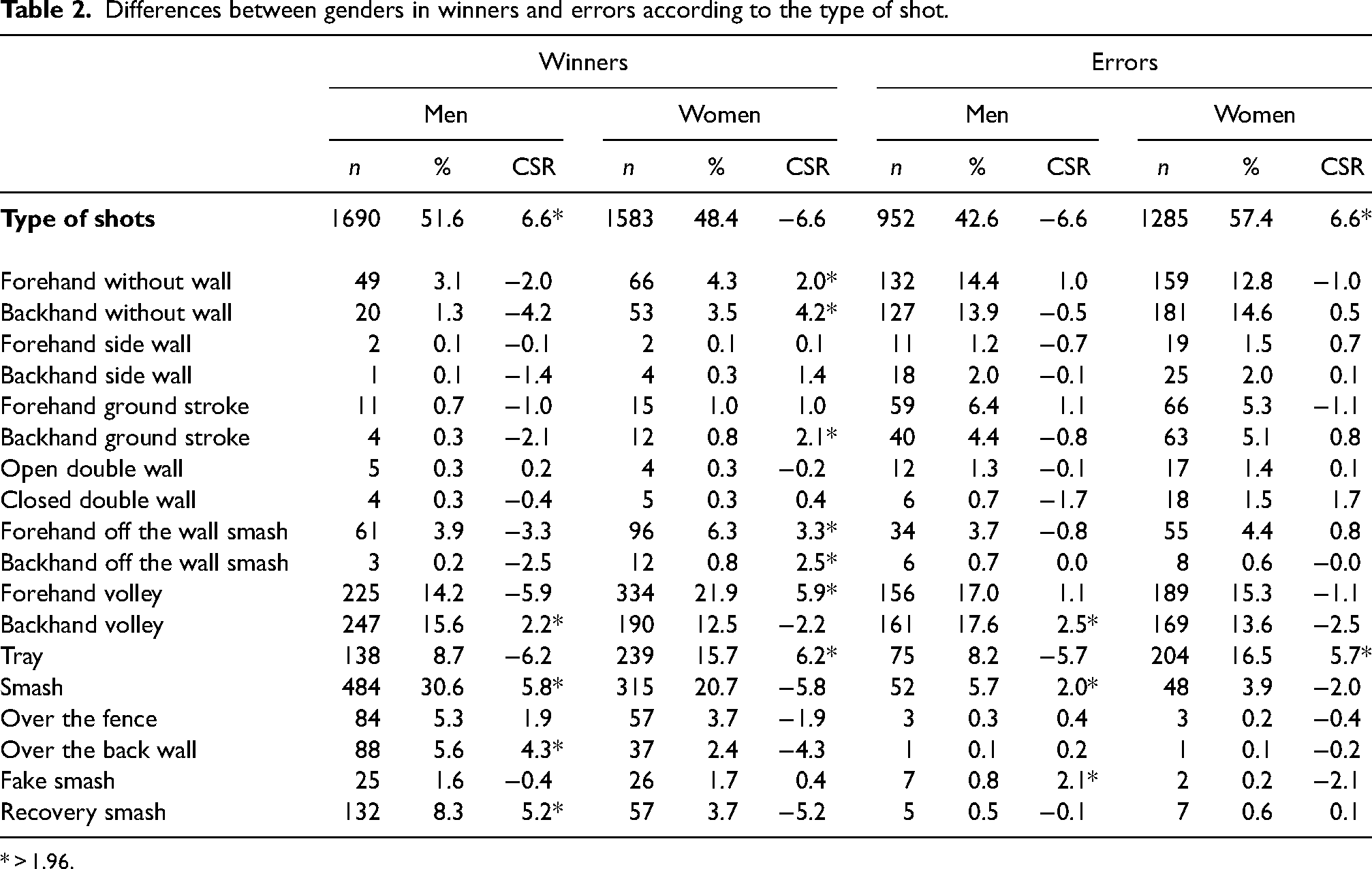
The results of Table 2 show that gender is associated with the type of shot when it is a winner (χ2 (17) = 219.777; p = 0.000; Vc = 0.259) or an error (χ2(17) = 67.374; p = 0.000, Vc = 0.174).
Differences between genders in winners and errors according to the type of shot.
* > 1.96.
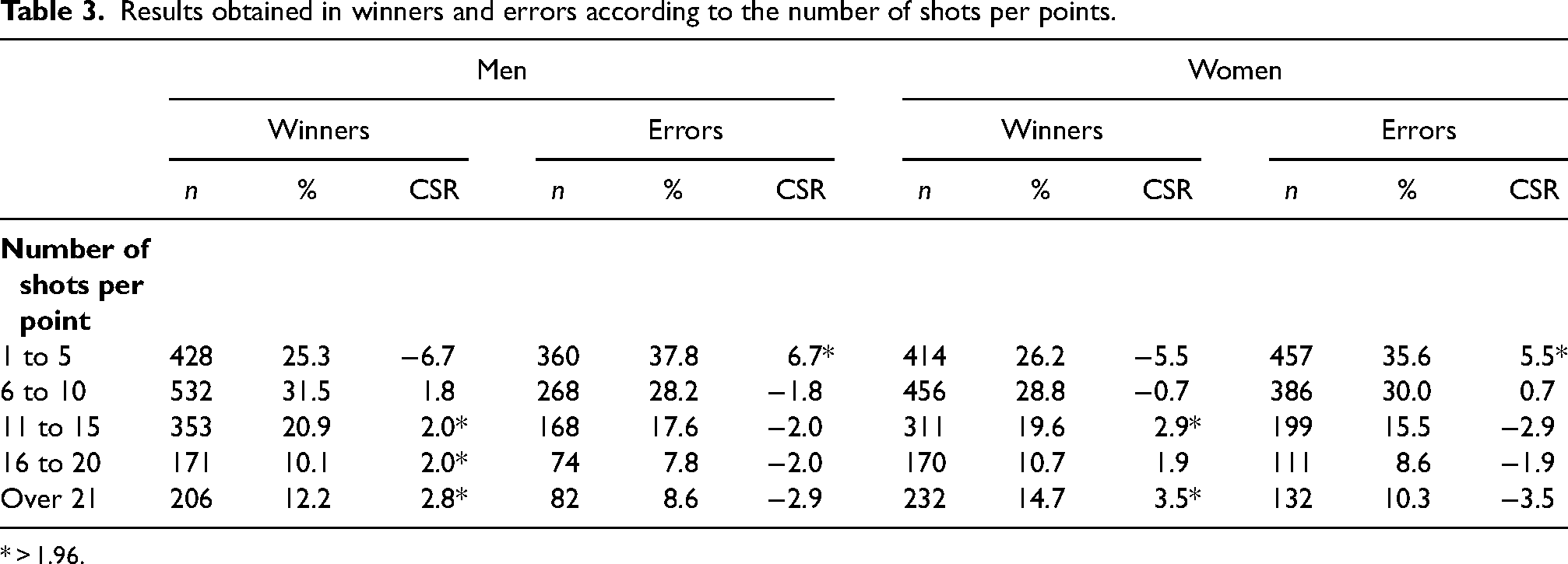
The results obtained in the finishing actions of both genders, taking into account the number of shots, are reflected in Table 3. The results show that the effectiveness of the last shot of the points is associated with the number of shots in women's (χ2 (4) = 41.887; p = 0.000; Vc = 0.121) and men’s (χ2(4) = 50.333; p = 0.000; Vc = 0.138) professional padel.
Results obtained in winners and errors according to the number of shots per points.
* > 1.96.
As can be seen, in points of short duration (one to five shots), there is a greater probability (CSR = 6.7 for men and CSR = 5.5 for women's padel) of finishing the points with errors. However, as the points increase in duration (number of shots), they usually end with a winner, both in men’s and women’s padel.
Discussion
The objective of this study was to analyse the effectiveness of finishing actions in men’s and women’s padel according to the type of shot and the number of shots per point.
In men's padel, more winners are made than in the women's, and on the contrary, fewer errors are made in men's padel than in women's padel. The conclusions of other investigations accord with the results obtained in this study, since they show that men make more winners and fewer unforced errors than women.6,10,20 Men develop a more aggressive game making more winners and women develop a more conservative game waiting for the opposing pair to make an error, therefore, we recommend adjusting the way of training according to the gender of the athletes.
When men’s and women’s padel players execute some variant of the smash they make more winners. Various investigations also conclude that winning pairs make a greater number of winning smashes than losing pairs.4,14,15,28 Sánchez-Alcaraz et al., 9 indicate in their study that the efficiency of the smash decreases significantly when the players move away from the net, therefore, the winning smashes are usually hit close to the net. On the contrary, when men and women execute back wall shots and forehands or backhands without a wall, they make more errors, which are usually shots from the middle and back of the court. Various investigations show that about 80% of the direct points are obtained from the net zone.13,15,16 In addition, while the winning pairs spend more time at the net, the losing pairs hit more groundstrokes with or without a wall during the match.13,16,29 Thus, as Courel-Ibáñez et al. 16 indicated in their study “while the objective of the pair of players who are in the back zone is to fight to get the net position, that of the players who are in the net zone is to fight to keep it”.
Men use the smash and recovery smash more as winners, and women use the tray, off-the-wall smash, and forehand volleys more as winners. Comparing genders, women generate more game winners through forehands and backhands without wall, forehand volleys, trays, and off-the-wall smashes than men. For their part, men perform more winning actions through backhand volleys and smashes than women. Other research indicates that men make flatter or topspin smashes and, in general, more shots close to the net, while women make more shots from the middle zone and the back of the court.4,7,9 Therefore, men are more effective performing finishing actions at the net, and women are more effective performing attacking actions in the middle and back of the court. Similarly, the results of this research indicate that in men's padel the smash and the backhand volley are used more, therefore, more winners and errors are made than in women's padel. However, in women's padel the tray is used more and for this reason, more winners and errors are made than in men's padel with this shot. Coaches must provide information on the effectiveness of the game according to the gender of the players and create determined tasks where the specific type of hitting is trained. These results could be due to anthropometric and strength differences between elite men and women players.12,30 Men are taller, with a higher muscular percentage and higher levels of vertical jump and grip strength than women players, which would allow them to successfully use the smash in positions further away from the net. 9 On the contrary, women are shorter, so they have to let the ball pass so that it bounces off the wall, and then hit it. Similarly, women have less strength to make a winning smash.
In short-term points (one to five shots), both in the men's and women's categories, there is a greater probability of finishing the points with errors. However, as points increase in duration (number of shots), they often end with winners. For their part, Courel-Ibáñez and Sánchez-Alcaraz 16 conclude in their study that minimising the number of errors during the first 4 s, as well as being able to score after 11 s, seem to increase the chances of victory in professional padel. This can be attributed to players wanting to win the point as soon as possible, which leads to haste and errors. Therefore, players should play more conservative shots early in points and try to make the decision to hit a finishing shot at the right time.
Despite the novel results found in this study, some of the limitations found should be highlighted. The moment of the set (beginning, middle, or end), as well as the equality in the score of the set, and the number of the set, are factors that could influence the results obtained. Future studies could be aimed at trying to determine the influence of these contextual variables on the finishing actions in padel.
Conclusions
Men make more winners and fewer errors than women. When men’s and women’s padel players execute some variant of the smash, which are usually shots close to the net, they make more winners. On the contrary, when they execute back wall shots and forehand or backhand shots without a wall, which are usually hit from the middle and back of the court, they make more errors. Also, while men tend to make more errors on forehand volleys, women hit more winners.
While men use over-the-back wall and recovery smashes more as winners than women, women use off-the-wall smashes, forehands or backhands without a wall, and forehand volleys more than men as winners. On the other hand, men make more errors with the fake than women.
In men's padel, the smash and the backhand volley are used more, therefore, more winners and errors are made than in women's padel. However, in women's padel the tray is used more and for this reason, more winners and errors are made than in men's padel with this shot.
The style of play in padel varies in men's and women's categories, therefore, the way of training must be adjusted according to the gender of the athletes.
Finally, men’s and women’s professional padel players make a large number of errors during the first five shots of each point, their number decreasing as the number of shots increases. Likewise, padel athletes make fewer winners at the beginning of the point, increasing their number as it progresses.
These findings are highly relevant, since the style of play differs according to the gender of the athletes and helps players make the decision to perform one type of finishing shot or another depending on the moment of the game. In addition, it helps coaches design specific training tasks and develop competition strategies.
Footnotes
Declaration of conflicting interests
The author(s) declared no potential conflicts of interest with respect to the research, authorship, and/or publication of this article.
Funding
The author(s) received no financial support for the research, authorship, and/or publication of this article.
