







Abstract
Training to improve high school sport coaches’ and athletic directors’ knowledge, skills, and competencies to address and respond to rising mental health concerns is more important than ever. High school student-athletes are at increased risk for mental health concerns, given the pressures of balancing sport, school, and other responsibilities. This paper describes a community-based participatory research (CBPR) study that guided two years of public impact and social change efforts to improve coach education and training in one large Midwestern state in the United States. Our collective goal was to empower coaches and athletic directors to coach “beyond the Xs and Os.” Using a CBPR framework, we describe the decision-making process that led to the co-development and implementation of a mental health training program piloted with 147 high school coaches and athletic directors. We also describe intermediate outcomes associated with our collective change efforts demonstrating the value of using a CBPR approach. Our “Coach Beyond” processes and outputs showcase how CBPR can lead to transformative action and social change to reorient sport as a context focused on the holistic health, wellness, and development of student-athletes.
Training to improve the knowledge, skills, and competencies of high school sport coaches and athletic directors to respond to adolescent mental health concerns is more important than ever. High school–aged adolescents are experiencing unprecedented mental health issues following the COVID-19 pandemic, and the United States (US) Centers for Disease Control and Prevention 1 reported a 40% increase in adolescent mental health symptomology in the past decade. Although sport is often assumed to serve as a protective factor against mental health concerns, sport participants are no less likely to experience risks for mental health symptomology than the general population.2,3 Furthermore, high school student-athletes experience heightened barriers to help-seeking, such as real or perceived threats to playing time, concerns about being perceived as weak or lacking commitment, and sport cultures fraught with demands to perform at a high level, act tough, and compete under pressure. 4 These forces and factors influence the estimated 12 million high school student-athletes participating in sport annually in the US. 5
According to the US National Coach Survey, 6 high school coaches (e.g. coaching sports offered through a school) spend 10–40 hours a week working directly with student-athletes. Meanwhile, high school athletic directors often work full-time in schools where they manage schedules, games, and competitions; oversee facilities and athletic resources; provide guidance and support to coaches and student-athletes; and facilitate broader local, state, or national sporting events within the structure of education-based athletics. As such, high school coaches and athletic directors spend a great deal of time with student-athletes beyond the school day and have the potential to influence athletic activities, norms, expectations, and processes within schools and communities.
Of significance to high school sports in the US are the changing profiles of coaches. In the past two decades, the number of US high school sport coaches who are licensed educators has decreased substantially. State and national data suggest that 50–70% of school-based coaches are not educators 7 (e.g. certified teachers or school staff). Indeed, a majority of high school coaches identify as community members, parents/caregivers, or volunteers.6–8 For high school student-athletes, this means their coaches are not receiving the same training as educators on mental health, social–emotional health, whole child development, and school-based health policies and procedures (e.g. crisis intervention procedures or suicide protocols). For athletic directors, this also means that the days of working with coach–educators are waning, and a new wave of coaches may have differential training and professional development needs compared to past generations.
Gaps in coaching education also are prominent systemically in the US due in part to the lack of a formalized governing sport body, meaning coach training, licensure, and educational requirements vary significantly by state. The coach education and training system for US high school athletics is decentralized, resulting in variations in the requirements and credentials needed to coach, depending on location. Atkinson et al. 9 found that most states require school-based coaches and athletic directors to complete the NFHS Fundamentals of Coaching training along with trainings in first aid, cardiopulmonary resuscitation, sport rules and regulations, and sport knowledge. Furthermore, many states do not require continuing education or training related to positive youth development or socioemotional health. 9 Trends are concerning, given that over half of high school coaches are not educators, and nearly 4 in 10 (42%) high school-aged adolescents reported feeling persistently sad or hopeless in the last year. 1 With studies indicating student-athletes are equally vulnerable to mental health concerns compared to the general student population, 3 there is a clear need for resources that address gaps in coaching education and provide tangible support to athletic departments to meet the needs of high school student-athletes.
Since the COVID-19 pandemic, coaches are also beginning to recognize the changing sport landscape. Before COVID-19, Ferguson et al. 10 reported that coaches did not necessarily see themselves as actors responsible for responding to mental health issues and were more interested in learning ways to motivate their student-athletes. More recent data, however, collected after the COVID-19 pandemic indicate that coaches and athletic directors are more ready to learn about mental health. The National Coach Survey of approximately 10,000 youth sport coaches found that only 18% of coaches felt confident linking student-athletes to mental health resources, and only 25% felt confident in their ability to identify mental health concerns among student-athletes. Meanwhile, two out of every three coaches reported they were interested in receiving more training on mental health. 6 Low efficacy and a strong desire for additional training point toward evolving and timely opportunities to strengthen coach education and training, especially since the onset of the COVID-19 pandemic.
As a final point, recent studies indicate student-athletes see their coaches as key adult figures regarding their mental health. Liddle et al. 11 found that adolescent male sport participants believed their coaches would serve as potential avenues of support if they were struggling with mental health concerns. Moreover, Bates and colleagues 12 found that high school student-athletes want their coaches to focus less on winning and more on making sport fun. They also reported a strong desire for their coaches to check in on their well-being beyond the court, field, mat, etc. Alternatively, high school student-athletes shared that they thought their coaches might not know how to respond to these concerns, and some worried that their coaches would punish them for sharing their struggles by decreasing playing time, labeling them as weak, or viewing them as a “problem.” 12 With these sentiments in mind, one can argue student-athletes will ultimately benefit if coaches receive education and training on how to check in on student-athletes, destigmatize help-seeking, and respond in appropriate ways (e.g. listening actively, problem-solving, and facilitating linkage/referral) to mental health concerns.
Current study
Training and education gaps, growing interests among coaches, and evolving needs of high school student-athletes highlight opportunities to educate coaches and athletic directors on ways to support student-athlete mental health. Given that many coaches are no longer educators, athletic directors also need access to quality trainings that prepare coaches for mental health crises such as active suicidality and that help to facilitate successful linkages and referrals to school-based mental health services when needed. The purpose of the current article is to describe a community-based participatory research (CBPR) study that built statewide momentum to improve coach education and training in one large Midwestern state in the US (Ohio). Our CBPR approach contributed to multifaceted activities focused on awareness-building, co-learning, and capacity-building efforts to help coaches go “beyond the Xs and Os.” In turn, these efforts also guided the development, implementation, and evaluation of a pilot mental health training program for high school sport coaches and athletic directors. In this article, we synthesize how our collaborative work led to numerous intervention and research processes, outputs, and intermediate outcomes that have informed policy and helped leverage sport to address mental health risks, especially among high school student-athletes.
Community-based participatory research
CBPR is a research orientation that places value on equitable collaborations between community members and academic partners, reflecting shared decision-making throughout the research process. CBPR is conceptualized across four domains: contexts, partnering processes, intervention and research process and outputs, and intermediate and long-term outcomes 13 (see Figure 1). CBPR requires a substantial investment, including personnel, resources, and time, to work toward collective action and social change. CBPR values community members’ contributions, power, and control at each step of the research process, from defining the research topic to disseminating the results. 14 Participatory research positions community members as knowledgeable actors with the skills, knowledge, and insights to influence change. 15 In turn, utilizing a CBPR orientation can enhance the relevance of research studies, interventions, and public health campaigns because community members are involved in the development and success of the research agenda. 16

Community-based participatory research conceptual model. 13
To date, research studies utilizing a CBPR orientation are scarce within the coaching and sport for development literature, and a large number of studies focus on outcomes associated with trainings for coaches yet lack an emphasis on the processes underlying training development.17–20 In a recent review of mental health awareness programs, Breslin and colleagues 17 identified five studies on mental health awareness interventions in sport (e.g. help-seeking, knowledge of disorders, and literacy) implemented with coaches. Of those five studies, only two described interventions developed with the coaches’ voices, interests, needs, and perspectives in mind. For instance, Pierce et al.'s 21 intervention was developed by a regional football league and a community welfare organization. Bapat et al. 22 designed an intervention with the help of multiple stakeholders on a sport-focused steering committee. However, the processes underlying these partnerships and collaborations are poorly described and point to gaps in our understanding of how coaches and sport leaders should be involved in developing effective coach education programs. As such, opportunities exist to advance the coaching literature using different research paradigms and innovations to improve coach education and training. 18
For this study, our work was grounded in the CBPR conceptual model outlined by Wallerstein et al. 13 The contexts guiding our work are described in our literature review (e.g. the importance of the health issue, social and structural changes due in part to COVID-19, policy governance over coach education and training in the US, and a high level of readiness reported by coaches/needs of student-athletes). Next, we describe our CBPR approach to improve coach training and education in Ohio across the following domains: partnership processes, intervention and research processes, intervention and research outputs, and intermediate outcomes. These efforts outline the processes that led to the development of a mental health training program for coaches and subsequent policy and social change efforts.
Partnership processes
In 2021, a nonprofit foundation, The Susan Crown Exchange, put out a call for proposals to sport organizations, academic institutions, and state sport associations to focus on improving coach training and education in the US. The grant aimed to provide funding to train 1 million coaches in positive youth development practices and recalibrate sport as a context that facilitates social–emotional development and learning. Collectively, university researchers with expertise in positive youth development and mental health in sport at The Ohio State University began to explore whether the Ohio state association and local partners were interested in pursuing this funding and the relevance of this need in our community. We contacted leaders in diverse school districts and the state sport association. Both voiced a high level of interest and validated the need for this work in Ohio. As a result, our CBPR process began during our grant-writing phase, when university researchers partnered with leaders of the Ohio High School Athletic Association (OHSAA) and high school sport leaders, including school administrators, coaches, and athletic directors, from 10 Ohio school districts.
Partnerships focused on a commitment to collective decision-making and empowerment. Relationships were formalized when school district leaders signed letters of support to participate in a collaborative partnership to strengthen coach education and training in Ohio. In addition, funding was written into the grant application annually for each partner district to participate in this collaborative partnership. Coaches and athletic directors also helped co-construct the grant's goals and objectives. For instance, several athletic directors recommended we begin our work by auditing coach training requirements in our state. Coaches and athletic directors also voiced a desire to reengineer the coach licensure system to reduce redundancy in required trainings and to mitigate barriers to entry into coaching. Early involvement in setting collective goals made the work more meaningful, determined the priorities of this work, and increased the buy-in of key stakeholders, including the funder of this project. Due to the innovative partnerships embedded in our proposal, our grant was funded in 2021, and so began a three-year project where university researchers, state sport leaders, local coaches, athletic directors, and school leaders came together jointly as collaborators to focus on improving coach education and training in Ohio.
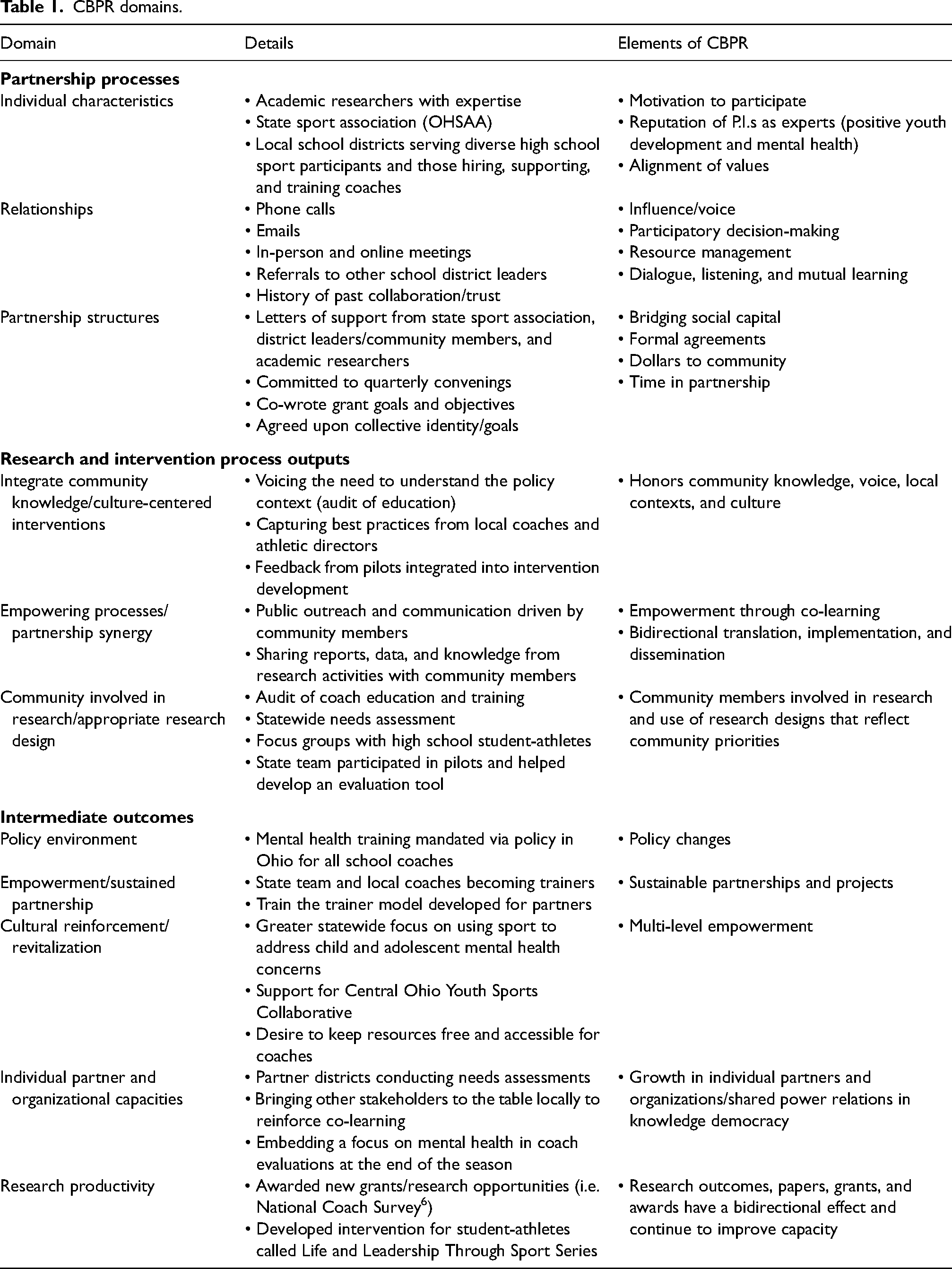
We began by creating a collective identity as the “Coach Beyond State Team” (hereafter referred to as the state team). Early in our process, this name helped to solidify our commitment to going “beyond the Xs and Os” and focusing on efforts to ensure coaches would be prepared to support the whole child, not just the athlete. Then, our state team of more than 30 school administrators, sport leaders, university researchers, coaches, and athletic directors launched this work by meeting every 8–10 weeks to discuss approaches to strengthen coach education and training and to reflect on potential barriers or setbacks that might arise. During these convenings, our state team began strategizing how to develop and implement coach education and training sessions to benefit the group and individual school districts. These discussions were mutually beneficial, as representatives from different districts and organizations were involved in “building the table.” 23 Building the table resulted in the creation of a shared vision, readiness, relationships and interdependence, commitment, and buy-in for change. Table 1 details the individual characteristics, relationships, and partnership structures during the beginning of our CBPR work (see Wallerstein et al. 13 ).
CBPR domains.
Intervention and research processes
Our next phase focused on integrating community knowledge into the work, creating empowerment processes, and involving the community in research. This element of CBPR honors the community's knowledge and voice, empowers co-learning processes, and facilitates the development of research priorities that reflect the community's needs.
Audit of coach training and education
As mentioned in the partnership process, coaches and athletic directors on our state team voiced a desire to understand better the landscape of coach training and education in Ohio. To this end, our group worked collaboratively to audit Ohio's landscape of coach training and educational requirements. This involved conducting a curricular audit and cost analysis that explored the Ohio coach licensure process (the costs, time commitments, and renewal periods for trainings). University researchers mapped the required coach trainings per state policy and audited content, time, and costs associated with the trainings (see results in Atkinson et al. 9 ). We validated our findings with the state team and discussed other process-related issues influencing the coach education and training system. For instance, some training courses require renewals every two years. In contrast, others were required only every three years. Our team noted how the lack of alignment in renewing various trainings created challenges in tracking and compliance for sport leaders. Of importance, the audit also indicated that training and continuing education on topics such as positive youth development, mental health, whole child development, and socioemotional learning through sport were not mandated nor accessible for coaches in the state. 9 This pointed toward gaps in coach education and training in Ohio, especially concerning supporting student-athlete mental health.
Public outreach and communication
Our state team also discussed the need to create a sense of readiness for training improvements by reorienting coaches and members of the sport community (parents, caregivers, student-athletes, and others) to the many ways sport can teach student-athletes skills they can use for the rest of their lives. To achieve this goal, our state team developed two public service announcements that focused on the importance of coaching “beyond the field, mat, court, or pitch.” The announcements featured notable sport leaders such as the athletic director at The Ohio State University, a famous NBA basketball coach, several Ohio State coaches, the executive director of the OHSAA, and coaches and student-athletes from the school districts represented by the Coach Beyond State Team. The announcements ran on local news stations, radio stations, TVs, and scoreboards during breaks at state tournaments to further message that coaching involves caring for the health and well-being of the whole child. Our state team also worked collaboratively to create a monthly newsletter called the “Coach Beyond Minute” that highlighted resources, tools, and videos focused on coaching and supporting the whole child. Newsletters included video clips of an “MVP” coach or school, provided a progress update on the work of our state team, and shared other resources that aligned with our mission to coach “beyond the Xs and Os.”
Statewide needs assessment
Our team also wanted to know the training needs and interests of coaches in Ohio. As such, we conducted a rigorous statewide needs assessment. University researchers supported this effort by modifying a previous survey used in Central Ohio to capture perspectives of coach training needs and interests across the state (see Anderson-Butcher et al.; 7 Bates and Anderson-Butcher 8 ). State team members provided feedback on the items in the survey (e.g. questions about pay, quality of current required trainings, and questions about training interests/needs). Together, state team members modified the survey items, piloted the measure with coaches in local districts, and shared the final survey with coaches and athletic directors statewide. The survey garnered over 5000 responses from Ohio coaches and highlighted education and training strengths and weaknesses. One notable statistic helped drive our collaborative decision-making: 76% of Ohio coaches reported wanting additional training on mental health, and only 29% of Ohio coaches reported feeling confident in addressing mental health concerns. Survey results were shared with the state team and other school leaders to raise awareness about coaches’ training needs and interests. 8 University researchers also generated local, regional, and statewide reports of findings for each partner to highlight local and statewide priorities.
Focus groups with high school student-athletes
To further engage the community in our work, our state team members felt it was important to elevate the voices of high school student-athletes to inform our work. Many of our state team members felt that our positionalities as researchers, coaches, and sport leaders represented only one perspective and that we needed to elevate the experiences of high school sport participants. Working collaboratively with university researchers, school district leaders on our state team scheduled focus groups with high school student-athletes to help capture their needs and wants regarding coaching. Engaging with Institutional Review Board–approved safeguards, university researchers conducted eight focus groups with 56 high school student-athletes across the state. Following each focus group, university researchers wrote brief reports that provided high-level summaries of student-athletes’ stressors, needs, and perceptions of positive and negative coaching behaviors to inform our coach training and education efforts.
The most salient learnings from these focus groups were that student-athletes wanted their coaches to check in on their well-being, that student-athletes felt their coaches were important figures in their lives and many felt they would tell a coach if they were struggling, and that student-athletes desired coaches who are vulnerable, honest, open, fair, and caring rather than cold, punitive, nepotistic, and unfair. 12 Member checking with student-athletes helped to validate these findings and furthered our commitment to power-sharing and reflexivity. 19 Our state team members utilized these local reports during community meetings to discuss the needs of high school student-athletes and highlight opportunities to improve coach education and training locally and more broadly across the state.
Capturing best practices from the field
Finally, our state team engaged in an extensive process of capturing best practices in coaching from the perspective of seasoned coaches and athletic directors. We collaborated to capture video vignettes of diverse coaches and athletic directors (e.g. different regions, races/ethnicities/genders, and team and individual sports) sharing best practices and lessons learned throughout their careers. Over 18 months, our team filmed more than 40 coaches and athletic directors, resulting in more than 10 hours of footage. Video clips were reviewed and incorporated into our training development process to draw on the expertise and experience of coaches and athletic directors in Ohio. Additionally, video vignettes were shared in our newsletters and served as exemplars of coaches who went “beyond the Xs and Os.” Table 1 synthesizes the processes that set the stage for developing our intervention and research outputs.
Intervention and research outputs
After one year of collaboration on the project, our state team gathered for a two-day summit to reflect on the processes mentioned above. By this phase, members had built a high level of partnership synergy and validated the need for training on mental health for coaches and athletic directors in our state. In addition, coaches and athletic directors confirmed a growing readiness in their schools and districts for this type of training in light of the other aspects of our CBPR project. Drawing on our learnings and the expertise of the university research team, which had more than 40 years of collective experience working at the intersection of school-based mental health, positive youth development, and youth sport, we co-developed a 1-hour pilot training on mental health for high school sport coaches and athletic directors. The training, called Coach Beyond: Supporting Student-Athlete Mental Health, is grounded in four learning objectives: (a) to gain knowledge about the underlying causes of mental health concerns and the effects of stress and trauma, (b) to recognize the signs and symptoms of mental health concerns, (c) to examine techniques to support student-athletes with mental health needs, and (d) to identify linkage and opportunities for referral to mental health clinicians or services (Table 2).
Overview of Coach Beyond: supporting student-athlete mental health training.
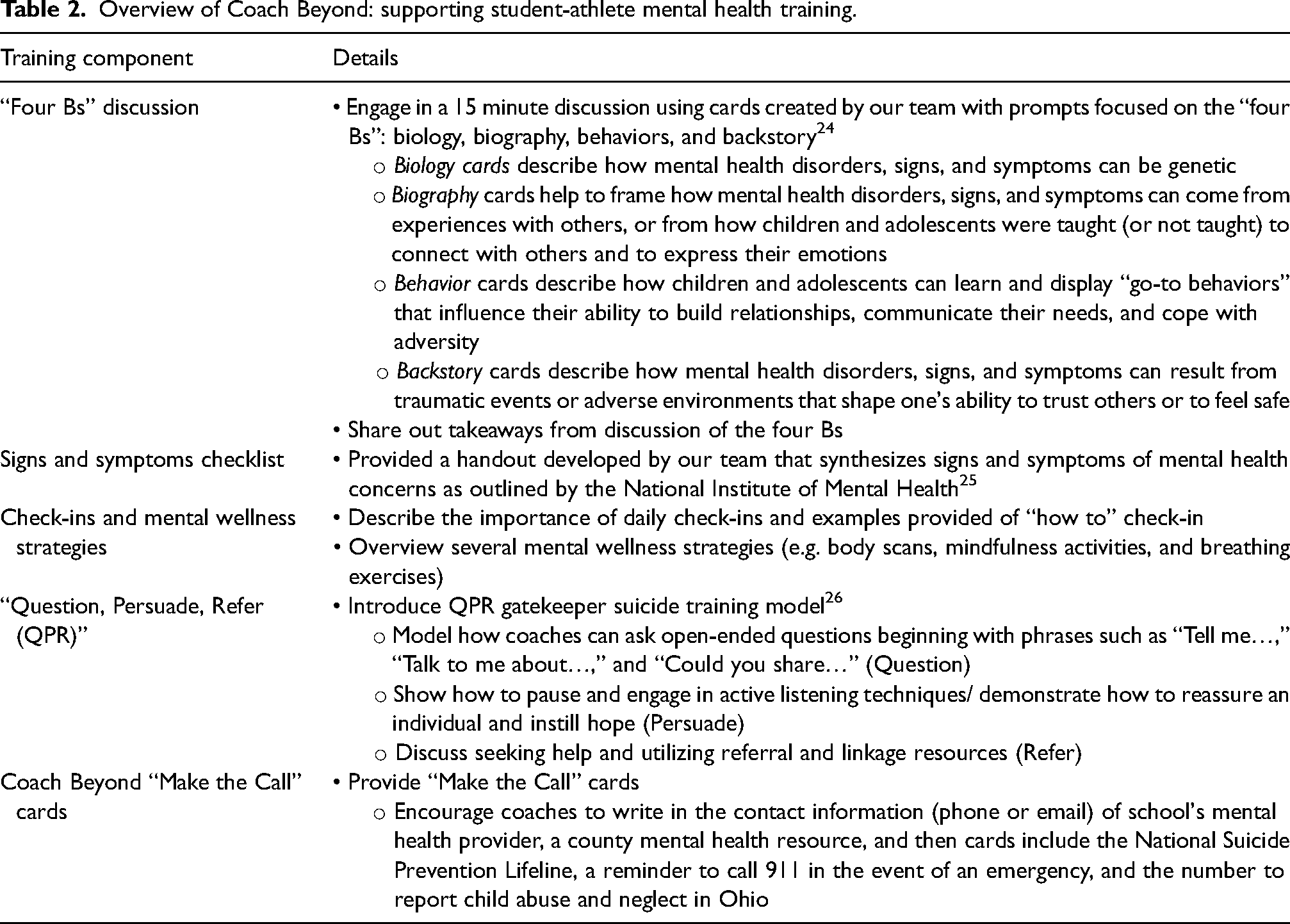
To achieve these learning objectives, we developed five components using evidence-based literature/peer-reviewed articles, numerous learnings from our intervention and research processes, and feedback and ideas from our state team. For instance, state team members recommended starting the training with a discussion to increase buy-in. University researchers then created a discussion card deck with prompts grounded in the literature related to adolescent mental health. The card deck was then piloted first with our state team and modified for use in subsequent pilot sessions. Table 3 describes the components of the mental health training program.
Learning outcomes (N = 147).
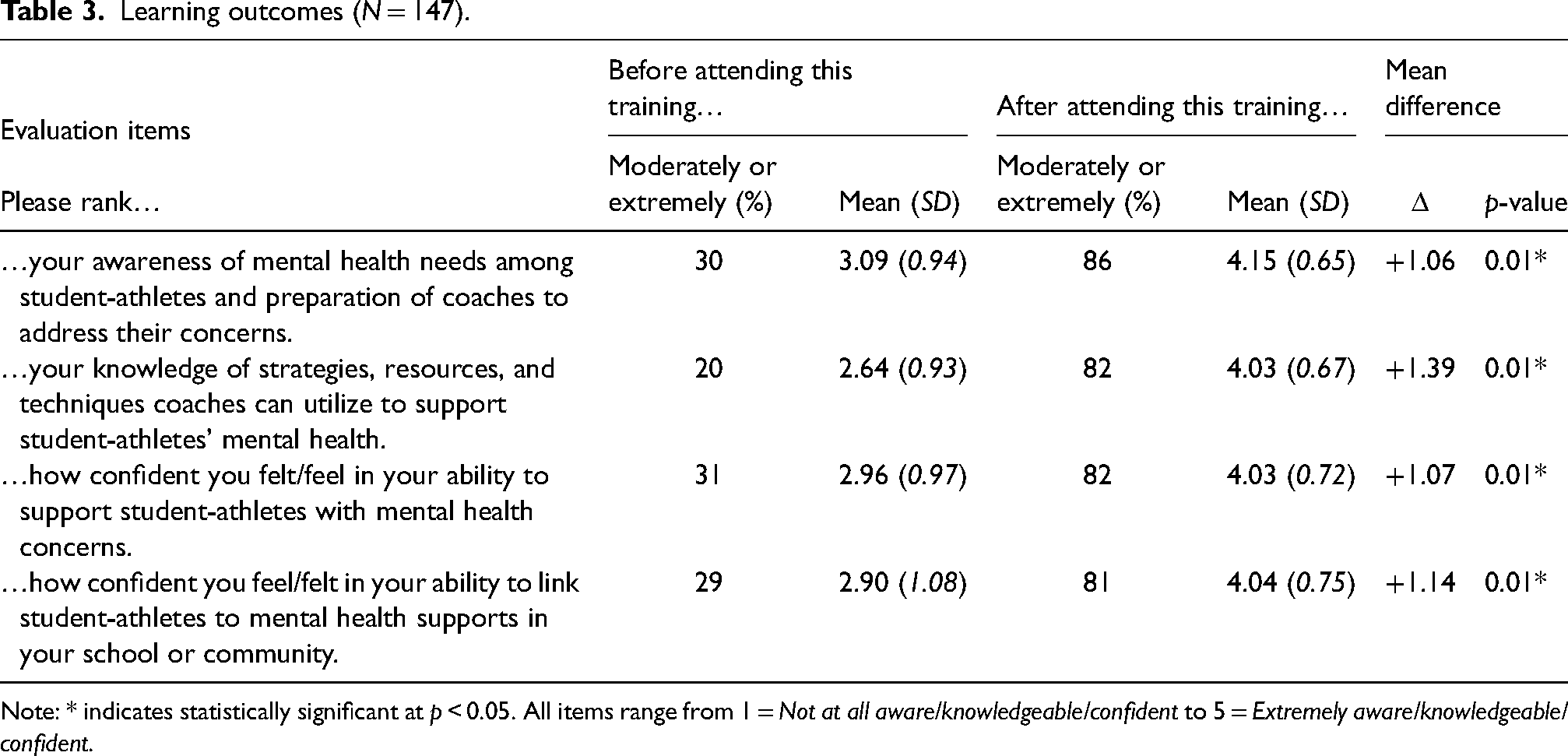
Note: * indicates statistically significant at p < 0.05. All items range from 1 = Not at all aware/knowledgeable/confident to 5 = Extremely aware/knowledgeable/confident.
Intervention pilots
Two phases of piloting the intervention followed the initial training development phase. In spring 2021, two licensed independent social workers who were also members of the Alliance of Social Workers in Sport (e.g. those with advanced knowledge, skills, and competencies in mental health prevention and intervention) piloted the training with coaches in two partner school districts. Our team gathered initial responses and feedback about the training content and delivery during this phase. Additionally, state team members who were athletic directors at the two pilot sites provided feedback about improving the training. Guided by this feedback, the training was modified and adapted to offer more concise and relevant examples. Then, facilitators conducted six additional training pilots. All six training programs occurred in the fall of 2022 and spring 2023. Facilitators conducted the first training at a large sport association meeting of high school coaches and athletic directors. The other five pilots took place at local Ohio high schools, where coaches were invited to attend by their local athletic directors who sat on our state team.
Intervention evaluation
We worked with our state team to create a brief retrospective pre–post-test evaluation survey to assess the training's four learning objectives, similar to how coaches and athletic directors on our state team would evaluate a professional development activity or training in their local schools. The goal was to create a brief tool that an athletic director could implement and analyze quickly (e.g. low time investment, shows the influence of training for community/school leaders, could be reported to continuing education offices, etc.). Our team created four questions with different stems (i.e. “Before attending this training…” or “After attending this training…”). All items were measured on a 5-point Likert scale ranging from 1 (not at all knowledgeable/aware/confident) to 5 (extremely knowledgeable/aware/confident). The evaluation tool also included one open-ended response question: “What is one thing you learned from the session that you will use in the future?”
Of the 147 participants who completed the training evaluation survey via a QR code, 71% of coaches and athletic directors identified as male and 29% as female. A majority of the participants identified as White (85%), followed by Black/African American (14%) and Hispanic/Latino (1%). Participants reported coaching for an average of 12 years (SD = 8.52). Participants’ primary sports coached included basketball (12%), track and field (11%), soccer (10%), swimming and diving (8%), field hockey (8%), baseball (7%), and football (5%). All other sports represented less than 5% of the sample. University researchers analyzed the evaluation results of the pilots first using nonparametric tests of difference (Wilcoxon test) with statistical significance set at p < 0.05. If nonparametric results demonstrated significant differences, researchers then utilized paired sample t-tests to examine differences in mean scores and validated the nonparametric results. In addition, researchers analyzed open-ended questions using conventional content analysis. 27 Two research team members independently read the data repeatedly to establish familiarity, and then, each researcher manually developed initial codes for each question.
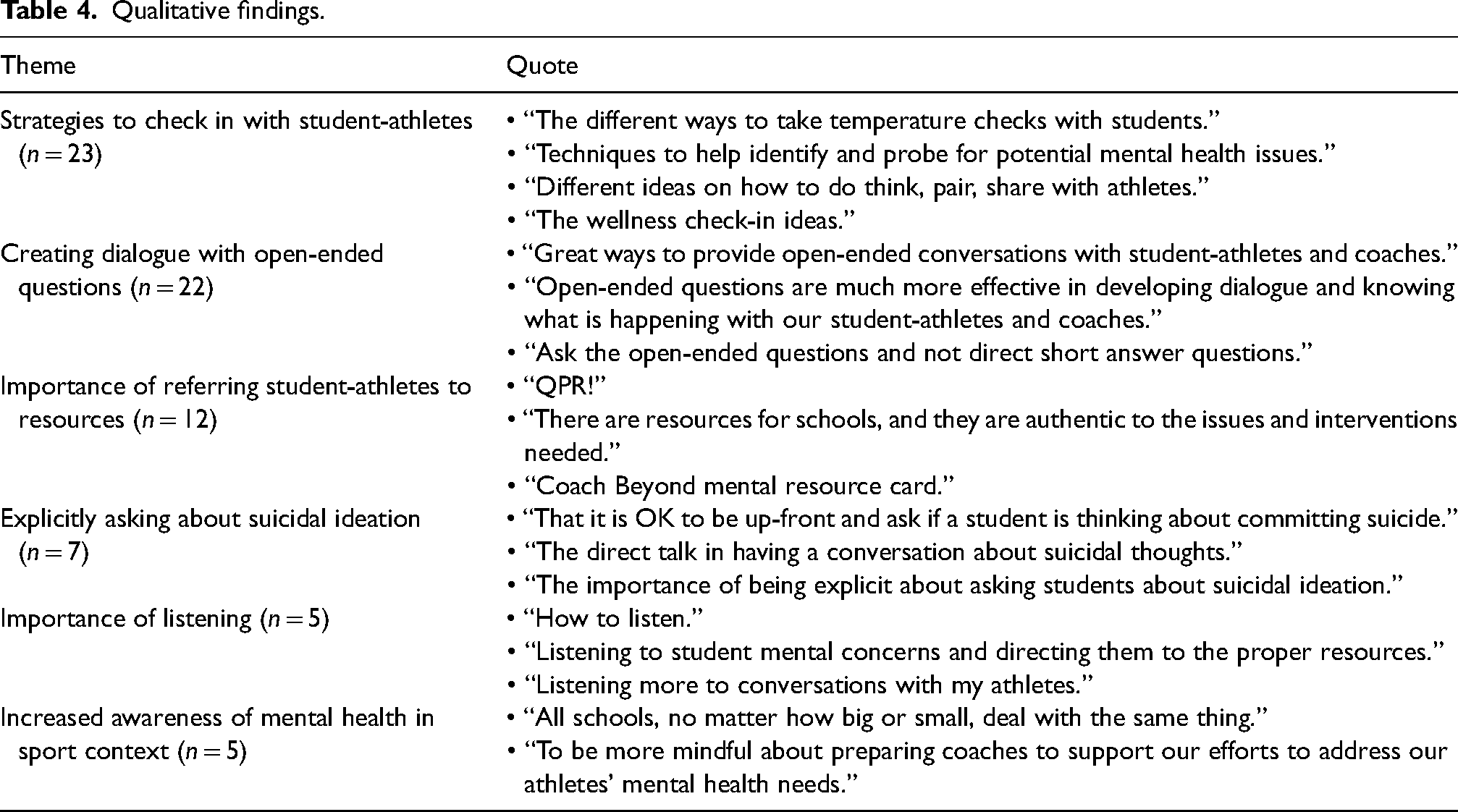
Ultimately, coaches and athletic directors who participated in the pilots reported significant improvements in their perceived knowledge, awareness, and efficacy (such as confidence in their abilities) with regard to the four learning objectives (see Table 3). Qualitative data demonstrated that coaches had several key takeaways and learnings from the training (see Table 4). While not the sole focus of our study, evaluation findings supported the development of a culture-centered intervention, a high level of partnership synergy, and the use of appropriate research designs to facilitate bidirectional translation, implementation, and dissemination of our collaborative work 13 (see Table 1). Athletic directors at each pilot location were given site-specific evaluation results to provide back to community members to demonstrate the local influence of this training on coaches in their schools and districts.
Qualitative findings.
Intermediate outcomes
Policy environment
From a CBPR perspective, our evaluation results have provided opportunities for discussions and continuous improvement of training, public outreach, and communication mechanisms. Our state team, for instance, has used the findings to continue to build buy-in and awareness across the state, including presenting at statewide superintendent meetings, regional coaching associations, and other membership groups. This work and other coinciding efforts in our state have led to significant changes in our statewide policy environment regarding coach training and education. In July 2023, Ohio passed a House Bill that mandated mental health training for school-based coaches. 28 This policy shift has increased demand for our mental health training program and led to the evolution of providing the training in multiple formats. We took our co-developed content and built an entirely online asynchronous version to complement in-person training options. While governance and roll-out of this policy change are ongoing, our work superseded the House Bill and supported Ohio becoming one of the first states to mandate mental health training for school-based coaches.
Empowerment/sustained partnership
Our work continues to leverage the expertise of coaches and athletic directors to recalibrate sport and improve coach education and training. Several members of our state team and coaches have become trainers and implemented the intervention locally and across the state, demonstrating the power-shifting mechanisms and deep participation embedded in this collective work. 19 In this regard, community members are leading the training's delivery, implementation, and evaluation, demonstrating their ownership and engagement. Since our initial pilots, our team has delivered over 35 community-based, in-person training programs reaching over 4000 coaches in Ohio, and we continue to reach over 74,000 coaches on the OHSAA listserv with our communication and outreach efforts.
Cultural reinforcement/revitalization
Our audit, needs assessment, training program, and evaluation outputs have provided support for shifts in legislation regarding coach education, and our state team is now involved in advocacy efforts to reduce redundancy in our current coach training requirements and to integrate mental health content that is free and accessible to avoid making this “one more thing” required of our coaches statewide. State leaders and legislators are also using our work to look at how the state is leveraging sport as a context to support child and adolescent mental health. Further, a collaborative of sport leaders has utilized our data to guide the initial phases of establishing the Central Ohio Youth Sport Collaborative, modeled after Philadelphia's Youth Sport Collaborative, and to develop a subcommittee within the OHSAA focused on improving environmental issues in high school sport (e.g. coach preparation, fan behavior, student-athlete safety, and parent/caregiver boundaries). These innovations have revitalized how our state thinks about the role of sport in achieving positive health outcomes for children and adolescents.
Individual and organizational capacity
Our work has empowered several communities and school districts to conduct their own needs assessments, develop local strategies to strengthen coaching education and training, or fund new initiatives regarding student-athlete mental health. Partner districts have combined our training efforts with sessions for coaches and student-athletes to discuss topics such as mental health, leadership, and stress and pressure. Several districts saw value in bringing more voices to the table locally so parents/caregivers, coaches, athletic directors, and student-athletes can discuss and reflect on environmental and interpersonal strategies that support student-athlete mental health. From a capacity lens, several district leaders also set expectations for coaches to support student-athlete mental health by including this domain in their coaching evaluations at the end of the seasons. The goal is to assess coaches’ application and utilization of skills from the mental health training and use the evaluation to provide feedback and encourage continued learning.
Research productivity
Our collective work has contributed to numerous research outputs, including a statewide report on the needs of Ohio coaches 8 and multiple regional and district reports to contextualize specific needs and interests. Furthermore, university researchers were approached to lead the first-ever US National Coach Survey modeled off of the work in Ohio to assess the landscape of coach education and training in the US. 6 Several grant opportunities also emerged, including a project with a local school district to train coaches, student-athletes, and parents/caregivers on mental wellness practices. In addition, Coach Beyond now has a webpage comprising research reports, coaching best practices and resources, training materials, and webinars available to coaches nationally. Other research studies related to this work are ongoing, including developing curricula for student-athletes known as the “Life and Leadership Through Sport Series.” These intermediate outcomes are tied to our CBPR approach and continue to shape the landscape of coach education and training in Ohio (see Table 1).
Discussion
This article summarizes the results of a CBPR study that outlines the decision-making processes that informed the co-development, implementation, and evaluation of a mental health training program for high school sport coaches and athletic directors and supported policy changes in Ohio. Our CBPR approach engaged community members on our state team, including researchers, sport association leaders, coaches, and athletic directors, at each step of the research process: defining our first steps, gathering needs assessment data, providing feedback on a potential intervention to address a need and gap in training, and serving as the pilot sample for this training. 14 In addition, our state team evaluated the training, shared the findings with the community, continued building awareness across the state, and advocated for more resources and support to advance this work. As a result of these collective efforts, a public health campaign designed to improve coach education and training to “coach beyond” was launched to meet the current needs of coaches and to support student-athletes participating in high school athletics. Our state team primarily focused on co-learning and building capacity among partners to integrate and cultivate a balance between knowledge co-generation, power shifting, reflexivity, and the development of an intervention that would mutually benefit all partners.13,19,29 Together, these efforts helped generate momentum to mandate mental health trainings for coaches in Ohio.
Our learnings from this CBPR project in the state of Ohio are vast. Central to this work was our focus on local relevance and on capturing numerous ecological perspectives at the policy level (audit of coach education and training requirements in Ohio), at the athletic director and coach level (rigorous statewide needs assessment on training needs and interests), and at the student-athlete level (focus groups to elevate their voices and experiences). This partnership structure has the potential to inform future coach training programs and models how to “build the table” to engage coaches in the training development process. One critical step in the CBPR process that facilitated our work was involving partners in cyclical and iterative processes in which feedback and new ideas were encouraged. Refinement of the needs assessment and intervention were improved based on this study's collaborative and iterative nature and the dissemination of all learnings across partners. Because coaches and athletic directors were involved in the process and meetings were scheduled every 8–10 weeks, they were more likely to share the survey and want to pilot the intervention at events that would reach a large number of coaches and athletic directors. Meetings were also time to network with other sport leaders and gain perspective on challenges and supports within other regions.
Our CBPR approach allowed for ownership of our public health initiative and intervention development by leveraging community members actively engaged in the settings where the intervention will be implemented.20,30 Consistent with this prior research, coaches informed all of the components of this public awareness campaign, shared strategies through vignettes, and elevated the voices of student-athletes that not only aided in successfully piloting this intervention but also created a sense of readiness and urgency. These aspects of our training development process also provide a pathway for other leaders, practitioners, and researchers to advance educational and training efforts at the intersection of coaching, sports, and mental health. Additionally, beyond our focus on mental health, our state team uncovered additional topics and areas where coaches needed support and training, such as coping with coach stress and pressures, supporting positive behaviors, and fostering a positive team environment, revealing a need to co-construct more training. Having worked collaboratively on the mental health training, our state team is bought in and ready to address additional gaps and continue our capacity-building efforts.
Furthermore, our current training is for school-based coaches, where there is some degree of local control to engage coaches in this type of training due to their connection to a school. However, our needs assessment revealed a need to support community-based coaches, requiring more outreach and community collaboration in youth sports to advance our training efforts. Our state team members continue to advocate that youth frequently stop playing sports before high school, and we need to empower coaches to retain youth and buffer risks for mental health symptomology, unhealthy lifestyles, and social isolation later in life. Our collaborative wants to build readiness to “coach beyond” sooner, demonstrating how innovations in one sector of sport (e.g. high school) can translate to other sectors (e.g. club, recreation, and developmental).
Limitations
Throughout our project, a continual process of planning, engaging, executing, developing, and evaluating progress led to improvements and content relevant to the needs of coaches and athletic directors. However, our work has several limitations. First, while a needs assessment and an evaluation tool were co-developed, our work did not use solely valid and reliable measurement tools. In the future, the mental health training program and intervention can be evaluated using valid and reliable measures, and researchers can examine the psychometrics of the needs assessment to contribute to future constructs with ecological validity in the coaching literature. We also may have increased our risk for Type I errors by running four t-tests to assess changes in perceptions and outcomes associated with the pilot mental health training programs. Second, our study does not focus on long-term outcomes such as behavior changes and indicators of equity in help-seeking among student-athletes. In the future, scholars can examine whether and to what extent different elements of the CBPR process influenced coaching behaviors and health outcomes among athletes more broadly. Perhaps, a needs assessment at the end of the three-year grant cycle would help contextualize this work's influence across the state and within the coaching profession. Finally, university researchers are authors of this work and hold inherent biases in describing our processes and outcomes. However, our state team members are also authors and validated our descriptions of our collective actions and helped edit, revise, and finalize the findings from the study reported here.
Conclusion
CBPR values equitable collaborations between community members and academic partners, reflecting shared decision-making throughout the research process. Our work is promising in that research studies at the intersection of sport and coaching education can be more relevant, ecologically valid, and effective if community members are involved, step by step, in developing and informing the research agenda and development of the intervention. 16 Our work describes how university researchers, leaders of state governing bodies (OHSAA), and high school sport leaders (school administrators, coaches, and athletic directors) can come together as a collective to build coach capacities and influence public policy. Given the rise in adolescent mental health needs across the US, particularly among high school student-athletes, multifaceted approaches like ours to develop effective training programs for coaches are needed now more than ever. Our work has highlighted several processes that can inform coach training development programs, ensure greater reach, and facilitate transformative action and social change in sport.
Footnotes
Declaration of conflicting interests
The authors declared no potential conflicts of interest with respect to the research, authorship, and/or publication of this article.
Funding
The authors disclosed receipt of the following financial support for the research, authorship, and/or publication of this article: The research reported here was supported by the Susan Crown Exchange as a part of the Million Coach Challenge Grant. This article was made possible, in part, by the support of the sport leaders in the following Ohio school districts: Akron, Canal Winchester, Dublin, Elgin, Granville, Hilliard, Logan-Hocking, Mansfield, Newark, North Union, Princeton, and Wheelersburg.
