







Abstract
The current study analysed Key Performance Indicators (KPIs) specific to high-performing female futsal players using univariate and multivariate statistical approaches to better understand team dynamics in conjunction with individual performance. Data were collected from a sample of 10 female futsal players (mean age: 23.9 ± 3.4 years) over 25 official matches of the Spanish first division. Twenty KPIs were selected in collaboration with coaches and researchers to represent diverse offensive and defensive aspects of play. This study used observational methods and principal component analysis (PCA) to reduce the dimensionality of data and determine key performance factors. Descriptive statistics and factor analysis were conducted, with Kaiser-Meyer-Olkin (KMO = 0.63) values and communalities evaluated for sampling adequacy. PCA shown two main components explaining 64.09% of the total variance. The first component, “Aggressiveness in Attack”, (47.02% variance), was strongly associated with offensive production, including high rates of goal plays, shots, goals, assists, and fouls received. The second component, “Forceful Defence” (17.07% variance), primarily reflected defensive effectiveness, characterized by high rates of successful disputes, ball recoveries, and defensive intensity indicators, along with fewer ball losses. Individual player profiles revealed distinct tactical roles, with some players showing strong tendencies toward either offensive or defensive abilities. In conclusion, the use of multivariate analyses provides valuable insights into the performance of women's futsal, offering practical implications for coaches and players seeking to improve strategies and enhance individual and team performance through data-informed training and tactical planning.
Introduction
Performance analysis in team sports has evolved significantly over recent decades, with Key Performance Indicators (KPIs) emerging as crucial metrics for evaluating athletic success. 1 These indicators, defined as the selection and combination of variables that describe specific aspects of performance, serve as quantifiable measures contributing to sporting success. 2 This connection arises because KPIs typically represent specific actions or outcomes identified through research or expert consensus as being strongly linked to successful results. By breaking down overall success into these measurable components, KPIs enable coaches and analysts to objectively evaluate performance, identify strengths and weaknesses, and focus training and tactical adjustments on critical areas to increase the probability of achieving team goals. Collectively, these monitored KPIs form a ‘performance profile'—a comprehensive summary of an athlete's or team's abilities and actions across relevant metrics. 3 Such profiles provide a snapshot of performance patterns, often encompassing technical, tactical, and/or physical aspects, offering valuable insights for comparison and development. However, the data underlying these profiles presents methodological challenges that can impede coaches’ and athletes’ understanding of performance dynamics. 4 Overcoming these methodological challenges is crucial, as a rigorous evaluation of KPIs provides coaches and analysts with indispensable objective information. This information allows for the optimization of training planning, supports the development of game strategies, and facilitates informed tactical decision-making at both the individual and team level.
A primary challenge lies in the statistical approaches used to analyse performance data.5,6 Traditional univariate statistics, while valuable for understanding isolated variables, 7 may oversimplify the complex interactions inherent in team sports. Conversely, multivariate statistical methods offer a more comprehensive framework for analysing the multiple interdependent variables that influence match outcomes.8,9 This methodological distinction becomes particularly relevant in futsal, where performance depends on the intricate interplay of technical, tactical, and physical elements.10,11
Women's futsal has experienced exponential growth in recent decades, reaching high levels of professionalization and competitive demand. It is characterized as a dynamic sport with complex technical-tactical interactions that require specific analyses to optimize performance. However, despite its growing popularity in women's futsal specifically, research employing sophisticated statistical analyses remains limited. Only a previous study has examined team-level KPIs using univariate statistics, specifically employing two-way ANOVA to analyse differences across competition groups and final rankings. 12 Their study categorized 50 variables into three conceptual domains: points and fouls, attack, and defence. However, this univariate approach, while informative, may not fully capture the multidimensional nature of team sports performance.13,14 This approach, while valuable, offers only a partial view, and the literature notably lacks studies that delve into the interrelationships of technical-tactical indicators using more advanced methods in the female context.
Principal Component Analysis (PCA) has emerged as a powerful tool for addressing the complexity of performance data, reducing dimensionality and identifying key underlying factors (i.e., latent constructs summarizing patterns among observed technical-tactical KPIs). 15 In the context of women's futsal, its application has shown promise, particularly in the analysis of external physical load indicators from training and matches. For instance, Rico-González et al. 16 analysed numerous variables derived from training tasks, identifying five to seven principal components that explained a significant portion (65–75%) of the variance in external physical training load. Similarly, Oliva-Lozano et al. 11 employed sophisticated analyses to examine key external (and internal) physical load variables in professional female players across a season, contributing to a better understanding of physical demands. These studies underscore the utility of PCA for quantifying and managing player external physical load, aligning with broader research emphasizing load monitoring in team sports. 17
Despite these advances, a comprehensive assessment combining both univariate and multivariate approaches to examine technical and tactical KPIs in women's futsal remains absent from the literature. 10 This gap is particularly significant given the sport's growing professionalization and the increasing emphasis on evidence-based performance optimization strategies. 18 Therefore, this study aimed to describe and analyse KPIs in competition for high-performance female futsal players using multivariate statistical techniques (PCA and factor analysis). We hypothesized that PCA would identify distinct offensive and defensive performance factors explaining more than 60% of the variance in player performance, and that individual player profiles would demonstrate significant variations in their loading on these factors, reflecting specialized team roles.
Methods
Design
This research followed an observational methodology design with systematic observation of competitive matches. 19 The design was nomothetic (multiple players), follow-up (25 official matches during the 2020/2021 season), and multidimensional (20 performance indicators), which provided a comprehensive framework for analysing individual performance in a natural competitive environment. 2 This methodological approach has been previously used for assessing technical and tactical performance in futsal, 10 ensuring both the precision of the data collection and the ecological validity of the competitive context.
Participants
The study sample comprised 10 elite-level female futsal players (age: 23.9 ± 3.4 years, height: 165.7 ± 3.9 cm, body mass: 59.7 ± 4.9 kg) participating in the Primera RFEF Futsal Femenina (Spanish first division) during the 2020/2021 season. The team is an established participant in the top division, consistently competing in the upper mid-table of the league standings. All female players were professional athletes with at least five years of experience in elite futsal. Data were collected across 25 official matches, representing 60.97% of the regular season. Players participated in an average of 20.4 ± 1.5 matches throughout the season, with a minimum requirement of 15 matches for inclusion in the study. Goalkeepers were excluded from the analysis due to their distinct tactical roles and performance patterns compared to outfield players. 10
Following the Declaration of Helsinki guidelines and to ensure participant confidentiality, all performance data were anonymized prior to statistical analysis. 20 Since the study involved assessment of routine performance data from adult professional athletes, and all data were anonymized, the requirement for written informed consent was waived. The study protocol was approved by the Ethics Committee of the University of Murcia (approval number: 3180/2020).
Key performance indicators
The selection of Key Performance Indicators (KPIs) followed a systematic two-phase process. Initially, the research team developed a comprehensive list of 28 potential KPIs based on an extensive literature review of performance analysis in futsal. 10 This preliminary list was then subjected to expert evaluation by two professional futsal coaches (holding the highest national coaching qualification, RFEF Level III, and University degrees in Physical Activity and Sport Sciences), each with over 10 years of experience in elite women's futsal. The coaches independently reviewed the proposed indicators and selected 16 KPIs they deemed most relevant for assessing player performance in competitive matches.
Additionally, the coaches suggested the addition of four KPIs that were not originally considered by the researchers. The final framework consisted of 20 KPIs encompassing both offensive and defensive aspects of play: matches played (MP), Goals (G), Assists (A), Goal Plays (GP), Successful Opportunities of Goal (SOG), Percentage of Opportunities of Goal (%OG), Shots (S), Shots on Goal (SG), Fouls (F), fouls received (FR), Yellow Cards (YC), Completed Passes (CP), Percentage of Completed Passes (%CP), Percentage of Completed Passes of Goal (%CPG), Losses balls (LB), Losses in Own Field (LOW), Ball Recovered (BR), Recoveries in Rival Field (RRF), Disputes (D), and Percentage of Disputes Won (%DW). Detailed definitions for replication purposes are available in Supplementary Material 1.
Data collection
Data collection followed a systematic observational methodology adhering to standardized match evaluation protocols. 19 All matches were recorded using a 4 K video camera (25 Hz) positioned at a central location between 3 and 7 meters above the playing surface, ensuring a complete view of the court and all player movements. Match footage was analysed using LongoMatch software (version 2020, Fluendo, Barcelona, Spain) to facilitate systematic coding of performance indicators.
A qualified observer, holding a University degree in Physical Activity and Sport Sciences and with more than 10 years of experience in high-performance futsal analysis conducted the primary data coding. To ensure observational reliability, three matches (12% of the total sample) were independently coded by two additional researchers. Inter-observer reliability was assessed using the Interclass Correlation Coefficient (ICC), with a minimum acceptable threshold of 0.75. 21
Statistical analysis
The study employed an exploratory factor analysis using PCA with orthogonal rotation (varimax) following Rojas-Valverde et al. 15 recommendations. This approach identified the highest loading factors for correlations between performance indicators and each extracted factor, while also yielding performance values related to match outcomes. The Kaiser-Meyer-Olkin measure and communalities values after extraction were used to assess sampling adequacy.22,23 Bartlett's test of sphericity assessed the adequacy of correlations between items.
Factor retention was determined using Kaiser's criterion of 1 and scree plot interpretation. 24 Performance indicators with factor loadings greater than |0.5| were considered to show strong positive or negative correlations, indicating substantial value for factor interpretation. 25 Additionally, to explore whether the identified overall performance patterns differentiated between match outcomes, a Linear Discriminant Analysis (LDA) was conducted. Match result, categorized as win or loss (n = 24 matches, excluding n = 1 draw), was used as the grouping variable. The standardized factor scores from the two principal components (Aggressiveness in Attack and Forceful Defence) obtained from the prior PCA were entered as predictor variables. The statistical significance of the overall discriminant function was assessed using Wilks’ Lambda test. Standardized canonical discriminant function coefficients were examined to evaluate the relative contribution of each component to group separation, and the model's correct classification percentage was calculated using leave-one-out cross-validation. An alpha level of p < 0.05 was set for all inferential tests. All statistical analyses were conducted using Statistical Package for Social Science (SPSS version 26.6, SPSS Inc., Chicago, IL, USA).
Results
Descriptive analysis indicated that players participated in an average of 20.4 ± 1.50 matches throughout the season (Table 1). Table 1 presents descriptive statistics for the 10 players; note that Mean (M) and Standard Deviation (SD) values reported for absolute count KPIs (e.g., Goals, Assists, Shots, Recoveries) represent the mean and standard deviation of the total values accumulated per player across their analysed matches. Offensive performance indicators showed players accumulated an average total of 6.7 ± 3.3 goals (G) and an average total of 4.8 ± 3.1 assists (A) over the season's analysed matches. The average shot-to-goal conversion rate (%OC) was 0.29 ± 0.15. Ball possession metrics indicated high technical proficiency, with an average pass completion rate (%CP) of 0.81 ± 0.03, and players won an average of 73.0 ± 26.2% of their disputes (%DW). On average, players lost the ball (LB) 119.6 ± 30.6 times in total and recovered the ball (BR) 73.0 ± 26.2 times in total, with approximately 25% of total recoveries per player (average total of 31.9 ± 9.8 recoveries per player) occurring in the opponent's half (RRF) (Table 1).
Descriptive statistics of performance indicators for 10 elite women's futsal players during the analysed matches.
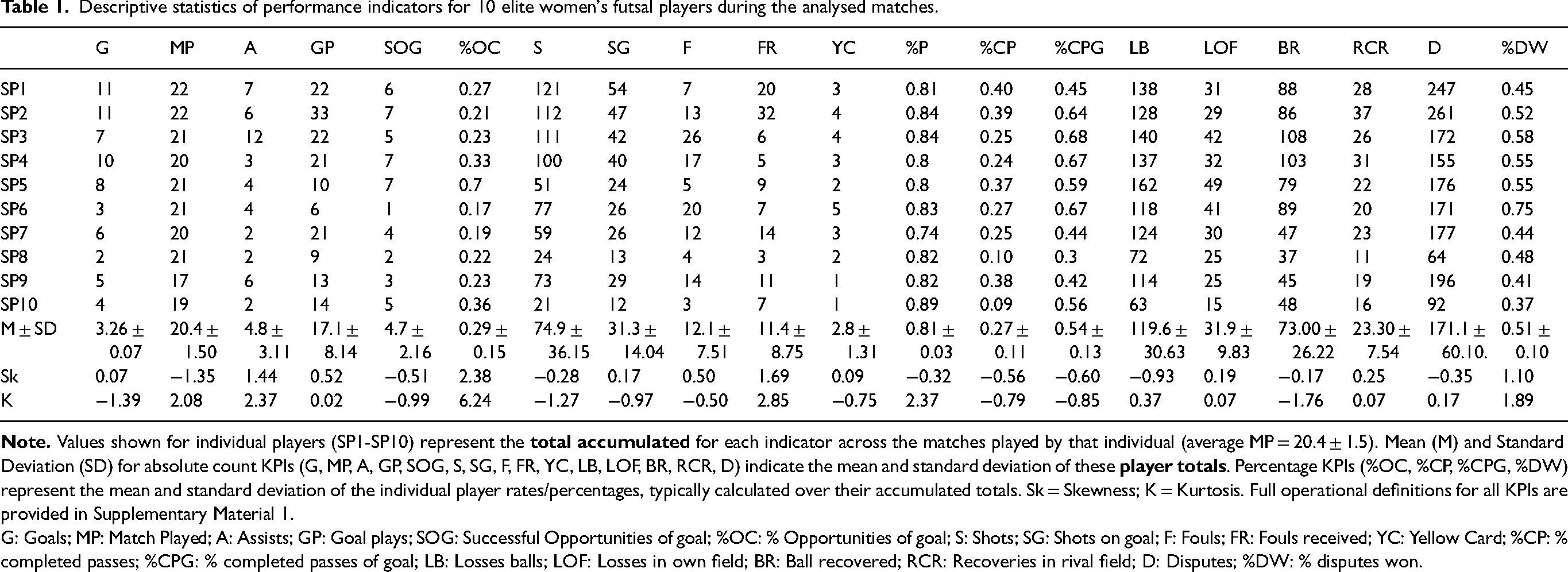
G: Goals; MP: Match Played; A: Assists; GP: Goal plays; SOG: Successful Opportunities of goal; %OC: % Opportunities of goal; S: Shots; SG: Shots on goal; F: Fouls; FR: Fouls received; YC: Yellow Card; %CP: % completed passes; %CPG: % completed passes of goal; LB: Losses balls; LOF: Losses in own field; BR: Ball recovered; RCR: Recoveries in rival field; D: Disputes; %DW: % disputes won.
Principal Component Analysis yielded two significant factors that collectively explained 64.09% of the total performance variance. The sampling adequacy was confirmed by a Kaiser-Meyer-Olkin value of 0.63, with communalities exceeding 0.7 for 17 of the 20 performance indicators. Factor 1, Aggressiveness in Attack, accounted for 47.02% of the variance, while Factor 2, Forceful Defence, explained 17.07%. The Factor Scores Matrix using Bartlett's Method demonstrated sufficiently large correlations for each factor [Factor 1 (p = 0.03) and Factor 2 (p = 0.04)], confirming the statistical significance of both extracted components.
The rotated component matrix (Supplement 3; visually represented in Figure 1) shown the distinct structure of the two factors based on the variable loadings. Factor 1 (Aggressiveness in Attack) indicated strong positive loadings for key offensive indicators, including Goal Plays (GP = 0.82), Successful Opportunities of Goal (SOG = 0.80), Goals (G = 0.78), Shots on Goal (SG = 0.77), Shots (S = 0.75), and Assists (A = 0.70). It also loaded positively on Fouls Received (FR = 0.65), Finalization Pass (FP = 0.58), % Opportunities of Goal (%OC = 0.55), and % Completed Passes of Goal (%CPG = 0.50). This pattern clearly indicates that Factor 1 represents a dimension of active offensive involvement, encompassing volume of actions, creation of chances, ability to draw fouls, and successful offensive production.
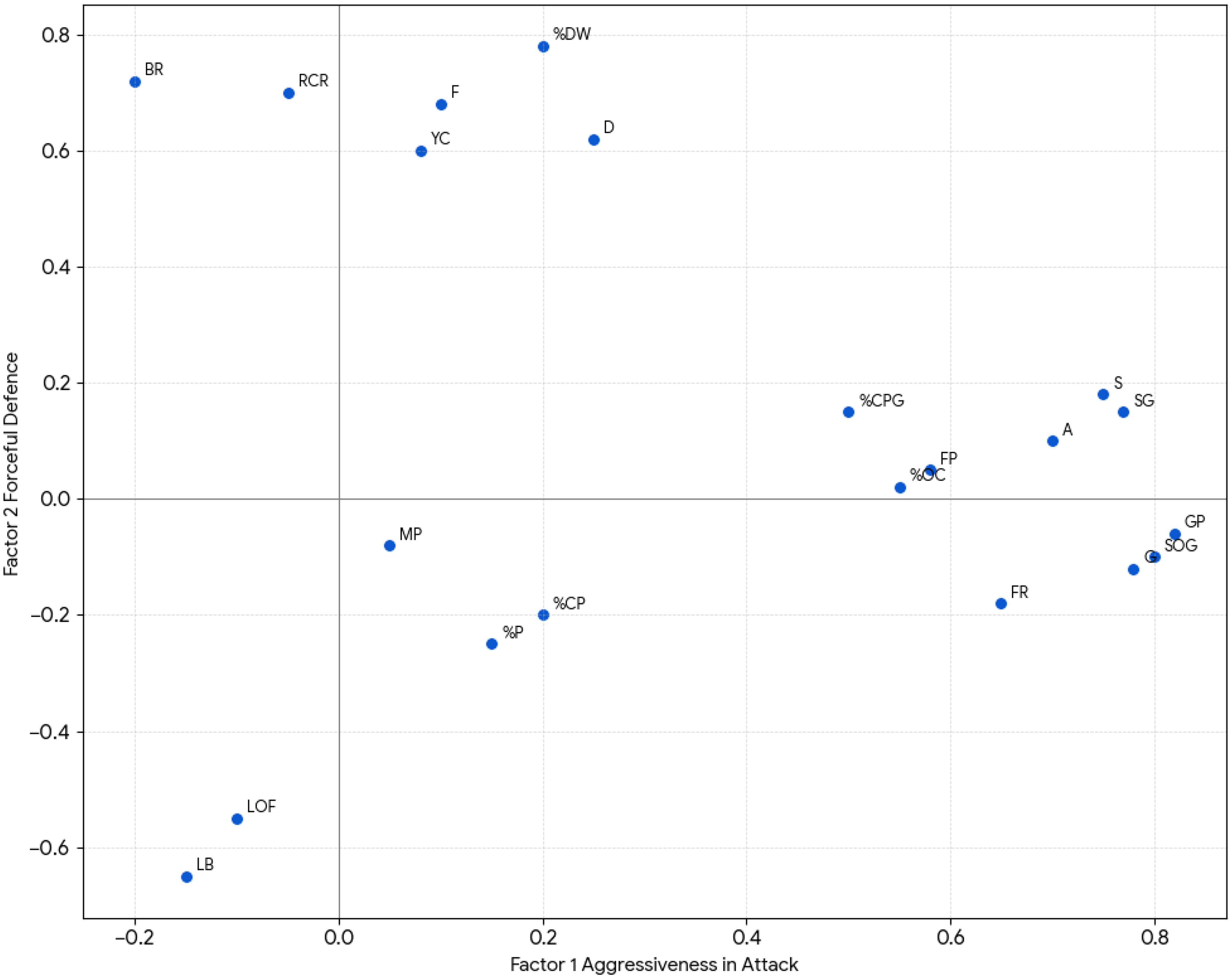
Factor loading distribution of Key Performance Indicators in elite women's futsal. Factor 1 represents Aggressiveness in Attack and Factor 2 represents Forceful Defence.
Factor 2 (Forceful Defence) was primarily defined by strong positive loadings on defensive success and intensity metrics, such as % Disputes Won (%DW = 0.78), Ball Recovered (BR = 0.72), Recoveries in Rival Field (RCR = 0.70), Fouls committed (F = 0.68), Disputes (D = 0.62), and Yellow Cards (YC = 0.60). Notably, this factor also showed strong negative loadings on error indicators: Losses Balls (LB = −0.65) and Losses in Own Field (LOF = −0.55). This pattern suggests Factor 2 represents effective and intense defensive activity, characterized by winning possession back, succeeding in duels, and maintaining defensive solidity by avoiding errors.
Examination of individual player profiles (Figure 2) revealed distinctive tactical tendencies. Players SP1 and SP2 exhibited stronger offensive characteristics aligned with Factor 1, particularly in goal-scoring opportunities and attacking plays. SP3 and SP5 showed higher associations with Factor 2, demonstrating proficiency in defensive actions and possession maintenance. Players SP4, SP6, and SP9 displayed more balanced profiles, contributing effectively to both offensive and defensive phases of play. This distribution of player profiles suggests a tactically balanced team structure with specialized roles in both attack and defence.
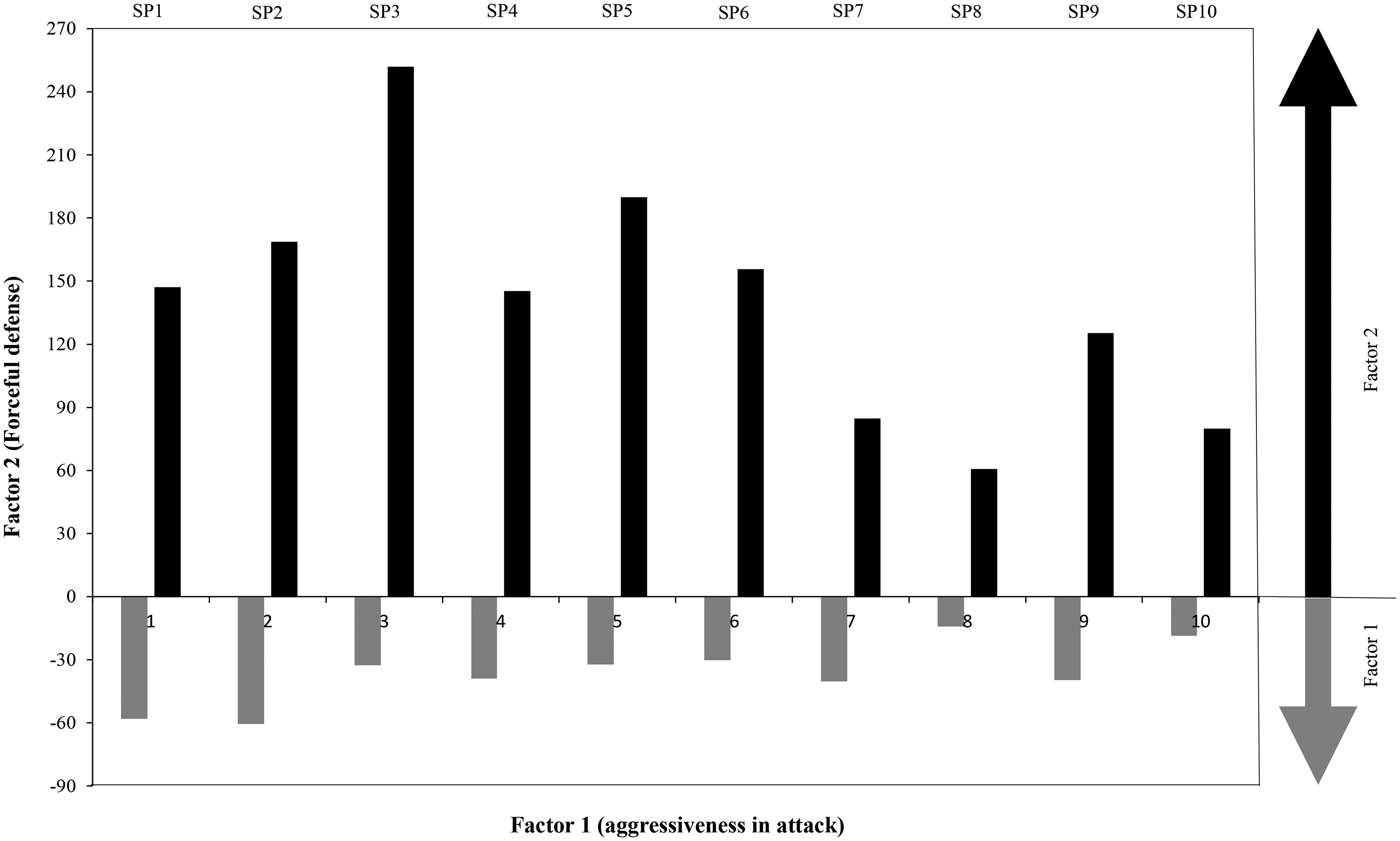
Individual player profiles based on Factor 1 (Aggressiveness in Attack) and Factor 2 (Forceful Defence) scores in elite women's futsal players (n = 10).
A Discriminant Analysis was performed to determine whether the factor scores of the two principal components (Aggressiveness in Attack and Forceful Defence) could differentiate between won (N = 20) and lost (N = 4) matches in the sample (N total = 24 matches, excluding 1 draw). Wilks’ Lambda indicated that the overall discriminant function was not statistically significant (Λ = 0.97, p = 0.45), suggesting the predictors did not significantly differentiate between the groups. The standardized canonical discriminant function coefficients were 0.25 for Component 1 and −0.15 for Component 2. Cross-validated classification analysis (leave-one-out) showed that the model correctly classified 58.3% of the original grouped cases, which is close to chance level (58.3%) and not indicative of predictive utility. Taken together, these results indicate that the two identified principal components do not significantly discriminate between win and loss outcomes in this cohort.
Discussion
The present study examined the performance of elite female futsal players based on an overall evaluation of Key Performance Indicators (KPIs) via univariate and multivariate statistical methods. The results identified two performance factors - Aggressiveness in Attack and Forceful Defence - which accounted for 64.09% of performance variance, confirming our hypothesis and following previous studies of performance factor identification in team sports.13,16,26
The descriptive analysis identified unique patterns in offensive performance, including the average of 3.26 goals and 4.8 assists per player, along with a 29% shot-to-goal conversion rate. These values are consistent with earlier findings by Santos et al. 27 who identified comparable offensive statistics in elite futsal competitions. The high proportion of completed passes (81%) in our study is similar to that reported for male elite futsal,28,29 and indicates a similar level of technical ability and that the level of technical implementation in women's futsal has reached a similar level. This result contradicts earlier expectations of gender-based performance disparities in futsal 10 and corroborates emerging evidence of convergence in technical ability across gender groups. 11
Aggressiveness in Attack emerged as the leading factor derived from the Principal Component Analysis, accounting for a substantial 47.02% of the total performance variance. This factor was strongly and positively defined by a wide range of offensive actions and outcomes, including Goal Plays (GP = 0.82), Successful Opportunities of Goal (SOG = 0.80), Goals (G = 0.78), Shots on Goal (SG = 0.77), Shots (S = 0.75), Assists (A = 0.70), and Fouls Received (FR = 0.65), along with moderate positive loadings on variables related to chance creation and conversion like Finalization Pass (FP = 0.58), % Opportunities of Goal (%OC = 0.55), and % Completed Passes of Goal (%CPG = 0.50). This clear pattern indicates that Aggressiveness in Attack represents high involvement and productivity in the offensive phase, encompassing the generation of scoring chances, shooting volume, successful execution (goals and assists), and the ability to provoke fouls from the opposition. The prominence of this factor aligns with previous research highlighting the critical role of offensive variables in determining futsal performance and match outcomes,28,30 while our findings quantify the combined contribution of these diverse offensive actions within a single performance dimension for elite women's futsal. From a practical standpoint, understanding this Aggressiveness in Attack dimension is crucial for coaches. It identifies players who most significantly drive offensive creation and finishing. Analysing the specific high-loading KPIs (such as GP, SOG, S, FR) during match observation can provide objective insights into a player's attacking impact beyond just goals scored. Furthermore, training drills can be tailored based on this factor, for instance, by focusing on improving decision-making and execution in goal plays (GP, SOG) or enhancing a player's ability to maintain possession under pressure to draw fouls (FR) if development in this offensive profile is desired.
The second dimension identified, Forceful Defence, explained 17.07% of the variance and demonstrated key aspects of defensive performance in this cohort. This factor was characterized by strong positive loadings on indicators of defensive success and intensity, namely % Disputes Won (%DW = 0.78), Ball Recovered (BR = 0.72), Recoveries in Rival Field (RCR = 0.70), Fouls committed (F = 0.68), Disputes (D = 0.62), and Yellow Cards (YC = 0.60). Equally important were the strong negative loadings on error indicators, specifically Losses Balls (LB = −0.65) and Losses in Own Field (LOF = −0.55). This combination suggests that Forceful Defence represents not just defensive intensity and activity (winning duels, committing necessary fouls, recovering the ball), but also defensive reliability and effectiveness in maintaining possession security. The emphasis on winning duels and recoveries aligns with findings on the importance of defensive pressure 30 and intense defensive tactics observed in modern futsal.31,32 Furthermore, the strong negative association with losing the ball suggests that effective, forceful defending in this context also involves playing securely and minimizing errors, potentially challenging classical views that might separate purely disruptive defensive actions from ball retention. 29 The practical relevance of the Forceful Defence factor lies in identifying players contributing most to defensive solidity and ball recovery. Coaches can use KPIs with high loadings on this factor (like %DW, BR, RCR, and importantly, LB, LOF) to monitor defensive effectiveness and reliability during competition. For instance, tracking dispute success rates or the frequency and location of ball losses can inform tactical adjustments. Training interventions can then specifically target improving 1-on-1 defending technique (%DW), anticipation skills for interceptions (BR, RCR), or secure ball handling and passing under pressure to minimize costly turnovers (negative LB, LOF).
Individual player profiles exhibited clear tactical specializations, corroborating emerging research on role-specific performance in team sports.8,16 Players SP1 and SP2 presented attacking orientations, whereas players SP3 and SP5 were defensively skilled. Such tactical variety is in accordance with modern tactical theories of the need for specialists in dynamic team shapes. 18 In addition, the presence of players with balanced profiles (SP4, SP6, SP9) is in accordance with recent research on the importance of tactical flexibility in current futsal. 11 It is important to highlight that the main objective of using PCA in this study was exploratory in nature: to reduce the dimensionality of the KPI set and identify key underlying performance constructs, rather than establishing causal links or modelling direct interactions between these components.
Our findings have several important implications for tactical preparation and training periodization. First, the strong association between defending and effective transitions suggests that training should emphasize the connection between these phases of play to align with recent research into integrated training approaches that simultaneously develop tactical, technical, and physical components in context-specific drills, as supported by recent research. 17 Second, the diverse player profiles recognized herein imply the necessity of position-specific training protocols with tactically flexible positioning, a result that supports current thinking regarding skill development in team sports. 33
The two factors’ complementary nature implies that team success in women's futsal depends on a balanced tactical organization approach. This result builds on the work of Villarejo-García et al. 12 and offers empirical validation of tactical periodization models focusing on the coupling of offensive and defensive aspects. The findings also point to the development of women's futsal in the direction of more complex tactical solutions, contradicting conventional assumptions regarding gender differences in tactical complexity. 10
In an effort to link performance patterns with competitive success, a discriminant analysis was performed to compare won and lost matches using the principal component scores. Contrary to expectations, we did not find statistically significant differences. This finding suggests that the general performance dimensions captured by the Aggressiveness in Attack and Forceful Defence components, while useful for describing the structure of performance, may not be sensitive enough on their own to explain competitive success in this sample of elite women's futsal. It is plausible that match outcome at this level depends on more complex interactions among multiple factors, on more specific KPIs not fully reflected in these general components, or is strongly influenced by situational variables (such as opponent quality or match status) that were identified as a limitation of this study. Therefore, although PCA provides a valuable framework for understanding performance structure, future research integrating a broader spectrum of variables (including situational ones and specific KPIs) is required to fully unravel the determinants of victory in elite women's futsal.
Finally, although this study provides valuable insights into women's futsal performance through a robust analytical approach combining univariate and multivariate methods, some limitations should be acknowledged. Our examination of 25 games from one season and concentration on 10 elite players from the Spanish first division can be complemented with longitudinal designs involving several seasons and teams to promote generalizability. Further research may extend our framework to address goalkeeper-specific metrics and incorporate physical performance data. Our successful PCA methodology could also be applied to investigate other domains of the game, for instance, the effect of situational variables on patterns of performance. The evident clarification of discrete player profiles and factors of performance provides a solid grounding for future investigation with complementary analytic methods.
Limitations and future directions
Furthermore, we acknowledge that the selection of the KPIs was based on expert consensus (coaches and researchers). While this method aimed to maximize ecological validity and applicability within the context of elite women's futsal, it may introduce potential subjective bias. Future research could complement this approach by applying objective feature selection methods, such as those based on machine learning, to validate and potentially refine the set of key performance indicators identified in this study. A second relevant limitation is that this study did not consider key situational variables that modulate performance. Factors such as opponent quality, match context (e.g., scoreline, time remaining), potential effects of player fatigue throughout the game, or the impact of substitution patterns, were not included in the analysis. Integrating these variables was beyond the objectives of this initial investigation focused on identifying principal components based on KPIs, but it represents an important direction for future studies seeking a more comprehensive and contextualized understanding of performance dynamics in elite women's futsal. Additionally, while we analysed individual player profiles based on the identified factors, this study did not incorporate playing position as a variable. Future research involving larger samples across multiple teams could benefit from categorizing players by position (e.g., pivot, wing, defender) to investigate potential relationships between tactical roles associated with positions and specific performance profiles. Finally, while PCA identified key performance components, this technique does not model the potential interrelationships between them (e.g., how offensive and defensive components might influence each other). Future research could complement these findings by utilizing techniques such as Structural Equation Modelling (SEM) to explore these complex interactions and develop a more integrated model of performance dynamics in elite women's futsal.
Conclusions and practical applications
This study provides important evidence regarding the performance of elite female futsal players by analysing 20 key performance indicators (KPIs) in 25 competitive matches. By applying descriptive statistics and principal component analysis (PCA), we identified two overarching factors —Aggressiveness in Attack and Forceful Defence—that together explain 64.09% of the performance variance. The Aggressiveness in Attack factor had a high correlation with offensive KPIs such as goals, goal plays, successful opportunities, and shots on goal, while the Forceful Defence factor correlated positively with defensive success and intensity metrics and negatively with ball losses, indicating defensive effectiveness and solidity. Player profiles revealed distinct tactical specializations, with some players showing clear offensive or defensive orientations, while others showed a more balanced tactical contribution approach. These findings validate the efficacy of multivariate analysis methods in assessing women's futsal performance and provide a framework for understanding the complex interactions between technical and tactical factors that influence match outcomes.
The findings from this study offer several potential practical applications for futsal coaches and trainers, providing objective information to support their decision-making processes. For instance, identifying how players align with the Aggressiveness in Attack and Forceful Defence factors can help inform strategic planning by highlighting individual strengths related to specific tactical roles. Training programs could be enhanced by incorporating drills targeting the development of attributes central to these factors, such as decision-making in goal plays (linked to F1) or anticipation for ball recovery (linked to F2). Furthermore, monitoring KPIs strongly associated with these factors may provide valuable data for tracking player development and identifying areas needing attention throughout the season. This analytical framework can also support youth development programs by offering clear metrics to potentially track player progression and help identify areas for targeted improvement. Finally, the insights gained could offer objective input to consider alongside other criteria in recruitment and tactical system design, aiming for a balanced team composition.
Supplemental Material
sj-docx-1-spo-10.1177_17479541251343609 - Supplemental material for Multivariate analysis of performance indicators in elite women's futsal: A principal component approach to understanding game dynamics
Supplemental material, sj-docx-1-spo-10.1177_17479541251343609 for Multivariate analysis of performance indicators in elite women's futsal: A principal component approach to understanding game dynamics by Diego H Villarejo-García, Daniel Puche-Ortuño, Carlos D Gómez-Carmona and José Pino-Ortega in International Journal of Sports Science & Coaching
Footnotes
Authors’ contributions
J.P-O and D.H.V-G conceptualized the study. C.D.G-C and D.P-O developed the methodology. C.D.G-C and D.H.V-G managed software implementation. J.P-O and D.H.V-G conducted formal analysis. C.D.G-C and D.P-O performed the investigation. C.D.G-C and D.H.V-G curated data. D.P-O and D.H.V-G prepared the original draft. C.D.G-C and J.P-O reviewed and edited the manuscript. D.H.V-G and D.P-O created visualizations. C.D.G-C and J.P-O supervised the project. J.P-O acquired funding. All authors have read and approved the final version of the manuscript
Declaration of conflicting interests
The authors declared no potential conflicts of interest with respect to the research, authorship, and/or publication of this article.
Funding
The authors received no financial support for the research, authorship, and/or publication of this article.
Ethical statement
The study protocol was approved by the Ethics Committee of the University of Murcia (protocol code: 3180/2020) and conducted in accordance with the Declaration of Helsinki for research involving human participants.
Data availability
Data supporting the findings of this study are available from the corresponding author upon reasonable request. Public data sharing is restricted under the Spanish Government's Organic Law 3/2018, of 5 December, on Personal Data Protection and Digital Rights Guarantee, which mandates secure data custody.

Supplemental material
Supplemental material for this article is available online.
References
Supplementary Material
Please find the following supplemental material available below.
For Open Access articles published under a Creative Commons License, all supplemental material carries the same license as the article it is associated with.
For non-Open Access articles published, all supplemental material carries a non-exclusive license, and permission requests for re-use of supplemental material or any part of supplemental material shall be sent directly to the copyright owner as specified in the copyright notice associated with the article.
