







Abstract
This manuscript examines the influence of different types of feedback provided by the coach during small-sided games (SSG) on players’ performance. Sixteen U-16 amateur, healthy, and well-trained soccer players (age: 15.28 ± 0.48 years) participated in this study, playing several 3-min 4v4 SSG under the following conditions: 1) Absence of a coach (AC), 2) presence of a coach (PC), 3) general verbal stimulation (VS) from the coach, 4) verbal stimulation with offensive instructions (VS_OF), and 5) verbal stimulation with defensive instructions (VS_DF). Six physical performance variables were recorded using GPS devices (Catapult Vector S7), and seven technical-tactical performance variables were recorded and evaluated through video. The statistical analysis showed how the coach's presence significantly affected the players’ perceived effort (RPE) (p < .001), regardless of the type of verbal feedback provided. Defensive verbal instructions significantly influenced the total distance traveled regarding control condition (p = .046), the total number of passes made (p = .039), and the number of successful passes (p = .044). Offensive verbal instructions significantly increased the total number of passes made by the players (p = .019). and the number of successful passes (p = .004).
Introduction
Football is a team sport that belongs to the group of socio-motor sports, characterized by collaboration and opposition between players in a common space, and simultaneous participation in dynamic and unpredictable situations. 1 It is an acyclic and intervallic sport in which there are numerous actions and interactions derived from the execution of technical-tactical skills and variations in speed within a determined time and space. 2 The sport's demands and the different types of efforts are directly related to the level of the players, the game model used by the team and the role or position that the player occupies on the field. 3
From a physiological point of view, the predominant system in football is aerobic, which is reflected in an average heart rate close to 85% of maximum and an oxygen consumption of approximately 70% of VO2max. 4 However, the key moments of the game rely heavily on anaerobic metabolism, as high-intensity actions require rapid energy production through phosphocreatine and anaerobic glycolysis. 5
In locomotor terms, football players cover between 10 and 13 km per match, with an intensity distribution that varies depending on the position and the team's playing model. 6 In a study with professional soccer players, 7 it was observed that during a match the players spent 38.9% of the time walking (0.1–6 km/h), 29.5% running at a low intensity (7- 12 km/h), 13.3% running between 13–16 km/h, 8.4% running between 16–19 km/h and 9.85% of the time sprinting ( > 19 km/h). In addition, the number of explosive actions varies according to field position, with midfielders covering the greatest total distance and forwards and wingers covering the most distance at high speed. 8
In order to improve locomotor performance, coaches use training methods such as small-sided games (SSG), which are motor-play situations used in football teaching and training, characterized by a small number of players, taking place in a small space and with rules adapted to the specific training objectives. 9 The use of SSG makes it possible to simulate match contexts, promote decision-making, develop technical skills and adapt to different physical and cognitive demands.10,11
The design of SSG involves the manipulation of different variables, known as task constraints, that affect player response and training effectiveness.
12
Among the most relevant are:
- Number of players: A smaller number of players increases the internal load, raising heart rate, blood lactate concentration and subjective perception of effort. It also encourages a greater number of individual technical-tactical actions, while a greater number of players favours collective interactions.
9
- Pitch area: The reduction of space generates a higher density of players and an increase in the frequency of interactions, leading to quick transitions and more direct play. On larger fields, there is a greater number of long possessions and a reduction in individual duels, with an increase in distance travelled at high speed.
13
- Goals and goalkeepers: The use of small goals or the absence of goalkeepers generates a greater physiological response and an increase in the number of individual offensive actions, such as drives and shots on goal. In addition, the distribution of multiple goals on the field modifies the tactical behaviour of players, increasing attention in defensive zones and favouring a greater number of finishes.
11
- Modification of the rules of the game: The introduction of specific rules, such as the limit of touches or the obligation to complete a certain number of passes before finishing, increases the cognitive load of the exercise. These restrictions affect both the physiological response and the decision-making of the player, generating specific technical-tactical adaptations.
14
- Training regimen: The duration of sets, recovery time and type of effort (continuous or intermittent) influence the physiological response of the player. Although there are no significant differences between the use of continuous or intermittent methods in terms of aerobic improvements, the combination of both approaches may be optimal for adaptation to match effort.
15
The load produced during the performance of a SSG or any other training task can be defined as the sum between the locomotor, mechanical and metabolic demands (external load) and the psychophysiological demands (internal load). 16
External load relates to the mechanical and locomotor demands of the task, including metrics such as distance travelled, number of sprints, maximum speed and number of accelerations and decelerations. 17 In order to quantify the external load in soccer, global positioning systems (GPS) have acquired greater relevance in recent years and are being commonly used in team sports monitoring. GPS allows obtaining objective and reliable data on what players do during individual training and matches, which facilitates the planning and adjustment of loads during the different microcycles. 18
Internal load refers to the athlete's physiological and psychological response to a specific external load. 19 In this regard, internal load is not only influenced by physical factors related to the external load. It has been demonstrated that athletes performing the exact same session on different days, maintaining the same external load, may experience markedly different internal loads depending on factors such as their emotional state. 16 The internal load of the task is commonly measured using average heart rate, percentage of maximum heart rate, the nature of the effort typically determined by RPE, and blood lactate concentration.20,21
During the development of a reduced game, one of the least studied modifiable variables which can influence both the aforementioned external and internal loads is the coach's intervention at a communicative level. 22 Within the verbal information that the coach can provide, there are different forms of communication: 1) general technical instructions or corrections, 2) general positive reinforcement focused on advice without correction and 3) organizational and methodological aspects, such as player positioning or game rules. 23
Among the different ways in which the coach can interact with the player during the development of a small game, verbal stimulation as a form of positive reinforcement is a particularly important factor to improve the tactical learning process and the footballer's involvement into the game, especially during high-intensity sessions.15,24
Verbal encouragement provided by the coach has been shown to positively influence the psychological state of players, increasing their motivation, confidence, and level of attention in both training and competition.25,26 These effects could be explained, in part, by an increased level of arousal in the athlete, which is associated with greater activation of the sympathetic autonomic nervous system and the subsequent release of hormones such as adrenaline. This physiological response prepares the body for exertion, enhances alertness, and enables individuals to maintain or even improve their level of motor performance. 27
One of the main psychophysiological effects demonstrated by verbal encouragement during training is the enhancement of task enjoyment and well being 21 which has been shown to be associated with the release of oxytocin. 28 As described by these authors, this hormone, has been linked to motivation and commitment, essential psychological attributes for successful performance in sport.
Verbal stimulation can be considered an effective tool to enhance internal load through both psychological and physiological mechanisms, with potential implications for optimising player performance. 29
Regarding the technical-tactical actions performed by players, research on the coach's communication has shown positive effects on both the number of technical actions carried out and their accuracy.30,31 However, no studies have yet evaluated the effects of the coach's presence, the impact of positive reinforcement and the influence of different types of verbal stimulation on players’ conditional and technical-tactical performance during SSG training.
Therefore, the aim of this study is to analyze the influence of coach presence and verbal stimulation (both when focused on encouragement and when focused on providing tactical instructions) on exercise intensity and technical-tactical performance during soccer-specific training in youth players. We hypothesize that the presence of the coach and his verbal support could lead to an improvement in the intensity of the exercise and the level of play manifested by the players, which would mean greater motivation and commitment to the activity and an improvement in the player's performance.15,24 In the same way, we expect the tactical orientation of the instructions to have a direct effect only on the type of actions they target.23,32
Materials and methods
Participants
We conducted a priori sample size calculation using the G*Power software v.3.0.10 33 to determine the minimum required sample size for a one-tailed Wilcoxon signed-rank test (matched pairs). Assuming a medium-to-large effect size (dz = 0.6), an alpha level of 0.05, and a high statistical power (1-β = 0.80), the analysis indicated a total sample size of 20 participants.
Initially, a team of twenty U-16 players competing in the U-16 First Regional Division (the third-highest tier in federated soccer in Madrid) was selected. The two goalkeepers on the team were excluded, as they were not accustomed to training with small-sided games (SSGs). On the day of data collection, two additional players were unavailable due to injury, resulting in a final sample of sixteen outfield players (age: 15.28 ± 0.48 years; height: 175.13 ± 5.02 cm; weight: 61.5 ± 5.93 kg), all of whom trained in two 90-min sessions and played one competitive match per week.
Inclusion criteria were at least 4 years of experience in the sport at the federated level and the absence of injury or physical discomfort that would prevent normal sports practice in the last month.
The athletes were informed about the purpose of the research and were required to obtain informed consent through their parents or legal guardians to participate in the study. The entire intervention was conducted in accordance with the guidelines of the 2013 Declaration of Helsinki 34 and it was approved by the Ethics Committee of the Polytechnic University of Madrid.
Materials
During the data collection the following devices were used:
GPS Tracking Device: The physical demands of the players were measured using Catapult Vector S7 devices from Catapult Sports S.L. (Melbourne, Australia), which have been previously validated for use in team sports.
35
These devices provide data at a frequency of 10 Hz, including distance covered, speed, time, position, altitude, and, thanks to the built-in triaxial accelerometer, allow the recording of acceleration data at 400 Hz. Vector Openfield Software: Openfield Field Console 3.9 and OpenField Cloud 4.7 (Melbourne, Australia) were used to export device data to a final CSV file for subsequent statistical analysis. Video Camera: A digital camera COOAU SPC 06 4 K/30FPS (Guangdong, China) was used to record the different matches, capturing Full HD 1080p video at 30 frames per second.
Procedures
The study was conducted at the participants’ regular training field, on four different days during their usual training times under favorable environmental conditions. The schedule and days of the week were consistent (Tuesdays and Thursdays at 6:00 PM) to avoid the effects of different circadian rhythms on the results obtained. 36
The Figure 1 summarize the protocol designed. During the first two sessions, the coaches and players were informed about the procedures to be carried out and the objectives of the study. In addition, the written consent was distributed and signed by the parents. During these sessions, the players familiarized themselves with the 4 vs. 4 task under the different conditions they would perform and with the materials that would be used. The correct functioning of the GPS devices was checked, as well as the optimal positioning of the video camera for recording the trials.
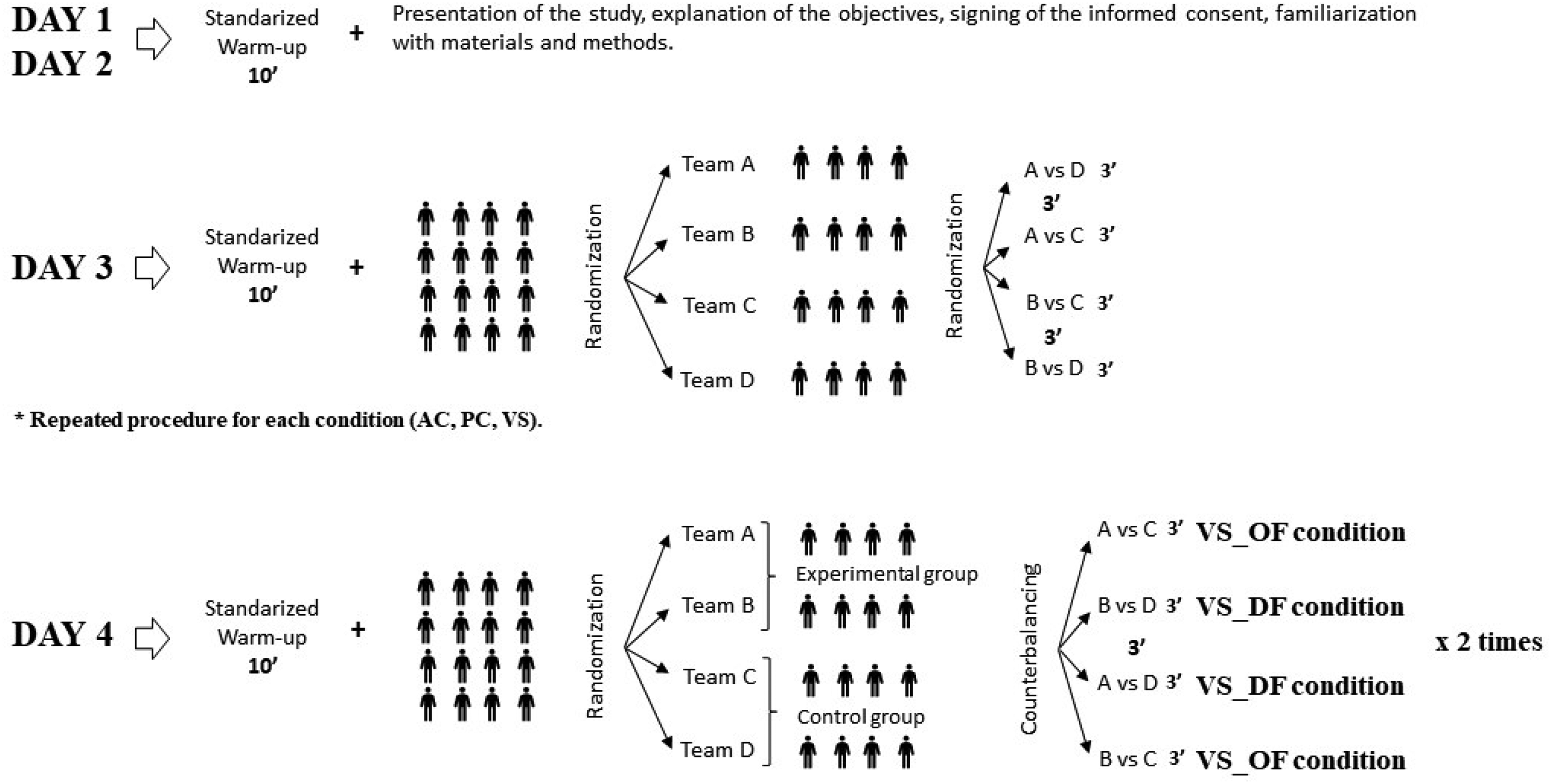
Design of the protocol. Notes: Absence of a Coach (AC), Presence of a Coach (PC), Verbal Stimulation (VS), Verbal Stimulation with tactical-technical offensive instructions (VS_OF), Verbal Stimulation with tactical-technical defensive instructions (VS_DF).
In the third session, the first data collection took place. After a standardized warm-up (10 min of joint mobility exercises and various movements of increasing intensity), the 16 participants were randomly assigned to 4 teams of 4 players. The athletes were randomly requested to play two 4 vs. 4 matches under three different conditions: 1) Absence of a Coach (AC), 2) Presence of a Coach (PC), and 3) Verbal stimulation of the coach (VS). To ensure that no learning effect in the task could bias the results (e.g., adaptation to teammates’ and opponents’ playing styles), the process of team formation and matchup determination was randomized and repeated for each study condition. Two different matches were played for each condition, with matchups changing between them. The randomization for team formation and for the order of the conditions were carried out by one of the researchers using the Excel program, using a spreadsheet with the players’ names.
In the fourth session, the group was randomly divided into two (control group and experimental group). Randomization was also carried out using the Excel program. In this session, two conditions were tested: 1) Offensive verbal stimulation (VS_OF) and 2) Defensive verbal stimulation (VS_DF). To ensure that the order did not influence the results, half of the experimental group started with one condition and the other half with the other condition. Each team played two matches under each condition.
All matches lasted 3 min, with a 3-min recovery period between them to allow full recovery (Figure 1).
For technical-tactical analysis, all SSG were recorded. A hand notation system was developed to identify the technical actions performed during each small-sided game, as previously done in other studies. 37 Technical demands were classified into four categories (passes, shots, defensive duels, and interceptions) and two sub-categories (successful and unsuccessful). All technical-tactical variables were previously defined by consensus among the investigators. To ensure the reliability of the observations made during gameplay, one designated small-sided game was re-analyzed three months later by the same researcher and for a second investigator (assessing both intra-rater and inter-rater reliability).
Testing protocol
The same format was always used for the small-sided game (SSG): 4 × 4 outfield players with two small goals placed centrally at each end, without goalkeepers. The objective of the game was to score more goals than the opponent. The playing area measured 36 × 23 meters, providing an individual interaction space of 103.5 m². The full 11-a-side football rules were strictly applied by a referee, except for the offside rule. The kick-off was randomly determined. During all SSG, 10 balls were distributed around the perimeter of the playing area to maximize effective playing time. 6 The video camera was positioned in the other half-field to ensure recording all the movements of the players.
Following the manufacturer's instructions, the GPS devices were placed on the players 15 min before data collection to ensure proper satellite connection. The GPS devices were inserted into a pocket located on the upper back, within a vest specifically designed to hold them. Once data collection was completed, the data were downloaded to a personal computer using the manufacturer's software described above for subsequent analysis
Study variables
The independent variables of the study were the different conditions under which the small-sided games (SSG) were conducted:
Absence of Coach (AC): During this series, the coach was not present during the game. The role of referee was performed by someone not affiliated with the coaching staff or the team. Presence of Coach (PC): During this series, the coach was present during the game, but his single role was to referee. Therefore, the coach was not allowed to communicate with the players beyond what was necessary for enforcing the rules of the game. With Verbal Stimulation (VS): During this series, the role of referee was performed by someone not affiliated with the coaching staff or the team. The coach was present and allowed to communicate with the players. The communication consisted of positive reinforcement, with messages like “Very good,” “Keep it up,” and “Good job.” The stimulation was continuous and spontaneous, aiming to maintain a minimum frequency of approximately 4 stimuli per minute, depending on the players’ behavior and the development of the game. With Verbal Stimulation and Offensive Technical-Tactical Instructions (VS_OF): The experimental group received a series of offensive technical-tactical instructions prior to and during the game. The main objective was to score goals by maintaining possession and taking advantage of opportunities to progress and finish the action. The types of technical-tactical instructions and methodological guidelines were:
- Maintain possession and play forward when possible. - Maximize width and depth to create space. - Continuously create space: Nearby players offer support to maintain possession, while distant players make penetrating runs to exploit spaces behind the opponent's defense. - Create and recognize 2v1/3v2 superiority situations. With Verbal Stimulation and Defensive Technical-Tactical Instructions (VS_DF): The experimental group received a series of defensive technical-tactical instructions prior to and during the game. The main objective was to prevent conceding goals and ensure effective defense. The types of technical-tactical instructions and methodological guidelines were:
- Maintain a compact structure with close distances between players and lines. - Anticipate the opponent's movements and passes to ensure good pressure: The nearest player applies intense pressure on the ball carrier, while distant players shift to cover and close spaces. - Force the opponent to play wide by closing interior spaces and preventing through passes that penetrate the defensive line.
In all conditions involving verbal stimulation (VS, VS_OF and VS_DF), the same coach provided the instructions to ensure consistency between conditions. The coach maintained a moderately loud and energetic tone, designed to be clearly audible over the ambient noise of the training environment without being perceived as aggressive or disruptive.
In the general verbal stimulation (VS) condition, spontaneous positive reinforcement messages (E.g. ‘Very good!’, ‘Keep it up!’, ‘Well done!’) were delivered with a minimum frequency of four verbal cues per minute. The timing and content depended on game development but aimed to ensure a consistent motivational climate throughout the task.
The dependent variables considered in the study were:
1- Physical Performance:
1. Rating of Perceived Exertion (RPE): The subjective perception of tension, discomfort, and/or fatigue experienced during physical exercise. 2. Total Distance Covered (DIST): The total distance covered (in meters) during each SSG was measured. 3. Player Load (LOAD): The accumulation of movements recorded by the accelerometers of the GPS system based on changes in acceleration between two consecutive time points along the 3D axis (ΔAx, ΔAy, ΔAz) and the result is given in arbitrary units (a.u). 4. Maximum Sprint Speed (MSS): The maximum speed reached by the players (km/h). 5. Sprint Distance Covered (SDC): The distance covered (in meters) at a speed greater than 18.0 km/h.
15
6. High-Speed Distance Covered (HSD): The distance covered at a speed between 13–17.9 km/h.
15
2- Technical-Tactical Performance:
1. Number of Successful Passes (POK): All passes that were delivered successfully to the receiver, without any contact from an opponent, allowing the receiver to maintain possession or pass to another teammate. Passes that were touched by an opponent, even if they reached the intended receiver, were not counted.
38
2. Total Number of Passes (TP): The POK plus the number of lost passes per player. A lost pass was any errant pass or ball recovery by the opposing team.
38
3. Number of Successful Shots (SOK): Shots that are directed within the frame of the goal, excluding those that hit the posts or crossbar unless they directly result in a goal. 4. Total Number of Shots (TS): The total count of all attempts to score a goal, including shots that are on target, off target, blocked by defenders, or hit the goalposts. 5. Number of Successful Duels (DOK): Situation between two opposing players where a player successfully gains or retains possession of the ball after directly challenging an opponent. For a duel to be classified as positive, the player must emerge with clear control of the ball, either by winning it from the opponent or by maintaining possession under pressure. 6. Total Number of Duels (TD):All situation between two opposing players where both attempt to gain control or possession of the ball, challenging each other, on the ground or in the air. 7. Number of Interceptions (INTERC): Every time the player effectively intervene and either regain possession of the ball or alter the trajectory of the pass before it reaches its intended recipient.

Statistical analysis
Data statistical analysis was performed using SPSS 19.0 software. The reliability Intra and Inter- rater was calculated using the Cohen's Kappa coefficients 39 and interpreted as poor (0.00), slight (0.01–0.20), fair (0.21–0.40), moderate (0.41–0.60), substantial (0.61–0.80) and almost perfect (0.81–1.00). 40
A statistical analysis was conducted to investigate the influence of the different experimental conditions on the previously discussed conditional and technical variables. The obtained data did not follow a normal distribution (Shapiro-Wilk normality test) and their variances were heterogeneous (Mauchly's test of sphericity), so that, non-parametric tests were applied.
For our first experimental case, the Friedman test was used to compare the differences between repeated measures according to the experimental conditions (AC, PC, VS). The Wilcoxon test was conducted to identify specific differences between pairs of conditions. Hedge's g 41 was calculated for determining the effect size, with values of 0.2 indicating a small effect size, 0.5 a medium effect size, and above 0.8 a large effect size. 39
In the second experimental case, the Mann-Whitney U test was carried out to determine if there were differences between groups (control vs. VS_OF and control vs VS_DF) for the 4 vs. 4 task. Hedge's g 41 was calculated for effect size, with values of 0.2 indicating a small effect size, 0.5 a medium effect size, and above 0.8 a large effect size. 39
Results
Intra-rater reliability, assessed using Cohen's Kappa index, demonstrated an almost perfect agreement in the categorization of actions (K = 0.934, p < .001). Similarly, inter-rater reliability also showed an almost perfect level of agreement (K = 0.932, p < .001).
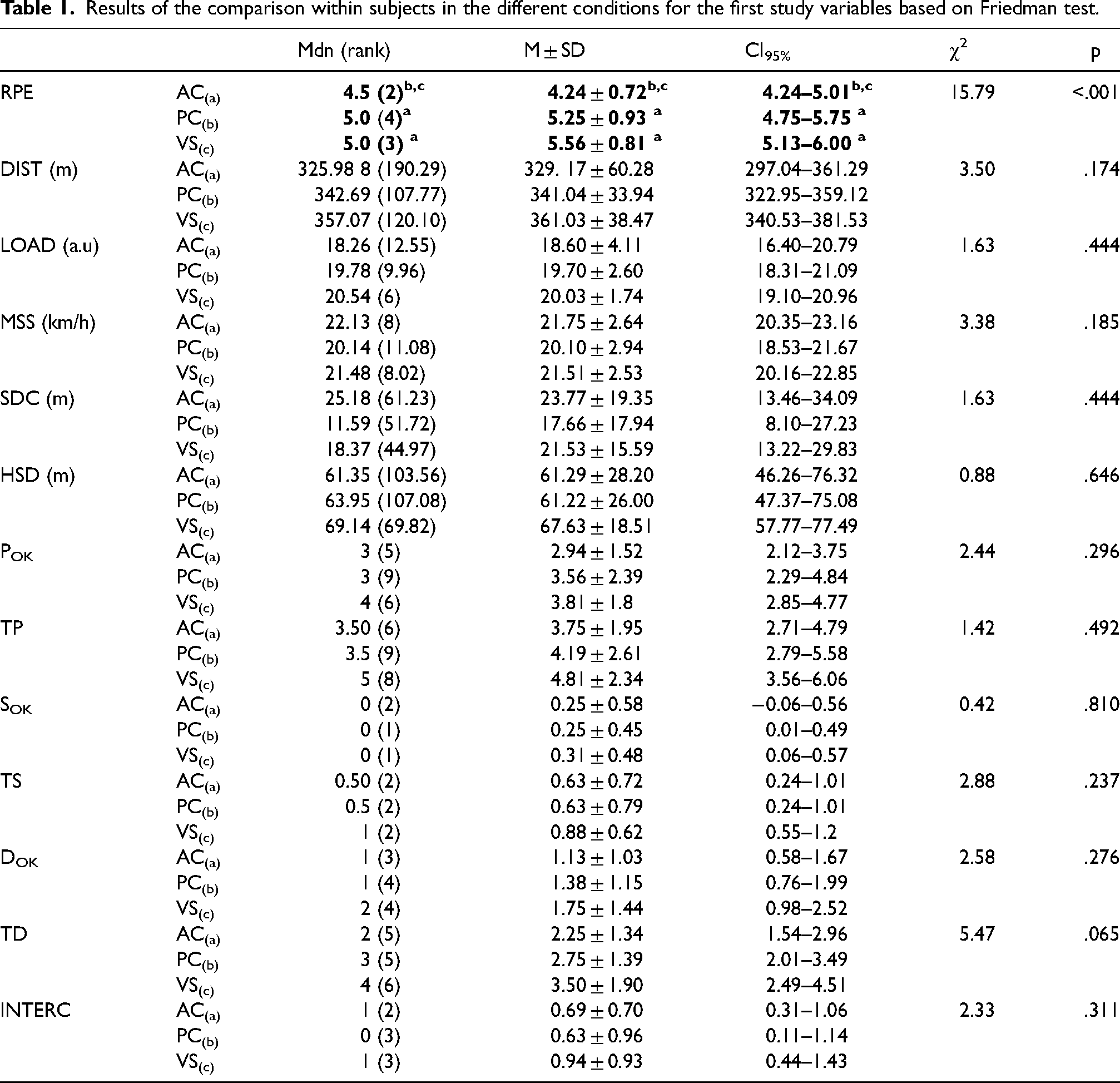
In the first experiment, the Friedmann test results showed an interaction effect within conditions only for the RPE variable, χ2(2) = 15.79, p < .001 (Table 1). Post hoc analyses conducted with Wilcoxon test revealed that the RPE of the AC condition (Mdn = 4.5; Rank = 2.0) was significantly lower than the others: PC condition (Mdn = 5.0; Rank = 4.0, Z = -2.887, p = .004, g = 0.85, 1-B = 0.5) and VS condition (Mdn = 5.0 ; Rank = 3.0, Z = -3.274, p = .001, g = 1.22, 1-B = 0.88).
Results of the comparison within subjects in the different conditions for the first study variables based on Friedman test.
The Table 2 shows the results of the second experimental case for the defensive verbal stimulation (VS_DF), pointing out a significant increment on the distance covered (327.83 vs. 382.76 m; Z = -1.99, p = .046, d = 0.95, 1-B = 0.39), the total number of passes completed (TP) (2 vs. 8 passes; Z = -2.06, p = .039, g = 0.9, 1-B = 0.58) and the number of successful passes (POK) (2 vs. 9 passes, Z = -2.01, p = .044, g = 1.14, 1-B = 0.56). It must be pointed out that the VS_DF induced positive but non-significant results in most of the analysed variables, as for example, in the SDC (8.82 vs. 20.83 m), HSD (51.51 vs. 79.27 m) or the LOAD (18.76 vs. 20.58 a.u).
Results of the comparison between condition-groups for the various study variables based on the U Mann Whitney test for the defensive verbal stimulation (VS_DF).
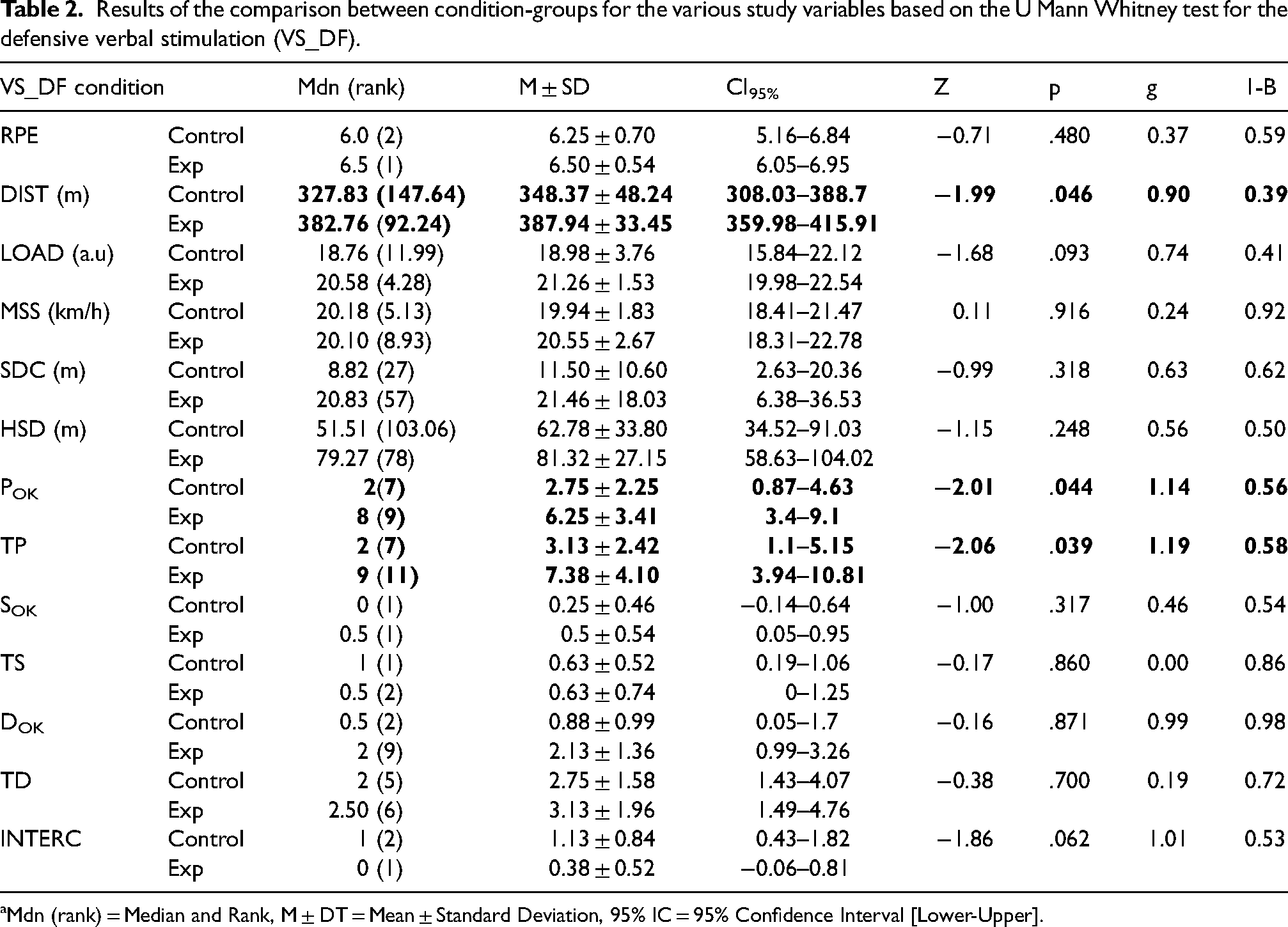
Mdn (rank) = Median and Rank, M ± DT = Mean ± Standard Deviation, 95% IC = 95% Confidence Interval [Lower-Upper].
On the other hand, the analysis of the results for offensive verbal stimulation (VS_OF) condition (Table 3) showed a positive effect on the total number of passes completed (TP) (1 vs. 4.5 passes; Z = -2.34, p = .019, g = 1.3, 1-B = 0.56) and the number of successful passes (POK) (3.5 vs. 5.5 passes; Z = -2.84, p = .004, g = 1.61, 1-B = 0.47). It must be indicated that, even when the results were not significant, the offensive verbal stimulation resulted in lower positive improvements (in some cases negative) compared to the control group in must of the considered variables as for example, in the SDC (16.97 vs. 12.73 m), HSD (63.20 vs. 63.22 m) or the LOAD (18.28 vs. 9.80 a.u).
Results of the comparison between condition-groups for the various study variables based on the U Mann Whitney test for the defensive verbal stimulation (VS_OF).
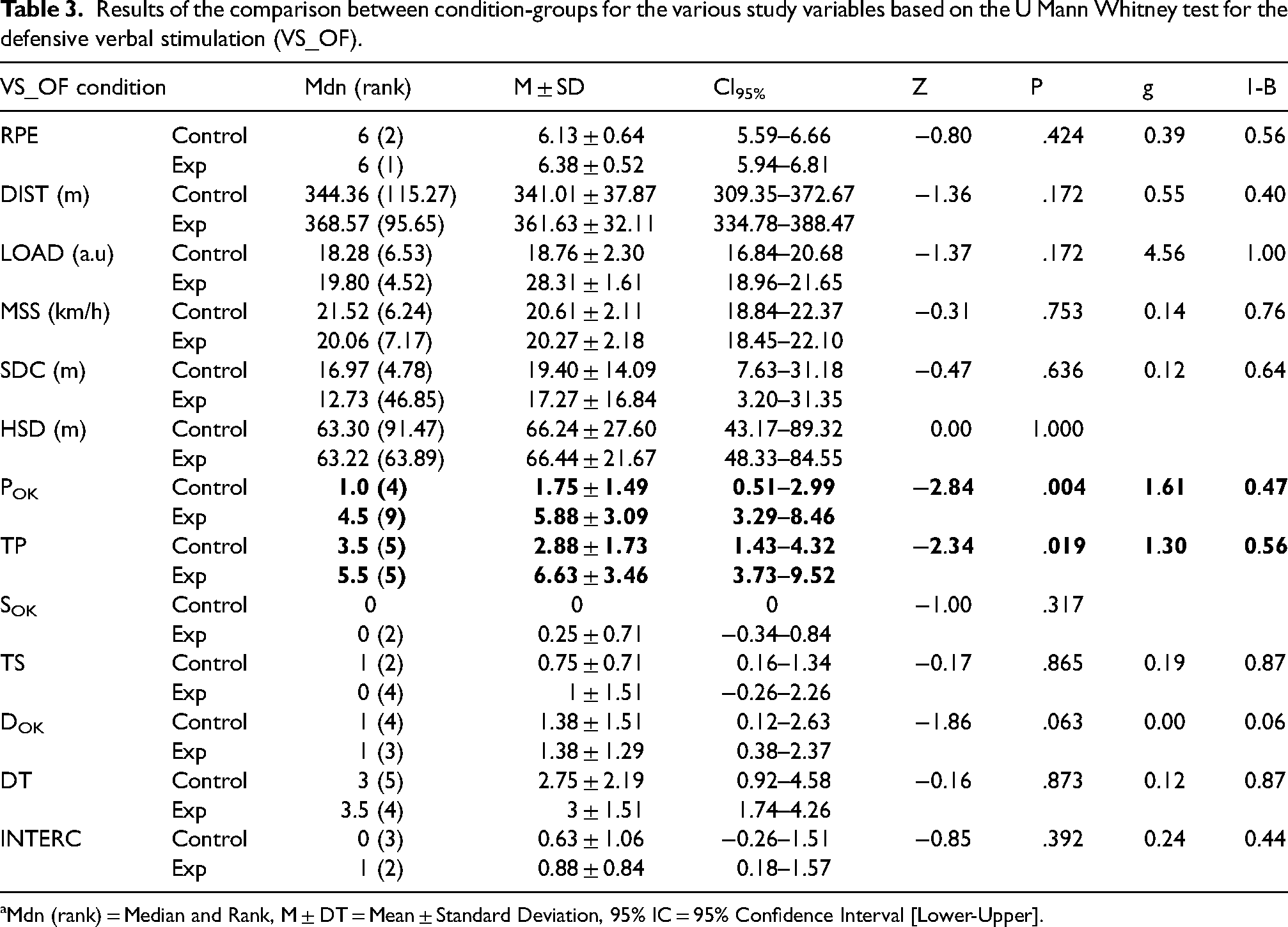
Mdn (rank) = Median and Rank, M ± DT = Mean ± Standard Deviation, 95% IC = 95% Confidence Interval [Lower-Upper].
Discusion
The objective of this study was to analyze the effect of the verbal stimulation and technical-tactical instructions of the coach on the conditional and technical-tactical performance of a group of young grassroots soccer players in a small-sided games.
Initially, the differences between the absence (AC) and the presence of the coach (PC) were analysed, in addition to the emission of verbal stimulation to all the players (VS) during the development of the small-sided game, observing that the only variable that showed statistically significant differences was the subjective perception of effort (RPE), with an increase in the variable both in the PC (0.5 over 10 for the median and 1.01 over 10 for the mean, p < .001) as in VS conditions (0.5 over 10 for the median and 1.32 over 10 for the mean, p < .001).
A striking result is that no differences were observed for the rest of the variables analysed between the PC and VS conditions, which seems to indicate that the positive concurrent feedback provided did not have a significant effect on the analysed performance of the players, contrary to what was observed in other research. 21 These results suggest that the presence of the coach itself affects the intensity of the game that footballers perceive subjectively without any modification of their conditional abilities, thus coinciding with previous studies.Haga clic o pulse aquí para escribir texto. 22 The greater perceived exertion, therefore, could be attributed to psychophysiological factors related to players’ task perception, or appraisal. 42 Earlier studies have shown that the way athletes interpret stressful situations is closely linked to the perceived intensity of the stressor, the emotions they experience, their coping strategies, and ultimately, their performance level.Haga clic o pulse aquí para escribir texto. 43 In this regard, the fact of feeling observed may act as an additional external stimulus, leading to a higher perceived effort during the task.
Regarding the effects of verbal stimulation oriented to defensive indications (VS_DF condition), differences were only observed in the conditional variable “total distance” (DIST) in favour of the experimental group (54.9 for the median totalling the 10.15%, and 39,57 for the mean totalling the 10.20%, p < 0.05). Despite an increase in the variables high speed distance (HSD) and sprint distance (SDC) in favour of the VS_DF condition, these differences were not statistically significant compared to the control group (Table 2). The reason for this greater conditional load observed may be due to the instructions given by the coach. The players were asked to apply intense pressure on the rival and apply permanent defensive aid between teammates, which could lead to traveling a greater distance to cover all the spaces and prevent the progression of the opposing team, as observed in previous studies. 44 It is striking that the RPE variable did not show an increase for the experimental group despite this greater conditional load. (Table 2)
In relation to the technical actions carried out by the players in this same condition (VS_DF), stands out significantly the increment of number of successful passes (POK) (6.0 passes for the median increasing the 75%, and 3.5 passes for the mean increasing the 56%, p < 0.05) and increment of total number of passes made (TP) (7.0 passes for the median increasing the 78%, and 4.3 passes for the mean increasing the 58%, p < 0.05), in both cases in favour of the experimental group. Therefore, although the instructions given to the players focused on improving defensive performance, they could indirectly be enhancing the player's offensive performance.
On the one hand, the improvement in passing effectiveness could be due to an intensification of defensive efforts that generates an increase of the level of alert and concentration of the team, which can also be reflected greater effectiveness in offensive actions such as passing accuracy. On the other hand, an improvement at the defensive level can allow a higher ball recovery rate and therefore, an increase in the percentage of ball possession. In our study, this could not be contrasted since the teams’ ball possession time was not considered. This would have been a highly relevant factor when interpreting the data taking into account that no significant differences were obtained either in the number of interceptions (INTERC) or duels won (DOK) between the groups. This fact should be studied in the future studies.
Finally, regarding the effects of verbal stimulation oriented to offensive indications (VS_OF), significant differences were only observed in the TP variable (2.0 passes for the median increasing the 36%, and 4.13 passes for the mean increasing the 57%, p < 0.01) and in the number POK (3.5 passes for the median increasing the 78%, and 3.75 passes for the mean increasing the 70%, p < 0.05), being higher in the experimental group. The data obtained can be explained by the type of instructions given by the coach, aimed at improving decision-making and technical execution in specific attacking situations. Establishing clear offensive objectives related to the maintenance of the ball, a rational occupation of space, and the collaboration between the ball holder and his teammates depending on the rival location, could have allowed the generation of advantageous situations for the VS_OF group, which would be reflected in an increase of the total number of passes made. These results coincide with previous studies, 11 who indicate that the incorporation of provocation rules and the orientation of tasks towards specific objectives generate a greater frequency of actions related to the attacking efficiency.
Practical aplications
The results of this study emphasize the importance of considering the coach's physical presence during training tasks, regardless of the verbal encouragement provided. The mere fact that players perceive the coach observing their actions can lead to greater cognitive and motivational involvement in the task, which in our results has been reflected in an increased perceived effort during the tasks. Therefore, from a practical perspective, planning the coach's location throughout the tasks should be a variable to consider when designing training sessions.
Another particularly relevant variable that coaches should consider when structuring an SSG exercise is the type of technical-tactical instructions. Our results show that instructions emphasizing defensive behaviors can positively influence players’ external load. This can be especially useful when the goal of these tasks is related to improving athletes’ physical conditioning.
Limitations
One of the main limitations of the study was the players’ limited experience in using the Borg RPE scale. This may have led to an underestimation of internal load values.
On the other hand, this study used only one SSG format (4 vs. 4 with mini-goals in a 36 × 23 meter space). The limited relative space per player (103 m²) may have been a factor to consider regarding the few significant differences found between conditions and even between technical actions. Larger spaces per player could have allowed for greater movement possibilities, both with and without the ball. Similarly, it would have been interesting to evaluate the same conditions in a competitive context.
Regarding the technical-tactical evaluation of the players, key performance indicators such as team ball possession or effective playing time in each match would have been valuable for interpreting the results.
An important aspect that could not be assessed was the psychological and emotional state of the players. Mood, stress levels, and enjoyment have been measured in previous studies using validated questionnaires such as the Profile of Mood States (POMS), the Short Recovery and Stress Scale (SRSS), and the Physical Activity Enjoyment Scale (PACES), respectively16,21 In this regard, collecting data on the effects of verbal stimulation on athletes’ psychological and cognitive states would have provided valuable insights for interpreting the results and even to monitor individual motivation levels.
Considering the final sample size, the minimum required to achieve the desired statistical power could not be reached, as indicated by the a priori power analysis conducted with G*Power. Although previous studies with identical sample sizes have reported statistically significant results, 21 this remains a limitation that should be taken into account when interpreting the findings.
Moreover, it is important to consider that the selected sample consisted of young players with experience in soccer but not competing in a high-performance sports context. This may be a factor to consider when interpreting the external validity of the results. It would have been valuable to assess the same conditions as in our study in groups of different ages and competitive levels.
Conclusions
Therefore, based on the results of the study, we can conclude that in a 4 vs 4 small-sided game task performed by young players, the simple presence of the coach significantly affects the perceived effort (RPE) by the players and this increased perception is maintained independently of the verbal encouragement provided during the task.
On the other hand, the verbal stimulation given by the coach, aimed at improving defensive play, significantly affects both conditional variables such as the total distance traveled, and offensive technical-tactical variables such as the total number of passes given and the number of passes successful. Likewise, indications aimed at improving offensive play significantly improve a technical-tactical variable, such as the total number of passes made by the player.
Footnotes
Acknowledgments
We would like to thank all the participants who participated in this research and those who supported access to the participants.
Declaration of conflicting interests
The authors declared no potential conflicts of interest with respect to the research, authorship, and/or publication of this article.
Funding
The authors received no financial support for the research, authorship, and/or publication of this article.
