







Abstract
This study examined the mediating role of organizational citizenship behavior (OCB) in the relationship between team cohesion and team effectiveness by collecting data from a sample of 613 collegiate student-athletes in South Korea (hereafter referred to as “Korea”) and Hong Kong. Results revealed that team cohesion significantly predicted both OCB and team effectiveness, with OCB also exerting a strong positive influence on team effectiveness. Furthermore, OCB partially mediated the cohesion–effectiveness relationship, highlighting its critical function within sport teams. Cross-cultural comparisons showed that Korean athletes demonstrated higher levels of social cohesion and team effectiveness, while Hong Kong athletes exhibited stronger task cohesion. Notably, OCB's mediating effect was more pronounced among Korean participants. These findings offer insights into how prosocial team behaviors can be harnessed to improve performance and inform culturally responsive coaching strategies.
Keywords
Introduction
Organizational citizenship behavior (OCB) refers to “individual behavior that is discretionary, not directly or explicitly recognized by the formal reward system and that in the aggregate promotes the effective functioning of the organization”. 1 In the field of organizational behavior, OCB has received substantial attention from researchers and practitioners. This is because such seemingly voluntary prosocial behaviors are likely to have a cumulative positive impact on the effectiveness of organizations and people within an organization. 2 In fact, numerous studies have explored OCB-related variables, such as personality, organizational justice, job satisfaction, commitment and leadership style to understand why members of an organization engage in OCB, confirming the relationships among these relations. 3 Although the concept of OCB was initially introduced in a business context, such voluntary behaviors can also be widely observed in the realm of sports, where they may significantly impact team performance. For instance, a veteran basketball player on a team may share details about their training regimen with young teammates, initiate extra work outside of required practices, or organize social gatherings with teammates to foster team bonding. Similarly, an athlete on a soccer team may encourage teammates rather than casting blame after a difficult loss, helping avoid conflicts among members of the team. These types of prosocial, voluntary behaviors, which are not formally mandated by coaches, may improve other teammates’ skills and performance as well as strengthen team cohesion, ultimately leading to a positive impact on performance. 4 Several studies in the fields of sport management and sport psychology have applied the concept of OCB. Specifically, such research has predominantly focused on two areas: sport organizations and sport teams. Studies such as those by Chang and Chelladurai and Kerwin, 5 Husin et al., 6 Jeong et al., 7 and Lee et al. 8 explored OCB and related variables concerning staff members in sport organizations. Additionally, other research, including work by Andrew et al. 9 and Aoyagi et al., 10 investigated OCB among athletes within sport teams. Studies like these have highlighted the important roles of OCB in the context of sports, and Wagstaff et al. 11 have called for further exploration of OCB in elite sports.
Kim et al. 12 and Love and Kim 13 made significant contributions to the research on OCB in sports by developing a dedicated OCB scale specifically for sporting contexts, rather than relying on previously established OCB scales from other business settings. This development reflects the unique characteristics of the athletic environment related to OCB. Love and Kim's qualitative study 13 involved interviews with current and former college athletes in the United States, revealing connections between existing research on non-sport organizations and athletes’ perceptions of “voluntary” behaviors in sports. For instance, aspects of OCB identified by Love and Kim, such as “motivating and supporting teammates,” “giving good effort,” and “engaging in extra practice,” correspond with forms of OCB recognized in non-sport settings by Organ et al., 14 including “helping,” “organizational compliance,” and “self-development,” respectively. However, one aspect of OCB noted in non-sport contexts that was not prominent among athletes in the Love and Kim 13 study was Organ's concept of “sportsmanship.” A possible explanation for this omission is the significant power dynamics between coaches and athletes that exist in sport. While an employe in a non-sport organization might view their choice to refrain from complaining as a “voluntary” behavior, athletes may internalize the necessity of accepting coaches’ directions without question as a normative, unconscious behavior due to the inherent power imbalance in sports. 15 Building on the findings from Love and Kim's initial work, Kim et al. 12 developed a valid and reliable OCB scale consisting of 22 items across five dimensions: (a) bonding, (b) encouraging, (c) helping, (d) community service, and (e) extra work. This new OCB in sports scale can be utilized to examine potential relationships between psychological antecedents and the identified dimensions of OCB in sports as well as provide practical guidance to professionals working with athletes.
Given the emerging scholarship on OCB in sport, the current study makes three specific contributions beyond prior work: (a) it provides cross-cultural validation of the recently developed OCB in sport scale 12 by establishing its reliability and criterion and concurrent validity in South Korea (hereafter referred to as “Korea”) and Hong Kong; (b) it tests a model of direct and indirect effects in which OCB mediates the link between team cohesion and team effectiveness; and (c) it contrasts these paths across Korean and Hong Kong collegiate contexts. We expected that differences in student-athletes’ perceptions and attitudes toward athletic participation and experiences would arise due to the distinct structures and sports cultures in Korea and Hong Kong. Whereas collegiate sports in Hong Kong primarily focus on teaching sportsmanship and encouraging physical activity as part of the academic curriculum, Korea places greater emphasis on intensive athletic training and support for a select group of elite student-athletes. 16
Theoretical foundations
The proposed relationship between team cohesion and team effectiveness via OCB in sport is illustrated in Figure 1. Although team cohesion has been widely studied in relation to team effectiveness in sport settings, the impact of OCB has received limited attention, despite its potential importance for positive team effectiveness. Most existing research on OCB has focused on organizational or business environments, leaving a gap in understanding how OCB operates within athletic teams. Furthermore, much of the research on cohesion, OCB, and effectiveness has been conducted within single-cultural, often Western, contexts, limiting our understanding of how cultural and structural differences across countries may influence these relationships in sport teams. Many studies have focused primarily on direct relationships, such as cohesion leading to effectiveness, without considering mediating mechanisms like OCB or grounding these relationships in overarching theories such as social exchange theory 17 or social capital theory, 18 particularly in cross-cultural contexts. Therefore, this study was designed to address these gaps by examining whether OCB mediates the relationship between team cohesion and team effectiveness in sport teams, and by comparing these relationships across different countries.
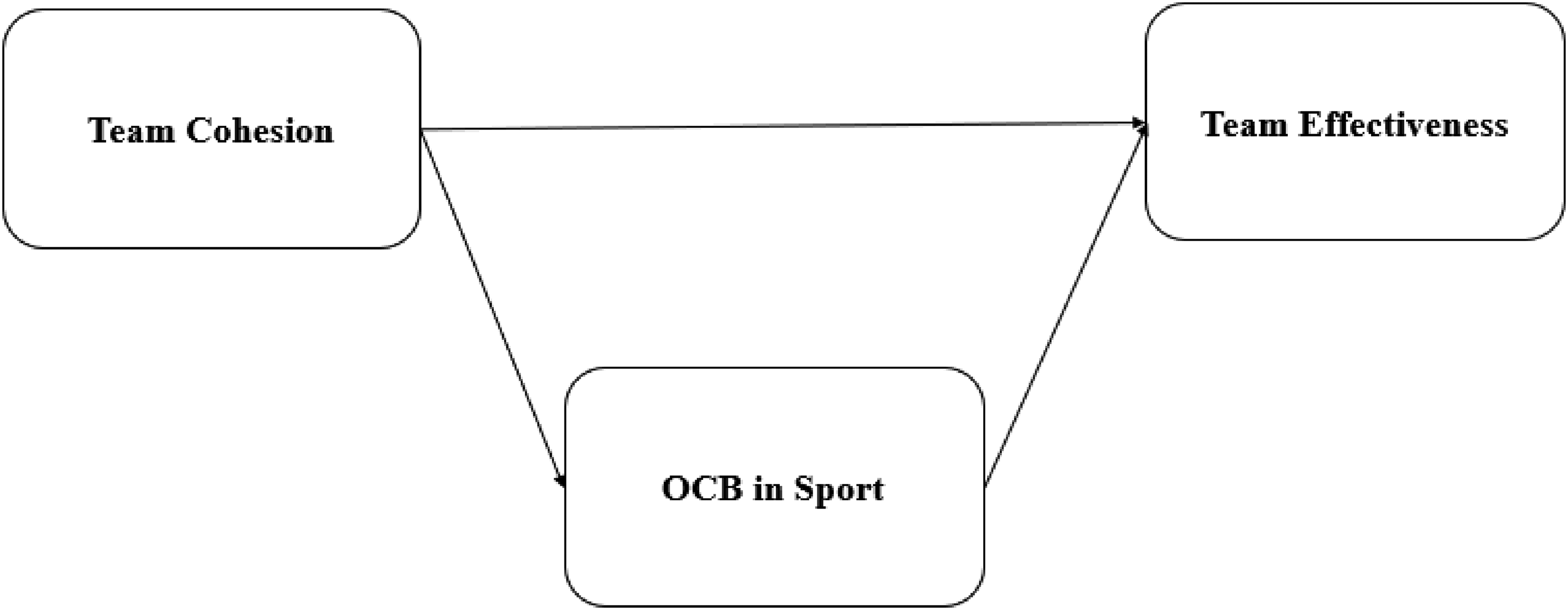
Conceptual framework for the current proposal.
Team cohesion
Team cohesion refers to “a dynamic process that is reflected in the tendency for a group to stick together and remain united in the pursuit of its instrumental objectives and/or for the satisfaction of member affective needs”. 19 The study by Love and Kim 13 revealed that athletes frequently spoke of bonding with teammates through social activities outside of sport (e.g. getting together with teammates for a meal over the weekend) as an important element of OCB in sport, although such bonding behaviors to increase team cohesion within a team were absent from prior research on OCB in non-sport contexts. Additionally, Martínez and Tindale 20 reported that team cohesiveness was significantly and positively associated with both helping behavior and sportsmanship, suggesting that cohesive teams are more likely to engage in high levels of OCB and experience smoother intra-team interactions. Such findings have led our research team to further investigate the deeper relationship between team cohesion and OCB via the current study.
According to social capital theory, resources, information, and opportunities derived from interpersonal and interorganizational relations in a social network may help individuals and organizations achieve their goals. 21 Social capital is defined as “the sum of resources, actual or virtual, that accrue to an individual or a group by virtue of possessing a durable network of more or less institutionalized relationships of mutual acquaintance and recognition”. 18 Based on the norms of reciprocity and trustworthiness arising from networks, social capital emphasizes the importance of social networks and connections focusing on ties with similar people as internal relations and bridging among diverse people as external relations. 22 Social capital is often conceptualized in two forms: bonding social capital, which refers to the strong ties among individuals with similar backgrounds or interests, and bridging social capital, which connects individuals across diverse social groups or organizational boundaries. 18 This study particularly emphasized bonding social capital, as it plays a critical role in strengthening group cohesion and providing emotional support. While bridging social capital brings in new ideas and resources, bonding social capital is more relevant to this study because it focuses on the strong, supportive relationships formed within collegiate sports teams. Many studies have discussed and identified beneficial effects of social capital on individual and organizational effectiveness in various outcomes, such as educational attainment, 23 public health, 24 community governance and economic problems, 25 and problem solving. 26 Given that success in sports objectives, 27 team cohesion plays a crucial role in competitive performance.28,29 Within sports teams, social capital enhances collaboration and coordination, while also fostering resilience, adaptability, and a strong collective commitment to achieving group goals.
Relationships between team cohesion and team effectiveness
Generally, it is well accepted that strong team cohesion can enhance overall team effectiveness like effectiveness because the increase in task performance from team cohesion influences team efficiency and helps the team attain goals. 30 In the literature, numerous studies have examined and reported a positive relationship between team cohesion and team performance. A meta-analysis conducted by Carron et al., 31 for example, confirmed the general relationship between team cohesion and performance in sport studies. Carron et al. examined the relationship between team cohesion and team performance based on type of sport (interdependent vs. individual sports), type of cohesion (task vs. social cohesion), gender (male vs. female), skill level, and age. The results revealed a moderate, positive, and significant relationship between team cohesion and performance regardless of type of sport, type of cohesion, and skill level and age, while the positive relationship between cohesion and performance was stronger for females than males. Relatedly, Martínez and Tindale 20 found that team cohesion was positively correlated with helping behavior and team performance metrics, suggesting that cohesion enhances both interpersonal prosocial behaviors and the coordination needed for successful group outcomes. These findings are reinforced by Grossman et al., 28 who demonstrated through a meta-analysis that behaviorally-focused and task-based cohesion measures yield stronger relationships with performance than attitudinal or socially-focused measures. Moreover, their findings suggest that behaviorally-focused measures of cohesion (e.g. shared practice, visible teamwork actions) had the strongest correlation with performance, reinforcing the notion that observable cohesion behaviors are important components of achieving success in team sport contexts.
Mediating effects of OCB between team cohesion and team effectiveness
The concept of OCB has received considerable attention from organizational researchers since it was introduced by Organ, 1 due to its potential impact on the development of efficient and effective organizational teams. 10 Leadership, team cohesion, and satisfaction have been identified as primary antecedents of OCB in sport, with positive associations established by organizational behavior researchers.32,10 In this study, the mediating effects of OCB between team cohesion and organizational effectiveness were expected and tested, as OCB can strengthen the impact of team cohesion by fostering cooperation and ensuring that team efforts align with organizational goals and objectives. 33
According to social exchange theory,17,34 members in a cohesive group are more likely to develop strong group norms that encourage frequent social exchanges among them. 35 Within the cohesive group, OCBs like voluntary helping behaviors often become the expected standard, prompting the members to support one another, 36 as engaging in such OCBs may be viewed as part of one's role within the group. This climate of mutual support can foster a sense of shared responsibility and reinforce ongoing prosocial behaviors, strengthening overall group functioning and performance. In other words, the members in the cohesive team are more attuned to the needs of others and more inclined to offer help and display altruistic behavior. 37 Consequently, these positive interactions build social capital within the team—shared trust, norms, and networks that facilitate coordination and cooperation for mutual benefit. Enhanced social capital not only promotes effective collaboration but also helps teams overcome challenges and achieve higher levels of effectiveness.
Martínez and Tindale
20
further support this pathway, demonstrating that helping behavior—a core component of OCB—mediated the effects of team cohesion on relevant performance tasks in softball and tennis. In contrast, members of less cohesive groups often lack clear norms and expectations for interpersonal support, resulting in fewer OCBs and reduced opportunities for positive social exchanges and social capital development,38,39 which may ultimately lead to lower team effectiveness.
- Hypothesis 1: OCB mediates the relationship between team cohesion and team effectiveness.
Moderating effects of country on the relationships between team cohesion and team effectiveness
Filho et al. 40 also conducted a meta-analysis using studies from between 2000 and 2010, confirming the general positive relationship between these two variables as well as the moderating effect of gender. The current study aimed to examine cross-cultural team dynamics in Korea and Hong Kong by exploring how their distinct cultural backgrounds (e.g. collectivism vis-à-vis individualism) and sports development systems (e.g. elite-oriented vis-à-vis sport-participation) influence student-athlete experiences. Particularly, the current study examined whether the country context could moderate the relationship between team cohesion and team performance, considering how student-athletes’ perceptions and attitudes toward athletic participation are influenced by the distinctive sports structures and cultures in Korea and Hong Kong.
Although both countries share certain Confucian heritage, their respective positions within East Asia provide valuable insights into the influence of national cultural norms on individual and group behaviors. According to Hofstede's framework, 41 Korea is characterized as a strongly collectivistic society with high power distance and strong uncertainty avoidance—features that support hierarchical team structures and foster strong internal cohesion. However, Hong Kong, influenced both by Chinese collectivist traditions and British colonial individualism, shows moderate individualism and a different orientation toward power distance.
These cultural distinctions are reflected in the structure and purpose of collegiate sports in both countries. Hong Kong's collegiate sports system primarily promotes sportsmanship and encourages physical activity as an integral part of the academic curriculum, but Korea's system emphasizes intensive athletic training and support for a select group of elite student-athletes.
16
In Hong Kong, the collegiate sports system—overseen by the University Sports Federation of Hong Kong (USFHK)—primarily aims to integrate sporting activities into academic life, encouraging broad participation and sportsmanship among students. For instance, the 2023–24 academic year saw student-athletes from 13 tertiary institutions competing in 18 different sports. Conversely, Korea's collegiate sports structure is centered on rigorous training and support for a select group of elite athletes, with the Korea University Sport Federation (KUSF) primarily providing advisory support and organizing limited annual competitions for a few sports. Thus, the current study proposed that cultural differences (i.e. the individualism and participatory nature of sport in Hong Kong vis-à-vis the more collectivist and elite, competitive nature of sport in Korea) act as a moderator in the relationship between team cohesion and team effectiveness through OCB; by influencing how cohesive team environments give rise to voluntary, prosocial behaviors that ultimately improve team effectiveness. For example, in highly cohesive teams, cultural influences on OCB may be amplified or diminished depending on the context.42,43 Based on the findings of the previous research, the following hypotheses are proposed:
- Hypothesis 2a: There will be significant differences in team cohesion between Hong Kong and Korea. - Hypothesis 2b: There will be significant differences in OCB in sports between Hong Kong and Korea. - Hypothesis 2c: There will be significant differences in team effectiveness between Hong Kong and Korea. - Hypothesis 3: The country moderates the relationship between team cohesion and perceived team effectiveness.
Method
Sample
The population for this study comprised student-athletes participating in intercollegiate athletics across Hong Kong and Korea. Data were collected from 613 college student-athletes who were officially registered members of their respective university teams. Institutional permission was first secured by contacting team coaches and managers. Survey questionnaires were administered to student-athletes either before or after their scheduled practices. Specifically, 261 respondents were Korea, while 352 were from Hong Kong. The average age of participants was 20.39 years [SD = 1.79], of whom 282 were men and 331 were women. In Korea, 96 respondents (36.8%) were men, while 165 (63.2%) were women. In Hong Kong, 186 respondents (52.8%) were men, while 166 (47.2%) were women.
A total of 25 different sports were represented among participants. Of the Korean male student-athletes, approximately 30% participated in either boxing, shooting, or taekwondo. In contrast, Korean female student-athletes primarily competed in judo, hockey, and fencing, which accounted for approximately 42% of the total. For Hong Kong male student-athletes, table tennis, soccer, and handball were the most common sports, representing approximately 37% of the total. Hong Kong female student-athletes mainly participated in table tennis, soccer, and handball, comprising approximately 46% of the total.
Measures
Previously validated instruments were used to assess the variables in this study. The Group Environment Questionnaire 44 was employed to evaluate team cohesion, including individual attractions to the group-social (ATGS), individual attractions to the group-task (ATGT), group integration-social (GIS), and group integration-task (GIT). In addition, OCB was measured using the OCB in Sport Scale. 12 The scale consisted of 22 items under five latent dimensions: (a) bonding, (b) community service, (c) encouraging, (d) extra work, and (e) helping. Finally, 20 items with five factors (ability, effort, persistence, preparation, and unity) from the Collective Efficacy Questionnaire for Sports (CEQS) developed by Short et al. 45 were used to assess student-athletes’ perceptions of team effectiveness because collective efficacy, as a team-level proxy, can measure athletes’ shared belief in their team's ability to organize, coordinate, persist, and perform. All items were measured using a 5-point Likert scale ranging from 1 (strongly disagree) to 7 (strongly agree).
To ensure measurement equivalence across participants from Hong Kong and Korea, all survey instruments were subjected to a rigorous back-translation process. The original English questionnaire was translated into Cantonese and Korean by bilingual experts, then independently back-translated into English to verify accuracy. Any discrepancies were resolved through consensus among the translators and our research team. Additionally, an identical 5-point Likert scale was used in both language versions to maintain response uniformity and comparability.
Statistical analysis
Structural equation modeling (SEM) analyses were performed using AMOS 24.0 to evaluate the adequacy of the measurement model and to test the proposed research hypotheses. Prior to conducting confirmatory factor analysis (CFA) and SEM, a mean difference analysis was carried out on the sub-dimensions of the three latent variables: team cohesion, OCB in sports, and team effectiveness.
To assess both the measurement model and the structural model, several widely recognized fit indices were employed, including the Tucker-Lewis Index (TLI), Goodness of Fit Index (GFI), Comparative Fit Index (CFI), Root Mean Square Error of Approximation (RMSEA), and Standardized Root Mean Square Residual (SRMR). According to established guidelines, TLI, GFI, and CFI values should exceed .90, while RMSEA and SRMR values should be below .08 to indicate an acceptable model fit.46,47
During the CFA analysis, we conducted a more rigorous evaluation of the measurement model by assessing both convergent validity and discriminant validity. Convergent validity was examined by calculating the composite reliability (CR) and average variance extracted (AVE) indices to determine whether they met the established criteria. Discriminant validity was assessed by comparing the AVE values with the correlations between latent variables to ensure adequate differentiation among constructs.
Results
Mean difference
The results of the analysis on the mean differences in the sub-factors of the three latent variables (i.e. team cohesion, OCB in sport, team effectiveness) based on the group distinction by nation (Hong Kong vs. Korea) are as shown in Table 1.
Mean difference of variables according to nationality.
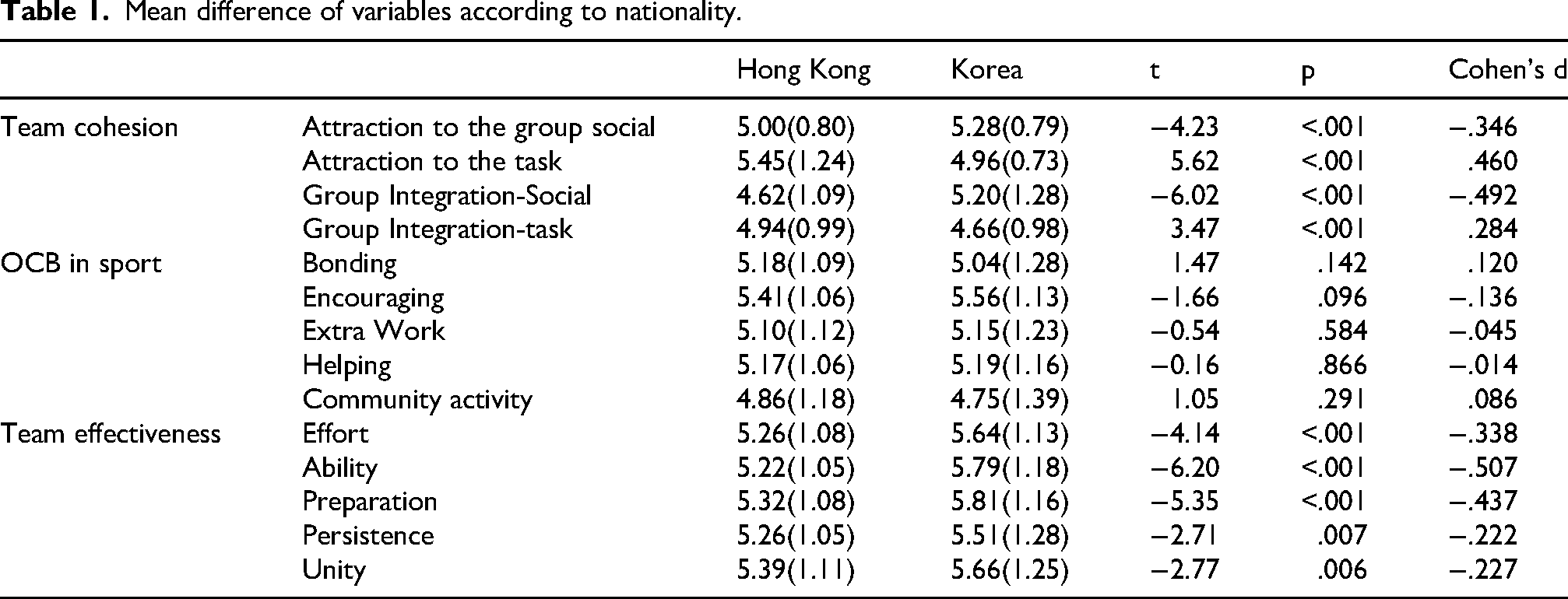
First, regarding team cohesion, statistically significant differences were observed across all sub-factors, including ‘Attraction to the Group Social,’ ‘Attraction to the Task,’ ‘Group Integration-Social,’ and ‘Group Integration-Task,’ thus supporting hypothesis 2a. Specifically, in sub-factors ‘Attraction to the group social’ and ‘Group Integration-Social’, Korean college student-athletes demonstrated higher values than their Hong Kong counterparts. However, in sub-factors ‘Attraction to the task’ and ‘Group Integration-task’, Hong Kong college student-athletes exhibited higher values than S. Korean college student-athletes. Subsequently, the analysis of mean differences in OCB in sports showed no statistically significant differences across any sub-factors, including ‘Bonding,’ ‘Encouraging,’ ‘Extra Work,’ ‘Helping,’ and ‘Community Activity,’ thus rejecting hypothesis 2b. Lastly, regarding team effectiveness, statistically significant differences were found in ‘Effort,’ ‘Ability,’ ‘Preparation,’ ‘Persistence,’ and ‘Unity,’ with Korean college student-athletes exhibiting higher values than their Hong Kong counterparts, thereby supporting hypothesis 2c.
Measurement model
In this study, item parceling was conducted to ensure the uni-dimensionality of the latent variables before conducting CFA. 48 Since relying on a single statistic to determine model fit is not appropriate, we employed several well-known fit indices recommended by Kline 47 and Hu & Bentler. 49 As presented in Table 2, multiple model fit indices, including the TLI, RMSEA, and SRMR, indicate that the measurement model demonstrates an acceptable fit based on the global model fit assessment guidelines. 47 Additionally, we tested convergent validity and discriminant validity of measurement scale based on the results of CFA. In the case of convergent validity of this measurement model, all C.R values were greater than the criterion of 0.7 suggested by Fornell and Lacker 50 and all AVE values were greater than the criterion of 0.5 suggested by Hair et al.. 46 Convergent validity was supported by the above criteria. Moreover, discriminant validity is supported when the square root of AVEs were greater than inter-construct correlation. 50 The range of inter-construct correlation (from .623 to .750) were less than the square root of AVEs (from .761 to .904) as shown in Table 3. Therefore, these results showed acceptable validity and reliability of measurements.
Confirmatory factor analysis.
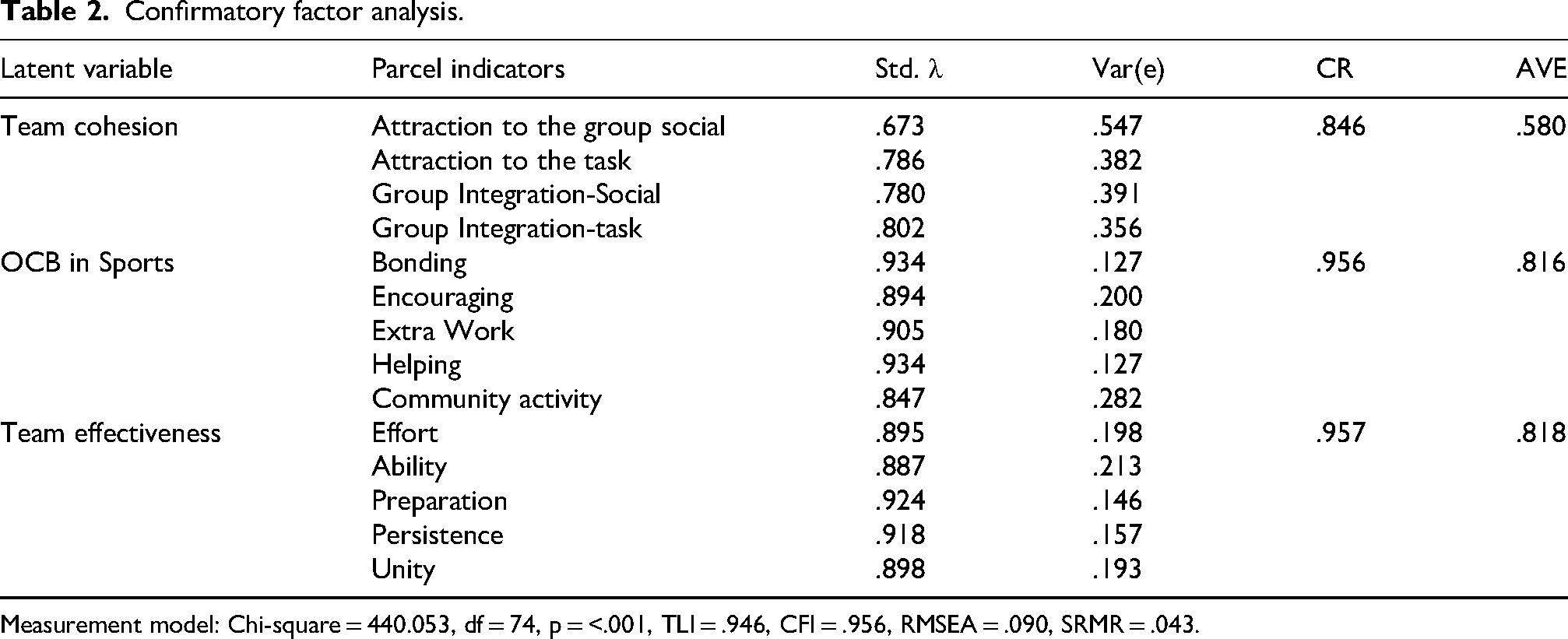
Measurement model: Chi-square = 440.053, df = 74, p = <.001, TLI = .946, CFI = .956, RMSEA = .090, SRMR = .043.
Correlation analysis.
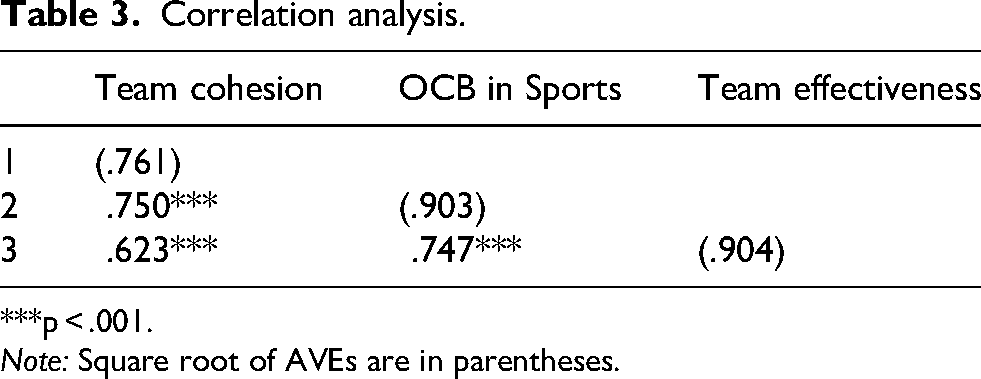
***p < .001.
Note: Square root of AVEs are in parentheses.
Structural model
Building upon the results of the measurement model, we proceeded with the evaluation of the structural model. The analysis revealed that the research model demonstrated an acceptable level of fit (χ² = 440.053, df = 74, p < .001, TLI = .926, CFI = .956, RMSEA = .082, SRMR = .043).
The statistical examination of the four hypothesized paths yielded the following findings. First, Team Cohesion was found to have a statistically significant effect on OCB in Sport (β = .750, p < .001). Additionally, OCB in Sport exerted a significant influence on Team Effectiveness (β = .584, p < .001). Furthermore, the direct effect of Team Cohesion on Team Effectiveness was also statistically significant (β = .178, p = .013). These results indicate that all three direct paths specified within the structural model were supported by statistically significant relationships. As a result of confirming whether the mediating effect is partial or completely mediated through additional model comparison, it was found to be partial mediation (△χ² = 6.221, △df = 1, p = .012).
Moreover, the analysis of the indirect path, where Team Cohesion influences Team Effectiveness through OCB in Sport, revealed a statistically significant mediating effect, thereby supporting hypothesis 1. This finding underscores the role of OCB in Sport as a key underlying mechanism that explains the relationship between Team Cohesion and Team Effectiveness, providing empirical support for this theoretical assertion. A summary of these findings is presented in Table 4.
Results of SEM.
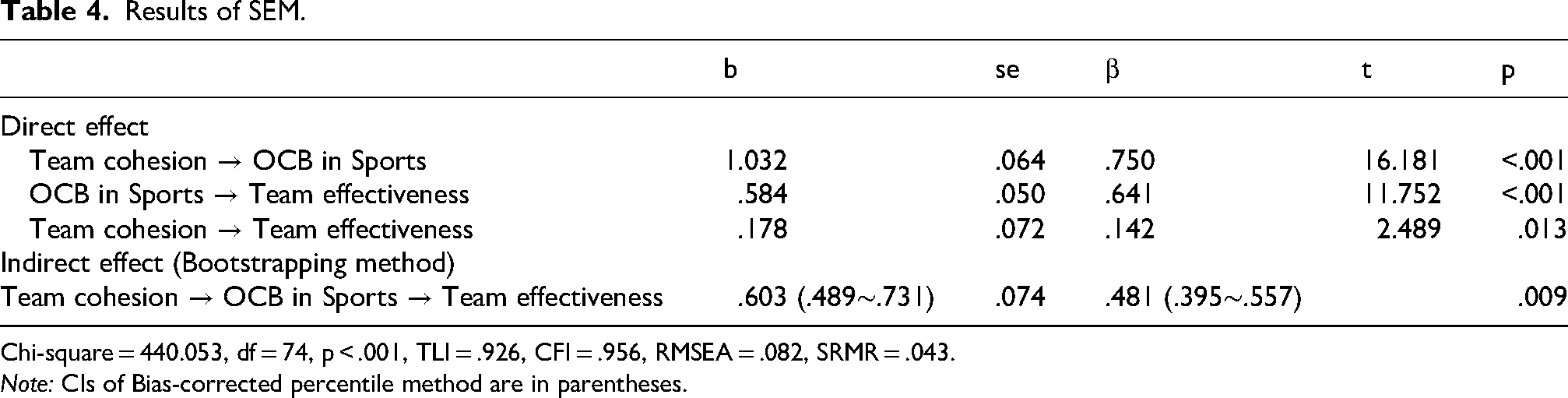
Chi-square = 440.053, df = 74, p < .001, TLI = .926, CFI = .956, RMSEA = .082, SRMR = .043.
Note: CIs of Bias-corrected percentile method are in parentheses.
Model comparison
We conducted separate analyses for the data from Hong Kong and Korea, applying each dataset to our research model to assess whether configural invariance was established across the two models. In SEM, verifying configural invariance is the fundamental step in multi-group analysis, as its confirmation allows for subsequent assessments of measurement invariance and intercept invariance.
However, in this study, configural invariance between the two models, distinguished by country, was not supported, indicating a lack of support for hypothesis 3. Specifically, for the model applied to the data from Korean college student-athletes, the RMSEA value did not meet an acceptable threshold, indicating a poor model fit (χ² = 336.048, df = 74, p < .001, TLI = .917, CFI = .932, RMSEA = .104, SRMR = .048).
Given the lack of configural invariance, this study opted for a direct comparison of path coefficients between the two models to provide an intuitive interpretation. The results of this comparison are summarized in Table 5.
Model comparison (unstandardized coefficients).
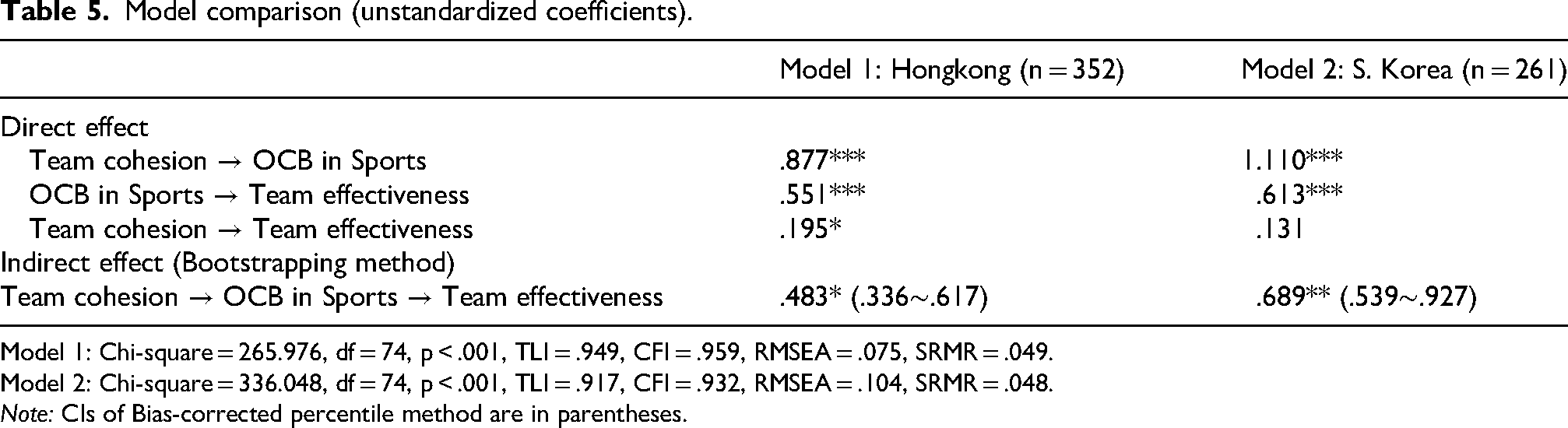
Model 1: Chi-square = 265.976, df = 74, p < .001, TLI = .949, CFI = .959, RMSEA = .075, SRMR = .049.
Model 2: Chi-square = 336.048, df = 74, p < .001, TLI = .917, CFI = .932, RMSEA = .104, SRMR = .048.
Note: CIs of Bias-corrected percentile method are in parentheses.
A comparative analysis of the two models indicated that the path from Team Cohesion to OCB in Sport, as well as the path from OCB in Sport to Team Effectiveness, exhibited stronger effects among Korean college student-athletes than their Hong Kong counterparts. In contrast, the direct path from Team Cohesion to Team Effectiveness demonstrated a greater effect among Hong Kong college student-athletes. However, this direct relationship did not reach statistical significance in the Korean sample.
Furthermore, an examination of the indirect effect revealed that Korean college student-athletes exhibited higher values compared to their Hong Kong counterparts, suggesting that the mediating role of OCB in Sport may be more pronounced in the Korean context.
Discussion
This study offers valuable insights into the complex relationships among team cohesion, OCB, and team effectiveness within intercollegiate athletics in Korea and Hong Kong. The findings confirmed our expectation that team cohesion can significantly impact OCB. This is consistent with the findings of previous research, which indicates that cohesive teams are more likely to engage in behaviors that help the group.10,51 The results indicate that when athletes experience a strong sense of unity and connection with their teammates, they are more inclined to partake in supportive behaviors, such as encouraging additional practice and fostering social bonds beyond the training environment. This reinforces the notion that the social dynamics within teams are pivotal in enhancing OCB. Moreover, the positive correlation between OCB in sports and team effectiveness emphasizes the necessity of cultivating an environment where athletes feel empowered to engage in voluntary, prosocial behaviors. 52 The findings of partial mediating effects of OCB between team cohesion and team effectiveness underscores the idea that effective teams are characterized not solely by their technical skills but also by the strength of their interpersonal relationships and the willingness of team members to support one another. For example, on a basketball team, high cohesion may lead teammates to offer support to each other during difficult practices or games (i.e. encouraging) and to volunteer to help with extra drills after practice (i.e. helping). 12 These behaviors partially mediate the relationship between team cohesion and team effectiveness by fostering a more motivated, resilient, and high-performing team. 31
Interestingly, our analysis uncovered notable differences in team cohesion and team effectiveness between Korean and Hong Kong intercollegiate student-athletes. Korean athletes exhibited higher levels of attraction to the social dimensions of team cohesion, while Hong Kong athletes demonstrated greater attraction to task-oriented cohesion. These discrepancies may reflect the unique cultural and structural contexts of collegiate sports in each region. In Korea, the strong emphasis on intensive athletic training and support for elite athletes often fosters close-knit teams, where athletes train together for extended periods, leading to strong interpersonal bonds and social cohesion. This social cohesion can be particularly beneficial in high-pressure competitive settings like Korea. 29 Conversely, Hong Kong's focus on sportsmanship and physical activity within an academic framework may lead to greater emphasis on task-oriented cohesion. Task-oriented cohesion involves teamwork centered around achieving specific goals, aligning well with the academic emphasis on structured activities and measurable outcomes. As a result, athletes in Hong Kong may concentrate more on collaborative efforts to meet objectives, reflecting the academic and sportsmanship values prevalent in their training environments. This aligns with Grossman et al.'s 28 finding that task cohesion exhibits a stronger correlation with performance than social cohesion, suggesting that the cohesion-performance relationship in Hong Kong may be more direct due to goal alignment and shared tasks. As such, the cohesion observed in Hong Kong teams may translate into performance more efficiently due to its task-centered focus, whereas in Korea, cohesion must be “converted” into action-oriented behaviors (i.e. OCB) to influence performance.
Furthermore, the study revealed that Korean athletes demonstrated higher levels of team effectiveness compared to their counterparts in Hong Kong. This difference may be attributed to the more competitive nature of sports in Korea, characterized by rigorous training regimes and elevated performance expectations. In contrast, sports in Hong Kong tend to be less competitive, often focusing more on recreational participation. These findings suggest that contextual differences, such as the competitive versus recreational nature of sports, may play a crucial role in shaping athletes’ perceptions and experiences, significantly influencing their performance outcomes. Our results, together with Grossman et al.'s 28 emphasis on behavioral cohesion measures, indicate that cohesive behavior may be especially critical in competitive, performance-driven settings like Korea, where group success hinges on athlete cooperation beyond formal roles.
However, no differences were found among any subdimensions of OCB in sports between the two countries. Unlike team cohesion and team effectiveness, which are often influenced by cultural norms and team structures, OCB in sports may be more universally valued and practiced by student-athletes, regardless of cultural background. These behaviors likely stem from shared norms within the sporting context, such as sportsmanship and teamwork, that transcend national and cultural boundaries.
In terms of the moderating effects of country on the relationships between team cohesion, OCB, and team effectiveness, while the direct relationship from team cohesion to team effectiveness was stronger among Hong Kong athletes, the mediating role of OCB was more pronounced in the Korean context, indicating that cohesive teams in Hong Kong may translate their unity directly into effective performance, whereas in Korea, the influence of OCB as a mediator is critical. This suggests a deeper reliance on interpersonal support and prosocial behaviors to achieve team success in Korea. Given that the benefits of OCB may be amplified in contexts of high task interdependence, where success depends on how well team members support one another, 20 it makes sense that OCB served as a stronger mediator in Korean teams, where interdependence and specialization are often emphasized due to the intensive training structures. In contrast, Hong Kong athletes may work more independently within less rigid structures, leading cohesion to exert a more direct influence on performance without needing to be filtered through OCB. The interesting findings may be explained by differences in how collectivism is operationalized within team environments in Korea. Although there was no difference in OCB between the two countries, prosocial behaviors such as OCB in Korea may have a stronger role than in Hong Kong as essential mechanisms for transforming team cohesion into tangible outcomes. In contrast, Hong Kong teams may rely less on indirect pathways from cohesion to effectiveness via OCB, possibly due to variations in team dynamics or organizational culture based on its moderate individualism.
Practical implications
The findings of this study offer practical implications for coaches and sport managers in intercollegiate athletics in Korea and Hong Kong. By creating environments that develop strong interpersonal relationships and encourage voluntary supportive behaviors among student-athletes, they can enhance not only the individual athlete's experience but also the overall effectiveness of their teams.
First, for Hong Kong teams, where task-oriented cohesion and direct pathways from team cohesion to team effectiveness were stronger than Korean teams, coaches and managers in Hong Kong should maintain the direct task cohesion-to-effectiveness channels while integrating OCB facets (e.g. bonding, helping, encouraging) into core workflows. In other words, sports managers and coaches should focus on (1) fostering team cohesion to enhance OCB by promoting a shared vision and goal, (2) encouraging open communication among team members, (3) offering team-building activities, such as workshops or other trainings, (4) emphasizing strategies that promote unity and team spirit, and (5) placing greater emphasis on clarity of roles and optimizing interdependence in task execution. For example, during our season kickoff mission session, coaches can ask athletes to co-create a one-sentence team mission and three clear KPIs of the season, then print and post them in the locker room and on every practice plan.
Second, for Korean teams, coaches should recognize the competitive nature of sports in Korea compared to the more recreational focus in Hong Kong. In turn, they should develop balanced training programs that cater to both competitive achievements and personal development, aligning with the missions of their athletic programs. Because Korean athletes in this study reported higher social cohesion, sport managers and coaches should prioritize (1) strengthening relational bonds, (2) communicating shared emotional experiences, (3) instituting peer-mentoring systems, and (4) building interpersonal trust. Given that OCB was a stronger mediator of effectiveness for Korean teams, interventions should deliberately cultivate helping, encouraging, and extra-role behaviors. Coaches could assign volunteer roles within the squad and co-plan morale-boosting activities, such as informal gatherings and team recovery routines. For example, coaches can set up a structured senior–junior mentoring program with brief weekly/monthly check-ins and concrete pair-level OCB goals to convert social cohesion into measurable OCB and ultimately improve team performance.
Third, coaches and sport managers in both countries should create an environment that encourages athletes to engage in OCB in their teams by implementing recognition programs. This is important because OCB mediates the relationship between team cohesion and team effectiveness, even though the strength of this effect may differ between countries. For instance, coaches can implement an award like the ‘Teammate of the Month’ to recognize athletes who consistently demonstrate supportive actions towards their teammates.
Lastly, coaches and sport leaders should adapt their leadership styles to the cultural and contextual needs of their teams. In Korea, leaders might focus more on fostering interpersonal relationships, while in Hong Kong, they might emphasize goal-oriented strategies. As an example, leadership training in Korea could include components on relational coaching techniques and modeling of prosocial behaviors that promote OCB. In Hong Kong, meanwhile, more emphasis could be placed on clarity of roles and optimizing interdependence in task execution. Overall, the current study highlights the importance of tailoring OCB-enhancing strategies not only to a team's current dynamics but also to the broader cultural and competitive environments. In this way, effective sport leadership is not one-size-fits-all—leaders must be flexible and adapt in order to maximize the positive impact of team cohesion and OCB.
Limitations and future studies
First, in this study, the variables (i.e. team cohesion, OCB in sport, and team effectiveness) were treated as higher-order constructs through item parceling to develop the research model, reflecting the researchers’ autonomous choice. However, this approach may face criticism for potentially obscuring the causal relationships among the individual variables. Thus, future research could develop research models that account for potential interrelationships among the subdimensions of the three constructs to enhance the depth and rigor of the research, which can offer additional theoretical and practical contributions related to the topic. Given our finding that OCB partially mediates the cohesion–effectiveness relationship, future research could examine how the subdimensions of these constructs uniquely interact, thereby offering further insight about the mechanisms driving team effectiveness.
Second, this study aimed to conduct a multi-group analysis to compare whether there were statistically significant differences in the causal paths of the research model between the Korean and Hong Kong samples. However, a critical limitation is that the basic assumptions required for such a comparison were not fully met. Therefore, future research should consider increasing the sample size or utilizing alternative grouping variables to ensure that the fundamental assumptions are satisfied. Such efforts will allow for more valid comparisons and provide deeper insights into the relationships among team cohesion, OCB in sport, and team effectiveness. Because OCB emerged as a particularly important mechanism in the Korean context, future studies might also test whether intentionally fostering prosocial behaviors (e.g. through interventions) strengthens the cohesion–effectiveness link in sport settings of varied cultures and levels of competition.
Third, a limitation of this study is that the RMSEA from SEM exceeded commonly recommended threshold(s), warranting cautious interpretation of model fit. Given that RMSEA is sensitive to sample size, model complexity, and correlations among variables, features of our sample and study design likely contributed to this result. Thus, future research should consider using more diverse samples and/or more parsimonious model specifications.
Conclusion
The current study investigated the mediating role of OCB in the relationship between team cohesion and team effectiveness among collegiate athletes in Korea and Hong Kong. Supporting Hypothesis 1, findings revealed that OCB significantly mediated the relationship between team cohesion and perceived team effectiveness. While both direct and indirect effects were significant, OCB played a particularly important role in the Korean context. Additionally, the results confirmed cultural variations in team cohesion (Hypothesis 2a) and effectiveness (Hypothesis 2c), although no significant differences emerged for OCB (Hypothesis 2b). The presence of cultural context in moderating the relationship between team cohesion and effectiveness was not supported (Hypothesis 3), but cross-group comparisons did suggest a stronger reliance on OCB as a mechanism of team functioning in Korea.
Theoretically, this study builds on existing literature by empirically validating the role of OCB in sports as a key behavioral conduit between team cohesion and team effectiveness. In doing so, the findings also demonstrate how OCB supports the activation of social capital within teams by fostering prosocial exchanges that may translate cohesion into collective effectiveness. Unlike prior research that often treated cohesion and performance as having a direct relationship,29,30,32 our findings provide robust support for the inclusion of OCB as a mediating factor, addressing a notable gap identified in existing scholarship. Moreover, the current study reinforces calls for context-specific models by demonstrating that cultural and structural conditions shape the activation of team-level processes. Practically, coaches and sport managers should consider ways to foster OCB explicitly and intentionally (e.g. through recognition, modeling, and team-building), as social cohesion alone may not translate directly into improved performance. By highlighting OCB's function as a driver of social capital, this study underscores that team effectiveness is not only the result of technical skills or cohesion itself, but also of the voluntary, trust-based behaviors that build the relational resources teams rely on to succeed. Ultimately, the current study helps illuminate how the performance gains that may result from cohesion are due not just due to teammates sticking together, but also the citizenship behaviors in which they engage as members of a team.
Footnotes
Acknowledgements
“This work was funded by the Academy of Korean Studies. (Project No. AKS-2023-R044).”

Funding
The authors disclosed receipt of the following financial support for the research, authorship, and/or publication of this article: This work was supported by the Academy of Korean Studies, (grant number AKS-2023-R044).
Declaration of conflicting interests
The authors declared no potential conflicts of interest with respect to the research, authorship, and/or publication of this article.