







Abstract
Objective
Although coach–athlete relationships (CAR) have been widely studied, less is known about how perceived coach behavior (PCB) operates through group-based identity processes and how individual emotion regulation and developmental factors shape this mechanism. Drawing on Social Identity Theory and Emotion Regulation Theory, this study examined a dual-moderated mediation model in which team identification (TI) mediates the association between PCB and CAR, with emotional intelligence (EI) and age defining key boundary conditions.
Methods
A cross-sectional questionnaire survey was conducted among 581 athletes from provincial-level competitive sports teams in China.
Results
Positive coaching behaviors strengthened CAR indirectly by enhancing athletes’ team identification, whereas autocratic behavior undermined this relationship by weakening TI. Moreover, EI moderated the TI–CAR pathway, such that TI was a stronger predictor of CAR among athletes with lower EI. This moderating effect was further conditioned by age, remaining significant among younger athletes but diminishing and becoming non-significant among older athletes.
Conclusion
These findings advance research on coach–athlete relationships by integrating group-based identity processes with individual emotion regulation and developmental perspectives. From a practical perspective, the results suggest that fostering team identity may be particularly effective for younger or lower-EI athletes, whereas more individualized leadership and communication strategies may be more appropriate for older or emotionally intelligent athletes.
Introduction
Coaching behavior has been widely acknowledged as a key determinant of athlete development and team effectiveness in competitive sports. A substantial body of research has investigated the ways in which Perceived Coach Behavior (PCB) influences the quality of the Coach–Athlete Relationship (CAR).1,2 Although these studies have generally reached consistent conclusions, the majority have concentrated on individual-level factors or isolated mechanisms,3–5 resulting in the relative neglect of group-level processes and individual difference variables. Therefore, the present study is designed to adopt a group-based perspective to examine the influence of PCB on CAR, with specific attention to the mediating role of team identification and the moderating effects of emotional intelligence and age.
The Perceived Coach Behavior (PCB) is defined as the subjective evaluation by athletes of the behavioral style, communication patterns, and emotional expressions exhibited by coaches during training and management processes. It generally comprises training and instruction, democratic behavior, autocratic behavior, social support, and positive feedback. 6 Correspondingly, the Coach–Athlete Relationship (CAR) is conceptualized as a dynamic interpersonal bond that is established between coaches and athletes within both training and competitive contexts. 7 Prior research has found that athletes’ perceptions of positive coaching behaviors—such as effective instruction, open communication, and emotional support—have been positively associated with enhanced CAR, 3 whereas perceptions of autocratic behavior have consistently been associated with lower-quality CAR. 8 However, existing studies have primarily focused on the direct relationship between PCB and CAR while largely overlooking potential mediating mechanisms, including group-level psychological processes like social identification and a sense of belonging. Consequently, the ways in which coaching behaviors influence CAR at the group level have not been adequately elucidated. To address this gap, the present study is intended to examine the mediating function potentially served by team identification in the relationship between PCB and CAR.
From a social identity perspective, Social Identity Theory (SIT) posits that an individual's self-concept is shaped not only by personal attributes but also by the extent to which they identify with social groups, such as their team. 9 Team identification (TI) refers to the psychological sense of belonging and emotional attachment individuals feel toward their team. It is a central component of self-concept, commonly expressed through positive endorsement of team goals, values, and interpersonal relationships. Specifically, team identification provides athletes with a form of externally derived, identity-based emotional support, such that athletes are more inclined to define themselves as members of the team (“we” and “us”) rather than in terms of their individual identity (“I” and “me”).10,11 Empirical evidence suggests that when athletes perceive coaches as fair, supportive, and collaborative, team identification offers this identity-based emotional support, enabling athletes to experience greater relational security and more positive emotional states.11,12 This, in turn, further enhances athletes’ feelings of closeness, loyalty, and willingness to cooperate with their coach. 4 TI, therefore, serves as an emotional bridge that contributes to the stability and quality of the CAR. 5 Accordingly, we propose Hypothesis 1: TI mediates the relationship between PCB and CAR.
At the individual level, previous research has primarily focused on the influence of athletes’ motivational levels and personality traits on team dynamics,13,14 while neglecting a critical interpersonal factor–emotional intelligence. Emotional intelligence (EI) is defined as the capacity to perceive, understand, regulate, and utilize one's own and others’ emotions, serving as a vital psychological resource for cognitive processing and social adaptation. 15 From the perspective of Emotion Regulation Theory (ERT), the formation and maintenance of the CAR depend not only on external interactions but also on how individuals emotionally interpret social cues and regulate their emotions and behaviors within relationships. 16 Individuals with higher EI typically exhibit greater emotional flexibility and adaptability. 17 This enables them to more effectively perceive emotional cues and employ appropriate regulatory and communication strategies in complex interpersonal contexts.18,19 This internal emotion regulation capacity may reduce reliance on the external, identity-based emotional support provided by TI. As a result, for athletes with higher EI, TI plays a weaker role in promoting the CAR, whereas athletes with lower EI depend more on team-based emotional meaning and security to regulate emotions and evaluate relationships, thereby strengthening the TI–CAR association. Based on this reasoning, we propose Hypothesis 2: EI moderates the mediation model linking PCB, TI and CAR. Specifically, EI moderates the second stage of the mediation pathway, that is, the relationship between TI and CAR.
Moreover, EI is context-dependent, and its moderating effect may differ across age groups. From a developmental psychology perspective, individuals differ across age stages in self-awareness, self-regulation, and psychological resilience.20,21 During adolescence and early adulthood, individuals facing high-pressure interpersonal and performance contexts are more likely to rely on external emotion regulation resources, such as belongingness, group support, and relational validation, to maintain emotional stability and social adaptation. 22 In competitive sport settings, the identity-related meaning and emotional security provided by team identification therefore play a more prominent role in shaping the coach–athlete relationship. Individual differences in emotional intelligence further determine how effectively such identity-based emotional resources are utilized. 19 Accordingly, at younger ages, emotional intelligence is more likely to significantly moderate the association between team identification and the coach–athlete relationship. As individuals mature, emotion regulation and socio-emotional processing capacities become more internalized and stable, reducing athletes’ reliance on externally derived identity-based emotional frameworks and increasing their dependence on internal regulatory and social–cognitive strategies to maintain relationship quality. 23 At this point, the regulatory effect of EI on TI and CAR may be weakened. In other words, age may exert a higher-order moderating effect by altering the strength of EI's moderating role. Accordingly, the present study proposes Hypothesis 3: The moderating effect of EI on the relationship between TI and CAR is further moderated by age. That is, age moderates the strength of EI's moderating role, indicating a dual (second-order) moderation effect.
The dual moderated mediation model is shown in Figure 1.
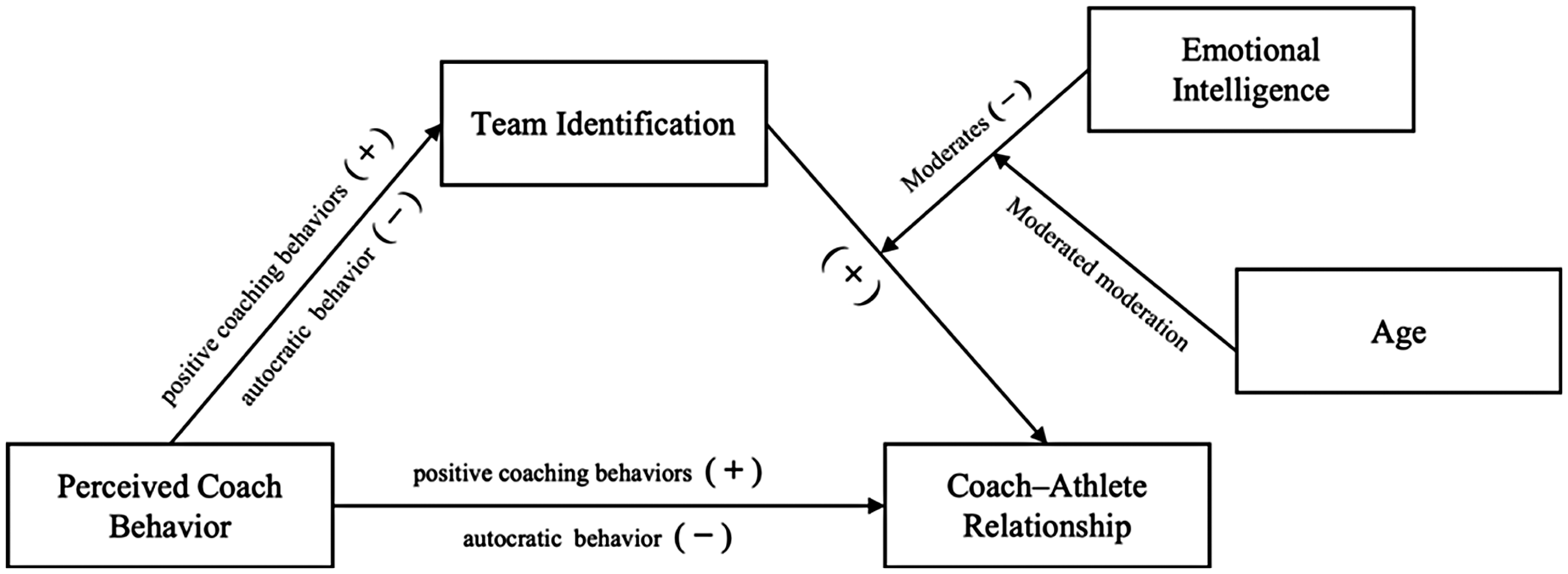
Conceptual model of the dual-moderated mediation framework. Notes: Team identification is hypothesized to mediate the association between perceived coach behavior and the coach–athlete relationship. Positive coaching behaviors (training and instruction, democratic behavior, social support, and positive feedback) are expected to have positive effects on team identification and the coach–athlete relationship, whereas autocratic behavior is expected to exert negative effects. Emotional intelligence moderates the association between team identification and the coach–athlete relationship, and age further moderates this moderating effect.
Method
Participants
Using a convenience sampling approach, a questionnaire survey was administered via the Wenjuanxing platform (https://www.wjx.cn/) to athletes from several professional training teams. A total of 600 questionnaires were distributed, with 590 questionnaires returned. After removing incomplete or unusually fast responses, 581 valid questionnaires were retained, resulting in a valid response rate of 96.83%. Of the participants, 379 were male athletes (65.2%) and 202 were female athletes (34.8%). The sample included 4 International Masters of Sport (0.7%), 6 National Masters of Sport (1.0%), 91 First-Level Athletes (15.7%), 396 Second-Level Athletes (68.2%), and 84 athletes with no official ranking or missing data (14.5%). The average age of participants was 20.7 years (SD = 2.8), and the average duration of athletic training was 5.6 years (SD = 3.1). The athletes represented a range of sports, including ball games (e.g., football, basketball, volleyball, badminton), track and field (e.g., sprinting, middle- and long-distance running, high jump, long jump, shot put), and shooting sports (e.g., archery, pistol, rifle). The Beijing Sport University Ethics Review Committee at Beijing Sport University approved our study (approval:2025123H) on March 18, 2025. All participants provided informed consent prior to participation, and the procedures adhered to the ethical principles outlined in the Declaration of Helsinki.
Measures
Perceived coach behavior (PCB)
PCB was measured using the Sports Leadership Behavior Scale developed by Ma and Wang, 24 which is a culturally adapted and revised version of Chelladurai's original Leadership Scale for Sports (LSS). 25 The scale consists of 30 items covering five dimensions: training and instruction (TAI), democratic behavior (DB), autocratic behavior (AB), social support (SS), and positive feedback (PF). Items were rated on a 5-point Likert scale ranging from 1 (“strongly disagree”) to 5 (“strongly agree”), with higher scores indicating higher levels of the respective coaching behaviors. The five-factor model showed acceptable model fit: χ2/df = 2.97, CFI = 0.916, TLI = 0.904, RMSEA = 0.058, 90% CI = [0.054, 0.062], SRMR = 0.052. All factor loadings were statistically significant and exceeded commonly accepted thresholds. In the present study, the overall internal consistency of the scale was excellent, with Cronbach's alpha = 0.941.
Coach–athlete relationship (CAR)
The quality of the CAR was measured using the Coach–Athlete Relationship Questionnaire (CART-Q) developed by Jowett and Ntoumanis. 26 The scale consists of 11 items encompassing three dimensions: closeness, commitment, and complementarity. Participants responded using a 5-point Likert scale ranging from 1 (“strongly disagree”) to 5 (“strongly agree”), with higher scores indicating a stronger and more positive coach–athlete relationship. The CART-Q has been validated for use among Chinese athletes. 13 In the present study, the coach–athlete relationship was treated as a unidimensional construct, and the total score was used in subsequent analyses. The scale demonstrated excellent internal consistency, with Cronbach's alpha = 0.949.
Team identification (TI)
TI was measured using the Organizational Identification Questionnaire developed by Mael and Ashforth. 27 This unidimensional scale comprises six items, each rated on a 5-point Likert scale ranging from 1 (“strongly disagree”) to 5 (“strongly agree”), with higher scores indicating a stronger sense of identification with the team. The scale has been validated among Chinese university students. 28 In the present study, the scale demonstrated good internal consistency, with Cronbach's alpha = 0.862.
Emotional intelligence (EI)
EI was measured using the Emotional Intelligence Scale (WLEIS) developed by Wong and Law. 29 The scale consists of 16 items covering four dimensions: self-emotion appraisal, others’ emotion appraisal, use of emotion, and regulation of emotion. Items were rated on a 5-point Likert scale ranging from 1 (“strongly disagree”) to 5 (“strongly agree”), with higher scores indicating higher levels of emotional intelligence. The four-factor model demonstrated excellent fit to the data: χ2/df = 1.175, CFI = 0.979, TLI = 0.975, RMSEA = 0.036, 90% CI = [0.027, 0.044], SRMR = 0.032. All factor loadings were statistically significant and exceeded commonly accepted thresholds. In the present study, the scale demonstrated excellent internal consistency, with Cronbach's alpha = 0.952.
Data analysis
Confirmatory factor analysis (CFA) was first conducted in Mplus8.0 to assess the structural validity of each measurement scale. Subsequently, descriptive statistics and Pearson correlation analyses were conducted in SPSS 29.0. Next, using Model 4 of the PROCESS3.3 macro in SPSS 29.0, the predictive effect of perceived coach behavior (PCB) on the coach–athlete relationship (CAR) and the mediating role of team identification (TI) were examined. The bootstrap method with 5000 resamples was employed to generate 95% confidence intervals (CIs) for the indirect effects. A mediation effect was considered statistically significant if the confidence interval did not include zero. Moderation and moderated mediation analyses were conducted using the PROCESS3.3 macro for SPSS 29.0. Specifically, Model 14 was used to test the moderating role of EI within the mediation model (i.e., moderated mediation), while Model 18 was employed to examine a moderated moderation model involving both EI and age. This three-way interaction model assessed whether age conditions the moderating role of EI in the relationship between TI and CAR. All continuous variables involved in interaction terms (emotional intelligence and age) were mean-centered prior to analysis to facilitate interpretation of interaction effects. The significance of conditional indirect effects of TI on CAR at different levels of EI and age was also tested using the bootstrap method (5000 resamples, 95% CIs), helping to delineate the conditional effects and boundaries of EI and age within the mediation mechanism.
Common method bias test
Common method bias was tested via Harman's single-factor test. 30 Results showed that nine factors had eigenvalues greater than 1, and the first factor accounted for 36.18% of the total variance, which falls below the commonly accepted threshold of 40%. These findings suggest that common method bias was unlikely to pose a significant threat to the validity of the study's results.
Results
Descriptive statistics and correlation analysis
The Means, Standard deviations, and Pearson correlation coefficients among the study variables (N = 581) are presented in Table 1. As shown in the table, several variables demonstrated statistically significant correlations. Specifically, the CAR was positively correlated with DB (r = 0.46, p < 0.01), SS (r = 0.48, p < 0.01), PF (r = 0.49, p < 0.01), TI (r = 0.65, p < 0.01), and EI (r = 0.73, p < 0.01). Conversely, CAR was negatively correlated with AB (r = −0.23, p < 0.01). Age was weakly but significantly negatively associated with TAI (r = −0.23, p < 0.01), DB (r = −0.31, p < 0.01), SS (r = −0.24, p < 0.01), and PF (r = −0.20, p < 0.01). Notably, age was significantly and negatively correlated with several perceived coaching behavior dimensions (e.g., training and instruction, democratic behavior, and social support), providing preliminary support for age as a theoretically relevant moderator in subsequent analyses.
Descriptive statistics and correlation analysis (N = 581).
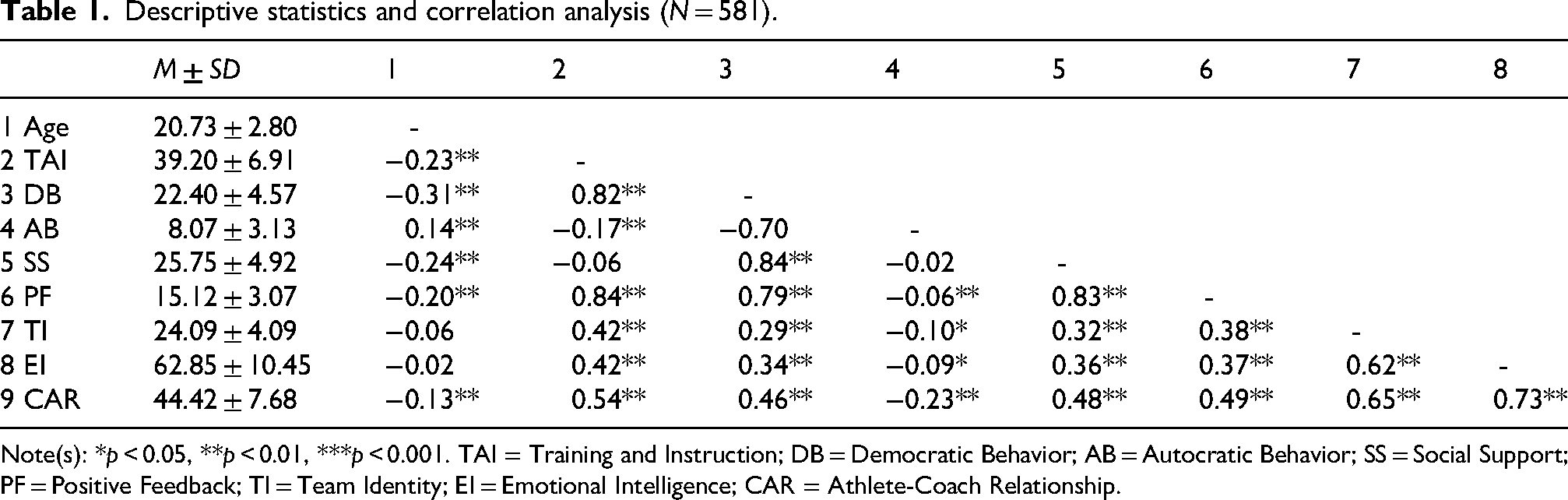
Note(s): *p < 0.05, **p < 0.01, ***p < 0.001. TAI = Training and Instruction; DB = Democratic Behavior; AB = Autocratic Behavior; SS = Social Support; PF = Positive Feedback; TI = Team Identity; EI = Emotional Intelligence; CAR = Athlete-Coach Relationship.
Test of the mediating role of team identification
To examine the mediating role of TI in the relationship between PCB and the CAR, each of the five dimensions of PCB was entered separately as the independent variable, with TI specified as the mediator and CAR as the dependent variable. Mediation analyses were conducted using Model 4 as proposed by Hayes. 31 The four perceived positive coaching behaviors (Training and Instruction, TAI; Democratic Behavior, DB; Autocratic Behavior, AB; Social Support, SS; Positive Feedback, PF) significantly and positively predicted CAR (B = 0.60, 0.77, 0.74, 1.24, respectively), with all 95% confidence intervals (CIs) excluding zero. In contrast, AB significantly and negatively predicted CAR (B = –0.55, 95% CI = [−0.75, −0.36]). TAI, DB, SS, and PF were also found to significantly and positively predicate TI (B = 0.25, 0.26, 0.27, 0.50, respectively), while AB negatively predicted TI (B = –0.13), with all 95% confidence intervals (CIs) excluding zero. After including TI as a mediator, the effects of TAI, DB, SS, and PF on CAR remained significant (B = 0.36, 0.50, 0.46, 0.73, respectively), with an indirect effect of 0.24, 0.27, 0.28, 0.51 and 95% confidence intervals (CIs) excluding zero. The negative effect of AB on CAR also remained significant (B = –0.40), with an indirect effect of −0.15, 95% CI = [−0.27, − 0.03]. These findings suggest that TI partially mediates the relationship between PCB and CAR (see Table 2). This result supported Hypothesis 1.
Test of the mediating effect of team identification between perceived coaching behavior and the coach–athlete relationship (N = 581).
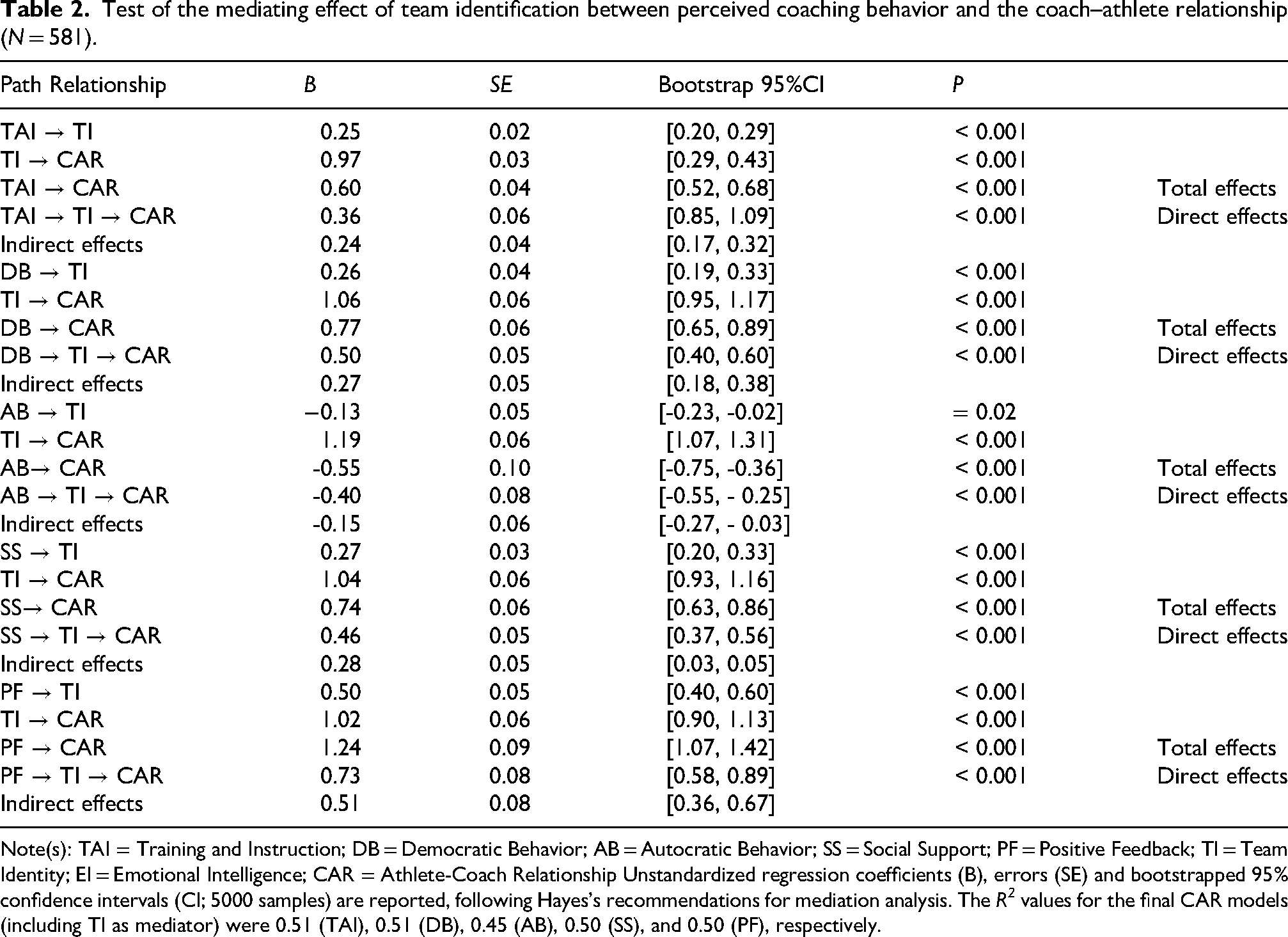
Note(s): TAI = Training and Instruction; DB = Democratic Behavior; AB = Autocratic Behavior; SS = Social Support; PF = Positive Feedback; TI = Team Identity; EI = Emotional Intelligence; CAR = Athlete-Coach Relationship Unstandardized regression coefficients (B), errors (SE) and bootstrapped 95% confidence intervals (CI; 5000 samples) are reported, following Hayes's recommendations for mediation analysis. The R2 values for the final CAR models (including TI as mediator) were 0.51 (TAI), 0.51 (DB), 0.45 (AB), 0.50 (SS), and 0.50 (PF), respectively.
Test of the moderating effect of emotional intelligence
To examine the moderating effect of EI, Model 14 of the PROCESS3.3 macro 31 was employed to test whether EI moderates the second stage of the mediation pathway. In the model using TAI as the independent variable, the interaction term between TI and EI significantly and negatively predicted the CAR (B = –0.011, 95% CI = [–0.016, −0.004]). A simple slope analysis (see Figure 2) indicated that the positive effect of TI on CAR was stronger when EI was low (B = 0.56, 95% CI = [0.43, 0.68]) and weaker when EI was high (B = 0.34, 95% CI = [0.19, 0.48]). These results suggest that EI negatively moderated the strength of the relationship between TI and CAR. Similar interaction effects were observed in models where DB, SS, PF, and AB served as independent variables. In each case, the interaction between TI and EI significantly moderated the second stage of the mediation model, providing further support for the presence of a moderated mediation effect (see Supplementary Table 3). This result supported Hypothesis 2.
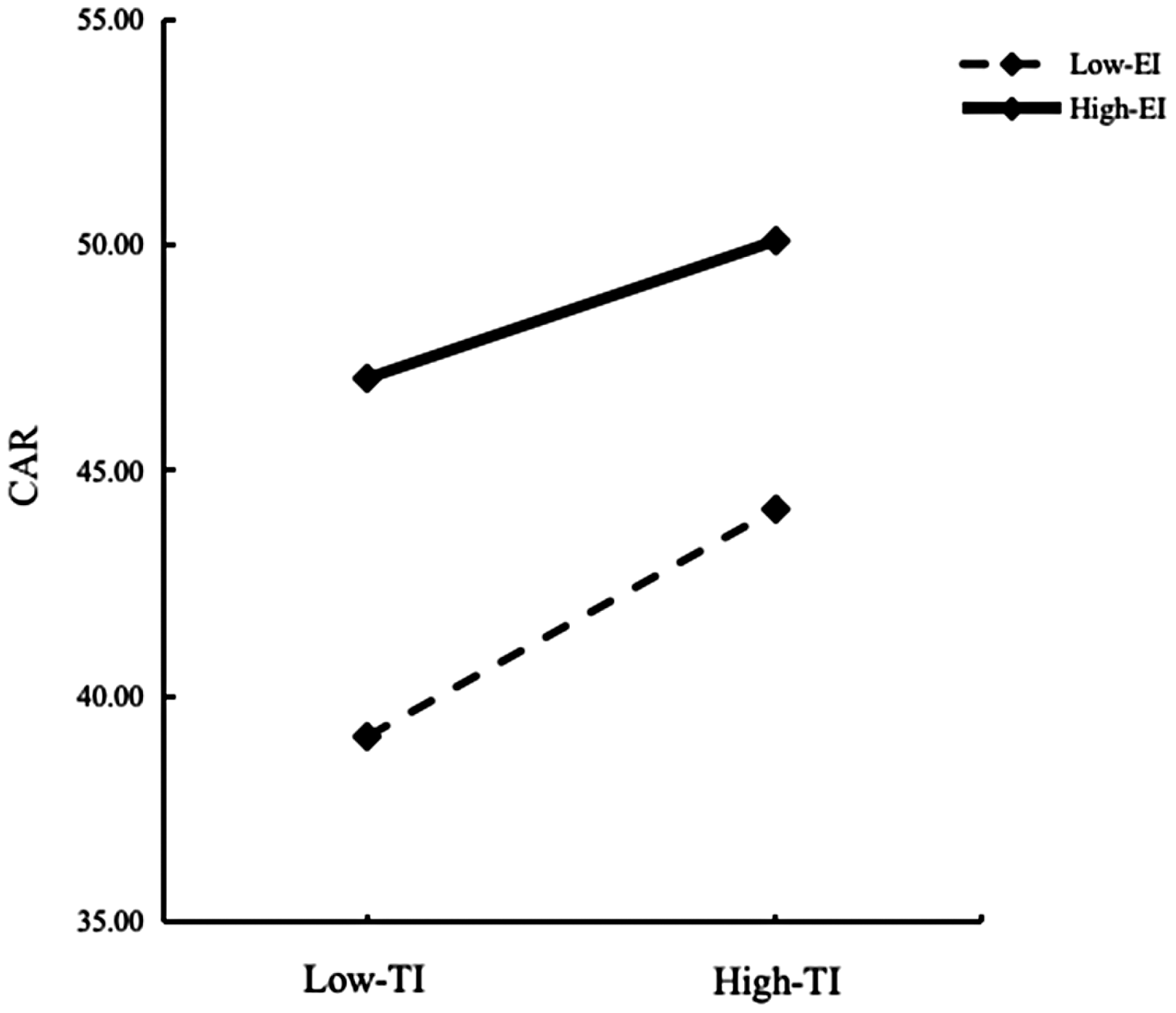
Interaction plot illustrating the moderating effect of EI on the relationship between TI and CAR. Notes: EI = Emotional Intelligence. TI = Team Identification. CAR = Coach–Athlete Relationship.
Test of the second-order moderating effect of age
To investigate the joint moderating effects of EI and age, Model 18 of the PROCESS3.3 macro 31 was employed to test the presence of a second-order (three-way) moderation effect. Using TAI as the independent variable, the Model 18 analysis revealed significant interaction effects. Specifically, the interaction between TI and EI was significant (B = –0.07, 95% CI = [–0.12, −0.03]), as were the interactions between TI and age (B = –0.24, 95% CI = [–0.38, −0.10]) and between EI and age (B = 0.078, 95% CI = [–0.13, −0.02]). Most notably, the three-way interaction among TI, EI, and age was also significant (B = 0.003, 95% CI = [0.001, 0.006]), indicating that the strength of EI's moderating role is conditioned by age. A simple slope analysis of the three-way interaction (see Figure 3) showed that when age was relatively low, EI significantly and negatively moderated the relationship between TI and the CAR (B = –0.014, p < 0.001). However, when age was relatively high (≥ 20.34 years), the moderating effect of EI became non-significant (B simple slope = −0.006, 95% CI = [–0.0126, 0.0000]). These findings suggest that age significantly moderates the moderating effect of EI, providing evidence for a second-order moderated mediation model. Similar patterns were found in additional models where DB, SS, and PF served as independent variables (see Supplementary Table 4). However, in the model using AB as the predictor, the three-way interaction among TI, EI, and age was not significant (B = 0.002, 95% CI = [–0.0002, 0.0045]), indicating that age did not significantly condition the moderating role of EI in this case. This result supported Hypothesis 3.
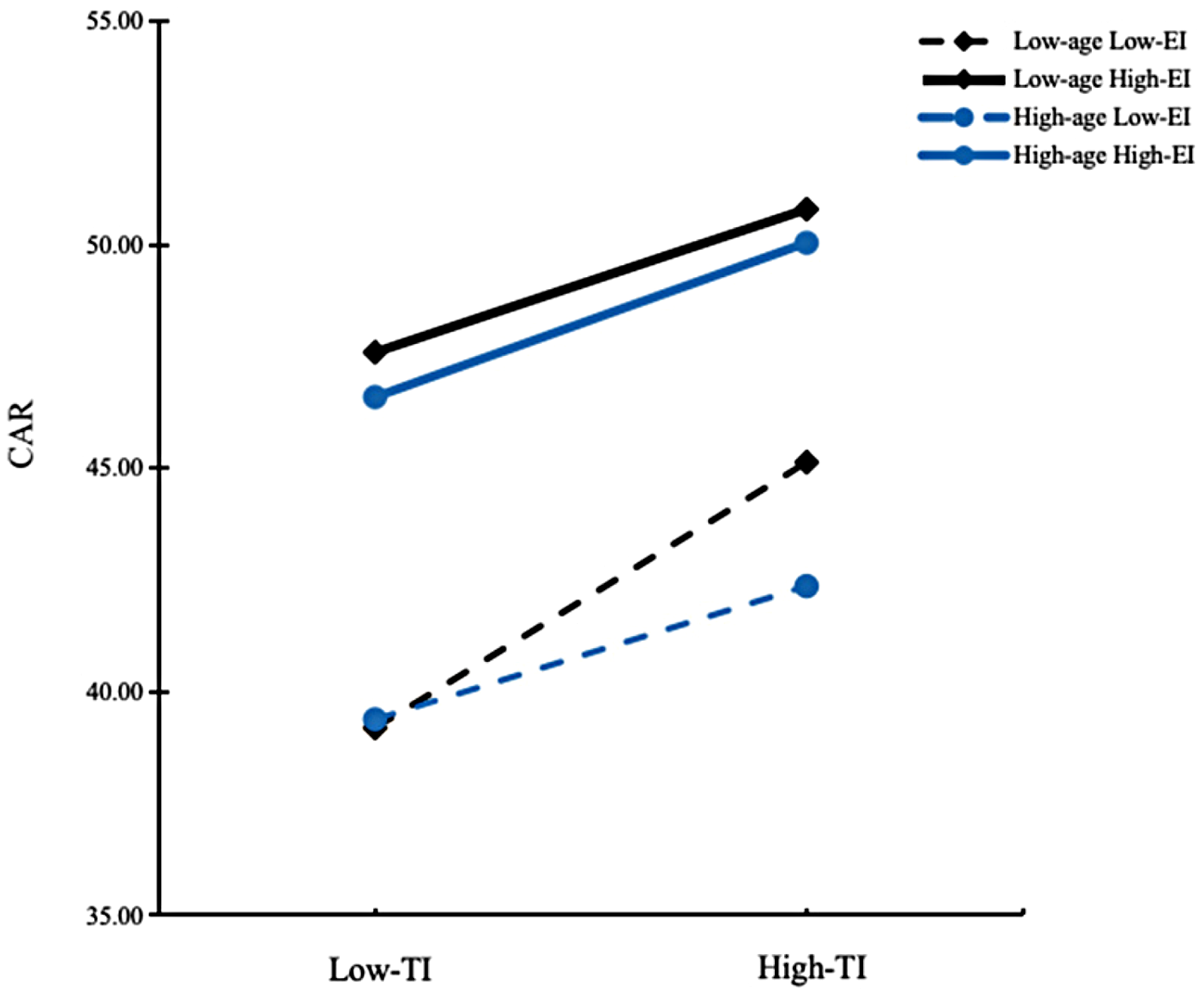
A three-way interaction plot illustrating the second-order moderating effects of EI and age on the relationship between TI and the CAR. Notes: EI = Emotional Intelligence. TI = Team Identification. CAR = Coach–Athlete Relationship.
In summary, the dual-moderated mediation model was supported across all models except for the one involving AB. Specifically, the mediating effect of TI was jointly moderated by EI and age. EI negatively moderated the mediating pathway such that the effect of TI on the CAR was stronger among individuals with lower EI and weaker among those with higher EI. Furthermore, age moderated the moderating effect of EI, such that this effect was more pronounced among younger athletes and gradually diminished with increasing age, eventually becoming non-significant. These findings suggest that age acts as a higher-order moderator, influencing the strength of EI's moderating effect on the relationship between TI and CAR. This provides empirical support for a moderated moderation effect embedded within a moderated mediation model, highlighting the complex interplay among individual psychological traits and demographic factors in shaping the coach–athlete relationship.
Discussion
This study explores the mechanism by which perceived coach behavior (PCB) influences athlete-coach relationship (CAR). Integrating a group-level perspective with an individual-differences perspective, we examined the mediating role of team identification (TI) in the association between PCB and CAR, as well as the independent and interactive moderating effects of emotional intelligence (EI) and age along this mediation pathway. The results indicated that TI partially mediated the relationship between PCB and CAR. Specifically, perceived positive coaching behaviors—such as training and instruction, democratic behavior, social support, and positive feedback—enhanced CAR by strengthening athletes’ team identification, whereas autocratic behavior exerted a negative effect on CAR by undermining team identification. Further analyses revealed that the positive effect of TI on CAR was not uniform across athletes. Specifically, EI significantly moderated this association, such that the predictive effect of TI on CAR weakened as EI increased. Moreover, this moderating effect exhibited developmental specificity: the moderating role of EI was more pronounced among younger athletes and became nonsignificant among older athletes. Taken together, these findings support a dual-moderated mediation model. This model highlights team identification as a group-level psychological mechanism linking PCB to CAR, while also clarifying how this mechanism operates differently across individual characteristics and developmental stages.
From a social identity perspective, the present findings indicate that TI partially mediates the relationship between PCB and CAR. According to Social Identity Theory, TI reflects individuals’ sense of belonging. Beyond this, it shapes how individuals define boundaries between the self and others and interpret the motives underlying others’ behaviors. 32 In competitive sport contexts, when athletes perceive coaches as displaying positive behaviors in training instruction, decision-making, and emotional support, these behaviors reinforce shared team goals and values. Such perceptions encourage athletes to categorize coaches as part of the in-group (“we” or “us”), thereby enhancing TI. 33 At higher levels of TI, athletes are more likely to interpret coaches’ behaviors in a relational and benevolent manner, viewing them as actions undertaken for both team and individual development. Such interpretations strengthen trust, emotional bonding, and willingness to cooperate, ultimately fostering a higher-quality CAR. 11 In contrast, autocratic behaviors convey signals of control and emotional distance, undermining athletes’ TI and increasing the likelihood that coaches are perceived as external controllers or emotionally detached authority figures. Such interpretations promote more negative evaluations of coaches’ behaviors, leading to impairments in CAR at both cognitive and emotional levels. 34 Thus, whether the influence is positive or negative, PCB affects the quality of CAR indirectly by altering athletes’ level of TI. Through this identity-based emotional and behavioral interpretive mechanism, athletes’ perceptions of coaches are translated into relationship outcomes. 35
Importantly, the present findings reveal that EI significantly moderates the association between TI and the CAR, such that the predictive effect of TI on CAR gradually weakens as EI increases. This finding is consistent with prior research highlighting the moderating role of EI in interpersonal relationships. 36 From an emotion regulation perspective, athletes with higher EI possess more advanced internal emotion regulation and socio-emotional processing capacities. As a result, they are more likely to rely on internal resources to evaluate and regulate relational cues during interactions, rather than depending primarily on the external emotional support derived from team identification.37,38 In contrast, athletes with lower EI have more limited internal regulatory strategies and therefore tend to rely more heavily on group belongingness and identity-based resources to obtain emotional security and relational stability. Accordingly, EI not only facilitates adaptive functioning within relationships, 36 but also operates as a substitutive mechanism under certain conditions. Through this mechanism, internal emotion regulation reduces reliance on TI as an external, identity-based emotional resource, thereby sustaining the quality of the coach–athlete relationship. 39
Notably, from a developmental perspective, our findings indicate that age, as a developmental factor, moderates the moderating role of EI in the association between TI and the CAR. Specifically, the moderating effect of EI on the TI–CAR relationship was significant among younger athletes but became nonsignificant once age exceeded 20.34 years. This pattern can be interpreted from a developmental perspective informed by Self-Determination Theory. According to this framework, the development of autonomy and self-regulation is stage-dependent. Individuals in earlier developmental stages rely more heavily on external supportive environments to satisfy basic psychological needs. 40 In competitive sport contexts, the identity-based emotional meaning provided by TI is therefore more likely to function as a salient external regulatory resource for maintaining the coach–athlete relationship. Athletes with different levels of EI vary in their capacity to utilize this resource effectively. As individuals mature, emotion regulation and relationship-maintenance strategies become increasingly internalized. Consequently, athletes tend to rely more on internal regulatory capacities rather than team-based identity frameworks to sustain relationship quality,23,40 which attenuates the moderating role of EI along the TI–CAR pathway. Notably, in models with autocratic behavior as the predictor, the three-way interaction among TI, EI, and age was not significant. This indicates that the negative impact of autocratic behavior on CAR is relatively stable and less susceptible to buffering by individual emotional capacities or developmental stage. 8 This finding further suggests that the moderating roles of EI and age are not universally applicable across all types of coaching behaviors, highlighting clear boundary conditions for their effects.
Overall, this study systematically examined the psychological mechanisms through which PCB influences CAR from both group-level and individual-differences perspectives, offering important theoretical contributions. By introducing TI as a group-level psychological construct, the study elucidates an identity-based mediating mechanism through which PCB affects CAR, thereby addressing the relative neglect of group-level processes in prior research. Moreover, by incorporating EI and age within a unified analytical framework, the study reveals the conditional moderating role of EI along the TI–CAR pathway and delineates its developmental boundary, advancing a developmental understanding of how individual differences shape the formation of coach–athlete relationships.
Although this study offers theoretical and practical contributions, several limitations should be acknowledged. First, the cross-sectional design limits causal inferences among the variables; future research could employ longitudinal or multi-wave designs to examine the dynamic stability of the mediating and moderating effects. Second, the findings are based solely on athletes’ self-reports, which may be subject to social desirability or recall bias; future studies may benefit from incorporating coaches’ self-evaluations or multi-source data to obtain a more comprehensive understanding. In addition, the present study focused primarily on team identification as a group-level psychological mechanism and did not simultaneously examine other potential pathways (e.g., trust, motivation, or leadership identification). Future research could extend the model by incorporating additional mediators or moderators to further clarify the mechanisms linking PCB and CAR. Finally, the sample was drawn from the Chinese competitive sport context, where specific training systems and cultural norms may limit the generalizability of the findings. Replication across different cultural and competitive settings is therefore warranted to evaluate the robustness and boundary conditions of the proposed model.
Practical applications
The results offer actionable guidance for coaches and sport psychologists seeking to enhance leadership effectiveness. For athletes who are younger or exhibit lower EI, it is particularly important to cultivate a supportive team environment and reinforce collective identity to enhance relational outcomes. Conversely, for athletes with higher EI or greater age-related maturity, leadership strategies should shift toward more personalized, autonomy-supportive approaches, emphasizing individualized communication, emotional self-regulation, and flexible management. By adopting differentiated strategies that are sensitive to both psychological traits and developmental stages, coaches may foster stronger and more effective coach–athlete relationships, ultimately improving training efficiency and performance outcomes.
Conclusion
This study demonstrated that perceived coach behavior (PCB) influences the coach–athlete relationship (CAR) through the mediating role of team identification (TI), and that this pathway is jointly moderated by emotional intelligence (EI) and age. Specifically, positive coaching behaviors were found to enhance CAR by strengthening athletes’ identification with the team, whereas autocratic behavior impaired CAR by undermining that identification. Furthermore, EI moderated the relationship between TI and CAR, with this effect being significant among younger athletes but diminishing among older athletes. Therefore, coaches are encouraged to adopt differentiated behavioral approaches based on athletes’ emotional maturity and developmental stage—emphasizing group cohesion and support for younger or lower-EI athletes, while implementing more autonomy–supportive and individualized strategies for those with higher EI or greater age.
Supplemental Material
sj-docx-1-spo-10.1177_17479541261430599 - Supplemental material for Optimizing coach–athlete relationships: How team identification, emotional intelligence, and age influence the effects of perceived coach behavior
Supplemental material, sj-docx-1-spo-10.1177_17479541261430599 for Optimizing coach–athlete relationships: How team identification, emotional intelligence, and age influence the effects of perceived coach behavior by Huimin Liu, Xiaoran Gao, Huan Wang, Lulu Zhou and Ran Feng in International Journal of Sports Science & Coaching
Supplemental Material
sj-sav-2-spo-10.1177_17479541261430599 - Supplemental material for Optimizing coach–athlete relationships: How team identification, emotional intelligence, and age influence the effects of perceived coach behavior
Supplemental material, sj-sav-2-spo-10.1177_17479541261430599 for Optimizing coach–athlete relationships: How team identification, emotional intelligence, and age influence the effects of perceived coach behavior by Huimin Liu, Xiaoran Gao, Huan Wang, Lulu Zhou and Ran Feng in International Journal of Sports Science & Coaching
Footnotes
Acknowledgements
The authors thank the participants for their time and effort in contributing to this study.

Ethical considerations
This study was approved by the Research Ethics Committee of Beijing Sport University (approval number: 2025123H).
Consent to participate
All participants provided electronic written informed consent prior to participation in the research.
Consent for publication
Confirming that informed consent for publication was provided by the participant(s).
Funding
The authors received no financial support for the research, authorship, and/or publication of this article.
Declaration of conflicting interests
The authors declared no potential conflicts of interest with respect to the research, authorship, and/or publication of this article.
Data availability
Data used within the study is available upon reasonable request from the corresponding author.
Supplemental material
Supplemental material for this article is available online.