







Abstract
In the Olympic snowboard halfpipe discipline, rotation is the key indicator of trick difficulty encouraging riders to perform multiple tricks involving a high amount of rotation in their runs. Therefore, this study explored the predictive capacity of angular velocity and airtime on the amount of rotation using deterministic models based on the performance parameters of the Men's Final at the Beijing 2022 Olympic Winter Games. IMU data and video recordings were used to determine the biomechanical performance parameters of 122 tricks performed by 12 riders with random intercept models being employed to develop the aforementioned deterministic models. The ratio between angular velocity and airtime at frontside/switch frontside was greater than 4:1, and at backside/switch backside it was close to 5:1. The coefficient of determination overall indicated a high level of fit, providing significant standardised estimates for all performance parameters investigated. The results showed that, regardless of the direction of rotation, angular velocity was the key performance indicator for increasing the amount of rotation, while airtime showed a comparably small influence. These results are important for coaches and riders in teaching and learning new skills as they indicate to focus more on rotation initiation than increasing jump height.
Keywords
Introduction
Snowboard halfpipe is part of the Olympic winter games since 1998 and since then it has been characterized as a rapidly developing sport. 1 The halfpipe is a half tube made of ice and snow in which difficult tricks are ideally performed with high amplitude, good execution and an individual style. These tricks are combined in a single run with as much variety as possible in terms of tricks, grabs (see glossary), rotations about variable axes and are subjectively scored by judges. 2 In contrast to other technical-acrobatic sports like gymnastics or diving there are no fixed difficulty ratings for specific tricks. The difficulty of a trick is evaluated by each judge individually. Halfpipe judges primarily use the amount of rotation to determine trick difficulty. 3 Therefore, based on these judging criteria 2 riders are encouraged to perform tricks with higher amounts of rotation.
Snowboard tricks include rotational movements around all three body axes.4,5 They are typically prepared on a trampoline6,7 as sports-specific as possible with a bounce board (see glossary) prior to being practiced on-snow or being performed under contest conditions. Merz, et al. 8 demonstrated that, regardless of the direction of rotation, the key performance indicators to increase the amount of rotation for snowboard halfpipe tricks on the trampoline are angular velocity, take-off velocity and the moment of inertia. In snowboard freestyle, obvious ways to increase the amount of rotations are to achieve a long airtime or spin faster. In the snowboarding community, achieving a long airtime is referred to “going big”. Merz, et al. 8 were able to show that for snowboard halfpipe tricks on the trampoline, it is more effective to increase the angular velocity rather than airtime (ratio of standardized estimate 3:1), which means “spin fast” rather than “go big”.
They also pointed out that the deterministic models on the trampoline are not easily extrapolated to on-snow conditions due to the missing (horizontal) translational motion on the trampoline, the different take-off and landing positions, the different sports equipment, and the fact that snowboarders perform in a much more complex and open environment without strictly regulated sports facilities and equipment. From a scientific perspective, it is unknown which movement parameters need to be developed when aiming at enhancing trick difficulty in a training process. Thus, it is unknown whether “go big” or “spin fast” is more effective under on-snow contest conditions.
Therefore, this study aimed to determine the influence of the angular velocity and airtime on the amount of rotation with world elite level performers using deterministic models. As the direction of rotation is believed to influence trick execution a second aim was to differentiate between frontside/switch frontside and backside/switch backside rotations (see glossary).
Materials and methods
Subjects and tricks
Twelve male world elite level snowboard halfpipe riders (age: 26.3 ± 4.9 years) performed 145 successfully landed tricks during 36 runs (three per rider) in the snowboard halfpipe final at the Beijing 2022 Olympic Winter Games, held at the Zhangjiakou Genting Snow Park. Of these tricks, five were not fully captured by the measurement system and 18 tricks were performed after a bail (snowboard-specific term for fall or crash, see glossary). In total, 122 tricks (frontside/switch frontside: n = 75, backside/switch backside: n = 47) included corks, flips and rodeos (see glossary), were analyzed. The study was conducted in accordance with the Declaration of Helsinki and was approved by the Ethics Committee of German Sport University (no. 214/2022) on November 24, 2022, with the need for written informed consent waived. All riders were informed by FIS (International Ski and Snowboard Federation) about the data collection, who approved the use of the data for scientific purposes.
Measurement system
At the Beijing 2022 Olympic Winter Games inertial measurement unit (IMU) data were recorded with 100 Hz using an IMU device (Invensense ICM-20602; measurement range: ±2000 °/s, ±16 g), included a gyroscope and an acceleration sensor. The device were strapped to the lateral side of the one rider's boot, above the ankle strap (as illustrated Figure 1 in Gorges, et al. 9 ). The recording frequency for the selected data analysis is within the range recommended by Schüler, et al. 10 The IMUs were small (50 × 34 × 11 mm) and lightweight (22.4 g) to exclude any influence on the rider's performance (see Figure 1).
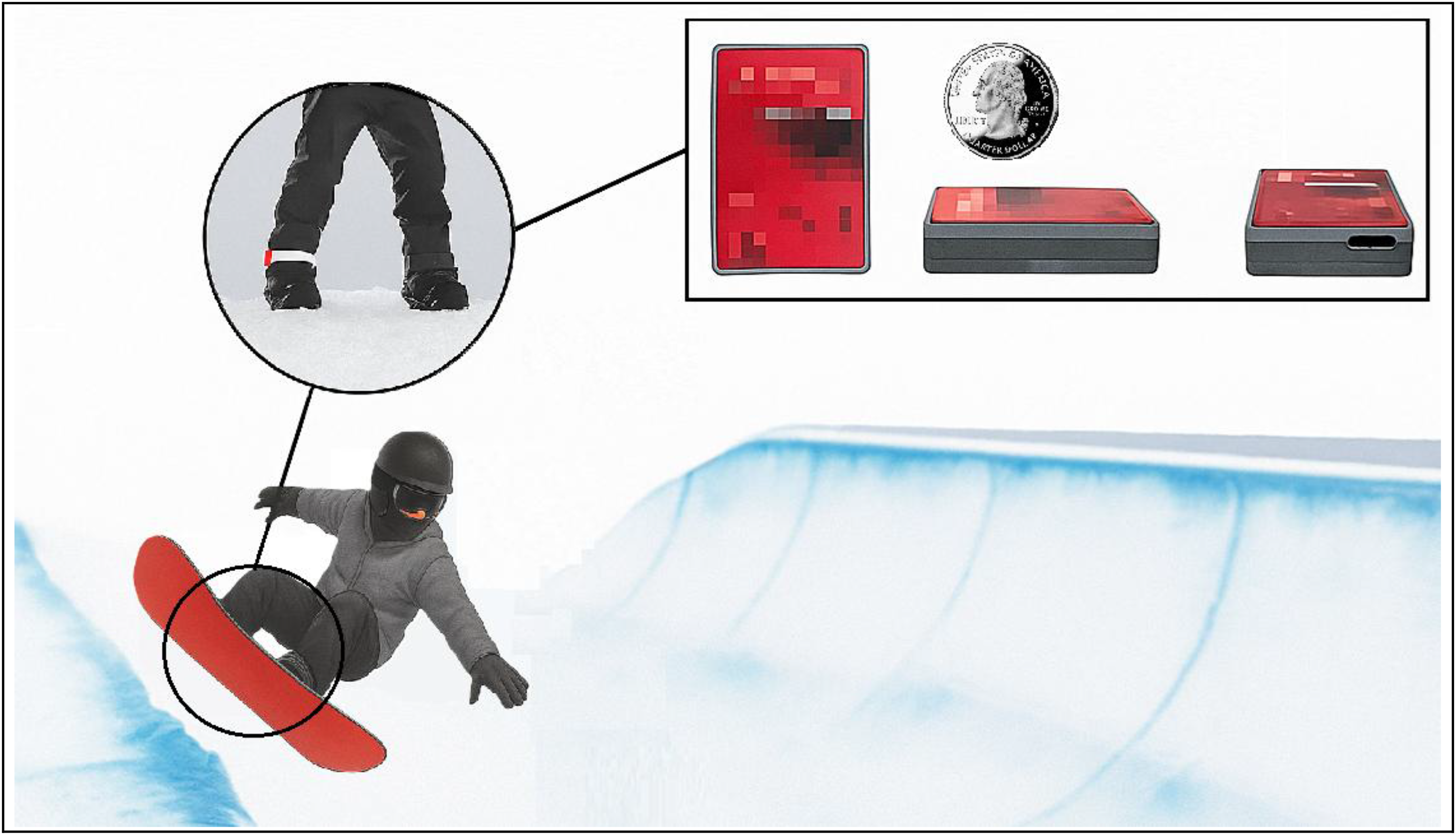
Measurement setup with IMU position (circle) and illustration of the IMU (top right) with coin for size comparison.
In order to determine take-off and landing in the IMU data, both events were detected manually in the broadcast video (framerate of 25 Hz and a resolution of 1920 × 1080px) such that the airtime and the duration of the riding phase between the tricks were known. The U-Net convolutional neural network, developed by Gorges, et al., 9 was then applied to the IMU acceleration data to detect whether the rider was in the air or in contact with the snow for each frame. The two binary time series were then synchronised by cross-correlation.
Procedures
All considered tricks (N = 122) were performed at the snowboard halfpipe men Olympic Winter Games final 2022 in Beijing. The halfpipe was 220 m long, 22 m wide, 7.2 m high with 18° inclination down the halfpipe and 82° inclination of vertical. The halfpipe consisted of hard-packed snow at −18.6°C snow temperature. During the competition, the average environmental conditions were characterized by an air temperature of −12.4 °C, a relative humidity of 47%, and a north-west wind blowing at 10.1 km/h. 11
In this study, the video and IMU data were used to calculate the following parameters:
Measured amount of rotation (mAR): The mAR was calculated as the cumulative displacement achieved in all three orthogonal axes during the airtime of the trick, expressed in degrees [°] (see eq. 1 and 2). Is


Airtime: The airtime represents the duration the rider spends in the air, beginning at the last contact of the snowboard with the snow at take-off and ends at the first contact of the snowboard with the snow at landing, 13 measured in seconds [s]. This definition has previously been used, with take-off and landing events manually identified through video analysis. 8
Angular velocity: The angular velocity refers to the mean rate of change in snowboard's orientation around the three body axes during the airtime, expressed in degrees per second [°/s]. This parameter is derived from raw IMU gyroscope data. 8 This method has been shown to provide sufficiently accurate measurements for the analysis of rotational movements in freestyle snowboard tricks. 14
Corresponding to Chow, et al., 15 the parameters were structured on a theoretical basis into an a-priori deterministic model according to Lees 16 adapted from Hay, et al. 17 as shown in Figure 2.
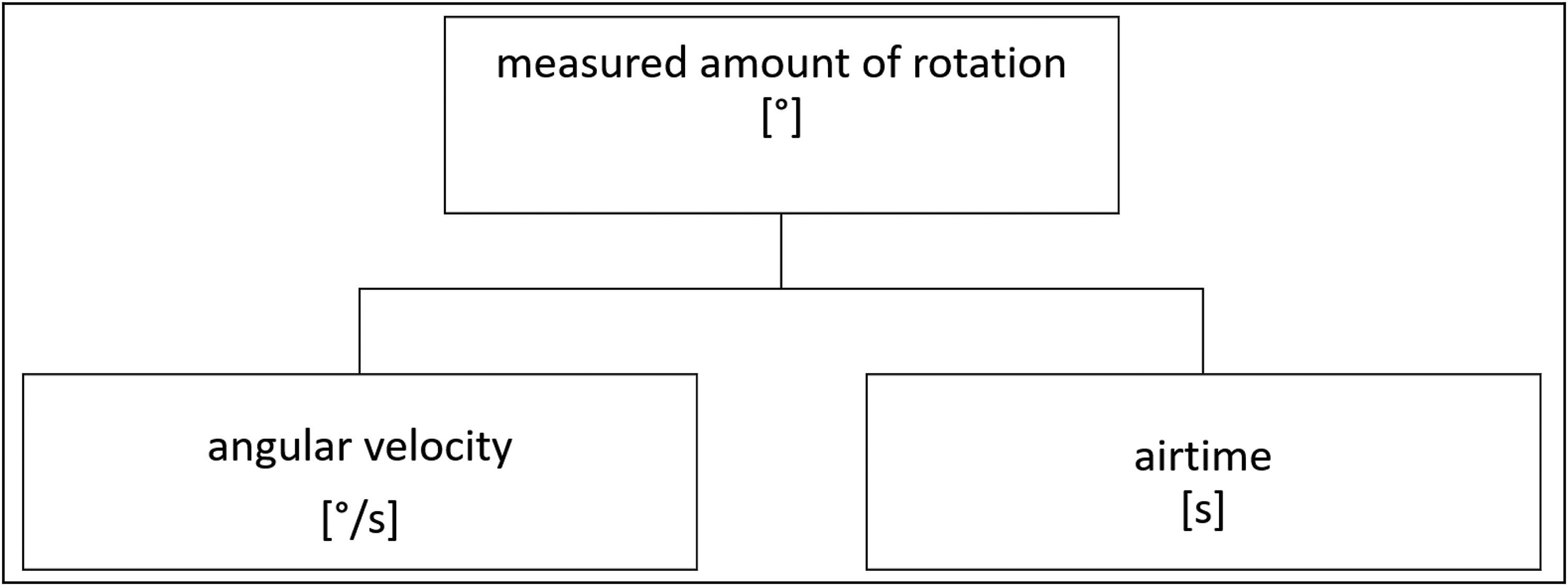
Deterministic model on theoretical basis.
This modelling paradigm uses a hierarchical framework to determine relationships between a movement outcome and the biomechanical factors that produce it. 18 The performance analysis on world elite level riders can clarify key performance indicators and provide evidence for coaches at elite level to recommend technique adjustments to their riders, resulting in a more systematic approach to defining training objectives and improving trick difficulty. The deterministic models were calculated for the direction of rotations (frontside/switch frontside and backside/switch backside) where forward and switch tricks (see glossary) were combined for model building, because it is assumed that there is no difference in the board movement between switch and forward tricks at the skill level of the subjects. 8 In snowboarding, ‘switch’ describes backwards riding, i.e., with the non-preferred foot forward. 19 The direction of rotation (frontside, switch frontside, backside and switch backside) describes the direction the rider rotates around the longitudinal axis and the direction of riding at take-off. A frontside rotation is counter-clockwise for a regular footer (see glossary; left foot forward on the snowboard) and clockwise for goofy footer (see glossary; right foot forward on the snowboard). Backside rotations are in the opposite direction, respectively.
Statistical analyses
The statistical procedure was conducted in accordance with the approach described in Merz, et al., 8 using R version 4.3.1. The mean (M) and range (minimum to maximum) were calculated for each parameter. Multicollinearity was checked by a variance inflation factor (VIF) using the “performance” package in R Core Team. The smallest possible value for VIF is 1, which indicates the complete absence of collinearity. A VIF value that exceeds 5 or 10 indicates a problematic amount of collinearity. 20 The deterministic model approach provides a strong theoretical and mechanical basis for examining the relative importance of various factors that influence the outcome of a movement task and clarifies key performance indicators. 15 Thereby, the influencing parameters are hierarchically structured on several levels. 18 The influence of the independent parameter on the dependent parameter one level above was tested using random intercept models with the function “lmer” in the R package “lme4”. 21 In contrast to multiple regression, random intercept models do not have the specific requirement that individual observations must be independent of each other. 22 The influence is shown on the basis of the standardized Estimate (sE), the z-transformed slope of the regression line. The coefficients of determination (R2-conditional and R2-marginal [R2m]) are given in the model diagram, which provides information on the model quality. 23 R2 describes the amount of variance explained and therefore the goodness-of-fit of the model. Thereby, R2-marginal accounts for the fixed effects, while R2-conditional is based on both the fixed effects and the random parts. 23 The more conservative parameter, R2m, was used for the coefficient of determination, since it does not take random effects into account. All statistical analyses were performed with the significance level set at α = 0.05.
Results
The deterministic models for backside/switch backside are illustrated in Figure 3, and for frontside/switch frontside tricks in Figure 4. The VIF varied from 1.21 to 1.90, thus indicating that multicollinearity can be excluded for the covariates. 20
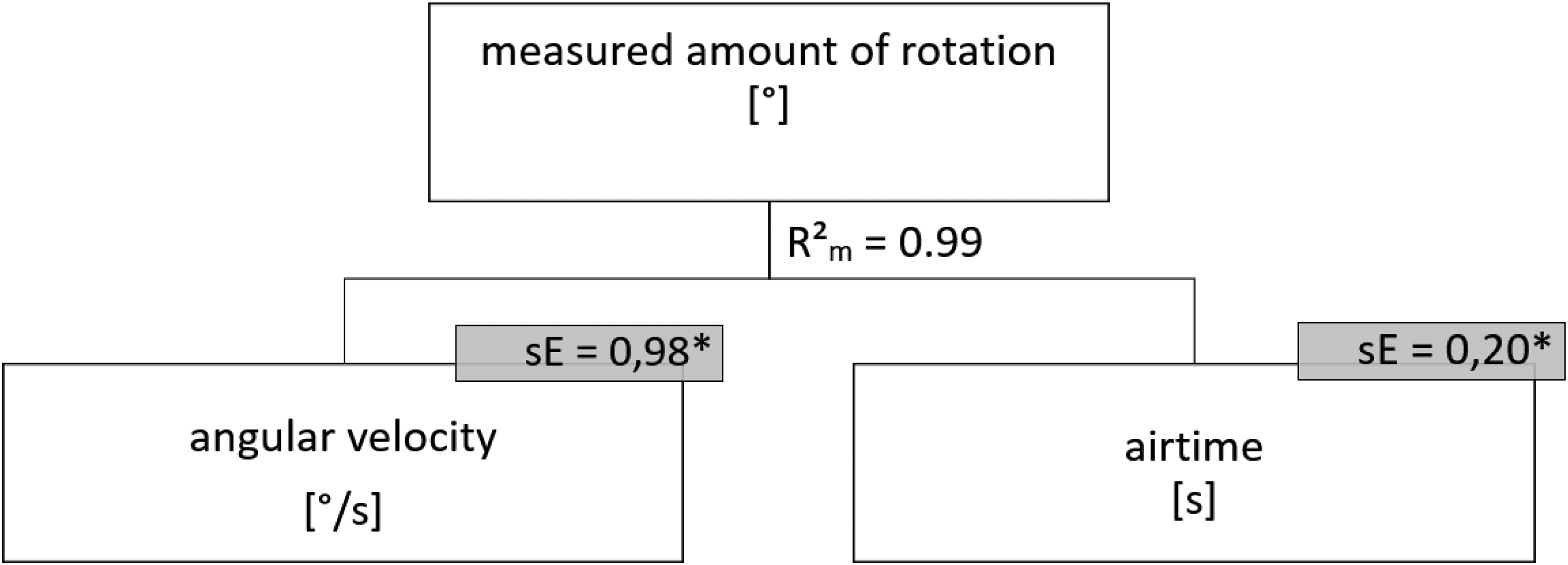
Deterministic model for halfpipe backside/switch backside tricks with standardized estimate (sE; *p < .05) and the coefficient of determination (R2m); n = 47.
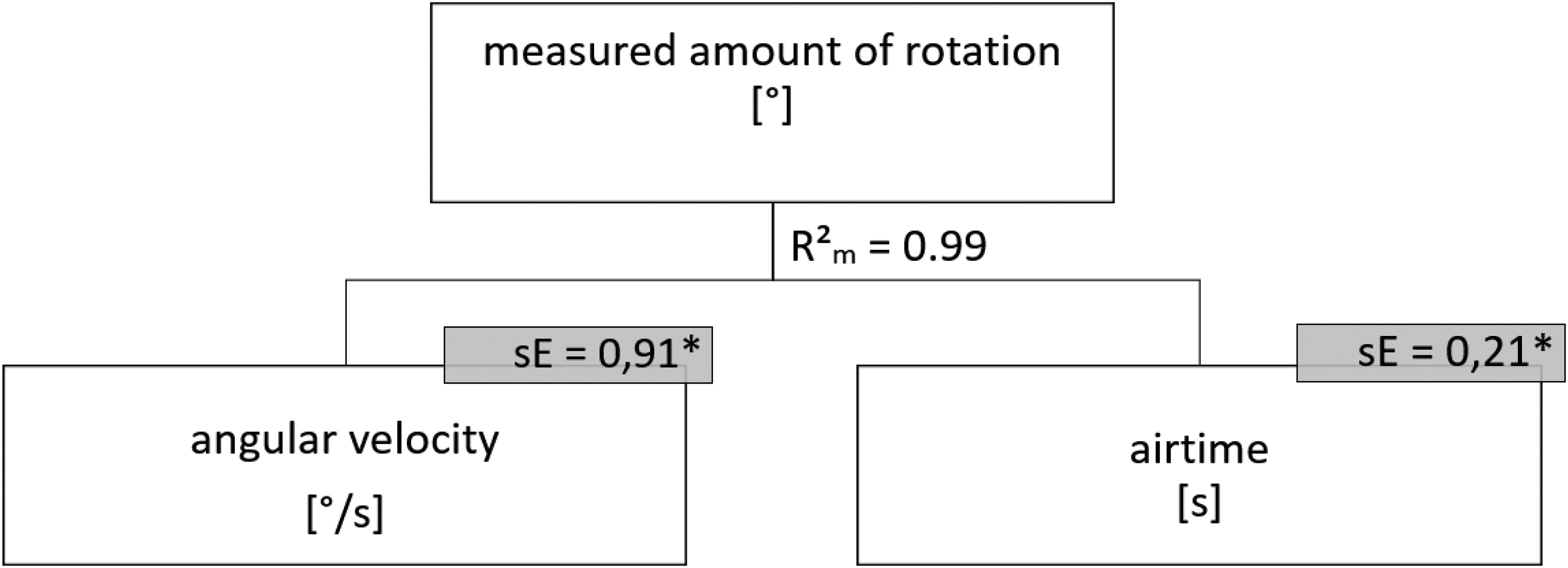
Deterministic model for halfpipe frontside/switch frontside tricks with standardized estimate (sE; *p < .05) and the coefficient of determination (R2m); n = 75.
Backside/switch backside
The deterministic model for halfpipe backside/switch backside tricks with sE and R2m values is shown in Figure 3. R2m explained almost complete variance explained (R2m = 0.99) of the measured amount of rotation (mAR; M: 780°; range: 279°-1199°) using angular velocity (380°/s; 133°/s - 570°/s) and airtime (2.08 s; 1.77 s - 2.57 s). The sE values were all significant (p < .001). For the mAR, the sE showed about five times greater influence of the angular velocity than of the airtime.
Frontside/switch frontside
The deterministic model for halfpipe frontside/switch frontside tricks with sE and R2m values is shown in Figure 4. The R2m explained an almost complete variance explained (R2m = 0.99) of the mAR (M: 1012°; range: 108°-1301°) using angular velocity (474°/s; 77°/s - 628°/s) and airtime (2.12 s; 1.41 s - 2.41 s). The sE values were all significant (p < .001). For the mAR, the sE showed more than four times greater influence of the angular velocity than of the airtime.
Discussion
In the current study, the influence of angular velocity and airtime on the amount of rotation was calculated using random intercept models for frontside/switch frontside and backside/switch backside halfpipe tricks performed by world elite level riders in the Men's Snowboard Halfpipe Final at the 2022 Beijing Olympic Winter Games and presented as deterministic models.
The dataset includes 47 backside/switch backside tricks and 75 frontside/switch frontside tricks. This reflects the fact that more frontside/switch frontside tricks were performed than backside/switch backside tricks at the Olympic Winter Games. 1 The measured amount of rotation (mAR) ranges regardless of the direction of rotation from 108° to 1301° and is calculated from tricks that include rotational values ranging from 180° to 1440° in their trick names. The mean mAR was higher for frontside/switch frontside tricks (1012°) compared to backside/switch backside tricks (780°), although the range of mAR values overlaps considerably. The difference in the mean mAR may result from no backside/switch backside tricks with 1440° amount of rotation being shown while most tricks with 180° rotation were backside/switch backside airs (see Glossary), which aligns with the common perception within the snowboarding community that backside/switch backside tricks are more difficult in the halfpipe. To our knowledge this has not yet been scientifically proven.
The airtimes ranged from 1.41 s to 2.57 s. On average, there were no clear differences in airtime between frontside/switch frontside and backside/switch backside tricks. The mean values were found to be 0.04 s apart, which corresponds to one frame at 25 Hz and lies therefore within the labeling inaccuracy. The mean airtime was slightly less than the snowboard big air tricks performed on an outdoor dry slope airbag (see Glossary) jump facility recorded by Jiang, et al., 24 but longer than the snowboard halfpipe tricks on the trampoline recorded by Merz, et al. 8 A longer airtime allows more time to perform the trick. At the same time, the longer airtime can have a positive effect on the judging criterion amplitude, which is not the case if the longer airtime is caused by a deep landing in the halfpipe. A deep landing in turn has an influence on the line 25 and therefore also on the next trick. The longest airtime was performed with a backside method (backside air with specific grab and tweak (see glossary)), reaching 366° mAR, which is a trick with 180° regarding the trick name, which indicates that the backside method according to Merz, et al. 5 takes a detour in rotation. In this context, a detour is defined as performing a trick in a way that the rider rotates more than assumed by the trick definition taking into account under- and over rotation during take-off and landing. 5
The angular velocity ranged, regardless of the direction of rotation, from 77°/s to 628°/s and resembles the range of the snowboard halfpipe tricks on the trampoline. 8 The mean angular velocity for backside/switch backside tricks (380°/s) was slower than for frontside/switch frontside tricks (474°/s). This was expected as the amount of rotation was higher for frontside/switch frontside tricks and the airtimes differed only marginally.
In the present statistical analysis multicollinearity was excluded, leading to statistically stable random intercept models. 26 Consequently, the following conclusions can be drawn. Angular velocity and airtime alone were sufficient to explain the variance of the mAR. The R2m of 0.99 for both deterministic models indicates a high goodness-of-fit according to 27 which highlights the robustness of the models. Therefor the two parameters can be considered highly suitable indicators for coaches and riders given that they can be measured during training runs and competition. All sE values are statistically significant (p < 0.001) which supports the theory-based choice of the parameters.
In halfpipe competitions, amplitude is also a judging criterion and shows interrelations to the airtime, which has been shown to correlate strongly with the score. 3 For this reason, riders strive for the greatest possible amplitude, regardless of the amount of rotations. The airtime is therefore often longer than necessary to perform the trick, especially in the case of tricks with a small amount of rotations. This results in a lower variation within the airtime, and therefore a lower influence of the airtime on the mAR.
In this study, different trick categories and different amounts of corks/flips (single, double and triple corks/flips) were combined in one deterministic model. It could be that the results of the models differ from each other when these trick categories and the amount of corks and flips are analysed individually. This would require a larger number of samples per trick category and should be considered in follow-up studies.
For frontside/switch frontside tricks the angular velocity influenced more than four times more the mAR than the airtime. For backside/switch backside tricks the angular velocity influenced approximately five times more the mAR than the airtime. The reason for the different ratio between the directions of rotation should be investigated in follow-up studies.
Due to the higher sE value of angular velocity compared to airtime, it can be concluded that angular velocity is a key performance indicator, regardless of the direction of rotation. Therefore, it is more effective to “spin faster” than to “go bigger”. However, the parameters are not mutually exclusive and of course the most advantageous strategy would be to “go big” and “spin fast” at the same time. These findings confirm results obtained on the trampoline, 8 whereby the ratio between angular velocity and airtime are greater for both directions of rotation in the halfpipe (frontside/switch frontside: greater than 4:1 and backside/switch backside: close to 5:1, see Figures 3 and 4) than on the trampoline (3:1). Although the airtime is relatively more important on the trampoline compared to the halfpipe, the aim of trampoline training is to prepare tricks for performance on the snow. For this reason, particular attention should be given to the angular velocity on the trampoline and scientists should focus on both measuring the angular velocity in subsequent studies and on describing the influence of moment of inertia and angular momentum in the halfpipe to define further key performance indicators which could not be investigated with the available data set. This could be done on-snow with the measurement system developed by Thelen, et al. 28 combined with an automatic event detection as developed by Gorges, et al. 9 and complemented by the grab detection by Friedl, et al. 29
A limitation of the study is the low camera framerate of 25 Hz, which results in an inaccuracy in the detection of take-off and landing 30 of ± 0.04 s each. This corresponds to an uncertainty of 3-6% of the airtime measured in the study and has an influence on the determination of the parameters. An additional difficulty for event detection lies in the fact that an IMU was attached to one boot and, depending on the direction of riding, it is the front or rear foot, which changes during the run. The characteristics of the IMU data differ by 0.035 s between front and rear foot in snowboard halfpipe riding. 31 However, according to their results the magnitude of the time delay between front and rear foot IMU data depends on the riding speed, riding technique, snowboard material, snow conditions, and further factors and therefore cannot be transferred to the data set used in this study. A previous study showed that event detection is more accurate when IMU sensors are attached to both boots. 9 The mentioned possible sources of error were reduced by combining manually detected airtime and machine learning based event detection.
Using a deterministic model also has certain limitations. The model was able to identify factors relevant to performance, while the dataset did not allow to include technique parameters as exemplified by Lees. 16 Its statistical approach implies a linear relationship between independent parameters and dependent parameters. 16 Moreover, the model contains parameters that not only explain the variance of another parameter, but are also judging criteria. This is becoming increasingly important in order to successfully perform a trick, as well as to do so in a well-executed manner and with a high amplitude. As Glazier, et al. 32 have elucidated, deterministic models are models of performance and not models of technique. This implies that they can be used to identify factors that are relevant to performance, but not necessarily aspects of technique. 16 Therefore, future research is needed to determine how these performance parameters are generated by riders. 32 Another limitation of the study is that only world elite level males were studied and the results are not necessarily applicable to females due to assumed anthropometric differences, and to less successful riders. Consequently, this can only be assumed theoretically.
Nevertheless, the results of the presented models are important for coaches and riders to learn and teach new skills with a higher amount of rotation in the halfpipe. Combining the results of this study with the deterministic model on the trampoline 8 provides evidence of a stringent learning process from trampoline training to on-snow halfpipe snowboarding. When optimising the trick, individual preferences, performance requirements, rider morphology, the execution, and style must also be taken into account.
Conclusion
The results of our study confirm what was shown for trampoline-based snowboard freestyle training utilise on-snow performance from world elite level riders at the men Olympic Winter Games final 2022 in Beijing, using random intercept models. It can therefore be summarised that, in order to increase the amount of rotation, which correlates with the subjective score, 3 it is more effective to “spin faster” than to “go bigger”. Therefore, as on the trampoline, angular velocity remains a key performance indicator that should be maximised in training. Future analyses should therefore focus on measuring angular velocity and to make this parameter easy to determine for training practice.
Footnotes
Glossary
Acknowledgments
We thank the FIS and all those involved. The results of this study do not constitute endorsement by the authors.

Ethical considerations
The study was conducted in accordance with the Declaration of Helsinki and was approved by the Ethics Committee of German Sport University (no. 214/2022) on November 24, 2022, with the need for written informed consent waived. All riders were informed by FIS (International Ski and Snowboard Federation) about the data collection, who approved the use of the data for scientific purposes.
Consent to participate
All riders were informed by FIS (International Ski and Snowboard Federation) about the data collection, who approved the use of the data for scientific purposes.
Consent for publication
Not applicable
CRediT authorship contribution statement
Funding
The authors disclosed receipt of the following financial support for the research, authorship, and/or publication of this article: This study was funded by the German Federal Ministry of the Interior and Community and was supported by a decision of the German Bundestag.
Declaration of conflicting interests
The authors declared no potential conflicts of interest with respect to the research, authorship, and/or publication of this article.
Declaration of generative AI and AI-assisted technologies in the writing process
Data availability
The data that support the findings of this study are not publicly available due to the risk of identifying individual participants.