







Abstract
Objectives
To explore the exposure, perspectives and experiences of heading in both women and girls who play football, and coaches of women and girls’ football.
Design
A convergent parallel mixed methods cross-sectional study.
Method
Quantitative data were collected via an online questionnaire completed by 211 players and 45 coaches. Qualitative data were obtained through semi-structured interviews with 17 players and 12 coaches. Descriptive statistics and reflexive thematic analysis were used to analyse the data.
Results
Most players reported performing 1–10 headers per week, yet 50% had never received formal heading training. Similarly, 71% of coaches had not received formal education on coaching heading, despite 49% reporting they coach it. Players were more likely to report fear and pain with heading as well as a previous concussion, if they had not been coached on heading technique. Both players and coaches expressed interest in receiving heading technique training. Key factors identified for safe and effective heading included body positioning, neck and core strength, and tracking the ball. Players reported fear of injury and lack of confidence, often linked to poor technique and limited training. Barriers to coaching heading cited by coaches included: safety concerns, lack of resources, and environmental constraints.
Conclusion
Heading remains a common and essential skill in women's football, yet formal training is lacking. There is a clear need for accessible, evidence-informed resources and coaching frameworks to support safe and effective heading skill development. Football organisations should prioritise gender-responsive strategies to improve coaching practices and player confidence in heading.
Introduction
Heading in football is an important skill, which can influence match results. The number of goals scored via a header in recent FIFA World Cup tournaments range from 16% (FIFA World Cup 2022) to 23% (FIFA U20 World Cup 2023) in men's football, and 12% (FIFA U17 Women's World Cup 2024) to 21% (FIFA Women's World Cup 2023) in women/girl's football. 1 Despite the importance of headers, a previous study reported that one third (34%) of players have never been formally taught how to head a ball, with this percentage being higher in women and girls (43%), when compared with men and boys (31%). 2 Heading can be a challenging skill to master, 3 made even more difficult if players are not being taught by qualified coaches during regular football training.
Heading a ball involves more than just making ball contact with the head; it also includes timing the run and/or jump, accurately tracking the ball's flight and speed, anticipating contact, using body positioning effectively to protect one's space during contested headers, and employing the body to generate power for the header.4,5 Heading technique may also vary depending on the aims of the header (i.e., pass, shot on goal, block). 5 Furthermore, a recent study highlighted differences in heading technique between professional men and women, with women more likely to close their eyes earlier before a header and to use less protective body positioning than men. 3
Being coached to develop these technical components of heading are not just important from a skill acquisition and performance perspective, they may also have implications for head injury risk.6,7 Effective use of protective body positioning may reduce acute head injury risk given that player-to-player contact when competing for an aerial ball is the most common mechanism of a head injury in football in both men and women.8,9 Further, being able to anticipate head-to-ball contact by keeping the eyes open to track the ball effectively may reduce head impact magnitude on contact through better engagement of the neck musculature.10,11 While the solution may appear simple in that heading a ball should just be coached as one of the basic skills in football along with first touch, running with the ball, passing, shooting, and 1 v 1 during the skill acquisition phase in young players, the scientific and public concerns around the effects of repeated head-to-ball contact on long-term brain health make this more challenging when compared to foot-based skills. These concerns mean that emphasis should be placed on improving the quality of header technique coaching to reduce the number of headers performed through repeatedly practicing this skill in the absence of instructional feedback. 12
Integrating technical coaching on heading into routine skill acquisition of football players requires a co-designed approach. Effective co-design should include gaining an understanding of the heading coaching landscape by talking to both coaches and players. 13 Thus, exploring player and coach perspectives and experiences regarding the development of heading skills is an important first step. Furthermore, given that women and girls appear more likely to be injured by the ball than men and boys, 9 seem less likely to be trained in heading technique, 2 and that the majority of football 14 and head injury 15 research have been conducted in men and boys, research that specifically targets women and girls should be prioritised. The aim of this mixed-methods cross-sectional study was to explore the exposure, perspectives and experiences of heading in football in both women and girls who play football, as well as coaches of women and girls’ football.
Materials and methods
A convergent parallel mixed-methods study design was used. The purpose of this study design is to obtain different but complementary data to gain a more in-depth understanding of a particular topic. 16 Therefore, data collection for our study included both quantitative and qualitative data collected in two parts. Part one included the completion of an online questionnaire by players and coaches, which was developed and reported according to the Checklist for Reporting Results of Internet E-Surveys (CHERRIES). 17 Part two included qualitative interviews with a sub-sample of players and coaches who agreed to be contacted for interview following completion of the questionnaire. We used the consolidated criteria for reporting qualitative research (COREQ) 18 in the design and reporting of part two of our study.
Ethical approval
Approval for this study was granted by The University of Sydney Human Ethics Research Committee: (2023/929). Data were collected between May and September 2024 (to coincide with the end of the 2023/24 professional season and most of the 2024 amateur football season in Australia).
Part one: Questionnaire
Participants
A convenience sample of players and coaches were invited to complete a questionnaire, based on the following eligibility criteria:
Players: Women/girls aged 12 years or older, playing competitive football for a club registered to one of the state or territory-based member federations in Australia during the 2023/2024 (professional) or 2024 (amateur) season. Players in Australia often transition to the 11 v 11 game at under-13, therefore 12 years was chosen as the minimum age to reflect this transition. Coaches: Women or men aged 18 years or older and currently coaching a competitive women's or girls’ football team during the 2023/2024 (professional) or 2024 (amateur) season in Australia. Sample size: An a priori sample size was calculated using the Qualtrics© online calculator. Based on a population sample of 136,408 women and girls registered to play football nationally during 2023
19
a minimum sample of 196 players and 20 coaches were required to ensure a representative sample of players using a confidence level of 95% and a 7% error rate (using a ratio of 1 coach to 10 players).
Recruitment
Players and coaches were recruited directly through targeted emails to football clubs and leagues throughout Australia (where email addresses were publicly available), snowballing, physical fliers (displayed at clubs or during state or territory-based tournaments), and social media groups (e.g., Facebook and LinkedIn).
Online questionnaire: The online questionnaire was purpose built by researchers for this study, inspired by questionnaires from previous studies,2,20 -Appendix I. Research Electronic Data Capture (REDCap, Nashville, TN, US) hosted by the University of Sydney was used to administer the questionnaire with responses exported into Microsoft Excel for analysis. Women football players, coaches and administrators were consulted and provided input during questionnaire development, based on best-practice.20,21 To check clarity, meaning, relevance, and response burden, the questionnaire was piloted with a convenience sample of players (n = 5) and coaches (n = 4) who had experience in the topic area but were not eligible to participate (for example, they had coaching and playing experience but not within the last 12-months) . Feedback received on the wording of questions, the use of specific football terminology, as well as the length of the questionnaire were considered and incorporated into the final version of the questionnaire. The questionnaire took approximately 15–20 min to complete. The questions and responses specifically pertaining to heading were analysed for this study.
The questionnaire included a mix of open text responses, as well as closed response options including drop-down boxes, related to the following domains (player and coach questionnaires are available in Appendix I):
Player and coach characteristics: Age, gender and playing and coaching experience and environment, were collected to gain a snapshot into who the players and coaches of women/girl's football are in Australia. Coaches were asked about their coaching certification and licenses.
Heading questions: Players and coaches were asked whether heading is taught at their previous and/or current clubs, Coaches were then asked if they had ever received formal training on how to coach/teach heading technique to players. Players and coaches were both asked the same open-ended question “Thinking about heading technique, please state the main things players should do when heading the ball?” Players were asked to estimate the number of headers they complete during an average week (including training and matches), if they felt confident heading a ball and if they feared getting injured when heading a ball. Similarly, coaches were asked to estimate the numbers of headers their players complete during an average week, and whether their players ever reported being fearful of being injured while heading
Head injury risk: Players were asked if during the current football season, they have ever experienced pain or discomfort in their head when heading a ball. Players were also asked whether they had sustained a concussion in the current or last football season while playing football (if ‘yes’ they were asked to describe the injury event). Similarly, coaches were asked if players had reported pain or discomfort on heading a ball, and the number of players diagnosed with a concussion during the current season (and to describe the mechanism of injury if known).
Part two: Qualitative interviews
Recruitment
Participants (players and coaches) were recruited from those who completed the questionnaire and expressed an interest in discussing their experiences further via online interviews.
Data collection
A semi-structured interview guide was developed through discussion and piloting with players (n = 2), coaches (n = 3) who had football experience but were not eligible to participate (for example, a technical director for a club who was not currently coaching a women/girls team), and the research team. The interview guide explored the perspectives and experiences of developing technical skills in football in both women and girls who play football, as well as coaches of women and girls football players. The questions and responses pertaining specifically to heading skill were analysed for this study (Appendix II).
One-on-one interviews were conducted over Zoom (Zoom video communications, Inc., San Jose, USA) by a single member of the research team (ER for players, ABM for coaches). Each question was open-ended, and follow-up prompts were used to delve deeper into the participants’ responses and gather more detailed information. All interviews were digitally recorded and transcribed verbatim from the audio files using a transcription service. Field notes were taken during each interview, and reflections were completed by the interviewer following each interview. The transcripts were anonymised, and each participant received a copy of their interview transcript to confirm that the data accurately reflected their interview.
Data analysis
Part one: Quantitative data from the questionnaire responses were analysed using (Microsoft Excel, US, and Stata 18, US). Descriptive statistics were used to summarise the frequency and proportion of player characteristics and numerical or categorical responses to other closed-ended questions. Associations between categorical data were analysed using Chi-square test of independence. Significance level was set a priori at 0.05. Cramer's V, an effect size measurement for the Chi-square test, is also reported with values of 0.15–0.24 and >0.25 interpreted as a strong or very strong effect size, respectively. 22 Responses to the open-ended question related to heading technique were reviewed to identify all unique factors reported by players and coaches. These factors were then summarised for both players and coaches based on whether they related to player skill execution, equipment (the ball), or other considerations (such as decision making) by the first author (KP), a researcher with extensive experience in heading in football research, with the results reviewed by all authors. Players and coaches were not required to complete every question in the questionnaire for their data to be included, with missing data to any question highlighted within the results.
Part two: Player and coach qualitative interview data were analysed separately using reflexive thematic analysis as described by Braun and Clarke,23,24 Initial data analysis involved the primary coder (ER for players, ABM for coaches) listening to the interviews and reading each transcript for data immersion. Transcripts were then imported into NVivo software (version 14, QSR international) and data coding conducted, including descriptions entered for each code. Two player interviews and two coach interviews were independently coded by an experienced qualitative researcher (AMB) with codebooks then compared and refined collaboratively. The remaining interview data were then coded and analysed by two authors (ER and ABM) according to the agreed codebook. Spreadsheets were developed for each participant group, where codes with similar meaning were grouped under provision themes, supported by participant quotes. All codes and themes from the data were discussed and refined among the broader research team (KP, ER, ABM, AMB, AR), with themes integrated across participant groups, as indicated by the patterns from the data.
Convergence of data
By combining the results of Part one and Part two in a mixed methods approach, we created greater depth to the understanding of this topic beyond that of either method alone. Two main integration strategies were used in our study.
The first strategy of integration was the connection of phases through the study design and data collection. 25 The survey described in Part one was developed and underwent preliminary analysis which then informed the research aims, participant sampling, and semi-structured interview guide used for Part two of our study.
The next strategy of integration occurred with the analysis of the quantitative and qualitative data by ‘following a thread’. 25 Themes were identified from Part one which underwent further exploration in the qualitative interviews from Part two. The findings from both parts of this mixed methods study were then integrated to present overarching themes identified with the data analysis.
Research team characteristics
The research team was comprised of five experienced clinician-researchers (four women; KP, ER, AMB, ABM, one man; AR), and three coaches (two women; DS, BW, one man; AR) who are experienced in coaching women and girl football players. Two authors (ABM, AMB) are formally trained and experienced in qualitative research methodology. Further detail regarding the experiences, perspectives, and positions of the research team which influenced the data analysis are included in Appendix III.
Results
Part 1: From 303 questionnaires where respondents provided consent to participate, 33 player and 14 coach responses were removed from the analysis as the respondent did not complete any questions beyond the demographic questions. From the remaining 256 questionnaires, there were 211 complete (n = 182) and incomplete (n = 29) player questionnaires (completion rate 86%) and 45 complete (n = 36) and incomplete (n = 9) coach questionnaires (completion rate (80%).
Part 2: In total 57 players and 24 coaches agreed to participate in an online interview,25 players and 17 coaches received email invitations (based on a broad spread of age and experience levels), of those, 17 players and 12 coaches responded and completed an interview. The number of interviews completed was based on whether any no new information, themes, codes or insights continued to emerge.
Participants
Player demographics for Parts 1 and 2 are reported in Table 1, with coach demographics reported in Table 2. Similar distribution of demographics can be observed between players (and coaches) for both the questionnaire and interview.
Player demographics for part 1 (questionnaire), and part 2 (interviews).
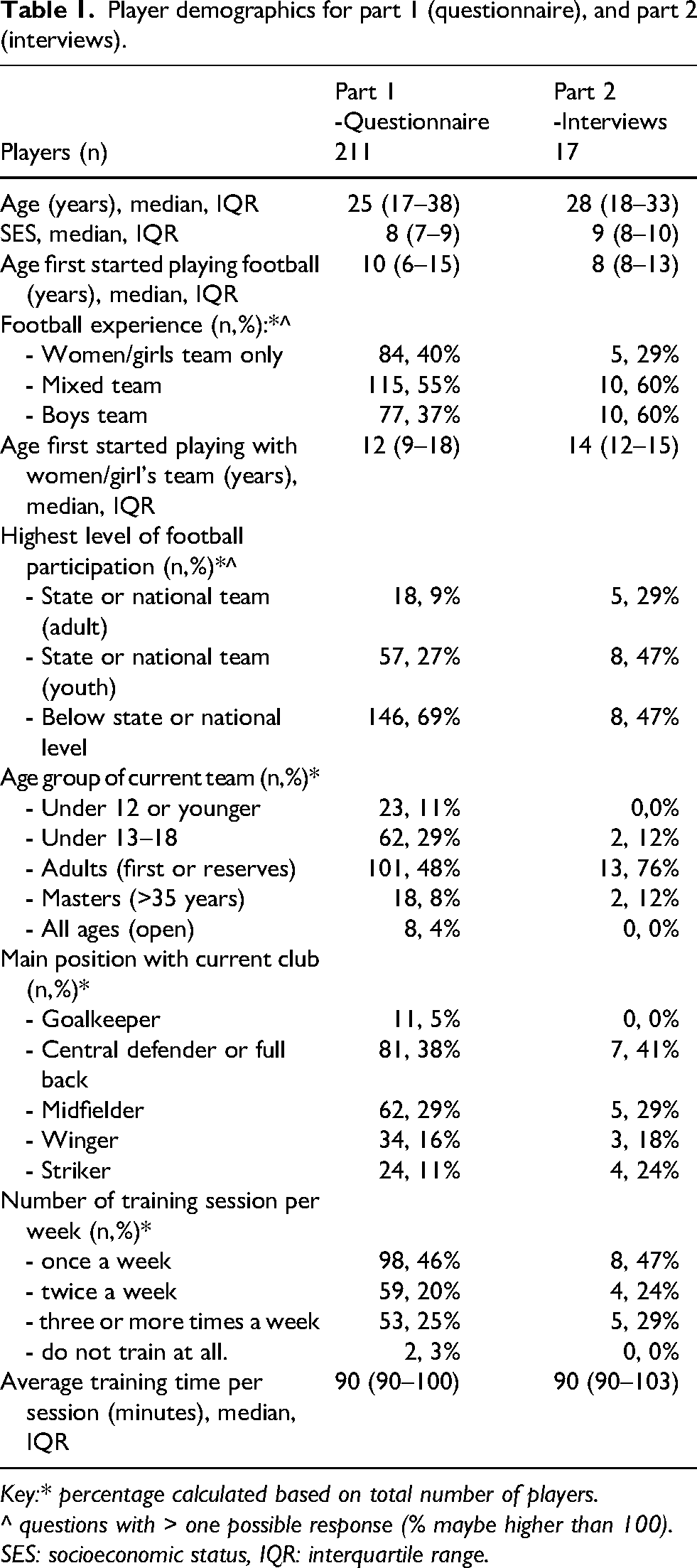
Key:* percentage calculated based on total number of players.
^ questions with > one possible response (% maybe higher than 100).
SES: socioeconomic status, IQR: interquartile range.
Coach demographics for part 1 (questionnaire), and part 2 (interview).
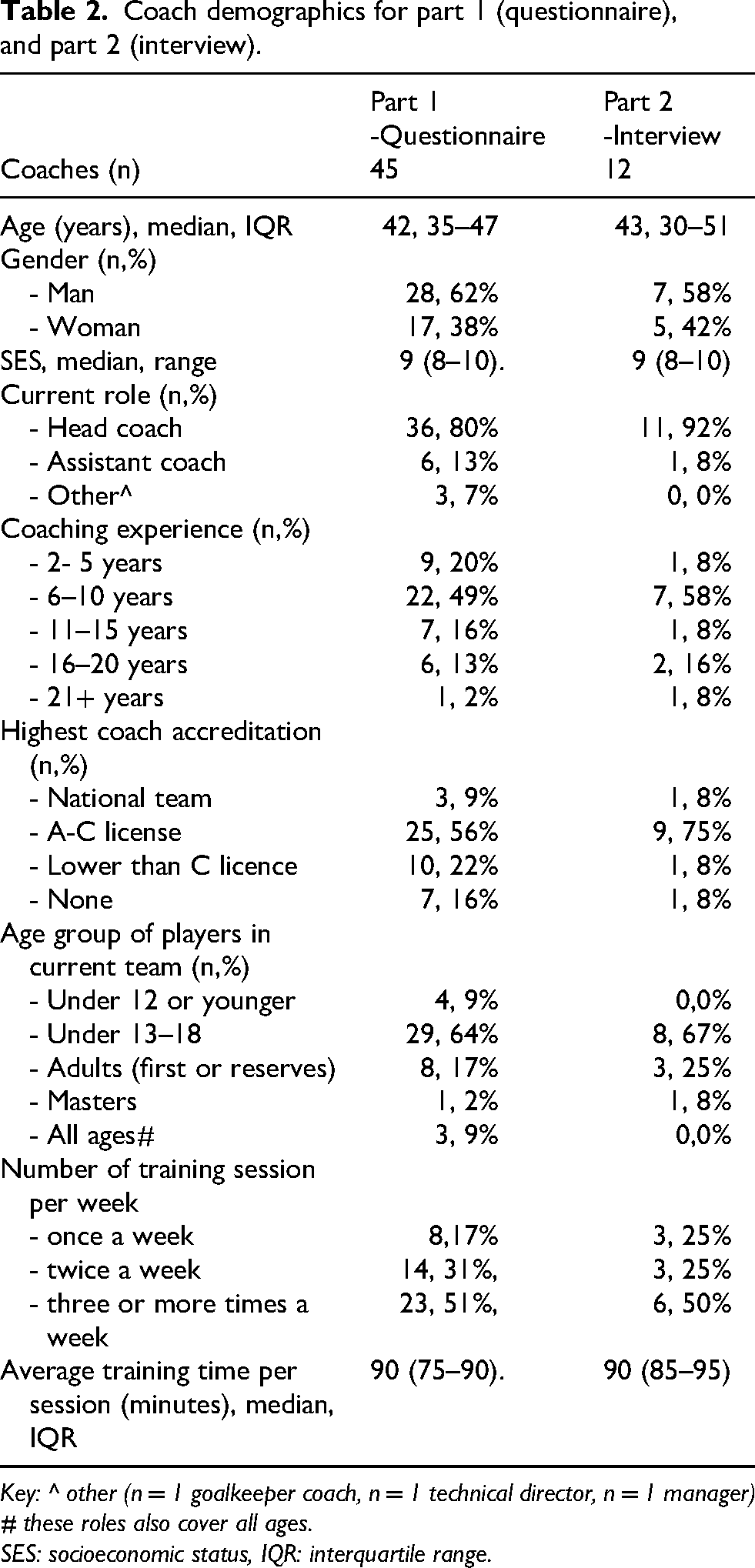
Key: ^ other (n = 1 goalkeeper coach, n = 1 technical director, n = 1 manager) # these roles also cover all ages.
SES: socioeconomic status, IQR: interquartile range.
Part one
In total 211 women or girls’ players and 45 coaches (17 women and 28 men) completed our questionnaires and were included in the analysis. Responses to the heading in football questions are reported in Table 3.
Player and coach responses to questions related to heading in football (reported as n,% unless otherwise stated).
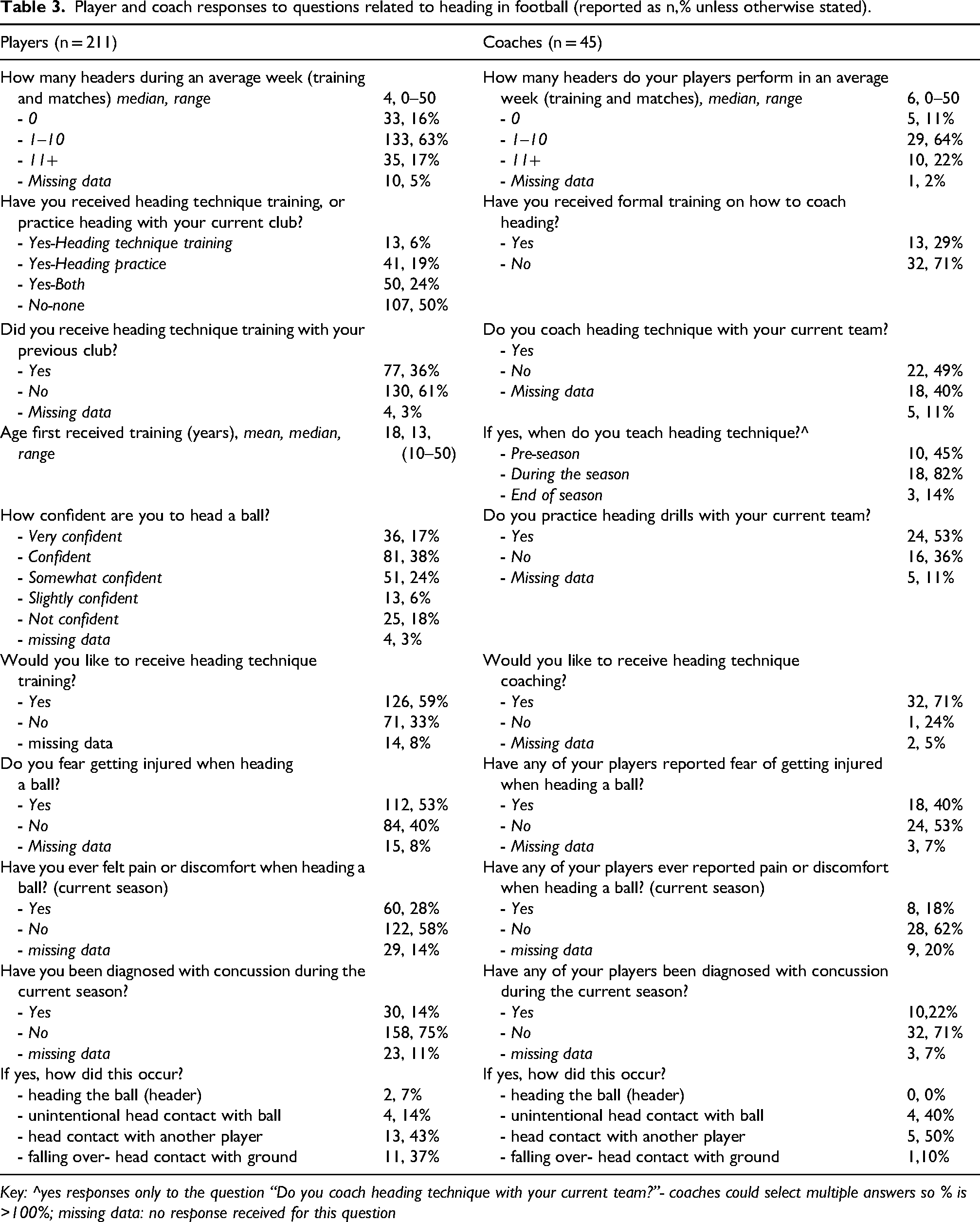
Key: ^yes responses only to the question “Do you coach heading technique with your current team?”- coaches could select multiple answers so % is >100%; missing data: no response received for this question
Player and coach responses to the open-ended question regarding what player's need to consider when heading the ball are summarised in Table 4. Comments were received from 158 (75%) players including 91 (58%) players who have received heading technique training and/or practice at their current club, 11 (7%) players who received heading technique training at a previous club, and 56 (35%) players who reported that they have never been coached to head a ball. Thirty-five(78%) coaches also responded to this question including 8 (23%)coaches who have received formal training to coach heading technique, and 27 (77%) coaches who have not.
Summary of player- and coach-reported factors that players should consider when heading a ball.
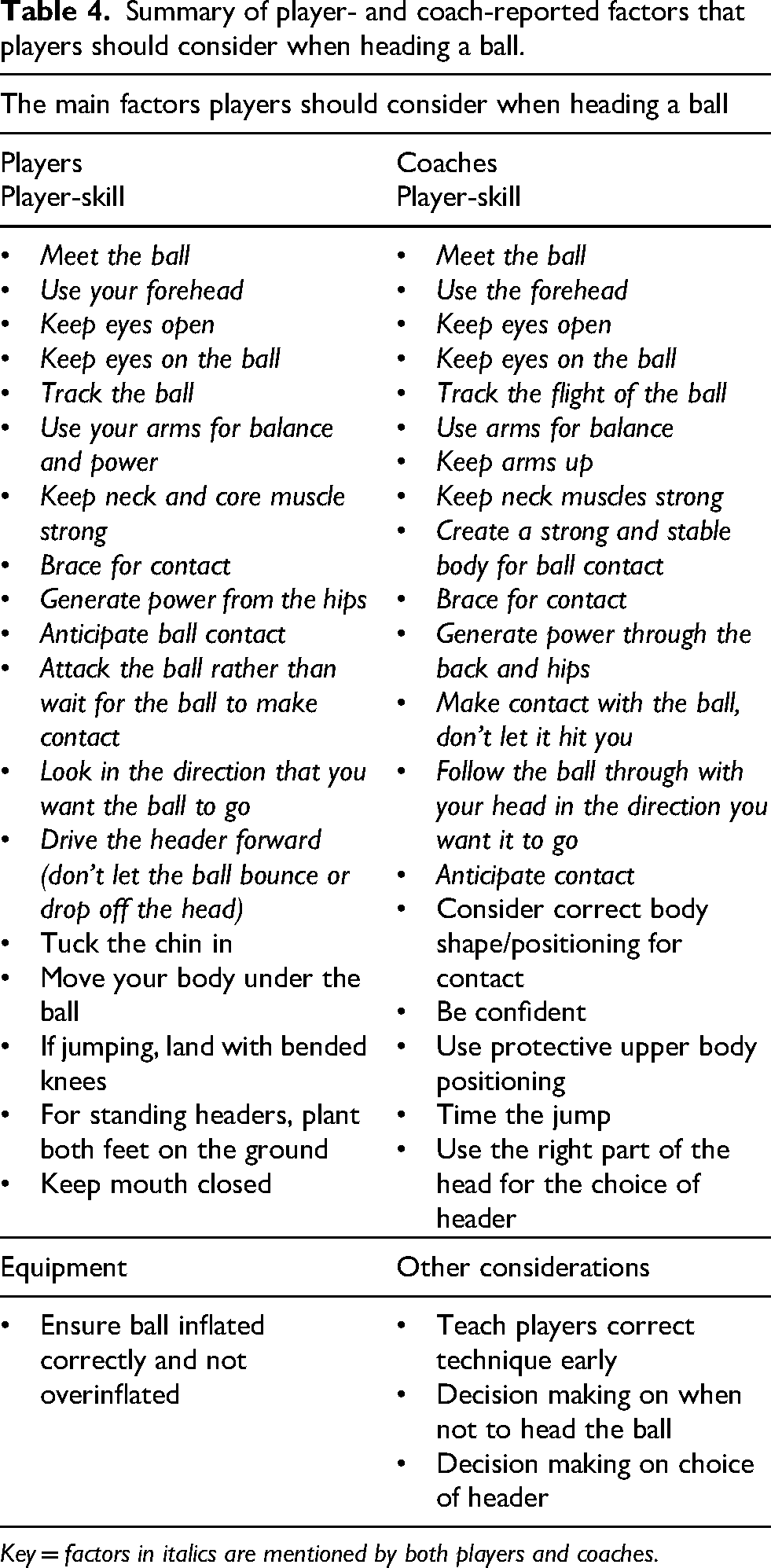
Key = factors in italics are mentioned by both players and coaches.
Players: While there was an association between whether the player had represented a state and/or national team and how often they trained (Cramer's V = 0.25, p = 0.01), and whether they felt pain on heading a ball (Cramer's V = 0.18, p = 0.01), there was no association with whether they practiced heading with their current club (Cramer's V = 0.07, p = 0.96), or previous club (Cramer's V = 0.20, p = 0.05), felt confident heading a ball (Cramer's V = 0.19, p = 0.12), felt fear on heading a ball (Cramer's V = 0.05, p = 0.92), or reported a concussion (Cramer's V = 0.10, p = 0.33). However, players who trained or practiced heading with their current or previous club were more likely to feel confident heading a ball (Cramer's V = 0.50, p ≤ 0.001, and Cramer's V = 0.72, p ≤ 0.001), less likely to report fear with heading (Cramer's V = 0.64, p ≤ 0.001 and Cramer's V = 0.70, p ≤ 0.001), less likely to report pain with headers (Cramer's V = 0.64, p ≤ 0.001 and Cramer's V = 0.64, p ≤ 0.001), and less likely to report a concussion (Cramer's V = 0.70, p ≤ 0.001 and Cramer's V = 0.71, p ≤ 0.001).
Coaches: There was no association between the number of years coaching and whether coaches taught or practiced heading with their current team (Cramer's V = 0.30, p = 0.43 and Cramer's V = 0.33, p = 0.20), or whether their players reported fear (Cramer's V = 0.30, p = 0.42), or pain with headers (Cramer's V = 0.36, p = 0.16), or concussion (Cramer's V = 0.36, p = 0.15). However, coaches with a national team or A licence were less likely to report that their players felt fear (Cramer's V = 0.71, p ≤ 0.001), or pain with headers (Cramer's V = 0.45, p = 0.01), or concussion (Cramer's V = 0.47, p = 0.003). Coaches who taught heading with their team were also less likely to report that their players felt fear (Cramer's V = 0.38, p = 0.04), or pain with headers (Cramer's V = 0.57, p ≤ 0.001), or concussion (Cramer's V = 0.61, p ≤ 0.001).
Part two
Participant data
We interviewed 17 players and 12 coaches (see Tables 1 and 2 for demographics). Coaches were mainly from New South Wales (n = 9), with one coach each from South Australia, Australian Capital Territory and Victoria.
Qualitative data
From each participant group (players and coaches), three clear themes were identified from the qualitative data examining their experiences and perspectives of football heading. One theme was shared across the coach and player qualitative data. The player codebook is reported in Appendix VI, with the coach codebook in Appendix V.
Player data
Theme 1: Many different factors contributed to developing the skill of heading
Players described how coaching demonstration, feedback, and repetition enhanced their heading skill “I think we did like half an hour on how to head the ball and just practicing that and just doing it over and over… I think it was an in-depth session where he explained exactly how you do it, how you do it safely all of that, and then would encourage us to incorporate it over other sessions.” Player 343 “When I was a junior, I remember a coach, we spent just a really good training session on headers and he's like, “This is how you do it. This is how you do it well. This is how you do it without hurting yourself.” Ever since then, I've been fine with them” Player 166 “I'm not scared of the ball, and I think learning how to head at a young age has helped that” (Player 347)
Other players described heading as an instinctive skill “I think it was sort of just expected and some girls were good at it and that was just how it was looked at.” (Player 389) “So you've got to be able to watch the ball, anticipate where it's coming, and read where it's going…. for me, it's better if I don't even think about it, I just do it” (Player 311)
And how training with boys improved their skill and confidence in heading the ball and provided them with positive reinforcement. “…. training with boys, they're not afraid to head the ball, and it was actually part of the warm up every single time. So I guess I just learn how to do it” (Player 91) “I knew that I would get praise from the guys if I headed the ball.” (Player 235)
Theme 2: We need more heading skill acquisition training
A lack of focus and time spent at training heading was identified by the football player participants “We don't do enough headers. The number of times I've had comments with others like teammates and stuff, people are crossing it into the box, but no one is confident to hit a ball with their head and time it well and that's a skill that you've got to learn. I don't know how to do it as a player” (Player 152) “…I don't know even if our coach had one conversation with us about it, of like where we're supposed to hit our heads with the ball. I don't know anything.” (Player 235) “I'm not sure that headers are a good thing, but at least she [team-mate] was trained to do it in an accurate way, probably a safe way, and that hasn't been the case at all for us… I mean, we weren't exactly taught. My dad [junior coach] always discouraged it” (Player 235)
Theme 3: Potential negative consequences of performing headers
Players described how a lack of training, concern about injury, poor technique and confidence affected their heading behaviour “…and some people, they may not do it for very good reasons. Some people wear glasses on the field and they don't wanna have the glasses smashed into their face” (Player 311) “And I'm not confident….If I go to head the ball I know that I don't have as much control about where it's gonna go… I'm also worried about the hurting part.” (Player 152) “Yeah, I guess with more research out there about concussions and witnessing some of my teammates getting concussions and things from just simply heading the ball. That's why I'm bit more hesitant to head the ball. Even though I'm confident in my technique of heading the ball. Yeah, it's just more the fear of injury.” (Player 124) “I have a natural urge to do it if it's a situation where I could get to the ball first but I've been trying to hold off doing it and using a different part of my body lately. (Player 203)”
Coach data
Theme 1 opportunities to facilitate heading coaching
Education on coaching heading benefitted coaches by improving both knowledge and confidence to teach heading safely to players. Coaches sought education through both formal and informal platforms: “The coaching courses we’ve done give you the basics for it” (Coach 1) “In relation to formal education, I haven't been taught formally. However, informally like on YouTube or whatever, yeah there's enough information out there” (Coach 6)
It was also suggested that formal resources and research would be beneficial for coaches in training heading. “I think resources would be great like in terms of a manual, maybe some suggestions on drills that could include, or ways that you can include them in other drills, or heading drills, maybe quick little ones, technical ones at the start of session, or something like that.” (Coach 2) “It's pretty much mainly playing and experience, and then a little bit of research to guide the level of heading that you should do in a training or a game.” (Coach 4)
Policies were also described which were implemented to maximise the safety of heading coaching “We don't allow contact the day before we play with set piece delivery because there's higher chance of you having a collision. Just close to game day, we try to stay away from anything that's full contact like that.” (Coach 11)
Theme 2: We face barriers to coaching heading
Various factors made it difficult to coach heading such as perceived risk, fear, confidence, technical and environmental barriers “We look at concussion and concerns around that…. I’d rather keep the ball on the deck” (Coach 1) “Girls had a lot of fear of heading the ball as well. I'll bring it down to a result of having poor technique and hurting the head in prior exposures” (Coach 3) “Generally, there's a fair bit of moisture in the air, so the ball's muddy or has gritty, dusty dirt on it. It's not fun to head in those conditions, so it's difficult to teach that skill at night-time” (Coach 1)
A lack of access to resources and education was clearly expressed by some coaches “I don't have any information. I haven't seen any resources at all. Whenever I'm researching drills to do, heading is never involved in any of that” (Coach 2)
Theme 3: Perspectives varied on when and how players should do heading training
Some coaches felt it was important to include when players were young “They should be taught young. How young, I would say probably 12. If you're expecting kids to play at an elite level in the NPL, they need to be taught that technique” (Coach 6)
While others expressed a need to delay heading training until players were more mature “Look, I wouldn’t be doing it until they’re in senior football, and they really are okay, their body is strong, we’re gonna do strength exercises as part of our training as well” (Coach 1)
Another suggestion was introducing heading training could be performed at an earlier age with some modification to equipment for safety. “Now, we might use a fluffy ball that doesn't hurt at all, but if you can do that at ages six, seven, eight and just teach them how to hit a ball that has no impact on them.” (Coach 4)
Coaches also described how to overcome hesitancy from their players in heading training by including it in warm-ups or training games. “Teaching the right technique early….In the women's space, I'll often hide it in warm-ups. We'll play fun heading scoring games. I'll hide it to make it a fun aspect” (Coach 3)
Perspectives shared by players and coaches
Theme 1: Heading skill is complex and changes depending on the game situation
Optimal heading technique reported by coaches included trunk and core strength, eyes open, body co-ordination in terms of reading the flight of the ball and then meeting it with the forehead, and players need to exhibit psychological bravery. “so as long as my eyes are on the ball, and I would always aim to strike the ball where my hairline meets my forehead that would be specific for me where I'd aim. I always concentrated on keeping my arms out for balance, and I would arch my back and push forward almost like rowing” (Player 400) “..judging the flight of the ball, so that would come under timing. The execution, knowing which part of your head to use. We want you to use your forehead but then it might be executing it to which way you're heading it down or hitting it to the side. So timing, execution, and also being brave.” (Coach 11) “Bravery, that's about it” (Coach 1) “it's almost like breaking a frame with your head and your whole body, to get through it and you just never ever let the ball hit you, you always have to hit the ball otherwise it'll hurt.” (Player 091) “Engagement of core, neck muscles, trunk. Understanding the flight path of the ball trajectory of the ball.” (Coach 3)
The match situation was felt to change heading skill “If you’re challenging with someone, like a close contact, I think the skill goes out the window next. It's very hard to think about keeping your core strong.” (Coach 1) “in any game scenario, there's different ways you wanna do it. If you wanna do a defensive or attacking header, if you wanna hit it down, if it's just someone's feet, if you want them to go on. If you're defending, you wanna go up and out. So they're the different types of headers… And then you need to be able to direct the header too, which can be the tough bit, because you whip your head around at the same time as hitting it right. I think that's the main things.” (Player 166) “…an arm and having that distance and trying to maintain that distance, and then as soon as you can feel your opponent, then it's pretty much all fires back off your focus back on the ball and then executing that skill. I try and take it as your opponent first, then worry about the ball” (Coach 4) “it depends whether you're heading to try to get a goal or heading to try and clear the ball in them situations,” (Coach 5)
Discussion
Our study aimed to explore the exposure, perspectives and experiences of heading in football by both women and girl players, as well as coaches of women and girls’ football in Australia, through an online questionnaire and one-on-one interviews. Key findings included: similar numbers of headers per player per week were reported by players and coaches; despite a higher number of players and coaches reporting an absence of formal training in heading technique, players still head the ball, and coaches still coach it; both players and coaches expressed an interest in receiving heading technique training; players and coaches reported similar factors that should be considered when heading a ball; players expressed a fear of being hurt while heading a ball, and fear of injury also influenced heading coaching behaviour, with players less likely to report fear and pain with headers if they had received coaching on heading; and finally concussions were more likely to be caused by player-to-player contact or contact with the ground than by contact with the ball, with players less likely to report a concussion if they had received heading coaching. These key findings were reinforced through the qualitative data and will be discussed below.
Headers are an integral football skill
Players and coaches expressed the need to perform headers during football training and match-play, with players and coaches reporting a median of 4–6 headers per player per week. The Football Associations in England, Scotland, and Northern Ireland currently recommend that players aged under-14 years and older perform less than 10 headers per week (reducing to 5 headers for under-12 to 13 age-gropus, with no headers in players aged under-11 or younger). 26 Although Australia currently do not have any nationally supported heading guidelines, it appears that the frequency of headers for most players are within these recommendations, with 33 players reporting that they never head the ball. However, some players are performing a lot more headers than this (with up to 50 headers reported per week). While the evidence surrounding the long-term effects of repeated head-to-ball contact is currently equivocal 12 with very limited data in women, 15 a precautionary approach supports limiting the number of headers per week, with a focus on quality training over quantity of headers from repeated practice.
Many players and coaches reported a lack of formal training focused on heading
Our data supports earlier studies where players, particularly women and girls, have reported a lack of training in heading technique.2,27 One player reported that “..I don't know even if our coach had one conversation with us about it” which was reinforced by the following quote from a coach “I haven't seen any resources at all. Whenever I'm researching drills to do, heading is never involved in any of that.” This highlights a fundamental gap in football coaching within Australia, that likely extends to other countries. How can coaches be expected to teach their players the technical skills of heading, if they have not been taught themselves? Our data demonstrated that despite only 29% of coaches reporting that they had received formal training on how to coach heading technique, 49% of coaches reported coaching heading technique with their players, and 53% reported practising heading drills. While one coach did highlight that there are informal resources available online, the quality of information and instructional content is likely varied and unregulated. Further, if players and coaches are seeking information from external sources this suggests a critical gap in their development from an organisational perspective.
Players and coaches expressed an interest in heading training
Interviewed coaches expressed that they would like a manual or guidance on incorporating heading drills into training. The questionnaire data also support this interest in instructional heading training. While only a few countries have heading guidelines in place where headers are restricted or prohibited in younger age-groups,26,28 players will be exposed to headers particularly during matches as they transition into older age groups, with the mean number of headers per player per match ranging from 3–9 headers across most studies.12,29 Therefore, there is a duty of care to support coaches and players in the technical skills required to head a ball within a controlled training environment before exposing them to headers during match-play. 27
Players and coaches highlighted similar factors to consider when heading a ball
Despite 50–71% of players and coaches reporting a lack of formal training in heading technique, players and coaches identified similar factors that players should consider when performing a header. Given that 12–21% of goals are scored by a header in FIFA Women's World Cups (including under-17, and under-20 tournaments), 1 the development of good heading skills can improve player and team performance. Furthermore, a study in youth girls football (players aged 12–15 years) reported that better heading technique was associated with lower peak rotational acceleration of the head during headers performed during match-play. 4 The rubric criteria used in this study to assess header technique was adapted from an earlier study in 12 year old girls 7 and included items such as keeping eyes on the ball, body positioning (athletic stance, side on position, soft elbows and knees), connect with the ball, with additional variables related to whether the header was performed while the player was standing or jumping. 4 Key factors in effective header execution identified in our study are similar: using the forehead, keeping the eyes open to track and anticipate ball contact, bracing through a strong neck and core, using the arms for balance, power, and protection, and actively attacking the ball rather than passively allowing it to bounce off the head. A finite element analysis study reported that active headers, where the neck muscles are engaged resulted in lower head impact magnitude and estimated head injury criterion, when compared with a passive technique (without neck muscle engagement). 10 Furthermore, a neuromuscular neck training program has been shown to reduce head impact magnitude, as well as pain on heading a ball and potential concussive events in adolescent boys and girls.11,30 The shared theme from our player and coach qualitative data analysis suggested that teaching heading technique may be useful from both a skill acquisition perspective but perhaps more importantly to reduce the potential risk of injury, with limited, but emerging evidence to suggest that a behaviour skills training approach can be used to improve header technique in girls. 7
Some players are fearful of getting hurt when performing a header
An important finding from our data is that players who trained or practiced heading with their current or previous club were less likely to report fear or pain on heading a ball, as well as less likely to report a concussion. This finding supports the important role of coaching in head injury prevention. 6 While a lack of skill in performing a header was one reason for being hesitant to head the ball, a player also reported that she is “also worried about the hurting part.” While players are more likely to be injured (including concussion) through player-to-player contact 9 (supported by the self-reported data in this study), often this player-to-player contact results from two or more players competing for an aerial ball leading to head-to-head or upper-limb-to-head contact. 6 This mechanism of injury also reinforces the need for coaching which extends beyond the actual head-to-ball contact when heading a ball, but also how to simultaneously track the ball and the movements and actions of other players in close proximity to better protect their head from unintended contact. 6 Many coaches highlighted the complexity involved in header technique and that technique often “goes out the window” when multiple players are competing for a ball in a match situation. A recent study explored the acceptability and feasibility of HeaderPrep, a program designed to prepare players for the skill of heading. 27 HeaderPrep starts without any head-to-ball contact, meaning that it is possible to coach players in the fundamental skill of heading without increasing the quantity of head-to-ball contacts performed per week particularly during an age when players are discouraged from heading a ball, as present in some guidelines. The challenge for football organisations is to develop these resources as a next step, which should include making these resources publicly accessible, as well as integrating into coaching licenses and certification.
Limitations
The main limitation of our study was that it only included players and coaches from within Australia, acknowledging that there is a lack of heading research from lower resourced countries. Therefore, these research findings may not extend to other regions or playing cohorts. Furthermore, due to the well-recognised gap in sport-related research in women and girls, we deliberately did not include men and boys as participants in our study. It has been hypothesised that the higher incidence of concussion in women's football is more related to the gendered environment in which women and girls are exposed while developing as football players, such as less access to qualified coaches, strength and conditioning opportunities, and high-quality facilities when compared with men and boys. 31 Conducting future research that compares the experiences of men and women when developing football technical skills, including heading, would be an interesting addition to the literature. Finally, while every attempt was made to gain a representative sample of players and coaches (and gain idea saturation through the qualitative interviews) other participants (particularly those from lower SES backgrounds) might have expressed alternate views.
Conclusion
Our study highlights that whilst most players report performing 1–10 headers per week, there is a lack of formal training and resources available to coaches and players on heading technique, which is despite an expressed interest in receiving such education. This is particularly important given that many players expressed a lack of confidence in performing a header which may be compounded by a fear of being hurt when doing so. The challenge now is for football organisations at local level including clubs, leagues and member associations as well as FIFA as the global governing body of football, to engage with coaches and players to provide the resources and support to enable skill development in heading, which can and should include instruction on more than just the actual head-to-ball contact.
Supplemental Material
sj-docx-1-spo-10.1177_17479541261449737 - Supplemental material for “Teaching the right technique early”: Coach and player experiences of heading in women and girl's football
Supplemental material, sj-docx-1-spo-10.1177_17479541261449737 for “Teaching the right technique early”: Coach and player experiences of heading in women and girl's football by Kerry Peek, Eliza Roughead, Andrea M Bruder, Andrew G Ross, Dawn Scott, Belinda Wilson, and Andrea B Mosler in International Journal of Sports Science & Coaching
Footnotes
Acknowledgment
Thank you to Bronwyn Kiceec and Edward Ferguson from Football New South Wales who assisted with questionnaire development, as well as the players and coaches who completed our questionnaire.

Ethical considerations
This study was approved by the institutional Human Research Ethics Committee at The University of Sydney (approval no: 2023/929).
Consent to participate
All participants provided written consent to participate in this project.
Consent for publication
Not Applicable.
Contributorship
KP: Conceptualization, Methodology, Data curation, Formal Analysis, Resources, Writing – co-wrote original draft. Guarantor.
ER: Conceptualization, Methodology, Project Administration, Data curation, Formal Analysis, Visualization, Writing – Review & Editing.
AR: Methodology, Writing – Review & Editing.
AMB: Methodology, Writing – Review & Editing.
DS: Writing – Review & Editing.
BW: Writing – Review & Editing.
ABM: Conceptualization, Methodology, Data curation, Formal Analysis, Writing – co-wrote original draft.
Funding
The authors disclosed receipt of the following financial support for the research, authorship, and/or publication of this article: This project was supported by a University of Sydney, Emerging Stars research grant awarded to KP.
Declaration of conflicting interest
KP, BW and DS are employed by FIFA.
Data availability
All data are contained in the manuscript or appendices.
Supplemental material
Supplemental material for this article is available online.
References
Supplementary Material
Please find the following supplemental material available below.
For Open Access articles published under a Creative Commons License, all supplemental material carries the same license as the article it is associated with.
For non-Open Access articles published, all supplemental material carries a non-exclusive license, and permission requests for re-use of supplemental material or any part of supplemental material shall be sent directly to the copyright owner as specified in the copyright notice associated with the article.
