







Abstract
Given the importance of quality sport opportunities for youth, it is necessary to better understand the education offered to coaches who deliver these experiences. This paper identifies and describes formal coach education offerings from the 10 most popular youth sports in Australia. We conducted a desktop review of National Sport Organisation (NSO) websites of these 10 sports, to explore the scope, content, and requirements of community coach education programs offered across Australia. The results from these searches highlighted considerable variation across sports with respect to the course costs, time commitments required, delivery mode, and content. Most sports offered one or two community-level courses and cost between zero to $383.69. Time commitments varied from 90 min to six months, and delivery modes included online learning, blended formats, and in some cases on-the-job training. Content offerings ranged from three to 11 modules, with some emphasising sport-specific technical skills while others focused on broader coaching principles. Understanding the diverse approaches currently adopted in Australia may serve to inform future community coach education programs in various national and international sporting contexts.
Community coach education in Australia: A desktop review
Coaches play a pivotal role in enhancing sport participation and improving the performance of athletes. They also contribute to broader societal goals by promoting the development of athletes as people, fostering civic unity through shared values and experiences, and encouraging positive health choices. 1 To deliver these ideals, coaches often undertake various forms of education to attain the necessary knowledge, skills, and competencies in their chosen sport.1–3 Conversely, coaches without sufficient education may undermine athletes’ participation, limit their performance outcomes, or expose them to potential harm. Coach education, therefore, plays a pivotal role in shaping coaching practice and has been subject to increasing academic scrutiny in recent years.4–6
Various national and international coaching frameworks have been established to guide coherent national coach education and development (see Table 1).1,7–10 They also serve to define and standardise effective coaching practice—and ensure safe and ethical sport environments—while attempting to professionalise coaching through shared competencies, standards, and pathways in diverse national contexts. More specifically, they describe the knowledge, skills, and behaviours expected of coaches at different levels, which NSOs then use to create courses and benchmark competency expectations for accreditation in sport specific settings.1,7–10 Ultimately, the frameworks are designed to help connect coaching behaviours with holistic athlete development and long-term participation in sport. 11
National and international sport coaching frameworks.
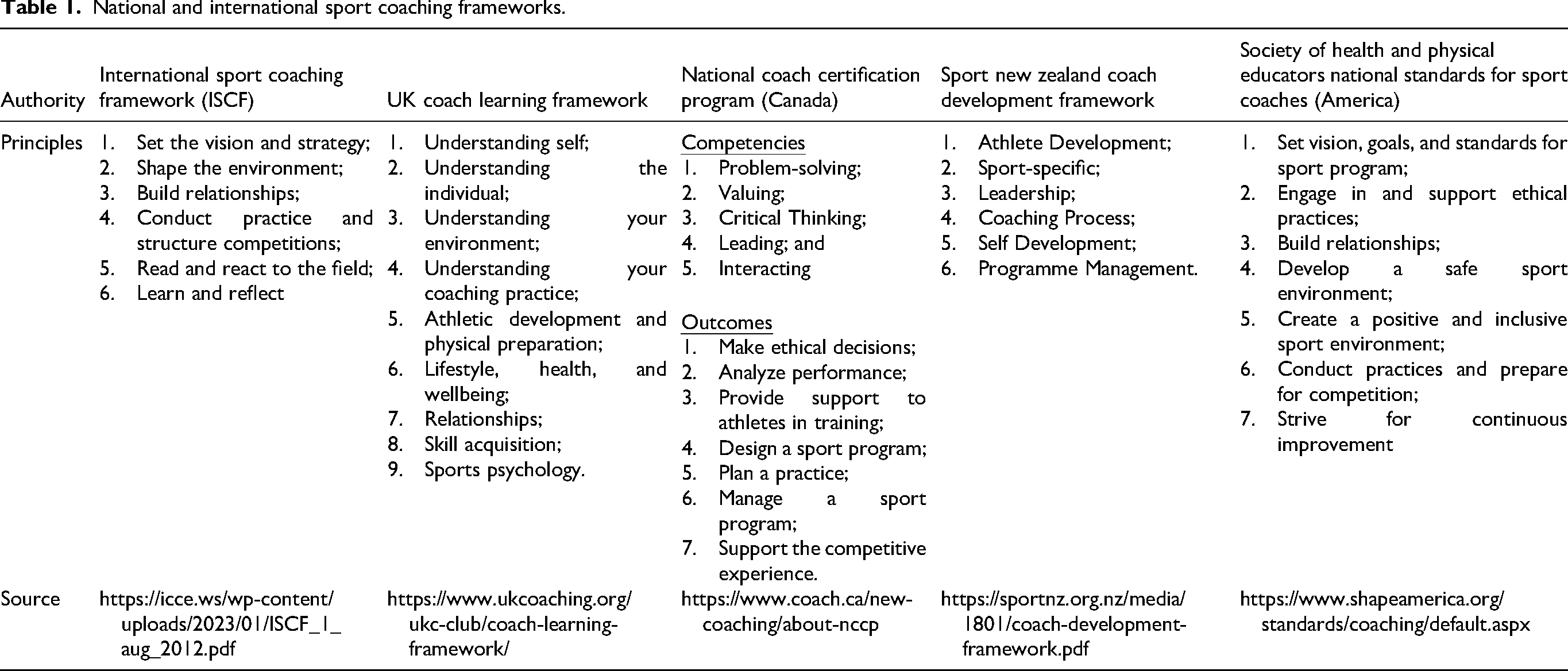
While frameworks like the ISCF accommodate for global cultural diversity and have been used to guide the content of coach education in certain countries (e.g., Aotearoa New Zealand),9,11 to date, there has been limited overt connection to the Australian context. In addition, these frameworks intentionally do not specify (a) how courses should be delivered, (b) the length, and (c) at what cost. There remains an opportunity for researchers to review these dimensions to support academics and practitioners in conceptualising how national sport authorities implement coach education.
Coach education encompasses widely cited definitions of formal (e.g., accreditation programs), non-formal (e.g., workshops about coaching), and informal learning experiences (e.g., observation and mentoring of coaching). 12 Formal coach education—the focus for this study—often includes learning about the sport, its rules, how to play, and what to coach via an accredited sport specific course. 12 These coach education programmes are typically large scale, involve mandatory engagement with uniform curriculum, learning objectives and assessment, and culminate in formal certification.12,13 Such programmes are broadly accessible to generate high participant volume while simultaneously often acting as a prerequisite for coaching practice.13,14
National Sport Organisations (NSOs; sometimes known as National Governing Bodies or National Sport Federations) are primarily responsible for the design and delivery of formal coach education to assure coach competency and acquisition of accreditation. 15 When delivering coach education, NSOs often differentiate between participation (community) and performance (elite) coaching contexts within education offerings, depending on the athletes being served.1,15–17 In countries like Canada, Aotearoa New Zealand, and Australia, community coaching focuses on participation, aiming to provide athletes with initial and positive experiences in sport. The performance context focuses on more intensive athlete engagement where the focus is on purposeful skill development and achieving competition outcomes in local, regional, or national competitions, such as in elite/representative pathways.1,9,16–18 In recent years, various academic groups have reviewed coach education practices, but they have tended to focus on performance contexts, 19 non-institutionalised coach programs, 20 or generic coach education across the community-performance spectrum. 6 As a result, there is an opportunity to more closely examine how formal community coach education is delivered for those coaching children and adolescents in the participation coaching domain. 1
Community coach education initiatives are nationally accredited and centrally structured but are often delivered locally by affiliated coach developers.2,13 Although historically these have been delivered face-to-face, more recently, course delivery has turned to online formats given the expansion of internet accessibility and breadth of information now available. 21 Online learning can provide scalable and cost-efficient courses while also delivering individualised opportunities for tailoring coach education through various platforms, resources, and tools. 4 For instance, Driska and Nalepa 22 showed how a self-paced online coaching course more than quadrupled users from 3000 to 14,000 during a two-year period. Similarly, the Australian Sport Commission (ASC) 23 proposed that up to 500,000 coaches would complete their recent online Community Coaching Essential Skills course. Regardless of how it is delivered, community coach education is influenced by the largely voluntary nature of the coaching workforce and as a result, tends to be ‘low touch’, short in duration (e.g., a few hours face-to-face or online), and involve no requirement to demonstrate practical competence.13,24 In addition, individuals from diverse backgrounds often face structural barriers within coach education systems.25,26 For example, time constraints—often magnified by caregiving responsibilities—may disproportionally limit women's ability to undertake formal coach education. 25 For Indigenous and LGBTQ + coaches, a lack of culturally safe learning spaces or targeted development opportunities that acknowledge their identities often present as barriers to accessing coach education. 26 Given that Australian community coach education is the focus for this study, we now consider key moments in Australia's coach development landscape over time.
Coach education in Australia
In a recent review of the history of coach education in Australia, O’Connor et al. 27 described how the early structures for a standardised national coach accreditation framework were established between the 1970s to 1980. This was largely driven by NSOs and Government interest in improving sport performance. In 1978, the Australian Coaching Council was established and soon after it introduced the National Coaching Accreditation Scheme, which aimed to provide a unified framework across sports. 27 Coach education was primarily delivered through face-to-face workshops in alignment with three levels of coach accreditation: Level 1 (introductory course, 14 hours), Level 2 (intermediate course, 60 hours), and Level 3 (advanced, 100 hours). During the 1990s, coach education became more closely aligned with vocational education frameworks and sport-specific accreditations. This approach emphasised competency-based training aligned with multiple levels of accreditation; however, tensions emerged between the needs of community coaches and those in elite pathways, with the latter often receiving more structured support. 27
During the early 2000s and 2010s, coach education fragmented as NSOs developed their own systems, which led to inconsistencies across sports. 27 To address this disparity, the ASC and Australian Institute of Sport (AIS) began to influence coach development more directly by offering an online Beginning Coaching General Principles course as an option to complete before undertaking sport-specific accreditation. By the late 2010s, the ASC and AIS also began to construct key strategies to shape high-performance coach development, a move in alignment with the growing professionalisation of Australian sport. At the same time, the disestablishment of the ACC and NCAS meant that community coaching remained in a period of transition. 27
More recently, the ASC has provided a suite of seven self-paced, free, online “Community Coaching Essentials Skills” modules to support the “education and development of coaches” and replace the General Principles coaching course. 28 The modules serve as a precursor to sport-specific coach education and cover topics including (a) who you coach; (b) where you coach; (c) what you coach; (d) how you connect; (e) how you engage; (f) how you deliver; and (g) how you improve. 28 This is a significant and positive shift from the generic “what” you coach (i.e., techniques and tactics) to how you coach and can be applied across a range of sporting contexts. Whilst promising, it is not clear how (or whether) NSOs are translating these changing approaches to coach education at the community level. With little consensus on how novice sports coaches should best be educated, 29 further research is needed to shine a light on coach development practices at this level.
There have been a series of publications outlining national approaches to coach education over the past 10 years5,30–33; however, to our knowledge, no studies have reviewed NSOs formal coach education for community coaching contexts in Australia. Sharing local, contextual information about coach education provides an opportunity to exchange good practices and facilitate international collaboration,11,27 so a review of community coach education in Australia is timely. Therefore, the purpose of this paper is to conduct a desktop review of formal community coach education offerings from the 10 most popular sports in Australia for young people aged 0–14 (ages typically associated with community sport participation). Our aim is to better understand how NSOs in Australia design and deliver community coach education in various sports.
Methods
We conducted a desktop review of community coach education programs across sport organisation websites in Australia.
34
This methodology was suitable to deliver a timely synthesis of publicly available online information related to Australian coach education at the community level. Recent studies have employed similar review methodologies to analyse publicly available information on sport governing body websites, exploring topics such as international anti-bribery and corruption policies
35
; inclusion-related language and resources across multiple US sports
36
; and youth resistance training resources from Australian sports.
37
As such, our approach drew upon various methodological strategies from these researchers to design, source, and analyse data related to the study purpose. More specifically, we followed Moore's
34
six steps to guide our data collation and analysis (synthesis) as follows:
Check the authority and reliability Be clear about what you are looking for Be organized and systematic Document things as you go Comparison is critical Use both analysis and synthesis.
Step 1: Check the authority and reliability of sources (i.e., inclusion / exclusion criteria)
Following Moore's first step to ensure we relied on accurate and authoritative sources for our data collection and analysis, 34 we reviewed AusPlay data—a national survey tracking Australians’ sporting activities—from January to December 2024, to identify the ten sports with the highest participation among children aged up to 14 years. 38 This age group was chosen as community coaching in Australia is primarily delivered with children aged between under 6–14 years old. The top 10 sports by participation for children aged 0–14 were: (1) Swimming, (2) Football (soccer), (3) Gymnastics, (4) Basketball, (5) Australian Football, (6) Netball, (7) Tennis, (8) Cricket, (9) Athletics, and (10) Cycling. i We excluded data from courses targeting the coaching of athletes aged over 15 years old because higher levels of accreditation (beyond initial community/grassroots coach education) are often required for coaching adolescents and adults27,37 and data from 15–17-year-olds are combined with that of adults within AusPlay reports. Finally, as the focus was on initial community coach education, we excluded any accreditation that connected with representative level (i.e., elite and/or high-performance sport) coaching, as that was not relevant to the study aims.
Steps 2–4: Be clear about what you are looking for, be organized and systematic, and document things as you go
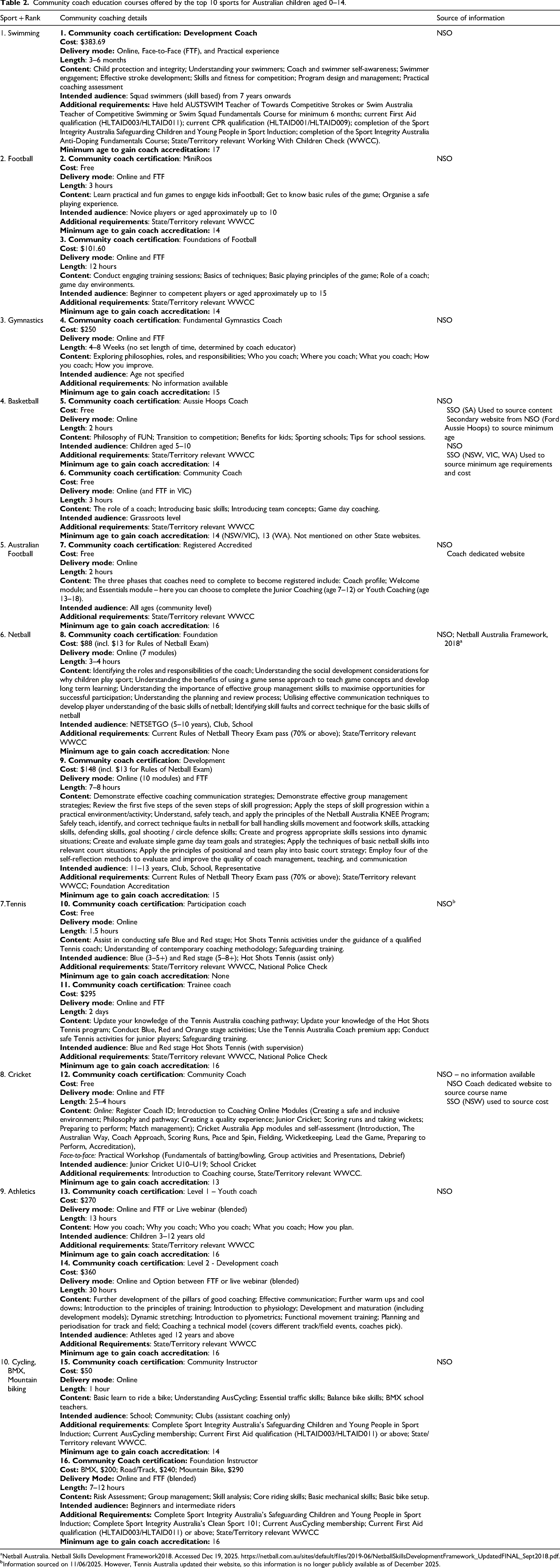
At several timepoints throughout 2025 (January, June, and December), JG conducted searches on NSO websites for publicly available information regarding community-level coach education within the top 10 sports. Information was typically accessed via “Coaching” or “Get involved” tabs on the NSO website home page. While most NSO websites were organised in this way, Cricket and Australian Football websites required navigation to secondary websites to locate community-coaching information (see Table 1, column three). Following Moore's advice, 34 (pp. 109–110) we supplemented our search using Google to look for what “may not appear on the first two or three pages of the search results, particularly if you are looking for something obscure.” For example, when data was not present on NSO websites, searches for missing course fees involved JG using Google to identify “cost of [course name] + [sport] + Australia” (e.g., cost of “community coach course + Basketball + Australia”). These searches frequently led to State Sporting Organisation (SSO) websites with more specific content descriptors and localised details, including pricing and course dates. We drew upon additional data to ensure we had some form of data for comparison (and have acknowledged the sources in column three, Table 2). This was important because at times, NSO's provided the framework for coach education federally but lacked any detail about courses. As such, additional searches to State affiliates were required to determine the delivery style, cost, and time-length.
Community coach education courses offered by the top 10 sports for Australian children aged 0–14.
aNetball Australia. Netball Skills Development Framework2018. Accessed Dec 19, 2025. https://netball.com.au/sites/default/files/2019-06/NetballSkillsDevelopmentFramework_UpdatedFINAL_Sept2018.pdf.
bInformation sourced on 11/06/2025. However, Tennis Australia updated their website, so this information is no longer publicly available as of December 2025.
Steps 5–6: Comparison of data for analysis and synthesis
According to Moore, 34 the material collected should be broken down into its component parts (as per Table 2) before synthesising the results. In this study, JG extracted data to map the following information for reporting and analysis: sport name, certification name and level, cost, delivery mode, course length, curriculum/topics, target audience, prerequisites, and minimum age requirements. The categories were chosen to support standardised comparison across the top ten sports with respect to community coach education programs in Australia. The next step involves bringing data together to produce something that increases our understanding of the investigation, “where the whole is greater than the sum of the parts” 34 (p.114). Following collation of all information in an Excel spreadsheet, AB and SGK checked the accuracy of content for mapping (Table 2) in a collaborative meeting with JG where any disagreements were also discussed and resolved. The final step involved before collectively determining how best to represent the synthesis of data in the results section and connected tables.
Results
In Australia, the top 10 sports for children aged 0–14 included a diverse range of individual (i.e., Swimming, Gymnastics, Athletics, and Cycling) and team sports (i.e., Football, Basketball, Australian Football, Netball, Tennis, and Cricket, see Table 2, 38). Swimming was the most popular sport (n = 1,121,569, participation rate [PR] = 23.2%) followed by Football (n = 670,451, PR = 13.9%), Gymnastics n = 328,573, PR = 6.8%), Basketball (n = 315,731, PR = 6.5%), Australian Football (n = 280,286, PR = 5.8%), Netball (n = 244,645, PR = 4.7%), Tennis (n = 183,652, PR = 3.8%), Cricket (n = 158,314, PR = 3.3%), Athletics (track and field, n = 152,958, PR = 3.2%), and Cycling (including BMX and Mountain Biking, n = 135,641, PR = 2.8%). 38
Names and levels of accreditation
Across the 10 sports, we found 16 potential community coach accreditation courses. Most sports had one or two levels of community coach accreditation for coaching players aged up to 14 years old. For example, the Netball Foundation course (Level 1) targeted children aged 5–10 years old while the Development course (Level 2) focused on coaching 11–13-year-olds. Eleven of the 16 coaching courses specified a 0–14 target audience while the remaining five did not specify a targeted age group to coach upon achieving certification. Those which included a specific audience were Football (MiniRoos; Foundations of Football), Basketball (Aussie Hoops), Australian Football (Junior, Youth), Netball (Foundation; Development), Tennis (Participation; Trainee), Cricket (Community), and Athletics (Level 1; Level 2). Five courses did not provide information for what age range to coach upon certification but noted being ‘beginner-focused’ (Gymnastics [Fundamental], Basketball [Community], Cycling [Community; Foundation], and Swimming [Development]). Australian Football provided age-specific modules (e.g., Junior, Youth), enabling coaches to complete the module most relevant to the age of their cohort of children and/or adolescents.
Costs
The cost of coach education varied considerably, ranging from no cost (e.g., Cricket) to $383.69 (Swimming), with a mean cost of $148.67 per course ii (median = $124.80). The top ranked participation sport (Swimming) had the most expensive course but there did not appear to be any strong connection between sport participation numbers and cost of course for the remaining sports. Five sports provided free entry-level courses including Football (MiniRoos), Basketball (Aussie Hoops and Community), Cricket (Community Coach), Australian Football (Registered Accredited), and Tennis (Participation). Cycling (Community, $50), Netball (Foundation, $88), and Football (Foundations of Football, $101.60) offered lower cost courses, whilst Gymnastics (Fundamental, $250), Cycling (Foundation, $200–$290), Tennis (Trainee, $285), Athletics (Youth Coach, $270; Development Coach, $360) and Swimming (Development coach, $383.69) were higher cost. In some cases, costs were not stipulated at the national level so secondary sources (such as State Sport Organisation websites) were used to guide the cost. Course costs varied between some Australian States and Territories within the same sport. For example, the Basketball Community Coach course was offered free in most States and Territories but incurred a $20 fee in Victoria. iii Similarly, Athletics courses had local cost variations, with fees differing within States and Territories (e.g., the Level 1 Athletics – Youth Coach course was priced at $270 in New South Wales, $262.50 in Victoria, and $244.49 in the Australian Capital Territory). iv
Delivery mode
Delivery mode refers to how NSOs provide community coach education. No courses were delivered solely face-to-face; however, all 16 community coaching courses included an online delivery mode. Five courses were delivered exclusively online (Basketball [Aussie Hoops], Australian Football [Registered Accredited], Netball [Foundation], Tennis [Participation], and Cycling [Community Instructor]) while the 11 remaining courses employed a blended model combining online theoretical content with in-person practical components. For example, Cricket required participants to complete various elements online before attending a face-to-face practical coaching workshop. Other blended courses, such as Athletics, required participants to complete an initial online module before attending a second ‘live’ session, which could be undertaken through an online webinar or in-person. Similarly, the Netball Development accreditation mandated approximately three hours of online training before completing four-to-five hours of face-to-face coursework and assessment. Gymnastics and Swimming were the only sports that incorporated supervised on-the-job training as part of the accreditation process. In Gymnastics, ‘on-the-job training’ meant trainee coaches completed approximately one training module per week, while gaining practical coaching experience under the supervision of a qualified coach. The Swimming Development course involved online learning, face-to-face workshops, practical assessment tasks, and supervised coaching.
Course duration
The duration for completing community coach education varied from 90 minutes (Tennis) to six months (Swimming). Tennis offered the shortest coaching course (Participation, 90 minutes) followed by Australian Football (two hours) and Basketball (Aussie Hoops, two hours). Swimming and Gymnastics required the greatest time commitments, with the Gymnastics Fundamentals course taking four-to-eight weeks of supervised practical experience along with completion of an activity pack. The Swimming Development course proposed up to six months to complete all learning and practical elements. Excluding the Gymnastics and Swimming courses (as outliers), most learning experiences averaged one to two hours to complete.
Content
The content of community coach education courses varied greatly. Most sports covered foundational elements of coaching practice including sport-specific techniques, safeguarding, game principles and rules, and strategies for delivering training sessions. Some courses extended beyond these to incorporate topics such as competition preparation, communication, and principles of sport performance. Topics were often broken down into individual learning modules (i.e., structured learning components designed to develop the knowledge, skills, and behaviours required for coaching) and across the top 10 sports, the number of modules ranged from three to 11, with an average of 5.5 modules per course. The development courses from Athletics (11 modules) and Netball (10 modules) included the greatest number of modules while Australian Football and Football (MiniRoos) offered the fewest modules (three) in their coach accreditation.
Aside from the course content (i.e., topics in modules), some courses involved completion of additional requirements prior to registering for the coach training (e.g., Tennis, Cycling, and Swimming courses) or prior to finalising the coach accreditation (e.g., Netball Rules Exam). Other sports like Basketball, Athletics, Cricket, Gymnastics and Australian Football had no specific requirements prior to enrolling or as part of achieving certification meaning that online coach education modules could be undertaken immediately. All sports required a Working with Children Check but this was often upon commencing coaching, rather than when undertaking the coach education.
Age requirements
The minimum age requirement to undertake community coach accreditation varied across sports, ranging from no specified minimum age (Tennis, Participation) to 17 years (Swimming, Development coach). Thirteen out of 16 courses required participants to be at least 14 years old to enrol, making it the most common minimum age. Cricket had the lowest age (13 years old), while Swimming had the highest (17 years old). Athletics and Cycling (Foundation) noted a minimum age of 16 years, while Netball did not report a minimum age for the Foundation course, yet stated 15 years old was the minimum age to undertake the Netball Development course. The NSO website for Basketball did not state a minimum age to enrol in the Aussie Hoops and Community coach courses, so information was sourced from State websites. These websites displayed discrepancies in minimum age requirements (e.g., 14 years in New South Wales and Victoria; 13 years in Western Australia).
Discussion
Given the evolving nature of coach education over the past three decades, 5 we conducted a desktop review of community sport coach education with the top 10 sports for people aged 0–14 in Australia. The goal was to identify and describe how current community coach education courses were designed and delivered across a range of sports. Accreditation levels were generally determined by the age range to be coached, where entry level coach education was connected to children and beginners. Many of the courses enabled young people to start coaching from 14 years old, which appears to be younger than other international coaching contexts where they required participants to have completed secondary education. 31 While no Australian sports organisations stipulated why certain ages were required before commencing coaching, it could be considered favourable to encourage young people to gain coaching certification. For instance, Bateman et al. 39 showed that coach education courses develop psychological, social, and life skills which led to benefits in academic contexts, character development, and wellbeing. Therefore, early access to coach education may broaden young peoples’ life skills while also encouraging consideration of careers in coaching.
Research has shown that time constraints and financial limitations often restrict coaches from diverse backgrounds engaging with educational opportunities.25,26,40 General coaching courses that are more expensive and take longer to gain accreditation—like Botswana's two week Level 1 coaching course and a Level 1 course in the UK consisting of seven workshops delivered over three and a half days (in addition to three online modules)32,41 —can limit accessibility, especially given that community coaches are generally parents or caregivers.20–22 Notably, the free courses offered by some of Australia's top ten sports are also the shortest in duration which reduces time and financial barriers, thereby enhancing accessibility to coach education for young people and those from diverse community contexts.25,26
While there was a range in the number of content modules for completion across sports, most sports covered a variety of foundational coaching topics including sport-specific techniques, safety, inclusivity, and rules. Therefore, they also included modules incorporating how to teach sport-specific skills and activities rather than just the rules and techniques of the game (i.e., what to coach). Traditionally, the dominant approach in global coach certification emphasised technical and tactical aspects of coaching (the ‘what’) rather than the pedagogical aspects of practice (i.e., the ‘how’). 42 Focusing more on how to coach in recent times demonstrates a response to calls for more interpersonal knowledge to feature in formal coach education.11,43–44 This is something that many contemporary global coach education frameworks have pushed for during the past 15 years.1,7–10,23 Community-level certification programs in Australia have attended to this by specifically decreasing the emphasis on high-level technical detail and using the limited time available to focus on areas that will make the sporting experience more enjoyable for novice coaches and players (e.g., game design, simple skill cues, promoting engagement, and connection). For instance, the MiniRoos course encourages coaches to “learn practical and fun games to engage kids in Football” while Basketball draws upon a “philosophy of FUN model,” signifying an intent to move beyond the traditional (and historical) skill-drill coaching approach. These features demonstrate how the sporting landscape—and coach education—continues to evolve by integrating approaches that equip coaches with the knowledge and skills necessary to foster positive sporting experiences for young people.
Our findings affirm the recent shift in coach education delivery towards online formats and self-directed learning to empower intentional and self-paced learning.21,40 However, it is important to note that current literature is conflicting. While self-paced online courses have been championed for their capacity to reach a broad audience at a minimal cost and address issues of course location,3,4 Wang et al. 6 lamented online courses which included minimal instructor interaction and a reliance on automated assessments. A further criticism of the ongoing movement to online learning in coach education is that it perpetuates an ‘top-down’ model containing standardised learning episodes often disparate from the complex reality of coaching.19,45,46 For instance, Piggott 47 noted that through online learning, coaches miss out on valuable social learning elements to deepen their knowledge like the opportunity to share, cooperate, and openly disagree with other coaches. In the UK, some Level 1 coaching coursework requires coach developers to create space for social interaction, dialogue, and reflection between learners via online modules, workshops with group discussions, and scenario-based tasks.19,48 Indeed, recent systematic reviews of coach education showed that coaches enjoyed courses where learning activities were interactive and where time was set aside for educator support.6,40 Most of the courses included within this study indicate Australian NSOs have taken heed of this message, maintaining blended learning opportunities with online and face-to-face interaction. Regardless, NSOs find themselves in a somewhat impossible situation when designing introductory courses because coaches want accessibility and flexibility at the same time as human interaction, making it incredibly difficult to assure the most appropriate learning modes for a volunteer workforce. 6
According to Wiersma and Sherman, 49 the challenge to many sport organisations has been offering community-level coach education in a manner that maximises attendance. At the same time, coach education has been accused of compromising a focus on learning and development 50 where “the notion of ‘something is better than nothing’ applies.” 13 (p.412) As Walsh and Carson 29 noted, performance-related content knowledge, reflective practice, and experiential and situational learning continue to be pivotal for coach development so although online learning allows coaches to remain in their own contexts, content delivery should shift from lectures and discussions to creating rich media that supports interactive learning activities. 22 This is because coursework that can be easily translated into coaching practice promotes deeper understanding and personal growth in specific coaching topics. 51 Therefore, blended courses combining online sport-specific content with face-to-face practical sessions appear to be the most effective, as they deliver technical knowledge while fostering peer-mediated, socially constructed learning. Courses that disregard this social and practical component may neglect opportunities for beginner coaches to learn and apply key learning intentions in their coaching contexts.
Limitations and future research
This desktop review provides a snapshot of coach education from a limited number of Australian sports in the community context. In addition, the review captures the public-facing, documented curriculum rather than the enacted curriculum as experienced by coach learners while completing coursework. Future research might investigate how the Australian community coach education context compares with other geographic (e.g., Aotearoa New Zealand) or historically aligned (e.g., UK and Canada) countries. This would helpconsolidate current policy driven practice across a range of global settings. In addition, future research could evaluate the quality of coach education content at community levels to assess how closely NSOs align their policy and practice with contemporary national and international coach education frameworks. Considering how NSOs design and develop courses to best support coach learning is critical given the complexities of coaching children in community contexts.6,41 Therefore, it would be valuable to conduct further qualitative work with multiple stakeholders involved in coach education, given few studies have examined what content knowledge is constructed by policy makers and how that knowledge is structured as a curriculum to meet the needs of community coaches. 19 Finally, future research could incorporate the voices and lived experiences of coaches themselves. This would intentionally connect with those who take part in coach education and help determine ‘what works’ and ‘what could be improved’ regarding the way coach education is designed and delivered in a variety of Australian sport contexts. We encourage NSO coach education managers to collaborate with coaching scholars to review how learners respond to courses delivered 3 and what knowledge has been used as the basis for curricula and assessment in these community coach education courses.6,19
Conclusion
One of the main aims of coach education is to improve coaching capabilities. Over the past 30 years, coach education has had to regularly adapt to the evolving sport landscape and emerging learning strategies. 5 Despite substantial scholarly attention being given to high performance coaching pathways,46,52,53 there remains limited research into how community-level coach education is structured and delivered. This study directly addresses that gap by mapping community coach education offerings from Australia's highest participation youth sports. Understanding the Australian setting helped affirm what current practices are, while also potentially serving to inform future community coach education programs in diverse sporting contexts. While we did not evaluate their effectiveness, this review provides a baseline from which researchers, policymakers, and sport organisations can conceptualise how introductory coach learning opportunities are currently configured and delivered. Coach education remains an important factor for developing confidence of coaches in these contexts while also playing a critical role in their overarching growth and development. 54 Like Wang et al., 6 we acknowledge that each NSO has their own unique constraints and in the absence of a nationally driven coach education framework, these findings could be used to ‘think with’, rather than as a guide for, what best practice community coach education looks like in Australia.
Footnotes
Acknowledgements
We are grateful for the research support provided by Antonia Gentle and Natalie O’Brien throughout various phases of this project.

Ethical considerations
Not applicable.
Consent to participate
Not applicable.
Consent for publication
Not applicable.
Authorship statement
All individual authors contributed to the paper. AB conceived the study, assisted in acquisition of the data, conducted elements of the analysis, and final interpretation of the data. He contributed to drafting of the manuscript, reviewed versions, and approved the final manuscript. JG acquired the study data, conducted elements of the analysis, drafted parts of the manuscript and approved the final version. AG contributed to the conception of the study, analysed and interpretated data, reviewed the manuscript, and approved the final version. SGK contributed to the conception of the study, directed initial data collection and interpretation of data, reviewed the manuscript and approved the final manuscript version. All authors agree to be accountable for all aspects of the work.
Funding
Internal University research funding supported this research. Sarah G. Kennedy is funded by a NHMRC Investigator Grant (GNT2042481).
Declaration of conflicting interests
The authors declared no potential conflicts of interest with respect to the research, authorship, and/or publication of this article.
Data availability
Not applicable.