






Abstract
Rugby Union is a full contact collision sport, whereby success in the tackle event, is a key marker of match outcome. Moreover, the tackle is associated with the sport's most prevalent injury, concussion. To date, we have little insight into players’ experience of the tackle. Therefore, a series of online focus groups were performed to understand elite male rugby union players’ experiences of collision. Facilitated by a moderator, focus groups were performed with eighteen elite rugby union players across four teams, utilising the Microsoft Teams platform. All players were competing in the Gallagher Premiership during the 2024/ 2025 season. Braun and Clarke's (2019) reflexive thematic analysis was employed. To assist the analysis, Bronfenbrenner′s ecological systems model was applied to illustrate the interlinking systems that influence the tackle event, directly or from afar. Findings generated four key themes: 1) Microsystem – People, Positions and Time Determine the Tackle, 2) Mesosystem – Where Coaching Meets the Process of Tackle Variation, 3) Exosystem – Tackle Contexts in relation to rules, refereeing and the laws of the game, and 4) Macrosystem – Wider Contexts Driving Tackle Experiences. The findings detailed here offer novel insights into the tackle event in elite men's rugby union and an ecological platform for future work.
Introduction
Rugby union is a worldwide invasion team sport, played in over 123 countries, with 9.6 million registered players. 1 Matchplay is physically demanding, characterised by high-intensity efforts (sprinting, change of direction, wrestling and tackles), interspersed with low-intensity efforts (walking and jogging). 2 The tackle event carries the greatest injury risk of all match play and training actions, potentially due to the significant energy transfer between players and its chaotic nature. 3 The injury incidence for premiership match-play in England is 76/1000 h, and the most common injury, concussion, accounts for 24% of all injuries, with an incidence rate of 18.4/1000 h, 4 illustrating an occurrence rate of one every 1.6 matches. Research has been undertaken to better understand concussion in rugby union e.g., 5 especially given recent reports of an association with neurodegenerative diseases.6,7 Governing bodies have aimed to increase the safety of match-play through policy changes, particularly focused on the tackle, whilst maintaining the spectacle of the game. 8
Injury incidence is not the sole rationale for investigating the tackle event. 9 The aim of rugby union match play is to advance the ball down the field to gain scoring opportunities. 10 Likewise, in defence, a team's aim is to restrict territory and therefore scoring chances. As such, Colomer et al. 11 identified successful match performance indicators linked with the tackle event, for instance, tackle percentage (successful tackles versus missed tackles), tackles completed, turnovers won and tries scored. Moreover, Scott et al. 12 reported in 96 United Rugby Competition (URC) games, missed tackles and tackle ratios as a key differentiator between winning and losing teams. The study further highlighted at Six Nations (International) level that line breaks and turnovers won as key features of winning teams. As a crucial component that influences match outcome, several research articles have aimed to delineate the optimal ways to perform the tackle with the purpose of limiting missed tackles and winning the tackle event. 13 Key metrics such as body position, “head up and face forward”, contact with the shoulder, head placement on the correct side, and leg drive upon contact were noted as key determinants of both injury prevention and performance. Despite the clear importance of tackle technique, Hollander et al. 14 reported a lack of association between players’ knowledge of tackling techniques and the execution of the techniques in practice. Furthermore, Hendricks et al. 15 reported that coaches commit only ∼16% of their total training session time to coaching tackle techniques, although they rated this as an area of high importance. Coaching is often positioned as a central component of shaping tackle behaviours. 16 However, coaching philosophies often lack a consistent definition and are frequently used to describe applied approaches to training. 17 As a result, their practical impact on tackle training can be difficult to fully delineate. Indeed, coach behaviours are not solely shaped by philosophy but are influenced by many other variables (e.g., stakeholder perspectives, past coaching experiences, athlete needs). Therefore, the behaviours coaches utilised to elicit optimal tackle technique are of particular interest. Taken together, given the prevalence of injuries, the potential association with neurodegeneration, the importance of tackle success to match success, and the need to understand the influences upon tackling, the tackle is an area that warrants further investigation.
The majority of previous research into the rugby tackle has been performed from a quantitative stand-point,18,19 with limited studies employing qualitative methods. 20 Dane et al. 21 highlighted the effectiveness of qualitative investigation, exhibiting the need to empower tackle coaching in the women's game, by providing bespoke training to adequately support the needs of the players. Similarly, in Rugby League, Dixon et al. 22 documented novel insights into optimal ways to perform the tackle, match events with higher associated risks of injury, differences in coaching philosophies and the psychology behind playing collision sports. However, no research has attempted to perform this kind of qualitative research with elite level men's rugby union players. As a result, the experiences and perceptions of those involved in rugby union tackles remain unknown. Therefore, the aim of the current study was to perform a series of focus groups with elite level rugby union players to explore their perceptions of the tackle event, their views on match play events with associated risks and their perspective on the coaching philosophies that influence these behaviours.
Theoretical framework: Ecological systems model
The tackle is a complex, multifaceted event, that is influenced by a unique environment and a multitude of factors. Models such as the Bronfenbrenner 23 socio-ecological system model, attempt to provide insights into the impact of social environments on human development. The model was originally developed to document how the development of individuals is influenced by their innate characteristics and immediate environment (e.g., family, communities). 24 The Bronfenbrenner model comprises five levels; the microsystem, mesosystem, exosystem, macrosystem, and chronosystem (see Figure 1). The microsystem is described as the ecosystems inner most level, where the immediate interactions occur (e.g., a family unit). The mesosystem outlines connections influencing the individual (e.g., schools and parents interacting). The third layer, the exosystem, was described to have a great effect on the individual without directly interacting with it (e.g., media, government policies). The fifth system, the macrosystem, encompasses the three other systems, which is far removed from the individual (event) but still have significance (e.g., wider cultural influences and political systems). The final system, the chornosystem, documents changes over time.
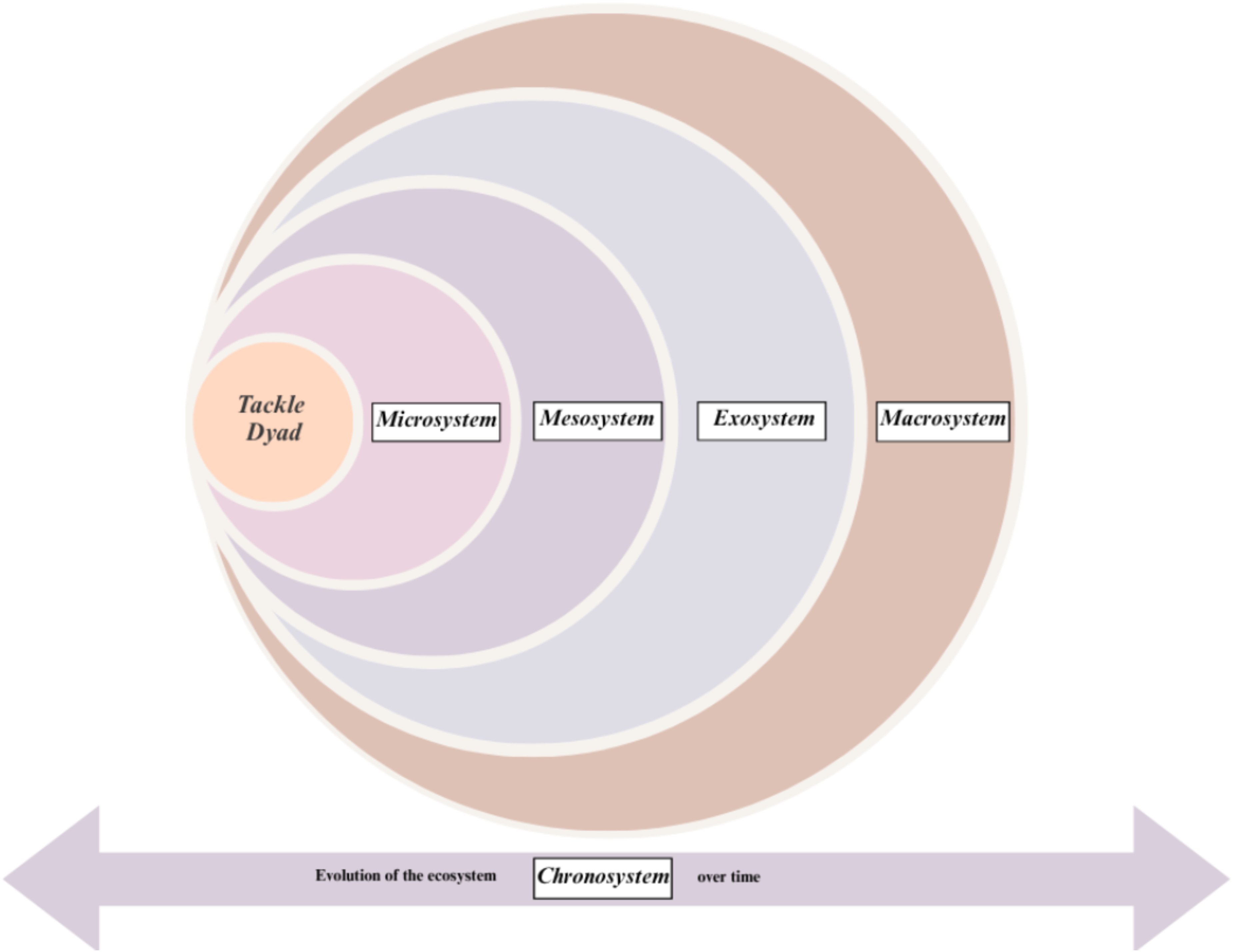
Bronfenbrenner's ecological systems model in adapted to the tackle. The model highlights how the tackle is nested within the different systems of varying influence. The Microsystem is the innermost system which directly influences the tackle. The Mesosystem involves less direct impact and interlinks the Microsystem. The Exosystem encompasses the next layer, indirectly influencing the tackle. The final outermost layer is the Macrosystem, addressing the broader socio-cultural contexts of the tackle. Whilst the Chronosystem underneath outlines how changes occur over time.
Whilst the Bronfenbrenner model was initially developed to explore human development, it has been applied in sporting contexts. For instance, Bronfenbrenner's work has been utilised to gain insights into elite athletes’ experiences, 25 whilst Kerr et al. 26 used the socio-ecological model to explore the influences upon non-disclosures of concussion. Indeed, Hendricks et al. 27 has previously documented how rugby athletes operate within a socio-ecological structure influenced by layers of interlinked contextual factors that change over time or through external modifications. Therefore, this framework is suitable to contextualise the elite rugby union players’ experiences of the tackle event. Accordingly, in this study, the individual shall be recognised as situated in a social-ecological context and the tackle event investigated with specific attention paid to the surrounding environment.
More recent research by Bronfenbrenner and Morris 28 has evolved the original model to examine the interactions between the person and the context. The bioecological model in its revised concept, emphasises the person, proximal process, context and time (PPCT) role on human development. The person reflects components of the individual athlete, which in this study may explain direct variances within performing the tackle (e.g., body composition, technical ability). Proximal process are the everyday regular activities resulting from performing within and across systems (e.g., training drills). The time element shifts across all systems, from individual tackles that happen in milliseconds to seasonal changes in techniques and law changes over the years. The context explores the impact of the four systems on the tackle and vice versa. These concepts provide an established and situated theoretical framework to analyse players’ experiences of the tackle event, in a situated and wide context.
Methods
Participants
Purposive sampling was employed, consistent with qualitative approaches, 29 to provide comprehensive perspectives from a varied representation of Gallagher Premiership players. Eighteen participants from four Gallagher Premiership teams were recruited through gatekeepers, consisting of front row forwards (n = 5), second/ back row forwards (n = 5), halves (n = 2) and outside backs (n = 6). All premiership clubs in the league were contacted to participate, with four confirming their interest and participating. Players were competing in the Gallagher Premiership during the 2024/2025 season, with a mean ± SD age and player experience in elite rugby union of 25.4 ± 3.1 years and 71 ± 52 games played. Initially, gatekeepers were provided with an explanation of the study, accompanied by an information sheet, including the benefits and risks of participation. Following written consent from the gatekeepers, players were contacted, and the corresponding information was provided with consent obtained. The exclusion criteria for the study were that any players had failed a head injury assessment within the previous two weeks, that had resulted in a sports related concussion or was still experiencing post-concussive symptoms, in line with the RFU medical standards.
Design and data collection
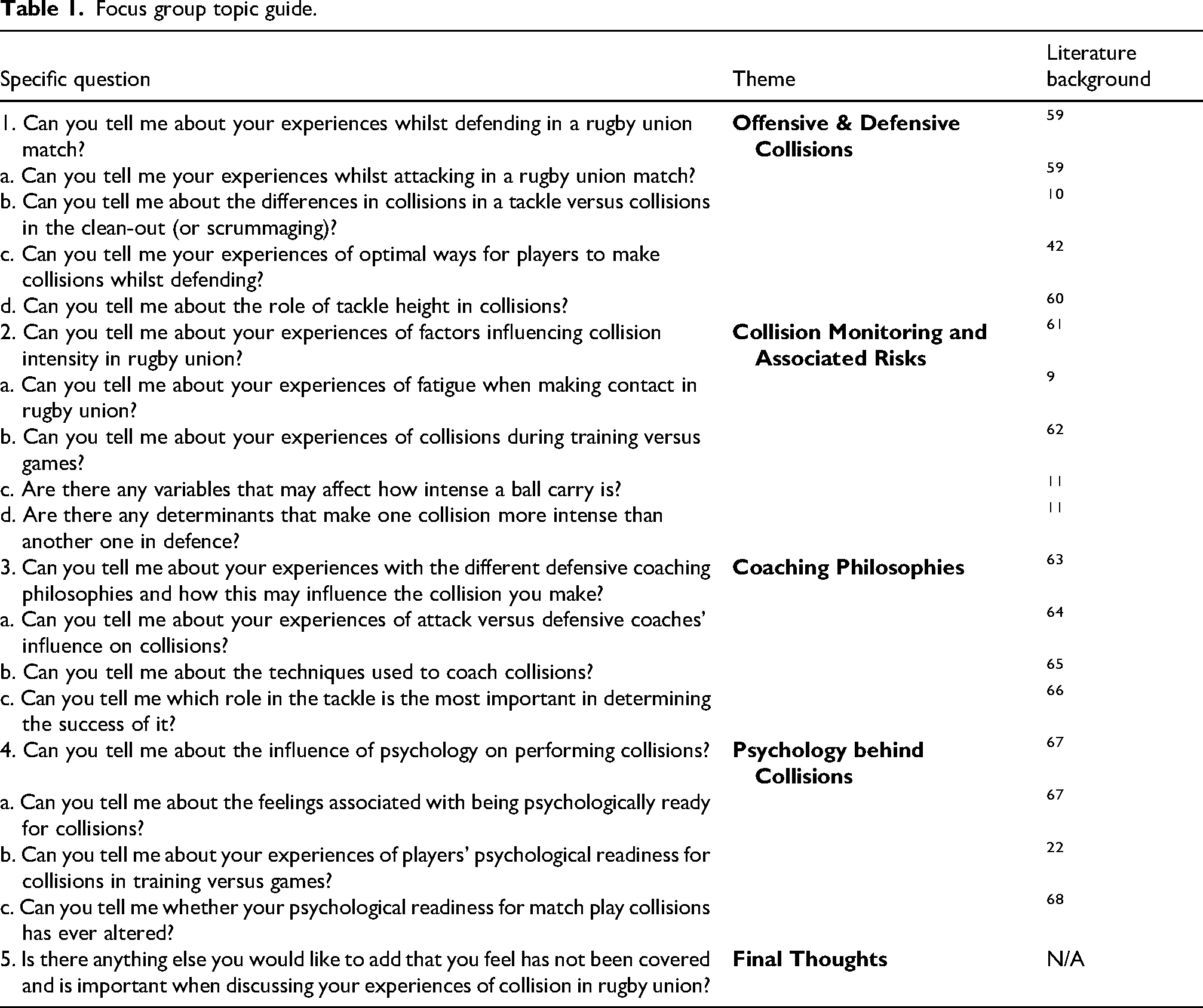
Aligning with previous research designs, 30 a qualitative investigation that intended to assemble participants’ perspectives through the method of focus groups was employed. Focus groups’ strengths are in the group interaction and in uncovering consensus or diversity in a subject area. 31 Barbour 32 states that the decision to employ focus groups must be weighed up within the context of the study. In this study, the benefits lay within the potential to co-create accounts and insights from a variety of positions (i.e., focus groups contained front rows, back rows, half-backs and outside backs). Indeed, focus groups have been highlighted as particularly useful in prior qualitative research exploring the tackle in other codes of rugby, rugby league. 22 To facilitate the discussion, a ‘topic guide’ or semi-structured interview schedule documented in Table 1 was constructed, informed by previous research as highlighted in the table. The groups consisted of online session via the Microsoft Teams platform and one in person group, which were transcribed verbatim. Participants were assigned pseudonyms at the beginning of the transcription process, and any identifiable information was removed. Each focus group comprised 3 to 5 participants and lasted between 35–60 min in line with previous research, 33 with all participants represented in the supplementary file.
Focus group topic guide.
Analytical approach
Reflexive thematic analysis
To further understand players’ perceptions of the tackle event, a thematic analysis was performed. This analysis method has been a prominent tool used by qualitative researchers to identify, explore and analyse patterns, also known as themes, within data sets comprised of shared lived experiences. 34 Originating in Braun and and Clarke 35 six step guide, thematic analysis has evolved, emphasising a component of reflexivity in more recent work. 36 Considering the scarcity of previous research with the given population, the RTA provides rich, in-depth detail to be accounted for amongst the datasets. In the first instance, once all interviews were transcribed, familiarisation with the dataset began. The transcriptions were thoroughly read and re-read, whilst notes were made. The systematic generation of initial codes from key features in the data followed this. An abductive process started with the data (participants’ voices), and meaningful sections of text were coded. From the gathered data and codes, some initial themes were proposed. For example, 1) how position and context determine tackle selection in defence, and 2) strategies that shape the speed of match play through disrupting the defence and generating attacking momentum. To make sense of these themes and add analytical power, Bronfenbrenner's model was then utilised to group, sort, and rework themes and codes. This involved the lead researcher reworking the analysis and then showing to the wider group. For instance, the initial analysis recognised tackle type, pitch location and player position as influences. Following an in-depth discussion, the lead researcher returned to the data once more and, reworked again, utilising the social ecological model. This back and forth is consistent with Braun and Clarke's reflexive thematic analysis and resulted in the themes that follow below. From the specifics of each theme, precise names were refined, and definitions made clear. A final analysis then took place, where the preceding literature and the research questions were linked to extract examples. Finally, a report was produced. No software was used when performing the analysis or when processing the data. See the appendix for the themes table. Upon the completion of the analysis, member reflections were undertaken where each of the participants were provided with the fundamental outcomes to ensure the findings were a credible account of their experiences. 37
Rigour
Through the transparency and credibility of the accounts expressed by participants, qualitative research establishes rigour and trustworthiness in the data illustrated. As such, to provide space and time for participants to express their experiences, neutral open-ended questions were employed to facilitate this. Nevertheless, it is crucial that reflexivity is at the core of the research, given the primary instrument in collecting, analysing, and interpreting the findings is the researcher. Therefore, it is good practice to detail the contributions and backgrounds of each author. 38 The lead author who collected data has a degree and post graduate degree in sport and exercise science and strength and conditioning, respectively. He has played over 16 years of professional rugby league, competing in 248 games for five different clubs (St Helens, Salford, Leigh, Toronto, and Toulouse). He has experience of seven recorded concussions and finished inside Super Leagues ‘top three tacklers’ for one season, amassing 931 tackles. Through the background experiences documented, the first author credibly accessed and developed rapport with an elite sample, which led to candid and open discourse. Nonetheless, to mitigate any potential of the data being tainted by bias, the other authors were involved in the analysis. The second author is a professor of applied physiology and medical research lead at the Rugby Football Union. The third author has worked in elite rugby league as a sports psychologist and is an experienced qualitative researcher. The fourth author's expertise is grounded in care in sports coaching as a reader in sports coaching and physical education. The fifth author has an extensive background in rugby league as a professor of sport and exercise science, focusing on monitoring team sport athletes. The sixth author is an ex-professional rugby union player of over ten years playing for four different clubs (Bath, London Irish, Newcastle Falcons and Gloucester) with a PhD in molecular physiology and current performance nutritionist of a premiership rugby club. The final author is an ex-professional rugby league player, currently working in elite rugby union with England Rugby and the British and Irish Lions and a professor of human physiology. In keeping with current advancements in RTA, the authors did not endeavour to establish inter-coder agreement but refined themes and codes by identifying contrasting perspectives and critically questioning disparities.
Findings
Via Reflexive Thematic Analysis we generated four interconnected themes discussed below, which achieve the aim of providing rich in-depth insights into the tackle event. To help illustrate these themes Figure 2. maps the broader socio-ecological influences of tackle experience.
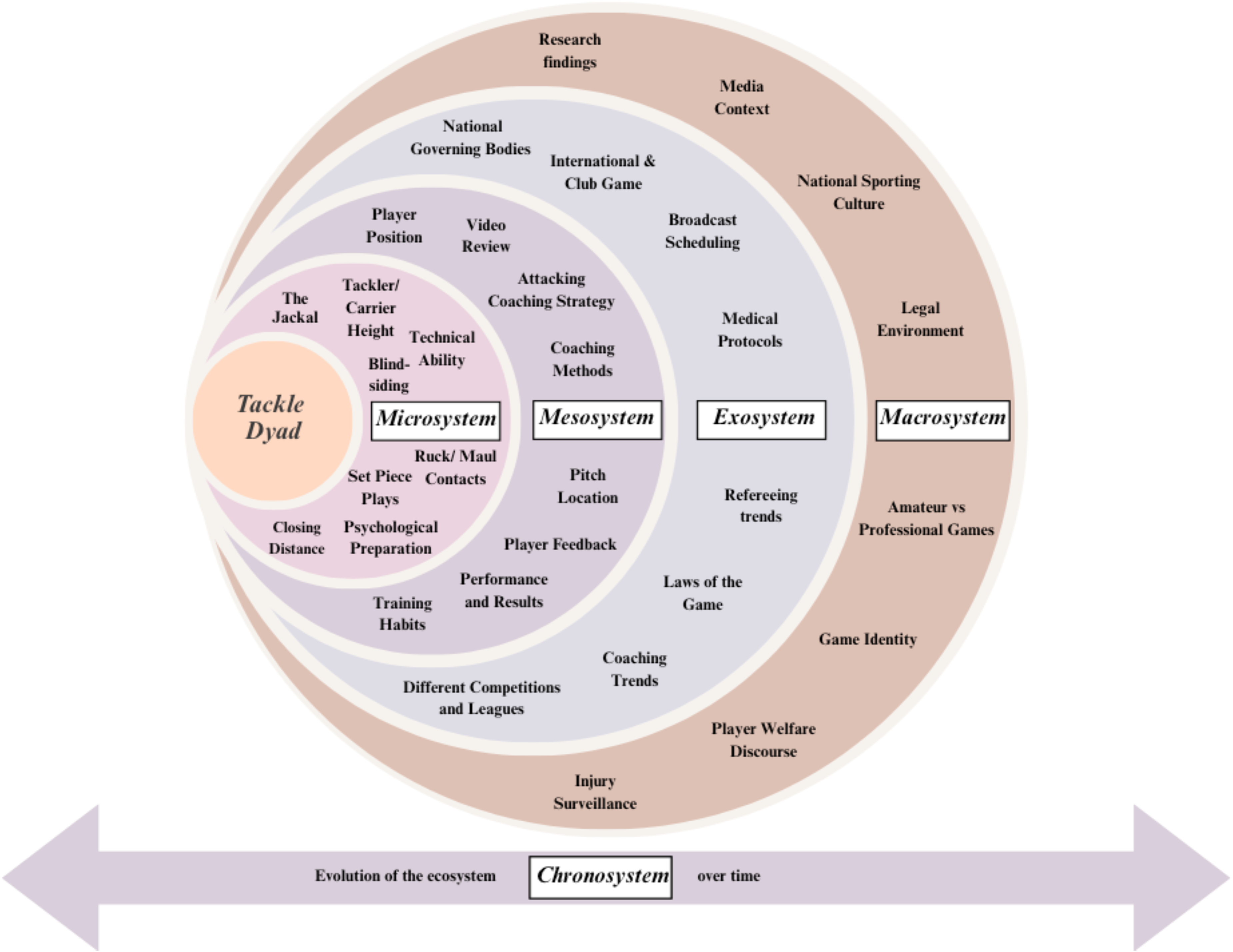
An adaptation of bronfenbrenner's ecological systems model in relation to the tackle event. The model highlights how the tackle is nested within the different systems of varying influence. The Microsystem is the innermost system which directly influences the tackle, as such ruck/maul contacts, technical ability, box kicks, ruck speed, the jackal, tackler/ carrier height and psychological preparation encompass this section. The Mesosystem involves less direct impact and interlinks the Microsystem including player position, bracing and blind-siding, closing distance, coaching philosophies, pitch location, set piece players, performance/ results and training habits. The Exosystem encompasses the next layer, indirectly influencing the tackle through research findings, the international/ club game differences, broadcast scheduling, medical protocols, refereeing trends, different competitions, coaching trends and injury surveillance. The second outermost layer is the Macrosystem addressing the broader socio-cultural contexts of the tackle such as the laws of the game, player welfare, game identity, amateur/ professional games, legal environment, national sporting culture, media coverage and national governing bodies. The final outermost layer is the chronosystem, which documents changes over time.
Ecological systems model and the tackle
Figure 2 below represents an interpretative map illustrating the key components of the tackle and how they interact with layers of influence.
Theme 1: Microsystem – people, positions and time determine the tackle
The inner most level of the ecological system focused on direct tackle events in match play that had an immediate interplay amongst the players and in game contacts instantly influencing the tackle event. The microsystem encompassed the proximal process elements of the Bronfenbrenner model (e.g., psychological preparation for tackles and technical preparations for the tackle). These processes were shaped by person characteristics, evidenced in the nuances between different positional groups, along with the context of match play (set piece, ruck maul), that will influence tackle selection.
Principally, players discussed the tackler's footwork and tracking the opponent as process components. G3Participant2 illustrates this component below and was echoed by G3Participant1, G2Particpant5 and G3Participant4 throughout the focus groups: G3Participant2: ‘If you can step in close, your first step after that collision, as well, is also gonna be, like, one of the strongest, but if you've lunged that in, and you've got straight legs, like, you're not gonna get any sort of leg drive.’ G3Participant2: ‘It's all just outcome based really. We look at the same outcome every time, which is you want to slow their ball down and take away space from them, however you go about that isn’t it really. We show highlight reels most weeks of the game before and you'll have tackles that look really messy, really grabby, but that would be an effective tackle or something that we would praise because we would slow their ball down and hit them behind the gain line. Even if it doesn't look like perfect technique, like it looks really high, really messy, that's still an effective tackle. G3Participant2: Yeah, especially in rugby union, that's what you're trying to do because the more you slow the ball down, the more time you've got for your defensive line to get set, whereas if you're, like I said about chop tackles, if the boys are on the floor straight away, that ball's available to play. You might only have one or two seconds for everyone to get set and off the line, whereas if you've got them for a higher shot and you've slowed that ball right down, you might give boys three, four, five seconds to set that line. That means that you've got better spacing, you're more connected, you're going to get off the line with more pace, so you're going to be more, effective.’ G2Participant2: ‘I’ll start off, I'd imagine me, G2Participant1 and G2Participant3 pretty similar as a forward quite a lot, If you're carrying off nine, you're running into pretty much a brick wall. You try and manipulate the defence a bit, by using the ball, but most of the time you're sort of carrying into probably two forwards as well. Your carrying position's probably pretty similar to your tackle position. Well for us we look to carry quite low to obviously create quick ball. G2Participant5: The only other thing I'd add is like sometimes you can get it where cause players are like to a certain extent allows to like latch on to each other. So basically there's two you're trying to tackle two people at the same time, like the mass of two people. You obviously go for the guy with the ball, but that's pretty, maybe a nuance of our game that you might not get elsewhere is people, there's sometimes more than one guy you're trying to bring down or dominate to win the collision, which can make the collisions a lot higher.’
In addition to time, players’ highlighted the tackle context, another feature of Bronfenbrenner's PPCT model, as an important aspect of the tackle microsystem. In the focus groups, there was a shared perception that contacts in the ruck are difficult to officiate. Head contacts in particular were perceived as challenging for referees to see due to the number of players. G2Participant2: ‘I feel like around the pitch if someone gets hit in the head in a tackle in a carry, it's pretty obvious you'll get looked at. Where I reckon in that rucks is actually where maybe that doesn't get seen as much. I'd say in a ruck, if I get cleaned out. Like there's and you get hit on the head, nothing will happen and it's like it's quite hard to actually for the technique because your head can be low anyway. But I feel like stuff like that, I reckon probably 10 times in a game someone gets hit in the head in a ruck, right with a shoulder or like head on head and it's sort of well, it's not really looked at because it's quite hard to officiate because if your head's basically by the ground and they're clearing out low, like, that's where you can see like shoulders to head, head on heads, which maybe aren't picked up by the TMO, but they do happen … I'm not saying that if you get hit on the head in a breakdown, it should be a penalty because it's, I almost feel like you can't avoid it sometimes It's just one of those.’ G1Participant1: ‘it's different for backs than for you guys [forwards]. If you're thinking about like an edge breakdown so often for us [backs] it's more about, like a race to get into a position and then these guys [forwards] are thinking about hitting people off the ball. We're [backs] actually thinking about just staying over the ball rather than taking someone out of it. So, for like an edge breakdown, often there's not that much of a collision there. It's like just getting get into a good position and then just hold on rather than like actually hit someone and take them off their feet. Definitely less of a collision now.’ G2Participant5: ‘There's a lot more variety in my tackle maybe compared to these guys (forwards) like. There's a variety in reaction time that I have. There's some of them really quick. Some of them I've got to sort of track a guy down for a long time and I'm expecting to make a tackle, but it takes me a bit longer to get there. Like mostly I'd say I'm quite a low tackler so like it never really ends up being high and it can be sort of a lot of different angles, a lot of stretching.’
Theme 2: Mesosystem – where coaching meets the process of tackle variation
The mesosystem highlights close influences upon the tackle microsystem, such as strategies for pitch locations, defensive philosophies, and training habits derived by coaches. In this way, the mesosystem was seen as interconnected to and impacting upon the types and intensities of contacts that players recounted. For instance, a crucial area associated with risk for forwards was the change in defensive strategies near the goal line. Players noted that the goal line context requires players to operate lower when tackling to match the height of the ball carrier. The will to regain possession was noted to be key because the defence cannot hold the attack out for a significant amount of time. G3Participant4 outlines below. G2Participant5: G3Participant4: G3Participant1: G3Participant3: It's completely different tackle. It's because you're defending inches, isn't it? You don't want to give away an inch, whereas outfield, that doesn't matter so much, so you can often give half a meter or whatever, but when you're on your goal line, you can't do that, so you've got to literally just be as low. you can they can't because they're trying to be as low as they can as well so you it's just a battle.’
Building on coaching strategies discussed above, set piece and set piece training habits also played a prominent role for forward players. For instance, players discussed how setting up the ‘maul’ was quite problematic. For lay readers, a maul often ensues when play is restarted from the side line, and subsequently, the attacking team forms a congregation of players that bind onto each other in a ‘group hug’ like action. This is often done with the aim of going forward as one entity. To do this, players will often ‘latch’ on to each other while hinging at the hips to generate momentum. Conversely, the opposition will often seek to stop a maul by joining the congregation at force from the opposite direction whilst also hinging. Players recounted how problems arise during mauls due to the head positioning of some players involved and the forces involved. G1Participant3 documents this below. G1Participant3: ‘the guy going to get the ball off the people jumping, that's horrible because you're like, it's almost like you're carrying into your own people, but it's with your head. Because you think about two lifters either side you're hitting into that jumper. There's nowhere for you head to go. So that can feel like a big impact, especially in trying to give go forward to the maul. … It's niggly like if it collapses, people landing on you. I don't know about you G1Participant2, but in training, training feels completely different to a game. … mauls is usually the first collision that you have within training. And so, the opposition you play against obviously knows that what you're doing, because on the same team, you know, the same calls for me, that's probably the hard training wise. That's probably the hardest collision you get.’
Coaching methods and training habits were further discussed by players who noted differences in coaching trends over time, e.g., preferences for the ‘chop’ tackle, which enabled the ‘jackal’, versus higher up contacts, which aimed to slow the ruck. G3Participant4 showed how contrasting defensive strategies, coaching methods and associated training habits can influence the tackle: G3Participant4: ‘Yeah, so I've had two clubs where it's all been about timing the tackle, get two people in there, try and hold them up, change the momentum, get our defensive line set, and that was very much like, that's what they'd review every week, and then I've had two clubs where we've had real good jacklers in the side, so it's been like, right, chop, chop and roll, because obviously once you've made the tackle, in order for our jackler, because we had a few real good jacklers, to be able to get over the ball, the tackler who made the tackle had to roll out of the way, because otherwise it would give the penalty away. So that philosophy was very much like, right, chop, tackle, roll, chop, tackle, roll. Yeah, and just the way they go about it, for example here, one of the other clubs, it was like, all the drills would do would be very much like two men in the tackle, change momentum. Whereas the other clubs I was at was like, right, chop and roll, chop and roll, you've got to operate low, you've got to live low.’
Theme 3: Exosystem – tackle contexts in relation to rules, refereeing and the laws of the game
The exosystem impacted the development of the tackle, but it was not an environment where the tackle was directly performed. Areas such as the laws of the game, refereeing and coaching trends, national governing bodies and different competitions and leagues combined to influence the tackle from afar. For instance, the inability of players to brace as a catcher during box kicks was highlighted as a component within this system associated with increased risk of injury. Although this event sat within the microsystem (closing distance/ blind-siding), players’ perceptions were that new rule changes had made this event more difficult due to the lack of ‘shepherding’. It was perceived that this gave the attacker a free run to the catcher, and therefore, the rules modified the context of the event. This sat within the exosystem as the laws of the game influenced this component of the tackle. Below G4Participant5 shows. G4Participant5: ‘I think as well because it's such a major rule change this that they've bought this year around the no cradle, there's still sort of an area of uncertainty around. With some of the calls refs have made. But yeah, I think there is definitely a lot, a lot of the guys who are in those position are going up to catch the ball. There probably is a little bit more fear that you are going to, it's to encourage that one-on-one contest in the air. But that fear that you probably are going to get taken out in the air. It's definitely crossing a lot a lot more boys’ minds. Whereas with the cradle, it's something which has happened. They're pretty hard to try and avoid that but yeah, that's something's certainly something that's crossed my mind.’ G3Participant1: ‘That's one for me is that when box kicks go up, I'm up for a box kick landing and someone's well-timed hitting you. That's the worst one. Because you don't really know where they are because you're focusing on the ball.’
In a further section of this system relating to in-game alterations to rule changes, players discussed how coaching trends had developed over time from an attacking point of view. Notably, players explained how coaches coached a lower carry approach. G4Participant3: ‘It's like a bit of a balance, right, because the rules have been changed to drop the tackle height to promote safety. But then at the same time, on the other side of the ball, part of like attack coaches and like coaching people to carry lower in order to stop like what you're saying, like the ball being ripped and ball being put in danger. So, like, I suppose the question is like, how, how does the game make it safer for everyone if we can't just keep bringing the height down. You've got to tackle lower because people are carrying lower and you got to tackle lower, you know.’ G3Participant4: G3Participant1:
Theme 4: Macrosystem – wider contexts driving tackle experiences
The final system related to the contributions of broader society and cultural forces upon the tackle event. Wider contextual factors, such as player welfare discourses and legal environments, were identified as features of the macrosystem. These features interact and influence the exo, meso and microsystems of the tackle. For example, players discussed training being in a level 2 zone intensity in line with contact load guidelines.
39
Such guidelines were developed amongst a context of athlete welfare discourses, wider legal developments in sports such as NFL, and wider governing body policies on injury. However, in practice, the player described how they engaged in a process influenced by these macro contexts by operating at a low intensity to control the contact. The intensity was so low that the player ‘tackled’ in an upright grab body position. Reflectively, the player noted how over time, this training process became a habit and, unfortunately, translated into a game. G1Participant2: ‘Well, when I had those two cards back-to-back in Year X, I blame that solely on training habits, completely on training habits. Where because we train that way all the time… it was a kind of like a grab level 2. So you never change your body height, and then you go into the game and you've been doing that for 12 weeks of preseason plus the six weeks is 20 weeks from practising this kind of like high grab and then you go into a game where you get to, I've got two, Player S got two cards, Player U got two cards, Player Z got two cards.’
Another powerful component of the macrosystem identified by players in this study is the evolution of the game's identity. Rooted detailed a temporal shift from the traditionally masculine values, such as aggression valued by previous generations. Specifically, players noted a balancing act between arousal and calmness on matchdays. G2Participant5: ‘I'll say, like most of the time, I feel quite calm. Like the more the more amped up I get. I think that's where errors come into my game, so I just I try and stay calm and normally it's sort of like muscle memory kicks in and you end up doing the things that you that you want to do.’ G1Participant2: ‘I also think like bigger picture stuff on the game at the minute is that emotional side of the game is getting less and less and less. So if you wind back the changing rooms to 12 years ago or 14 years ago when I started you, that's where you had boys headbutted walls still. And you have boys slap on each other, screaming, shouting. They're spraying water in their face, but then 14 years ago, just throw a punch, maybe a penalty. So now you throw a punch it's a red card and a six week ban. So the game physicality is the style of physicality has changed. I believe it's a way more physical game now. As in the collisions are bigger and harder, but they're less aggressive as in there's less punching there's less, it's more controlled. There's much more controlled aggression rather than just raw aggression.’ G1Participant2: ‘I think there's two parts to it. I don't know how you break it up psychologically, but there's one about the game plan and your role and you knowing, and having like you really knowing it, so you’re not thinking about it, you know where you’re going you know where your job is. And then the other part of it is like that emotional get up for the game. The way I play and where I am, the second one, I've never had an issue with I've never gone into a game thinking oh, I don't know if I fancy this today, you know, I've never had that feeling. Whereas I have had that feeling where I go into the game or like I'm not 100% sure if he calls a 7-man line out shift one where that ball is going so. For me, having both of those things concrete as I know exactly what I'm doing and where I should be, and then I'm then I'm sweet, but then that the first one says, well, can perhaps impact the second one because emotionally, if I'm thinking I'm not thinking, let's go. Let's go. Let's go. Which is where I am in a good place.’ G4Participant2: [In training] nobody jackals, but nobody gets cleared out. If you Jackal in training no one's going to go and clear you out. I think those are the areas where you will see like the more nasty ones [injuries]. Other areas where we like, we do have a lot of hours to train like two man tackles and stuff, you don't see people getting nasty head knocks off. It's the ones where you can't get loads of reps in the week because they're a bit dangerous, that's where the decision making isn't great, and that's where probably, the players are at their most vulnerable. G4Participant2: I don't know if you can practice certain things, but like you said it, there's only so much you can do until you have to just actually do it 100%. But that's what makes it like that's what's rugby is, isn't it? Like we've all made like, we get paid to do the job. It's like F1 drivers like I'm sure, when they're like going around … G4Participant1: I think we all know the risks.
Discussion
The current study explored elite rugby union players’ experiences of the tackle event through a series of focus groups. The findings of the study illustrate several novel insights from an elite population, not previously noted in the literature. Several key elements align with components of Bronfenbrenner's PPCT socio-ecological model to highlight how different systems influence the tackle event through process, person, context, and time. Participants described key tackle proficiency techniques for the tackler, reflecting personal position differences perceived to be associated with greater tackle success and the immediate context of the tackle. Moreover, players highlighted the central importance of time and how tackles, regardless of context, are outcome-based (slow or quick ball), which dictates the impact point of the tackler. The jackal had a significant influence on contact zones and whether players were aiming to recoup possession through performing a lower contact in the preceding tackle by way of a chop tackle. Players also discussed head contacts from two distinct perspectives, initially in the ruck, as this is a difficult place to officiate for referees and separately in the back row position in the process of setting up a maul from a successful line out due to the lack of space for the head. Recent rules and officiating changes have placed a prominent focus on box kicks, with players perceiving an inherent risk with this kind of contact due to a lack of bracing for the collision. Lastly, elements of the game's identity were documented as players alluded to some transformational parts of rugby culture, such as a focus on calmness, albeit with a deep rooted feeling of going to ‘war’. Amongst this complexity, this discussion will explore the tackle, contacts in ‘mauls’, and after ‘box kicks’.
Tackle proficiency metrics have been a focal point of research to understand the patterns in contact techniques linked with injury and tackle success.40,41 Of the key techniques highlighted by players in this study, identifying the ball carrier onto the shoulder, shortening steps, and leg drive upon contact all correlated with previous research associated with performance and injury prevention. 42 As a reciprocal interaction between players adapting to their environment, Bronfenbrenner's proximal process of the defender aiming to plant the lead foot as close to the attacker as possible was a crucial and somewhat novel element discussed. Driven by coaches’ feedback from the resultant outcome-based approach, tackle techniques included the ‘chop’ tackle to quickly enable a teammate to ‘jackal’, which contrasted with a higher up contact to slow the ruck time and get the defensive line set. Training habits also shaped tackle behaviour through the repetitive nature of practice. Indeed, Starling et al. 39 has shown how contact guidelines have recently been introduced to track and monitor contact loads. However, players cited that the repetition of performing contacts in zone 2 means contact in an upright body position is performed more often in training by the tackler. The interaction between repetition of zone 2 contacts and match play when contact zones must be lower, is potentially problematic for players. Due to the habitual nature of tackle technique, players may be more likely to perform high tackles with dangerous head contacts, especially with the increased fatigue associated with higher intensity match play. This tension, illustrates the interplay of the socio-ecological model between the proximal process of performing contacts and the alteration illustrated here through changes in rules over time.
Head contacts were also noted by players in the lineout and subsequent maul. Influenced by playing position, some players elucidated how ‘adding’ into a maul can be an intense collision due to the lack of space for head placement. Players described this as one of the most difficult contacts in training due to the augmentation of the opposition knowing the play, as such, correlating with the proximal process of training habits. Research investigating lineouts illustrated lower performing teams lost more lineouts and higher performing teams won more of their opposition's lineouts, 43 and thus the lineout is an important part of rugby performance. Yet, there is little research delineating the individual positional roles within the lineout and the collision exposure that occurs during training and matches. Reflecting the positional specific elements here, some players’ reported that being at the head of the maul was a lower risk. Therefore, the individual exposure to each person within the lineout may contrast and as such, warrants further inquiry. Positional role further shaped interactions at edge breakdowns and contacts near the goal line for backs. Backs discussed how the breakdown on an edge is a race to position, in contrast to middle breakdowns, which are a competition amongst forwards. Similarly, backs felt there was a lot more variety in their tackle in comparison to forwards, however, the coaching of goal line defence is not leading to backs being as proficient as forwards. Given the individual roles ascribed to each position, the person feature of the Bronfenbrenner model highlights the distinction between playing groups and their experience of the tackle.
Time was discussed by players relating to tackle type. If the tackle creates a ‘slow ruck’ for the defending team, this is positive, and if it creates a ‘fast ruck’, it is deemed negative. Players highlighted coaches’ focus on slowing down the ruck to set the defensive line, a transformative tactic, since recent rule changes to post-contact components of the ruck. In March 2020, World Rugby altered the enforcement of ruck infringements at the breakdown, bringing increased scrutiny to the jackal, and shifting its officiating over time. 44 More emphasis was placed on which player wins the race to possession before the ruck is formed and ensuring the ‘jackler’ supports their body weight without going to ground. To further player safety, World Rugby 45 reduced additional problematic elements of the jackal, such as the ‘crocodile roll’ to reduce the risk of knee injuries during match play. 46 This was a significant change given the association the jackal has with turnover possession in central pitch areas. 11 Related to the jackal, players in this study perceived coaching methods to originate from two divisions, a chop tackle for a teammate to perform the jackal, or a higher up contact aimed at slowing the ruck down. These methods manifest in the interplay of coaches coaching the tackle, and players changing over time via weekly feedback in the microsystem to alter players’ technique. They also refer to the change in refereeing trends over time, situated in the exosystem, prompted by law changes by governing bodies in the macrosystem. Given the increased scrutiny on the jackal, the likelihood of players performing the chop tackle to enable this event decreases. Consequently, players report contacting the body of the attacker higher up to control the carrier to the floor and allow time for the defensive line to set and get connected as more beneficial. Tackle height is, however, a continual discussion in rugby due to higher up contacts having an increased likelihood of HIA's 47 and concussions. 48 In an effort to reduce concussions, governing bodies have rolled out trials to alter behaviour change in the tackle, 49 along with tackle technique programs to modify tackle technique to more frequently select a lower contact zone (RFU tackle technique program). However, it appears players in the current study feel contacting the ball carrier in a higher zone may increase the ability to slow the ruck down and therefore provide a greater tactical advantage. In line with Bronfenbrenner, time played a significant role in this section, highlighting how key rule changes in the exosystem can influence coaching methods and subsequent tackle types to gain tactical advantage.
A box kick is a short-range contestable kick that aims to put the opposition under pressure, gain territory or regain possession. 50 The deployment of the box kick has substantially increased over recent years. Strydom et al. 51 showed an increase from 6% of all kicks in the 2003 Rugby World Cup to 23% in the 2019 Rugby World Cup. The box kick alters the environmental conditions in which the tackle occurs and, therefore, is context dependant. Recent rule changes are aimed at penalising teams that ‘escort’ or slow down the chaser en route to the catcher, to provide an even contest in the air, 52 transforming the context of the event. However, players cited a lack of ability to perform this type of contact in training, which potentially leads to poorer decision making in match play. This may not help players’ abilities to brace when catching from a box kick, which is often difficult anyway due to their focus on the ball and the association of tackler speed and accelerating tackler with a concussion. 53 However, the risk associated to the tackler was not highlighted. Previous research in Rugby League has found bracing for contact as a key variable in predicting contact intensity, also discussed by players. 22 However, the tackle events related to these contact types were not congruent with match play and, as such, outlawed and penalised, driving behavioural change. 54 Therefore, finding ways to train the box kick safely is of paramount importance to aid players’ coordination. Further contextual factors unique to rugby union are the ruck maul, lineouts, and contested scrums. 55
Strengths, limitations and practical applications
The current study provided credible and transparent in-depth accounts of elite rugby union players’ experiences of the tackle that had previously not been heard before. As such, there are practical applications generated here that may translate to similar populations. In line with a qualitative research design, it is not claimed that the experiences and perceptions provided are generalizable to all rugby union players. Instead, the findings provide readers with rich insights to consider the transferability to their own specific context.
56
Nevertheless, as with any exploratory investigation, there will always be some limitations of the work discussed. As such, the current study is not immune to this, with a potential limitation highlighted by the 18 participants included. However, this number did provide equal representation across the positional groups, using purposeful sampling to gain insights from a diverse group of playing positions. Moreover, focus groups were discontinued when sufficient information had been generated from the groups, in line with prior research outlining suitable sample sizes for qualitative research.
57
As such, the following components are considered for practical applications:
The players’ perspectives in this paper have shown that ruck outcomes underpin the perceptions of tackle success. Therefore, policymakers aiming to understand tackle and coaching trends should do so by rigorously incorporating a broad range of stakeholders’ views. For instance, Dixon et al.
58
have shown the value in speaking to tactical coaches, physios, doctors and strength and conditioning coaches who may be able to add further tackle insights relevant to the code. A context-driven approach could be taken to tackle techniques. For instance, defence could explore the mechanisms of successful tackle outcomes from an injury prevention and performance perspective in contrasting contexts (goal line versus edge). Elements of match play, such as the box kick and maul contacts during the lineout for the back row, expose players to high-risk contacts. The ability to train these methods should be considered along with reducing exposure in match play by governing bodies. Players perceived that contemporary rugby union cultures aimed to balance aggression with composure. Psychological skills to support controlled aggression in contact may be an area for future research, education, and practice.
Conclusions
Through a series of online focus groups, this study aimed to explore the subjective experiences of elite rugby union players playing in the Premiership in England. Using Braun and Clarke 36 reflexive thematic analysis and informed by Bronfenbrenner 23 theoretical framework, the four focus groups were analysed. Four key themes were produced. The key themes were: 1) Microsystem – People, Positions and Time Determine the Tackle, 2) Mesosystem – Where Coaching Meets the Process of Tackle Variation, 3) Exosystem – Tackle Contexts in relation to rules, refereeing and the laws of the game, and 4) Macrosystem – Wider Contexts Driving Tackle Experiences. To provide further context to the tackle event, a theoretical model was included to provide context of several interlinking systems and their influencing role in the tackle event. This research moves the existing research forward by providing previously unheard subjective experiences of players and mapping the environment of the tackle in elite rugby union.
Supplemental Material
sj-docx-1-spo-10.1177_17479541261456106 - Supplemental material for Mapping the ecology of the tackle event: What shapes how elite rugby union players takle?
Supplemental material, sj-docx-1-spo-10.1177_17479541261456106 for Mapping the ecology of the tackle event: What shapes how elite rugby union players takle? by Andrew J. Dixon, Keith A. Stokes, Martin A. Littlewood, Colum J. Cronin, Craig Twist, James F. Hudson and Graeme L. Close in International Journal of Sports Science & Coaching
Footnotes
Acknowledgements
The authors thank all participants for taking part in this study. This research did not receive any specific grant from funding agencies in the public, commercial, or not–for–profit sectors.
ORCID iDs

Ethical considerations
The Liverpool John Moores University Ethics Committee approved the study (25.09.2024).
Consent for publication and participation
All players were required to voluntarily agree to participate after reviewing and signing the consent form. The authors obtained written informed consent for publication by all participants.
Authors contributions
All authors contributed to the study conception and design. AD performed the data collection, whilst all authors contributed to the overall analysis and interpretation of the findings.
Funding
The authors received no financial support for the research, authorship, and/or publication of this article.
Declaration of conflicting interests
The authors declared no potential conflicts of interest with respect to the research, authorship, and/or publication of this article.
Supplemental material
Supplementary material for this article is available online.
References
Supplementary Material
Please find the following supplemental material available below.
For Open Access articles published under a Creative Commons License, all supplemental material carries the same license as the article it is associated with.
For non-Open Access articles published, all supplemental material carries a non-exclusive license, and permission requests for re-use of supplemental material or any part of supplemental material shall be sent directly to the copyright owner as specified in the copyright notice associated with the article.
