







Abstract
Some strategies can be used to improve pectoralis major (PM) demand such as grip width, movement velocity, type of resistance and range of motion. Also, the normalized surface electromyography is commonly used to assess muscle activity during resistance training and allows the analyses of muscle activation across different portions of the exercise. The investigators aimed to compare sternal and clavicular PM's regions activity at the initial, middle, and final portions of the concentric phase during both flat and incline bench press. External and clavicular portions of PM EMG signals of thirteen males which performed 1 set of maximal repetitions of both flat and incline bench press at 60% of maximal load were analyzed. On flat bench press the final portion of concentric phase had lower muscular activation compared to middle (p < 0.001) and initial (p < 0.001) portions (clavicular) and to middle (p < 0.05) portion (sternal). For incline bench press the middle portion had a higher activity than initial (p < 0.001) and final (p < 0.05) portions at clavicular region while in sternal region final portion was lower than initial and middle (both p < 0.001) portions. The results suggest that reducing the range of motion by excluding the final portion of the concentric phase in the bench press may help maintain higher pectoralis major activation. It can be particularly advantageous in hypertrophy-oriented training, as it avoids the decrease in muscle activity during exercise.
Introduction
Resistance training focusing on pectoralis major (PM) is widely applied by researches for several goals, such as shoulder rehabilitation, performance enhancement, and muscle hypertrophy.1–3 Among the various exercises for this muscle, the bench press, in its many variations, is considered a fundamental due to its effectiveness in increasing upper body strength and muscle mass.2,4,5–7 Several training strategies can be adopted to optimize PM demand, including adjustments in grip width,3,8 movement velocity,9,10 type of resistance,9,10 and range of motion (ROM).3,11 In this sense, the angle of the bench, flat or inclined, is one of the most influential variables, as it alters the relative activation of different PM regions.5,12,13 Evidence suggests that the incline bench press preferentially recruits the clavicular region, whereas the flat bench press tends to emphasize the sternal region.3,7,8
Surface electromyography (EMG), when normalized to a reference value, is one of the most widely used techniques to assess muscle activation during resistance training.14–16 Normalized EMG allows for detailed analysis of activation patterns across different phases of a lift, providing valuable information to guide exercise selection and refine technique. 17 Previous studies have reported average or peak EMG amplitude for the entire ROM to compare exercises or postures.18–20 However, muscle activation can vary substantially across distinct portions of the movement.
Analyzing specific points, such as the initial, middle, and final of the concentric phase, for example, may yield more precise information for exercise prescription. Previous work on elbow flexor and extensor exercises has shown that EMG amplitude changes according to both external torque and muscle length.18,19 Applying these concepts to the PM, it is plausible that the sternal and/or clavicular regions present distinct activation patterns during different portions of the concentric phase, influenced by bench angle and the mechanical demands of the lift.3,8,21
Understanding how bench press variations influence PM activation across different movement phases is essential to identify whether specific regions of the muscle experience unique mechanical demands. Such knowledge could help optimize training strategies to maximize recruitment and improve outcomes. Therefore, the study aimed to compare the activation of the sternal and clavicular regions of the PM at the initial, middle, and final of the concentric phase during both flat and incline bench press. Considering that EMG amplitude generally increases with greater muscle force output, 17 we hypothesized that both PM regions would exhibit higher activation at the start of the concentric phase, when the external torque and mechanical demand are expected to be greatest.
Methods
Sample
Thirteen subjects, all males aged 28.8 ± 4.5 years, height 174.6 ± 5.6 cm and body mass 79.4 ± 9 kg participated in the study. The participants had to be resistance-trained for the last 12 months or more and should be able to perform 1 maximal repetition of bench press with a load at least 100% of their body mass load. The study was submitted and approved by the ethics committee from Hospital Universitario Clementino Fraga Filho (approval number: 3.924.362) and all the subjects signed the informed consent.
Instrumentation
A bipolar EMG device (DuePro EMG, LISiN and Bioelettronica, Italy), previously validated technique, 22 was used for muscular activation measurement. The bipolar electrode configuration was placed over the sternal and clavicular portions of PM, following the procedures depicted in the previous study. 21 B-mode Ultrasound (Logic, Healthcare, USA) images were used to identify muscular fascicle direction and an electrode vector of HD-EMG device (MOUVI, OTBioelettronica, Italy) was placed over the PM to identify the muscular innervation zone. Both procedures were needed to improve bipolar EMG signals, avoiding unwanted noise and were also depicted by Albarello and colleagues. 21
A triaxial accelerometer with a range of ± 8 g and 100 Hz of sampling rate (DueBio EMG, LISiN and OTBioelettronica, Italy) was placed to measure bar displacement, as previously reported,21,23,24 during bench press exercise, in order to identify concentric and eccentric phases.
Experimental protocol
The experimental data were a portion of the same data set used by Albarello et al.. 21 Briefly, the subjects were asked to make four visits to the laboratory. On the first and second days, they performed 1 repetition maximum (RM) test, for flat and 45 degrees inclined bench press exercises to determine the exercise load based on 1RM test results. The 1RM test consisted of up to three attempts, with 5-min rest intervals between attempts. To improve the reliability of the load determination, the 1RM test was performed on two separate days for each exercise. Inter-day reliability was assessed using the intraclass correlation coefficient (ICC) and coefficient of variation (CV), as previously reported. 21 On the third and fourth days the subjects performed four sets of flat or inclined bench press with 60% of 1RM load, randomized between the days. The subject was asked to perform as many repetitions as possible until failure at each set. For all bench presses performed the subjects had to touch the bar on the chest (final of eccentric phase) and lift it until full elbow extension (final of concentric phase).
The EMG data of sternal and clavicular regions were recorded during the exercise sets. The exercise cadence was controlled by a metronome, set to beep every 2 s, allowing the subjects to perform 2 s duration on each phase (concentric and eccentric). Notably, subjects were familiarized with exercise cadence on the first and second days. For data analysis, only the first set was included to minimize the influence of fatigue, which is known to affect both movement execution and EMG responses across successive sets. The first repetition of this set was excluded due to its typically distinct characteristics, as it often involves adjustments in coordination, tempo, and stabilization, making it less representative of steady-state performance. The mean duration of the first three valid repetitions was then calculated and used as a reference to characterize each participant's typical execution tempo. This procedure allowed normalization of repetition timing and helped identify inconsistencies in movement execution. Repetitions with durations deviating more than 10% from this reference were considered non-representative and excluded. Additionally, if two consecutive repetitions exceeded this threshold, both and all subsequent repetitions were removed, as this pattern was interpreted as a systematic change in performance (e.g., onset of fatigue or loss of movement consistency), rather than random variability.
Data analysis
EMG data were preprocessed by a bandpass filter (20–350 Hz) and a reject band filter centered at 60 Hz and four harmonics. Only the concentric phase of EMG signal was analyzed. As the phases were identified by the accelerometer signal, 10% of EMG signal (first 5% and last 5%) was excluded, in order to eliminate the electromechanical delay. 25 After, the EMG signal was equally separated into three portions, which are representative of three portions of concentric phases (initial, middle, final), see Figure 1a. Figure 1b shows an example of an accelerometer and EMG signal separated in initial, middle, and final portions. Then, for each subject, a total of three (referred to each portion) *number of repetitions EMG signal sections were obtained per region (sternal and clavicular). For each EMG section the root mean square (RMS) value was calculated and normalized by the maximum RMS value. All data analysis was performed in MatLab 2019 (MathWorks, EUA).
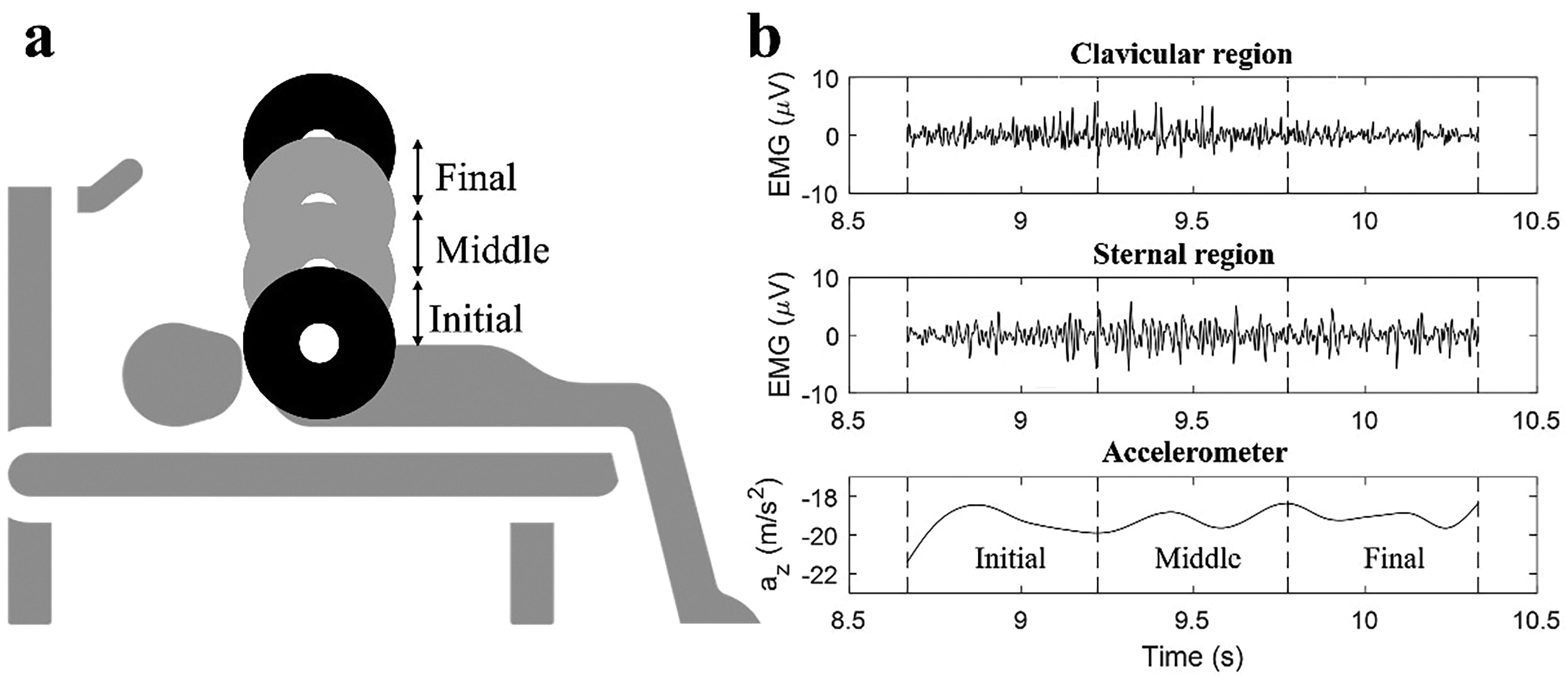
(a) Illustration of flat bench press with the three portions of the movement; (b) Raw EMG and acceleromter signals during one concentric contraction.
Statistical
The Shapiro Wilk (p > 0.05) test was performed to determine the EMG RMS Normalized portion's normality. For portions comparison one-way ANOVA (p < 0.05) test for repeated measures was applied (initial, middle and final) followed by its effect size (h2). To identify the paired comparison between the three groups, Bonferroni's post-hoc was applied. All statistical analysis was performed in RStudio interface (version: 2025.05.01) for R software. 26
Results
For the flat bench press, the results showed a statistically significant decrease in muscle activation during the final portion of the concentric phase (F = 30.42; p < 0.001; η2 = 0.225 and F = 7.36; p < 0.001; η2 = 0.065 for clavicular and sternal regions, respectively) (Figure 2). Specifically, the clavicular region demonstrated a statistically significant difference between the final portion and both the initial and middle portions (p < 0.001). For the sternal head, a statistically significant difference was observed only between the middle and final portions (p < 0.001).
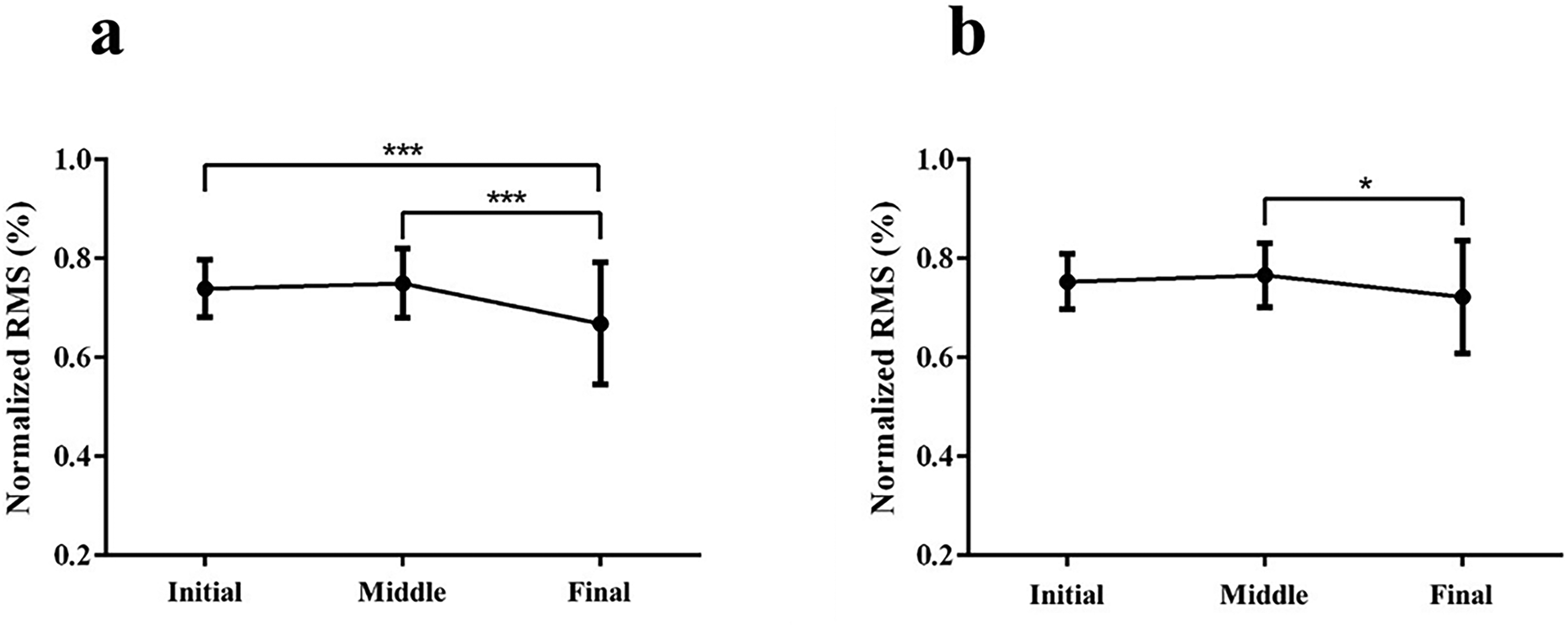
Mean and standard deviation of normalized RMS for clavicular (a) and sternal (b) heads at flat bench press. * p < 0.05; *** p < 0.001.
Similarly, than flat bench press, the incline bench press (Figure 3) also showed statistically significant variation in activation across movement portions for both regions of the pectoralis major (F = 21.97; p < 0.001; η2 = 0.158 for the clavicular, and F = 27.53; p < 0.001; η2 = 0.191 for the sternal regions). For the clavicular region, the highest activation was observed during the middle portion of the concentric movement, which was statistically significantly greater than both the initial (p < 0.001) and the final portions (p < 0.001). For the sternal region, the lowest activation occurred at the final of the concentric phase, with statistically significant differences between the initial and middle portion (p < 0.001), as well as between the middle and final portions (p < 0.001).
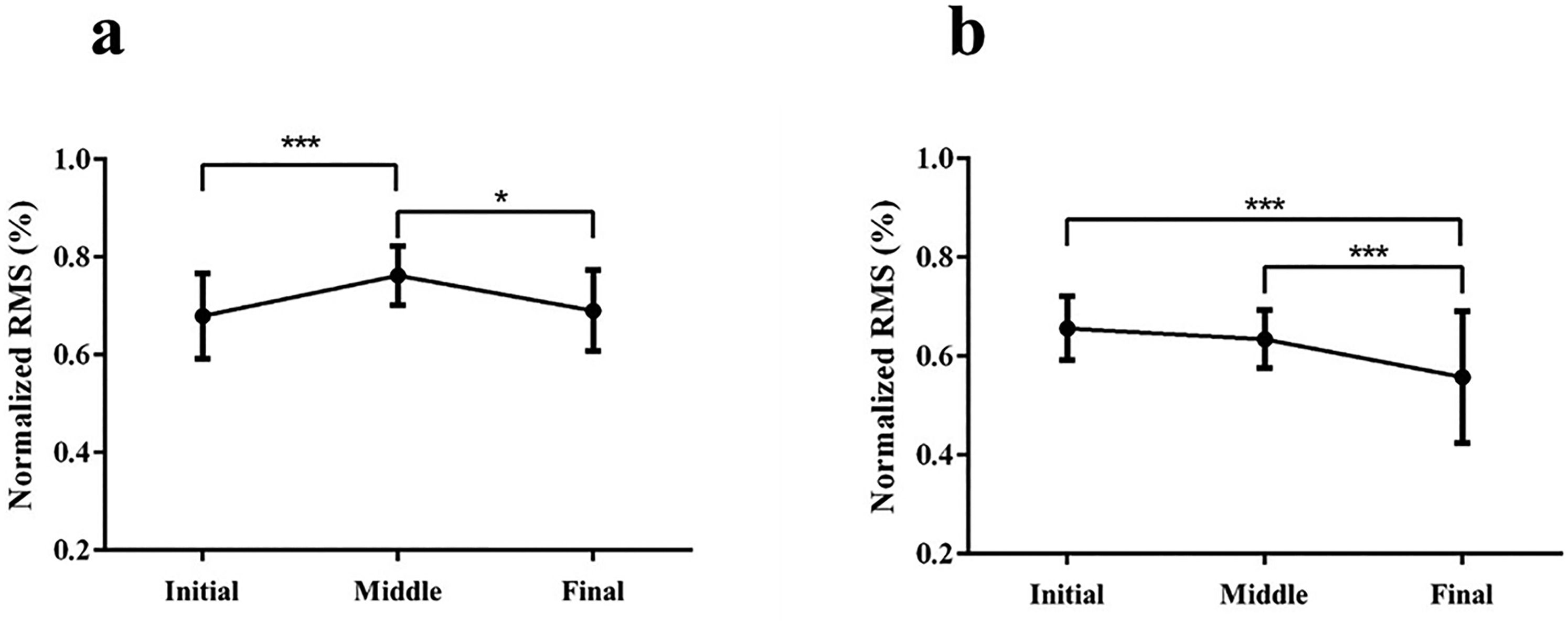
Mean and standard deviation of normalized RMS for clavicular (a) and sternal (b) heads at inclined bench press. * p < 0.05; *** p < 0.001.
Discussion
The main findings of this study indicate that muscle activation of the pectoralis PM during the final portion of the concentric phase was consistently lower than during the middle portion across all four conditions analyzed. Notably, in the incline bench press, the clavicular region showed significantly lower activation in the initial portion compared with the middle portion. In contrast, no significant differences between the initial and middle portions were observed in the other three conditions. These results reveal a consistent decline in PM activity toward the final portion of the concentric phase, a pattern with direct implications for exercise prescription. For instance, when the goal is to maintain high PM activation for a prolonged period, completing the concentric movement through its full ROM may not always be necessary.
The reduction in PM activity observed in the final portion of the concentric phase can be explained by the decrease in external torque as the load approaches the vertical alignment over the shoulder joint. According to previous studies,18,19 EMG activity is strongly influenced by the magnitude of the external moment arm and the muscle length at each joint position. Oliveira and colleagues, 19 for example, reported lower biceps brachii activation at the initial portion of the concentric phase in standing and inclined dumbbell curls, where the external moment arm is minimal at the start of the lift. Conversely, in elbow extension exercises, where the external moment arm is greatest at the initial portion, EMG activity is also highest at that stage. 18
In the shoulder joint, the external torque varies throughout the concentric phase, primarily due to changes in the moment arm.3,27 At the initial portion, PM fibers are in a relatively lengthened position, beyond the neutral point of horizontal adduction, which favors force production according to the length–tension relationship. 11 As the movement progresses to the middle portion, the lift seems to approach the sticking point (approximately 180° of shoulder horizontal abduction) where the external moment arm is near its maximum (18) and the PM fibers remain close to their optimal length for force generation for both regions (8). This combination likely explains the elevated muscle activation observed during the initial and middle portions of the concentric phase in our results.
The sticking point, as reported in previous literature, occurs at roughly 30% of the bar's vertical displacement during the flat bench press.27–30 This mechanically disadvantageous position is characterized by a substantial moment arm at the shoulder joint and PM fibers positioned near their optimal length, requiring greater neural drive to overcome the resistance.31,32 Since this region corresponds to the transition from the early to the middle portion of the concentric phase, it aligns with the phases of higher muscle activation observed in this study.
In contrast, during the final portion of the concentric phase, the line of load application moves closer to the shoulder joint, reducing the moment arm and consequently the external torque. Simultaneously, the PM fibers shorten, moving away from their optimal length–tension relationship and compromising their capacity to generate force efficiently. 33 These mechanical factors reduce the PM's contribution to force production in this phase, resulting in the observed drop, in EMG activity compared with the middle portion.
From a practical perspective, performing partial ROM at longer muscle lengths has been shown to elicit greater hypertrophic adaptations in various muscles compared with full ROM 34 or work performed at shorter lengths. 35 In bodybuilding practice, partial ROM is often employed in the bench press to emphasize mechanically advantageous portions of the lift.36,37 This approach can also reduce the involvement of synergist muscles such as the triceps brachii, which may be prioritized in separate training sessions. The present findings suggest a further potential benefit of partial ROM: maintaining higher PM activation by avoiding the torque drop observed in the final portion of the concentric phase. Nevertheless, further studies are needed to confirm whether partial ROM consistently sustains muscle activation across different bench press variations. Importantly, the present study did not assess hypertrophic outcomes, but rather acute muscle activation patterns assessed via surface EMG.
Therefore, the findings should be interpreted within this specific context. The results indicate that muscle activation of the pectoralis major is reduced during the final portion of the concentric phase, suggesting that excluding this phase may help maintain higher levels of activation during the exercise. However, caution is warranted when extrapolating these acute responses to long-term adaptations, as the relationship between EMG amplitude and muscle hypertrophy is not direct and is influenced by multiple factors such as muscle length, mechanical tension, and training volume. Future longitudinal studies are needed to determine whether these activation patterns translate into meaningful differences in hypertrophic outcomes.
It is important to emphasize that the present findings are exclusively based on the concentric phase of the movement. Although the eccentric phase likewise represents a relevant portion of the exercise, eccentric contractions exhibit distinct mechanical and neural characteristics related to force production, 38 typically resulting in lower EMG activity compared with concentric contractions.38–40 Therefore, future investigations may specifically address the eccentric phase as an independent focus, providing results and discussion through methodological approaches similar to those employed in the present study.
Some limitations of this study must be acknowledged. The findings cannot be generalized to other PM exercises, such as bench presses performed with machines, dumbbells, or single-joint movements. Furthermore, only one set at 60% of 1RM was tested, which limits the extrapolation of results to multiple sets, conditions involving fatigue, or higher training intensities. Additionally, the exercise cadence was controlled using a fixed tempo (2 s concentric and 2 s eccentric phases), which may not fully reflect the movement velocity typically adopted during resistance training exercises. Finally, the relatively small sample size (n = 13) should be considered when interpreting the findings. Future longitudinal studies examining these variables will be valuable for refining resistance training protocols aimed at improving performance and reducing injury risk, particularly in contexts such as competitive powerlifting.
Conclusion
The results suggest that reducing the range of motion by excluding the final portion of the concentric phase in the bench press may help maintain higher pectoralis major activation. This approach can be particularly advantageous in hypertrophy-oriented training, as it avoids the decrease in muscle activity associated with the shortened muscle lengths and suboptimal length–tension relationship at the end of the lift. Additionally, using partial ROM in this manner can strategically reduce triceps brachii involvement, allowing for greater emphasis on the pectoralis major or preserving triceps capacity for subsequent exercises. Coaches and practitioners can apply this strategy to adjust bench press execution according to specific training goals, optimize mechanical loading, and potentially improve safety across different populations.
Footnotes
Acknowledgments
The authors would like to thank DSc. Helio Cabral, DSc. Liliam Fernandes de Oliveira and DSc, José Carlos Albarello for their assistance with text reviewing and Coordenação de Aperfeiçoamento de Pessoal de Nível Superior (CAPES) for financial resources. The opinions or assertions contained herein are the private views of the authors and are not to be construed as official or as reflecting the views of the Universidade Federal do Rio de Janeiro. The authors declare that they have no conflicts of interest relevant to this article.

Ethical considerations
This study was approved by the Ethics Committee of Hospital Universitario Clementino Fraga Filho (approval number: 3.924.362). All participants provided written informed consent prior to enrolment in the study. This research was conducted ethically in accordance with the World Medical Association Declaration of Helsinki.
Authors contributions
André B.B. Coutinho – data analysis and interpretation; statistical analysis; writing of manuscript.
Thiago T Matta – research concept and study design; literature review; data collection; reviewing/editing a draft of the manuscript
Funding
This work received funding from Coordenadoria de Aperfeiçoamento de Pessoal de Nível Superior (CAPES).
Declaration of conflicting interests
The authors declared no potential conflicts of interest with respect to the research, authorship, and/or publication of this article.