







Abstract
Visual exploratory activity (VEA) has been widely associated with attacking performance in football, yet its role during the defensive phase remains unclear. This study compared the frequency of VEA between successful and unsuccessful defensive sequences in small-sided games (SSGs). Thirty-five under-15 players participated in standardized 3 vs 3 SSGs with goalkeepers and the offside rule. VEA was defined as off-ball head movements away from the ball and expressed as frequency per second within each defensive sequence. A linear mixed-effects model, with team as a random effect, was used for analysis. A significant effect of defensive outcome on VEA was observed (F (1, 86.45) = 4.17, p = .044), with higher frequencies in successful (M = 0.267; 95% CI [0.202, 0.331]) compared to unsuccessful sequences (M = 0.152; 95% CI [0.055, 0.248]). The effect size was moderate (Cohen's d = 0.549), exceeding the predefined smallest effect size of interest (d = 0.50). However, sensitivity analysis indicated that the study was only powered to detect larger effects (d = 0.668), warranting cautious interpretation. These findings provide initial evidence that greater visual exploratory activity is associated with successful defensive performance in youth football.
Introduction
In football, players must continuously perceive relevant information emerging from the interaction between the environment and task constraints to make effective decisions, such as selecting passing options or identifying opportunities to progress with the ball.1,2 Accessing such information requires active visual exploration of the surroundings, typically through coordinated movements of the head and eyes toward informationally rich areas of the pitch, including free spaces and opponents’ positions.2,3 This process is commonly referred to as visual exploratory activity (VEA), or, in applied contexts, scanning.
Previous research has examined how VEA influences subsequent actions in football. Evidence suggests that longer and more frequent scanning behaviors are associated with improved decision-making, particularly in passing performance. 2 Differences are also observed in the visual exploratory activity between players from different positions, 4 which indicates that this skill is developed as a consequence of the specific training conditions a player is exposed to. Broadly, it is assumed that the ability to simultaneously monitor the ball and explore the surrounding environment enhances action possibilities by providing players with richer information about teammates’ and opponents’ behaviors. 5 However, existing literature has predominantly focused on on-the-ball situations, limiting current understanding of VEA during the defensive phase.
From a methodological perspective, visual exploratory activity can be operationalized through observable head movements rather than the traditional direct gaze-tracking measures. Although gaze-based approaches provide detailed information regarding visual fixation behavior,6,7 they often require more constrained or less representative experimental settings, in addition to specialized equipment and time-consuming analytical procedures that may not be readily available in applied football environments. In contrast, VEA assessed through head movements allows the investigation of exploratory behavior in representative football contexts while preserving the perception-action coupling that characterizes performance in team sports. Moreover, head movements can be more easily identified by coaches and performance analysts during both training sessions and match analysis, making them a practically useful indicator of players’ exploratory behavior and attentional orientation in football contexts.
During defensive play, players are required to solve a complex perceptual problem: tracking the ball and the ball carrier while concurrently monitoring the movements of off-the-ball opponents. For instance, a central defender must detect penetrating runs while remaining attuned to the ball's position, as the timing of a pass directly constrains the effectiveness of actions such as maintaining or breaking an offside line. Indeed, different tactical principles rely on the ability of the defensive player to cut off passing lanes, 8 which strongly depends on the ability to actively scan multiple objects in movement. From this perspective, more frequent visual exploration, rather than exclusive focus on the ball, may support anticipatory behaviors such as interception and, ultimately, ball recovery. Despite this rationale, no study to date has directly examined whether VEA contributes to successful defensive outcomes, limiting the understanding of how training activities can promote VEA during the defensive phase in football.
Small-sided games (SSGs) are widely recognized as representative training environments that promote the development of perceptual and decision-making skills.9–11 These tasks preserve key informational constraints of the full game while allowing for systematic manipulation of task conditions, such as pitch size, number of players, and rules. 12 Importantly, they embody the principle of repetition without repetition, whereby players are repeatedly exposed to similar situations that require adaptive and variable responses. 12 For this reason, SSGs can be used as both a pedagogical intervention intended to develop perceptual-motor skills, but also as representative assessment environments designed to reproduce relevant perception-action demands of defensive play in football, which is the case of the current study. In this sense, although formal matches likely present richer and more complex affordances due to the greater number of players, interactions, and tactical possibilities, smaller SSG formats increase players’ direct involvement in play and frequency of interactions with nearby teammates and opponents.13,14 Such characteristics may increase opportunities for visual exploratory actions in specific moments of the game, making SSGs a suitable context for examining the relationship between VEA and defensive performance.
Based on this rationale, the present study aims to compare the frequency of visual exploratory activity (VEA per second) between successful and unsuccessful defensive sequences during small-sided games performed by under-15 players. It is hypothesized that higher frequencies of VEA will be observed in successful defensive sequences. From an applied perspective, identifying associations between visual exploratory activity and defensive outcomes may help practitioners design representative training environments that encourage players to actively scan while maintaining attunement to the ball, teammates, opponents, and nearby tactical affordances.
Methods
Participants, sample size estimation, and sensitivity analysis
The present study is part of a broader research project investigating visual exploratory activity under different task constraints in small-sided games. While the original sample size estimation was based on comparisons between experimental conditions, the current analysis focuses on differences between successful and unsuccessful defensive sequences within a single condition. For the main study, and following current recommendations on sample size justification,15–17 a Smallest Effect Size of Interest (SESOI) of d = 0.5 (f = 0.25) was defined to ensure the detection of meaningful differences between conditions with 80% statistical power. In the absence of meta-analytic evidence for the primary outcome, the visual exploratory activity, 15 this threshold was determined based on conventional benchmarks for effect sizes (Cohen's d) and empirical findings previously reported in the literature. 18 Sample size estimation was performed using G*Power (version 3.1.9.7), adopting the following parameters: β = 0.80, α = 0.05, two-tailed testing, and a two-way ANOVA design (one group with six repeated measures). The analysis indicated that a minimum of 19 participants would be required. To strengthen the external validity of the results, data collection was carried out across three clubs, resulting in an initial sample of 36 players. Participants were recruited through convenience sampling, and one player who did not complete all procedures was excluded. Consequently, the final sample consisted of 35 athletes.
Given the observational nature of the current analysis and the imbalance between outcome categories, the results should be interpreted with an emphasis on effect size magnitude rather than strict a priori power considerations. To further contextualize the inferential results, a sensitivity analysis was conducted using G*Power (version 3.1.9.7) to estimate the minimum detectable effect size given the final sample of defensive sequences. Assuming a two-tailed test, α = 0.05, and statistical power of 0.80, with unequal group sizes (n₁ = 64; n₂ = 25), the analysis indicated that the study was able to detect effects of d = 0.668 or larger.
The study involved 35 male under-15 football players from three clubs located in Belo Horizonte, Brazil (mean age = 14 ± 0.5 years). All participants competed in regional competitions, engaged in training sessions five times per week, and were classified as tier 2 according to McKay et al. 19 This age group was selected primarily due to its accessibility, considering the logistical constraints of the collaborating clubs and their competitive schedules. Eligibility criteria included being physically fit to participate in the small-sided games and obtaining authorization from the respective clubs. Written informed consent and assent were obtained from all participants and their legal guardians. In cases where players were not residing with their guardians, club representatives provided formal authorization for participation. Ethical approval for the study was granted by the local research ethics committee (CEP-UFMG, CAAE n° 80581224.5.0000.5149) on August 24th, 2024.
Experimental design
The intervention was implemented over two separate days at each club, with at least 24 h between sessions. On the first day, participants attended an introductory session in which the experimental procedures and rules of the small-sided games were explained. This session also included practice SSGs conducted under the same conditions as those used during data collection. On the second day, players performed the standardized SSG protocol: 3 vs. 3 matches with goalkeepers and the offside rule, each lasting four minutes, on a 36 × 27 m pitch. This format was selected because it enables the expression of core tactical principles observed in formal matches 8 while typically resulting in less structured positional organization compared to formats with a higher number of players, such as 4 vs. 4 or 5 vs. 5. The inclusion of goalkeepers, the offside rule, and the relative playing area per player was intended to preserve key constraints of the full game, given that modifications in task design can influence the frequency of visual exploratory activity. 3 A total of six matches were recorded, two per club, with each participant involved in one match to balance players’ exposure to the game.
Teams were structured to include one defender, one midfielder, and one forward, to balance for the effect of playing position on tactical behavior20,21 and VEA. 4 Players were first categorized according to their usual playing positions, as indicated by their head coaches. Within each positional group, coaches then allocated players to teams in a way that ensured a balanced level of competition, drawing on their knowledge of players’ technical, tactical, and physical attributes. This approach sought to minimize mismatches between teams while maintaining the representativeness of the game context. Similar procedures based on coaches’ informed judgments have been reported in previous SSG research.22,23
Each session began with a five-minute warm-up led by the club's fitness staff. Coaches were instructed to follow the athletes’ typical routines while keeping the intensity low. Following the warm-up, each team participated in one SSG. While two teams competed, the remaining teams waited on the sidelines until their turn. No additional coaching instructions were provided during the games.
Matches were recorded using two DJI Mini drones (DJI Mini SE, MT2PD; DJI Mini 4 Pro Fly, MT4MF), positioned laterally to ensure full coverage of the pitch. Previous research has shown strong agreement between drone-based tracking and GPS or LPS systems when assessing positional data in SSGs, 24 supporting the use of this technology for tactical analysis. Camera positioning and angle were standardized across sessions. For analysis, the video with the highest visual quality was selected to assess players’ visual behavior.
Dependent variable
The dependent variable was the frequency of off-ball visual exploratory actions performed by teammates within each team during the defensive phase. A visual exploratory action was defined as a head movement away from the ball, resulting in a change in gaze direction. 2 Only actions performed while the opposing team had the ball were included. Actions involving goalkeepers or performed during ball possession were excluded from the analysis. Visual exploratory actions were aggregated at the team level rather than analyzed individually, as the outcome of interest (defensive success) is inherently collective and cannot be attributed to a single player.
The frequency of visual exploratory activity (VEA) was calculated as the ratio between the total number of off-ball visual exploratory actions performed by all players on the defending team and the duration of the defensive sequence, expressed in seconds (VEA·s−1). A defensive sequence was defined as the period beginning when the opposing team gained possession of the ball, marking the onset of the defensive phase for the out-of-possession team. The sequence continued until a defensive action (e.g., interception, tackle, or deflection) occurred, the ball left the pitch, a foul was committed, or possession changed between teams. Moments when the ball was out of play (throw-ins, goal kicks, and fouls) were not analyzed. No minimum or maximum duration was established for the defensive sequences analyzed.
Successful or unsuccessful defensive outcomes were categorized according to the System of Tactical Assessment in Soccer protocol, 8 according to the “action outcome” category and the “defensive” subcategory. A sequence was classified as successful when a direct ball recovery or disruption of the opponent's possession occurred, resulting in situations such as throw-ins, corner kicks, or goal kicks. On the other side, a defensive unsuccessful sequence was considered when an opponent shot on goal or the attacking team kept ball possession. These definitions allowed the assessment not only of immediate interruption of play but also of the defensive team's ability to regain territorial control following the offensive sequence, thereby providing a broader evaluation of defensive effectiveness.
Data analysis
To examine differences in visual exploratory activity between successful and unsuccessful defensive sequences, a linear mixed-effects model was employed. This approach was adopted to account for the nested structure of the data, with multiple defensive sequences clustered within teams.
Visual exploratory activity frequency (VEA per defensive sequence) was included as the dependent variable, and defensive outcome (successful vs unsuccessful) was entered as a fixed effect. A random intercept for team was specified to account for between-team variability. match-level variance was tested but not retained due to model instability / limited number of clusters. Models were estimated using restricted maximum likelihood (REML), and a variance components covariance structure was adopted.
Estimated marginal means were computed to facilitate the interpretation of differences between conditions. Pairwise comparisons were performed with Bonferroni adjustment. Statistical significance was set at p < 0.05. An effect size (Cohen's d) was calculated based on the difference between group means and the pooled standard deviation to quantify the magnitude of the observed differences. The resulting effect size was interpreted in relation to the smallest effect size of interest (SESOI; d = 0.50) defined a priori. The SESOI was originally determined using G*Power (version 3.1.9.7). 25
As both the independent and dependent variables were derived from observational coding procedures, inter- and intra-observer reliability were assessed to ensure measurement consistency. 26 For intra-rater reliability, the same evaluator reanalyzed the defensive sequences on two separate occasions, with a 14-day interval between assessments to minimize memory effects and ensure independence of measurements. For inter-rater reliability, a second evaluator with equivalent training independently reanalyzed 10% of the original video sequences. For the continuous variable scanning frequency, the Intraclass Correlation Coefficient (ICC) was calculated using a two-way mixed-effects model. 27 The evaluator was treated as a fixed effect, as the same researcher performed both assessments, while the game sequences varied between measurements. Reliability was interpreted according to the criteria proposed by Cicchetti 28 : < 0.40 (poor), 0.40 to 0.59 (fair), 0.60 to 0.74 (good), and ≥ 0.75 (excellent). The results indicated good inter-rater reliability (ICC(3,1) = 0.802, 95% CI [0.713 to 0.865], p < 0.001) and excellent intra-rater reliability (ICC(3,1) = 0.968, 95% CI [0.952 to 0.979], p < 0.001).
For the categorical variable defensive outcome (successful or unsuccessful), Cohen's kappa coefficient was computed, using an asymptotic standard error and a significance level of 5%. Interpretation followed the guidelines of Landis and Koch 29 : < 0.40 (poor), 0.41 to 0.60 (moderate), 0.61 to 0.80 (substantial), and > 0.80 (almost perfect). The analysis revealed almost perfect agreement for both inter-rater (κ = 0.974, p < 0.001) and intra-rater reliability (κ = 0.947, p < 0.001). All analyses were performed using SPSS Statistics (version 19.0; IBM Corp., Armonk, NY, USA).
Results
The linear mixed-effects model revealed a significant effect of VEA frequency on the defensive outcome (F(1, 86.45) = 4.17, p = 0.044), indicating differences between successful and unsuccessful defensive sequences. Estimated marginal means showed that successful defensive sequences were associated with higher scanning frequency (M = 0.267; 95% CI [0.202, 0.331]) compared to unsuccessful sequences (M = 0.152; 95% CI [0.055, 0.248]). Pairwise comparisons confirmed that this difference was statistically significant (mean difference = 0.115; SE = 0.056; p = 0.044; 95% CI [0.003, 0.227]). The magnitude of this difference corresponded to a moderate effect size (Cohen's d = 0.549), indicating that successful defensive sequences were associated with higher visual exploratory activity, with an effect that exceeded the predefined smallest effect size of interest. Figure 1 shows the descriptive data of the study.
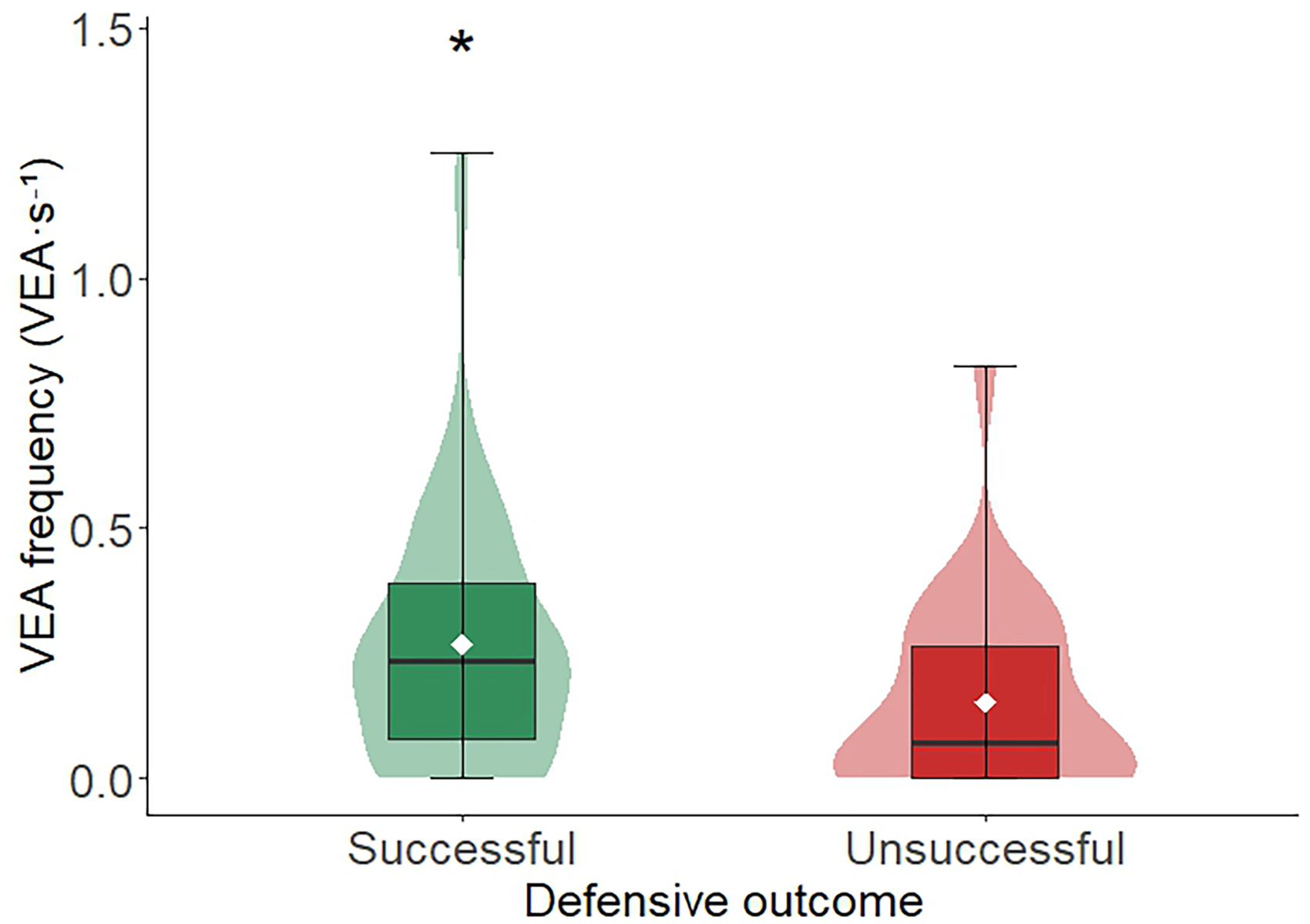
VEA frequency in each defensive outcome.
Discussion
The present study aimed to compare the frequency of visual exploratory activity between successful and unsuccessful defensive sequences in small-sided games. The results indicated a significant difference between conditions, with a moderate effect size. The magnitude of this difference (Cohen's d = 0.549) slightly exceeded the smallest effect size of interest defined a priori (d = 0.50), suggesting that the observed effect is meaningful from a performance perspective.
However, the sensitivity analysis indicated that the present sample was powered to detect effects of d = 0.668 or larger. Therefore, the observed effect falls below the minimum detectable threshold, indicating that the study may be underpowered to reliably detect effects of this magnitude. Consequently, while the results provide initial evidence supporting the role of visual exploratory activity in defensive performance, they should be interpreted with caution, particularly with regard to the precision and stability of the estimated effect size.
From a theoretical standpoint, the results can be interpreted within an ecological dynamics framework. Defensive performance emerges from the continuous interaction between the player and the evolving informational dynamics of the game, requiring the integration of multiple sources of information. In this context, visual exploratory activity may enhance players’ attunement to affordances by allowing them to detect relevant cues beyond the immediate location of the ball, actively shaping future possibilities for action.3,4 However, effective defensive scanning likely involves more than simply directing attention away from the ball. Defensive players must continuously coordinate visual exploration with body orientation, positioning relative to teammates and opponents, and the tactical principles governing collective defensive organization, such as maintaining compactness, protecting central spaces, and closing passing lanes.8,30 During defensive play, players are therefore required to dynamically regulate attention between the ball carrier and the movements of off-the-ball opponents while preserving the possibility to intervene effectively. In this sense, higher frequencies of scanning may support anticipatory adjustments in positioning and timing of defensive actions, potentially contributing to more functional defensive behavior.
These findings extend the existing literature on visual exploratory behavior in football, which has predominantly focused on offensive or on-the-ball situations. Previous studies have shown that increased scanning is associated with improved passing decisions and overall attacking performance.2,3,5 The present results suggest that a similar relationship exists in the defensive phase, reinforcing the idea that visual exploration is a general perceptual skill that underpins performance across different moments of the game. Moreover, the magnitude of the observed effect is comparable to that reported in offensive contexts, indicating that the relevance of scanning is not restricted to ball possession.
The use of small-sided games likely contributed to the identification of this effect. By increasing players’ involvement and reducing distances between teammates and opponents, SSGs create environments with frequent informational demands and rapid changes in play.31–33 This may amplify the need for continuous visual exploration and make its relationship with performance more evident. At the same time, the constraints adopted in the present study, including the number of players, pitch dimensions, and the inclusion of goalkeepers and the offside rule, were designed to preserve key characteristics of the formal game. Nonetheless, it is possible that different task configurations would lead to variations in the magnitude of the effect observed. For example, playing under numerical inferiority has been shown to induce more zonal marking strategies, focusing on closing the central corridor of the pitch. 34 In this context, with defenders occupying a more compact space behind the ball, scanning measured through head movements may occur less frequently, as a substantial proportion of the relevant information may remain within the players’ forward field of view (see Figure 2 for an example). Conversely, situations involving greater spatial dispersion, multiple passing lanes, or attackers positioned behind the defensive line may require broader and more frequent visual exploration to detect emerging threats. Future research should therefore examine how numerical imbalance, spatial configurations, pitch dimensions, and different SSG formats shape defensive visual exploratory behavior in youth football.
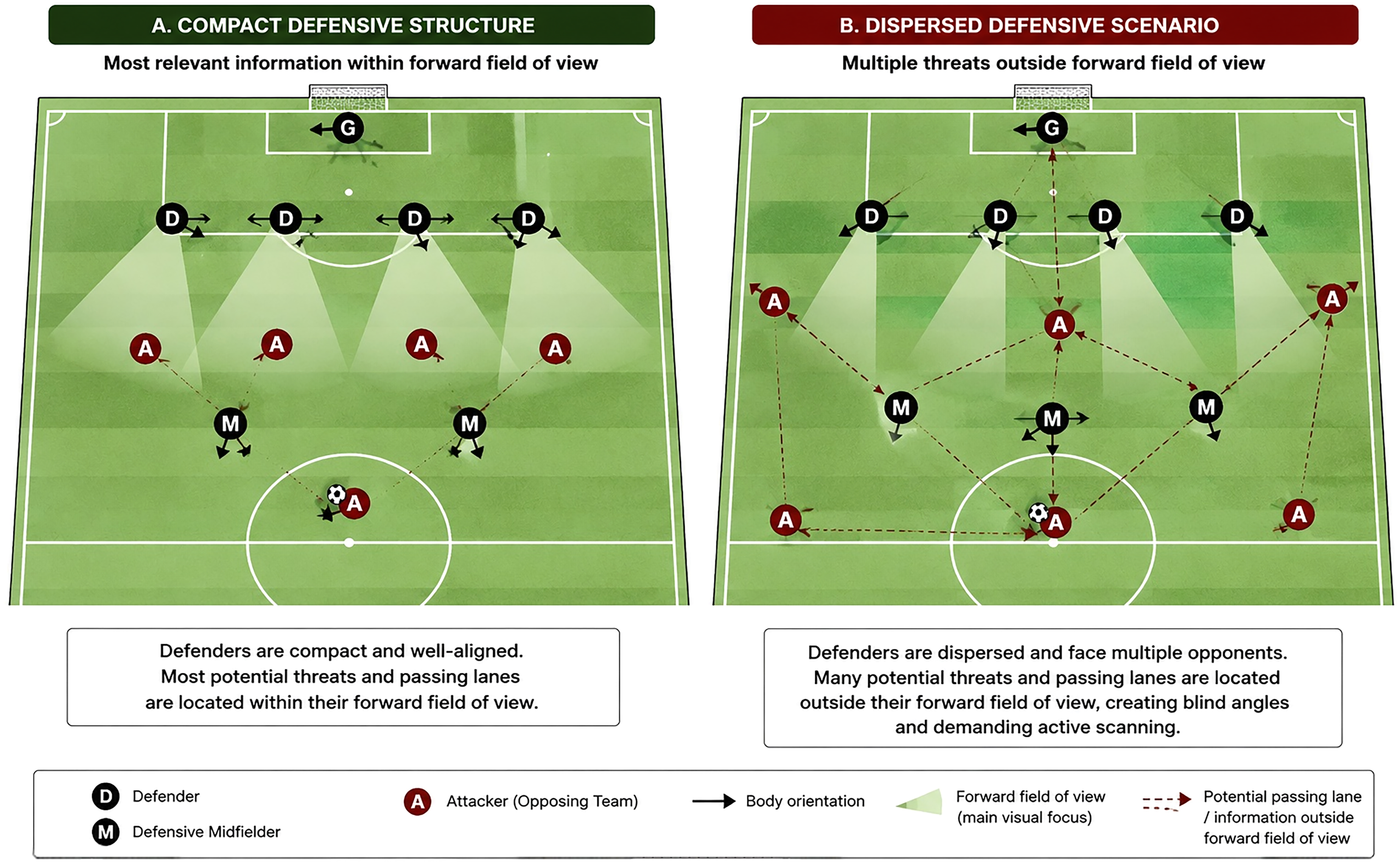
Illustration of defensive contexts with high and low visual exploratory activity demands.
From an applied perspective, the findings suggest that representative training tasks may be designed to expose players to informational demands associated with successful defensive sequences. Coaches may consider using constraint manipulations that encourage players to distribute attention beyond the immediate location of the ball while preserving attunement to relevant tactical information. This may include increasing uncertainty, promoting off-the-ball attacking movement, or creating situations that require defenders to monitor players positioned behind the defensive line.35–37 Different SSG formats may also shape visual exploratory demands differently. Smaller formats may increase the frequency of interactions and defensive adjustments, whereas larger formats may expand the spatial range requiring exploration and broaden the width and depth of visual scanning behavior. Additionally, instructional approaches emphasizing external attentional focus may help direct players’ attention toward relevant informational sources within the environment. Importantly, the present findings should not be interpreted causally, as the observational design only allows the identification of associations between visual exploratory activity and defensive outcomes.
As limitations of this study, we acknowledge that the sample was restricted to under-15 players, which may limit the generalizability of the findings to other age groups or levels of expertise. Although small-sided games provide a representative context, they do not fully capture the complexity of formal matches. Furthermore, the study focused on the frequency of visual exploratory activity, without considering qualitative aspects such as the direction, duration, or timing of scans, which may also play an important role in shaping defensive performance. In addition, the sensitivity analysis indicated that the study was powered to detect relatively large effects (d = 0.668), which exceeds the magnitude of the observed effect. As such, the study was only powered to reliably detect relatively large effects, and the observed moderate effect size falls below this threshold. Therefore, the results should be interpreted with caution, particularly regarding the precision, stability, and reproducibility of the estimated effect.
Future research should explore how visual exploratory behavior develops across different stages of expertise and whether similar effects are observed in full-match conditions. Investigating qualitative characteristics of scanning and their relationship with specific defensive actions may provide a more comprehensive understanding of the underlying mechanisms. Additionally, experimental and longitudinal studies examining the effects of targeted training interventions on visual exploration and defensive outcomes are necessary to establish potential causal relationships between exploratory behaviors and defensive performance.
Conclusion
This study examined the relationship between visual exploratory activity and defensive success in small-sided games performed by under-15 football players. The findings demonstrated that successful defensive sequences presented higher frequencies of visual exploration activity. The magnitude of this difference reached the predefined smallest effect size of interest, indicating that the effect is not only statistically significant but also practically meaningful.
These results reinforce the role of visual exploratory behavior as a key perceptual component underpinning defensive performance. By actively scanning the environment, players appear better equipped to integrate information about the ball, teammates, and opponents, supporting more effective anticipation and decision-making during defensive actions. Importantly, the findings extend previous research by showing that the benefits of visual exploration are not limited to attacking contexts but also apply to defensive phases of play.
From an applied perspective, the study highlights the potential relevance of incorporating perceptual demands into training design. Small-sided games and constraint manipulations that encourage players to explore the environment beyond the ball, such as numerical imbalances, variations in game format, or attackers positioned behind the defensive line, may create informational contexts associated with functional exploratory behaviors during defensive play. However, given the observational nature of the present study, these findings should be interpreted as associative rather than causal, and future experimental research is required to determine whether training interventions targeting visual exploratory activity can effectively influence defensive performance.
Footnotes
Acknowledgments
Not applicable
ORCID iDs

Ethical considerations
The study was approved by the local research ethics committee (CEP-UFMG, CAAE n° 80581224.5.0000.5149) on August 24th, 2024.
Consent to participate
All participants consented to join the study, with written informed consent and assent obtained from all participants and their legal guardians. Club representatives provided formal authorization for participation in cases where players were not residing with their guardians.
Consent for publication
Not applicable
Author contribution
Gibson Moreira Praça: Conceptualization, Data curation, Formal analysis, Investigation, Methodology, Project administration, Software, Resources, Supervision, Visualization, Writing – original draft, Writing – review & editing
Deborah Guimarães Quirino Electo Conrado: Methodology, Project administration, Supervision, Validation, Visualization, Writing – review & editing
Rodrigo Elifas Marques Ferreira: Conceptualization, Data curation, Writing – review & editing
Sarah da Glória Teles Bredt: Writing – review & editing
Lucas Savassi Figueiredo: Writing – review & editing
Funding
The authors received no financial support for the research, authorship, and/or publication of this article.
Declaration of conflicting interests
The authors declared the following potential conflicts of interest with respect to the research, authorship, and/or publication of this article: Gibson Praça is an Editorial Board member of the International Journal of Sports Science & Coaching.