







Abstract
The coach–athlete relationship (CAR) is central to athletes’ psychosocial functioning, yet little is known about whether athletes form distinct relational profiles and how these relate to resilience and competitive anxiety. Drawing on the 3C model of CAR and stress-appraisal theory, this study examined (a) whether youth athletes can be grouped into homogeneous CAR profiles and (b) whether these profiles differ in resilience, cognitive anxiety, somatic anxiety, and self-confidence. Participants were 202 youth ice hockey players from Hungarian state-accredited academies who completed validated measures of CAR (CART-Q), resilience (CD-RISC-10), and competitive anxiety (CSAI-2). Latent Profile Analysis identified four distinct CAR profiles - Partnership, Indifferent, Distanced, and Alienated. Profiles showed meaningful differences in resilience, with the Partnership group reporting the strongest adaptive capacity. They also differed in somatic anxiety and self-confidence, with Partnership athletes reporting lower physiological arousal and higher confidence. Cognitive anxiety did not differ across profiles, suggesting that worry is less influenced by relational quality. These results highlight that athletes experience CAR in qualitatively different ways, with distinct implications for coping and emotional functioning. The findings underscore that athletes differ meaningfully in their relational experiences with the coach, making person-centered approaches essential for accurately understanding how coach–athlete relationships relate to resilience and competitive anxiety. By highlighting distinct relational profiles, the study demonstrates that effective coaching requires both tailored interpersonal strategies and the professional competences needed to adapt communication, support, and structure to individual athletes.
Introduction
The success of competitive athletes is not solely determined by their innate abilities, high levels of conditional and coordination skills, perseverance, and a unique combination of mental strength. It also requires a positive and supportive environment. 1 Theoretical frameworks such as the Demand–Control–Support model2,3 highlight that high demands combined with low autonomy and limited social support can intensify strain and anxiety 4 - patterns typical of competitive youth sport. The transactional model of stress and coping 5 further suggests that athletes’ emotional responses depend on how they appraise these demands and the coping resources they believe they possess. Within this perspective, resilience becomes a critical factor: it reflects athletes’ capacity to positively adapt when faced with adversity, drawing on both personal skills and environmental supports.
In high-performance sport, the coach plays a unique dual role within this process. Coaches not only influence the environmental conditions that define the demands, control, and support perceived by the athletes, but through their leadership behaviours they also implicitly signal what they believe about athletes’ coping resources and capacities. In highly hierarchical and often autocratic sport structures, these signals become especially salient, making the coach both a key source of environmental pressure and a central interpersonal figure who shapes athletes’ stress appraisals, resilience, and anxiety.
Given this dual influence, the quality of the coach-athlete relationship (often abbreviated as CAR) is likely to be a critical factor in how young athletes interpret stress and manage competitive demands. 6 The present study therefore examines the relationship between the coach-athlete relationship, resilience, and anxiety among junior players of state-accredited ice hockey academies in Hungary.
Coach-athlete relationship and its profiles
Coaches occupy central leadership roles in sport: they direct performance, shape team culture, and influence athletes’ psychological development. Sport leadership research has long drawn on general leadership theory - traits and behaviors7–11 - and adapted these frameworks to coaching contexts. Leader–Member Exchange (LMX) theory highlights that leaders form non-uniform, individualized relationships with subordinates, and that these relationship qualities predict motivation, well-being, and performance. 12 This relational perspective in leadership research is echoed in sport psychology by the 3C framework that conceptualizes coach-athlete relationship (CAR) by defining three interrelated dimensions of it: Closeness (emotional bond and mutual trust), Commitment (the deliberate intention to sustain the relationship), and Complementarity (behavioral reciprocity and cooperative coordination).6,13 Closeness captures the affective dimension, manifests as respect, care, and empathy; Commitment reflects the cognitive dimension, enduring investment by coach and athlete; Complementarity represents the behavioral dimension, captures how well behaviors and communications align to sustain productive interaction.13,14 The 3C model further frames CAR as shaped by individual, interpersonal, and sociocultural factors and as a determinant of individual, interpersonal, and team outcomes.15,16
Measurement of CAR has relied heavily on the Coach-athlete Relationship Questionnaire (CART-Q), and empirical work links CAR quality to multiple psychological and performance indices. Examples include associations with passion, 17 burnout and engagement,18,19 cognitive performance and attenuated cortisol responses under stress, 20 life satisfaction and self-esteem in judo athletes, 21 intrinsic motivation, 22 and confidence and trust across multisport samples.23,24 Coaching style also matters: transformational behaviors are positively related to CAR quality. 25
Methodologically, most CAR research has used variable-centered techniques (correlation, regression, factor analysis) to map relationships among constructs and generalise findings. 26 The person-centered alternative prioritises identifying homogeneous subgroups of individuals who share similar profiles across variables, typically via cluster analysis or latent profile analysis (LPA). 27 Sport psychology has applied person-centered approaches, having investigated commitment profiles, 28 goal orientation profiles, 29 burnout profiles, 30 and physical competence profiles, 31 as well as sport motivation profiles,32–35 demonstrating the method's utility for capturing within-sample heterogeneity. Despite these advances, CAR profile research is limited.
A few recent studies have explored CAR clusters,36,37 but, to our knowledge, none have applied LPA 38 to identify latent CAR profiles and examine their psychological correlates. The present study fills this gap by using a person-centered LPA approach to compare athletes’ psychological functioning - specifically resilience and anxiety - across CAR profiles. This contributes methodologically to the CAR literature and substantively by extending the significance of coach-athlete relationships from performance outcomes to broader domains of education, well-being, and personal development.
We expect that distinct subgroups (i.e., profiles) of players will emerge based on their levels across the three CAR dimensions - closeness, commitment, and complementarity. Although the person-centred approach is exploratory and the exact number or configuration of profiles cannot be determined a priori, previous research suggests that at least four CAR profiles are plausible. Accordingly, we anticipate identifying the following:
H1. Within the three-dimensional space defined by the components of the coach-athlete relationship, we expect to identify four distinct groups of players characterized by: (1) substantially below-average levels of all three dimensions of the coach-athlete relationship (Alienated), (2) below-average levels of all three dimensions of coach-athlete relationship (Distanced), (3) above-average all three dimensions of coach-athlete relationship (Indifferent), and (4) substantially above-average all three dimensions of coach-athlete relationship (Partnership).
Anxiety
Anxiety is a well-studied topic in sport psychology,39,40 as understanding its effects on athletes and strategies for effective management is critical. 41 According to the Multidimensional Theory of Anxiety, 42 anxiety can be conceptualized across three distinct dimensions. Cognitive anxiety refers to the psychological and mental components of anxiety, including worry, fear, and pessimistic thinking. Athletes experiencing cognitive anxiety may have racing thoughts, anticipate negative outcomes, and struggle to maintain focus, reflecting the mental processes associated with anxiety-provoking situations. Somatic anxiety, in contrast, encompasses the physiological and bodily symptoms triggered by stress or anxiety. 43 These may include increased heart rate, perspiration, muscle tension, trembling, and nausea, reflecting the body's “fight-or-flight” response to perceived threats. The third dimension, self-confidence, often conceptualized as self-efficacy, refers to an individual's belief in their ability to perform a task or handle a situation. 42 Low self-confidence is characterized by uncertainty and doubt, while high self-confidence indicates strong belief in one's abilities. Athletes with higher self-confidence are generally better equipped to cope with pressure and tend to experience lower levels of anxiety. 44
Research among two hundred and twenty-eight athletes from 15 sports suggests that negative personal rapport between coach and athlete appeared to be a significant predictor of all measured forms of sport anxiety. 45 A more recent study among 222 youth (12–18 years) and collegiate (18–24 years) participants yielded similar results. 46 Examining 71 coach-athlete dyads, involved in their relationship for a minimum of one season, Stephen et al. 47 found that within coach-athlete dyads, athletes who felt more compatible with their coach experienced lower negative cognitive/attentional and somatic effects from their coach's behavior during game situations. Fletcher and Hanton 48 also has documented the coach being an often reported stressor among competitive athletes, and these results were strengthened by the study of Laborde et al. 49
In youth athletes, these three dimensions of anxiety are not only determinants of sport performance but also of broader developmental outcomes. 50 Difficulty managing cognitive or somatic anxiety may negatively affect concentration in educational contexts, 51 interpersonal relationships with peers, 52 and overall mental health 53 of adolescents. Conversely, developing the capacity to regulate anxiety in the sport setting can foster transferable coping skills - helping young people to manage exam stress, social evaluation, and future career challenges. Thus, examining anxiety within the coach-athlete relationship context provides insight into how sport can either exacerbate or alleviate pressures that are central to adolescents’ everyday lives.
From a stress-environment perspective, the heterogeneity in athletes’ anxiety levels across distinct coach–athlete relationship (CAR) profiles can be theoretically accounted for by the Demand-Control-Support (DCS) framework, which links demands, control/autonomy, and support to strain responses. 2 According to DCS, individuals’ psychological strain (including anxiety) experiences vary depending on the level of demands they face, the degree of autonomy or control they perceive, and the amount of social–emotional support available in their environment. Although the Demand–Control–Support model is not a leadership theory, it captures the structural and psychosocial conditions that leaders - including coaches - create. We propose that Demand–Control–Support (DCS) conditions established in the training environment constitute structural antecedents of the coach-athlete relationship (CAR). Specifically, the availability of support, opportunities for control/autonomy, and clarity in handling demands shape the quality of CAR as captured by the 3C model - closeness (affective support), commitment (shared goals/stability), and complementarity (coordinated behavior). In turn, the quality of the coach-athlete relationship (CAR) operates as a relational mechanism that shapes how athletes interpret competitive demands. Within Lazarus's transactional model, 5 strong CAR profiles foster more challenge-oriented primary appraisals and strengthen secondary appraisal resources by enhancing athletes’ perceived support, clarity, and coping capacity. Conversely, lower-quality CAR profiles bias athletes toward threat appraisals and weaker perceptions of coping resources.
Because cognitive anxiety, somatic anxiety, and self-confidence are direct reflections of these appraisal processes - worry and negative expectations stemming from threat appraisals, physiological arousal from perceived insufficient coping, and self-confidence from positive resource appraisals - the combined DCS and Lazarus frameworks predict systematic differences in these emotional responses across CAR profiles. High-quality CAR profiles should be associated with lower cognitive worry, reduced physiological activation, and greater self-confidence, whereas low-quality profiles are expected to correspond with elevated anxiety and diminished confidence.
Given the arguments presented above, the following hypotheses are formulated: H2. The CAR-profiles will differ significantly in players’ levels of cognitive anxiety: the higher the average values of closeness, commitment, and complementarity within a profile, the lower the cognitive anxiety, whereas lower average values will be associated with higher cognitive anxiety. H3. The CAR-profiles will differ significantly in players’ levels of somatic anxiety: the higher the average values of closeness, commitment, and complementarity within a profile, the lower the somatic anxiety, whereas lower average values will be associated with higher somatic anxiety. H4. The CAR-profiles will differ significantly in players’ levels of self-confidence: the higher the average values of closeness, commitment, and complementarity within a profile, the higher the self-confidence, whereas lower average values will be associated with lower self-confidence.
Resilience
Resilience is a protective factor encompassing personality characteristics that facilitate successful adaptation despite adverse circumstances, mitigate the negative effects of stress, and enable adaptive coping.54,55 It also refers to the capacity to return to normal functioning following periods of excessive stress, highlighting its role in both immediate and long-term adaptation. The concept is complex and multifaceted, making precise definition and reliable measurement challenging. The American Psychological Association defines resilience as “the process of adapting well in the face of adversity, trauma, tragedy, threats, or even significant sources of stress”, 56 commonly described as the ability to “bounce back” from adversity and achieve positive outcomes. 25 Debate continues regarding whether resilience should be understood primarily as a stable trait or a dynamic, context-dependent state. 57 Numerous instruments have been developed to assess resilience, including the 25-item Connor–Davidson Resilience Scale (CD-RISC), 58 and a culturally adapted 10-item Hungarian version. 59
In high-intensity sports such as ice hockey, resilience is particularly relevant due to the physical demands, fast pace, and frequent exposure to setbacks such as injuries, losses, or performance slumps. 60 Players must adapt to unpredictable situations, recover quickly from mistakes, and maintain focus under pressure, requiring both psychological and physiological resilience. It also supports coping with the cumulative stress of training, travel, and competition schedules, enabling sustained performance and well-being. 61
Elite athletes are at heightened risk of mental health challenges between 17 and 21 years of age, a period that coincides with peak competitive demands.62,63 Given these unique pressures, further research is warranted on resilience and mental health in youth ice hockey specifically, 64 as well as on the role of the coach-athlete relationship. Coaches serve as key agents in fostering resilience - modeling adaptive coping, encouraging persistence, and creating safe environments in which setbacks are viewed as opportunities for growth.65–67
As outlined earlier, the CAR dimensions of closeness, commitment, and complementarity shape the interpersonal climate through their links to the Demand–Control–Support components and the appraisal processes described in Lazarus's transactional model. Because resilience reflects perceived capacity to adapt and cope under pressure, athletes embedded in high-quality CAR profiles are expected to report stronger appraisal resources and higher resilience, whereas low-quality profiles may undermine these resources. Therefore we hypothesize that: H5. Significant differences will emerge between the clusters in terms of players’ resilience levels. Specifically, profiles characterized by higher levels of closeness, commitment, and complementarity will demonstrate higher resilience.
Methods
Research approach
The study followed a functionalist-positivist paradigm with a quantitative research strategy, suitable for theory testing. Data were collected through questionnaires, measuring variables in numerical form, and analyzed using statistical methods. 68
Sample characteristics
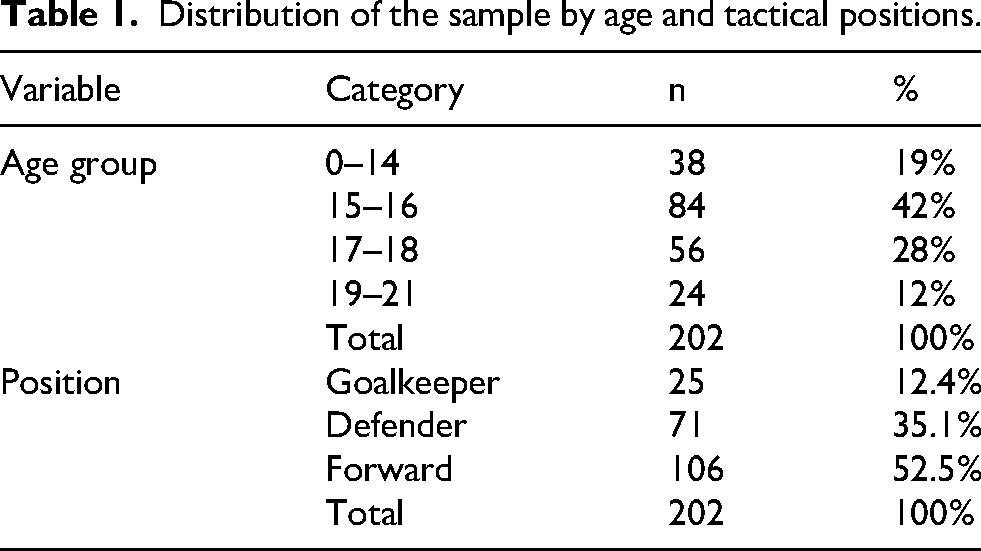
The sample consisted of 202 male youth ice hockey players, aged 13 to 20, from state-accredited Hungarian ice hockey academies. The average age was 16.19 years (SD = 1.71). Table 1 presents the age distribution, and shows the breakdown by tactical position.
Distribution of the sample by age and tactical positions.
Research procedure
The Department of Psychology and Sport Psychology at the Hungarian University of Sports Science received preliminary ethical approval for the study (MTSE-OKE-KEB/04/2023) based on supporting documentation. The Methodological Center of Fehérvár 19 Ice Hockey Academy informed the four state-accredited Hungarian ice hockey academies about the study's purpose, confidentiality, and voluntary participation. Legal guardians were then invited via email, detailing the study's aims, procedures, and ethical considerations. Data collection was conducted through an anonymous, self-administered online questionnaire. After obtaining parental consent, athletes completed the survey in a quiet environment, with a staff member present for oversight but without intervention.
Questionnaire structure
The omnibus questionnaire comprised multiple sections, including the constructs analyzed in this study. Following demographic questions, the study focused on the coach-athlete relationship, resilience, and anxiety.
Coach-Athlete relationship – CART-Q
The validated Hungarian version of Jowett and Ntoumanis’ 13 Coach-Athlete Relationship Questionnaire (CART-Q) 69 was used to assess the coach-athlete relationship. The questionnaire has been validated in multiple other languages, including English, Belgian, Chinese, Greek, Spanish, Swedish, 14 as well as Brazilian. 70
The instrument consists of 11 items, measured on a 7-point Likert scale (1 = Strongly Disagree, 7 = Strongly Agree). It assesses three key dimensions: Commitment (3 items), Closeness (4 items), and Complementarity (4 items). The Cronbach's alpha values were acceptable (α = .82–.90) 71 and closely aligned with previous Hungarian findings (α = .79–.87). 69 For each component, the mean score of the relevant items served as the variable for further analysis.
Anxiety
The Hungarian version 72 of the CSAI-2, 73 consisting of 27 items, was used to measure the players’ anxiety level. The answers were given on a 4-point scale, ranging from “1” indicating not at all, to “4” meaning very much. The questionnaire's subscales that assess the intensity of cognitive anxiety, somatic anxiety, and self-confidence in sport were created by calculating the mean of the response scores that correspond to each factor. The subscales reported satisfactory internal consistency (α = .76–.86), in line with a previous Hungarian study of ice hockey players, 74 that reported alpha coefficients from .80 to .85.
Resilience
The Hungarian adaptation and revision 59 of the Connor–Davidson Resilience Scale, 58 consisting of 10 items, was used to measure the players’ resilience. The answers were given on a 5-point scale, ranging from “0” indicating not at all, to “4” meaning very much. The questionnaire's subscales that assess the intensity of resilience, were created by averaging the response scores. The scale showed satisfactory internal consistency (α = .80), close to the value in a previous Hungarian study, with an alpha coefficient of .85. 59
Table 2 shows the descriptive statistics and correlations regarding the variables in our study.
Descriptive statistics and correlations.
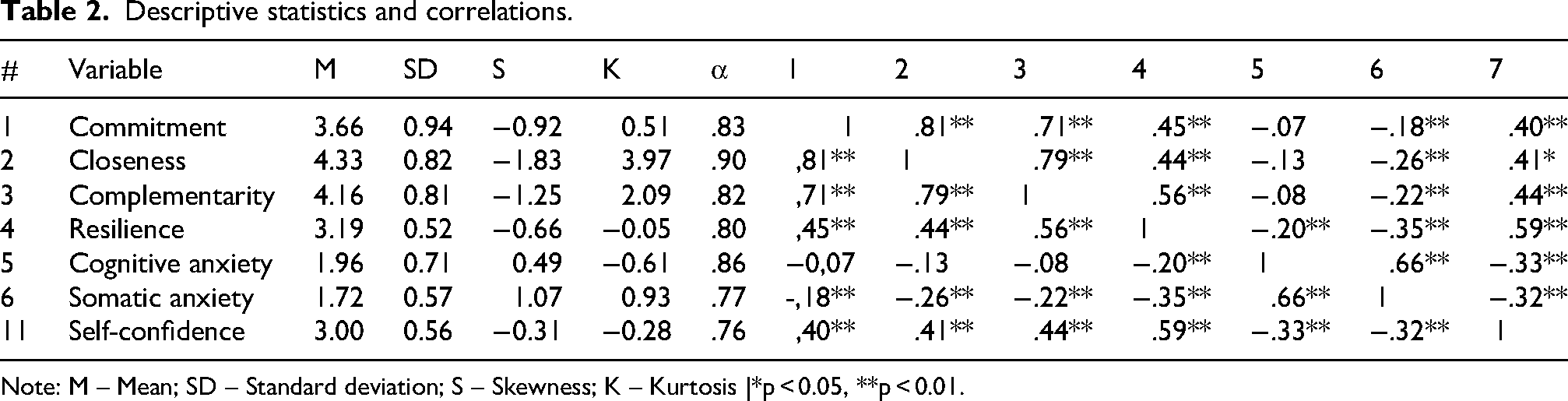
Note: M – Mean; SD – Standard deviation; S – Skewness; K – Kurtosis |*p < 0.05, **p < 0.01.
Data analysis
The analytical procedure had three main phases. First, the validity and reliability of the Coach-athlete Relationship (CAR) measure were tested using confirmatory factor analysis (CFA). Model fit was assessed using multiple indices, including the Comparative Fit Index (CFI), Standardized Root Mean Square Residual (SRMR), Goodness-of-Fit Index (GFI), Normed Fit Index (NFI), Tucker–Lewis Index (TLI), and Root Mean Square Error of Approximation (RMSEA). Model adequacy was determined based on established criteria: CFI and TLI values ≥ .90 75 and RMSEA values ≤ .08. 76 Prior to conducting CFAs, the Harman single-factor test 77 was applied to assess potential common method bias, given that all data were collected via a single questionnaire at one time point. 78 This involved principal component analysis, with all items loaded onto a single factor and the proportion of variance explained examined. These preliminary analyses were performed in SPSS 27.0 and AMOS 27.0.
In the second phase, Latent Profile Analysis (LPA) was employed to identify distinct profiles of coach-athlete relationships. Profile estimation was based on mean scores across the three CAR dimensions. A series of models specifying one to five profiles were evaluated. Model selection relied on multiple fit indices, including the Akaike Information Criterion (AIC), 79 Bayesian Information Criterion (BIC), and adjusted BIC (ABIC), with lower values indicating better fit. Model comparisons were further supported by the Vuong–Lo–Mendell–Rubin likelihood ratio test (VLMR) 80 and the bootstrap likelihood ratio test (BLRT). 81 Classification quality was evaluated using entropy, with higher values indicating more precise profile assignment. 82
Finally, after determining the optimal number of latent CAR profiles, the BCH auxiliary method was applied to examine whether these profiles differed with respect to anxiety (cognitive, somatic, self-confidence) and resilience. 83 The BCH approach is particularly suitable for assessing differences in distal outcomes across latent profiles and offers advantages over traditional methods such as ANOVA. 84 All LPA analyses were conducted using LatentGOLD 6.1.
Results
Preliminary analysis
The Harman's single-factor method 77 involved conducting a principal component analysis in which all items were loaded onto a single factor, and we looked at the proportion of variance explained by this factor. In our case, the value was 27.31%, indicating the absence of a dominant factor. This suggests that CMB is unlikely to bias our results.
We also tested whether the three theorized CAR-factors (closeness, commitment, and complementarity) could be empirically distinguished using Confirmatory Factor Analysis (CFA). The three-factor model showed a significantly better fit than a theoretically meaningful one-factor model across all fit indices, and it demonstrated acceptable fit by most standards: χ2 (df) = 143,930 (41), RMSEA = .112, CFI = .934, GFI =.883, NFI = .911, TLI = .912 (see Table 3). Moreover, the values closely resemble those reported in the Hungarian validation of the questionnaire. 69
Results of confirmatory factor analysis (CFA).

CAR profiles
Goodness-of-fit indices and model comparison tests for the Latent Profile Analyses (LPA) are presented in Table 4. Both four- and five-profile solutions demonstrated acceptable fit and were therefore compared in greater detail. The Vuong–Lo–Mendell–Rubin (VLMR) likelihood ratio test indicated that the four-profile solution provided a significantly better fit than the three-profile solution (p < .01), and the five-profile solution yielded a significant improvement over the four-profile model. The Bootstrapped Likelihood Ratio Test (BLRT) also suggested that the five-profile model improved fit relative to the four-profile solution (see Table 4).
Results of latent profile analysis (LPA).
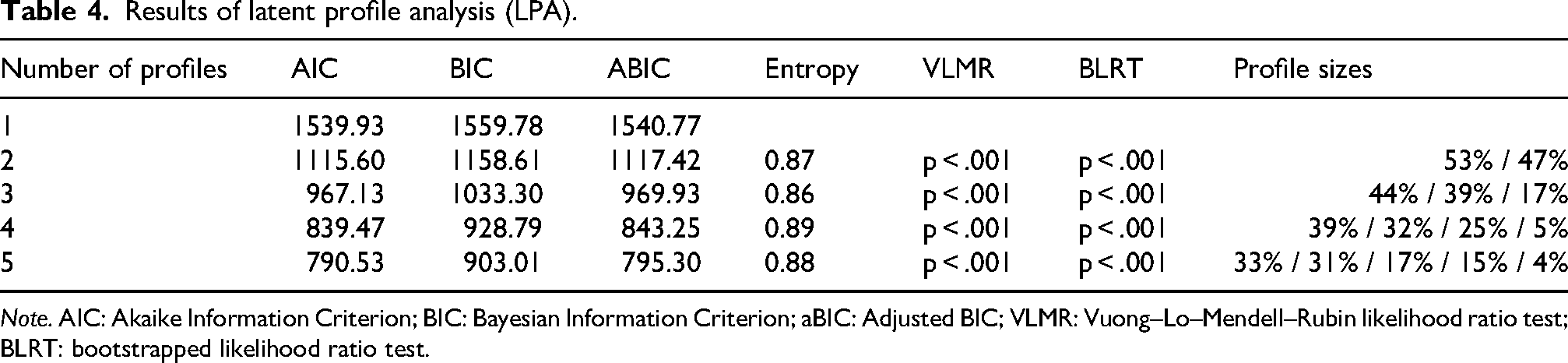
Note. AIC: Akaike Information Criterion; BIC: Bayesian Information Criterion; aBIC: Adjusted BIC; VLMR: Vuong–Lo–Mendell–Rubin likelihood ratio test; BLRT: bootstrapped likelihood ratio test.
However, the five-profile model included two small-sized profiles and one very small profile, raising concerns regarding stability and interpretability. Considering both statistical criteria and theoretical interpretability, the four-profile solution was deemed optimal and retained for further analyses, 85 although in this model a moderate residual correlation was observed between Closeness and Commitment (BVR = 6.2), consistent with their conceptual overlap.
The smallest profile, Alienated (Profile 4), represented approximately 5% of the sample (n ≈ 10). Classification certainty was examined using modal posterior probabilities, which were high for all profiles, including the Alienated profile (Profile 1: 0.93; Profile 2: 0.99; Profile 3: 0.92; Profile 4: 0.94). Given the small size of the Alienated class though, results for this profile should be interpreted with caution.
The mean values of the coach-athlete relationship dimensions within each profile are presented in Table 5. The content of the four-profile solution is presented in Figure 1. The largest profile (39%, n = 79) was characterized by values close to the sample mean on commitment, closeness, and complementarity, and was therefore labelled Indifferent. A second profile, representing 31% of participants (n = 63), displayed high scores across all three dimensions of the coach-athlete relationship (CAR) and was designated Partnership. A third profile, comprising only 5% of the sample (n = 10), showed markedly below-average scores on all CAR dimensions and was labelled Alienated. Finally, a fourth profile (25%, n = 50) reflected slightly below-average values across the three CAR components and was labelled Distanced.
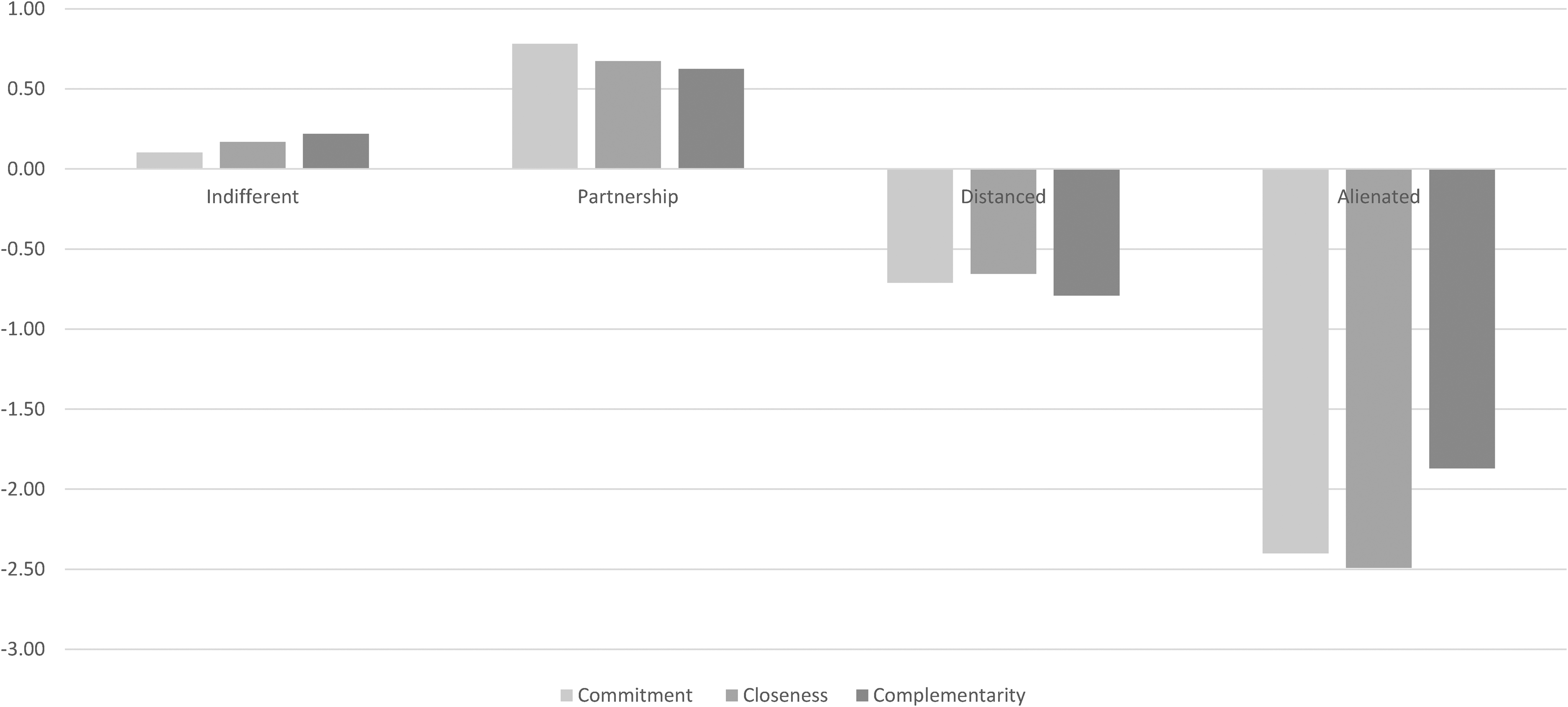
Differences of four CAR profiles.
Estimated means of the four CAR profiles (Differences of four CAR profiles from the component mean are indicated in brackets).
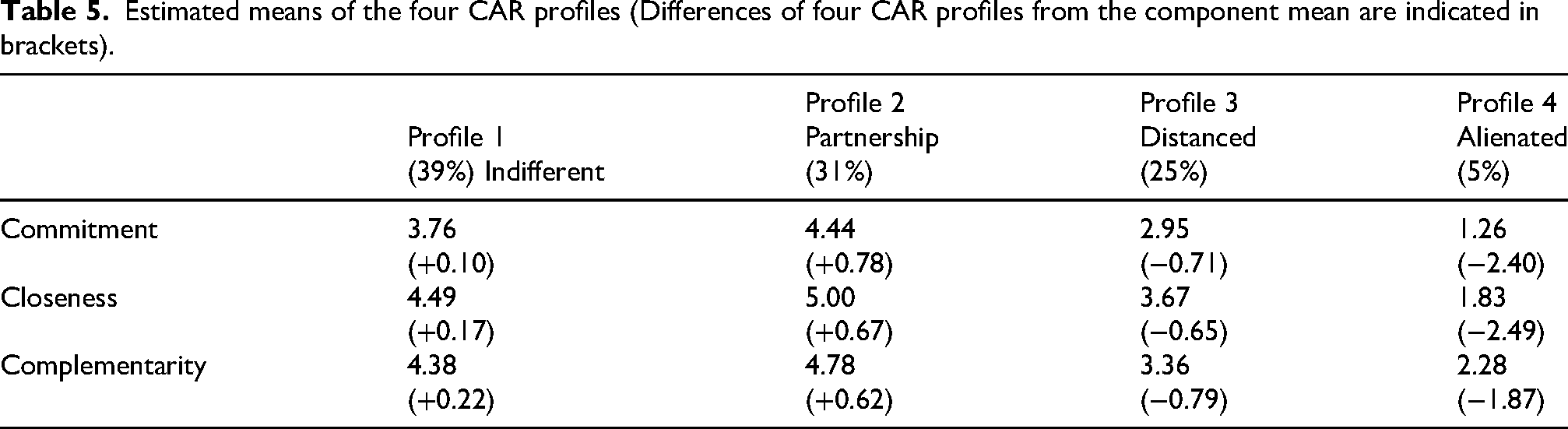
Hypothesis 1 was thus partially supported. Four distinct profiles were identified: Indifferent, Partnership, Distanced, and Alienated. As predicted, one profile emerged with high levels of all three CAR dimensions (Partnership), another with average levels (Indifferent), and one with lower levels (Distanced). In addition, an Alienated profile was identified, characterized by very low levels of commitment, closeness, and complementarity.
Differences in resilience and anxiety
The chi-square tests indicated significant differences between the four profiles (p < 0.001) in resilience, somatic anxiety and self-confidence. Based on the pairwise comparisons, the levels self-confidence of the individuals in the Partnership profile were significantly higher than those observed in the other three profiles, while Somatic anxiety was significantly lower. Contrasting results were evident among individuals in the Alienated profile: they demonstrated significantly lower self-confidence compared to the other profiles (except for the Distanced profile) (see Figure 2 and Table 6).
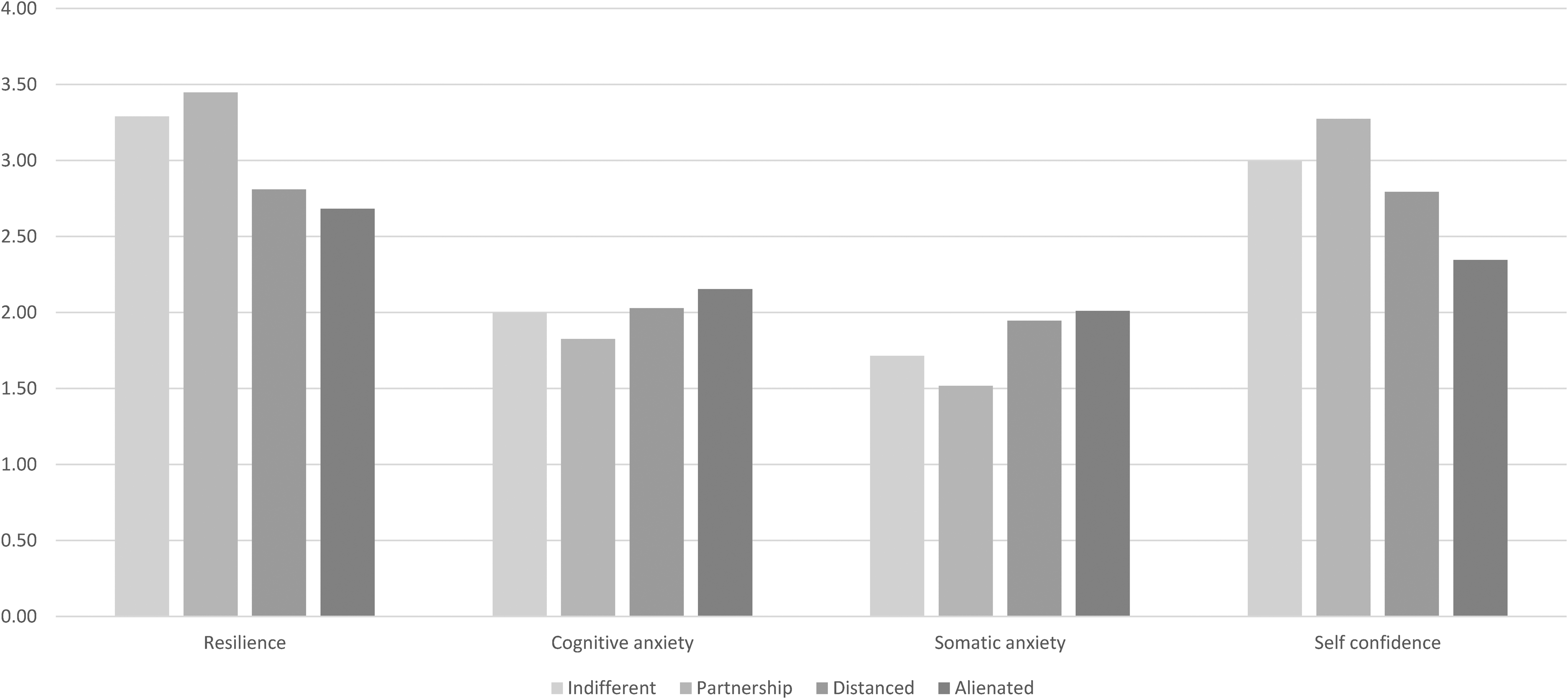
Differences among the CAR profiles in resilience and the dimensions of anxiety.
Profile differences in resilience and anxiety.
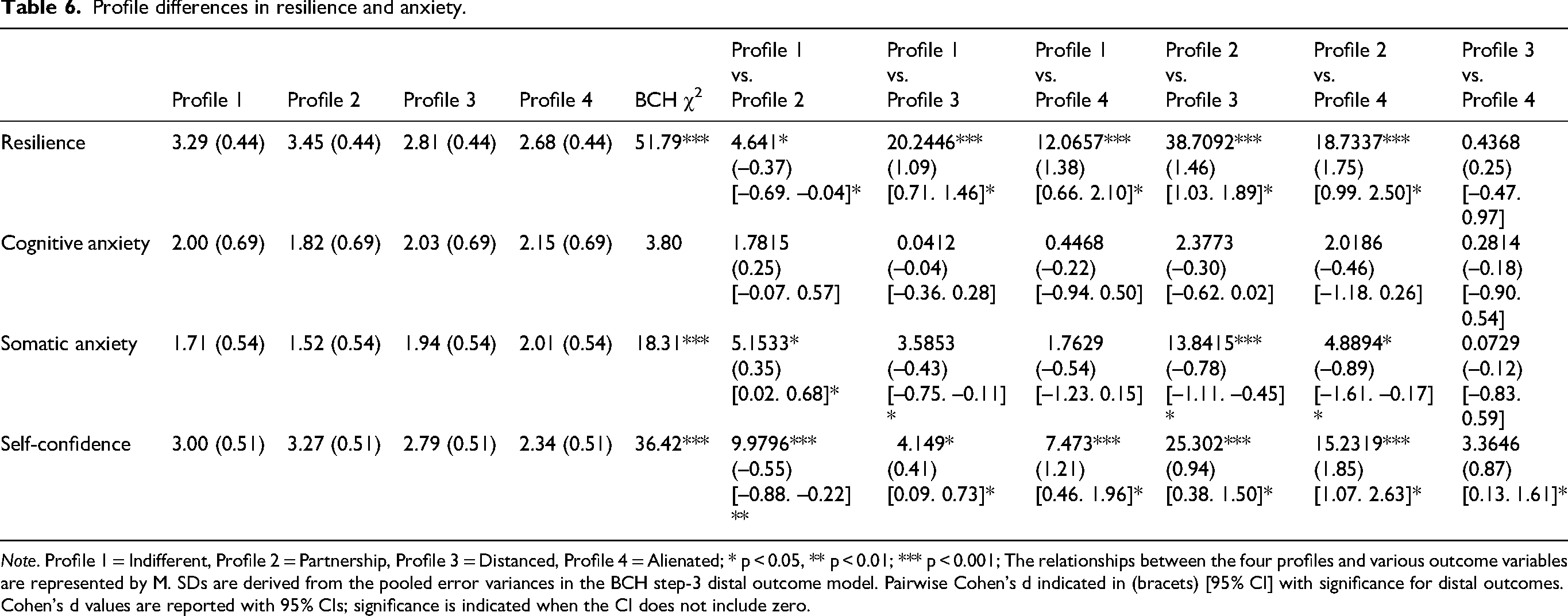
Note. Profile 1 = Indifferent, Profile 2 = Partnership, Profile 3 = Distanced, Profile 4 = Alienated; * p < 0.05, ** p < 0.01; *** p < 0.001; The relationships between the four profiles and various outcome variables are represented by M. SDs are derived from the pooled error variances in the BCH step-3 distal outcome model. Pairwise Cohen's d indicated in (bracets) [95% CI] with significance for distal outcomes. Cohen's d values are reported with 95% CIs; significance is indicated when the CI does not include zero.
The Indifferent profile ranked second among the profiles and self-confidence, and these differences with all the other profiles were shown to be significant. The Alienated players showed significantly lower levels of self-confidence compared to the Partnership and Indifferent profiles. There were no significant difference observed among the profiles regarding Cognitive anxiety. Based on these results, the Hypothesis 2-3-4 was partially supported.
The results further indicated that the resilience was significantly higher among the Partnership profiles compared to all other profiles. The Indifferent players had higher resilience than the Distanced and Alienated respondents. No differences emerged between the Distanced and the Alienated group regarding resilience. Consequently, Hypothesis 5 was partially supported.
Discussion
Theoretical implications
Using a person-centered approach, this study examined coach-athlete relationship (CAR) profiles across three key relational dimensions among 202 youth ice hockey players in Hungary. Four distinct profiles emerged, differing in resilience and anxiety, providing insights into patterns of CAR.
This study contributes to the literature in three ways. First, by adopting a person-centered approach, it identifies distinct CAR profiles among youth ice hockey players. Second, it uncovers four qualitatively different profiles, highlighting interindividual variability in commitment, closeness, and complementarity. Third, it underscores the importance of considering unique combinations of these dimensions when examining associations with sport-psychological outcomes such as resilience and anxiety. These contributions are elaborated below.
The empirical focus was to explore athlete profiles derived from CAR dimensions within Hungarian ice hockey academies. Such profiling is rarely investigated internationally or nationally. Given that CAR components are closely linked to resilience and anxiety, mapping these profiles offers valuable insights into young athletes’ psychological functioning. The four profiles were: Alienated (5%), reporting poor relationship quality across all dimensions; Distanced (25%), perceiving below-average quality; Indifferent (39%), reflecting approximately average relationships; and Partnership (31%), characterized by high-quality relationships across all three dimensions.
These profiles parallel Roux et al.'s 37 “High,” “Moderately High,” “Moderate,” and “Low” CAR categorizations. Consistent with their findings, profile lines did not intersect, indicating that the rank order of the four clusters was consistent across all CAR dimensions. Unlike Roux et al., 37 the present study examined links to resilience and anxiety, extending their work.
Closeness was the highest-valued component in all profiles except Alienated, where all dimensions were low. In the Partnership profile, closeness reached the maximum observed value (M = 5.00), slightly exceeding commitment and complementarity, suggesting that emotional bonds underpin high-quality CAR. In the Indifferent profile, closeness (M = 4.49) and complementarity (M = 4.38) were relatively high compared to commitment (M = 3.76), indicating that moderate involvement still requires mutual understanding and affective connection. The Distanced profile exhibited the lowest complementarity (M = 3.36), reflecting weaker cooperation, while closeness (M = 3.67) remained comparatively higher. Alienated athletes displayed uniformly low values, with closeness slightly above complementarity, highlighting the absence of a meaningful relational bond.
Concentrating on the differences among the profiles, we examined whether the CAR profiles varied in their average levels of resilience and the three dimensions of anxiety: cognitive, somatic, and self-confidence. Our findings revealed some notable patterns across all these variables. Interestingly, cognitive anxiety did not differ meaningfully across CAR profiles, suggesting that worry, rumination, and intrusive thoughts are largely intrapersonal phenomena that operate somewhat independently of the affective, cognitive, and behavioral dimensions of the coach–athlete relationship. While appropriate levels of closeness, commitment, and complementarity can strengthen resilience by supporting adaptive coping, coordination, and joint problem-solving, they do not directly regulate the self-focused, evaluative thinking patterns underlying cognitive worry. This distinction points to the limits of a coach's circle of influence: even athletes embedded in highly supportive and well-coordinated dyads may continue to experience performance-related worry, and many may hesitate to disclose these concerns due to fears of negative judgment or appearing “weak.” It is also plausible that coaches typically address cognitive anxiety at the team level - through structure, tactical clarity, error-correction methods embedded in the tactical flow of the game or motivational framing - rather than through individualized dyadic exchanges, making cognitive anxiety less sensitive to CAR variations. In contrast, somatic anxiety and self-confidence are more relationally malleable, as they are shaped by athletes’ perceptions of support, autonomy, and coordinated action within the coach-athlete dyad. Locus of control (LoC) theory 86 also may help explain why cognitive anxiety did not vary across CAR profiles. Cognitive anxiety reflects internalized, self-evaluative worry patterns that are strongly influenced by intrapersonal dispositions such as locus of control, and therefore less sensitive to relational dynamics. Even when athletes have high closeness, stable commitment, coordinated complementarity they may still engage in internal worry loops like: “What if I make a mistake?” “What if my performance drops?” Athletes with a more external LoC may be especially prone to cognitive anxiety, regardless of relational quality. High-quality relationships may buffer physiological arousal and enhance perceived coping resources, but they may not substantially alter deep-seated cognitive tendencies toward worry, especially among athletes with a more external locus of control.
Somatic anxiety differs somewhat across profiles. This pattern aligns with theoretical expectations 87 because somatic anxiety reflects state-dependent physiological arousal such as elevated heart rate, muscle tension, and autonomic activation during stress. Within Lazarus's transactional model, 5 these physiological reactions emerge when situational demands are appraised as exceeding perceived coping resources. The interplay of closeness (affective), commitment (cognitive, relationship-focused), and complementarity (behavioral) - the three CAR factors - directly shapes these appraisals by providing emotional security, clear expectations, and coordinated action tendencies. When all three dimensions are present at high levels, as in the Partnership profile, athletes are more likely to make challenge-oriented appraisals, experience higher perceived coping efficacy, and consequently exhibit reduced somatic activation. Conversely, profiles characterized by weaker relational quality leave athletes more vulnerable to physiological stress: uncertainty, mistrust, and poor role alignment bias athletes toward threat appraisals, amplifying arousal. The finding that only the Partnership profile exhibited significantly lower somatic anxiety - while the Indifferent, Distanced, and Alienated profiles did not differ - suggests that it is not any single relational factor, but the synergistic interplay of closeness, commitment, and complementarity that most effectively shapes appraisal processes and mitigates somatic anxiety. This provides coaches with a clear rationale for cultivating all three dimensions simultaneously to support both performance and wellbeing.
Self-confidence differed across most profiles, with the notable exception that the Alienated and Distanced profiles did not differ from each other. This pattern highlights the importance of the synergistic interplay of closeness (affective), commitment (cognitive, relationship-focused), and complementarity (behavioral) in fostering athletes’ belief in their ability to perform successfully. High levels of all three dimensions, as in the Partnership profile, provide emotional support, a sense of relational security, and clear role expectations, which together enhance self-confidence. In contrast, the Alienated and Distanced profiles share low levels of relational quality, resulting in similarly lower self-confidence; when relational support is minimal, small differences in coordination or commitment have little impact. The observation that the Distanced profile exhibited moderately higher levels of closeness, commitment, and complementarity than the Alienated profile - yet did not show significantly higher self-confidence - suggests the presence of a threshold effect. Self-confidence appears to depend not merely on partial improvements in relational quality, but on high levels across all three CAR dimensions simultaneously. 37 Below this threshold, moderate increases in one or two components may be insufficient to meaningfully enhance athletes’ belief in their performance capabilities. In contrast, the Partnership profile, which demonstrates high closeness, commitment, and complementarity, surpasses this threshold and is associated with significantly higher self-confidence.
The effectiveness of the three CAR components in fostering self-confidence depends not only on their individual presence but on their coherence and mutual reinforcement. A coach who expresses warmth and demonstrates commitment may still fail to build an athlete's self-confidence if their behaviors are inconsistent - for instance, by reinforcing poor performance, overlooking progress, or providing unclear instructions. Conversely, a coach who is emotionally distant cannot compensate for well-intentioned actions or structured guidance; insincere warmth is often perceived as inauthentic, eroding trust and diminishing confidence. Self-confidence is most robust when closeness (affective), commitment (cognitive, relationship-focused), and complementarity (behavioral) are aligned - creating a relational environment that is emotionally secure, cognitively supportive, and behaviorally consistent. In practice, this requires coaches to synchronize their emotional tone, relational intentions, and day-to-day interactions: authentic encouragement, reliable reinforcement, and clear role expectations together cultivate athletes’ belief in their capacity to succeed.
The coach-athlete relationship, especially its dimensions of closeness, commitment, and complementarity, is linked to athlete resilience through emotional support and a climate of trust and cooperation. 88 Complementarity - the degree of behavioral cooperation and reciprocal responsiveness between coach and athlete 13 is a critical factor for resilience. We might conceptualize the interplay of these three dimensions using a structural metaphor: closeness and commitment serve as the bricks, while complementarity functions as the mortar. Closeness, as the affective component, provides the emotional bond between coach and athlete; commitment, as the cognitive component, reflects the intention to maintain and invest in the relationship. However, these “bricks” alone cannot guarantee adaptive functioning under stress. Complementarity, the behavioral dimension, binds these elements together, translating emotional connection and relational intention into smooth coordination, consistent expectations, and constructive role alignment. It is through these everyday interactions - training sessions, feedback exchanges, and small collaborative adjustments - that the structural integrity of the relationship is maintained and resilience is cultivated. In this sense, resilience is most robust when the affective, cognitive, and behavioral elements are all present and effectively integrated, as illustrated by the Partnership profile in our study. Crucially, complementarity cannot be effective in isolation. When it is relatively high but closeness and commitment are low - as in the Alienated profile - it does not automatically foster resilience, trust, or relational stability. Like mortar without bricks, high complementarity alone has nothing solid to hold onto; it cannot compensate for the absence of affective and cognitive foundations.
Practical implications
A primary practical implication of this person-centered analysis is that coaches shall recognize that players are not a homogeneous group regarding their relational experiences with the coach. Traditional variable-centred approaches assume uniform associations between CAR, resilience, and anxiety across all athletes, which can obscure important subgroups and lead to misleading conclusions. In contrast, the latent profiles identified in this study demonstrate that athletes vary substantially in closeness, commitment, and complementarity, and these relational patterns carry different implications for their emotional responses and coping resources. Understanding that “the team” is not a single psychological unit, but rather a set of distinct relational profiles, allows coaches and support staff to better tailor their interactions, communication, and support strategies. This perspective also emphasizes that one-size-fits-all interventions may fail, because athletes in Alienated, Distanced, Indifferent, or Partnership profiles require different relational inputs, levels of structure, and types of psychological support. Recognizing this heterogeneity is therefore the essential first step in applying CAR findings in practice.
Building on this foundation, the second implication is that coaches’ effectiveness depends directly on their professional competences. To respond appropriately to varied relational profiles, coaches require specific knowledge, skills, and attitudes 89 that enable them to interpret CAR differences and adjust their behaviour accordingly. The profiles identified in this study can therefore inform competence development: 1) Knowledge. Coaches should understand the 3C model of CAR -closeness, commitment, complementarity - and why dyadic quality matters for athletes’ resilience and anxiety. They should know the structure of competitive anxiety, and how to track resilience efficiently. 2) Skills. Practically, coaches should monitor CAR and DCS cues (responsiveness/coordination, clarity of roles and demands, perceived autonomy/support) and pair these observations with brief anxiety/resilience check-ins. Communication skills that build psychological safety (reflective listening, conflict navigation, clear rationales) help consolidate CAR and reduce dysfunctional emotional responses; where cognitive worry persists, coaches should triage and collaborate with a sport psychologist for targeted mental-skills add-ons (e.g., mindfulness) shown to reduce competitive anxiety. 3) Attitudes. An athlete-centred, autonomy-supportive stance sets supportive DCS defaults (credible support, shared control, structured demands) and fosters the 3Cs that underpin resilience and confidence while buffering distress. This alignment of structure (DCS) and relationship (CAR) offers a coherent route to stronger resilience/self-confidence and healthier anxiety profiles.
Dyadic coach–athlete relationships are closely tied to organisational coordination because they are one of the primary sites where interaction, mutual adjustment, and shared understanding are produced and sustained. Consequently, these dyads do not develop in isolation; they are embedded within the organisation's broader coordination architecture. Classic organisation-design work 90 shows that coordination is achieved through three mechanism families: structural (e.g., formal meetings, scheduled interaction points), technocratic (e.g., rules, procedures, performance systems, standard operating instructions), and person-oriented (e.g., culture, shared values, leadership style). These mechanisms jointly provide the contextual foundation in which dyadic bonds can either flourish or deteriorate. Coaches should therefore attend to (and purposefully populate) each layer tailored to the player's CAR-profile: structural coordination to assure frequent and meaningful coach–athlete contact; technocratic coordination to clarify expectations, roles, and task demands; and person-oriented coordination to cultivate trust, psychological safety, and the relational tone. Taken together, these layers set the organisational conditions that enable - or constrain - the perceived demands, control/autonomy, and support that ultimately shape closeness, commitment, and complementarity in the coach–athlete relationship, influencing resilience and anxiety.
To enhance the emotional dimension of the coach-athlete relationship, coaches should have a toolkit for each CAR-dimension: demonstrate empathy, practice active listening, and provide trust-building feedback that creates a psychologically safe and motivating environment. 91 Instead of emphasizing past-oriented evaluative criticism, future-oriented and constructive feedback, along with the development of emotional intelligence and assertive communication, can further strengthen affective bonds.92,93 The cognitive dimension can be fostered through clear and consistent communication while encouraging athletes’ independent decision-making, thereby deepening the shared understanding of collective goals. 94 Finally, the behavioral dimension may be reinforced through coaches’ role modeling, attentiveness to athletes’ individual needs, and consistent use of constructive feedback, which together promote mutual respect and effective cooperation. 16
For coaches, the differences of the profiles underline that relational quality remains crucial for fostering resilience, but reducing cognitive anxiety requires targeted strategies beyond this, such as mental skills training, cognitive restructuring, or mindfulness exercises, which directly address worry and intrusive thoughts. These are often best provided by sport psychologists integrated into the staff. This underscores the importance of a multidisciplinary support system where coaches and sport psychologists collaborate to address both interpersonal and intrapersonal dimensions of athlete performance and wellbeing. In other words, strong coach-athlete relationships create a secure foundation, but additional intrapersonal interventions are necessary to manage performance-related cognitive anxiety effectively.
In conclusion, ice hockey coaches benefit from recognizing that players differ in their relational experiences, as suggested by the profiles identified in this study. Effective leadership requires sensitivity to these individual differences in closeness, commitment, and complementarity, understanding not only the current state of each coach-athlete relationship but also how it can be strengthened. By tailoring their approach to the unique needs and characteristics of each player, 95 coaches can foster positive relationships, enhance resilience and self-confidence, and support adaptive stress management, ultimately promoting both player development and team success.96,97
Limitations and further research directions
Several limitations of the present study should be acknowledged. First, the sample consisted exclusively of male players, which limits the generalizability of the findings. Future studies should aim to include female athletes to explore potential gender differences in coach-athlete relationships, resilience, and competitive anxiety. Second, its cross-sectional design allows only for the identification of associations, not causal relationships. Third, because players from multiple clubs participated, specific effects of club organizational culture and competition schedules may have influenced the results; future research could examine these contextual influences in more detail. Fourth, the use of standardized questionnaires, while practical, may not fully capture the complexity and subtle nuances of the phenomena under study, limiting a deeper understanding of coach-athlete relationships, resilience, and athlete anxiety.
The observed associations between supportive coaching environments and athletes’ anxiety and resilience raise questions about the role of transactional and transformational leadership styles in promoting effective closeness, commitment, and complementarity (CAR) in coach-athlete relationships. 98 Future studies could explore how combining these leadership approaches ensures athletes work within a structured and consistent system while also experiencing a supportive and inspiring environment that fosters favourable sport psychological outcomes.
Beyond the coach-athlete dyad, team dynamics and peer relationships may also play a critical role, and social network analysis could be a valuable approach. Additionally, qualitative methods could provide deeper insights into the complexity of these phenomena. Repeating questionnaire-based assessments would allow longitudinal tracking of trends among Hungarian elite youth hockey players, while applying the instruments in different countries could enable interpretation of results within broader socio-cultural contexts.
Footnotes

Ethical considerations
Ethics approval was obtained from the Hungarian University of Sport Science Research Ethics Committee (Ethical Approval Number: MTSE-OKE-KEB/04/2023) after a review process in the spirit of the Helsinki declaration.
Consent to participate
Prior to the study, all athletes and their legal guardians were provided with a written consent form detailing the study's purpose, the voluntary nature of participation, and the right to withdraw at any time without penalty; verbal assent was also obtained from the participating athletes.
Consent for publication
Not Applicable.
Authors’ contribution
RT, LT, OB: Conception and design of the study.
RT, AN, LT, OB: Acquisition of data.
CK: Analysis and interpretation of data.
CK: Manuscript preparation.
Funding
The authors received no financial support for the research, authorship, and/or publication of this article.
Declaration of conflicting interests
The authors declared no potential conflicts of interest with respect to the research, authorship, and/or publication of this article.
Data availability
The data used are available upon reasonable request from the corresponding author.