







Abstract
This study aimed to quantify changes in running performance-related parameters in U20 elite male soccer players across transitions between training at moderate-altitude and sea level. Nineteen players from a professional club were monitored across three stages: moderate altitude (2000 m), sea level (<500 m), and return to moderate altitude. Running performance was assessed using 10-Hz GPS, and generalized linear mixed models were applied with altitude stage as a fixed effect and player as a random effect. Results showed substantial reductions in distance per minute (DPM: mean change in percent; ±90% confidence intervals; −9%; ±3%), high-speed running distance (HSR: −55%; ±16%), sprint distance (SprintD: −78%; ±30%), explosive accelerations (EAcc: −32%; ±7%), and explosive decelerations (EDec: −29%; ±8%) from the first stage (moderate altitude) to the second stage (sea level). By contrast, DPM (7%; ±4%), HSR (60%; ±14%), SprintD (81%; ±28%), EAcc (28%; ±8%), and EDec (29%; ±8%) increased substantially when returning from the second stage (sea level) to the third stage (moderate altitude). These findings indicate that transitions between moderate altitude and sea level induce marked but reversible changes in training running performance, particularly in high-intensity actions. The results highlight the context-specific nature of altitude-related adaptations and may inform training load management in elite youth soccer.
Introduction
Altitude training has been widely implemented in high-performance sport because exposure to hypoxic stress can enhance exercise capacity at sea level.1,2 Residence at moderate altitude induces physiological adaptations that may improve oxygen transport and exercise tolerance, forming the basis of the live high–train low model. 3 Accumulated evidence indicates that altitude training can improve sea-level performance compared with exclusive normoxic training, and that its relevance extends beyond hematological adaptations to include changes in muscle metabolism, exercise economy, and tolerance to high-intensity intermittent exercise.1,4,5 These adaptations are particularly relevant for team sports, where performance depends on repeated high-intensity efforts and recovery rather than continuous endurance alone, and where athletes are frequently exposed to changing environmental conditions across a competitive season.1,2
Historically, altitude training was primarily applied to endurance sports such as distance running, cycling, and cross-country skiing, where performance is strongly constrained by oxygen delivery and utilization. As understanding of hypoxia-induced adaptations expanded, altitude and simulated hypoxic training strategies were progressively adopted in intermittent and team sports. In these settings, research emphasis shifted from maximal aerobic capacity alone toward performance determinants more closely related to competition demands, including repeated high-intensity efforts, fatigue resistance, and recovery between bouts.1,5 This shift has direct relevance for association soccer, a sport characterized by frequent high-intensity actions interspersed with incomplete recovery.1,2
In association soccer, scientific interest in altitude initially arose from competition rather than training interventions. Teams traveling from sea level to compete at altitude consistently demonstrated reduced physical output and impaired match performance, whereas teams chronically based at altitude exhibited a pronounced home advantage. 5 This phenomenon, particularly evident in South American competitions, prompted systematic investigation of altitude as an environmental stressor influencing soccer performance.6,7 The widespread adoption of global positioning systems and match-tracking technologies subsequently enabled more detailed analyze of running performance under different altitude conditions. The International Study on Soccer at Altitude (ISA3600) provided a comprehensive examination of physiological responses and match running outputs at approximately 3600 m. 8 Findings from this project consistently showed reductions in total distance covered, high-speed running, and peak running periods at altitude, accompanied by increased physiological strain, even following short-term acclimatization.9–11 These results indicate that altitude-related decrements in soccer performance are not fully offset by brief exposure periods. However, these findings primarily reflect the responses of sea-level teams acutely exposed to altitude and provide limited insight into the performance responses of players who are chronically residing at altitude and repeatedly transition to sea level. 12
Importantly, subsequent evidence suggests that altitude-related effects on soccer performance are not confined to extreme elevations. Moderate altitude, typically defined as ∼1500–2500 m above sea level, has also been shown to impair match running performance in non-acclimatized players, particularly during high-intensity phases of play. 13 This indicates that moderate altitude represents a physiologically meaningful environment with direct relevance to professional soccer competition. Given that many elite teams competing within professional club systems are based or regularly compete at moderate altitude. understanding performance responses in this environment is of practical importance. In parallel, hypoxic exposure and training interventions have been explored as means of influencing soccer-specific physical capacities, especially repeated-sprint ability.14,15 Although some studies report greater improvements following repeated-sprint training in hypoxia compared with normoxic conditions, outcomes remain inconsistent and appear highly dependent on hypoxic dose, training structure, and player characteristics. 16 Moreover, the extent to which such adaptations translate to running performance across different competitive and environmental contexts remains unclear, particularly in elite youth players.
Overall, existing soccer-altitude research has focused predominantly on acute exposure of sea-level teams competing at altitude and on short-term acclimatization strategies for isolated competitions. 17 In contrast, a common but underexplored competitive scenario involves elite teams competing within professional club systems that are chronically based at moderate altitude and transition between moderate altitude and sea level across a competitive season. In this context, players may develop partial long-term adaptation to moderate altitude while being exposed to frequent altitude transitions, travel demands, and congested match schedules, all of which may interact to influence running performance. 1 This scenario may be particularly relevant for elite U20 players, who are exposed to high competitive demands while still undergoing physiological maturation processes typical of this age group.
Given the increasing prevalence of cross-regional leagues and travel demands in modern soccer, understanding the effects of transitions between moderate altitude and sea level has clear practical relevance. Therefore, the purpose of the present study was to investigate the effects of transitions between moderate altitude and sea level on running performance in U20 male elite soccer players competing within a professional club system. By focusing on players chronically residing at moderate altitude and monitored under real preparatory-period conditions, this study aims to address a meaningful gap in the literature and to provide evidence relevant to performance monitoring and load management in contemporary elite soccer.
Method
Research design and participants
A longitudinal observational design was employed to examine the effects of transitions between moderate altitude and sea level on running performance in male professional soccer players. The study monitored the natural training and competition processes of a professional soccer club chronically based at moderate altitude. No experimental intervention was introduced, and all measurements were collected as part of the club's routine performance monitoring procedures. 2 Nineteen male soccer players from the U20 squad of a professional Chinese soccer club participated in the study (Age =18.7 ± 0.6 years, Height =178.4 ± 5.9 cm, Body mass =71.6 ± 6.4 kg, Training experience =9.1 ± 1.8 years). All players were full-time academy athletes competing within a professional club system and were engaged in a high-performance training and competition environment comparable to that of senior professional teams. The squad had resided and trained at moderate altitude for an extended period. Players were eligible for inclusion if they (1) were registered members of the U20 squad throughout the entire observation period, (2) had no musculoskeletal injuries that limited participation in training or match play, and (3) completed the full monitoring schedule. Players who missed more than 20% of training sessions or sustained injuries requiring withdrawal from team activities were excluded from the final analysis. The study was conducted in accordance with the Declaration of Helsinki and was approved by the institutional ethics committee (Ethics approval number: SCNU-SPT-2024-070). All players and their legal guardians were informed of the study procedures and provided written informed consent prior to participation.
Materials and procedure
All data were collected as part of the team's routine performance monitoring system during the preparatory period, with the specific aim of examining the effects of transitions between moderate altitude and sea level on running performance in male professional soccer players. Running performance was assessed using a 10-Hz global positioning system (GPS) tracking device (Catapult Sports, Australia), which has been shown to provide valid and reliable measurements of movement characteristics in soccer players.18,19 To minimize inter-unit variability, each player wore the same GPS device throughout the entire observation period. Devices were activated at least 15 min before each session to ensure optimal satellite connection, and data were downloaded immediately after each training session using the manufacturer's software. The monitoring period comprised three consecutive stages representing a complete moderate altitude–sea level–moderate altitude transition cycle (Figure 1). The relocation to sea level during the second stage was part of the club's annual training plan and was intended to take advantage of increased oxygen availability to enhance training intensity, schedule preparatory matches, and conduct targeted technical and tactical training. Following this period, the team returned to moderate altitude for the third stage, thereby completing a typical altitude transition sequence. Across all stages, the coaching staff maintained consistent training objectives appropriate for the preparatory period, and researchers did not influence training content or load.
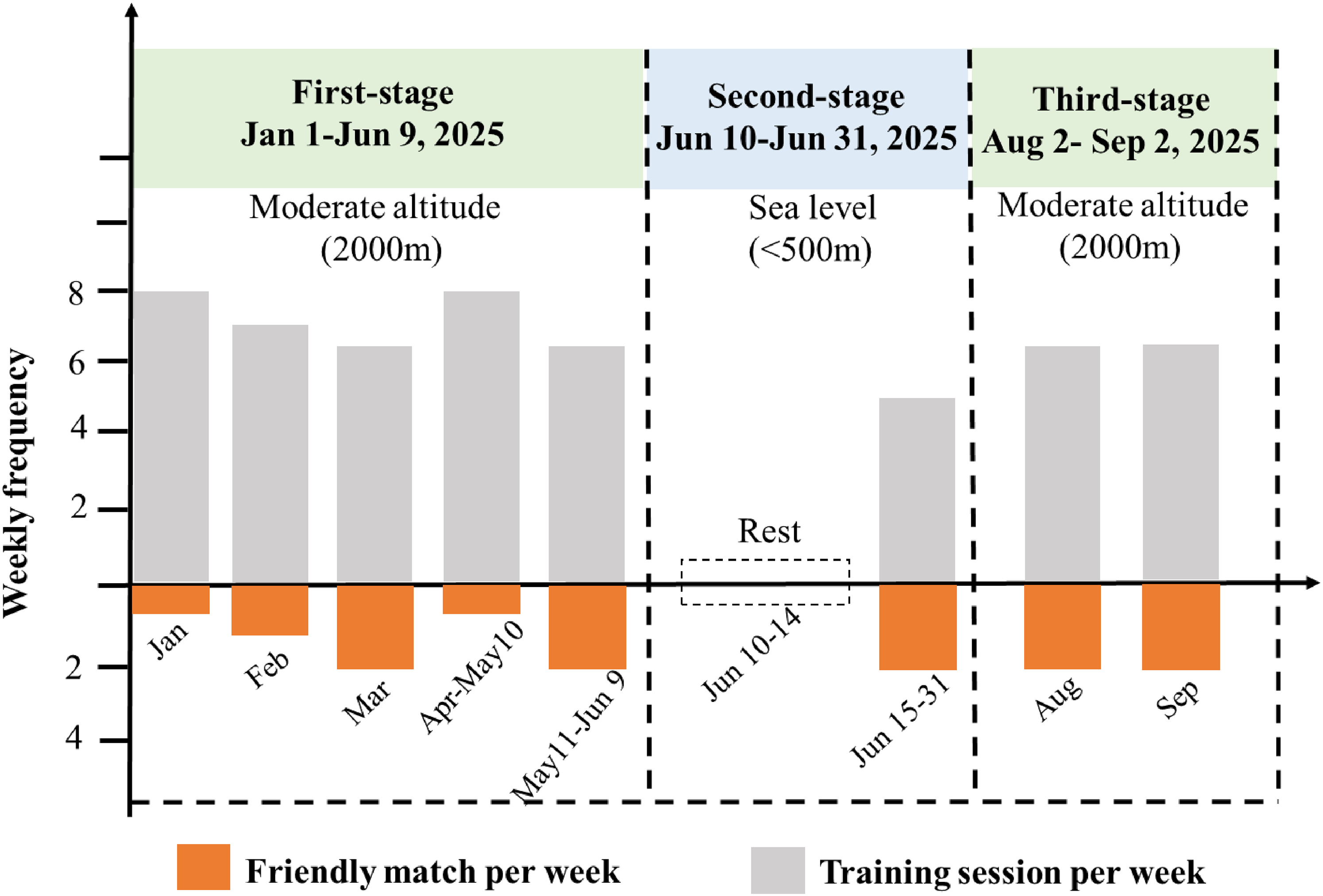
Training cycle protocol across the three-stage period.
Within this longitudinal observational framework, training sessions were planned and delivered by the club coaching staff in accordance with preparatory-phase objectives. To minimize the potential influence of variability in session content on running performance metrics, only regular soccer training sessions (technical–tactical and integrated match-based drills) were included in the analysis, while set-piece–specific sessions and isolated conditioning sessions were excluded. Training frequency was maintained consistently across all stages to ensure that observed changes in running performance reflected altitude transition effects within a real-world professional soccer training environment. Running performance variables extracted from the GPS data included distance per minute (DPM), top speed (TopS), high-speed running distance (HSR), sprint distance (SprintD), explosive accelerations (EAcc), and explosive decelerations (EDec). These variables were used to quantify and compare running performance across different altitude stages and during altitude transitions. Only training sessions with complete GPS records and full player participation were included in the final analysis.
Statistical analysis
Generalized linear mixed models were realized using PROC Glimmix in SAS® OnDemand for Academics. Separate models were constructed for each running performance variable, which served as the dependent variable in the analysis. In each model, altitude stage was included as a fixed effect with three levels: the first stage (moderate altitude), the second stage (sea level), and the third stage (return to moderate altitude). A random intercept for player was included to account for repeated measurements within individuals across the three stages. The dataset consisted of repeated observations collected from 19 players across the three altitude stages. The data had a hierarchical structure, with observations nested within players, and player identity was included as a random effect to account for within-subject correlation. A Gaussian distribution with a log link function was specified for all models, as all dependent variables were treated as continuous performance measures. Model-based estimates were back-transformed and expressed as percentage changes with 90% confidence intervals.
The models estimated the mean value of each dependent variable at each stage. Effects of altitude stage were quantified and expressed as standardized effect sizes (ES), calculated from the model-based mean changes. Effect sizes were interpreted using the following qualitative thresholds: trivial (<0.2), small (0.2–0.6), moderate (0.6–1.2), large (1.2–2.0), and very large (>2.0). 20 Uncertainty in the estimated effects was assessed using 90% confidence intervals (CI). Effects were considered clear when the confidence intervals did not simultaneously overlap both positive and negative substantial values. 21 Clear effects were further described using a magnitude-based qualitative likelihood that the true effect was substantial or trivial (whichever probability was greater), according to the following scale: <0.5% most unlikely, 0.5–5% very unlikely, 5–25% unlikely, 25–75% possibly, 75–95% likely, 95–99.5% very likely, and >99.5% most likely. In the present study, only effects with a likelihood of ≥95% were included in the interpretation and discussion.
Results
A total of 1491 observations (training sessions) were included in the final analysis after applying the inclusion criteria. Values of running parameters across the three stages of the training cycle at moderate altitude, sea level, and return to moderate altitude during the preparatory period are presented in Figure 2. The mean change in DPM (mean change in percent; ±90% confidence intervals; −9%; ±3%, P < 0.001), HSR (−55%; ±16%, P < 0.001), SprintD (−78%; ±30%, P < 0.001), EAcc (−32%; ±7%, P < 0.001), and ED (−29%; ±8%, P < 0.001) decreased substantially from the first stage (moderate altitude) to the second stage (sea level). By contrast, DPM (7%; ±4%, P < 0.001), HSR (60%; ±14%, P < 0.001), SprintD (81%; ±28%, P < 0.001), EAcc (28%; ±8%, P < 0.001), and EDec (29%; ±8%, P < 0.001) increased substantially when returning from the second stage (sea level) to the third stage (moderate altitude), whereas the remaining parameters exhibited only trivial changes.
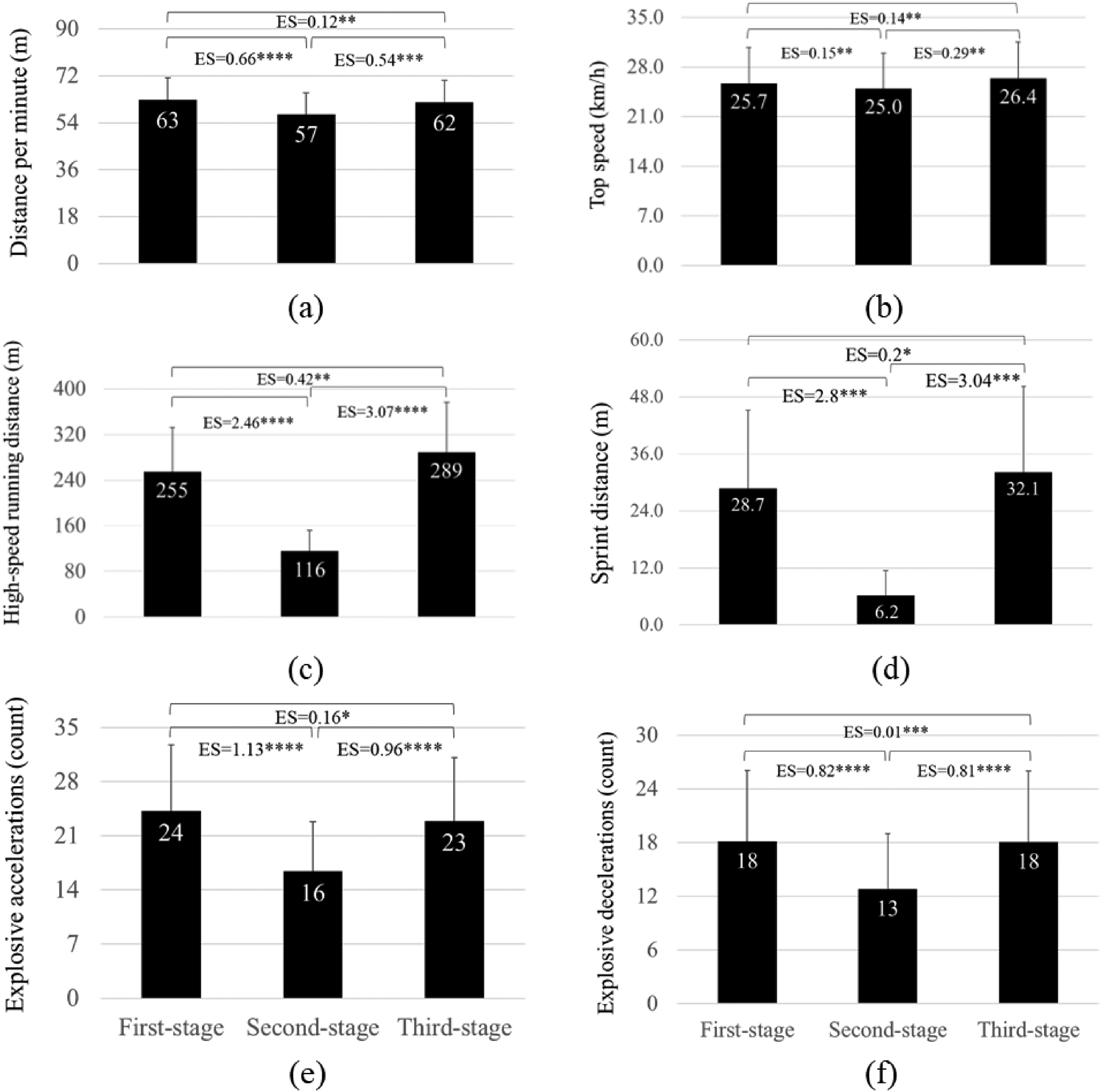
Changes in running performance variables across different stages of repeated transitions between moderate altitude and sea level during the preparatory period. (a) Distance per minute (DPM, m); (b) Top speed (TopS, km/h); (c) High-speed running distance (HSR, m); (d) Sprint distance (SprintD, m); (e) Explosive accelerations (EAcc, count); and (f) Explosive decelerations (EDec, count). Number of asterisks indicate the likelihood for the magnitude of the true change as follows: *possible; **likely; ***very likely; ****most likely.
Discussion
The present study investigated the effects of transitions between moderate altitude and sea level on running performance in male professional soccer players chronically residing at moderate altitude. By examining a complete moderate altitude–sea level–moderate altitude cycle under real preparatory-period conditions, this study addresses a practically important but underexplored scenario in soccer-altitude research, which has predominantly focused on sea-level teams competing at altitude or on short-term hypoxic training interventions. The main findings were that running performance declined substantially when players descended from moderate altitude to sea level, that most performance variables recovered upon return to moderate altitude.
A substantial body of soccer-specific evidence indicates that altitude exposure reduces running output in sea-level natives, with the ISA3600 program demonstrating lower total distance, high-speed running, and peak activity periods at 3600 m alongside increased physiological strain, even with short-term acclimatization. 10 Importantly, altitude-related impairments are not confined to extreme elevations; moderate altitude has also been associated with decrements in high-intensity running in non-acclimatized players, highlighting that 1500–2500 m constitutes a meaningful environmental stressor for soccer performance. 22 In this context, the present work contributes a different and practically relevant perspective by focusing on chronically altitude-adapted players who transition to sea level and back, a scenario frequently encountered in geographically dispersed leagues but relatively underrepresented in empirical soccer research. 23
The observed decline in running performance during the descent from moderate altitude to sea level appears counterintuitive if one assumes that higher oxygen availability at sea level should immediately enhance external running output. However, such an assumption neglects the context-specific and time-dependent nature of altitude adaptation and de-adaptation. Specifically, physiological and neuromuscular adaptations developed during prolonged altitude exposure may not be immediately reversed upon return to sea level, and performance responses can depend on the duration and timing of exposure. 24 In the present cohort, players had accumulated approximately six months of continuous residence and training at moderate altitude prior to descending, a duration sufficient to establish stable altitude-related physiological and neuromuscular adjustments. Evidence from altitude-training research indicates that adaptation and subsequent decay upon return to sea level can follow distinct time courses and may not be fully reversed within a limited time window, with individual variability further influencing the trajectory of change. 24 Consistent with this notion of context-dependence, competition-level analyze in soccer have shown that altitude differentials between teams and venues influence match outcomes and contribute to altitude-related home advantage, implying that being “optimized” for one environment does not necessarily translate into immediate benefit when competing in another. 25 Thus, rather than reflecting a simple “oxygen benefit,” the sea-level stage may represent a period in which established altitude-specific pacing, movement economy, and neuromuscular patterns are temporarily perturbed, particularly when the exposure to sea level is finite (two months in this study) and embedded within a preparatory block with shifting session aims.
The magnitude of the decline was greatest in high-intensity and explosive actions (e.g., HSR −55% ± 16%, SprintD −78% ± 30%, EAcc −32% ± 7%, and EDec −29% ± 8%), which aligns with the broader team-sport and intermittent-exercise literature indicating that high-intensity intermittent performance is especially sensitive to alterations in oxygen availability and recovery kinetics. 26 Mechanistic work and syntheses of repeated-sprint exercise in hypoxia emphasize that changes in muscle oxygenation, phosphocreatine resynthesis, and neuromuscular fatigue development can disproportionately affect maximal or near-maximal efforts compared with lower-intensity volume measures. 27 Soccer-specific evidence further supports the sensitivity of repeated-sprint and intermittent running performance to hypoxic stress and fatigue interactions under controlled settings, reinforcing the plausibility that high-intensity outputs are the first to change when the system is challenged by environmental transitions and accumulated load. 5 In applied monitoring terms, this pattern also fits with the growing recognition that high-speed and sprint-related metrics can reflect neuromuscular state and fatigue more acutely than global distance measures, and that interpretation depends on context and the way external load is accumulated. 28 An additional applied explanation that complements the physiological perspective is that external running outputs in soccer training are strongly shaped by session design. Even when the intent of a sea-level camp is to increase training intensity, changes in technical/tactical emphasis, constrained-game formats, match scheduling, and coaching objectives can reduce running volumes and high-speed opportunities, while internal load and perceived intensity may remain high. Evidence linking external training-load metrics (e.g., total distance, sprint distance, HSR) with fatigue and neuromuscular performance across different training windows in elite soccer supports the idea that running outputs are embedded within broader load–fatigue dynamics rather than being direct proxies of “fitness” alone. 29 Moreover, environmental transitions are often accompanied by travel and routine disruption, and broader athlete travel literature indicates that travel fatigue and jet lag can affect recovery, sleep, and readiness, potentially modifying training responses even without large time-zone shifts. 30 Therefore, the sea-level decrement observed here is most plausibly interpreted as the combined effect of (i) a context shift away from the players’ habitual altitude environment after prolonged exposure, (ii) a sea-level exposure duration that may induce partial but not complete de-adaptation (two months), and (iii) the typical fluctuations in training content, fatigue, and recovery that occur across preparatory blocks. 31
When the team returned from sea level to moderate altitude, most running variables increased substantially (e.g., HSR +60% ± 14%, SprintD +81% ± 28%, EAcc +28% ± 8%, EDec +29% ± 8%) . Given that the preceding sea-level period (two months) was shorter than the pre-cycle altitude residence (six months), and that the subsequent return stage represented only one month back at altitude, this rapid restoration is consistent with a re-expression of retained altitude-specific adaptations rather than the development of new adaptations. Time-course discussions in the altitude-training literature suggest that performance responses after altitude exposure depend on both the accumulated hypoxic dose and the timing of return, and that the balance of positive and negative effects can vary across days to weeks after relocation, with meaningful inter-individual variability.32,33 At the competition level, altitude-related home advantage and altitude-differential effects provide converging support for the idea that teams or players accustomed to altitude can rapidly regain functional advantage upon re-exposure, even if their performance at sea level is not immediately enhanced. 25 From a team-sport hypoxia perspective, this rebound also aligns with evidence that hypoxic conditioning can influence determinants relevant to intermittent performance (fatigue resistance, recovery between bouts), though outcomes can be dose- and protocol-dependent. 27
The comparison between the two moderate-altitude stages adds important nuance: total distance declined substantially from the first to the third stage, whereas the remaining variables exhibited only trivial changes. This dissociation between overall volume and intensity-related actions is consistent with the notion that total distance is particularly sensitive to cumulative fatigue, periodization aims, and contextual constraints, while high-intensity exposures may be maintained or prioritized to preserve neuromuscular readiness. Observational evidence in elite soccer indicates that relationships between external loads (e.g., total distance and HSR) and fatigue or neuromuscular performance can emerge over multi-week windows, supporting the interpretation that accumulated load across a preparatory cycle can suppress global volume even when high-intensity metrics are relatively stable.28,29 In the present case, the sequence of prolonged altitude residence (six months), a sea-level phase that may have partially altered adaptation and training structure (two months), and a relatively short re-exposure to moderate altitude (one month) provides a plausible context in which high-intensity running capacity can rebound quickly while overall running volume remains constrained by accumulated load and the training cycle. This interpretation is also practically relevant because it cautions against using a single GPS metric to infer “full recovery” after altitude transitions; a normalization of HSR or sprint distance does not necessarily imply restoration of overall locomotor volume or load tolerance. 34
From an applied perspective, the present findings challenge the assumption that a short-to-moderate sea-level phase will automatically generate an immediate external-load or performance “boost” in altitude-adapted soccer players. Instead, transitions to sea level may transiently suppress running output, particularly high-intensity and explosive actions, through a combination of contextual change, partial de-adaptation, travel-related disruption, and modifications in training content.30,35 Conversely, the rapid rebound upon return to moderate altitude suggests that altitude-adapted squads may re-establish their typical external-load profile relatively quickly, although total running distance may remain influenced by accumulated load and the broader preparatory cycle. At the broader soccer level, evidence that altitude differentials affect match outcomes reinforces the practical significance of understanding how altitude-adapted teams manage transitions across environments.12,23,36
Several limitations of this study should be acknowledged. First, the sample consisted of players from a single professional club and involved Nineteen male U20 academy athletes, which may limit the generalizability of the findings to senior professional players or other competitive contexts. Second, running performance was assessed during training sessions rather than official matches, and no physiological or perceptual measures were collected, restricting the ability to directly explain the underlying mechanisms of the observed performance changes. In addition, although match exposure was limited to friendly matches during the study period, the variability in friendly match frequency across different phases may have influenced training load and potentially confounded the interpretation of altitude-related effects. Future research should incorporate multi-club samples, match-based performance data, and integrated physiological and perceptual measures to further elucidate the effects of altitude transitions across different stages of the competitive season.
Conclusion
The findings indicate that descending to sea level is associated with substantial reductions in running performance, particularly in high-intensity and explosive actions, despite increased oxygen availability, whereas a return to moderate altitude leads to a rapid recovery of most performance variables. Collectively, these results highlight the time-dependent and context-specific nature of altitude-related performance responses and demonstrate that short-term exposure to sea level does not necessarily confer immediate performance benefits in altitude-adapted soccer players. These findings provide practical insight for managing training load and performance preparation in professional teams that routinely transition between different altitude environments.
Footnotes
Acknowledgements
The authors gratefully acknowledge Mr Xupeng ZHOU, strength and conditioning coach of the China Yunnan National Games Team, for his valuable contribution to the precise monitoring and collection of training data during the training process.

Ethics approval and consent to participate
This observational study was conducted in accordance with the principles of the Declaration of Helsinki. The study protocol was reviewed and approved by the Ethics Committee of the School of Physical Education and Sports Science, South China Normal University (Ethics approval number: SCNU-SPT-2024-070). All data were collected as part of routine training monitoring, and no additional interventions were implemented for the purposes of this study. Written informed consent was obtained from all participants prior to participation. For participants under 18 years of age, written informed consent was additionally obtained from their legal guardians.
Consent for publication
Not applicable. This manuscript does not contain any identifiable individual data, images, or personal information that would require consent for publication.
Authors contributions
LF was involved in data collection, analysis and interpretation, drafted and revised the manuscript. HL developed the idea, was involved in the analysis and interpretation, drafted and revised the manuscript. All the authors approved the final version of the manuscript.
Funding
This work was supported by the Sports Performance Analysis and Training Scientific Innovation Team (2024WCX TD030).
Declaration of conflicting interests
The authors declared no potential conflicts of interest with respect to the research, authorship, and/or publication of this article.
Data availability and materials
The datasets generated and analyzed during the current study are not publicly available due to privacy and data-sharing agreements, but are available from the corresponding author upon reasonable request and with permission of all authors.