






Abstract
This exploratory, quasi-experimental study examined how coach educational background influences training-induced adaptations in young elite karate athletes. Forty-five national-level under-15 karatekas were assigned to three non-randomized groups based on their coach profile: sports instructor (School 1), university-trained sports teacher (School 2), or a combined supervision team (School 3). Each coaching unit independently designed an eight-week plyometric and agility program under standardized constraints, allowing the program characteristics to reflect their methodological expertise. Pre- and post-intervention assessments included anthropometry, muscular power, linear sprint time, change-of-direction (COD) speed, and dynamic balance. Data were analyzed using ANCOVA with baseline scores as covariates. Effect sizes were expressed as partial eta squared (ηp2) for between-group effects and Cohen's d for descriptive changes. ANCOVA revealed no significant group effects for BMI, body fat percentage, squat-jump, or 10-m sprint. Conversely, significant between-group differences favoring School 3 were observed in most key performance metrics (p < 0.01). School 3 demonstrated superior outcomes for muscular power (countermovement jump, drop jump, standing long jump, medicine-ball tests; ηp2 up to 0.67), linear sprint time (15-m sprint; ηp2 = 0.30), modified COD T-test (MCOD-T; ηp2=0.67), and Y-balance test - composite score (YBT-CS; ηp2=0.40). Post-hoc tests confirmed School 3 outperformed School 1 and School 2 with large effect sizes across these variables (e.g., MCOD-T: d = 3.59 vs. School 1; 15-m sprint: d = 1.63 vs. School 1). We conclude that integrating academic knowledge with sport-specific practical experience provides a stronger foundation for designing structured, progressive, and effective training programs that maximize positive performance adaptations.
Keywords
Introduction
The connection between knowledge and the teaching-learning process is a vital part of education. 1 Coaching effectiveness in sport, is increasingly understood not only as a pedagogical process, but as a multidimensional expertise requiring the integration of scientific knowledge, planning methodology, and sport-specific decision-making. 2 In contemporary coaching models, such as the professional judgment and decision-making framework or the integrated coaching process, coaches are expected to mobilize theoretical knowledge to design structured training environments that support both performance and athlete development.1,3 In this context, the coach's academic background may directly influence how training principles such as load management, periodization, and motor learning strategies, are translated into practice.4,5
In sports, it is important to have a teaching-based coaching plan to help athletes reach their full potential. 6 In this context, studies show that a coach's academic background can have a significant impact on the effectiveness of training programs and athlete development.3,6 This, in turn, can affect athletes’ performance. 3 The educational background of a coach influences the methodological design of training curricula, specifically regarding the application of exercise science principles like periodization and recovery management.6,7 Such integration contributes to more comprehensive athlete support systems that promote both performance and well-being.
According to Siedentop and colleagues, 8 in educational settings, the three main components of performance are objectives, means, and results. Moreover, it has been reported that teacher quality is very important in helping students succeed. 9 That is why Mincu 9 argues that this should be one of the most important things to work on to make the education system better. Indeed, these pedagogical approaches are very important for sports education. In sports coaching and education, coaches and educators benefit from formal academic preparation in sport sciences, including curriculum design, motor learning, biomechanics, physiology, and evidence-based training design. Recent studies, show that it is important to use teaching methods that include both the theoretical foundations and practical application in sports training. 10 Evidence suggests that structured pedagogical frameworks, specifically those integrating physical literacy-oriented instruction with systematic continuing professional development, significantly enhance the acquisition of technical and tactical proficiencies. These high-quality educational interventions are associated not only with superior neuromuscular and physiological adaptations but also with improved cognitive functioning. Such findings underscore the critical role of teaching quality and methodological structure in optimizing both performance-related outcomes and the holistic development of the athlete. 11 On the other hand, methodical collaboration between academic teachers and sports instructors can create a better training environment for young athletes. This helps them learn to think critically, overcome challenges, and develop broader competencies beyond physical strength. 12 Consequently, such a synergistic approach can contribute to improving athletes’ development and preparing them for success in sport and in life.
To achieve success in many sports, competence or excellence in a wide variety of performance parameters is necessary. For example, in combat sports like karate, athletes must execute rapid offensive and defensive maneuvers such as attacks, evasions, and counterattacks typical of kumite.6,13–16 Lower-limb explosive power, commonly assessed via squat jump (SJ), countermovement jump (CMJ), or drop jump (DJ), is strongly linked to faster technique execution and improved scoring in young karate athletes.13–16 Similarly, short-distance sprinting (5–15 m) reflects the acceleration needed for initiating attacks or closing distance with opponents.13,16 COD ability, measured by tests like the modified COD T-test (MCOD-T), closely replicates the multidirectional, high-speed actions of combat, while dynamic balance (e.g., Y-balance test [YBT]) is essential for postural control during kicks, rotations, and single-leg stances.6,15 Most if not all of these parameters are also essential for success in other dynamic sports such as football (international and North American), basketball, hockey (ice and field) and others. These performance measures are validated in adolescent and combat sport populations and are sensitive to neuromuscular adaptations from plyometric and agility training.6,14–17 As the demands in karate are often reflected and can be applied to other sports, research involving improvements in coaching performance can have widespread athletic applications. However, the influence of a coach's academic knowledge and practical experience expertise on these physical parameters in young karate athletes remains unexplored. Evidence from related sports and youth contexts suggests that higher coach education involving the merging of physical education, sport, and exercise science, and pedagogical training are associated with improved athlete performance and more effective training design, including load management and progression.6,18 No studies have directly addressed this relationship within structured plyometric and agility programs in karate.
The diverse approaches used to evaluate teaching quality consistently highlight the centrality of student-focused instruction. This means building good relationships with the students and really understanding the things being taught.9,11,19,20 Literature shows that there are several important parts of teaching that help it work well. These include setting challenging goals, planning ahead, and managing time well. 20 In physical education, these elements are especially important for helping kids develop their motor skills.
A strong command of subject-specific knowledge is essential for effective teaching. 21 Physical education teachers are often regarded as “Subjects Supposed to Know”, 19 highlighting the expectation that they possess substantial disciplinary expertise to deliver effective instruction. Physical education and sport sciences have a long history of examining coaching and instructional practices, and this line of inquiry has continued to expand in recent years as researchers deepen their focus on optimizing training and learning environments. Indeed, there are now sports research laboratories, and an increasing number of individuals are interested in acquiring the knowledge necessary to provide more effective coaching. Many studies have looked at how coaches and teachers understand their knowledge, often focusing on the connection between what they think about a subject and how they act in the real world. 22 However, research suggests that coaches don't always apply scientific knowledge in their practice. 23 Some studies suggest that coaches may not see academic training in sports sciences as essential. 3 However, Collinet 24 says that physical education teachers rely a lot on their academic training, while coaches like to use many different learning approaches. Coaching is often more flexible and less structured than the programs that physical education teachers follow. 4 This difference may come from the different paths that coaches and physical education teachers take in their careers.
In Tunisia, teachers who have studied and graduated with a master's degree in physical education can teach in schools and sports promotion centers. On the other hand, sports instructors, who are often former champions without formal academic backgrounds, supervise students in the sports/study program at the primary level and in centers that focus on sport promotion. These sports instructors may work alone or with physical education and sport teachers who have special knowledge about sports. Studies on expert coaches show that as coaches become more mature in their profession, they increasingly rely on experiential, tacit, and context-specific knowledge rather than solely on academic or technical knowledge. 25 Instead, they start using methods that are more adaptive and focus on the needs of the athletes. 26 Research on coaching expertise also highlights that professional development is shaped not only by formal education but also by long-term experiential involvement in sport. Early and sustained participation, combined with mentorship from experienced coaches, contributes to the development of practical knowledge and professional judgment. Moreover, many coaches recognize the need for ongoing learning, with a majority identifying continuous professional development as essential to effective coaching practice. 24
Despite the abundance of studies on the knowledge and expertise of sport teachers and coaches, we don't know much about how a coach's academic training affects athletic performance. Although pedagogical knowledge and scientific training knowledge are often treated as a single construct in coaching, they represent complementary yet distinct competencies. Pedagogical knowledge refers to instructional strategies, classroom/group management, communication, and motor-learning principles that support effective teaching. In contrast, scientific or sport-specific knowledge encompasses strength and conditioning principles, training-load management, biomechanics, physiology, and the evidence-based design of plyometric, agility, and sprint training programs. Importantly, holding a physical education teaching degree does not necessarily imply advanced expertise in strength and conditioning or performance-planning frameworks. These distinctions are particularly relevant to the present study because the dependent variables assessed (muscular power, sprints, COD speed, and dynamic balance) directly depend on the coach's ability to apply scientifically validated training methods. Thus, differences in academic background may lead to differences in program design quality and training effectiveness. Despite growing research on plyometric and agility training in youth athletes, little is known about how coaches’ academic and scientific backgrounds influence the effectiveness of such programs in combat sports. Existing evidence largely focuses on training modalities rather than on the competence of the individuals designing and delivering them. To our knowledge, no study has examined whether coaches with stronger scientific preparation in training-load management, neuromuscular development, and performance planning produce superior physical adaptations in young athletes in general and in this research, specifically, karatekas compared with coaches relying mainly on pedagogical training or practical experience. This gap is particularly relevant because the physical qualities assessed in this study (muscular power, sprint time performance, COD ability, and dynamic balance) depend heavily on the correct application of evidence-based training principles.
Therefore, the aim of the current exploratory study was to examine how coaches’ academic knowledge and practical experience backgrounds influence young elite karateka's adaptations to an 8-week plyometric and agility training program. Specifically, we compared changes in muscular power, linear sprint time, COD ability, and dynamic balance across three groups (School 1, School 2, and school 3) respectively trained by (1) a sports instructor without formal academic qualifications, (2) a university-trained sports teacher specialized in karate, and (3) a combined instructor–teacher coaching team. We hypothesized that athletes trained under the combined instructor–teacher coaching team (School 3) would demonstrate greater improvements in physical performance, including muscular power, linear sprint times (speed), COD ability, and dynamic balance, compared with athletes trained by a sports instructor without academic knowledge (School 1) or a university-trained sports teacher (School 2). We also hypothesized that no meaningful differences would be observed among the three groups for short-term anthropometric outcomes (body mass index [BMI] and body fat percentage [%BF]).
Methods
Research design
The present study was conducted as an exploratory, quasi-experimental, non-randomized trial involving young elite karatekas following an eight-week plyometric and agility training program. This design was necessary given that participants were naturally situated within their respective schools, precluding random assignment to the intervention groups. A total of forty-five male Tunisian karate athletes, all under the age of fifteen and competing at a national level, were divided into three groups corresponding to three different schools, each distinguished by the educational background of their respective coaches: School 1 employed a karate sports instructor who was a former karate champion but he did not have any formal academic teaching qualifications. School 2 had a sports teacher who specialized in karate. School 3 utilized a combination of a karate sports instructor and a sports teacher, both of whom specialized in karate, who jointly supervised the same group of students.
The training programs lasted eight weeks for all groups, with each program independently designed and supervised by its respective coach(es). The study included two testing sessions: one conducted before the intervention (Pre-Test) and the second after the intervention (Post-Test). During both sessions, athletes completed the same comprehensive battery of physical assessments. These assessments included anthropometric measures (BMI and %BF), muscular power tests (SJ, CMJ, DJ, standing long jump [SLJ], and medicine ball throw [MBTT]), linear sprint tests (5-, 10-, and 15-m), COD ability using MCOD-T, and dynamic balance evaluation using YBT. To ensure procedural consistency, all assessments were carried out under standardized conditions and supervised by the same research team. The influence of the coach's background (academic knowledge and practical experience) on the athletes’ training response was then assessed by comparing the performance gains across the three groups.
Participants
Coaches
Four coaches from public Tunisian sports high schools voluntarily participated in the study. These institutions follow a sport-study model, allowing students to combine a traditional academic curriculum with daily specialized karate training. All coaches received identical general instructions: they were asked to independently design a training program aimed at improving agility and plyometric performance. No additional guidance regarding the program's structure or implementation was provided, ensuring that each coach relied exclusively on their own professional expertise during its development.
In this study, pedagogical training was operationally defined using objective indicators, including academic education in sport sciences, pedagogical certification, and professional status. Based on these criteria, the coaches represented different levels of theoretical and methodological preparation:
- School 1: One karate sports instructor, former elite athlete without formal academic teaching qualifications. - School 2: One certified sports teacher specialized in karate. - School 3: A combined staff including both a sports instructor and a sports teacher jointly supervising the same group of athletes.
Within the Tunisian sport-education system, a sports instructor completes short, applied technical training, whereas a sports teacher is a university-trained professional (Bachelor's or Master's degree) with formal preparation in curriculum design, physiology, motor learning, and training planning. In School 3, this complementary pairing provided a mixed model combining practical expertise and academic preparation.
Detailed information on coaches’ qualifications and roles is provided in Table 1.
Characteristics of participating coaches and their assigned schools.
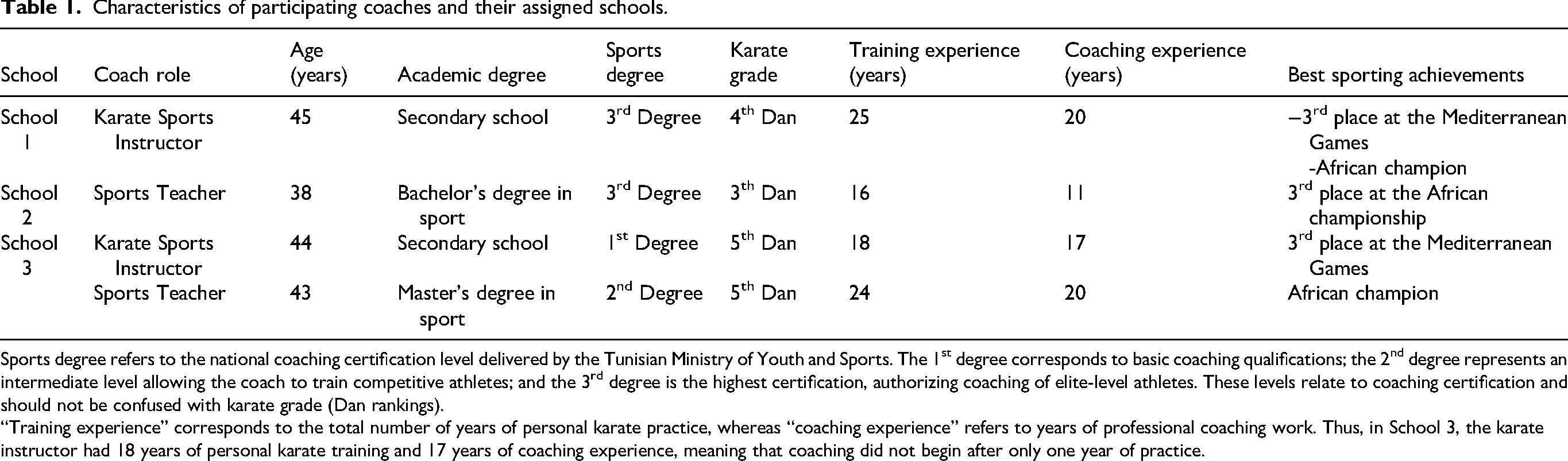
Sports degree refers to the national coaching certification level delivered by the Tunisian Ministry of Youth and Sports. The 1st degree corresponds to basic coaching qualifications; the 2nd degree represents an intermediate level allowing the coach to train competitive athletes; and the 3rd degree is the highest certification, authorizing coaching of elite-level athletes. These levels relate to coaching certification and should not be confused with karate grade (Dan rankings).
“Training experience” corresponds to the total number of years of personal karate practice, whereas “coaching experience” refers to years of professional coaching work. Thus, in School 3, the karate instructor had 18 years of personal karate training and 17 years of coaching experience, meaning that coaching did not begin after only one year of practice.
Athletes
An a priori power analysis was conducted using G*Power software (version 3.1.9.7) to determine the appropriate sample size for an Analysis of Covariance (ANCOVA). The analysis was configured to detect a main effect of “Group” (three groups) on the post-test outcomes, while controlling for one covariate (Pre-Test score). Based on the study design, we applied a large effect size (Cohen's F = 0.5), 27 an alpha significance level of 0.05, and a desired statistical power (1 − β) of 0.80. Because no pilot data were available for this specific population and training program, the expected effect size was estimated from previous studies on plyometric and agility training in youth combat and ballistic sports.28,29 The calculation indicated that a minimum total sample size of 42 participants (14 athletes per group) was required to achieve the specified power. To account for potential attrition and ensure robust data, 45 athletes (15 per group) were enrolled in the study. This sample size yields a post-hoc statistical power of approximately 0.83 for detecting large inter-group differences.
The present study involved 45 Kumite Karate athletes (29 males and 16 females) from the Tunisian national under-15 Shotokan Kumite team, all of whom volunteered to participate (Table 2). All athletes met the following inclusion criteria:
- Non-smokers and in good health, with no chronic or acute diseases - Female athletes were not menstruating at the time of the assessments - No use of any dietary supplements, medications, or other substances during the experiment
Baseline demographic and anthropometric characteristics of study participants by coaching group (three preexisting groups).
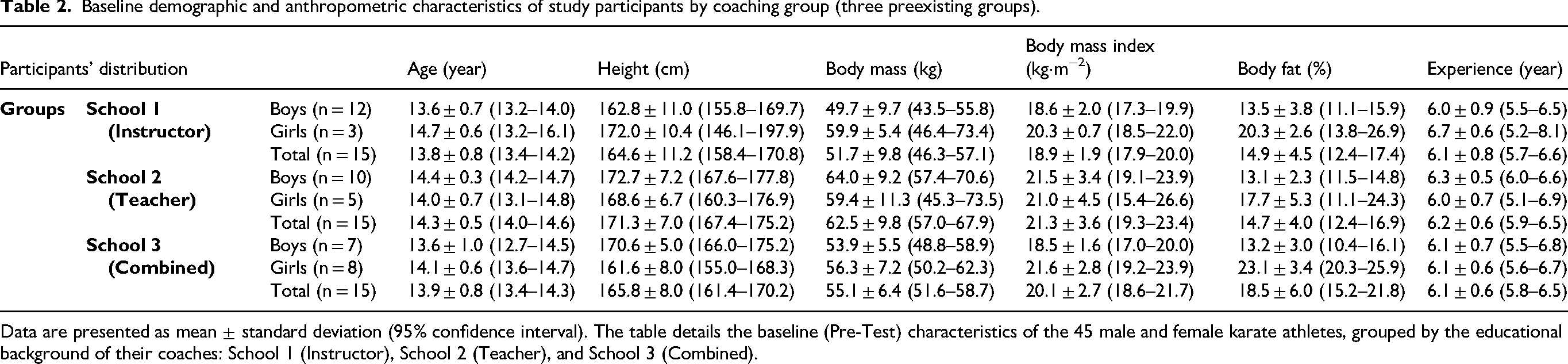
Data are presented as mean ± standard deviation (95% confidence interval). The table details the baseline (Pre-Test) characteristics of the 45 male and female karate athletes, grouped by the educational background of their coaches: School 1 (Instructor), School 2 (Teacher), and School 3 (Combined).
The participating athletes were divided into three groups based on the sports school they attended: School 1, School 2, and School 3.
Prior to their involvement, the athletes and their legal guardians were fully informed about the potential risks and benefits of the study. Written parental consent was obtained for all participants. The study was conducted in accordance with the ethical principles outlined in the Declaration of Helsinki. 30 The protocol was reviewed and approved by the Ethics Committee of the National Center of Medicine and Sciences in Sport of Tunis, Tunisia (Approval number: LR09SEP 01/2024), before the commencement of any assessments.
Procedures
Testing procedure
The study was conducted during the competitive phase of the karate season, specifically from early April to late May, corresponding to the official competition period for Tunisian under-15 athletes, and for 2 weeks prior to the experiment, the athletes underwent familiarization sessions (two sessions per week) to minimize any learning effects during the course of the study. These sessions allowed the athletes to become acquainted with the general environment, testing equipment, and specific techniques required for each fitness assessment.
Two days before to the commencement of the experiment, each athlete underwent anthropometric measurements while fasting. Body mass was measured to the nearest 0.1 kg using an electronic scale (BC-554 Ironman Body Composition Monitor; Tanita, Illinois, USA), while height was measured to the nearest 0.1 cm using a wall-mounted stadiometer (Butterfly, Shanghai, China). Body fat percentage was calculated using the Jackson-Pollock method, with measurements taken on the left segments for right-handed athletes and the right segments for left-handed athletes.31,32
The testing protocol comprised two sessions: The first session (Pre-Test) was carried out before the implementation of the coaches’ training programs, 8 weeks after plyometric and agility training program, the second session (Post-Test) was conducted. All measurements took place during the competitive phase of the season. To minimize the potential effects of fatigue, athletes were instructed to avoid any strenuous activities 48 h prior to the experiment and not to exercise on the day of the testing. All performance assessments were conducted by the same research team, who were blinded to group allocation throughout both testing sessions to minimize potential measurement bias. Standardized verbal encouragement was provided uniformly to all athletes by the same experienced investigators, and all testing procedures followed established protocols.
The test battery assessed, muscle power, linear speed, COD speed, and dynamic balance. During Pre-Test and Post-Test, the tests were conducted over 2 days with a 48-h recovery period in between. Testing was always performed indoors, on the karate mat, at the same time of day (between 4 p.m. and 6 p.m.), under similar environmental conditions (temperature ∼22°C and ∼50% humidity), and in the same sequence by the same assessors.
On the first day, athletes completed the MBTT, SJ, CMJ, and MCOD-T. On the second day, they performed the YBT, linear sprint (5-, 10-, and 15-m), SLJ, and DJ tests. A 15-min standardized general warm-up was conducted before each testing session, and a minimum of five minutes of rest were provided between different tests and between repeated trials within the same testing session to minimize fatigue and ensure reliable performance.33,34 The test order was structured according to established guidelines to minimize fatigue and ensure optimal reliability of performance measures. Neuromuscular and explosive power tests (SJ, CMJ, DJ, MBTT) were performed first, as these assessments are highly sensitive to fatigue and require maximal muscle readiness. COD and sprint tests were conducted afterwards, as they generate higher metabolic demand. Dynamic balance testing was placed at the end to prevent alterations caused by prior high-intensity efforts. This ordering follows recommended testing principles, prioritizing low-fatigue and high-precision tests before more fatiguing activities, as suggested in previous performance assessment research.35–37
Vertical jumping tests
Vertical jump performance was assessed using the SJ, CMJ, and DJ. All jumps were performed with hands on hips to eliminate upper limb contribution, and jump metrics were recorded using an infrared system (Optojump Next, Microgate, Srl, Bolzano, Italy) to calculate flight time, contact time, and jump height. Each test included three trials with ∼60 s rest between attempts; the best attempt was retained for analysis.33,34 A 3-min rest separated the three jump tests.
For the SJ, athletes initiated the jump from a static semi-squat position (∼90° knee angle), held for 3 s to suppress countermovement before take-off. The CMJ required athletes to execute a rapid downward movement to a self-selected depth, immediately followed by maximal vertical propulsion. Throughout the movement, athletes were instructed to maintain an upright trunk posture and keep their hands placed firmly on their hips to isolate the action of the lower limbs. In the DJ, athletes dropped from a 40 cm platform and immediately rebounded with the goal of maximizing height while minimizing ground contact time, assessing fast stretch-shortening cycle (SSC) efficiency.
Standing long jump test
The starting position of the SLJ required subjects to stand with their feet shoulder-width apart behind a starting line and their arms loosely hanging down. On the command ready, set, go, participants executed a countermovement with their legs and arms and jumped at maximal effort in the horizontal direction. Participants had to land with both feet at the same time and were not allowed to fall forward or backward. The horizontal distance between the starting line and the heel of the rear foot was recorded via tape measure to the nearest 1-cm. Each athlete performed three trials of the SLJ, with approximately 60 s of rest between attempts. The best performance out of the three trials was recorded for analysis. The Intraclass Correlation Coefficient (ICC) for test–retest reliability was 0.90 in Tunisian national team karate athletes. 38
Medicine-ball throwing test
The athlete began by sitting with their back against a wall, making sure it was firmly supported. They held the medicine ball, which weighed 3 kilograms, at their chest level. They held it firmly with both hands. The elbows remained bent and close to the body, which made it easier for the player to throw. When the “Go” command was given, the athlete performed a maximum effort chest pass. This meant that the players had to spread their arms wide and push the ball away from their bodies as hard as they could. It is crucial to throw with as much force as possible. This requires using your whole upper body (including the shoulders, chest, and core) to create the most power and force in the throw. 39 The throwing distance was measured using a tape measure (1-cm precision) from the wall against which the athlete's back was positioned to the first point of contact of the medicine ball with the ground. Each athlete performed three maximal chest-pass throws, with the best distance recorded for analysis
Linear sprint tests
Athletes’ sprint time performance was evaluated over 5-, 10-, and 15-m intervals, following protocols described by Aloui and colleagues 35 and Makhlouf and colleagues. 36 These distances were chosen to assess horizontal explosive strength and fast SSC performance during sprinting. Sprint times were recorded using a photocell-based electronic timing system (Brower Timing Systems, Draper, Utah, USA), which measures time to the nearest 0.01 s. This system was placed at each distance marker, so we could measure the times to the nearest 0.01 s. The athletes were told to run as fast as they could during the test. This would make sure that the test results were reliable. The ICCs for test-retest reliability were 0.96 and 0.97, for 5- and 10-m linear sprint times, respectively in Tunisian national team karate athletes. 38
Modified change-of-direction T-test
The MCOD-T has been described as a measure of planned four-directional agility and body control that evaluates the ability to quickly change directions while maintaining balance without a loss in speed. Performance time in the MCOD-T was measured using a photocell-based electronic timing system (Brower Timing Systems, Draper, Utah, USA). The timing gate was placed at the start/finish line. The timer was automatically triggered when the athlete broke the infrared beam at the start and stopped when the beam was crossed again at the finish. Each athlete performed two trials, separated by 3 min of rest, and the best time was used for analysis. The test followed previously validated protocols This test was performed as previously described by Mhenni and colleagues37,40 and Aloui and colleagues. 35 The ICC for test-retest trials of MCOD-T was 0.92 in Tunisian national team karate athletes. 38
Dynamic balance test
Reach distances in the YBT were measured using the metric scales integrated into the YBT Kit (Move2Perform, Evansville, IN, USA). For each direction (anterior, posteromedial, and posterolateral), the distance was recorded as the maximal point reached by the athlete's great toe along the calibrated measurement line, to the nearest 0.5 cm. following the protocol described by Aloui and colleagues 35 and Makhlouf and colleagues. 36 Participants completed three trials, with approximately 3 min of passive recovery between each attempt to minimize fatigue. The best performance score was recorded and used for subsequent analysis. This test evaluates the participants’ ability to maintain postural control while reaching in multiple directions, providing a composite score as an indicator of dynamic balance proficiency. A composite score (CS) was calculated and taken as the dependent variable using the following formula: YBT-CS = [(maximum anterior reach distance + maximum posteromedial reach distance + maximum posterolateral reach distance) / (leg length × 3)] × 100. The ICC for test-retest trials for the three movement directions of YBT were ranging from 0.84 to 0.89 in Tunisian national team karate athletes. 38
Training procedure
During the 8-week training period, the athletes trained five days per week (Monday to Friday), with two rest days on Saturday and Sunday. Each training session lasted approximately 2 h, from 4 p.m. to 6 p.m. The weekly training program comprised two non-consecutive of physical training (plyometric and agility) and three sessions of karate-specific training (technical and tactical). The coaches were instructed to provide detailed information on the physical training program, including the exercises, number of repetitions and sets, recovery periods, total mat contacts during plyometrics, and total distance covered during agility exercises, along with photographic documentation of each session (See the tables 1–6 in the Supplemental Digital Content for an overview of the training programs for Schools 1, 2, and 3), which allowed the research team to monitor and verify overall training load. Raining adherence was recorded via session-by-session attendance sheets. Athletes were required to attend at least 90% of the training sessions to be included in the final analysis, and adherence was high across all groups (School 1: 98%, School 2: 97%, School 3: 95%). In addition, all physical training sessions were supervised by the research team to ensure comparable session duration, training frequency, and general workload structure across schools. While session structure was controlled, intentional differences in exercise selection and progression were maintained to reflect each coach's pedagogical and academic background, in accordance with the aims of the study.
Statistical analyses
All statistical analyses were performed using IBM SPSS Statistics version 27 (IBM Corp., Armonk, NY, USA. Data are presented as mean ± standard deviation (SD) for normally distributed variables, while median and interquartile range (IQR) are used for non-normally distributed data. The normality of all dependent variables was assessed using the Shapiro-Wilk test. The results indicated that the SJ, CMJ, DJ, SLJ, MBTT, the 5- and 15-m sprint times, and the YBT-CS were normally distributed (p > 0.05). However, BMI, BF, 10-m sprint time, and MCOD-T exhibited non-normal distributions (p < 0.05). Given that the group sizes were equal (15 athletes per group) and the F-test is considered robust to such violations under these conditions,41,42 ANCOVA was applied to all variables to identify group differences while controlling for baseline (Pre-Test) values.
To assess the magnitude of change within each group (School 1 [Instructor], School 2 [Teacher], and School 3 [Combined]) following the 8-week intervention, intragroup comparisons of measurements between the Pre-Test and Post-Test sessions were made by quantifying the magnitude of change within mean values (Pre-Test to Post-Test), using Cohen's d as the standardized effect size measure with 95% confidence intervals (CI).
To determine the differential training effect between the three coaching groups, a single-factor Analysis of Covariance (ANCOVA) was performed. This method compared the Post-Test measurements (dependent variables) between the three independent groups (the factor), while statistically controlling for potential initial baseline differences by utilizing the corresponding Pre-Test scores as a covariate. Where the ANCOVA revealed a significant main effect of group, Bonferroni-adjusted pairwise post-hoc comparisons were subsequently conducted to identify the specific group differences.
Effect sizes were computed to quantify the magnitude of difference for all statistical comparisons. The effect size for ANCOVA effects was reported as partial eta squared (ηp2), which was interpreted using Cohen's 27 thresholds: small (< 0.06), medium (0.06 to 0.14), or large (> 0.14). For all intragroup and pairwise comparisons, Cohen's d was used to quantify the magnitude of the effect, using Sawilowsky's 43 thresholds: very small (0.01), small (0.2), medium (0.5), large (0.8), very large (1.2), and huge (2.0). The alpha level was set at p < 0.05 for statistical significance.
Results
Within-Group changes
Based on the data presented in Table 3 regarding the within-group changes following the eight-week intervention, the training adaptations varied substantially according to the coaching supervision structure. No statistically significant changes were observed in any anthropometric or physical performance variables among the group supervised solely by the karate instructor (School 1). Notably, this group displayed a significant decrement in COD performance, evidenced by a large effect size increase in the MCOD-T time (d = 1.49). Similarly, the athletes trained by the specialized sports teacher (School 2) did not demonstrate statistically significant intragroup improvements across the measured battery, as the 95% CIs for the effect sizes in power, speed, and agility tasks encompassed zero. In distinct contrast, the Combined group (School 3), which benefited from the synergistic supervision of both an instructor and a sports teacher, achieved the most profound and significant performance enhancements. This group demonstrated significant improvements with moderate-to-large effect sizes in explosive power and ballistic performance, specifically in the SJ (d = 1), CMJ (d = 0.84), DJ (d = 0.77), SLJ (d = 1.33), and MBTT (d = 1.30), alongside significant gains in 15-m sprint time (d = −0.77) and MCOD-T (d = −1.58).
Intragroup (pre-post) changes and between-group (ANCOVA) comparisons of anthropometric and physical performance variables following the 8-week training intervention.
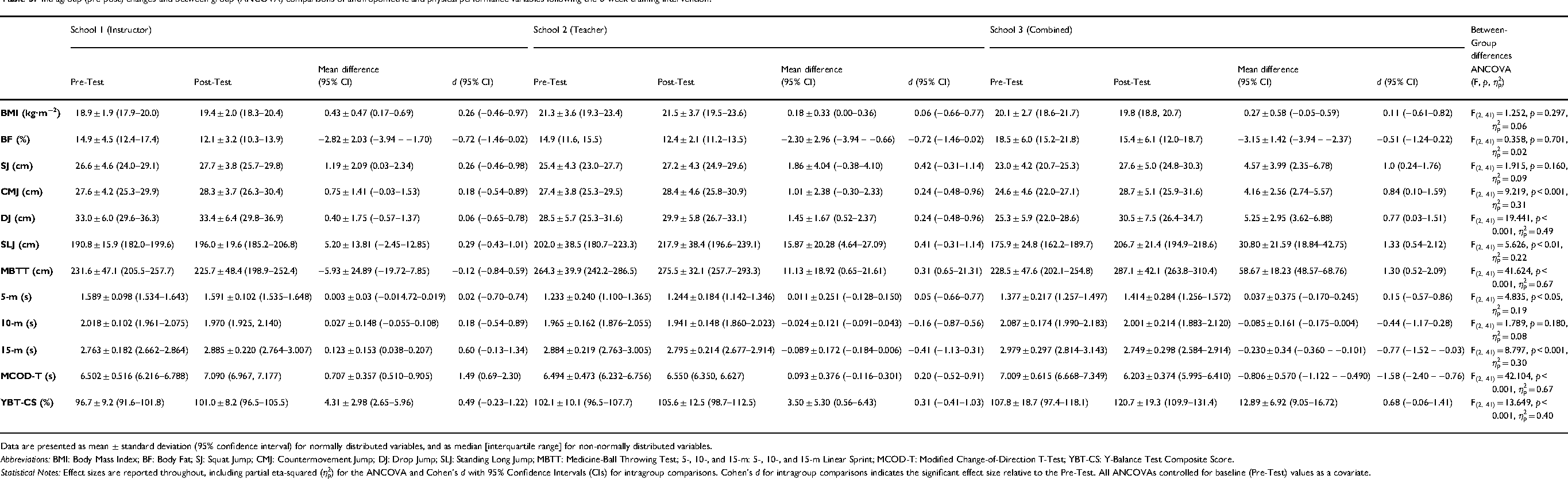
Data are presented as mean ± standard deviation (95% confidence interval) for normally distributed variables, and as median [interquartile range] for non-normally distributed variables.
Abbreviations: BMI: Body Mass Index; BF: Body Fat; SJ: Squat Jump; CMJ: Countermovement Jump; DJ: Drop Jump; SLJ: Standing Long Jump; MBTT: Medicine-Ball Throwing Test; 5-, 10-, and 15-m: 5-, 10-, and 15-m Linear Sprint; MCOD-T: Modified Change-of-Direction T-Test; YBT-CS: Y-Balance Test Composite Score.
Statistical Notes: Effect sizes are reported throughout, including partial eta-squared (ηp2) for the ANCOVA and Cohen's d with 95% Confidence Intervals (CIs) for intragroup comparisons. Cohen's d for intragroup comparisons indicates the significant effect size relative to the Pre-Test. All ANCOVAs controlled for baseline (Pre-Test) values as a covariate.
Between-Group changes
The single factor Analysis of Covariance (ANCOVA), performed to compare the groups (School 1 [Instructor], School 2 [Teacher], and School 3 [Combined]) on Post-Test measures while controlling for baseline (Pre-Test) values (as a covariable), revealed a significant main effect of group affiliation across the majority of the physical performance variables (Table 3). Specifically, significant group effects were observed for CMJ, DJ, SLJ, and MBTT (Table 3). Bonferroni-adjusted pairwise comparisons of these power and ballistic measures consistently indicated that the Combined group (School 3) achieved superior post-intervention performance (Figure 1). The School 3 group's adjusted Post-Test means were significantly higher than both School 1 and School 2 for CMJ (vs School 1: d = −1.49, p < 0.01, Figure 1-A; vs School 2: d = −1.37, p < 0.01, Figure 1-A) and DJ (vs School 1: d = −2.45, p < 0.001, Figure 1-B; vs School 2: d = −1.84, p < 0.001, Figure 1-B). The MBTT revealed a step-wise difference, with School 3 outperforming School 1 (d = −3.30, p < 0.001, Figure 1-D), as well as School 2 (d = −2.11, p < 0.001, Figure 1-D), which in turn outperformed School 1 (d = −1.19, p < 0.01, Figure 1-D), while for SLJ, only the difference between School 3 and School 1 was significant (d = −1.24, p < 0.05, Figure 1-C).
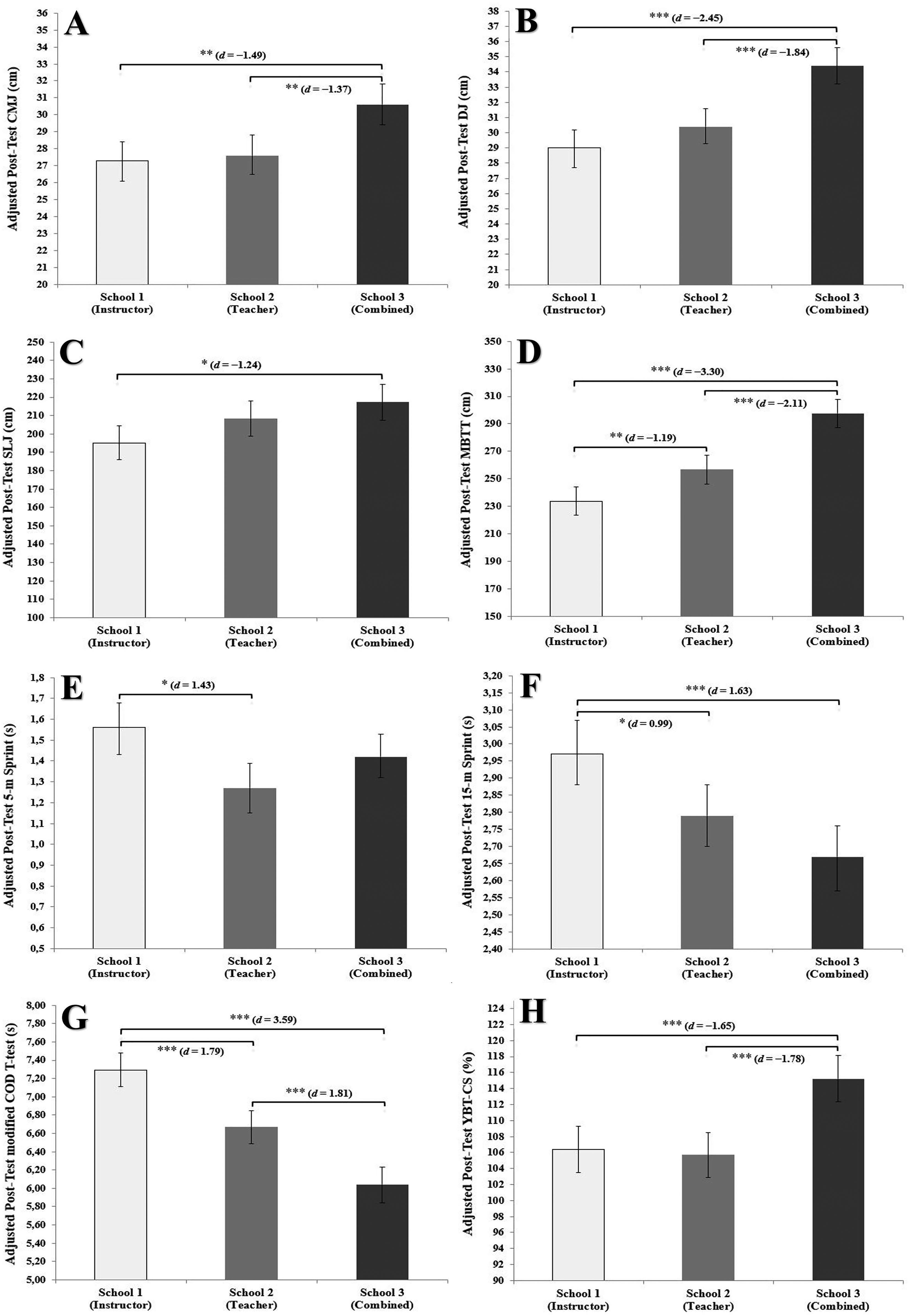
Bonferroni-Adjusted pairwise post-hoc comparisons of adjusted post-intervention (post-test) means for physical performance variables between coaching groups (school 1, school 2, and school 3). Note: Each plot (A through H) displays the adjusted Post-Test means for all three coaching groups (School 1 [Instructor], School 2 [Teacher], and School 3 [Combined]), with 95% CI error bars. The reported significance levels for the comparisons between groups were calculated using Bonferroni-adjusted pairwise post-hoc tests following a single-factor ANCOVA, which utilized the Pre-Test score as a covariate to adjust the Post-Test measurements. Significance is denoted as: *p < 0.05; **p < 0.01, ***p < 0.001.
The ANCOVA also yielded significant main effects for measures of speed (5- and 15-m sprint times), COD (MCOD-T), and balance (YBT-CS) (Table 3). For the speed and COD tasks, where lower time is superior, the School 3 group recorded the lowest (fastest) adjusted Post-Test means (Figure 1). Post-hoc analysis showed the School 3 group was significantly faster in the 15-m sprint compared to School 1 (d = 1.63, p < 0.001, Figure 1-F), as well as School 2 group was significantly faster in the 15-m sprint compared to School 1 (d = 0.99, p < 0.05, Figure 1-F). A similar graded improvement was found for the MCOD-T, with School 3 being significantly faster than School 1 (d = 3.59, p < 0.001, Figure 1-G), as well as School 2 (d = 1.81, p < 0.001, Figure 1-G), which in turn outperformed School 1 (d = 1.79, p < 0.001, Figure 1-G). For the 5-m sprint, the only significant comparison showed that School 2 was significantly faster than School 1 (d = 1.43, p < 0.05, Figure 1-E). Finally, for the YBT-CS, which reflects dynamic balance, the School 3 group showed a significantly higher (better) adjusted mean compared to both School 1 (d = −1.65, p < 0.001, Figure 1-H) and School 2 (d = −1.78, p < 0.001, Figure 1-H).
No significant group differences were found for BMI, %BF, SJ and 10-m sprint (Table 3).
Discussion
The purpose of this study was to evaluate the impact of coaches’ background (academic knowledge and practical experience) on the performance of young elite Tunisian karatekas following an 8-week plyometric and agility program. It focused on how coach expertise affected changes in three groups of schoolchildren's anthropometric measure, muscular power, linear sprint times, COD speed, and dynamic balance.
After training program, we found no significant differences between groups in BMI, body fat percentage changes, 5-m sprint time and SJ performance. However, in the School 3 group, significant improvements were detected in muscular power, 15-m sprint time, COD performance, and balance. Compared to School 1, the School 3 group accomplished superior gains in CMJ, DJ, SLJ, MBTT, 15-m sprint time, modified COD T-test, and dynamic balance. In line with literature, these findings may reflect the effect of instructors and sports teachers’ alliance to create and carry out effective training programs, which gives the children a more memorable and engaging experience. 44
Regarding muscular power (CMJ, DJ, SLJ, MBTT), sprinting, and MCOD-T, The School 3 group consistently outperformed Schools 1 and 2. Significant improvements in along with large effect sizes (e.g., d = −3.30, p < 0.001 vs School 1 and d = −2.11, p < 0.001 vs School 2 for MBTT; d = −2.45, p < 0.001 vs School 1 and d = −1.84, p < 0.001 vs School 2 for DJ), are consistent with the advantage of the program's effectiveness in enhancing neuromuscular function and explosive performance.
In sprint and COD tasks, School 3 showed significant enhancement in the 15-m sprint time (d = 1.63, p < 0.001 vs. School 1) and large effect sizes in the modified COD T-test (d = 3.59, p < 0.001 vs. School 1; d = 1.81, p < 0.001 vs. School 2), consistent with evidence that plyometric and agility-based training improves SSC function and multidirectional speed.29,45 On the other hand, School 1's performance in the 15-m sprint and MCOD-T significantly decreased (d = 0.60 and d = 1.49, respectively) (Table 3), highlighting the limitations of a training approach that did not follow structured principles such as planned progression, controlled training volume, defined intensity targets, and systematic load monitoring. 46
School 3 showed the highest improvement in most physical performance compared to School 1 and School 2, with a large effect size. This progress might be due to the organized training program that follows scientific principles. This program uses methods like progressive overload, plyometrics, and agility drills. These methods have been shown to improve speed, power, and agility. 47 The negligible progress observed in Schools 1 and 2 is consistent with the significance of high-quality training and effective execution. The performance differences observed between the three groups can be understood by examining both the structure of the training programs and the academic background of the coaches who designed them. School 1, implemented a simple program with low exercise diversity, limited variation, and a progression based mainly on increasing repetitions, resulting in a moderate and relatively unstructured training load. Such minimally periodized programs typically produce modest adaptations because they do not apply key principles such as progressive overload, specificity, and task complexity, all of which are essential for enhancing agility and power.48,49 School 2, presented a moderately more structured program with greater variation (group jumps, squat jumps, box jumps) and a clearer progression in contacts, which is consistent with moderate neuromuscular adaptations through improved motor unit recruitment and coordination. 50 In contrast, School 3, applied the most scientifically coherent and progressively structured program. It included the highest weekly volume (in both contacts and agility distance), the greatest exercise diversity (vertical, horizontal, and lateral plyometrics; bounding; hurdle jumps; multidirectional runs), more systematic progression, and longer recovery intervals which may indicate a more structured approach to managing training load. This organization aligns closely with established principles of periodization, which emphasize progressive overload, specificity, and adequate recovery as key determinants of enhancements in power and COD performance.51,52 Moreover, research consistently shows that coaches with higher academic knowledge tend to design more structured, evidence-based programs, apply motor-learning principles more effectively, and manage intensity and progression more systematically.53,54
The significant differences in performance gains between school group 3 and the other two groups cannot be attributed to the training duration or athlete level, which were standardized. Instead, they likely stem from the structural differences in the training programs, an objective reflection of the coaches’ integrated academic and practical expertise.7,55 A comparative analysis of the three independently designed training programs (see Tables 7 and 8 in Supplemental Digital Content for Comparative Analysis of Training Programs) shows substantial differences in training load, structure, and progression, which may have contributed to the divergent performance outcomes. School 3 implemented the highest overall training volume, with the greatest number of plyometric contacts and the longest agility distances per session, a strategy shown to enhance neuromuscular adaptations. 56 This program also included the most diverse range of plyometric tasks (vertical, horizontal, and lateral jump variations) which is known to produce superior power gains compared to single-direction programs. 57 In addition, School 3 followed a more structured progression with clearer periodization, a key factor linked to optimal performance improvements. 58 The longer recovery intervals used in School 3 may also have preserved movement quality during explosive tasks, thereby maximizing training benefits. 58 A critical methodological difference between the programs was the management of recovery intervals. While School 2 utilized shorter rest periods (e.g., 20 s between agility repetitions and 3 min between exercises; See Table 7 in Supplemental Digital Content for Comparative Analysis of Training Programs), School 3 implemented significantly longer recovery (e.g., 5 min between exercises; See Table 7 in Supplemental Digital Content for Comparative Analysis of Training Programs). This suggests that School 2's design may have inadvertently prioritized metabolic conditioning. Conversely, the synergistic approach in School 3 (combining academic and practical expertise) focused on maintaining high movement quality and peak power output by allowing for more complete neuromuscular recovery, which likely contributed to their significantly greater gains in explosive power (CMJ, DJ) and COD speed. 59 Finally, the multidirectional and COD-focused agility exercises included in School 3 are more effective for developing agility than linear or limited-variation drills. 60 Collectively, these differences suggest that School 3 provided a stronger and more comprehensive neuromuscular stimulus, which likely contributed to its superior performance improvements compared with Schools 1 and 2.
The synergy between theoretical knowledge and practical experience is essential for building structured, performance-enhancing programs. 61 Collaboration between sports teachers and instructors may help improve program quality through the complementary use of pedagogical insight and scientific rigor, thereby potentially facilitating the creation of developmentally appropriate and technically sound interventions. The coaching style of School 3 was characterized by the application of movement specificity and a non-linear (undulating) periodization scheme. 57 This contrasts with the instructor-only approach (School 1), which relied on linear volume increases and lower exercise diversity, suggesting that formal academic training 2 provides coaches with a broader toolbox of evidence-based strategies to optimize the stimulus-to-fatigue ratio in elite youth athletes.18,24
Following the 8-week training program, School 3 demonstrated marked performance gains, which can be attributed to the collaborative and well-structured training approach. While Schools 1 and 2 used training protocols with limited structure (see Tables 1–4 in the Supplemental Digital Content for an overview of the training programs for Schools 1 and 2), School 3's program was co-designed by a sports teacher with a master's degree and a karate instructor with high-level experience. This combination appears to have contributed to more effective management of training volume and intensity (see Tables 5 and 6 in the Supplemental Digital Content for an overview of the training programs for School 3), which might have been associated with the observed improvements.
The program follows the principles of training, including periodization, recovery balance, and progressive overload 62 (see Tables 7 and 8 in Supplemental Digital Content for Comparative Analysis of Training Programs). School 3 athletes significantly improved their performance (Figure 1), indicating a possible association between the more structured program design and the observed adaptations. Conversely, School 1 exhibited a dearth of academic input, while School 2 fell short in leveraging sport-specific expertise. The programs, which lacked a systematic framework, yielded outcomes that were either limited or negative. This observation aligns with the idea that less structured training programs may present certain limitations and suggests that evidence-informed, interdisciplinary approaches that integrate theoretical principles with practical application could offer potential advantages. 63
This study suggests that more structured and scientifically informed training models may be associated with improved outcomes. School 3's success demonstrates that a combination of intensity, specificity, and recovery can result in significant athletic enhancements (see Tables 7 and 8 in Supplemental Digital Content for Comparative Analysis of Training Programs). The presence of two coaches may have independently contributed to the superior performance outcomes. The two coaching profiles likely offered complementary expertise. Although direct observation of on-field coaching behaviors (e.g., frequency of technical feedback) was not performed, the distinct architectural differences between the training programs suggest a variation in methodological expertise. The program designed by the combined team (School 3) was characterized by a higher exercise diversity and a non-linear (undulating) periodization scheme, reflecting a more complex application of pedagogical structuring. In contrast, the instructor-led program (School 1) followed a more traditional, linear volume-based progression with lower exercise variety. These differences in the training blueprint provide an objective reflection of how the coaches’ educational backgrounds translated into the systematic manipulation of training variables. 2 Such synergy between practical experience and academic knowledge has been highlighted in coaching literature as a major factor enhancing training quality and athlete development.4,5,24 Dual supervision may also have improved feedback frequency, individualized corrections, safety monitoring, and motivation, given the reduced coach-to-athlete ratio and increased interaction time.11,55,64 Therefore, the superior improvements observed in School 3 may reflect not only the effect of advanced academic knowledge but also the operational advantages of two complementary coaches working together. In contrast, the findings from Schools 1 and 2 may reflect the limitations of less structured programming and suggest that having a pedagogical foundation, supported by ongoing assessment and adaptation, could be beneficial.
This investigation found that BMI and %BF exhibited consistent trends across the three groups following the intervention. However, the changes observed in these metrics did not differ significantly. All groups showed slight, non-significant increases in BMI and minor, consistent reductions in % BF, suggesting similar outcomes despite differing programs. These findings align with previous research indicating that short-term, performance-oriented training alone has minimal impact on body composition without additional nutritional or higher-volume interventions. 65
The uniformity in anthropometric results is in agreement with previous results suggesting that plyometric and neuromuscular training largely improves power, speed, and agility; they have little effect on body composition unless paired with dietary techniques or metabolic conditioning. 66 Evidence further supports that integrating structured exercise and nutrition yields better body composition outcomes. 64
In conclusion, while this exploratory study does not definitively establish the causal mechanisms of how a coach's background dictates program design, the observed differences in training architecture and subsequent athlete adaptations suggest that a combination of academic knowledge and practical experience may optimize the delivery of youth training. These findings serve as a preliminary proof-of-concept, highlighting the need for future large-scale research involving broader coach cohorts and qualitative interviews to fully map the relationship between professional background and the training design process. 5
Beyond immediate performance gains, the specific methodological precision observed, such as the prioritization of recovery intervals for mechanical quality and the use of undulating periodization, suggests that this synergy may support more sustained and injury-resilient athletic development. 6 As the sports science landscape continues to evolve, emphasizing both formal academic knowledge and practical mastery may contribute to higher coaching standards, ensuring that training blueprints remain high-quality, evidence-led, and developmentally appropriate across disciplines.
Limitations and future research
This study is subject to several limitations. First, its quasi-experimental, non-randomized design prevented full control over confounding factors such as group dynamics, motivational differences, and selection bias. Although the use of ANCOVA statistically controlled for baseline performance differences (Pre-Test), the absence of participant randomization remains a limitation that precludes definitive causal inferences regarding the independent effect of coaching background on athlete performance. Second, biological maturation was not formally assessed; while participants were of similar age and training background, maturational variability may still have influenced outcomes. Third, the sample size was relatively small and restricted to Tunisian U-15 national-level karate athletes, which constrains generalizability. Fourth, long-term retention of performance gains was not evaluated. Finally, the lack of direct observation of coaching-athlete interactions. Therefore, we cannot establish a causal relationship between coaching delivery and performance. However, by analyzing the designed programs, we offer evidence of how professional background influences the training stimulus provided to elite youth athletes.
Future research should therefore employ randomized designs, larger and more diverse samples, robust maturity and load-monitoring measures, and long-term follow-up. Integrating psychosocial and motivational factors, as well as frameworks such as the Athletic Talent Development Environment (ATDE), would provide a more comprehensive understanding of how coaching expertise and training interventions shape youth athlete development.
Practical applications
This study suggests that the coach's background (academic knowledge and practical experience) may play a meaningful role on the athletic growth of young elite Tunisian karatekas. The collaboration between a sports teacher with advanced academic qualifications and a highly experienced karate instructor led to a remarkable success of School 3 which offers critical insights for practical implementation in high-performance youth sports programs.
It is incumbent on organizations to prioritize the interdisciplinary training of coaches and to ensure that the curricula for such training programs encompass the development of technical competencies, such as a comprehensive understanding of exercise physiology, biomechanics, and motor learning, in conjunction with pedagogical methodologies.
This necessitates the establishment and implementation of certification pathways that underscore scientific principles and effective teaching methodologies, in addition to a strong command of specific techniques. The integration of collaborative coaching structures within sports federations and clubs must be promoted. This means actively pairing coaches with strong academic credentials (e.g., sports scientists) with experienced, sport-specific technical coaches. Such synergistic processes are indispensable in the planning of training programs with scientific rigor, practical relevance, and developmental appropriateness for young athletes. Furthermore, continuous performance monitoring and data-driven program adaptation are essential. It is imperative that objective assessments of athlete performance be administered on a regular basis. In view of the above considerations, these assessments should serve as a basis for implementing ongoing adjustments, thereby ensuring that training remains optimized for individual and group progress.
Supplemental Material
sj-docx-1-spo-10.1177_17479541261459975 - Supplemental material for Impact of coach education and practical experience on performance gains in young elite karate athletes following an 8-week plyometric and agility training program
Supplemental material, sj-docx-1-spo-10.1177_17479541261459975 for Impact of coach education and practical experience on performance gains in young elite karate athletes following an 8-week plyometric and agility training program by Saifeddine Souibgui, Haifa Jmili, Mohamed Arbi Mejri, Narimen Yousfi, Issam Makhlouf, David George Behm and Maher Mrayeh in International Journal of Sports Science & Coaching
Footnotes
Acknowledgements
The authors are grateful to all the sports teachers, instructors, and coaches, as well as all the elite karate athletes from various schools (Sports High School Pierre de Coubertin in El Menzah, Tunis, Tunisia; 9 Avril 1938 Sports High School, Tunis, Tunisia; Hannibal Sports High School, Ariana, Tunisia) for their valuable time and contribution. This study was supported by the Ministry of Higher Education and Scientific Research, Tunisia.

Ethical considerations
This study was approved by the Ethics Committee of the National Center of Medicine and Sciences in Sport (CNMSS) of Tunis (Approval number: LR09SEP 01/2024).
Consent to participate
Written parental consent was obtained for all participants prior to enrolment in the study. This research was conducted in accordance with the ethical principles outlined in the Declaration of Helsinki.
Consent for publication
Not applicable.
Author contributions
SS, HJ, MAM, IM, MM, DB contributed to the design and conception of the study. SS and HJ conducted all experiments and collected the data. SS, HJ, and MAM were involved in the analysis of the data. The manuscript was written by SS, HJ, MAM, IM, MM, DB and revised by SS, HJ, MAM, IM, MM, DB and NY. The final manuscript was read and approved by all authors before submission.
Funding
The authors received no financial support for the research, authorship, and/or publication of this article.
Declaration of conflicting interests
The authors declared no potential conflicts of interest with respect to the research, authorship, and/or publication of this article.
Data availability statement
We are unable to make raw data publicly available.
Supplemental material
Supplemental material for this article is available online.
References
Supplementary Material
Please find the following supplemental material available below.
For Open Access articles published under a Creative Commons License, all supplemental material carries the same license as the article it is associated with.
For non-Open Access articles published, all supplemental material carries a non-exclusive license, and permission requests for re-use of supplemental material or any part of supplemental material shall be sent directly to the copyright owner as specified in the copyright notice associated with the article.
