







Abstract
This study examined how delayed decision-making affects speed and accuracy in handball jump throws. Thirty-five experienced male players (age: 24.87 ± 4.57 yr) performed frontal 9 m jump throws under three visual-stimulus onset delays: T1 (0 s), T2 (0.100 s), and T3 (0.250 s). Throwing speed (TS) was measured via radar gun and accuracy via video analysis of hits on corner targets. Data were analysed using Friedman and Cochran's Q tests for condition effects, and binary logistic regression to examine the speed–accuracy relationship. Delayed stimulus onset caused a progressive reduction in TS (χ2(2) = 33.036, p < 0.001, Kendall's W = 0.472). Accuracy was significantly affected (Q(2) = 9.652, p = 0.008, Cramér's V = 0.371), remaining stable between T1 and T2 but deteriorating sharply in T3 (T3 vs T2: p = 0.007). Logistic regression showed that normalized speed did not predict accuracy under T1 or T2 (T1 p = 0.601; T2 p = 0.106); however, under T3, a significant association emerged (OR = 1.164, p = 0.009), indicating the absence of a classic speed–accuracy trade-off. Temporal constraints modulate performance non-linearly: players prioritize accuracy under moderate pressure (T2) by reducing speed, but reach a critical threshold under severe constraints (T3) where both parameters collapse. This interval represents the limit of online motor reprogramming and the breakdown of perceptual-motor coupling. Training should incorporate late-stimulus drills to enhance perceptual-cognitive flexibility and fast-reprogramming capacity under extreme time pressure.
Introduction
Handball is a high-intensity team sport played by two teams of seven players on a 40 × 20 m court. The primary objective is to overcome the opponent's defensive system to execute an effective throw; however, this action is strictly conditioned by the goalkeeper's presence and the restricted goal area, the 6-meter zone. In elite competitions, most teams organize their defensive systems in close proximity to their own goal area, utilizing formations such as 6:0 or 5:1 to increase defensive density and deny the attacking team direct access to the 6-meter line for high-probability throwing opportunities. 1 This spatial configuration creates a highly congested environment characterized by constant physical interactions and severe spatio-temporal constraints. Consequently, players are forced to perform high-velocity actions under constant defensive and temporal pressure, frequently concluding offensive sequences with long-range throws from outside the defensive perimeter. 2 In this scenario, the jump throw serves as an essential technical resource to attack the goal directly, allowing players to bypass defensive interventions by utilizing the vertical space. 3
The jump throw is a highly complex motor action that depends on the optimal integration of cognitive demands and biomechanical coordination. 4 From a perceptual-cognitive perspective, effective decision-making requires rapid pattern recognition and the interpretation of visual cues to design anticipatory strategies. 5 Simultaneously, from a biomechanical standpoint, achieving both high velocity and accuracy is determining for throwing effectiveness. While high-speed throws increase the difficulty for the goalkeepeŕs intervention, precision ensures final scoring success.6,7 Consequently, jointly analysing these variables is essential to understanding performance adaptations in competitive contexts. 8
Traditionally, Fitts's Law 9 has provided the fundamental framework for understanding motor control by establishing a logarithmic relationship between movement time, distance, and target size. This law describes a functional speed–accuracy trade-off, suggesting that any attempt to increase movement velocity will inherently result in a loss of precision. However, in dynamic sports like handball, external temporal constraints further complicate this balance. As noted in previous studies regarding motor control and unstable conditions in handball throwing,10,11 severe time pressure forces the neuromuscular system to rely on rapid approximations rather than fully optimized motor commands. This often leads to a systemic degradation where both throwing velocity and spatial accuracy are compromised, as the player lacks the necessary window to calibrate the motor output. However, this relationship might not always be linear. According to Vickers, 12 expert athletes may develop adaptive mechanisms, such as optimized visual search strategies, to preserve accuracy even under critical thresholds of information availability. This suggests that expertise might allow the system to circumvent classical trade-offs through superior perceptual-motor calibration.
This tension between speed and accuracy under pressure has been extensively analysed in sports such as football 13 and volleyball, 14 as well as in precision-based tasks like pistol shooting. 15 Nevertheless, its impact on high-velocity, ballistic actions like the handball jump throw remains less explored. In handball, the presence of defenders significantly reduces decision time, which potentially compromises the proximal-distal sequential organization and disrupts the technical coordination of the throw.16,17 Although the temporal window available before defensive contact has not been directly quantified in real competition, studies conducted in both controlled settings and real match conditions consistently show that increasing levels of opposition reduce throwing velocity and alter motor execution.8,18,19 Crucially, this temporal pressure is compounded by the goalkeepeŕs anticipatory behavior. Given that elite throws from 9 m leave the goalkeeper with only ∼550 ms of ball flight time, initiating movement at or after ball release would severely compromise their ability to cover the goal. Consequently, expert goalkeepers have been shown to initiate defensive movements approximately 190 ms before ball release, 20 reflecting their own physical temporal constraint rather than an arbitrary strategic choice. This creates an inherently dynamic duel: from the moment of take-off, the thrower continuously generates kinematic cues (e.g., jump height, torso orientation, pelvis rotation) that the goalkeeper attempts to read, while the thrower simultaneously tries to withhold and camouflage decision-relevant information until the final stages of the aerial phase. The capacity to delay this motor decision while still maintaining acceptable throwing velocity and accuracy is therefore a paramount, highly trainable performance factor in elite handball, and the 190 ms anticipation window of elite goalkeepers represents the best available proxy for the critical temporal threshold within which this duel is resolved. These constraints make the handball jump throw an ideal model for testing motor control theories under ecologically relevant time pressure.
Despite its relevance, studies examining the direct influence of late decision-making on the speed–accuracy relationship in handball are scarce. 21 Most existing research has focused either on isolated biomechanical parameters17,22 or on how defensive opposition affects ball velocity, 18 but rarely how these factors interact under severe temporal pressure. While some authors have explored technical adaptations to late target changes, 21 there is still a need for protocols that fully simulate the cognitive and physical urgency of real-game scenarios. 4 Thus, the aim of this study is to analyse the influence of three temporal constraint levels, simulating late decision-making, on the velocity and accuracy of the handball jump throw. It was hypothesized that increased temporal pressure would trigger a non-linear speed–accuracy decoupling suggesting that the experts’ ability to maintain performance depends on critical thresholds of information availability.
Methods
Participants
The sample consisted of 35 male handball players (age: 24.87 ± 4.57 yr; weight: 86.49; 12.8 kg; height: 185.36 ± 6.62 cm; and 14.28 ± 4.63 yr of experience in handball training). All participants provided written informed consent, in accordance with the Declaration of Helsinki, prior to the commencement of the investigation. Before enrolling, they received detailed information regarding the research protocol, the fundamental characteristics of the study, and any potential risks associated with the testing procedures. Recruitment took place within the squads of Balonmano Dominicos and Ademar Zaragoza, both competing in the Spanish 1st National Handball League, as well as Balonmano Huesca of the ASOBAL League. Under the Participant Classification Framework outlined 23 the athletes were identified as belonging to the second (n = 18) and third (n = 17) competition tiers, which corresponds to highly trained or national-level performers. All athletes possessed extensive experience in handball training and in the specific technique of jump throwing (i.e., ≥10 years). The players’ physical performance data were anonymised prior to analysis to ensure full confidentiality. As data collection formed part of the athletes’ routine employment conditions for monitoring their seasonal conditional performance, 24 the club granted its approval for the study. The study protocol was approved by the Ethics Committee of Aragón (CEICA), reference number 10/2021.
Procedures
Throwing speed
A high-performance sports radar (Stalker Pro II, Stalker Radar, Richardson, TX, USA) was positioned 1 m behind the 9-m line, directly behind each athlete and aligned with the throwing arm, to record throwing speed (TS). Only attempts that entered the goal directly, without contacting the ground, were deemed valid. Official Molten handballs were employed throughout testing (Molten Corp., Hiroshima, Japan; circumference: 58–60 mm; weight: 425–475 g).
Before completing the throwing protocol, participants undertook a standardised warm-up designed by the research team in collaboration with the technical staff. This consisted of five minutes of low-intensity running, followed by three minutes of mobility exercises and two minutes of active and ballistic stretching. A specific warm-up focused on throwing skills was also performed immediately prior to testing.
Familiarization with the throwing test consisted of three sets of three jump shots taken from the nine-meter line. A 30-s rest interval was provided between individual throws, with three minutes of recovery between sets to ensure complete recovery. 25 Once completed, the players threw a single series of three throws at the light targets, with one throw performed under each temporal condition (T1, T2, T3). The order of conditions within the series was randomised for each player. Players were instructed to always throw the ball at maximum speed and with maximum accuracy.
The target zones selected for accuracy assessment corresponded to the extreme areas of the goal, upper and lower corners on both the right and left sides, as these locations are most likely to elicit variations in player movement patterns. 26 A high-definition digital video camera (Sony HXR-MC50P; Sony Corporation, Tokyo, Japan) was mounted on a tripod behind the nine-metre line to record the goal and subsequently analyse throwing accuracy. A throw was deemed accurate when the ball impacted within the designated target area, positioned 0.4 m from the light signal; all other impacts were classified as inaccurate (Figure 1).
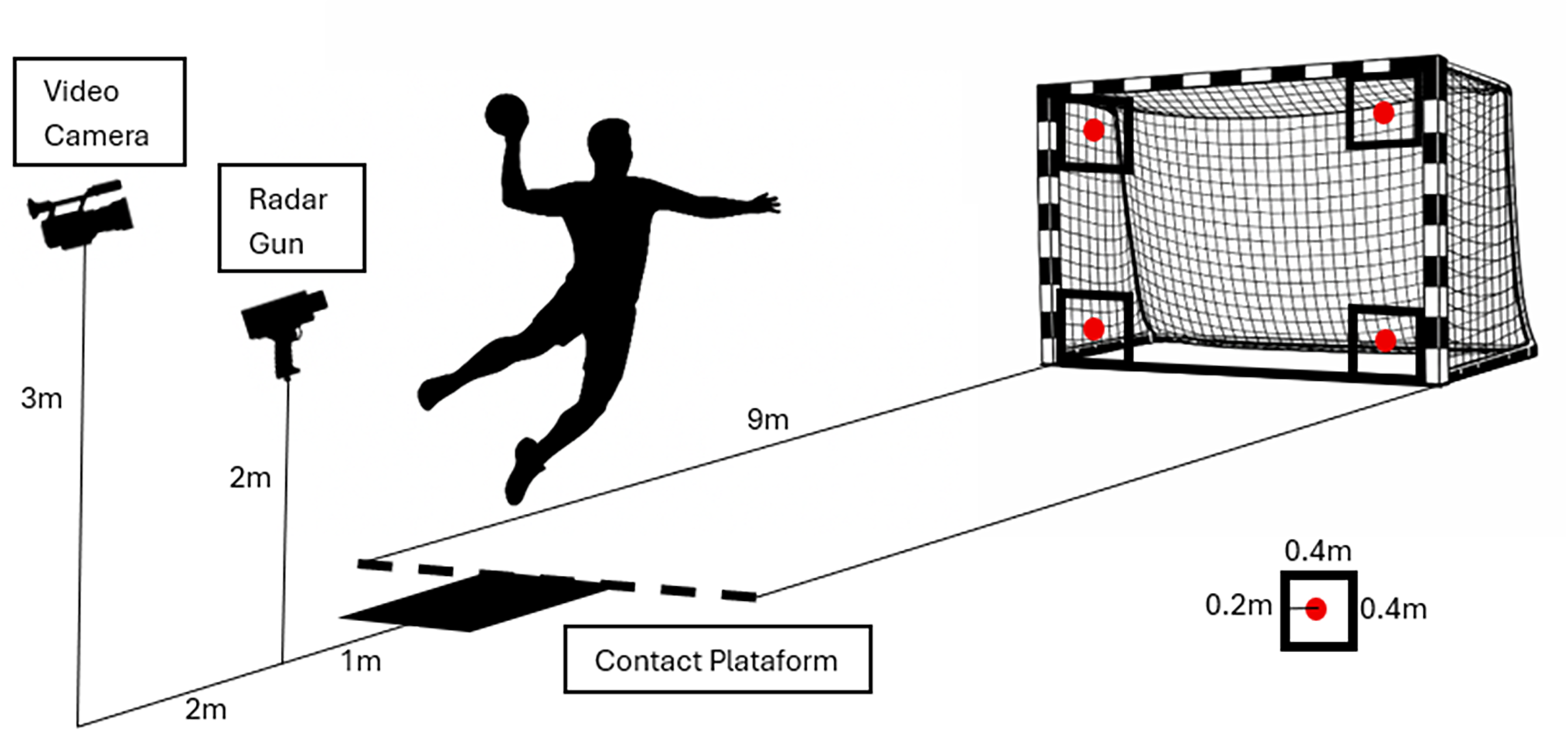
Experimental set-up.
To evaluate speed and accuracy, each throw was accompanied by the appearance of a light (Witty SEM light system, Microgate, Bolzano, Italy) with time limitations to make it more difficult to execute the jump throw in handball. In all cases, the shot was preceded by a two-step approach run, replicating the most frequent step cycle in long-distance throwers during handball competitions. 27 The player must release the ball before falling back to the ground. The last support is always performed on a Chronojump contact platform (Boscosystem, Barcelona, Spain) placed 9 m from the goal, which will be connected to the Witty SEM light system placed at the four corners of the goal at 0.2 m from the top and side posts. The lights will be delayed with difficulty levels (T1, T2, T3) in which the time of activation of the lights is delayed from the moment of foot contact with the platform (T1: 0 s; T2: 0.100 s; T3: 0.250 s). These delays were selected to bracket the 193 ± 67 ms threshold of goalkeeper anticipation reported in previous research, 20 representing moderate and severe constraints on the players’ response window. One throw per difficulty level will be carried out, in each of them only one of the 4 lights will be switched on. This design was conceived to preserve the fundamental perception-action coupling of the shooter-goalkeeper dyad, consistent with the principles of representative learning design, 28 by isolating the temporal micro-phase in which the shooter must conceal kinematic intentions while the goalkeeper initiates her anticipatory response.
Statistical analysis
Throwing speed was treated as a continuous variable and throwing accuracy as a dichotomous variable (0 = miss, 1 = hit). To improve inter-individual comparability by reducing inter-subject variability arising from intrinsic differences in maximum throwing capacity, velocity values were normalized (Sn) by dividing each participant's throwing velocity in each condition by their previously obtained individual maximum velocity. 29
Given that the Shapiro–Wilk test and visual inspection of the distributions revealed departures from normality for speed data in T1 and T2, and considering the ordinal nature of the ranked data in repeated measures of non-normal variables, a Friedman test was used to assess differences in normalised throwing speed across the three temporal conditions (T1, T2, T3). The Friedman test is an appropriate non-parametric alternative to repeated-measures ANOVA when normality cannot be assumed.30,31 When the Friedman test indicated statistical significance, post-hoc pairwise comparisons were performed using the Wilcoxon signed-rank test, with Bonferroni correction for multiple comparisons. This non-parametric paired test evaluates median differences between two related conditions and is recommended for repeated measures designs with non-normal distributions. Effect size for the Friedman test was estimated using Kendall's W. For Wilcoxon post-hoc comparisons, effect size r was calculated as r = Z/√N, where Z is the standardised test statistic and N is the number of pairs.
Throwing accuracy (hit vs. miss) was compared across the three conditions using Cochran's Q test, which allows comparison of proportions in repeated dichotomous data. 32 Effect size for Cochran's Q was estimated using Cramér's V, calculated as V = √(Q / n(k−1)), where k is the number of conditions. When Cochran's Q was significant, McNemar's test was applied to identify pairwise differences (T1 vs T2, T1 vs T3, T2 vs T3). For McNemar's tests, both continuity-corrected p-values and exact significance values were reported, as recommended in small and moderately unbalanced datasets. 33
To examine the relationship between throwing speed and accuracy within each temporal condition, three separate binary logistic regression models were fitted (one per condition). In each model, accuracy was entered as the dependent variable and normalised speed (Sn) as the predictor. Model fit was evaluated using omnibus chi-square tests, and Nagelkerke pseudo-R2 coefficients. 34 Odds ratios (OR) with 95% confidence intervals were reported to quantify the magnitude of association. This approach is appropriate for modelling the probability of a hit event from a continuous predictor and has been previously used in perceptual-motor studies. 35
All statistical analyses were conducted using IBM SPSS Statistics v26 (IBM Corp., Armonk, NY, USA) with a significance level set at p < 0.05.
Results
Throwing speed
Normalised throwing speed differed significantly across the three temporal conditions (T1, T2, T3), as shown in Figure 2.
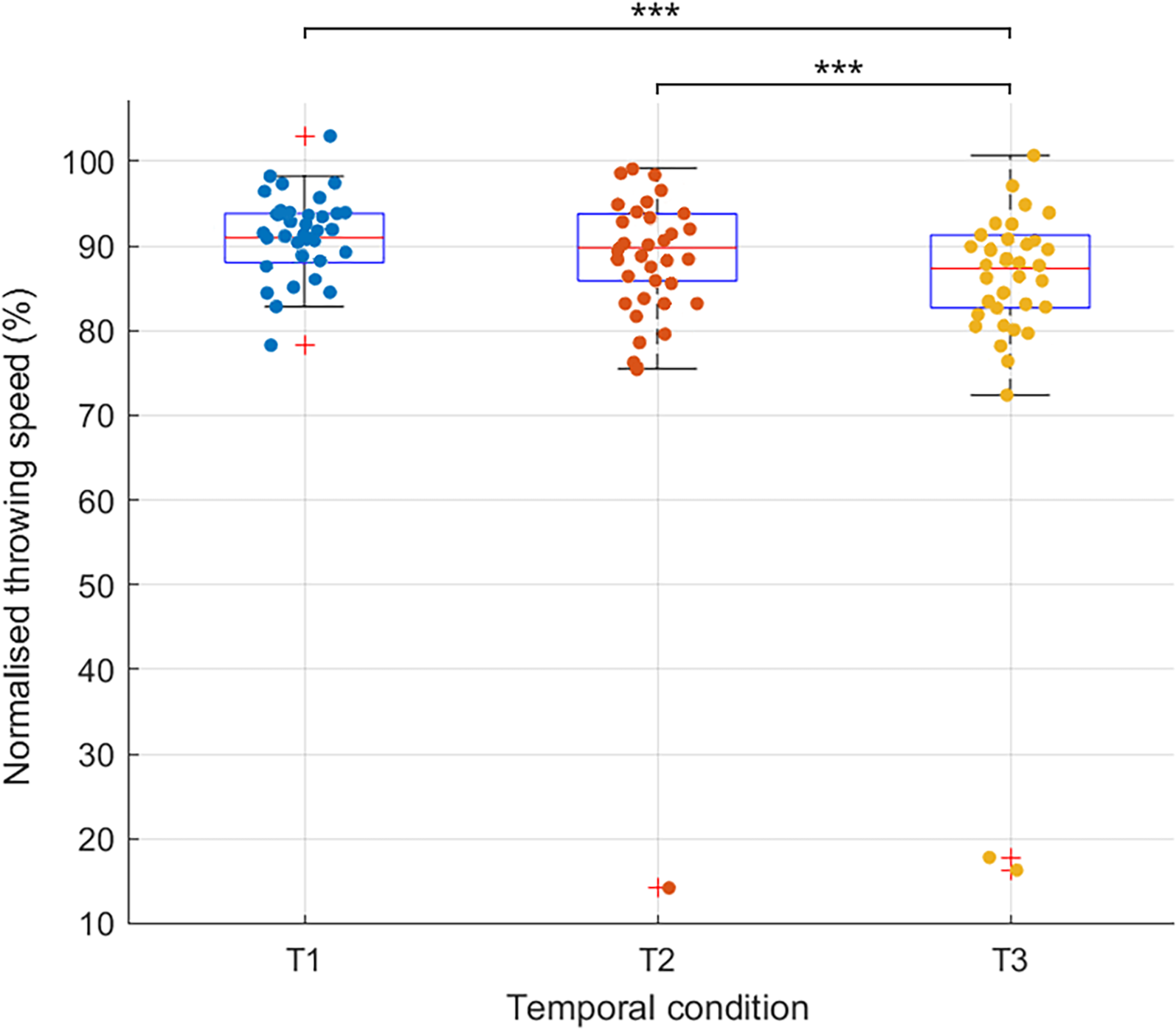
Normalised throwing speed across temporal conditions. Distribution of normalised throwing speed (expressed as percentage of each participant's individual maximum velocity) across the three stimulus-onset conditions (T1 = 0 s; T2 = 0.100 s; T3 = 0.250 s). Points represent individual participants and the box/whiskers summarise the group distribution. Normalised speed progressively decreased from T1 to T3 (Friedman test: χ2(2) = 33.036, p < 0.001, Kendall's W = 0.472; post-hoc Wilcoxon signed-rank tests with Bonferroni correction). *** p < 0.001.
The Friedman test revealed a significant main effect of stimulus timing on speed (χ2(2) = 33.0376, p < 0.001, Kendall's W = 0.472). Post-hoc pairwise comparisons confirmed a progressive reduction in speed as stimulus onset occurred later. Normalised speed did not differ significantly between T1 and T2 (Z = −2.064, p = 0.102, r = 0.349). In contrast, speed was significantly lower in T3 compared with T1 (Z = −4.652, p < 0.001, r = 0.786) and lower in T3 compared with T2 (Z = −3.653, p < 0.001, r = 0.617), both representing large effect sizes. Across these contrasts, the majority of participants exhibited negative ranks, indicating a consistent decrease in throwing speed particularly under the most severe temporal constraint (T3). Three outlying observations are visible in Figure 2 — one under T2 and two under T3 — corresponding to throws in which the player was unable to coordinate the kinetic chain sufficiently to direct the ball toward the illuminated target. These were retained in the analysis as genuine performance observations reflecting breakdown under maximal temporal constraint. A sensitivity analysis excluding these throws confirmed that the direction, significance, and post-hoc comparisons of the main findings remained unchanged.
Throwing accuracy
A total of 24 throws were successful in T1, 25 in T2, and 14 in T3. Throwing accuracy across conditions is presented in Figure 3.
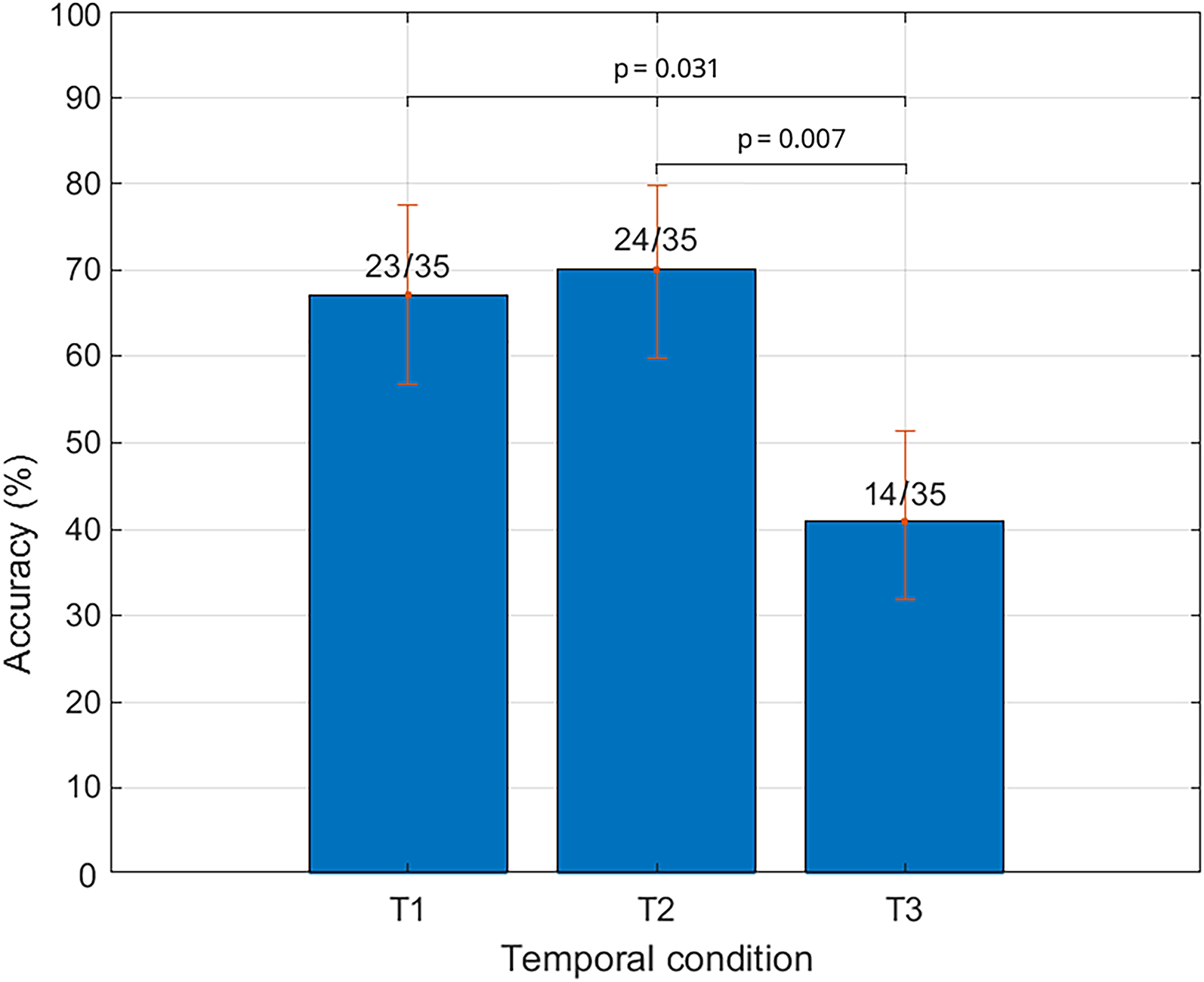
Throwing accuracy across temporal conditions. Proportion of successful throws (hit = 1) in each temporal condition (T1, T2, T3). Error bars indicate 95% confidence intervals for a binomial proportion. Accuracy was maintained from T1 to T2 and decreased in T3 (Cochran's Q with McNemar pairwise tests results; indicated in text).
Cochran's Q test revealed a significant effect of temporal condition on accuracy (Q(2) = 9.652, p = 0.008, Cramér's V = 0.371), indicating a large effect size. Pairwise comparisons using McNemar's test indicate that accuracy did not differ significantly between T1 and T2 (exact p = 0.643). In contrast, accuracy was significantly lower in T3 compared with both T1 (exact p = 0.031) and T2 (exact p = 0.007). Thus, throwing accuracy was preserved under moderate temporal constraint (T2) but deteriorated markedly when the stimulus appeared very late (T3).
Speed–accuracy relationship
Results from the logistic regression analyses are summarised in Table 1. In T1, the logistic regression model did not differ from the null model, and normalised speed was not a significant predictor of accuracy (χ2(1) = 0.273, p = 0.601; OR = 1.033, 95% CI [0.915, 1.167]; Nagelkerke R2 = 0.011). Similar results were obtained for T2 (χ2(1) = 2.615, p = 0.106; OR = 1.059, 95% CI [0.962, 1.165]; Nagelkerke R2 = 0.103). In T3, normalised speed was a significant predictor of accuracy (χ2(1) = 6.813, p = 0.009; OR = 1.164, 95% CI [1.015, 1.334]; Nagelkerke R2 = 0.239).
Logistic regression models predicting accuracy from normalised speed. Separate binomial logistic regression models (one per condition) with accuracy as dependent variable and normalised speed (Sn) as predictor. Odds ratios (OR) with 95% confidence intervals are reported alongside omnibus model tests and pseudo-R2 indices.

Discussion
The primary objective of this study was to analyse how increasing temporal constraints influence the velocity and accuracy of the handball jump throw. Our findings reveal that as the window for decision-making narrows, elite players implement a prioritized motor strategy. Specifically, we observed a progressive reduction in throwing velocity across all conditions (T1 > T2 > T3), whereas accuracy was successfully preserved under moderate pressure (T2) before deteriorating sharply under extreme temporal constraints (T3). Crucially, the absence of a predictive relationship between speed and accuracy across conditions indicates that performance in this ballistic task does not follow a classic, linear speed–accuracy trade-off.
Of note, the average normalized throwing velocity observed in the baseline condition (T1) was 92.3 ± 3.1%, a value that aligns with previously reported results in experienced handball players, 36 who found that prioritizing accuracy over maximum power can lead to velocity losses of up to 15%. Furthermore, the inter-individual variability in the jump throw for our experienced cohort (∼3.3%) remains well within the 7% threshold previously reported by Serrien et al. 37 for elite handball players. In this regard, the only study to date investigating temporal constraints in the handball jump throw 21 aligns precisely with our findings. In their work, experienced throwers exhibited a velocity loss of 3–6% when the target cue was delayed, a range that matches the reduction seen in our T2 condition. Interestingly, their results also showed that accuracy did not follow the same progressive decline as velocity, remaining relatively stable under moderate uncertainty. However, the sharp deterioration in accuracy found in our T3 condition represents a novel finding that can be explained by differences in experimental design. Rousanoglou et al. 21 triggered the target signal when throwers crossed a photocell system located 1 m from the throwing line. This setup presumably places their temporal delay closer to our T2 than our T3. Consequently, while Rousanoglou's participants operated within a functional adaptive window, our T3 condition likely surpassed a critical information threshold, triggering a systemic collapse in accuracy that had not been previously documented in the literature.
Furthermore, the selection of the temporal constraint levels (T2 = 100 ms and T3 = 250 ms) was ecologically grounded in the anticipation dynamics of elite handball goalkeepers. According to Rojas et al., 20 expert goalkeepers initiate their defensive movements approximately 193 ± 67 ms before the ball is released, demonstrating a strategic delay to collect more precise information about the thrower's kinematics. By setting our most restrictive condition (T3) at 0.250 s, we simulated the critical period in which a player must process a stimulus and adjust their motor command while the goalkeeper is already initiating their response. This temporal window represents the limit of online motor reprogramming, beyond which the capacity to correct the ball's trajectory mid-flight becomes jeopardized.
Overall, the observed changes in throwing speed and accuracy align with the constraints-led approach 38 and principles of limited-time control in ballistic movements, whereby late information forces the system to rely on rapid approximations rather than fully optimised motor commands. 10 In particular, the decreases observed in T3 are consistent with evidence showing that temporal constraints disrupt both the biomechanical organisation of ballistic actions and their perceptual-cognitive components. 12 However, the dissociation observed between the reductions in throwing speed and the preservation of accuracy at T1 and T2 suggests that players are able to maintain the spatial component of the throw under moderate temporal restriction, albeit at the cost of releasing the ball at lower velocities. 39 It is only when the stimulus appears very late (T3) that the perceptual-motor system seems to reach a critical threshold, beyond which compensatory adjustments are no longer sufficient, leading to a breakdown in accuracy. This breakdown of performance under severe temporal constraints may be linked to the loss of postural stability, a factor previously identified as expertise-dependent in high-level athletes. 40
A deeper analysis through binary logistic regression further elucidates the complex interplay between speed and accuracy under pressure. Across all conditions, normalized throwing speed did not reliably predict accuracy, reinforcing the absence of a traditional speed–accuracy trade-off in this ballistic task. However, a noteworthy finding emerged in the most constrained condition (T3). The logistic model reached statistical significance (p = 0.009), with a moderate effect size (Nagelkerke R2 = 0.239; OR = 1.164). This finding should be interpreted with caution as it may reflect a breakdown of independent motor control over speed and accuracy rather than a conventional speed–accuracy trade-off, whereby extreme time pressure forces athletes into a single high-speed execution pattern that simultaneously determines both outcomes.
These observations are consistent with the principles of Fitts's Law, which posits that under severe time pressure, the motor system struggles to maintain spatial accuracy as movement velocity increases. 9 The severe temporal stress of T3 may have pushed the participants’ perceptual-motor systems toward their operational limits, increasing motor noise that typically degrades performance in high-velocity ballistic actions. 41 However, the significant result observed under T3 conditions suggests that this limit may paradoxically produce a coupling between speed and accuracy, whereby extreme temporal constraint forces a unified motor response in which both variables are co-determined. Given the moderate effect size this and the reduced sample size (n = 35), interpretation should be addressed in future research with adequate statistical power.
Another key limitation of the present study, and one that must be emphasised, is the lack of information about the side of the target and the nature of the shot (cross-body vs. non-cross-body). These two types of throws are biomechanically distinct: cross-body shots often involve greater trunk rotation, different alignment of the throwing arm and altered coupling between shoulder and pelvis. Mixing both types within each condition likely increased variability and may have partially obscured potential associations between speed and accuracy, particularly in T3, where a clearer relationship might emerge when analysing each side separately. Future studies should incorporate video-based shot classification to distinguish these categories. Finally, beyond speed alone, other factors inherent to the jump shot likely exert a more dominant influence on accuracy. For instance, the jump height and aerial phase duration provide the necessary time-window to process the visual stimulus. 17 Furthermore, individual differences in trunk stability and pelvic-shoulder decoupling may play a more decisive role than absolute speed in determining whether a ball hits the target under pressure. 22 Additionally, the proposed study design did not include the temporal constraints imposed by collective defensive pressure during competition. From a representative learning design perspective, 28 this constitutes a limitation on full ecological validity. Nevertheless, the focus on the temporal window governing the thrower–goalkeeper interaction was deliberate, as this interaction represents the decisive moment in which temporal and kinematic demands converge. Future research should progressively incorporate defensive context to examine how collective pressure modulates the speed-accuracy relationship at a broader tactical scale. The absence of a live goalkeeper also limits full ecological validity; future designs should consider including an active goalkeeper to replicate the thrower–goalkeeper interaction more faithfully. Additionally, the heterogeneity of the sample across competition tiers should be acknowledged as a potential source of inter-individual variability. Notwithstanding these limitations, the results of the present study provide insights into how temporal constraints modulate both the execution and the outcome of the jump throw in handball.
Conclusion
The present study demonstrates that temporal constraints modulate handball jump-throw performance non-linearly, identifying a critical threshold at 250 ms where the perceptual-motor system reaches a tipping point and accuracy collapses. Our results suggest that performance failures in late-decision scenarios are not merely a lack of technical skill, but a breakdown in the optimal tuning window of motor control when faced with extreme time pressure. From a sports coaching perspective, these findings have direct implications for drill design. Coaches should transition from static shooting practice to progressive delayed decision-making tasks. Specifically, training programs should incorporate uncertainty windows that systematically push players beyond the 100 ms mark (T2) toward the 250 ms collapse zone (T3). By practicing within these critical temporal thresholds, players can develop more robust adaptive mechanisms to operate within the critical information windows imposed by goalkeepers. This evidence-based framework allows practitioners to bridge the gap between isolated technique and the chaotic, time-constrained reality of elite competition.
Footnotes

Ethical considerations
This study was approved by the Ethics Committee of Aragón (CEICA), reference number 10/2021, and conducted in accordance with the Declaration of Helsinki.
Consent to participate
Written informed consent was obtained from all participants prior to their inclusion in the study.
Consent for publication
Not applicable.
Funding
The authors received no financial support for the research, authorship, and/or publication of this article.
Declaration of conflicting interests
The authors declared no potential conflicts of interest with respect to the research, authorship, and/or publication of this article.