






Abstract
Raw International Powerlifting Federation (IPF) powerlifting has grown rapidly over the past decade, yet little is known about how that growth has unfolded across countries, demographic groups, athlete careers, and performance standards. Using the OpenPowerlifting database, we analysed IPF-sanctioned, drug-tested, raw full-power competition results from 2012 to 2025. After filtering for valid male and female entries with complete meet performances, the final dataset comprised 126,509 lifters across 8601 competitions. Participation increased approximately 23-fold over the study period, with a temporary disruption in 2020 and recovery to above pre-pandemic levels by 2024. The sport remained male-dominated, although female participation increased over time, and participation was heavily concentrated geographically, particularly in the United States. Despite this rapid expansion, the demographic profile of competitors changed relatively little: lifters remained predominantly young adults, and body mass distributions were broadly stable. Competitive careers were typically short, with a median of two competitions per lifter and nearly half of all athletes competing only once. Nonetheless, performance standards improved across the period, particularly among women, with increases in median totals and Goodlift scores. These findings suggest that raw IPF powerlifting has evolved from a niche activity into a rapidly expanding international sport characterised by high entry, limited retention, and rising competitive standards. This study provides a population-level foundation for understanding the development and future trajectory of competitive powerlifting.
Introduction
Powerlifting is a sport that consists of three lifting events: the squat, bench press and deadlift. In a full powerlifting competition, individuals complete three attempts across all three lifting events in a defined sequence (squat first, bench press second and deadlift third). For competitors, the heaviest attempt successfully completed in each event is combined to provide their final score (known as a total). Lifters compete in partitioned sex, age and weight categories, and performance comparisons between individuals of different body mass are made using adjusted coefficients – such as the Wilkes, Dynamic Objective Team Scoring System (DOTS) and Goodlift scores. 1
As a sport, powerlifting broadly manifests under two distinct ‘codes’, ‘raw’ and ‘equipped’ powerlifting.2,3 Raw powerlifting places emphasis on minimal use of assistive equipment, generally only allowing use of ‘basic’ equipment such as neoprene knee sleeves, lifting belts and weightlifting shoes. 2 In contrast, equipped powerlifting allows the use of highly elastic ‘ply’ suits (such as full ply suits or bench shirts), which can increase the amount an athlete can lift through enhanced storage of elastic energy.2,4 Powerlifting competitions are organised by numerous federations, but the criteria for competition success are always consistent across them; within each respective category, the lifter with the highest total wins. However, principal rule differences exist across federations in terms of; the criteria for a lift to be successful (e.g., depth required on a squat or the extent to which lifters may arch on a bench press) 4 ; the extent to which assistive equipment can be used (e.g., the specific criteria of belts, knee sleeves, knee/wrist wraps in raw powerlifting and whether single or multi ‘ply’ equipment is allowed in equipped powerlifting) 5 ; and the extent to which lifters are tested for performance enhancing drugs. 6 Powerlifting federations may also vary in terms of the exact criteria for lifter classification (e.g., specific weight and age classes) and selection or preferred method of adjustment coefficient employed. The International Powerlifting Federation (IPF) is estimated to be the largest global federation for raw powerlifting, with an estimated presence in at least 100 countries, the IPF also makes concerted efforts for international legitimacy by maintaining World Anti-Doping Agency compliance and through participation in the World Games.2,7,8
The IPF places a strict emphasis on judging procedures, assistive equipment characteristics and anti-doping controls.2,9,10 Interest in raw powerlifting at scale is a relatively recent phenomenon. For example, the USAPL's (the USA's IPF affiliate until 2021) first raw national championships only occurred in 2008 and the first exclusively raw IPF ‘classic’ world cup only occurred in 2012 (despite the IPF being founded in 1973). 9 While the IPF has participated in the World Games since its inception in 1982, raw IPF powerlifting has only been included since 2025, highlighting increased attention to raw powerlifting from the IPF. 8 Coincidingly, increased research regarding powerlifting has begun to emerge with approximately 160 peer-reviewed articles concerning powerlifting being published between 2010 and 2025 (compared to 55 articles being published between 1970 and 2009). 2 To date, the majority of powerlifting research has focused on aspects of training, performance, nutrition, recovery, injury and competition strategy.2,9
Despite these indications of a growth in the popularity of raw powerlifting, very limited research has been performed that investigates trends in terms of geographic or demographic populations. Two studies have examined aspects of powerlifting participation in Australia (between 1968 and 2022) 11 and the USA (between 2012 and 2016). 12 An exponential growth in the number of individuals participating in powerlifting competitions in Australia was estimated to occur between 2011–2019 (around 500 individuals in 2011, compared to 4000 in 2019). 11 While in the USA, the number of individuals estimated to compete in raw powerlifting competitions (compared to equipped) was approximately double (∼14,000 lifters equipped, ∼31,000 raw). 12
Considering these collective indications that, in recent years, there has been a growing interest in raw powerlifting. Therefore, the purpose of the current study was to quantify geographic, demographic, participation, and performance changes in raw IPF powerlifting between 2012 and 2025 using the open-source OpenPowerlifting database. Specifically, we aimed to describe changes in annual participation, regional lifter distributions, career duration, and median performance characteristics across sex, age, and weight-based strata using absolute changes, proportions, and visually interpretable longitudinal trends.
Methods
Data source and cleaning
Competition results were sourced from the OpenPowerlifting database. A total of 415,390 lifters were identified prior to screening and cleaning. The dataset was then restricted to International Powerlifting Federation (IPF)-sanctioned, drug-tested, “Raw” (classic) full-power competitions.
Screening proceeded in two stages. First, entry-level exclusions were applied. The analysis was limited to male and female lifters, with guest lifters, disqualified lifters, and lifters who failed a drug test removed. To ensure performances reflected complete competitive efforts, only entries with recorded age, body mass, and valid attempts for all three lifts were retained. Exact duplicate entries were also removed. After entry-level exclusions, there were a total of 132,853 lifters in the dataset.
Second, lifter-level consistency checks were applied. Because the database does not provide a persistent unique athlete identifier, with athletes distinguished primarily by name and disambiguated using suffixes such as “#1”, additional within-lifter screening was used to reduce the risk of identity conflation and recording errors. Where a lifter was flagged by these checks, all entries associated with that lifter were removed from the dataset rather than only the specific problematic entries, as a true unique identifier was not available to support reliable entry-level correction. Lifters were removed if they met one or more of the following criteria: appearing with multiple genders (1 lifter), showing incoherent age progressions, such as decreasing ages (1769 lifters) or ages inconsistent with the passage of time (1414 lifters), or demonstrating improbable body mass changes (>20 kg per year or >20 kg between consecutive competitions; 2461 lifters). These categories were not mutually exclusive and together resulted in the removal of 2610 lifters, with 130,243 remaining.
The analysis dataset was then restricted to entries with a valid meet date for competitions occurring between 2012 and 2025 (inclusive), with ages between 15.0 and 84.5 years. After all filtering steps, the final dataset comprised 126,509 lifters across 8601 competitions.
Outcome definitions
Participation was defined as the number of individual lifters competing in each calendar year, with lifters distinguished using the OpenPowerlifting name field. Annual event counts reflected the number of distinct competitions held each year. Each competition was defined by its federation, name, location, and date. Career length was calculated in two ways; career years which is the time in years, from debut to most recent competitions, and the number of total competition entries. A “one-and-done” metric was derived to identify lifters with only a single competition entry recorded within the dataset. No adjustment was made for ongoing careers; lifters still active in 2025 were treated as having their most recent competition in that year, reflecting a snapshot of current activity and likely underestimating career length for the most recent cohorts.
Data analysis and statistical approach
Analyses were run for sex-specific and mixed-sex cohorts using consistent filtering and binning definitions. Participation and event hosting were summarised annually using counts and proportions. Demographic and performance variables were summarised using medians and interquartile ranges, both overall and stratified by sex. Longitudinal patterns were described using absolute changes, start-versus-end comparisons, annual proportions, and visual inspection of yearly distributions.
Formal inferential trend testing was not performed because the study was intended as a descriptive population-level analysis rather than a hypothesis-testing study. Annual trends were summarised across 14 yearly observations, with the 2020 COVID-19 disruption meaning that several outcomes were better described as growth, disruption, and recovery rather than as a single monotonic trend. We instead focus on absolute changes, proportions, and visually interpretable trends. Where curves appear visually stable, these were interpreted descriptively as showing no apparent change over time at a population level.
Data processing, analysis, and visualisation were conducted using reproducible scripts in R (version 4.5.0) and Python. In Python, data manipulation was conducted using pandas (version 2.3.2) and NumPy (version 2.3.5), while data visualisation was performed using matplotlib (version 3.10.6) and seaborn (version 0.13.2), consistent with the descriptive aims of the study.
Ethical approval
Ethical approval for this study was granted by the University College Dublin Human Research Ethics Committee under the low-risk reference 052-LS-26-LRSD-Berndsen. The study involved secondary analysis of existing competition results data.
Results
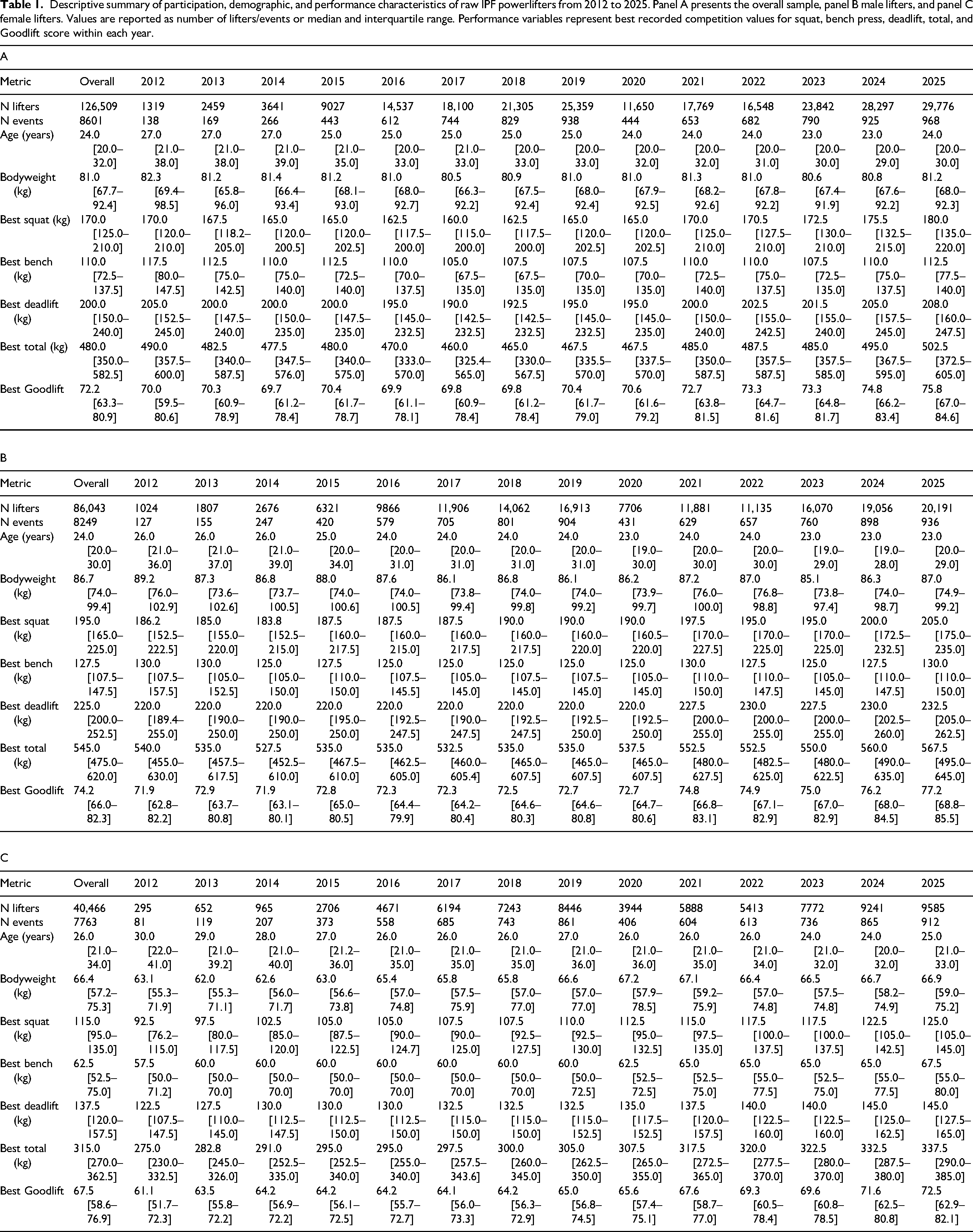
Overall results are summarised in Table 1, which report per-year medians and interquartile ranges alongside separate summaries for males and females. After filtering, 126,509 lifters were included in the final dataset, making this one of the largest standardised datasets of competitive powerlifting reported to date. The dataset comprises 86,043 males and 40,466 females, who collectively competed in 8601 events. Across all lifters, the median age was 24 years [20–32], indicating that raw IPF powerlifting is predominantly a young adult sport. Clear and stable sex-specific differences in absolute strength were evident throughout the period, with median best totals of 545 kg in males and 315 kg in females, with corresponding median best squat, bench press, and deadlift performances of 195/127.5/225 kg for males and 115/62.5/137.5 kg for females. Together, these figures describe a large, predominantly young competitive population spanning thousands of events, with clear and stable sex-specific differences in absolute strength. The following sections examine how this expansion unfolded across time, geography, demographic composition, career duration, and performance standards.
Descriptive summary of participation, demographic, and performance characteristics of raw IPF powerlifters from 2012 to 2025. Panel A presents the overall sample, panel B male lifters, and panel C female lifters. Values are reported as number of lifters/events or median and interquartile range. Performance variables represent best recorded competition values for squat, bench press, deadlift, total, and Goodlift score within each year.
Overall participation
Participation expanded rapidly across the study period, and raw participation numbers can be seen in Table 1. The total number of unique individuals competing in IPF raw competitions increased approximately 23-fold between 2012 and 2025, from 1319 lifters to 29,776. Annual growth, as measured by median delta, was 3563 additional lifters per year. This upward trajectory was temporarily disrupted in 2020, when participation fell to 46% of 2019 levels, and pre-pandemic participation was not exceeded until 2024, indicating a multi-year recovery period. As shown in later sections, this rapid expansion did not correspond to prolonged individual careers. The number of meets also increased substantially across the observed period, from 138 in 2012 to 968 in 2025; a 7-fold increase.
Although raw IPF powerlifting remained male-dominated throughout, female representation increased markedly in the early years, rising from approximately 22% in 2012 to 32% by 2016, after which it stabilised between 31–34% through 2025.
Global distribution and growth
Country-level participation and event-hosting patterns are summarised in Figure 1. Raw IPF powerlifting participation was geographically widespread, with lifters from 87 countries represented in the dataset between 2012 and 2025, although participation was highly concentrated in a small number of nations. A small number of countries have accounted for the majority of global participation. Across the full study period, the United States accounted for 47,335 lifters, representing approximately 37% of the entire dataset. However, its annual share changed substantially over time, increasing from 43.4% of lifters in 2012 (n = 573) to a peak of 60.5% in 2016 (n = 8791), before falling to 12.9% in 2025 (n = 3848). This indicates that although the United States dominated the aggregate dataset, more recent growth has become less US-centred as participation expanded across other federations. France and the United Kingdom followed, with 8786 and 7847 lifters respectively. Both countries increased their share of annual participation over time: France rose from 0.5% of lifters in 2012 to 10.4% in 2025, while the United Kingdom rose from 5.5% in 2012 to 8.8% in 2025, having peaked at 12.6% in 2022.
A similar aggregate pattern was observed for competition hosting, with 2223 meets held in the United States compared with 936 in the United Kingdom and 893 in Norway. However, hosting also varied over time: the United States increased from 18 recorded meets in 2012 to 159 in 2025, with a peak of 372 in 2019. Norway increased from 58 meets in 2012 to 97 in 2019, before declining in more recent years, with 44 meets recorded in 2024. Meets were predominantly mixed gender, with few male or female only events taking place. This trend was observed across most countries, though Norway was a notable exception, with 58.7% of events being for a single gender. Mixed-gender events in Norway increased from 17.0% of recorded meets in 2012 to 38.6% in 2024, although single-gender events remained comparatively common. Italy also shifted markedly, from exclusively mixed-gender meets before 2020 to 75.0% single-gender meets in 2025.
Absolute growth between 2012 and 2025 was driven both by expansion within high-volume countries and by rapid emergence in developing federations. The United States showed the largest absolute increase in lifters with 3350 additional lifters between 2012 and 2025, and a peak increase of 12,619 lifters over the baseline in 2019. France exhibited the largest proportional participation increase over the period, rising by 3081 lifters, representing a greater than 150-fold increase, though many countries demonstrated substantial expansion from small early-year baselines.
Age and mass demographics
Age and weight demographics of lifters are presented in Table 1 and in Figure 2. Despite a more than twenty-fold increase in participation, the demographics of lifters exhibited only minor changes over time. This stability in demographic structure suggests that growth occurred through expansion within the existing participation profile rather than a shift toward older or heavier cohorts.
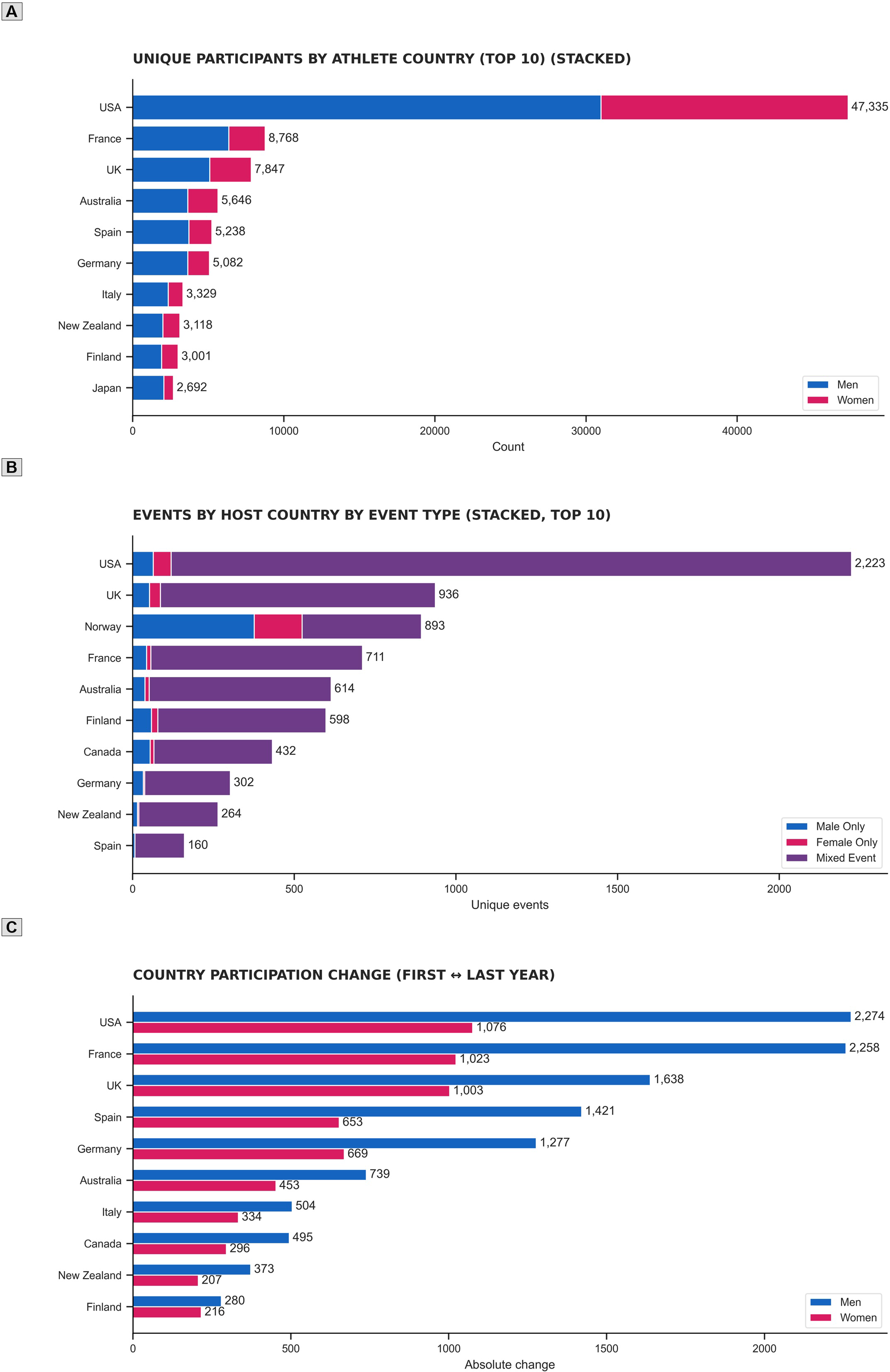
Country-level participation and event distribution in raw IPF powerlifting from 2012 to 2025. A: Total unique lifters from the 10 highest-volume athlete countries, stacked by sex. B: Total competitions hosted by the 10 highest-volume countries, separated into male-only, female-only, and mixed-sex events. C: Absolute change in the number of unique lifters between each country's first and last year in the dataset, shown separately for men and women.
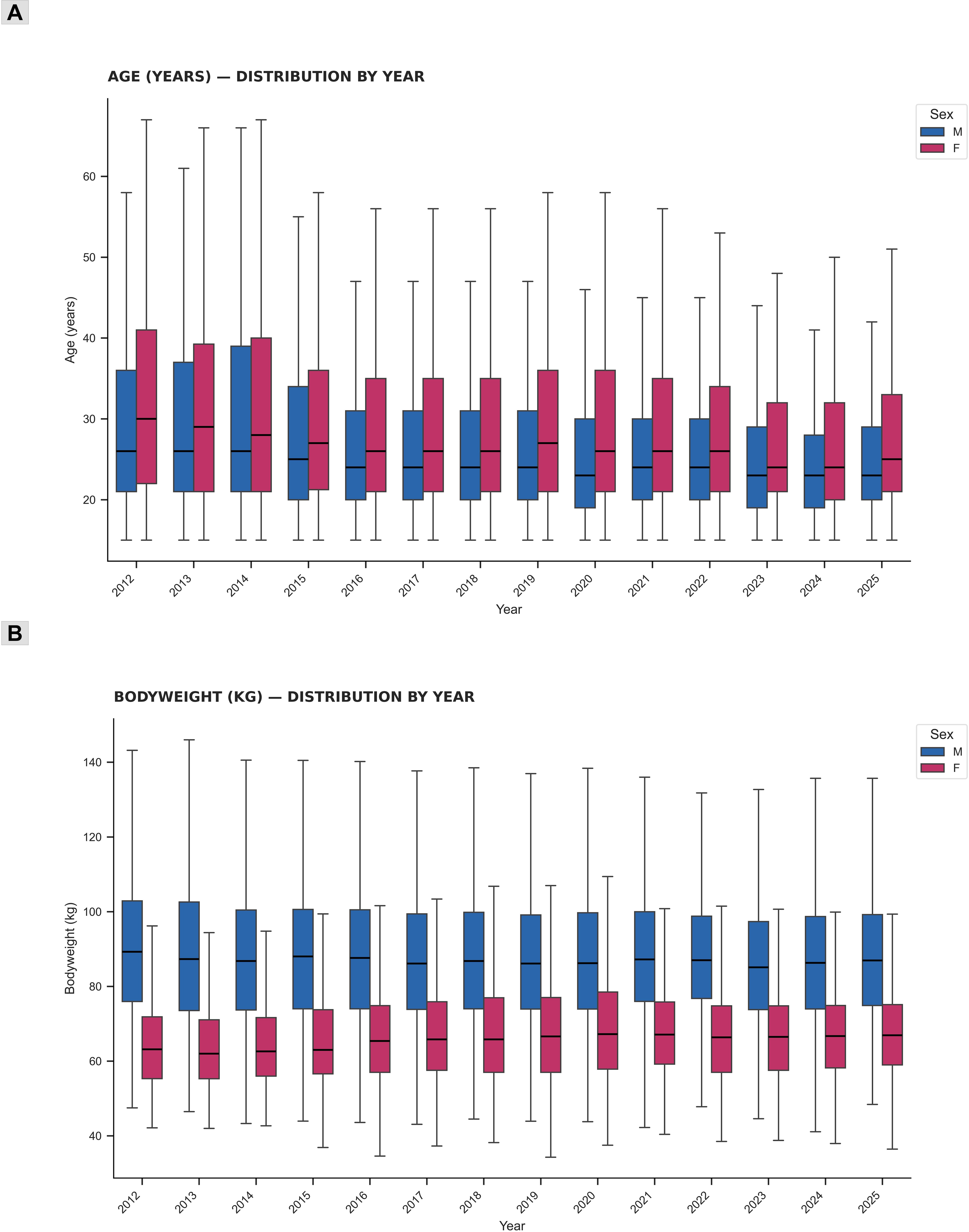
Age and bodyweight distributions of raw IPF powerlifters by year (2012–2025), shown separately for men and women. A: Age distribution by year. B: Bodyweight distribution by year. Boxplots show the median, interquartile range, and whiskers for each sex within each calendar year.
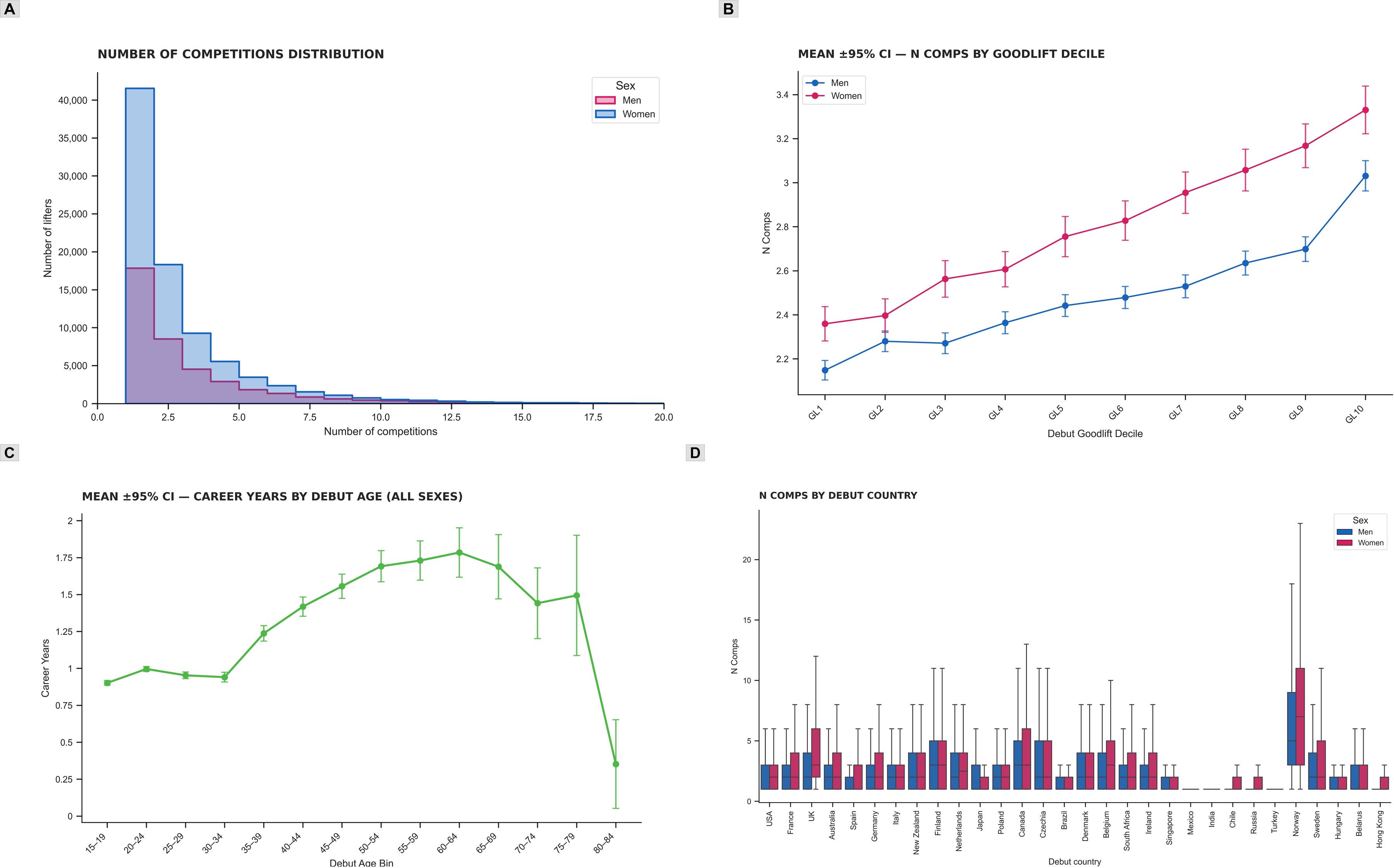
Career length characteristics of raw IPF powerlifters. A: Distribution of total number of competitions per lifter, shown separately for men and women. B: Mean number of competitions by debut Goodlift decile, with 95% confidence intervals, shown separately for men and women. C: Mean career length in years by debut age band, with 95% confidence intervals, shown for all lifters combined. D: Number of competitions by debut country, shown separately for men and women.
Despite a modest leftward shift in age distribution, the sport maintained a distinctly young demographic throughout the study period. The overall median age decreased by three years, from 27 years in 2012 to 24 years in 2025. Female lifters had a median age of 26 years [21–34], with males slightly younger at 24 [20–30]. At a sex-specific level, the median age of female lifters decreased from 30 years in 2012 to 25 years in 2025, while the male median decreased from 26 to 23 years.
Body mass distributions remained stable across the study period, with the overall median changing only slightly from 82.3 kg in 2012 to 81.2 kg in 2025. The median body mass of female lifters increased by just 3.8 kg, from 63.1 kg in 2012 to 66.9 kg in 2025 with a median of 66.4 kg [57.2–75.3 kg] across the study period. The median body mass of male athletes (median 86.7 kg [74.0–99.4 kg]) decreased by 2.2 kg over the same period from 89.2 kg to 87.0 kg.
Career length
Career-length characteristics are presented in Figure 3. Despite rapid growth of IPF sanctioned powerlifting, individual competitive engagement was typically brief. The median lifter competed in only two competitions, and approximately 69% exited within one year of their first appearance. The corresponding competition frequency was a median 2.6 competitions per year. Nearly half of lifters (46.9%) were “one-and-done”, producing a strongly right-skewed distribution in total competitive exposure. One-and-done rates ranged from 36% to 55% between 2012 and 2023, peaking at 54.9% in 2021. This indicates that entry into the sport substantially outpaces long-term retention.
Patterns were similar between sexes. Females have similarly long careers to males, though they competed slightly more frequently, with 2.8 compared to 2.5 events per year, and were less likely to be one-and-done competitors (44.1% compared to 48.3%). Mean number of competitions per lifter declined in both sexes between 2012 and 2023, from 5.0 to 2.6 in females and from 4.0 to 2.33 in males. However, this should be interpreted cautiously, as shorter observed careers in recent cohorts may be partly explained by right-censoring.
Stratified analysis demonstrated systematic differences in sustained participation. Lifters debuting between the ages of 35–69, and those with stronger debut performance levels, tended to remain engaged for longer, though careers remained short even within these cohorts. The association with stronger debut performance appeared broadly consistent across debut years, whereas age-related differences were clearer in earlier cohorts and less stable in more recent years, likely due in part to right-censoring in later debut cohorts.
These findings indicate that recent expansion reflects increased entry into the sport, rather than prolonged retention within it.
Performance
The strength performance characteristics of all lifters across years are presented in Table 1 and Figure 4, with values representing each lifter's annualised best performance within a given year. Strength performance improved over time in both sexes, but the magnitude of improvement differed.
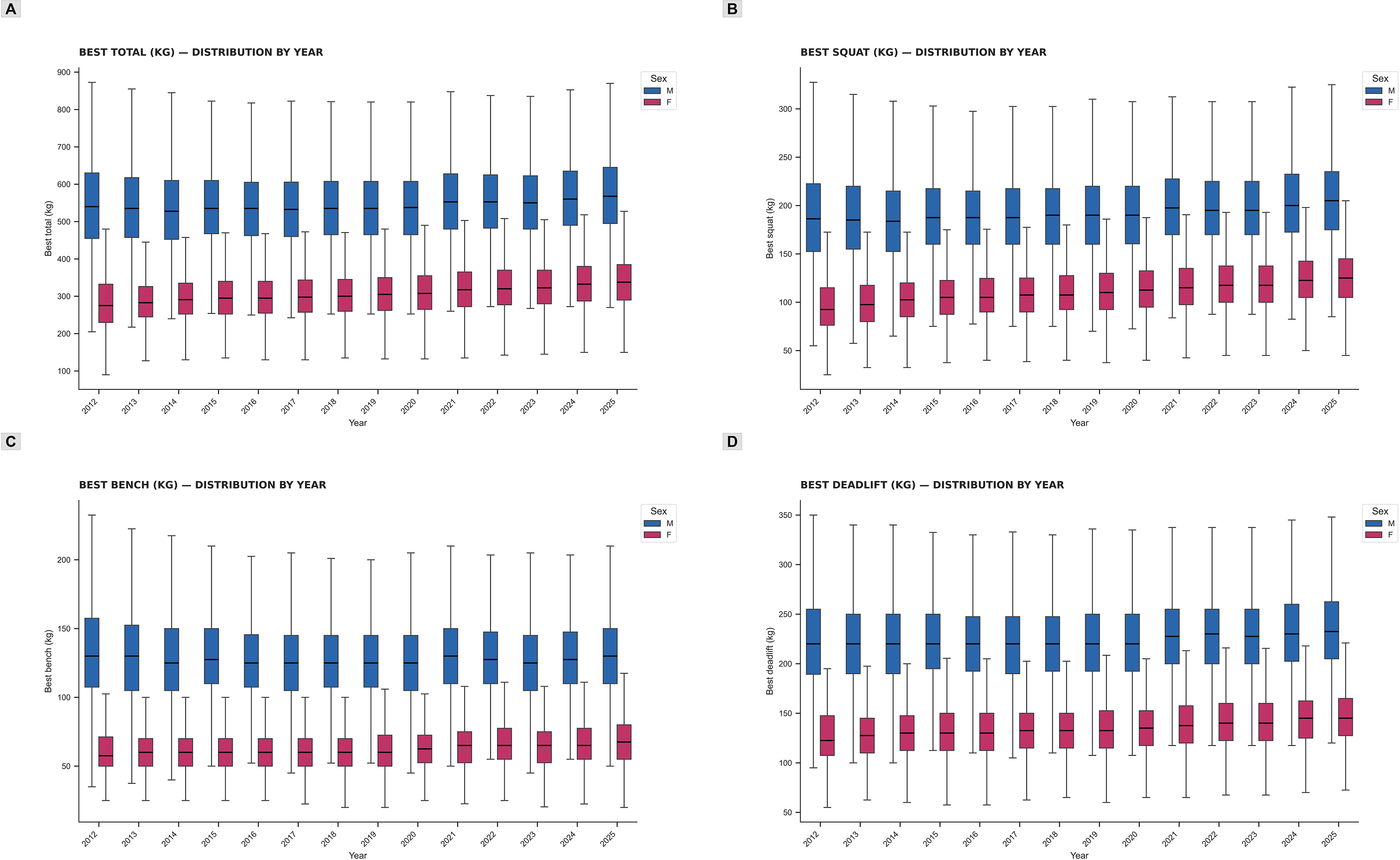
Distribution of raw IPF lifting performance by year (2012–2025), shown separately for men and women. A: Best total. B: Best squat. C: Best bench press. D: Best deadlift. Boxplots show the median, interquartile range, and whiskers for each sex within each calendar year.
Among female lifters, the median squat, bench press, and deadlift performance across the study period (2012–2025) was 115 kg [95–135 kg], 62.5 kg [52.5–75 kg], and 137.5 kg [120–157.5 kg], leading to median total of 315.0 kg [270–362.5 kg]. Median performance improved across all three lifts between 2012 and 2025. Median squat increased from 92.5 kg [76.2–115.0] in 2012 to 125.0 kg [105.0–145.0] in 2025, an increase of 32.5 kg. Median bench press increased from 57.5 kg [50.0–71.2] to 67.5 kg [55.0–80.0], an increase of 10.0 kg. Median deadlift increased from 122.5 kg [107.5–147.5] to 145.0 kg [127.5–165.0], an increase of 22.5 kg. Together, these changes corresponded to an increase in median total from 275.0 kg [230.0–332.5] in 2012 to 337.5 kg [290.0–385.0] in 2025, an overall increase of 62.5 kg.
In male lifters, absolute performance levels were higher, but improvements were smaller between 2012 and 2025. Median squat increased from 186.2 kg [152.5–222.5] in 2012 to 205.0 kg [175.0–235.0] in 2025, an increase of 18.8 kg. Median deadlift increased from 220.0 kg [189.4–255.0] to 232.5 kg [205.0–262.5], an increase of 12.5 kg. Median bench press remained unchanged at 130.0 kg, shifting from [107.5–157.5] in 2012 to [110.0–150.0] in 2025, a change of 0.0 kg. Consequently, median total increased from 540.0 kg [455.0–630.0] in 2012 to 567.5 kg [495.0–645.0] in 2025, an overall increase of 27.5 kg.
Importantly, performance gains in both sexes occurred in the absence of substantial shifts in age or body mass distributions, suggesting an elevation in competitive standards at a population level rather than demographic drift. This pattern was also reflected in median Goodlift score, which increased from 61.1 [51.7–72.3] to 72.5 [62.9–82.1] in females, an increase of 11.4 points, and from 71.9 [62.8–82.2] to 77.2 [68.8–85.5] in males, an increase of 5.3 points. Weight-class stratified analysis of median Goodlift indicated that these improvements were broadly distributed across classes rather than being driven by a single category. In females, median Goodlift was higher in all weight classes in 2025 than in 2012, with relative increases ranging from 5.5% in the 84 + kg class to 27.5% in the −69 kg class. In males, median Goodlift was higher in all weight classes except 120 + kg, with relative increases ranging from 4.0% in 105–120 kg to 23.9% in 53–59 kg, while the 120 + kg class decreased by 5.7% relative to 2012.
Discussion
The purpose of the current study was to investigate how raw IPF powerlifting has changed in terms of individual and global participation, athlete demographics, career lengths and performance changes over a 13 year period.
With respect to individual lifter participation, several interesting trends were noted in the current study, such as a considerable decline in the number of individuals competing was noted in 2020, almost certainly due to the onset of global public health restrictions enacted in an attempt to manage the SARS-CoV-2 pandemic. 13 Individual participation did not exceed pre-pandemic levels until 2024, indicating that the SARS-CoV-2 pandemic had a multi-year impact on IPF raw powerlifting. Male versus female participation showed a clear pattern: year-on-year IPF raw powerlifting is a consistently male dominated sport. The percentage of female lifters increased from ∼22% to ∼32% between 2012 and 2016. Since 2016, however, the percentage of female lifters in IPF powerlifting competitions has remained relatively stable, with year-on-year fluctuations of only 1–2%, including during the SARS-CoV-2 pandemic. Literature examining sex differences in global participation rates of individual sports is limited, but these values are approximately similar to what has been reported for ultrarunning (∼26–28% female participation,14,15 less than what has been reported for marathon running (∼42% female participation) 16 and greater than what has been reported for age-group Ironman triathlons (20% female participation). 17
With regards to global popularity, IPF powerlifting appears to be a sport that is concentrated in North America and Europe. Approximately 37% of lifters came from the USA, while combined ∼87% of lifters came from North America, the European Union, the United Kingdom and Scandinavia. In addition to regional concentration of athletes, competition hosting was similarly skewed, with the United States accounting for a disproportionately large share of total meets. This suggests that participation volume may be closely linked to event availability and organisational infrastructure. Regions with greater competition density likely provide more accessible entry points and repeat opportunities for lifters, whereas regions with sparse meet distribution may make it harder to compete regularly. This uneven access to competitions may partially explain both geographic disparities in participation and the variation in career length observed between countries.
Age demographics, for both sexes, were remarkably consistent, with the majority of lifters being young adults (i.e., aged between 18–35). The median age for males was relatively consistent across years (often fluctuating year on year, but never by more than 3 years), while the age of female lifters declined slightly from 30 in 2012, to consistently around 24–26 from 2016 onwards. Female lifters were consistently older than males by 1–2 years. Overall, age distributions remained stable across the study period, indicating that the rapid expansion of participation did not materially alter the underlying age profile of the sport. The median body mass of female lifters increased modestly until approximately 2020 before stabilising. The replacement of the 72 kg class with 69 kg and 76 kg categories in 2021 may have contributed to this stabilisation 18 In contrast, median body mass changed minimally in male lifters, consistent with the absence of weight-class restructuring during the same period. This demographic stability is important when interpreting performance trends, as improvements in lifting standards cannot readily be attributed to systematic shifts in age or body mass.
In terms of athlete career length, it was observed that athletes tended to have short careers. 46.9% of lifters competed in a single competition, while 68% of lifters had a career that spanned 3 competitions or less, with limited indication of any divergences in career length by sex. Interestingly, the age of each individual at debut appeared to have an influence on how long an individual's career lasted, as individuals who had a debut age of between 35–69 appeared to have slightly longer careers (0.5–1 year longer). This is consistent with what has been reported in a regional study completed by Van Den Hoek et al., that examined participation trends and growth in sanctioned powerlifting meets (irrespective of federation) in Australia between 1942 and 2022; in this work, it was also identified that 52% of participants (∼11000 lifters) competed only once, while 64% (∼13700 lifters) of participants competed only within a single calendar year. 11 Notably, Van Den Hoek's study employs data from multiple powerlifting federations, indicating that the participation trends observed in our study may be consistent with broader participation trends in the sport of powerlifting.
Research examining drop-out rates and factors that influence drop out from sport in adults is highly limited. However, work examining drop out rates in runners exposed to a training program has identified that ∼30% of novice runners drop out within 6 months. 19 In addition, a cross-sectional study of 20,191 parkrun participants has estimated ∼30 percent of first-time parkrun attendants do not return. 20 A longitudinal study of 223,224 parkrun participants in Australia indicated that 76% of participants completed a mean of 4 parkruns. However, for most participants, 2 of these occurred within 12 weeks, indicating that most participants likely had ‘parkrun careers’ < 1 year. 21 These results would correspond with that of the current study, in the sense that they indicate that most adults who will participate in a new sport may inherently drop out within 1 year. These findings suggest that, despite a higher barrier to entry compared to activities such as parkrun, competitive engagement in raw IPF powerlifting remains similarly brief. Entry into the sport appears to substantially outpace long-term retention, indicating that athlete turnover, rather than sustained participation, is a defining feature of the sport's recent expansion, consistent with other large-scale sporting datasets of this size and regional powerlifting data. 11 From an applied perspective, these findings suggest that participation growth in raw IPF powerlifting may depend not only on attracting new lifters, but also on improving athlete retention. For national federations and the IPF, this raises an important practical question: which aspects of the competitive environment support athletes to remain engaged beyond their first one to three competitions? Identifying modifiable features associated with longer competitive careers may therefore represent an important next step for the sport.
A notable deviation from the broader pattern of short competitive careers was observed in Norway. While career length remained relatively stable across most nations, Norwegian lifters demonstrated longer engagement, with males competing in approximately three additional events and females in five additional events compared to their global counterparts, and median career durations of 2.5 and 3.5 years respectively. Structural differences in competition organisation may contribute to this pattern. Norway hosts a higher number of events relative to its active lifter base, suggesting greater competition density, and a substantial proportion of meets are single-sex events, which are comparatively rare in many other nations. While causal inferences cannot be drawn, these structural characteristics may reduce logistical or social barriers to continued participation, or reflect distinct cultural norms within Norwegian powerlifting. Future work could include a more detailed investigation into whether aspects of a “Norwegian model” – competition density, meet format or federation structure –are independently associated with increased athlete retention. Such work would provide valuable insight for federations seeking to address longevity within the sport.
Performance trends showed considerable increases in median performance for both male and female lifters across all lifts except male bench press. For female lifters, the median squat, bench and deadlift performance increased by 35%, 17% and 18% respectively. For male lifters, performance increases were also estimated with improvements in the median squat and deadlift increasing by 10% and 6% respectively (bench press was unchanged). The magnitude of improvement for male lifters was smaller than that of female lifters and that the median best bench press performance did not change considerably for male lifters across the period of 2012–2025. Interestingly, these changes in median best lift performance for both sexes came in the absence of any substantial change to age or body mass demographics (see above), indicating a genuine elevation in competitive standards at a population level. This pattern was also broadly evident across weight classes when examined using median Goodlift score, suggesting that the overall rise in performance was not driven by isolated improvement in a small number of categories. These results are consistent with work by Van Den Hoek et al., using raw, drug tested powerlifting data extracted from the OpenPowerlifting database across a different timespan (2000–2024) and from multiple federations. Notably, Van Den Hoek's study similarly observed a negligible improvement in bench press performance for male lifters across their observed time period, which is consistent with our study. 22 However, the data source and filtering strategies of Van Den Hoek's study are somewhat mimicked by the current study. This means that there is likely considerable direct overlap between the data used in the current study and that of Van Den Hoek et al. 22 This is notable as the observation of limited improvement in bench press performance for male lifters in the current study is technically a replication of the finding of Van Den Hoek's analysis, as opposed to a strictly independent finding from alternative data.
Importantly, this pattern contrasts with that observed in some endurance sports, such as marathon running, where rapid increases in participation have coincided with slower median finishing times due to growth in recreational participation.23,24 In raw IPF powerlifting, participation expanded substantially while median performance improved and demographic distributions remained stable. The concurrent rise in participation driven by first-time lifters and performance suggests that expansion has likely occurred within an already strength-trained population, rather than through substantial recruitment of individuals with no prior exposure to resistance training or any survivorship effects. One speculative interpretation is that a proportion of new entrants may represent individuals already engaged in structured strength training who elect to formalise their participation through competition on a limited basis. If so, the data may reflect a sport that is highly effective at converting existing lifters into competitors, while the broader challenge lies not in attracting participants, but in sustaining competitive engagement over time. This raises the important structural question of under which conditions initial entrants are converted into repeat competitors. The Norwegian case suggests event structure and competition accessibility may play a role in this transition.
The lower increase in median best performances for male lifters compared to female lifters may be in part related to the observation that the ratio of male:female participants was never observed to be around 2:1 or less. The consistently larger talent pool of male lifters in raw IPF powerlifting across the observed time period may have generated an inherently higher ‘baseline standard’ for male compared to that of female lifters, which in part explain the lower development of median male performance between 2012–2025. Such a phenomenon has been well documented in other sports, where the sex-based performance gap has been shown to narrow as female participation increases in absolute terms, converging toward a stable difference attributable primarily to physiological sex differences. In marathon running, the sex gap in performance narrowed considerably during the twentieth century before stabilising, coinciding with the period in which female participation grew substantially. 25 A similar pattern has been observed in the Ultraman Hawaii triathlon, where the sex difference in performance decreased from approximately 24% to 12% over a period of increasing female participation. 26 Conversely, in ultra-triathlons, where female participation has remained low (approximately 8–10% of starters), the performance gap between sexes has widened with increasing race distance. 27 As a relatively young sport with upward trajectories in both male and female participation, raw IPF powerlifting appears to be following a comparable trend. The greater rate of improvement observed in female lifters likely reflects a maturing competitive landscape in which increasing female participation is driving performance standards upward more rapidly for females than for males, who have a longer-established and larger competitive base. For the sex-based performance gap in powerlifting to continue to narrow, improvements in female performance would need to continue to outpace those of male lifters.
Limitations
There are several limitations to the current study. First, while
Conclusion
In conclusion, the current study reports observations of substantial growth in raw IPF powerlifting between 2012 and 2025. This growth is characterised by some minor changes in demographic participation (e.g., small shifts in male/female lifter ratios). While most athletes have relatively brief careers and demographics remain approximately stable, performance trends suggest continued improvements in lifting standards, particularly among female lifters. Collectively, these findings suggest that raw IPF powerlifting has transitioned from a niche activity into a rapidly expanding international competitive sport, with future work needed to better understand athlete retention, regional development, and factors influencing long-term participation.
Footnotes

Author contributions
ID, JB and DN contributed to the conceptualization of the study, with ID leading the initial development of the project concept. ID and JB undertook the data curation. JB was responsible for software development, formal analysis, and visualization, and contributed to the methodology. Interpretation of the findings was conducted by ID, JB and DN. ID led the original draft of the manuscript, with contributions from JB. JB and DN contributed to critical review and editing of the manuscript. All authors approved the final manuscript and agree to be accountable for the work.
Ethical considerations
Ethical approval for this study was granted by the University College Dublin Human Research Ethics Committee under the low-risk reference 052-LS-26-LRSD-Berndsen.
Consent to participate
Not applicable. This study used secondary analysis of existing competition data and did not involve direct participant recruitment or interaction.
Consent for publication
Not applicable.
Funding
The authors received no financial support for the research, authorship, and/or publication of this article.
Declaration of conflicting interests
The authors declared no potential conflicts of interest with respect to the research, authorship, and/or publication of this article.
Data availability
The data that support the findings of this study were derived from publicly available competition results obtained from OpenPowerlifting.