






Abstract
Background
Learning sport is more than just learning how to play and it involves more that just formal training sessions. Therefore, here learning beach volleyball was investigated broadly using practice theory.
Objectives
Applying a site-ontological practice theory perspective, this ethnographic study sought to understand learning beach volleyball ‘as it happened’.
Methods
The participants were fundamentally junior boy beach volleyball players aged 14 years (N = 12) and their coach (and researcher). Ethnographic methods were employed over a three-month period to gather data including video-recordings, fieldnotes, and informal interviews.
Results
Learning beach volleyball happened beyond the formal sites of coaching – it occurred in a range of sites with different groups of people and in different ways. As they engaged in their various volleyball practices, each player developed and then they brought their new and emerging skills and knowledge to their games.
Conclusion
Learning is not something that only occurs in training sessions with a coach - it happens in a variety of different sites, and it is multi-faceted and complex. Therefore, to understand and support athlete development, a broader view of how and where they learn is required.
Introduction
When people come to learn something specific, their learning does not just occur in isolated discrete moments that are directly focused on learning. 1 So, here the focus is on learning more broadly – not coaching per se, and how athletes develop and grow in their sport practices in a range of ways and places, and this perspective on learning should help coaches appreciate how they might facilitate the development of their athletes and players. The study reported on here focuses specifically on learning beach volleyball, and for beach volleyball learning occurs during formal training sessions with a coach, but it also occurs in a range of other sites as individuals engage broadly in a range of volleyball practices. Also, learning beach volleyball is more than learning to play beach volleyball, because being a beach volleyballer involves a range of practices including skills and movement patterns, but also cultural practices like how to behave on the court, ways of interacting with others (e.g., teammate, opposition), and officiating games (e.g., scoring). All this learning occurs in a variety of different sites as parts of different social ensembles, 1 where everyone is learning differently, differently (that is, in distinct ways and at varying rates within the ensemble). In this article the focus is on beach volleyball because this is the sport I am involved in, but the principles and ideas are equally applicable and relevant to learning in any sport or active pursuit (e.g., football, mountain-biking), or indeed, learning anything (e.g., music, mathematics) – here the ethnographic details from beach volleyball are used to underpin a deep-dive into learning for this particular sport with these players.
While there is a long history of studying skill acquisition and motor learning in sports, here the aim is to understand learning as it happens, seeing learning as ontological transformation. This approach does not diminish the perspectives provided by other approaches to skill acquisition, but rather it gives a different ontological perspective. This is to provide further and new understandings of learning beach volleyball (and sport in general) by using the conceptual resources of practice theory, and more specifically, the theory of practice architectures.2–4
A practice theory perspective on learning beach volleyball
A practice theory perspective foregrounds the happingness of life and understands living as unfolding in time and space as we encounter one another as interlocutors through our practices. 5 Therefore, practices are more than mere activity - they are socio-material in nature and they shape, and shaped by, history, and the prevailing conditions and arrangements. Thus, any practice, including beach volleyball, is made up by individual actions that are fundamentally inseparable from the shared, intertwined practices of the ensemble of participants. These social ensembles are constituted by the various interconnected practices of those who are engaging in the particular shared practice in the site.5,6 For example, in a beach volleyball tournament there will be different people undertaking different practices at different times (e.g., playing, scoring, coaching, spectating, supporting), and these change over time – in this way their practices are distributed through an ensemble, and together they collectively engage in a shared practice of beach volleyball.
The history of studies of learning, including motor skill development, primarily take a cognitive, individualist, epistemological view of learning, seeing it as the acquisition of knowledge by an individual. 5 However, here a complementary view of learning as social, material, and ontological is taken, conceptualising learning as “coming to practise differently”,5(p12) and this happens inevitably as individuals and ensembles (e.g., teams, groups) engage in their individual and shared practices. 6 This view of learning, as coupled with participation in practices, ameliorates the concern of Lave 1 that most research and scholarship on learning actually focuses on teachers (including coaches) and ‘formal’ educational settings (e.g., school), ignoring the simultaneously social and material nature of learning that is an inseparable aspect of everyday life. This being the case, a socio-material understanding of learning means that how and why it happens depends on with whom and where it happens. 5 And so, the outcomes and consequences of learning are more than mere knowledge or refined techniques for individuals and teams - they realise transformation in the places (e.g., the beach volleyball centre) and the communities (e.g., the beach volleyball club) they inhabit, and the practices themselves (e.g., the sport of beach volleyball).
Furthermore, a practice perspective sees practices and learning, as being distributed across the participants in an ensemble in a site, albeit that they do not all learn the same things in the same way.3,5 For example, in a beach volleyball game the players will be learning differently and different things, although related, to the coach or the referee. Even the two players will be learning differently and different things, albeit related, as they each have different experiences and opportunities throughout the game, and they have different affordances depending on a range of factors (e.g., their prior experience, physical capacities, etc). Also, their learning is distributed across time and other sites, as the participants engage in beach volleyball practices in other ways and in other ensembles (e.g., playing with their siblings at home over a rope tied between the fence and the house). Thus, practice theory understands learning as “ontological transformation” 7 that occurs inevitably through participation in practices that are distributed across an ensemble of participants, and across time and sites.
The theory of practice architectures 2
Thus far a general practice theory perspective has been purported, but there are a range of theories of practice 8 so now the specific practice theory – the theory of practice architectures,2,4 is briefly outlined.
Practices are “embodied human social action in history” 5 (p.23), and according to the theory of practice architectures, practices are prefigured and shaped, but not predetermined, by conditions and arrangements in the practice sites. Therefore, Schatzki 9 suggests that to understand social life, it is crucial to grasp the relationship between practices and the conditions or arrangements in the practice site. To this end, Kemmis10(p.81) stated that “practices are not independent of the arrangements to be found in a site. Through this entanglement, the intersubjective spaces of particular local sites gain their own local character and uniqueness”. Thus, practices do not so much unfold in a context, but they are an integral part of the site or context. Practices unfold in local sites in three dimensions of the practice landscape: (1) semantic space which orients the language and discourse; (2) physical time-space which orients the activity and work; and, (3) social space which orients the relationships and power. In these three intersubjective spaces, practices are comprised of interconnected aspects: sayings, doings, and relatings, and these are enabled and constrained by the cultural-discursive, material-economic, and social-political conditions and arrangements – the practice architectures, that are in (or brought into) the practice site. 4 Of course, these three dimensions of the practice architectures are not independent of one another, as they always overlap and are intertwined. 2 The sayings, doings, and relatings that comprise a practice are held together in the project or purpose of a that practice. This is illustrated in Figure 1.
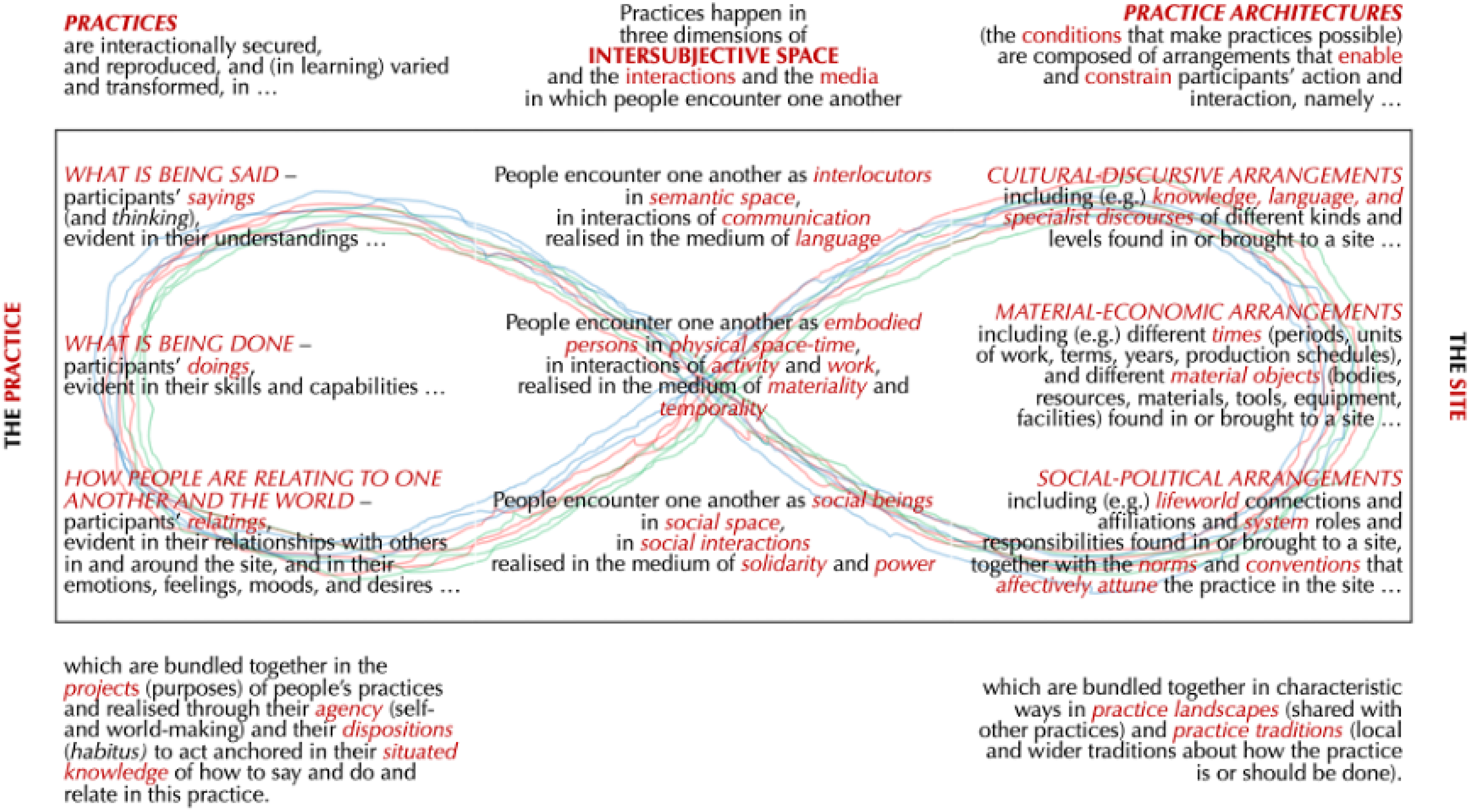
The theory of practice architectures4(p.29). Note: reproduced with permission.
Finally, practices do not unfold in isolation from other practices, but in practice landscapes there are always other practices, and these are often ecologically arranged with one another. 7
Gathering evidence
This study is loosely called an ethnographic case study – ethnographic because, as far as possible it involved being in the site where the practices and learning were happening, and a case study because it is loosely bounded around a group of boys who play beach volleyball. Of course, given the preceding discussion, it is clear that the nature of learning being studied here occurs across a range of different sites and times, and so some were somewhat observable and others less so, thus the evidence collected is patchy and variable. Also, the ‘group of boys’ practiced together as an ensemble to a greater or lesser degree in some sites (e.g., training sessions), but their practices and learning were also distributed across other ensembles across their various sites of participation. Nevertheless, in an attempt to take an ontological approach that captured the unfolding of their practices/learning, the loose interpretation of these research methodologies was employed.
With this in mind, the evidence gathered was undertaken to try and be as naturalistic as possible, and included video recordings, fieldnotes, and informal interviews. The video recordings were of training sessions in a two-court space (about 18 metres by 24 metres) with a fixed camera on a tripod in the corner. This meant that the recordings picked up audio and more nuanced pictures when the athletes were near the camera, but much less when they were further away. However, as the coach here, I was able to fill-in some of the gaps where necessary with the video prompted recall of specific moments. The fieldnotes were taken by myself as the researcher, but also as the coach. These fieldnotes were augmented and filled out by checking with the other coach involved. The fieldnotes were extensive but were often taken after the actual events as the coaching role demanded significant attention in the moment. As noted above, I also reviewed the videos and made more fieldnotes as particular aspects of the training sessions were revisited. Finally, throughout the three months of evidence gathering there were several occasions where I had informal conversations – much like a chat, with a number of the boys. These were neither long or recorded, but again, immediately afterwards significant notes were made about the nature of the discussion and the relevant insights they shared. Also, a few informal text chats were had with some of the parents about some of the boys’ practices away from my direct gaze (e.g., at home).
So, while the data was not particularly robust by some measures, it was on the whole unobtrusive and representative of the ‘happeningness’ of the various practices, and this was important as ontological understanding was sought of their learning.
Sites of learning
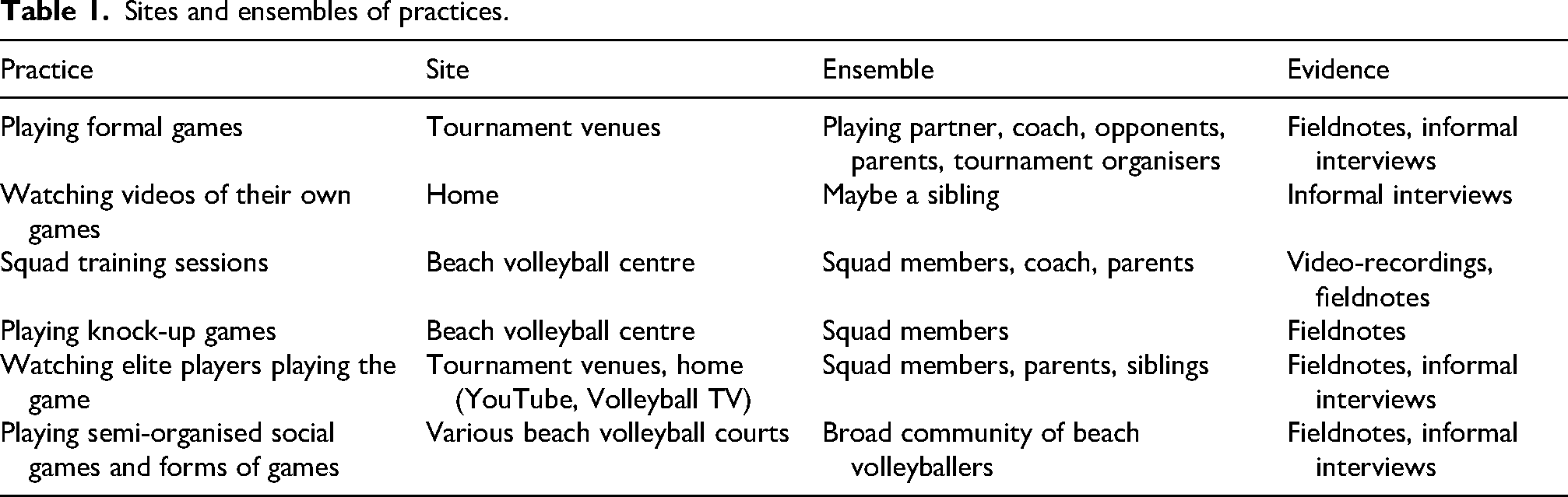
While it was not possible to follow the players to all their sites of learning, the data gathered through fieldnotes, video-taping, and informal conversational interviews revealed that learning beach volleyball occurred in (at least 6) realms each with their own site(s) and in different ensembles 3 (see Table 1).
Sites and ensembles of practices.
The projects of the practices.
Of course, these do not include all the informal and incidental thinking they do about beach volleyball, or other practices that may be relevant (e.g., watching the manga volleyball series Haikyuu!! on Netflix).
Playing formal games
Over the course of the season the boys played in a number of tournaments, culminating in the national beach volleyball championships, where they engaged in several games played under the governing rules and with the goal of trying to win their division. In these tournaments they played in pairs with a partner selected by the coach, and while the coach could talk to the players between games, during play they had to work things out themselves on the court. Fundamentally, while the tournaments throughout the season were seen as developmental as well as competitive, the focus of the structure beach volleyball programme had been the national championships.
During the games the players were placed into problem-solving situations, because mostly they were playing against teams they had not encountered before, and on courts they had never played on previously. So, while they could have ideas about how they wanted to play their matches, in each case they had to learn and modify as they played, in response to the changing conditions. Their learning during these games were in an ensemble that included, to a greater or lesser degree, their teammate, but also their opponents, the referee, their coach, and the spectators (including parents) who were watching. And all these people involved were learning related, but different, things about volleyball in this site at this time – they were all learning differently, differently.
For example, on one windy day there was a strong breeze blowing from baseline to baseline, meaning that from one end you were serving into the wind (this is an advantage) and from the other end you were serving with the breeze behind you (a disadvantage). This meant that the players had to serve differently from each end (they swap ends every seven points) in response to the conditions, and in each case they had to learn how to adjust their serves depending on how they perceived the strength and gustiness of the wind, and indeed, the state of the game – although they both knew that they had to modify their serves for wind in general, they still had to learn here how to adjust every time. Furthermore, one player had a top-spin jump serve and the other had a standing float serve, so the site arrangements impacted their serves in varied ways. Finally, one player had played a lot on the beach so had experience of playing in the wind, whereas the other had largely played in purpose-built sand courts inland, and had not really needed to content with breezy conditions previously, so they had to both learn differently even though in a general sense the conditions in the site were the same (i.e., wind down the court). The evidence of their learning can be seen in how their serving practices improved and developed throughout the same session. Invariably early on they hit ones with the wind long of the baseline, and ones into the wind into the net, but as they refined they came to adjust their serving length to accommodate the wind, and importantly they learned to take advantage and be more aggressive into the wind, and a bit more cautious when serving with the wind. In this situation the constant variability of the conditions meant that there was no single technique for serving as they needed to be responsive to the site. So, while from a motor skill perspective they had a general serving technique, they needed to learn to serve under different and changing conditions.
Watching videos of their own games
During the above-mentioned games, invariably quite a few of the players, or more commonly their parents, would set up a video camera (either on their phones or a GoPro) on a tripod at the end of the court to capture their games. Apparently, the boys would then at a later time watch the video and critique their play. While this was beyond the direct gaze of the researcher, through talking with the parents and players, this viewing usually happened at home at a later time and commonly they did it alone, or perhaps with a sibling if they had one that played. One parent said; The boys watch them from time to time to re-live the moments I guess. I’m not sure on their evaluation skills but I know they’re smart enough to look at where they can improve.
Interestingly, it seems that this is something that the players do to intentionally learn (i.e., “look at where they can improve”), and this is entirely self-directed and without structure or input from a coach or experienced other, although likely these people are present in their thoughts from previous interactions (e.g., training sessions). At this stage, this ethnographic study does not have adequate evidence to understand more the ontological transformation that occurs through these particular practices in these sites, but they would seem to be an important and integral part of their learning volleyball.
Squad training sessions
For all intents and purposes, most would see these times as the prime (and perhaps only) site where learning beach volleyball occurs, with the players turning up to develop and grow their skills and play. The data employed here comes from video recordings of some training sessions, and personal fieldnotes (recorded during and post training) by the author who was also the Head Coach. So, importantly, the coaching practices were significant in shaping the practice architectures – the conditions and arrangements, that shaped the players’ changing volleyball practices, i.e., learning.
In one particular session, the intention was for the players to be more aggressive in their play, and to aim to ‘finish rallies quickly’. In the younger junior divisions, teams can win games by relying on the opposition to make errors, but these boys were now moving into an older age bracket where they needed to force the point to end. To this end, a game was established where they only played to three points (i.e., first to get to three – a normal game is 21) but they could only score by an aggressive attack that was unplayable by their opponents. If a rally ending with a simple or unforced error, then no one scored. The point here was, consistent with the “constraints-led approach”, 11 to create new problems for the players to solve where the conditions increased the reward for attacking play, and decreased the consequences of errors, and under these arrangements rallies should be short and intense. At first, the players basically just played the game in much the same way as they had previously, with an aversion to mistakes often seeing the ball cross the net many times, and this also meant that, despite the games only being up to three points, they went for a relatively long time with little scoring.
With time, the players learned how to play more attacking volleyball under the modified game conditions through some experimentation and through some “freedom to swing” (i.e., hit the ball hard), but they also learned that if you could not attack (because perhaps they had shanked the first shot) then they were better to just play an intentional error rather than giving their opponents an easy ball to attack. Thus, under the rules designed to promote aggressive play, they also learned how to manipulate the constraints to their (unintended) advantage. The provoked a change in practice by the coach who modified the rules so there was no incentive to deliberately error (the team that lost the rally served rather than received for the next point). Nevertheless, the point here was that the players were learning volleyball, and how to play a more mature form of the game (and how to game the rules!) without generally being given direct instructions on how to do it. And when moments arose during those games, the coach from time to time may have asked a prompting question to perhaps help them perceive affordances on the court.
Playing knock-up games
Always prior and after the training sessions, and even during the tournaments, if there was ever a spare court they would all get on and play what they described as “muck around” games. These games can have from one to five players per side, and while it is obvious that they are practicing a form of volleyball, many of the standard rules seem to be ignored or disregarded, and no one seems to keep score. These games bore many of the characteristics of “deliberate play” - games that “are designed to maximize the inherent enjoyment”12(p.95). Fundamentally, these games appeared to be an opportunity to have fun and try out a range of shots that they might not do in a training session or a proper game, and any tacit rules are negotiated as they played amongst laughter and fun banter.
At the time, one of the best teams in the world was the Swedish men's pair who were famous for their jump setting, and all the boys were familiar with their volleyball practices (through YouTube videos and televised games on the Volleyball TV channel – see a later point). The Swedish style of play was revolutionary and in many respects it changed the way the game is played, but it did require quite a high level of skill and athleticism. Anyway, what came to characterise these knock-up games was the boys trying to play Swedish beach volleyball, where they would attempt to practice volleyball replete with jump sets and trick shots – they had seen in on their screens, and now they were learning, through experimentation and trial and error, to do it. They had some sort of understanding about what was involved through their observations, and now in this informal game environment they were undergoing some sort of “ontological transformation”. It was clear to any observer that they were not playing Swedish beach volleyball, but within the enabling and constraining conditions of the site, including the physical capacities of themselves and their teammates, they were learning and remaking their form of ‘Swedish beach volleyball’. Interestingly, with some encouragement from the coach, some jump sets did start to appear in the players games in the tournaments as the season progressed.
Watching elite players playing the game
As was noted in the example above, the players did watch elite pairs playing the game, including on YouTube and the Volleyball TV channel, but also on the senior courts during the tournaments where there were premier divisions alongside the junior competitions. At these times the boys would watch the elite players largely it seemed for entertainment and fun, and not with any particular learning intentions. However, it was clear that they had learned volleyball through these seemingly passive practices because they would talk about aspects of the games afterwards together and try to emulate aspects of their play during informal play (as noted above). Interestingly, the boys also adopted some of the other cultural practices that they witnessed in the elite players, including for example, the way they would interact between points (e.g., the double hand slap with your partner), showing how they were inadvertently “stirred into” 3 the broader volleyball practices.
Playing semi-organised social games and forms of games
Quite apart from their involvement in the beach volleyball programme, many of the boys play in social settings in games, or forms of games, that are semi-organised. In these sites, they are invariably playing with a range of people of differing abilities, knowledge, experience, and age. Again, in these sites the players are not explicitly going there to learn per se, but rather they are primarily going to play and have fun (i.e., ‘deliberate play’ 12 ) – it is largely a stress-free environment where mistakes have few consequences, and the scores are barely kept.
In one site of this social play, the common game is called ‘King or Queen of the Court’, where individuals play in ever changing pairs because after each rally the player who makes an error goes off, and the next player comes on and serves. Players move forward to the king/queen end as they stay on the court, and so the pairings are regularly changing, and it accommodates more than four players (the number of players in a regular 2v2 game). At these times, the boys involved (and everyone else) get to play with a variety of partners and against many different pairs, so they constantly need to learn to modify their play to effectively solve the different movement solutions they are constantly facing. For example, sometimes they get to play with an experienced and talented partner and other times with a relative beginner; sometimes they are playing against an older player who is slow and unable to jump, but has all the tricky shots, and other times their opponent is another junior. They main point here is that the conditions and arrangements for every rally are different within the same game, and that nature of the game structure means that they have to perceive and respond differently every time. To illustrate, if their partner is older and slower, they need to learn to pass the ball more directly to their teammate and be ready to cover more of the court in defence, and if their opponent is experienced they may play a greater variety of attacking shots, so they need to learn to read what is happening and be ready to respond.
In these games it was also the case that the coaches often played as well, and they on occasions would give the boys particular challenges or tips for them to try in the context where there were few consequences for making an error. For example, one boy was encouraged to “try and handset every second ball” because he often bump set (hand setting is seen as better as it is more accurate, but it can lead to technical faults if not executed well), while another was told to “be aggressive and play attacking shots on every third touch” (to finish a rally) rather than just playing a gentle shot over the net. In each case, the coach did not really tell them how to do it or specifically the body movements of the skill, but rather, took advantage of the rules and then enhanced the conditions with a little bit of encouragement and direction. In essence, it was not possible for the athlete (or the coach) to know exactly what to do in each rally, because, as outlined above, every occasion was peculiar, and so the player had to learn by solving the movement problem each time in response to the ever-changing conditions.
Other learning sites and occasions
Apart from the six learning sites identified above, it is also likely that the athletes were thinking about beach volleyball, and learning overtly or tacitly, throughout their days, and of course, these are not captured in the six recognisable sites noted above. This would include a broad range of things, from the reflections they might have in the car on the way home from a tournament, to considering different ways to serve as they cannot sleep at night; chatting with their mates at school to watching the anime volleyball show ‘Haikyu!!’ on Netflix.
Discussion
This investigation examines learning in beach volleyball using the resources of practice theory in order to better understand athlete learning. By design, the study sought to illuminate a different way that skill acquisition and motor skill development can be understood and conceptualised when it is viewed as being a social-material practice – not centring on people per se, but rather focussing on what people do, say, and how they relate to others. This does not diminish some of the existing conceptualisations of motor skill learning such as Schmidt's 12 schema theory, which can also explain many of the observed features of the player's development, but it adds a broader ontological perspective.
The theory of practice architectures frames beach volleyball, and learning beach volleyball, as being constituted in and through the distributed practices of individuals in ensembles of participants, and it focuses on the happeningness of these practices – their unfolding at particular times in specific places. These distributed practices are enabled and constrained by local practice architectures - by the cultural-discursive (e.g., the specific language of volleyball), material-economic (e.g., the court and equipment), and social-political (e.g., the perceived hierarchy of the players in the squad) conditions and arrangements that are found in the site. 3 These arrangements shape what players say and do, and how they relate in the individual and collective distributed learning of the social ensemble (e.g., a team or the training squad).
A practice theory perspective on learning also foregrounds that learning has implications for more than individuals, because while individuals do come to practice differently, but in doing so collectively there is distributed learning across various ensembles of practitioners – groups, teams, squads, clubs, communities. 5 As individuals come to practice differently, their practices and learning are ecologically arranged and therefore, mutually interdependent. In one sense this is obvious – players need to learn and modify their play in response to the practice architectures presented in a particular site (e.g., game) like the practices of their partner, the play of their opponents, and the prevailing weather conditions. But as they learn and continually innovate the game itself changes, as so do the ensembles of participants collectively practicing beach volleyball together. Indeed, there are times when radical shifts can be seen in the beach volleyball practices, and these correspond to times when particular players learn new practices to respond to the challenges provided by their opponents. For example, the current male Olympic champions from Sweden revolutionised the game when they began to jump set many of their second shots, and their changed practices created conditions where other players tried variations of this new tactic and technique, and so the players, the teams, and the sport all learned.
So, while the outlines of the practices and learning sites above is brief and somewhat general in nature, it is now worth considering what this view of learning does to add to our understandings and practices related to beach volleyball, and sport more broadly. In other words: so what?
At perhaps a basic level it is clear that these athletes were learning beach volleyball across a range of sites with different ensembles of people, and while this might seem common-sensical and obvious, in considering learning and development the tendency is to focus only the formal practices (e.g., training) and ignore or dismiss the informal. This valorising of formal education as being superior and more effective than everyday informal learning has been noted by Lave, 1 particularly in relation to school education, and yet the learning that occurs through informal practices often seems to have a greater impact because it imbues everyday practice. In the case outlined here, in the knock-up and social games the players were confronted with a variety of constantly changing and somewhat unpredictable conditions and arrangements (practice architectures) that required them to problem solve and develop and redevelop their practices in response. However, in their training sessions the practice architectures were more set and contrived to achieve specific and often narrow skill development through isolated repetition and drills with predictable movement patterns. In other words, the learning through informal practices was more akin to the requirements of actual games of beach volleyball, whereas the techniques learnt through the formal training sessions required the athlete to then reimagine and practice them in the unpredictable conditions of a game. This is not to say that the players did not learn some useful things in their training sessions, but it is acknowledgement that it was not the only, or even the prime, site where they learned beach volleyball. This form of developmental activity was noted by Jean Côté and colleagues 13 as a form of “deliberate play” that sat between “free play” and “structured play” as activities “… regulated by rules adapted from standardized sports rules, and they are set up and monitored by the children …” (p. 95) as integral parts of learning sports. So, it would seem important for coaches in their formal training sessions to incorporate or leave a space for some of the ‘messiness’ and unpredictability of their informal play.
It is well known that coaches play a significant role in shaping learning environments, 14 so as a coach, it was interesting to note my initial response to the realising that learning was taking part through this variety of practices in a range of practice sites. This was to try and find ways to enhance this ‘informal’ learning by adding new conditions or giving them some structures - i.e., to make it more formal! For example, when the players were watching elite athletes play, they could have been given some direction and specific instructions about what to watch and notice, and to collect some informal statistics (tally charts) about what they saw. In this way I could colonise their fun experience of watching some good beach volleyball to ensure that they noticed specific things, even though the nature of the elite game is quite different from theirs, and in the process rob them of some of the spontaneous joy of spectating a great game.
Of course, this raises the question about how is learning best enhanced across this range of practices in different practicescapes and with different ensembles, when everyone is learning differently, differently? And, perhaps unfortunately, there is not prescriptive answer (or answers) to this question, because every time someone engages in a beach volleyball practice they are learning, and so every time they are engaging in renewed and constantly renewing practices – i.e., no one ever does the same serve twice, because the server is different, and the site of serving is different. 11 That said, perhaps there are some principles that can orient the learning and development work with beach volleyball players, and athletes in other sports. Some of this conceptual work has been undertaken by researchers relatively recently who have employed an ecological dynamics perspective to develop the “constraints-led approach”. 14 While based on different ontological foundations to the theory of practice architectures, the constraints-led approach is grounded in pedagogy that centres on developing “a functional relationship between the performer and their environment”11(p.5) – or in other words, manipulating the practice architectures to enable and constrain desirable practices.
Implications
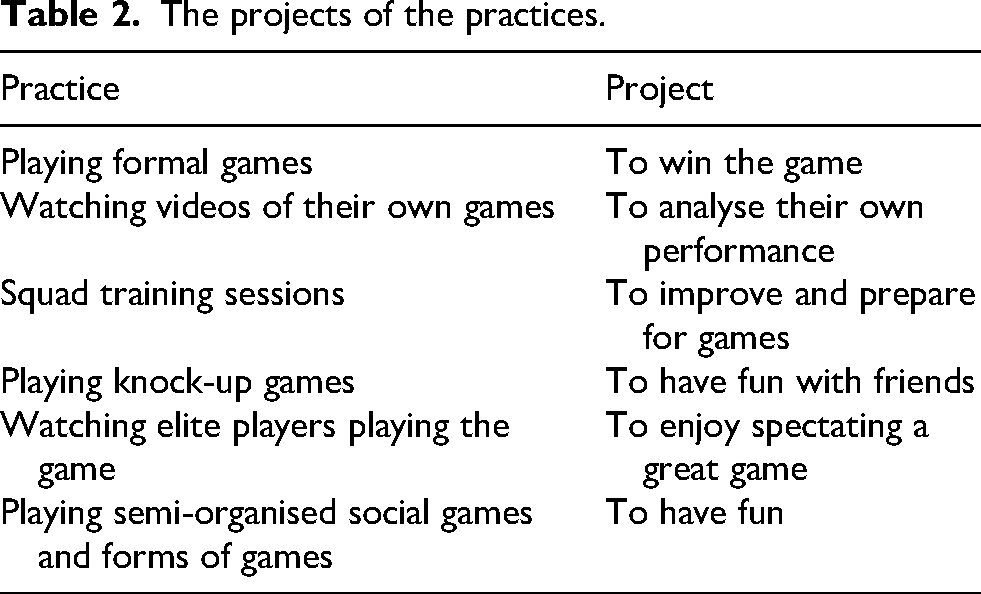
First, each of the six practices outlined in the findings each had their own main project or purpose (see Table 2).
In each site, the project is the telos or rationale for the particular practice, and so to interfere with these is to fundamentally change the nature of the practice (e.g., by asking players in this study to take notes on the elite games they were watching). However, it is important to note that these six practices together form the meta-practice of learning the sport, which has its own project of improving their beach volleyball. Also, the projects of the six practices identified, and the project of the meta-practice are not mutually exclusive, and they can, of course, work together. To this end, a coach can start by engaging with athletes around their different beach volleyball practices while maintaining the integrity of their project. Some possibilities include:
When watching elite games, rather than directing and formalising their learning, ask athletes what they enjoyed about game they watched, and what did they notice about the game. Maybe watch it with them so they can see your enjoyment and passion of the game. Ask if there any skills, plays or techniques that they would like to try. When they watch their own games, ask them what they noticed – what did they do well. And what would they like to work on. When playing social or knock-up games, ask them if there is anything they want to try, or after the game ask them what new things did they try and how did it go? Was it fun?
Second, the project of the broader practice is to improve in beach volleyball, and more specifically in playing the game (albeit that there is more to beach volleyball and what is learned than just playing the game). Now some of the six practices that emerged here are very close to playing the game (e.g., playing formal games in tournaments, playing knock-up games, playing semi-organised social games), and the stand-out practice associated with preparing them for playing the game is training sessions – it has a specific project of improving and preparing for games. Therefore, it would seem appropriate that training session practices, particularly given that learning is coming to practice differently, have practice architectures that resemble those of the game. So, this might mean, during training, the players would engage in movements and skills that solve problems that emerge in game conditions – something that has been promoted through a ‘teaching games for understanding’ 15 approach for many years. For example, a player developing their serving skills would always be serving to an opponent rather than just serving back and forth over the net, or an attacker would play a shot to a set ball against an opposing pair, rather than just hitting tossed balls to spaces defined by cones on the other side of the net. Indeed, in this way the players are developing innovative and effective ways to problem-solve and play in response to game-like conditions and arrangements. Indeed, to be more radical a coach might try something like asking the players in a training session to ‘be the best Swedish volleyball player’ they can be, thus blurring the boundaries between formal training and their other learning experiences. In general, these broad ideas have also been promoted and supported by recent developments in ecological dynamics ways of understanding motor skill development. 14 Perhaps surprisingly, it would seem that making formal learning sites (i.e., training) more like informal learning sites, rather than the other way around, is the key to more effective development in the players’ beach volleyball practices.
Footnotes
Acknowledgements
The author would like to thank Stephen Kemmis, Emily Scott and Kirsten Petrie for reading and giving feedback on this manuscript. There was no financial assistance with this study.

Ethical considerations (including approval number)
Approval was received from the Griffith University Human Ethics committee (number: 2025/617).
Consent to participate
Written informed consent was obtained from the participants and their parents.
Consent for publication
Not applicable
Funding
The author received no financial support for the research, authorship, and/or publication of this article.
Declaration of conflicting interests
The author declared no potential conflicts of interest with respect to the research, authorship, and/or publication of this article.
Data availability
All data generated or analyzed during this study are included in this published article.