






Abstract
This study explored the ratings between coach opinion of ideal training and match volume and frequency, and player practice across the youth female rugby league (RL) pathway. One hundred and eleven players (U12 to U18) completed an online survey reporting frequency and volume of RL training sessions and matches, the weekly duration of time in training modalities and participation in other sports. Coaches (n = 13) reported their opinion on the ideal frequency and volume of RL training/matches, time spent in training modalities and participation in other sports at each age category. Coaches reported that players should complete more rugby training sessions per week than players reported completing, with all coaches recommending at least two session per week at U12 and more than three at U18, whilst most players reported completing two or fewer sessions weekly (p < 0.01, effect sizes 0.56 to 0.87). Players reported greater monthly match exposure than perceived ideal from U12 to U16 (p ≤ 0.03, effect sizes 0.42 to 0.82). Contact training durations frequently exceeded Rugby Football League guidelines (15 to 30 min per week), with 21% to 47% of players exceeding 30 min and 3% to 21% reporting >120 min of full contact training weekly. To optimise player development, players, guardians, and coaches must establish communication networks regarding weekly activities to ensure training modalities are aligned. Contact load guidelines are required to facilitate contact skill development whilst managing player safety, and increased strength and conditioning volume may better prepare players for RL demands.
Introduction
In the United Kingdom, Women's rugby league has seen a 53% increase in participation since 2017. 1 Aligned with the growth of the sport, the Rugby Football League (RFL) has developed the women's age grade community game by introducing under (U) 11 and U18 age groups, in addition to pre-existing age groups (U12, U14 and U16). 1 Despite the growth of the game, research exploring the infrastructure of the development pathway in youth female rugby league (RL) is sparce, with previous literature finding the current development pathway to be an injury risk factor (e.g., lack of academies to help players develop, lack of funding to establish an appropriate pathway and lack of access to facilities) for women who play RL. 2
Youth rugby players often experience highly variable weekly training and match exposures. 3 Understanding the training load of youth athletes is a complex process, as load can be placed on athletes from multiple sports, across multiple environments (e.g., club, school) and in combination with non-sporting stressors (e.g., academic load). 4 Without clear communication between sport programmes, fluctuations in training loads may go unmanaged, leading to negative outcomes such as injury, burnout, or impaired performance. 4 Conversely, multi-sport participation has been associated with a reduced risk of overuse injury during adolescence, suggesting that sports sampling throughout junior and high school years may be protective. 5 These findings emphasise the importance of balancing total training volume, accumulated from all sports a player participates in, to support positive adaptations while minimising injury risk. Whilst there is a growing body of research on women's RL at senior level,6,7 little is known about the training structure of youth female RL players, highlighting the need for further research to inform appropriate, evidence-based training guidelines.
Coaches are central to youth player development, serving as key regulators of training volume, content, and quality. 8 Effective coaching requires balancing performance progression with player welfare through appropriate load management, stakeholder communication, and individualised programming. 9 Coaches should aim to progressively increase training volume and intensity in line with age and competitive level,9,10 using a combination of sport-specific sessions, strength and conditioning (S&C), and technical and tactical training to support holistic development. 11 This follows athlete development models, 9 whereby young athletes (aged up to 12 for girls and 14 for boys) should have a multi-sport approach (sampling), which then transitions into the specialisation years (aged 12 to 18 for girls and 14 to 18 for boys) to focus on one sport. 9 While the developmental pathway in women's RL has been highlighted as a potential injury risk factor, 2 the current training structure of youth female RL players remains unclear. Establishing whether current practices align with coach perceptions of an ideal structure is a critical first step toward evaluating and enhancing the effectiveness of the pathway.
Therefore, this study aims to compare ratings of the ideal frequency and volume of RL training, matches, time spent in training modalities and participation in other sports between coach opinion and the current practice of players across age groups (U12 to U18).
Methods
Study design
Two separate online cross-sectional surveys were administered to RL coaches and players. The coaches survey quantified opinion on the ideal training structure for youth female RL players from U12 to U18. The player survey collected participant demographics and quantified the players current training schedule. The reporting of the surveys in this study followed a consensus-based checklist for reporting of survey studies (CROSS). 12 This study was approved by the universities Research Ethics Committee (126764), with responses secured via online accounts to ensure confidentiality. Written consent was obtained before completion of the surveys, with minors carrying out players assent and parental consent forms prior to completion.
Subjects
Coaches (n = 13) were required to be currently coaching a women's RL team between the U12 and U18 age groups at the time of participation. As some coaches (n = 9) coached more than one age group, the number of coaches at each age group were one at U12, one at U13, seven at U14, four at U15, one at U16 and two at U18. Coaches detailed previous experience with six having coached at U12, nine at U13, eight at U14, two at U15, two at U16 and four at U18. Four coaches had a level 1 RL coaching qualification, 11 coaches had a level 2 RL coaching qualification, whilst one coach did not have any RL coaching qualifications.
One hundred and eleven women's / girl's RL players completed the players survey, nine at U12, 22 at U13, 17 at U14, 34 at U15, 15 at U16 and 14 at U18. Participants were required to be playing in a RL team within the U12 to U18 age groups. Playing age in years at each age group was (median [IQR 25%–75%]) 2.0 (2.0–5.0) at U12, 4.0 (1.8–6.3) at U13, 3.0 (2.0–5.0) at U14, 3.0 (2.0–5.0) at U15, 3.0 (2.0–6.0) at U16 and 4.5 (2.0–10.0) at U18.
Procedures
Surveys
The surveys were designed and distributed using the online software Qualtrics (Qualtrics, Provo, USA). Both surveys were designed and agreed upon by a four-panel member steering committee (TB, JDJ, OH and SS). The surveys were piloted by one player and one coach who were asked to provide feedback (e.g., clarity and time taken to complete). No changes were recommended by participants, and the survey was not amended following the pilot. The UK governing body of the sport, the RFL, distributed the surveys via email to all 78 registered women's RL clubs. In addition, both surveys were promoted via social media encouraging eligible personnel to participate. Recruitment was conducted between April and September 2024. Both surveys were completed voluntarily in the participants own time with names and email addresses required to prevent multiple entries from a single participant. Responses were analysed providing all questions had been answered.
Coach survey
The survey was split into sections and comprised of questions related to i) coaching background (3 questions); and ii) opinions to the optimal training schedule (11 questions). Questions relating to coaching qualifications gave four options, reflecting the four levels of the coaching course. Questions relating to volume of training per week offered five options, from zero to four plus. Questions relating to duration in a training modality gave seven options, starting at 0 to 30 min and increasing by 30 min up to 180 + mins. Questions relating to frequency of matches per month offered six options, from zero to five plus. Finally, questions on the number of other sports played offered four options, from zero to three plus. Coaches were required to complete all questions; the survey consisted of 14 closed questions in total. The survey can be found in supplementary material.
Player survey
The survey comprised of questions related to current training and match demands. The survey consisted of six closed questions and three open optional questions (e.g., what other sports do you play?). Questions offered the same options as the coach's survey to allow comparisons between groups. The survey can be found in supplementary material.
Statistical analysis
Data were collated using Microsoft. (2024). Microsoft Office 365. (2409). [Software]. and analysed using IBM Corp. (2021). IBM SPSS Statistics. (v 29). A Shapiro-Wilks test was used to assess normality. Data were not normally distributed, and survey responses were ordinal in nature, therefore, Mann Whitney U tests were used to determine whether differences existed between coaches’ opinion of the ideal training structure and players’ current practice. Data are presented as the percentage of responses within each category, alongside U statistic and mean rank. Effect size was calculated using the following formula:
13
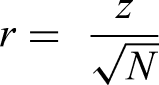
The magnitude of difference was rated as trivial (<0.10), small (0.10–0.29), moderate (0.30–0.49), large (0.50–0.69), very large (0.70–0.89), or nearly perfect (0.90–0.99). GraphPad Prism (v10) was used to create figures for data presentation.
Results
Rugby league training
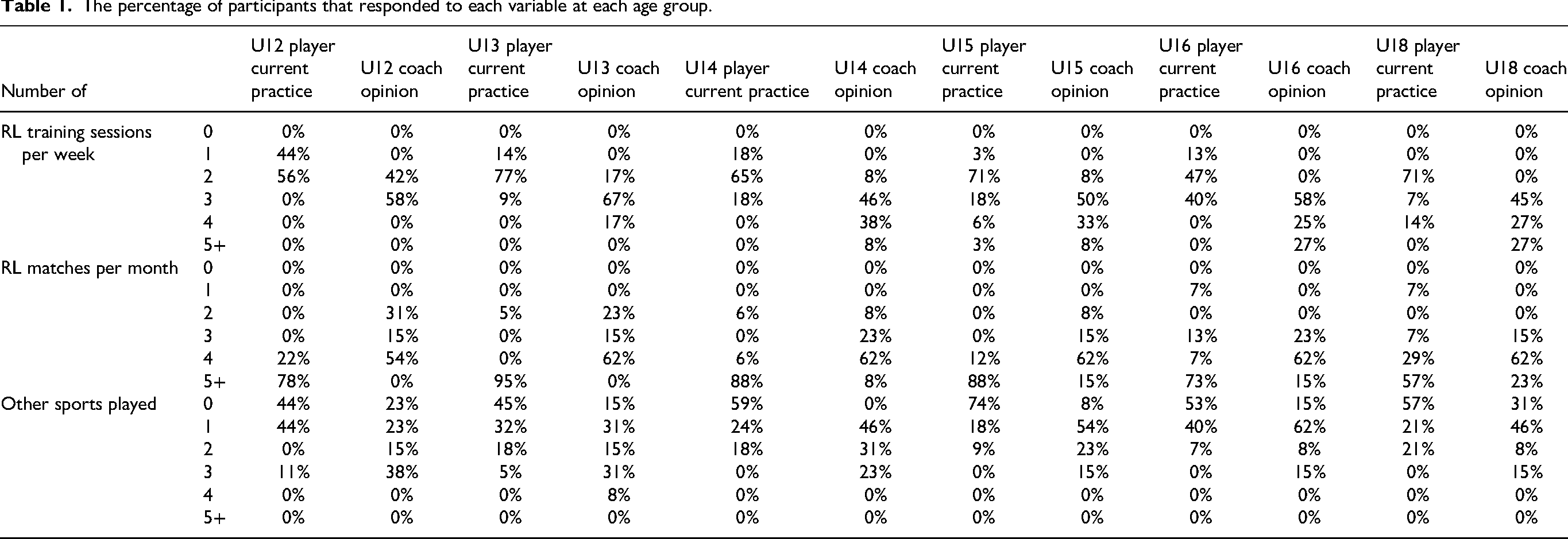
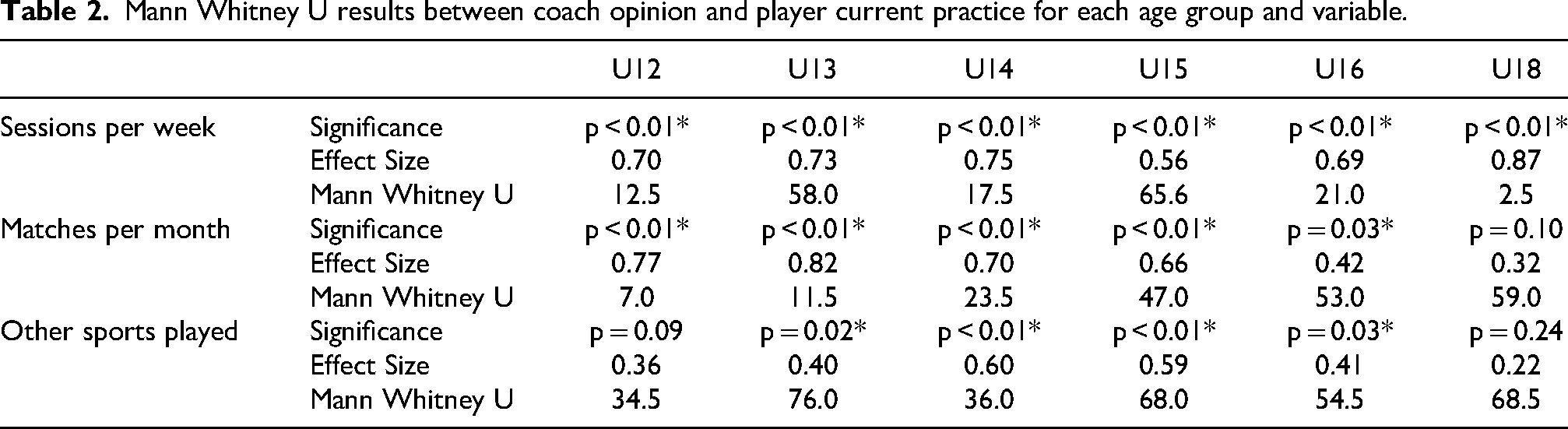
The percentage distribution of weekly RL session frequency reported by coaches as ideal, and by players as current practice, across the U12 to U18 age groups are presented in Table 1.There were large to very large significant differences between what coaches reported as ideal training frequency and players reported as current practice across all age groups, with coaches indicating players should be participating in more RL training sessions per week than they currently are.
The percentage of participants that responded to each variable at each age group.
Match participation
The percentage distributions of monthly RL match frequency reported by coaches as ideal and by players as current practice across U12 to U18 age categories are shown in Table 1. There were moderate to very large significant differences between coach reported ideal match frequency and player reported current practice from U12 to U16. Whereas no significant differences were observed at U18. Overall, a greater percentage of players reported higher monthly RL match frequencies than coaches rated as ideal across the younger age groups.
Participation in other sports
The percentage distributions for participation in other sports reported by players, and the number of other sports coaches rated as ideal across U12 to U18 age categories are shown in Table 1. There were moderate to large significant differences between coach rated ideal participation and player reported current practice from U13 to U16, whereas no significant differences were observed at U12 or U18. Overall, a greater percentage of coaches reported that players should participate in multiple sports compared with players reported current participation.
Training modalities
Figures 1 and 2 provide a comparative overview of player current practice and coach opinion across different age groups (U12 to U18), regarding time spent in different training modalities. The amount of time players spent in full contact training did not significantly differ to what coaches reported they should be participating in at U12 (p = 0.64, effect size 0.22), U13 (p = 0.12, effect size 0.26), U14 (p = 0.98, effect size 0.00), U15 (p = 0.88, effect size 0.02), U16 (p = 0.77, effect size 0.06), and U18 (p = 0.18, effect size 0.26). The amount of time players spent in controlled contact training did not significantly differ to what coaches reported they should be participating in at U12 (p = 0.31, effect size 0.22), U13 (p = 0.40, effect size 0.14), U14 (p = 0.40, effect size 0.15), U15 (p = 0.39, effect size 0.06), U16 (p = 0.76, effect size 0.06), and U18 (p = 0.05, effect size 0.38). The amount of time players spent in wrestle training did not significantly differ to what coaches reported they should be participating in at U12 (p = 0.15, effect size 0.31), U13 (p = 0.77, effect size 0.05), U14 (p = 0.70, effect size 0.07), U15 (p = 0.18, effect size 0.20), U16 (p = 0.38, effect size 0.17). However, there was a significant difference between coaches’ opinions and players actual time spent in wrestle training at U18 (p = 0.18, effect size 0.26), with coaches indicating they should be participating in more wrestle training than they currently are. The amount of time players spent in tactical and technical training did not significantly differ to what coaches reported they should be participating in at U12 (p = 0.22, effect size 0.27), U13 (p = 0.13, effect size 0.25), U14 (p = 0.21, effect size 0.23), U15 (p = 0.16, effect size 0.21), U16 (p = 0.55, effect size 0.11), and U18 (p = 0.63, effect size 0.10). The amount of time players spent in S&C training did not significantly differ to what coaches reported they should be participating in at U12 (p = 0.05, effect size 0.42), U13 (p = 0.95, effect size 0.10), U14 (p = 0.09, effect size 0.32), and U18 (p = 0.74, effect size 0.06). However, there was a significant differences between coaches’ opinions and players actual time spent in S&C training at U15 (p < 0.01, effect size 0.42) and U16 (p = 0.01, effect size 0.46) age categories, with coaches indicating they should be participating in more S&C training than they currently are across both age groups.
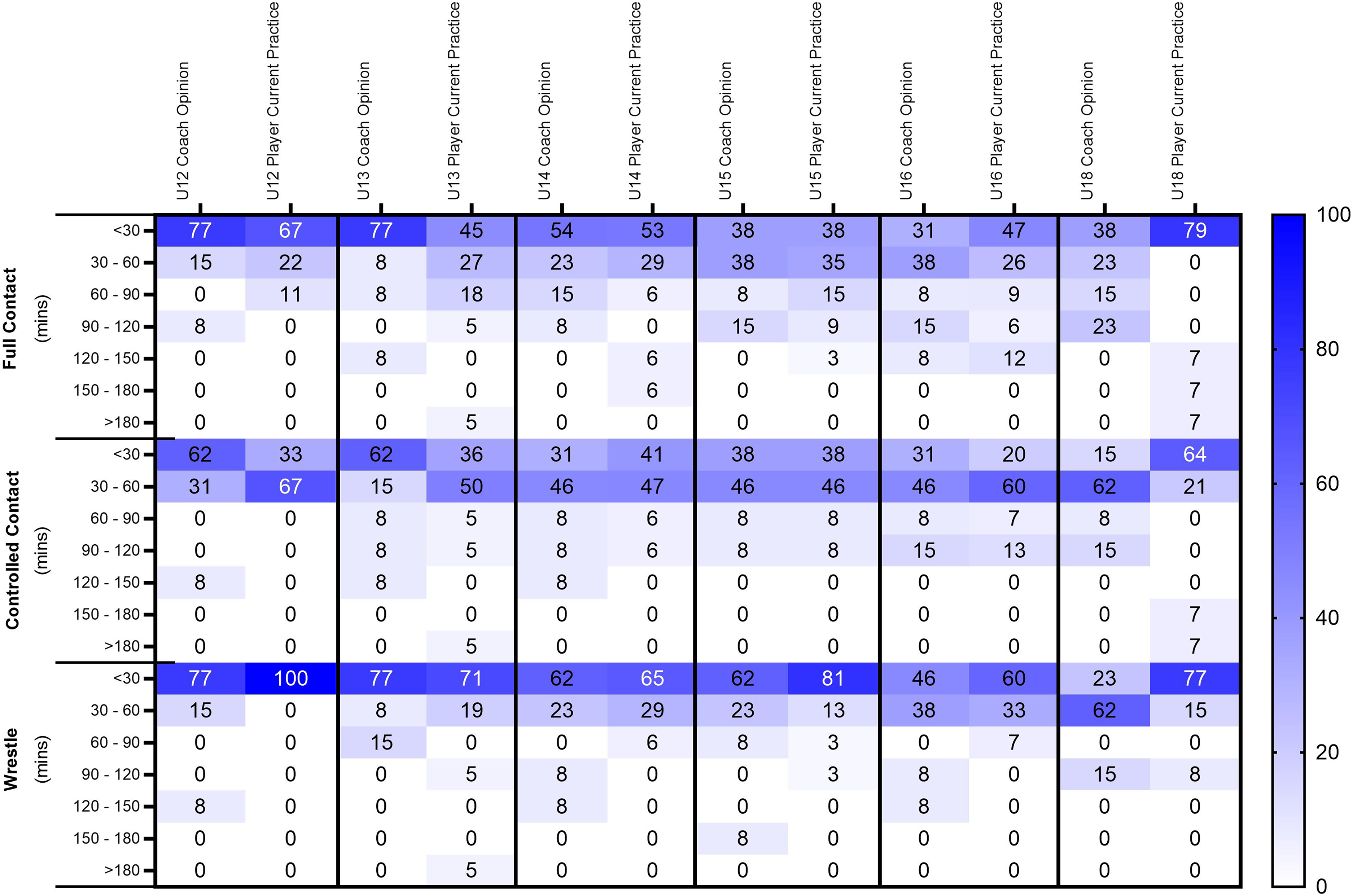
The percentage of participants in each time period per week for coaches’ opinion and player current practice for variations on contact training.
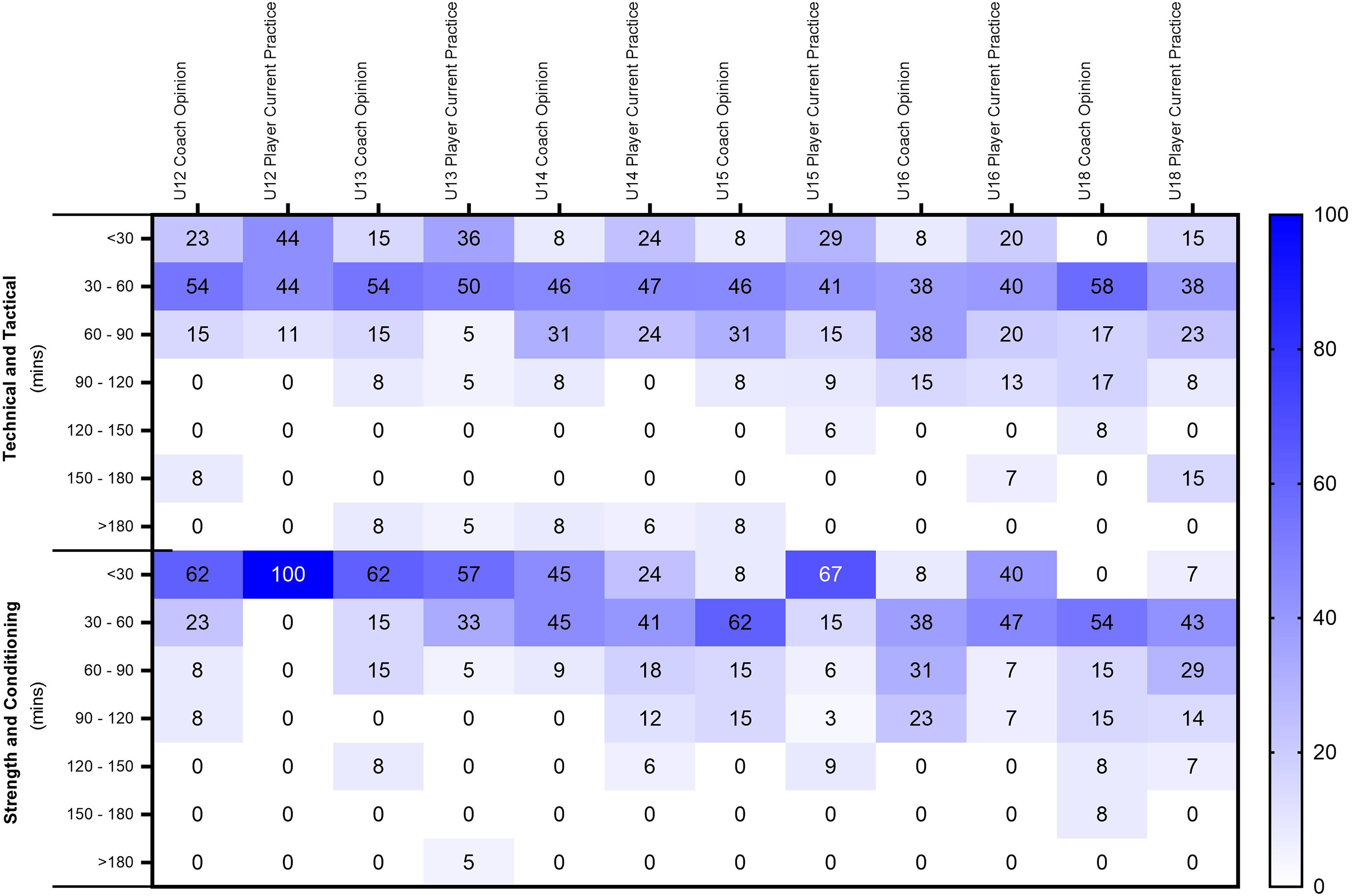
The percentage of participants in each time period per week for coaches’ opinion vs player current practice for tactical and technical training and strength and conditioning training.
Discussion
This study aimed to explore ratings between coach opinion and player current practice levels across youth female RL age groups (U12 to U18). Focussing on the ideal frequency and volume of RL training; matches; time spent in training modalities; and participation in other sports. There was a lack of alignment between coaches’ opinions of the ideal training structure and the actual training practices across age groups, highlighting the need for better coordinated development pathways that provide appropriate training opportunities while managing overall athlete load. A key finding of this study is that contact training practices showed a lack of consistency with RFL guidelines, with 21 to 68% of players from U12 to U18 exceeding the advised 15 to 30 min of full contact training per week 14 by 30 to 150 min. Although these guidelines were developed for senior players, the findings demonstrate substantial variation in contact exposure across youth female RL. Given that the tackle is the predominant cause of injury in women's RL, 15 improved guidance and education are required to support appropriate contact exposure, technical development, and player welfare.
Between 60% (U16) and 100% (U12) of players across the U12 to U18 age groups completed ≤2 RL training sessions per week. In contrast, between 58% (U12) to 100% (U16) of coaches indicated that players should participate in ≥3 session per week at U12-U16, increasing to 50% reporting ≥4 sessions per week as ideal at U18 (Table 1). This training frequency is lower than that previously reported in adolescent male rugby union players (6.6 ± 2.0), 15 and may reflect differences in development pathway opportunities between the sexes, with the male pathway better equipped to support a greater training volume than the female pathway. Between 26% (U15) and 56% (U12) of youth female RL players participated in at least one or more additional sports. Participation in multiple sports through sampling is recommended for female players up to 12 years of age to promote physical and psychological benefits, 16 after which specialisation is advised. 17 However, as players progress through age categories (i.e., U13 – U18), they are advised to increase the number of RL sessions they participate in per week. Furthermore, RL clubs should facilitate additional training for players through the provision of staff and facilities as both have been identified as barriers to development in women's sport. 18
Coaches reported that match exposure should increase across age categories, although players participated in significantly more matches per month than coaches reported to be ideal from U12 – U16 (Table 2). This increased match frequency may reflect participation across multiple teams or sporting environments, such as club, school, and representative programmes as previously shown in academy rugby union. 19 These findings emphasise the importance of communication between players (or guardians) and coaches to coordinate total training and match loads, manage fatigue, and reduce the risk of negative outcomes such as overtraining and injury. 4
Mann Whitney U results between coach opinion and player current practice for each age group and variable.
A moderate significant difference was observed between coach opinion and the volume of wrestle training completed at U18 (z = −2.47, p = 0.02), with players completing less wrestle training than coaches reported as appropriate. No other significant differences were found between coach opinion and player practice for full contact, controlled contact and wrestle training. However, 33% (U12), 55% (U13), 47% (U14), 62% (U15), 53% (U16), and 21% (U18) of players engaged in 30 min or more of full contact training per week. Appropriate management of contact exposure is important given that the tackle is the leading cause of injury, concussion, and head acceleration events in RL.2,7 Furthermore, poor tackle technique has been identified as the most important and feasible to manage injury risk factor in women's rugby league. 2 Therefore, further research is required is establish age-appropriate contact load guidelines for youth RL players that support both player development and player welfare in youth female RL
Moderate significant differences were observed between coach opinion and weekly participation in S&C at U15 and U16 (z = −2.84, p < 0.01 and z = −2.46, p = 0.01 respectively), with players in the U12 to U16 age groups typically completing less than 60 min of S&C training per week (Figure 2). This is lower than the recommendations for youth athletes, 20 and below the volumes reported in, senior women's players in the rugby codes who complete two resistance training sessions per week, lasting between 45 to 60 min, during the season. 21 This highlights an area of focus for coaches to enhance the physical development of players. However, factors such as limited access to S&C facilities and qualified staff may contribute to the lower than recommended S&C exposure. 2 Despite this, enhanced physical qualities such as strength, power, and speed are known to differentiate playing standards at the senior level, 6 emphasising the importance of increasing S&C training volumes for youth female RL players. No significant differences were found between coach opinion and player practice for tactical and technical training, although weekly durations in younger age groups (U12 to U14) remained below 60 min. Older age groups (U15 to U18) demonstrated greater variability, with training durations reaching up to 180 min per week (Figure 2). Collectively, these findings highlight inconstancies in training exposure across the youth female RL pathway and the need for more structured, evidence informed training practices.
Limitations
The 13 coaches who participated in the study represent 3.3% of the 392 registered youth female coaches, meaning the perspectives captured may not be representative of national coaching practice, limiting the generalisability of the findings. Despite this lower representation, this is the first study to investigate the perspectives of youth female RL coaches, and these insights are critical to performance and safety initiatives for young female players. Whilst definitions were provided for each training modality, training exposure data were self-reported by both players and coaches, which introduces potential recall inaccuracies in how training categories (e.g., full and controlled contact) were interpreted. The cross-sectional design provides a snapshot of current practice, preventing consideration of seasonal variation in training structure. Future research addressing these limitations through objective monitoring methods, longitudinal study designs, and a broader coach sample would help to better inform evidence-based training recommendations for girls’ and women's rugby league.
Conclusions
This study identified a lack of alignment between coach opinions and the current training practices of youth female RL players across training frequency, match exposure, contact training, and S&C participation. Coaches generally reported that players should undertake greater rugby-specific and S&C training than is currently occurring, while match and contact exposure varied substantially across age groups. These findings suggest that current practices within the youth female RL pathway are inconsistent and may not optimally support player development. Improved communication between coaches, players, guardians, and sporting programmes, alongside greater access to structured training opportunities, may help better support the long-term development and welfare of youth female RL players.
Practical applications
To support the development and performance of youth female RL players, first, a clear communication network between players (and their guardians), coaches and affiliated sports programs is required to align training loads across separate programs (e.g., RL club and other sports clubs). Secondly, appropriate contact training guidelines need to be established for youth female RL players regarding training volumes. Third, clubs should facilitate greater exposure to structured S&C training by providing and / or investing in better facilities and staff. Finally, targeted coach, player and guardian education, particularly in contact management, physical preparation, and scheduling will be vital to safeguarding health while supporting the growth and performance of youth female players within the RL system.
Supplemental Material
sj-pdf-1-spo-10.1177_17479541261466495 - Supplemental material for Coaching ideals vs reality; exploring the alignment between coach perception and the actual training and match schedules of youth female rugby league players
Supplemental material, sj-pdf-1-spo-10.1177_17479541261466495 for Coaching ideals vs reality; exploring the alignment between coach perception and the actual training and match schedules of youth female rugby league players by Thomas Briscoe, Josh Darrall-Jones, Omar Heyward, Stuart Barrow and Sean Scantlebury in International Journal of Sports Science & Coaching
Supplemental Material
sj-pdf-2-spo-10.1177_17479541261466495 - Supplemental material for Coaching ideals vs reality; exploring the alignment between coach perception and the actual training and match schedules of youth female rugby league players
Supplemental material, sj-pdf-2-spo-10.1177_17479541261466495 for Coaching ideals vs reality; exploring the alignment between coach perception and the actual training and match schedules of youth female rugby league players by Thomas Briscoe, Josh Darrall-Jones, Omar Heyward, Stuart Barrow and Sean Scantlebury in International Journal of Sports Science & Coaching
Footnotes

Ethical considerations
This study was approved by Leeds Beckett Universities Research Ethics Committee (126764).
Consent to participate
Written informed consent and parental assent (where applicable) was obtained before the completion of the surveys.
Consent for publication
Not applicable.
Funding
The authors received no financial support for the research, authorship, and/or publication of this article.
Declaration of conflicting interests
The authors declared no potential conflicts of interest with respect to the research, authorship, and/or publication of this article.
Supplemental material
Supplemental material for this article is available online.
References
Supplementary Material
Please find the following supplemental material available below.
For Open Access articles published under a Creative Commons License, all supplemental material carries the same license as the article it is associated with.
For non-Open Access articles published, all supplemental material carries a non-exclusive license, and permission requests for re-use of supplemental material or any part of supplemental material shall be sent directly to the copyright owner as specified in the copyright notice associated with the article.
