







Abstract
This study explored how cultural context influences news content by comparing American and Swedish news about the Iraq war in 2003. Using a theoretical foundation derived from the works of Hall (1980, 1997) and Hofstede (1979, 1980, 1991), a theme analysis of television and print news was conducted. The results revealed that the war was portrayed differently in the two countries and that emphasis was placed on different aspects. American media focused on military strategy, interpreted the war from the troops’ perspective, and explained it as the US bringing freedom to the Iraqi people. Swedish media interpreted the war from the international community’s and the suffering Iraqi civilians’ points of view and explained it as a failure of the international community. As hypothesized, American media had comparatively more masculine content while Swedish media had comparatively more feminine content. Findings suggest that culture is an important variable that should be considered when studying news production and coverage.
Keywords
Introduction
Most people depend on the news to inform them about what is taking place in the world. The more distant the event, the fewer opportunities generally exist to acquire information from other sources. As a result, people’s view of the world and knowledge of foreign affairs become pieced together largely from news reports in the media (Greenberg and Gantz, 1993; Kellner, 2003).
Culturally and geographically separated from the circumstances surrounding an international event, the news audience has to educate itself about situations that are often highly complex based on very limited information. Although audiences are found to be skeptical about the accuracy of the news (Fry, 1985), international news, plays an important role in shaping public perceptions and opinions of political issues (Lin, 2006), which in turn influences public policy and political processes (Asp, 1980; Carlsson et al., 1982; Patterson, 1994). Because of its central role, it is important to consider the factors that shape international news reporting.
News producers want their audiences to think that the news text is a close representation of the event it describes. Producing news is a process of competing influences, however, and the final product is shaped not only by technical transformation and journalistic decisions, but also by cultural factors. Bennett (1996: 9) said, ‘Viewing the news as a human construction makes it easier to see that every society constructs its public information differently, and that each system contains different limits or problems.’
Fiske (1989: 1) defined culture as ‘the constant process of producing meanings of and from our social experience’ and Hall (1996: 437) as ‘the actual grounded terrain of practices, representations, language and customs of any specific historical society as well as the contradictory forms of common sense which have taken root in and helped to shape popular life’. Culture may be viewed as a framework that incorporates values, beliefs and meanings that people use to orient themselves in relation to one another and the rest of the world.
Most news media are grounded in the core values of a particular nation (Neuman et al., 1992) and are instrumental in cultivating national identity (Blumer, 1992; Gitlin, 1995; Hadenius, 1992). Schudson (1995: 14) described news as a cultural narrative ‘produced by people who operate, often unwittingly, within a cultural system, a reservoir of stored cultural meanings, and patterns of discourse’. Gurevitch et al. (1993: 207) argued that for an event to be judged newsworthy it must be ‘anchored in narrative frameworks that are already familiar to and recognizable by newsmen as well as by audiences situated in particular cultures’. Gans (1979) found that ethnocentrism is one of the most significant elements of US news coverage of foreign policy and international events, and that editors often favor stories featuring commonly held American democratic ideals and cultural values. There is no reason to assume that these tendencies are limited to the US. Similar findings have been reported by Hafez (2000), Hickey (2002) and Clausen (2003). Yet, with few exceptions, cultural factors have largely been ignored when considering influences on the news process.
One of the most effective ways to analyze cultural influences on news is to compare the news coverage of an international event in two or more different countries. Hanitzsch (2008) found, however, that tailor-made, comparative cross-cultural studies are rare. In an attempt to fill this research gap, this study compared Swedish and American television and print news about the war in Iraq in 2003.
International wars typically generate a great deal of communication research, and the Iraq war was no exception (Compton, 2004; Dimitrova et al., 2005; Entman, 2004; Hiebert, 2003; Kull et al., 2003; Lin, 2006; Nord et al., 2003; Pfau et al., 2004; Tumber and Palmer, 2004). Although several studies have compared the war coverage in different nations (Aday et al., 2005; Dimitrova and Strömbäck, 2005; Kim and Jang, 2004; Walgrave and Verhulst, 2005), the ones that focus on cultural differences are the exception (Ghanem, 2006).
Edelstein (1983: 309) recommended that countries that are ‘terribly dissimilar’ should not be included in comparative analyses, and neither should countries that are too much alike. Sweden and the United States fit his criteria as two nations that are similar enough yet different enough to compare. Like in other western societies, mass media play a central role in both Sweden and the US (Hardt, 1979). Print media, in particular, have downplayed their historical political affiliations and embraced the ideal of objectivity. In Sweden, party affiliations are mostly disclosed on the editorial pages (Hadenius and Weibull, 2003). Sweden and the US are among the highest ranking nations in terms of press freedom (Stephens, 1991: 55) and journalists in both countries are highly professionalized and have systems for self-regulation in place (Dimitrova and Strömbäck, 2005; Hallin and Mancini, 2004). Concentration of ownership is a concern in both countries, although the owners typically exercise their influence indirectly (Bagdikian, 2000; Sundin, 2002). Another concern is political press management, where political players seek to control the media content. This is common practice in the US (Bennett, 1996; Gans, 1979; Hallin, 1994a; Iyengar and Simon, 1994) and several Scandinavian studies have indicated that politicians in these countries also adjust their work to appear more entertaining and personable on television (Asp and Esaiasson, 1996; Harmanen, 1999; Hvitfelt, 1996; Nord and Strömbäck, 2002). News media in both countries operate by a similar set of institutional criteria that determine which events are deemed newsworthy, referred to as news values (Galtung and Ruge, 1965; Gans, 1979; Hvitfelt, 1985; Larson, 1984; Nord and Strömbäck, 2002; Rosengren, 1974).
There are, however, also notable differences between the two countries. The US is arguably the most powerful nation in the world – Sweden is a small country of merely 9 million people. Although both countries are frequently involved in international peace negotiations, the US is often directly involved in armed conflicts, while Sweden has not been at war since 1814.
Politically, the two countries have different governmental structures, party and election systems and different citizen expectations about the nature and responsibilities of government (Åsard and Bennett, 1997; Dimitrova and Strömbäck, 2005). The media systems also differ. The US has a highly commercialized broadcast system (Bennett, 1996; Hallin and Mancini, 2004), whereas Sweden’s broadcast sector is built on a strong public service tradition and did not include commercial television until the late 1980s (Blumer, 1992; Djerf-Pierre and Weibull, 2001; Hvitfelt, 1996; Jönsson, 2004; Nord and Strömbäck, 2002, 2003).
Swedish journalists have been found to be more politically motivated than their American counterparts, more openly partisan, and more likely to embrace the watchdog role (Asp and Esaiasson, 1996; Carlsson et al., 1982; Donsbach and Patterson, 2004; Fjaestad and Holmlöv, 1976; Gans, 1979; Hvitfelt, 1996; Johnstone et al., 1976). Studies have also shown that the journalistic ideal of objectivity is interpreted differently in the two countries. Most Swedish journalists consider it their duty to go beyond the statements of opposing parties to disclose the hard facts of underlying issues and to critically monitor the political elite. As a result, they tend to interview a broader range of sources representing different perspectives (Johnsen and Mathiesen, 1992; Paraschos, 1991; Patterson, 1994; Westerstål and Johansson, 1986). In the US, professional norms of neutrality create conditions that favor the reporting of narrow, official perspectives. American journalists display little diversity in their decisions about whom to interview and thus homogenize the political content (Bennett, 1996; Bennett and Paletz, 1994; Patterson, 1994; Shoemaker and Reese, 1996; Vincent, 1992).
War reporting
The media’s ability to balance press freedom with social responsibility is frequently brought into question, especially during times of war when national security is at stake. Several scholars have voiced concerns over the relationship between the US media and military, in particular (Hvitfelt, 1992; Kellner, 1993; Massing, 1992; Nohrstedt, 1992; O’Heffernan, 1993; Wolfsfeld, 1997). Pool de Sola (1973: 129) wrote: ‘No nation will indefinitely tolerate a freedom of the press that serves to divide the country and to open the floodgates of criticism against the freely chosen government that leads it.’ American journalists tend to abstain from critical analysis and accept censorship when they believe it protects vital national interests (Dimitrova and Strömbäck, 2005; Nord and Strömbäck, 2002: 53). There is also a tradition within US media to rally behind the president during times of war. Criticizing the president is viewed as unpatriotic and unsupportive of the troops (Hallin, 1986). A former journalist and friend of the author confided, ‘When we’re at war, we’re Americans first and journalists second.’
It is also very difficult for journalists to gather information in a war zone and to verify its accuracy without leaning heavily on sources within the government. The Gulf war in 1991 was criticized for being highly censored by the American government in numerous studies (see, for example, Bennett and Paletz, 1994; Hallin, 1994b; MacArthur, 1993; Mowlana, 1992; Smith, 1992; Taylor, 1992; Vincent, 1992). Kalb (1994), voicing concerns over the effects of censorship and controlled access wrote: From whom, if not from the press, are the American people to get information on which to base an intelligent decision on the worthiness of a particular war, or the soundness of their government’s strategies and policies, or the actual conditions on and above the fields of combat? (Kalb, 1994: 4)
When Operation Iraqi Freedom appeared on the television screen, the news media were endorsing the administration’s claims and motives for the war (Jensen, 2004). Hiebert (2003) argued that the US government used strategic communication to influence the media coverage and thus rally support for the military action and Pfau et al. (2004) suggested that embedded reporters acted as patriotic advocates who provided the government with third-party assessments of the war. Hess and Kalb (2003) expressed concerns about a variation of the Stockholm syndrome with embedded journalists starting to identify with the soldiers, thus losing their professional detachment. The Swedish commercial television news program aired similar views (Nyheterna, 27 March 2003). Swedish public service television’s producers did not send embedded reporters because they were concerned about censorship, limited access to information and committing their resources for an extended period of time (B Persson, 21 January 2004, personal communication).
Nord and Strömbäck (2003) found that the Swedish coverage of the attack on the US in 2001 and the subsequent war in Afghanistan was fairly neutral and without any identifiable ideological stance toward the US. There was, however, a problem with the quality of the reporting, such as use of anonymous and unidentified sources, dominance of elite sources, interpretations in place of facts, and speculations. (Djerf-Pierre and Weibull, 2001; Nord and Strömbäck, 2002).
Sweden had a minor stake in the events leading up to the Iraq war through the UN’s Chief Weapons Inspector Hans Blix, who is a Swede. There was, however, a great deal of difference in public opinion about the war in the two countries. Over 80 percent of the Swedish people were opposed to US military action (Dagens Nyheter, 21 March 2003). In the US, there was more vocal opposition before 2003 when Saddam Hussein was linked to weapons of mass destruction (WMDs). The percentage of Americans in favor of the war increased from 59 percent during the pre-war period to 72 percent once the war was in progress (Pew Research Center, 2003).
Although it is important to consider the differences between the US and Sweden in terms of the political systems, the structure of the media systems, journalistic practices, participation in and opinion about the Iraq war, it may be argued that these differences stem from the cultures of these two countries.
Cultural influences on the news
When considering how culture influences the news portrayals of world events as they are reported through the media, it is important to first recognize that meaning is produced and negotiated through the use of language. Language uses signs and symbols such as sounds, written words, facial expressions, gestures, images, musical notes and objects to represent concepts, ideas and feelings. Hall (1997) described language as a representational and signifying system. Visual signs and images bearing a close resemblance to the things they refer to are also signs because they carry meaning and need interpretation. Meaning, when viewed as culturally determined, is never fixed and is not intrinsic to the signs and symbols used in communication but is always negotiated and contested. Hall (1997) suggested that meaning has less to do with accuracy and truth than with effective exchange or translation, which facilitates communication. The process of assigning meaning is thus double-sided, interactive and dialogic, with speaker and hearer, writer and reader, as active participants, using language as a means to reach mutual understanding but with no guarantees that this is achieved. Lippmann (1965) provided insight into this chaotic process, stating:
For language is by no means a perfect vehicle of meanings. Words, like currency, are turned over and over again, to evoke one set of images today, another tomorrow. There is no certainty whatever that the same word will call out exactly the same idea in the reader’s mind as it did in the reporter’s. (Lippmann, 1965: 42)
Hall’s (1980a) model of encoding and decoding provides a useful theoretical framework for the study of international news, as it emphasizes media’s ideological nature, the linguistic structure of their content and the active role of the audience (Hall, 1980a: 118). Hall saw media texts as located between their producers, who frame meaning in a certain way by applying a code, and their audiences, who decode the meaning according to their social situation and frames of interpretation. He contended, ‘There is no “message” that is already there in reality, that reality possesses exclusively and unproblematically, that language and other media systems, as transcriptive relay systems, can simply transpose into the blank minds and consciousness of their receivers’ (Hall, 1989: 47).
The encoding process starts when a historic event is transformed into a story and subjected to the complex, formal rules of language and media. The mediated message is produced through the institutional structures, practices, organized relations and technical infrastructures of the media and is framed by meanings and ideas, the routines of news making, historically defined technical skills, professional ideologies, institutional knowledge, definitions and assumptions.
Hall (1980b) did not imply that mass media audiences have to share the meanings encoded into the (written or audio-visual) texts by their producers. The model recognizes three hypothetical audience perceptions or decoding patterns, referred to as readings. Although Hall did not attempt to develop the encoding/decoding model further, the decoding aspect came to receive a great deal of attention by cultural studies scholars such as Morley (1986), who elaborated on Hall’s model.
Cultural values and dimensions
A common method for comparing two cultures is to use dimensions of cultural variability, in which values play an important role in explaining cultural differences. Hofstede (1979) developed four cultural dimensions in his original study involving 40 different nations: power distance, uncertainty avoidance, individualism and masculinity. While the US and Sweden align closely on the first three dimensions, the fourth dimension, masculinity, captures some of the most prominent differences between American and Swedish cultures. Compared to a mean of 50, the US scored 62 and Sweden only 5, the lowest score of all. The masculinity index incorporates values such as assertiveness, success, decisiveness, ambition, independence, the prevalence of money and things, economic growth, differentiated gender roles, male domination, performance orientation, excelling, admiration for what is big and fast, and sympathy for achievers.
Femininity, by contrast, incorporates values such as nurturance, caring, benevolence, intuition, interdependence, people, quality of life, protecting the environment, fluid gender roles, gender equality, service, leveling (not trying to be better than others), admiration for what is small and slow, and sympathy for the unfortunate. Hofstede (1980) found a correlation between femininity and smaller populations. He also observed that dominant cultural values are translated into political priorities. He explained: Masculine countries strive for a performance society; feminine countries for a welfare society. In criticisms in the press from masculine countries like USA and Great Britain versus feminine countries like Sweden and the Netherlands and vice versa, strong and very different value positions appear. (Hofstede, 1991: 97)
Highlighting differences between what he referred to as American and European strategic cultures,
Kagan (2003: 3) argued that Europe is ‘moving beyond power into a self-contained world of laws and rules and transnational negotiation and cooperation’, while the US generally favors ‘policies of coercion rather than persuasion, emphasizing punitive sanctions over inducements to better behavior.. .. They want problems solved, threats eliminated’ (Kagan, 2003: 4). He noted also that Americans have an enduring and party-independent view of their nation having a unique place in history and a conviction that their interests and the world’s interests are one and the same. Kagan elaborates on these tendencies by discussing party affiliations in the US: Democrats often seem more ‘European’ than Republicans; Secretary of State Colin Powell may appear more ‘European’ than Secretary of Defense Donald Rumsfeld. Many Americans, especially among the intellectual elite, are as uncomfortable with the ‘hard’ quality of American foreign policy as any European, and some Europeans value power as much as any American. Nevertheless, the caricatures do capture an essential truth: The United States and Europe are fundamentally different today. Powell and Rumsfeld have more in common than do Powell and the foreign ministers of France, Germany, or even Great Britain. When it comes to the use of force, most mainstream American Democrats have more in common with Republicans than they do with most Europeans. (Kagan, 2003: 6)
Research method
In order to explore cultural influences on international news, this study compared Swedish and American television and print news about the Iraq war in 2003. The news texts were seen as mediated messages that are produced through the institutional structures, practices, organized relations and technical infrastructures of the media in accordance with Hall’s (1980a) encoding/decoding model. In the present study the news texts were treated as products of the encoding process. The following research question guided the study:
RQ1: What recurring themes were used in Swedish and American media, respectively, to inform about, describe, explain, visualize, assign meaning to and interpret the war in Iraq?
Furthermore, in the second stage of the analysis, cultural differences between the US and Sweden were conceptualized based on Hofstede’s (1979) masculinity/femininity dimension. Hofstede’s other dimensions do not differentiate as much between American and Swedish cultures. For the context of this study, Hofstede’s (1979, 1980, 1991) descriptions of masculine and feminine values, discussed earlier, were operationalized as masculine content emphasizing: (a) the importance and purpose of the war, (b) the success of the various operations, (c) the goodness of what was accomplished, (d) weaponry, (e) financial aspects, (f) male domination, (g) admiration for what is best, big and fast and (h) individual achievements. Feminine content, by contrast, was operationalized as emphasizing: (a) the international community, (b) alternatives to armed conflict, (c) a pessimistic attitude toward the war, (d) concern for civilians and the well-being of the Iraqi nation, (e) concern for the environment, (f) gender equality, (g) critique of efforts to dominate and excel and (h) sympathy for the unfortunate. In comparing the news coverage, the following hypothesis was tested:
H1: American media will have a higher percentage of news stories with mostly masculine content than Swedish media, while Swedish media will have a higher percentage of news stories with mostly feminine content than American media.
News reports are packaged and presented to fit each particular medium, a process referred to as media logic (Altheide and Snow, 1979). In order to capture the differences in content in two different media, newspapers and television were chosen.
The sample selection was guided by the aim to analyze some of the most widely watched news programs and distributed newspapers, on one hand, and finding cross-nationally compatible units of analysis, on the other. One Swedish public service news program, Aktuellt, with an average audience of 28 percent of the population, was selected along with TV4’s Nyheterna, with an average audience of 20 percent (Carlsson and Facht, 2002: 276). The two largest cable news channels in the US, CNN and Fox News, were selected. Although broadcast television generally has a larger news audience than cable channels (Associated Press, 2003), CNN dramatically increased its audience during the 1991 Gulf war (Vincent, 1992: 182); therefore it was expected that people would again turn to cable due to its extensive coverage. In order to facilitate a fair comparison, two regular prime-time news programs were selected: CNN News Night and the The Fox Report.
The New York Times, which sets the news agenda and serves as a model for American journalism, was chosen along with The Washington Post, the nation’s second most influential newspaper. Dagens Nyheter and Svenska Dagbladet, the largest and third largest Swedish daily papers (Carlsson and Facht, 2002: 86), were selected due to their focus on international news. Although the sample was deemed representative of the two types of media in the two nations, it was not assumed that the findings may be generalized to all newspapers and television programs in the two countries.
The analysis began on 18 March 2003, which marked the beginning of the war in Iraq, and ended with the fall of Baghdad in mid-April. In order to limit the sample to a manageable size, 12 days on which new developments occurred were selected. Since the television evening news typically covered the same events as the papers the following day, the materials were paired up accordingly. The sample included 1829 stories. The unit of analysis was the news story. All regular news articles that dealt with some aspect of the war were analyzed, except articles in the arts and entertainment, business, sports, or local sections, unless they began on the front page. All television reports that dealt with some aspect of the war were analyzed. The typical news story was presented by one reporter and framed by the news anchor. Headlines were considered a part of the main story.
Print articles were analyzed as they appeared in the actual newspapers, and television news programs were recorded and analyzed audio-visually. This approach allowed images to be included as an integrated part of the news story. Foss (1994: 216–17) stressed that the rhetorical function of images is more relevant than the creator’s intended purpose and that their communicative function may be identified by interpreting their physical data. The analysis was thus applied to the story as a whole, including both verbal and visual elements.
The sample was analyzed using a qualitative content analysis, following a model outlined by Altheide (1996), who explained: ‘The goal of qualitative research is to understand the process and character of social life and to arrive at the meaning and process, seeking to understand types, characteristics, and organizational aspects of the documents as social products in their own right’ (Altheide, 1996: 42). Larsen (1991: 122) also stressed the importance of studying a media text as a meaningful whole, arguing that traditional content analyses often segment the text into artificial categories originating outside of the text. Therefore, rather than using a few broad, predetermined categories, the researcher allowed the categories or themes to evolve during the analysis process.
Theme analysis is methodologically related to frame analysis. Frames have been defined as the way mass media organize and present issues and events (Entman, 1991, 2004; Gitlin, 1980), often with attention to ideological or value perspectives (Iyengar and Simon, 1994). Altheide (1996), discussing the similarities and differences in the concepts of frames and themes in media analysis, defined frames as broad thematic emphases of a text, a way of discussing a problem or event. Themes, on the other hand, are more tied to the format used by journalists to tell a story and to link sources to an event, which Altheide saw as mini-frames or points of view, ‘recurring typical theses that run through a lot of reports’ (Altheide, 1996: 30–1).
Kolmer (2008) warned that when a qualitative analysis focuses too much on latent content, reliability is limited. He suggested that ‘researchers should try to base their hypotheses as far as possible on manifest characteristics that offer less difficulties for the analysis, for instance on the topics addressed instead of the frames alluded to’ (Kolmer, 2008: 120). He also cautioned that when the unit of analysis is the whole news story, researchers must be careful not to reduce the content of the stories into simplified and polarized categories in the coding process.
During the course of the analysis, 21 themes evolved. In identifying the main theme, each story was examined in its entirety and careful attention was given to overall content and organization. The headline plays an important role as it represents the editor’s view of the main themes. Images, similarly, are used to illustrate the main ideas in the story, and were therefore analyzed in relation to the verbal message. In television news, the story is often built on the imagery.
In addition to identifying a main theme, each story was also coded for the extent to which the content reflected masculine and feminine values, respectively. At this stage of the analysis, the overall content was compared to the masculine and feminine categories operationalized from the work of Hofstede (1979, 1980, 1991) and coded as mostly masculine, mostly feminine, equally masculine and feminine, or neither.
The author and primary coder is a bicultural individual with dual citizenship, who has lived a significant amount of time in the US as well as in Sweden. The analysis was further tested for inter-coder reliability by having a random sample of 10 percent of the stories recoded by other researchers. The inter-coder composite reliability coefficient, using Holsti’s (1969) formula, was .75.
Finally, a descriptive and non-parametric statistical analysis of the findings was conducted in order to determine frequencies and interdependence.
The Iraq war in Swedish and American media
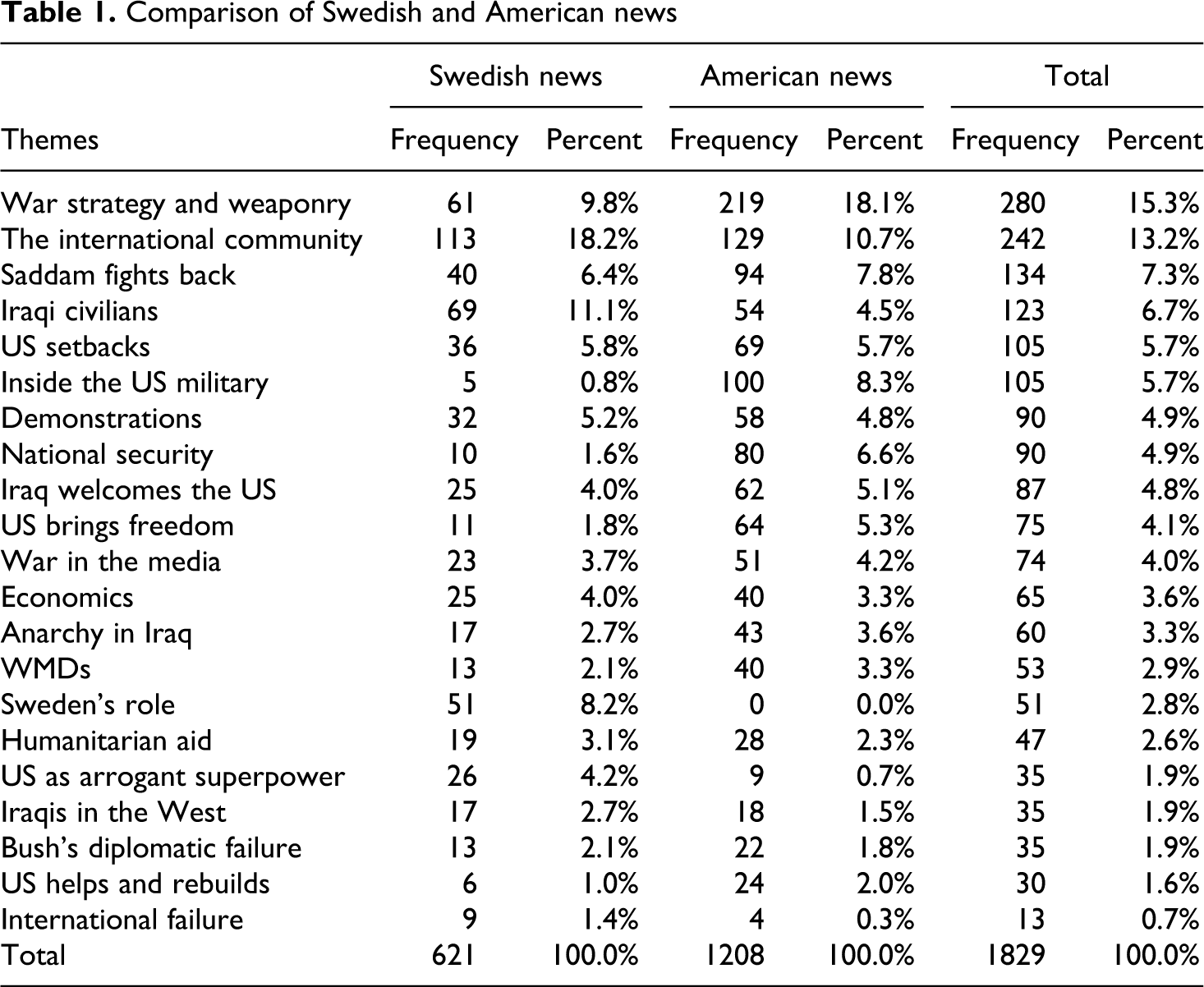
The results of the theme analysis are displayed in Table 1. A brief description of the most commonly recurring themes and main differences in the news coverage in the two countries follows.
Comparison of Swedish and American news
War strategy and weaponry
The theme war strategy and weaponry was the most commonly recurring theme overall and accounted for 18.1 percent of the American news and 9.8 percent of the Swedish news. This theme included descriptions and discussions of the American war plan. The stories focused on the technical side of the war rather than on the political or human side. In general, information on war strategy was almost exclusively available from the Pentagon and Central Command. As a result, the government had a great deal of control over what information was published or broadcast. Other sources included correspondents in Kuwait and Baghdad and embedded reporters.
This theme dominated the television news in both countries. While Swedish television mostly used footage from Iraqi television and some from American television, embedded American reporters provided most of the footage and reports for American television.
The international community
The international community theme included the official reactions of nations other than the US, Sweden and Iraq, as well as accounts of various nations’ level of support, discussions about the role of the United Nations and effects of the war on other nations. Swedish media devoted 18.2 percent of their news to this theme, American media 10.7 percent. It was the dominant theme of Swedish newspapers and assumed a shared third place on Swedish television.
With 14.1 percent of the print news dominated by this theme, it was the most prominent theme in American newspapers as well. It only accounted for 4.9 percent of the American television news. The international community theme thus mirrored the war strategy and weaponry theme in that it dominated the Swedish media and appeared primarily in newspapers in both countries. The print medium was better suited for providing an international perspective on the war.
Iraqi civilians
One category of news stories emphasized how the war impacted Iraqi civilians and sought to relay their fear, uncertainty and lack of resources. The category included accounts of civilian casualties, injuries, and attitudes toward the war expressed by Iraqis. This was the second most commonly recurring theme in Sweden, dominating 11.1 percent of the Swedish news. It was more common in television reports than in newspapers. In Aktuellt, the theme was predominant in 18.1 percent of the stories, many of which were provided by a Norwegian freelance journalist who remained in Baghdad during the war. She also wrote articles for Dagens Nyheter. In American news, the theme Iraqi civilians accounted for only 4.5 percent of the stories. Here, the theme was evenly distributed across the two types of media.
The limited access to information and the dangers associated with moving about Baghdad during the war probably explains the relatively small number of stories about Iraqi civilians in both countries but hardly the discrepancies in the amount of coverage. Obviously, it was harder for political reasons for the American news organizations to keep journalists in Baghdad. CNN’s Nic Robertson, for example, was deported a few of days into the war. Some of the print journalists had Arab names and may have been local freelancers.
The worst kind of news for a country waging war is civilian casualties, and American media may have also wanted to protect their audiences. Swedish media did not report any major event involving Iraqi casualties that the American media omitted. Sweden simply covered the events in greater detail and included more stories about locals throughout the war.
It should also be noted that the Swedish news stories involving civilians focused on the suffering of the Iraqi people caused by coalition forces rather than on the suffering caused by Saddam Hussein, whereas American media more often incorporated information about Hussein’s human rights violations.
Swedish and American perspectives on the war
The theme Sweden’s role only appeared in Swedish media, for obvious reasons. The theme captured statements about the war made by political leaders and government officials, discussions about Swedish weapons exports to the US and Britain, and possible security implications for Sweden. It also addressed Sweden’s contributions of humanitarian aid, Hans Blix’s role, and opinion polls. Swedish media framed the war for their audiences, providing a sense that Sweden was somehow involved. A similar theme from an American perspective was national security, which dealt primarily with anticipated threats to the American mainland because of the war, attitudes and opinion polls among Americans and effects of the war on the population, particularly military families.
Inside the US military was also largely an American theme. American media had committed a significant amount of resources to reporting about the war from within the military by embedding reporters. In addition to reporting on strategy and weaponry, discussed earlier, they also provided details about the troops’ experiences and life in the military. It was particularly evident the first few days before the war started that the embedded reporters did not have much to contribute that would qualify as newsworthy material under any normal circumstances.
Masculinity and femininity in Swedish and American news
It was expected that American media would have a higher percentage of news stories with mostly masculine content than Swedish media and that, conversely, Swedish media would have a higher percentage of news stories with mostly feminine content than American media. Results of a chi-square test indicated that the hypothesis was supported (χ2 (d.f. = 3) = 30.17, p < .001). As shown in Table 2, American news stories had mostly masculine content, 54.4 percent compared to 40.9 percent of Swedish news stories. Conversely, 35.7 percent of Swedish news stories had mostly feminine content, compared to 26.8 percent of the American stories.
Masculine and feminine content of Swedish and American media
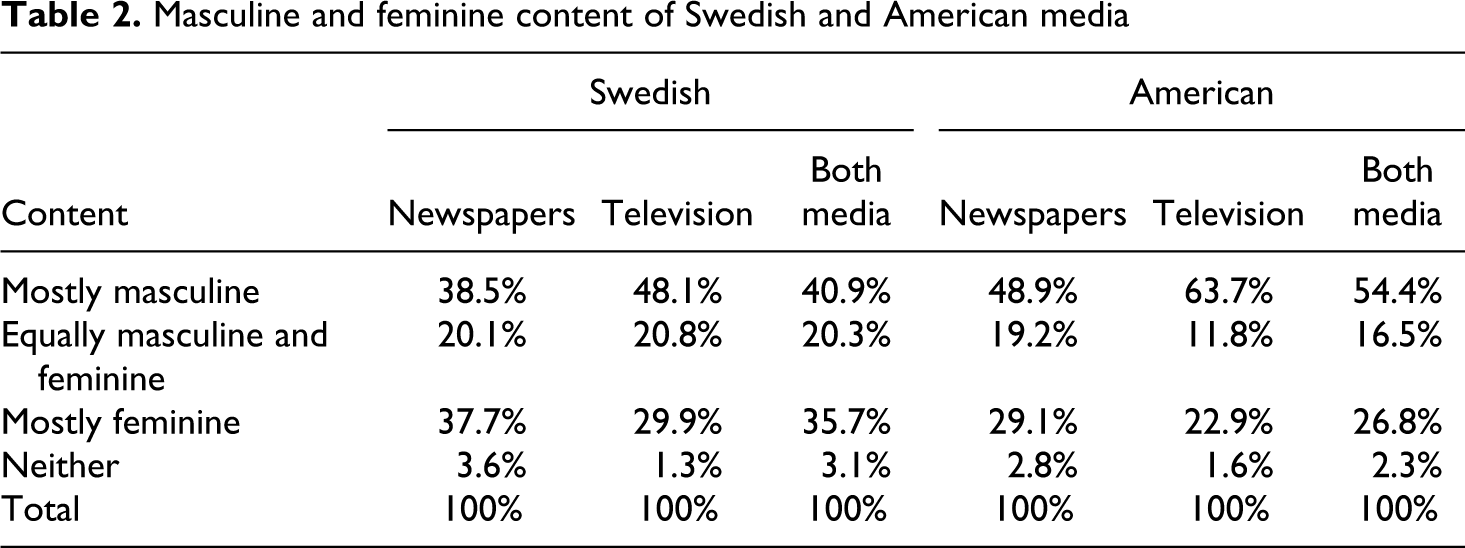
In the war coverage, masculinity was evidenced by reports that emphasized weapons, war plans, money and material things, violence, male domination, American superiority and determination to change the political landscape in Iraq, and a positive stance toward the war itself. War is a largely masculine event, which explains why Swedish media, particularly television, ran a greater number of news stories with masculine content than stories with feminine content overall.
Femininity, by contrast, was evidenced by reports focused on the international community, multilateralism, individuals’ suffering, grieving, safety and security, humanitarian aid, the rebuilding of Iraq and a negative attitude toward the war.
Discussion and conclusions
Research on news production suggests that although media institutions would like their audiences to think that the news texts closely represent the event they describe, the process, and ultimately the journalistic output, is influenced by a number of technical, social, political, financial and cultural factors (Bagdikian, 2000; Bennett, 1996; Gans, 1979; Gitlin, 1995; Hall, 1997; Hallin, 1986, 1994a; Kalb, 1994; Kellner, 1993; Schudson, 1995). Of these, cultural factors have received the least attention. This study sought to identify cultural influences on the process by comparing news coverage about the Iraq war in 2003 in Swedish and American television and print media.
Although there are several important differences between Sweden and the US that must be taken into account – the most important of which are the size of the populations, the structure of the media systems, the levels of involvement in the war, and the access to sources – cultural differences nevertheless emerge as an explanatory factor.
This study built on a theoretical framework developed by Hall (1980a, 1989, 1997) to explain the relationship between culture and news production, referred to as encoding. The results show that Swedish and American media provided two very different representations of the war in Iraq, which suggests that the professional values that media operate by are influenced by cultural values, and that so-called news values, even though universal in character (Galtung and Ruge, 1965; Gans, 1979; Rosengren, 1974), will generate different kinds of news about the same event when applied by particular media for the benefit of a particular audience who share a particular culture. News media are highly audience-sensitive and media professionals coexist with their audience within the same cultural system (Gurevitch et al., 1993; Schudson, 1995). Swedish and American media covered the same war, and there was no evidence from the sample that either country’s journalists intentionally provided false or biased information, yet the war was represented in two different ways simply by emphasizing different facts.
In American media, the war was described in terms of strategy and weaponry, interpreted via a perspective from inside the American troops, and explained as the US bringing freedom to the Iraqi people. The expressed attempt to minimize collateral damage was treated at length. These findings were similar to those on American news coverage of the first Gulf war, in which strategic and technical aspects of the war dominated (Griffin and Lee, 1995; Iyengar and Simon, 1994; Kaid et al., 1993).
Swedish media interpreted the war from a perspective of the international community and civilians in Iraq, visualized it in terms of suffering civilians, and explained it as a failure for the international community. The war was viewed as a world event, and the reactions from and effects on other nations were central in the reporting.
The results also revealed differences between newspapers and television, which supports the theory of media logic – each medium focusing on what it does best. Newspapers had to contend with their normal delays for production, printing and delivery. It appears that the only medium in the sample that truly benefited from embedded reporters was American television, which was able to present its audiences with live images from the battlefield. Compton (2004) argued that the reporters were caught up in the drama and the excitement of ‘shock and awe’ and lost sight of the plight of civilians. He suggested that the so-called Fox Effect led CNN and MSNBC to ‘trying to recapture lost market share by singing from the same patriotic song book’ (Compton, 2004: 181).
Hofstede’s (1979) masculinity/femininity dimension provided a useful theoretical framework for interpreting the differences in media coverage between the two countries. The hypothesis that the news stories about the war in Iraq would be proportionately more masculine in American media than in Swedish media and more feminine in Swedish media than in American media was supported, which in turn lends support to the overall assumption of this study – that culture influences news.
The majority of the US population favored a military intervention in Iraq at the time, while Sweden favored an international diplomatic process involving the United Nations and avoiding war. The dominant theme in the US, war strategy and weaponry, aligns very closely with masculine values. Conversely, the two dominant themes in Sweden, the international community and Iraqi civilians, align closely with feminine values. Other themes that reflect masculine values and that were more common in American media included inside the US military, Saddam fights back, US brings freedom, Iraq welcomes the US, anarchy in Iraq and WMDs, while other themes that reflect feminine values and that were more common in Swedish media included demonstrations and humanitarian aid.
The masculine values of assertiveness, decisiveness, independence, money and things, male domination, performance orientation, admiration for what is big and fast, and sympathy for achievers were clearly noticeable in the American news stories. As discussed previously, war is a largely masculine event, which explains why Swedish media, particularly television, still had proportionately more stories with masculine content than feminine content. However, the feminine values of caring, interdependence, people and quality of life, not trying to be better than others, and sympathy for the unfortunate permeated Swedish news more than American news.
One implication of these findings for future media research is that cultural context is an important variable that should be considered when studying news production and coverage. This study treated culture as a broad construct that explains variations in political and media systems across countries, as well as differences in values and beliefs that guide attitudes, perspectives and behavior (Fiske, 1989; Hall, 1980a, 1989, 1996; Hofstede, 1980, 1991; Kagan, 2003). More comparative analyses of international news events are needed, particularly across nations with a similar level of involvement. Also, future studies should control for other variables in order to determine the relative role of culture in shaping international news reporting. Gaining further understanding of the exchange of meaning through language in a shared space is crucial in a world that is becoming increasingly multicultural.