






Abstract
This comparative content analysis study (N = 946) examines how far political news is mediatized in the US and UK by systematically exploring the conventions used in television news bulletins. According to many of our mediatization of politics indicators – which included sound and imagebites, lip flaps, journalistic visibility, ‘wrapping up’, live and interpretive news – broadcasters with the most public service responsibilities supplied the highest level of mediatized political news. Our study thus appears to challenge conventional academic wisdom that US journalistic interventionism is greater than other advanced Western democracies and that enhanced commercialization is a precursor to higher degrees of mediatization. We suggest that the form, structure and style of journalism should be understood more carefully by scholars when making sense of how far news is mediatized, since the greater length of UK television news conventions and the ability to ‘go live’ longer allowed journalists greater freedom to interpret politics.
Keywords
The focus of this comparative study is on television journalism and, more specifically, the form, structure and style of political reporting cross-nationally and between media systems. 1 While television news has been investigated by scholars for many decades, when detailed empirical studies have been undertaken they typically explore national journalism cultures and media systems. In doing so, it could crack over some striking differences that separate how television journalism is produced and politics reported between nations. As Dimitrova and Strömbäck have pointed out, ‘scholars should be careful not to assume that findings regarding television news in one country apply elsewhere’ (2010: 499). Their comparative study of US and Swedish television news found significant semi-structural differences related both to the more commercially driven environment of American media along with different political systems and journalism cultures. They recommended ‘further comparative research on structural differences in television news format and framing in general’ is needed, notably ‘with a focus on routine news reporting and the antecedents of television news format and framing in particular.’ (Dimitrova and Strömbäck, 2010: 499)
We take up this challenge in this study by drawing on the concept of mediatization to explore routine television news coverage of politics in US and UK evening bulletins. For this conceptual tool can help to measure the degree to which media shape the behaviour of political actors and media content (Strömbäck, 2008). Our primary interest lies in the latter. But while empirical studies exploring the mediatization of politics have increased in recent years, most of them relate to politics immediately prior to election time (Strömbäck and Dimitrova, 2011; Strömbäck and van Aelst, 2010; Takens et al., 2013; Zeh and Hopmann, 2013). Their representativeness to political coverage more generally is thus questionable. Our cross-national study will examine how far political news is mediatized by systematically exploring the conventions used in television news bulletins to assess the level of journalistic interventionism. As scholars have previously pointed out, evaluating the comparative degree of mediatization in political news involves analysing how far journalists – as opposed to politicians – appear, shape and interpret political coverage (Strömbäck and Dimitrova, 2011; Strömbäck and Esser, 2009). In empirically exploring television news, our content analysis study draws on some well-established mediatization of politics indicators including sound and imagebites, lip flaps, ‘wrapping up’ along with other interventionist measures (Grabe and Bucy, 2009; Esser, 2008; Strömbäck and Dimitrova, 2011). Our study, overall, is designed to assess whether the form, structure and style of journalism shapes the degree to which political reporting is mediatized in television news bulletins.
The mediatization of politics: Interpreting journalistic interventionism
Debates about mediatization, of course, go well beyond how far media shape politics. Scholars have applied the concept of mediatization to a wide range of topics, such as religion, marketing and fashion (Lundby, 2009a). Or, indeed, in broader terms by interpreting changing cultures and the impact media have in everyday social life (Hepp, 2013; Hjarvard, 2008, 2013). Our approach in this study is primarily informed by the ‘institutionalist’ tradition of mediatization research (Hjarvard, 2008: 210). Put simply, this acknowledges the media as an autonomous institution shaping different aspects of society (see also Esser, 2013: 159–162). According to Couldry and Hepp (2013: 196), this tradition stems ‘mainly from journalism studies and political communication’ and understands ‘media more or less as an independent social institution with its own set of rules…Mediatization here refers to the adaption of different social fields or systems (for example, politics or religion) to these institutionalized rules’. In adapting to the influence of media, it is argued a ‘media logic’ is conformed to by different cultures and organisations (Altheide and Snow, 1979). It is a term, Hjarvard (2013: 17) has observed, that ‘is used to recognize that the media have particular modus operandi and characteristics (“specificities of media”) that come to influence other institutions and culture and society in general, available to them’. However, the notion of a uniform, overarching media logic has been criticised by a number of scholars (Couldry, 2008; Hepp, 2013; Landerer, 2013; Lundby, 2009b), since it is difficult to isolate and characterise one all-powerful media logic when a multiplicity of media compete to influence different spheres of society.
Despite considerable criticism of an all-inclusive media logic, Landerer (2013) has pointed out that many mediatization scholars persist in using the concept. And yet, ‘due to its broadness’ in his view it is ‘more confusing than helpful as an analytical concept’ (Landerer, 2013: 243). However, Esser’s (2013) conceptualisation of the mediatization of politics refers to a logic in news media, which is made up of three constituents: professional, technological and commercial aspects. While professional logic relates to the criteria used in the selection and presentation of news across competing formats (using edited or live news, for instance), technological refers to the means by which news is communicated (using editing equipment, say, or satellites to broadcast from remote locations). Commercial influence, by contrast, is a broader market-driven force that has ‘pushed news organizations further away from the world of politics but more toward the world of business’ (Esser, 2013: 171). Or, put differently, enhanced commercialization undermines political logic in news media coverage of politics, downsizing the policies and publicity political actors seek, or the wider polity governing a political system or culture (see Esser, 2013: 164–166).
Despite the differences between and within media formats and systems, Esser (2013: 160) maintains that the ‘rules and norms that govern the media taken as a whole are often more important than what distinguishes one media company, outlet, type, or format from another’. When exclusively interpreting whether a media logic supersedes a political logic, we agree this binary opposition has some merit. However, this analytical framework prevents an understanding of the influence competing media logics have on the media itself over time (that include, as Esser suggests, different professional, technological and commercial considerations). So, for example, the object of our study – the fixed time television news bulletin – is arguably shaped by a different logic to other forms of television journalism, such as dedicated 24-hour news channels, where the emphasis is on live and breaking news (Cushion and Lewis, 2010). For fixed time bulletins – in particular evening programmes – have historically aimed to encapsulate the day’s news (Conway, 2009), rather than a rolling format delivering the latest updates (Montgomery, 2007). The reporting of politics could thus potentially follow a different logic according to whether it was on a fixed time or rolling news television format. In other words, if the aim of an empirical study is to explore how a specific media format has been influenced by broader changes within the news media, it would be difficult to use a catch-all media logic to interpret the process of mediatization.
In a previous study, we examined how all UK television news was mediatizated by breaking down each type of journalistic convention (such as edited packages or live two ways) and interpreting each as representing different types of journalistic interventions (Cushion and Thomas, 2013). While interventions have primarily been used to represent how far journalists intervene in election coverage (Esser, 2008; Strömbäck and Dimitrova, 2011), we argued journalistic interventions could be exercised when editors select the type of convention used to report all news stories. While pre-edited news remained the dominant type of journalistic intervention, political reporting was disproportionately live compared to other topics. In so doing, we suggested the presence of live as opposed to edited conventions in fixed time television bulletins represented a measure of mediatization because it reflected the influence of rolling news culture within broadcast media. Our aim in this article is to develop a more focussed interrogation of political reporting and to carry out a US–UK comparative study to consider the generalizability of our conclusions.
In recent years, scholars have responded to calls for greater empirical understanding of comparative media systems and political identities (Blumler and Gurevitch, 1995). Indeed, within mediatization debates a neo-insitutionalist approach has emerged, according to Esser (2013: 161), with the aim to cross-nationally ‘distinguish different path-dependent models of institution-formation, different regulatory cultures of media policy, and different institutional arrangements ruling the media-politics inter-changes’. So, for example, since commercialized media environments have been used as a key explanatory variable for greater mediatization of media content (Landerer, 2013: 243), our study will test this proportion in respect of television news coverage of politics, comparing whether the degree of journalistic interventionism we previously identified in our UK study (Cushion and Thomas, 2013) is matched by US broadcasters. For the US has historically been associated with a high level of interventionism in its journalism. This has been linked to the professionalization of US journalism throughout the 19th and 20th centuries which, according to Schudson (2001), marked it as distinctive from many European countries. Within the US and UK, however, a broadly shared Anglo-American reputation of journalistic adversarialism has been a long-standing characteristic compared to, say, France where the relationship between the government and journalism has been more complicit (Hallin and Mancini, 2004). But historically, and in some of the most recent longitudinal studies, scholars have evidenced and emphasized the growth of interpretive or contextual journalism in US news media (Fink and Schudson, 2013; Steele and Barnhurst, 1996).
In the most recent cross-national content analysis studies, then, scholars have thus found that the US, comparatively speaking, offers the most interventionist approach to political reporting (Esser, 2008; Strömbäck and Dimitrova, 2011). In a detailed cross-national election content analysis study of the US, UK, Germany and France, for example, Esser (2008) argued that coverage reflected ‘a strongly interventionist U.S. American approach, a moderately interventionist Anglo-German approach, and a noninterventionist French approach’. To empirically draw these conclusions, Esser (2008) used well-established measures in political communication to interpret how far a media or political logic was conformed to cross-nationally. So, for example, the reduction of political soundbites in recent decades – where politicians are seen and heard less on-screen (Hallin, 1992) – has been interpreted as a more media-centred approach to political reporting, since it delimits the time elected representatives can talk and promotes the views of journalists. Esser’s study found public service broadcasters from each country contained the longest soundbites, while the US’s commercialized networks had the shortest. This is further compounded by a more active, interventionist trend in US journalism where politicians are seen without necessarily being heard on-screen – known as imagebites – with journalists narrating over their words and actions (Esser, 2008; Grabe and Bucy, 2009). Esser found imagebites were cross-nationally used to a greater extent on commercial rather than public service channels. A comparative measure, in other words, of journalists intervening more in the delivery of edited packages.
Esser also put the role of journalists under the spotlight by comparing how far they comparatively appeared on-screen – with the aim to assess the visibility of journalists in order to evaluate how centrally they placed themselves in the news narrative. Contrary to expectations, it was on public service broadcasters where journalists appeared longest on-screen, with Esser (2008: 413) noting that ‘lengthy interpretative pieces’ were supplied by reporters. However, the study did not – as we do – distinguish between edited and live news packages, with the latter – as we suggest further below – a likely cause (but not explained) of the high proportion of interpretive coverage. In our view, the comparative form and structure of television news items needs to be unpacked further. Esser’s study also did not systematically measure the nature of journalistic interventions – as our study does – in order to compare whether they are, in fact, interpretive or more descriptive.
The role of a journalist in a news story has been used in other ways to provide several indicators of mediatization, including whether they have the final say – ‘wrapping up’ – in a news package rather than a politician. Or, the extent to which journalists talk over politicians’ voices – known as a ‘lip flap’, similar to an imagebite (see Grabe and Bucy, 2009) – another measure of media logic. Strömbäck and Dimitrova’s (2011) study of US and Swedish election coverage used both measures and identified a far higher level of mediatization present in American journalism. As far as we are aware, there has not been any comparative analysis of US and UK television news exploring whether media or political actors ‘wrap up’ news items or in how often lip flaps are used.
Of course, the concept of mediatization delineates a long-term process, whereby the media have over time influenced different spheres of society including media coverage of politics (Lundby, 2009a). However, following the lead of previous studies (Dimitrova and Strömbäck 2010; Strömbäck and Dimitrova, 2011) we draw on cross-sectional data to explore the degree to which we can interpret the media logics of fixed time bulletins operating in the US and UK as well as how far journalistic actors (e.g., media logic) supersede the voices and images of political actors (e.g., a political logic). Needless to say, while it would have been beneficial to longitudinally trace television news coverage – to measure the degree of mediatization over time – since the emergence of 24-hour news channels in the US and UK (e.g., 1980s), we could not retrospectively access a sample of evening television news bulletins.
Developing cross-national research and comparing media systems: The method and sample of the study
Our sample of television news aims to bring important comparative perspectives, comparing – as already outlined – political news on US and UK evening bulletins. Above all, we ask whether competing cross-national media systems and journalistic cultures shape political coverage differently. But our sampling strategy is also designed in the context of recent developments in comparative communication research (Esser and Hanitzsch, 2012). While cross-national research has increased, in our view ‘national’ samples do not always reflect the nuance of uniquely hybridised media systems, such as the UK’s broadcasting system.
Indeed, in many studies public and commercial media are often crudely contrasted when – as they are in the UK – there are more subtle differences that relate to their market pressures and public service responsibilities as well as the regulatory environment they operate in (Cushion, 2012). The BBC, for example, is a wholesale public service broadcaster, regulated closely by the BBC Trust, with a clear public interest agenda for reporting politics. ABC and CBS, by contrast, have no public service obligations. ITV and Channel 5 lie somewhere in the middle, with mixed commercial and public service responsibilities. Both are regulated by a ‘light touch’ body called Ofcom (Cushion, 2012). While all UK broadcasters are legally required to be impartial (since 1987 this is no longer the case in the US), a close inspection of ITV and Channel 5’s specific licence agreements related to the provision of news and outlined in communication acts reveals some subtle differences.
ITV are legally obliged to supply local and national television news in peak time television whereas Channel 5 only has to produce national programming. 2 Since ITV has been the main competitor to the BBC for over 50 years, Channel 5’s relatively new public service status (launched in 1997) in a commercialized and competitive environment has meant it has been granted greater freedom to be distinctive from other broadcasters and experiment with more informal reporting styles and tabloid news formats. Compared to ITV, then, Channel 5 arguably has less regulatory responsibilities. 3 In short, the relative degree of public service obligations for each broadcaster can be summarised as the BBC having the most, ABC and CBS the least, with ITV and Channel 5 having both market and public obligations, but with the latter having more autonomy in its news format and style.
Television bulletins are the most consumed form of news in the US and UK (Ofcom, 2011; Pew Project for Excellence in Journalism, 2012). Our sample of television news includes: ABC and CBS’s 6.30 pm bulletins in the US, Channel 5’s 5 pm, BBC’s 6 pm and ITV’s 6.30 pm bulletins in the UK during 3 weeks in April and May 2013 (weekdays only). Drawing on previous studies examining the types of interventions routinely used in television news (Cushion, Aalberg and Thomas, 2014; Cushion and Thomas, 2013), different conventions were classified in order to compare the balance between more edited and live forms of communication. The relative ‘liveness’ of broadcast news was classified by pre-recorded edited packages, largely scripted news read by anchors and live reporters without a visual script. Five journalistic interventions were identified and can be spilt into more edited than live conventions. The first edited classifications included: (1) news anchors either narrating an item typically over a background or moving pictures and (2) a standard edited package from a reporter. Our more live interventions were threefold: an (3) anchor/reporter two way interacting, often on a split screen, (4) a reporter on location without any interaction with an anchor and finally (5) an anchor/reporter discussion within the studio. In our view, editorial decisions about which interventions to select when reporting a topic can significantly shape how a story is told. Pre-recorded reporter packages tend to be carefully scripted, checked by editorial staff and could make use of a journalist’s own sources and investigative knowledge to inform a story. News supplied by anchors, meanwhile, also tends to be scripted, previewed by editors, but does not typically involve an anchor’s own investigative journalism shaping the story. However, since it is live anchors can bring the latest news or update to a story. This is also the case with live reporters, who bring updates but also knowledge and expertise, since they might also have supplied an edited news package. Without a script to hand, however, there is less robust policing of content and editorial control when reporters communicate news live compared to pre-recorded material.
Each intervention acted as the unit of analysis, generating 946 news items overall. These items were then examined in more detail if they were coded as being a ‘politics’ news story. While election news studies have the luxury of being easily operationalized by any reference to the campaign, we included all local, national and international politics. The attempt was to explore politics beyond Washington and Westminster, and to capture routine, non-election coverage.
Beyond examining every type of journalistic intervention used throughout each television news bulletin, when a politics item was reported we examined the topic reported, who was sourced on-screen (e.g., soundbite), its length along with any off-screen sources (e.g., journalists referencing a source: ‘The President said today…’). We also measured the use and length of imagebites, the visual display of sources in political news items typically in more edited interventions. To explore the relative degree of interventionism, we coded how often and long journalists were visible on-screen, if they talked over politicians (e.g., lip flaps), whether they had the final say (e.g., wrap up) or politicians. All of these variables were coded in edited journalistic interventions only. To explore live news political interventions, we assessed the degree to which a journalist was factual or interpretive. After extensive piloting and having used a typology in a similar project (Cushion and Thomas, 2013), we developed four categories to assess the value added by less scripted, live journalistic interventions. This included whether a live reporter was used typically as (1) part of an edited package, (2) to provide a live update or (3) be at the scene of a story or (4) if they offered interpretation to an issue or event. Broadly speaking, the higher up the scale of 1–4 reflected a greater degree in the use of ‘liveness’ (for instance, reporting ‘the latest’ or being live ‘at the scene’) or, further still, offering more analysis (saying why something happened) than description (relaying what happened). While there were some instances when journalists adopted multiple roles in a news item – offering both the latest news or being interpretive, for instance – our analysis quantified the most prominent aspect to a live report.
Two researchers from the UK coded all the material with regular team discussions about the coding process and specific variables. In order to ensure data were consistently and accurately coded, we drew on perhaps the most conservative intercoder test – Cohen’s kappa (κ) – which controls for the probability of chance as opposed to simply measuring agreement. According to Cohen (1960), Kappa co-efficients of <0 indicate less than chance agreement, 0.01–0.20 slight agreement, 0.21–0.40 fair agreement, 0.41–0.60 moderate agreement, 0.61–0.80 substantial agreement and 0.81–0.99 almost perfect agreement. Approximately 10% of the sample was re-coded and all variables fell into the latter two categories. Since the sample was entirely in English, with data mostly nominal and relatively easy to operationalize, we believe our high kappa scores are robust compared to other cross-national content analyses.
The two central research questions in this study are:
To what extent do US and UK television evening news bulletins draw upon the same journalistic interventions to report news and politics? To what extent do different media and political systems between and within the US and UK shape the structure, form and style of political output in evening television news bulletins?
Based on the theoretical discussion of mediatization, the influence of competing journalism styles and different media systems in the US and UK, we developed 10 hypotheses overall.
The UK’s more public service influenced television news bulletins and less apparent style of journalistic interventionism will result in: H1a: The journalistic intervention most used will be an edited reporter package, occupying the largest proportion of time on bulletins with the strongest public service broadcasting obligations. H1b: The bulletins with the most public service broadcasting responsibilities will supply the longest news items and the longest political items. H1c: In different subjects reported (crime, health, business, politics, etc.) politics will be the most frequent and prominently reported live topic cross-nationally. H1d: The bulletins with the most public service obligations will draw on the most on and off screen sources to report politics. H1e: The bulletins with the strongest public service broadcasting obligations will carry the longest soundbites.
Correspondingly, the more interventionist style of journalism on US television news bulletins will result in: H2a: US bulletins will supply longer imagebites than UK broadcasters with the most public service responsibilities. H2b: US bulletins will make use of lip flaps to a greater degree than UK broadcasters with the greatest public service broadcasting obligations. H2c: Journalists on US bulletins will be more visible on-screen than UK journalists most influenced by public service broadcasting responsibilities. H2d: US journalists will wrap up political items more often than UK journalists on bulletins with the greatest public service broadcasting obligations. H2e: Live interpretative political coverage will be most evident on US bulletins, whereas UK bulletins with the greatest public service broadcasting obligations will be more factual.
Identifying routine journalistic interventions: Comparing the structure, form and style of television news bulletins
As H1a predicted, edited packages constituted the most amount of time on US and UK television bulletins, notably on broadcasters with the most public service responsibilities (see Table 1). However, the overall differences in journalistic interventions between US and UK television news bulletins were relatively marginal. Where differences begin to emerge more clearly is in the proportion of live news items, with all UK broadcasters spending more time on these less scripted forms of journalism. By contrast, anchors spent a greater proportion of time on-screen in the US – on average, well over twice as long. If there is a similarity between nations, it is most resembled in Channel 5’s coverage, which – of the UK broadcasters – featured anchors the most and spent less time using edited packages. Overall, while H1a is broadly supported the differences between countries and broadcasters appear quite minimal.
However, when examined more closely the form and structure of US and UK journalistic interventions differ to a much greater extent. The length of US television news items is uniformly much lower (mean = 1 m 12 s), on average, than UK television news (mean = 1 m 38 s). These differences become starker when compared between the wholesale commercial broadcasters (ABC mean = 1 min and 10s and CBS mean = 1 min and 15 s), the commercial public service broadcasters (ITV mean = 1 min and 41 s and Channel 5 mean = 1 min and 29 s) and the wholesale public service broadcaster (BBC mean = 1 min and 45 s).
Journalistic interventions on US and UK television news bulletins.
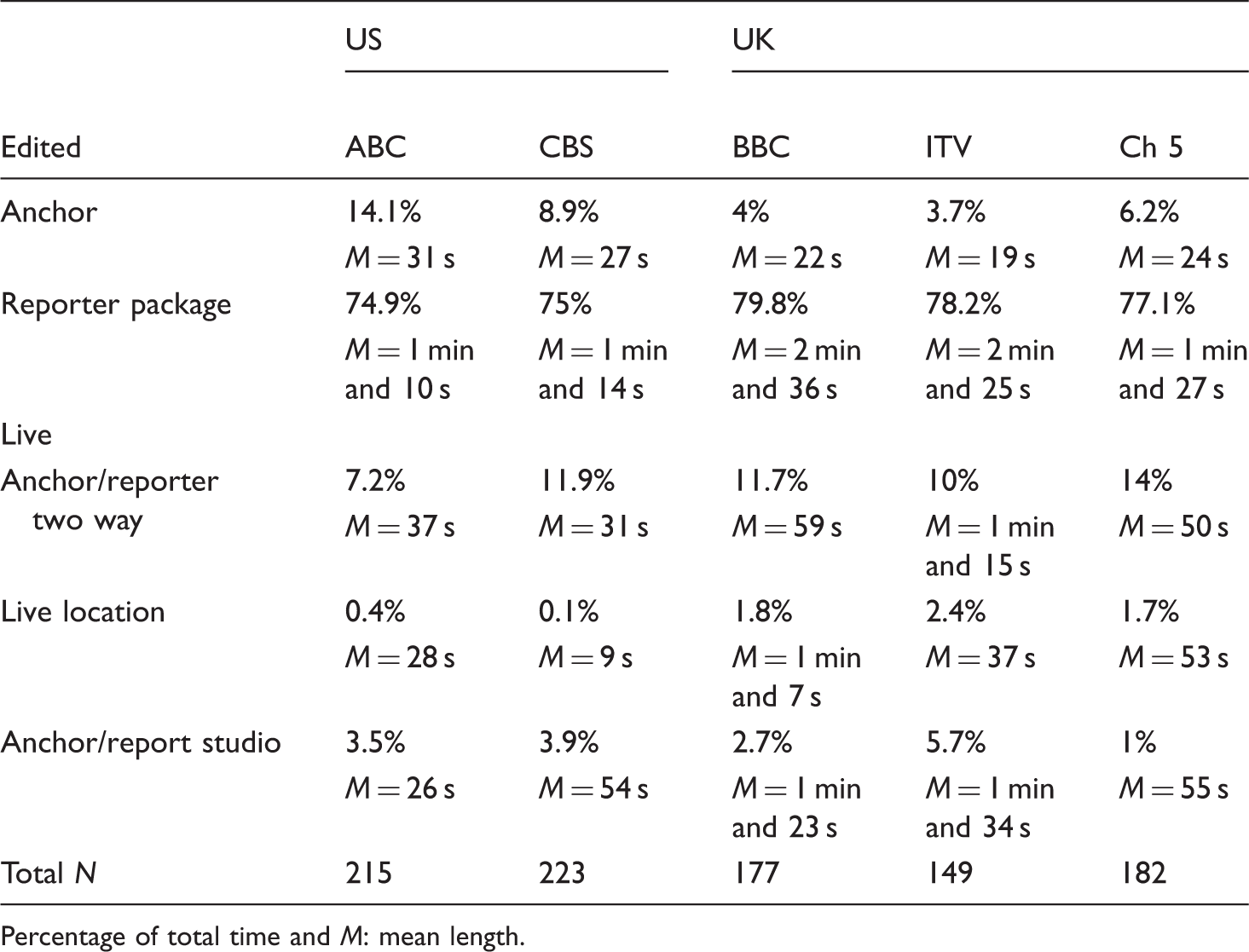
Percentage of total time and M: mean length.
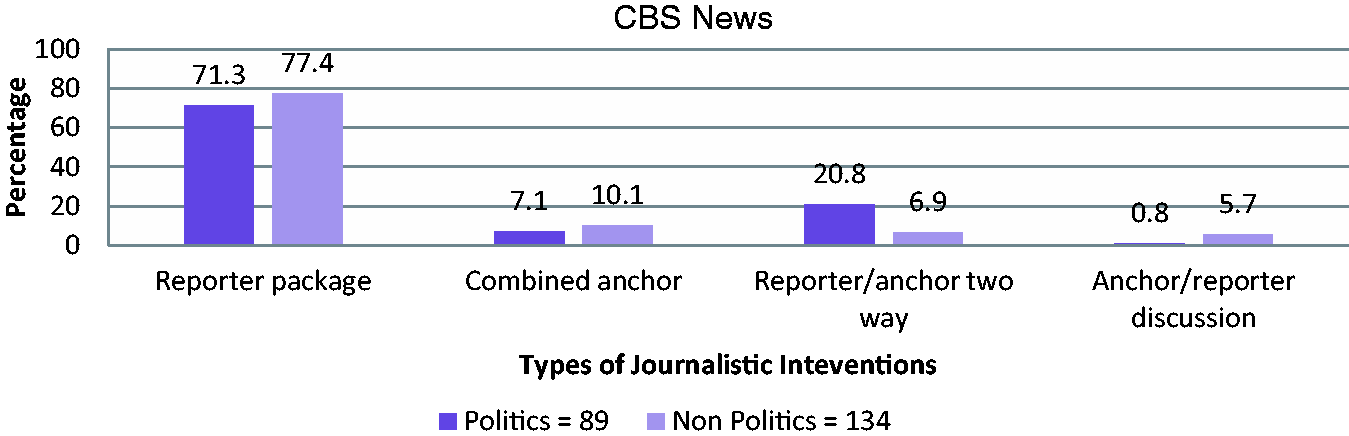
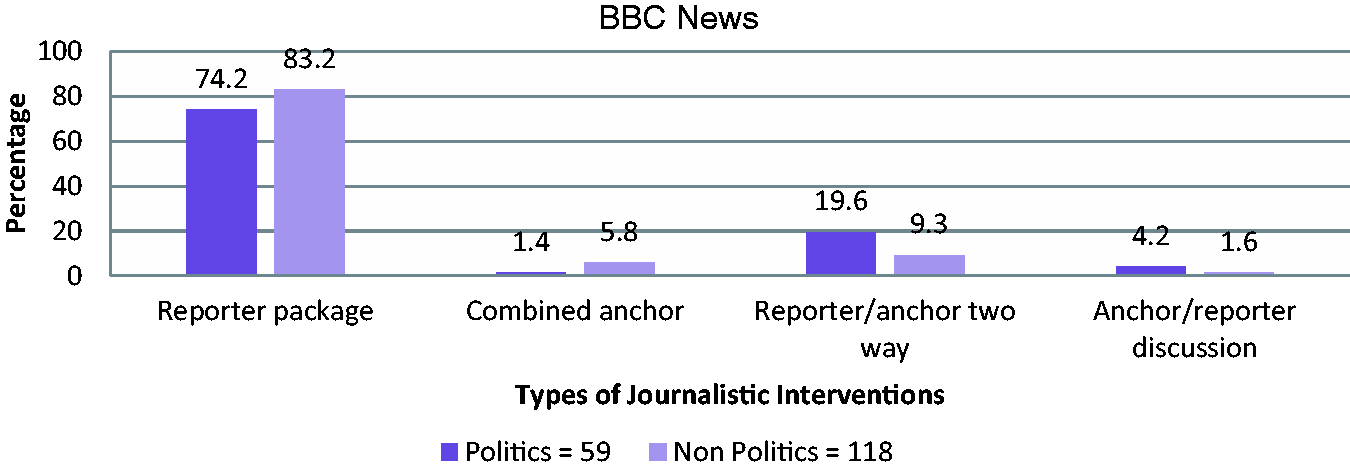
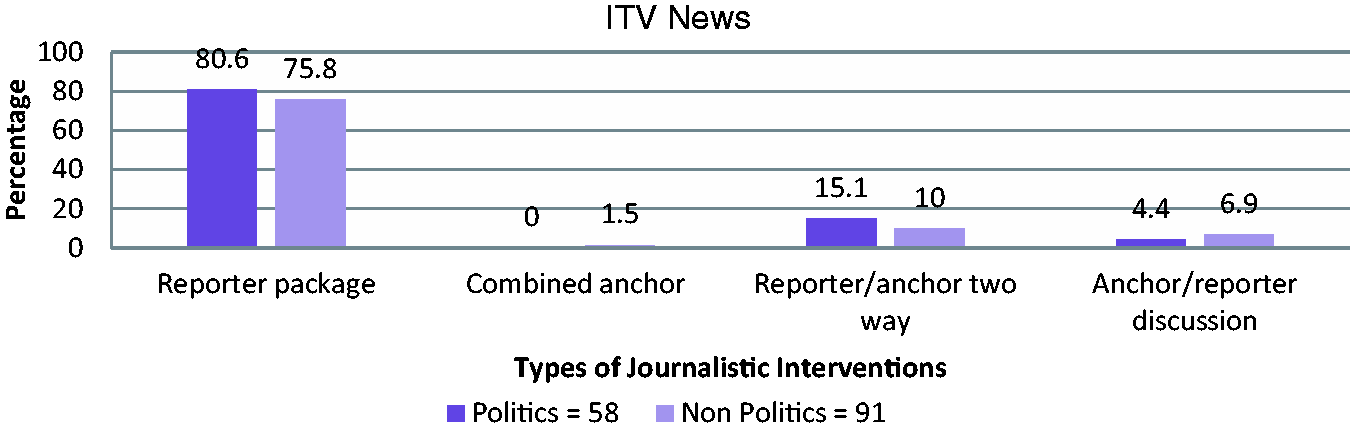
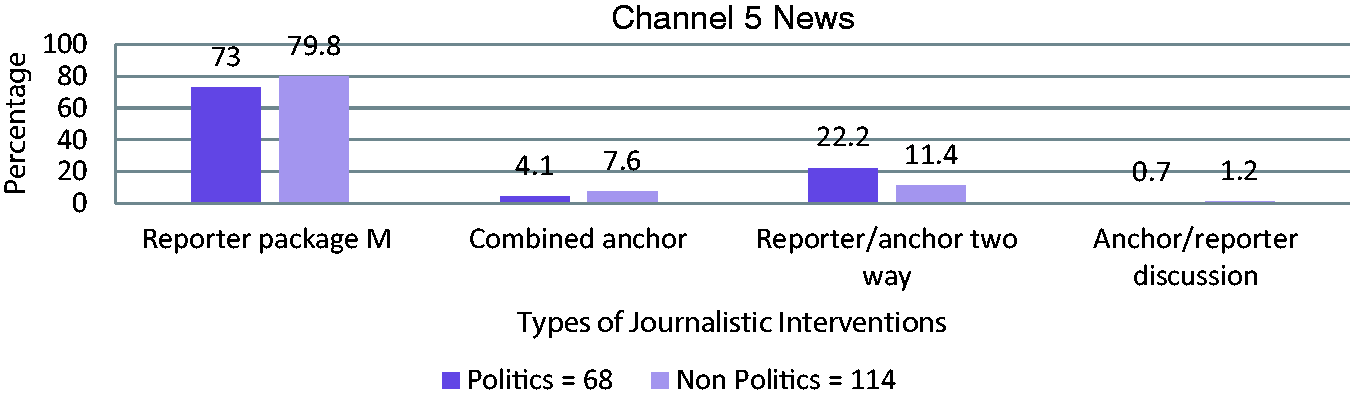
But how does the use of journalistic interventions in all news compare with just television reporting of politics? Figures 1–5 show the different journalistic interventions used in items that were framed by politics compared to non-political news across the five bulletins examined.
Journalistic interventions in political and non-political news items on ABC news. Journalistic interventions in political and non-political news items on CBS news. Journalistic interventions in political and non-political news items on BBC news. Journalistic interventions in political and non-political news items on ITV news. Journalistic interventions in political and non-political news items on Channel 5 news.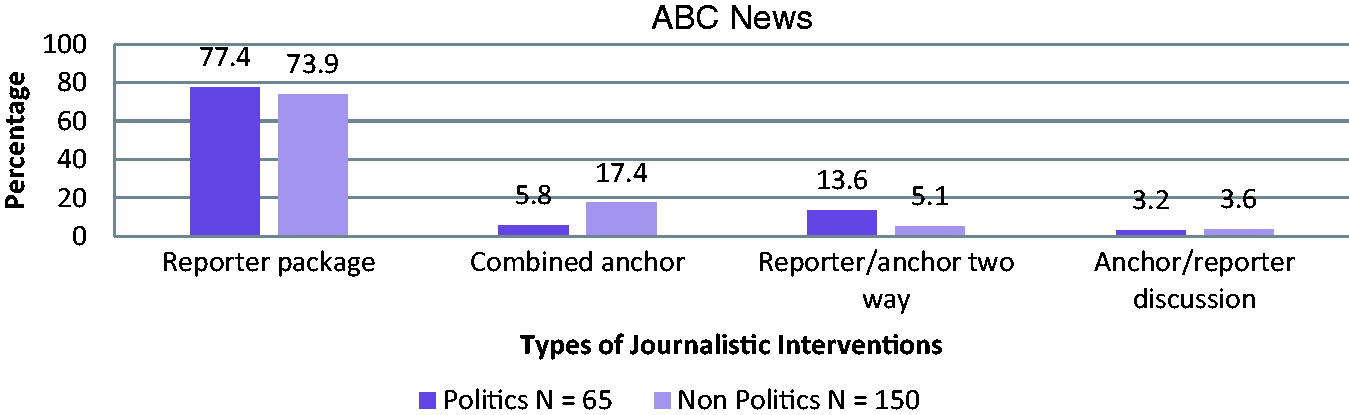
Journalistic interventions in live television political news reporting on UK and US television news bulletins.
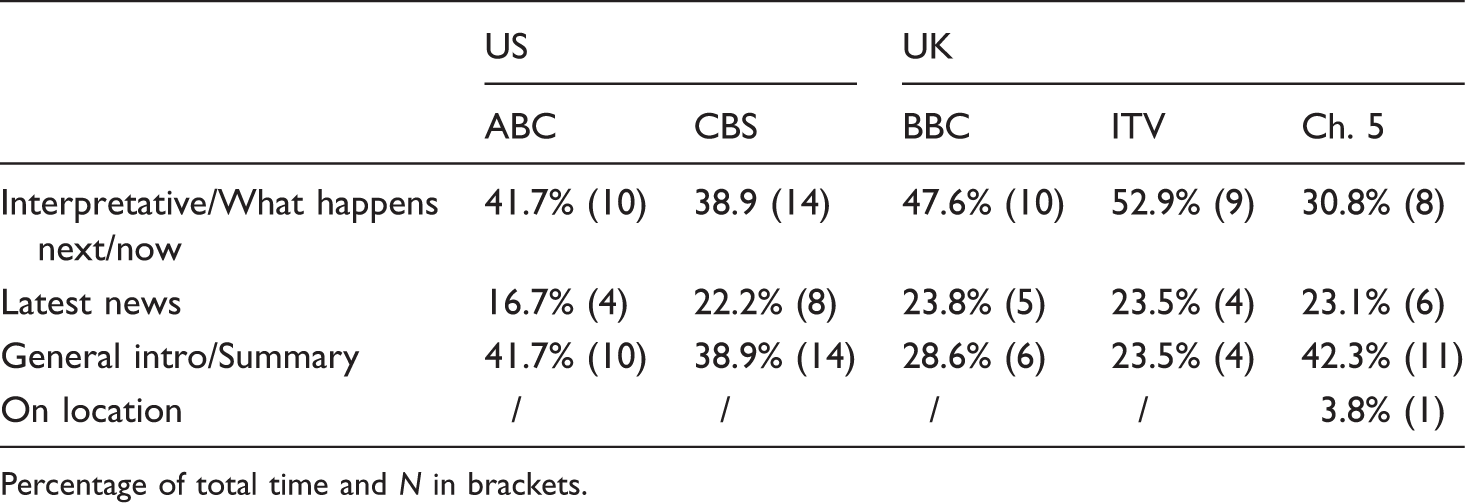
Percentage of total time and N in brackets.
But a striking comparative difference between political and non-political items in both countries is that politics is far more likely to be reported live on all channels (see Figures 1–5). On CBS news about politics is three times more likely to be live than non-political stories, with ABC not far behind this ratio while in the UK it is more than twice as likely on BBC and Channel 5. H1c, in this sense, is therefore fully confirmed – politics is a disproportionately live reported topic. Although the overall N is relatively low, of the 85 headline political items we found live journalistic interventions were the most commonly used convention in three out of five broadcasters (ABC, BBC and Channel 5). CBS had exactly the same proportion of items as edited packages and ITV had four times more edited packages than live items. H1c therefore partially supports the view that live political news is the most prominently reported.
Journalistic versus political interventions: Comparing sources, imagebites and visibility in television news bulletins
Our analysis now turns to examining political news items in more detail. The aim, overall, is to assess the relative balance granted to politicians’ voices compared to how far journalists themselves intervene in political affairs. Or, put another way, the study was designed to compare the degree to which politics is mediatized in US and UK television news. Considering all sources drawn upon in political news coverage, it is the UK broadcasters that have a higher ratio of on-screen items (either 1.7–1.8 per item) compared to the US (1.2–1.4 per item). Moreover, a political news item on all three UK broadcasters was more likely to contain an on-screen source (ITV = 65.5%, BBC = 57.6% and Channel 5 = 50%) than in the US (ABC = 43.1% and CBS = 42.7%). Off-screen sources, however, did not conform to a clear cross-national pattern, with a similar ratio of items in the US (1.7–1.8 per item) but more mixed in the UK (BBC = 2.1, Channel Five = 1.2, and ITV = 1 per item). Indeed, the percentage of items with an off-screen source was highest on the BBC (93.2%) followed closely by the US stations (ABC = 90.8% and CBS = 89.9%) Meanwhile, Channel 5 and ITV particularly were much less likely to include an off-screen source (in political news items overall 77.9% and 56.9% respectively). Thus, H1d is partially confirmed in that the main public service broadcaster is the most source-driven and that more on-screen sources inform the UK broadcasters.
Beyond considering the volume of sources shaping different interventions into political reporting, another measure of mediatization is the relative length of time political actors are allowed to speak on-screen (soundbites). Whereas most studies focus on just the length of politicians’ soundbites, we include all sources that appear in political news items in order to explore the proportion of time granted to all sources shaping political coverage. It should be noted, however, that politicians were sourced the most across all broadcasters. 4 The average length of political soundbites were shortest on US television bulletins (ABC mean = 7 s and CBS mean = 10 s). The BBC had the longest average soundbite (mean = 16 s). ITV and Channel 5 were not far behind (mean = 14 s respectively), but the former broadcaster had a much longer range (3–58 s) then the latter (2–38 s). H1e is by and large supported with the main public service broadcaster sourcing political actors the longest and the more commercial networks sourcing the least. While the UK’s commercial public service broadcasters had identical average length soundbites, the range was greater on the bulletin that carried greater public service responsibilities, further supporting H1e.
We now turn from the aural to the visual representation of political actors by looking specifically at imagebites. Since imagebites were conceived primarily for elected representatives appearing in edited television news packages (Grabe and Bucy, 2009), our analysis here is confined to politicians appearing in this type of journalistic intervention. Once again we found the BBC had the longest average imagebite (mean = 13 s), with ITV slightly less in length (mean = 11 s). Channel 5, meanwhile, had the shortest length of imagebites among UK broadcasters (mean = 9 s). US imagebites, however, were shorter than Channel 5 (mean average of 6 s for both, ABC and CBS). Contrary to H2a, then, imagebites appear longest on the most publicly driven television bulletins. Compared to soundbites, incidentally, their use in political news items was far less and broadly similar cross-nationally (CBS = 30.3%, Channel 5 = 30.9%, BBC = 32.2%, ABC = 33.8% and, bucking the trend a little, ITV = 44.8%).
The final part of the study examined more specifically the level of journalistic interventionism in political reporting. How far, in other words, did reporters intervene in political coverage compared to the role played by politicians? Journalists talking over politicians who are seen if not necessarily heard in television news bulletins has become known as a ‘lip flap’ convention (Grabe and Bucy, 2009). While this type of editorializing has been an observation identified in the US, it was a UK broadcaster – ITV (36.2%) – that had the highest proportion of lip flaps in political news items. On ABC (32.3%), BBC (32.3%), CBS (31.5%) and Channel 5 (29.4%) a lip flap appeared in less than a third of political news items. H2b therefore is not confirmed in that while a UK broadcaster had the most lip flaps, the use of this editorial convention was broadly similar on US and UK television news bulletins.
To explore the role of journalists in routine political reporting further, the visibility of journalists on-screen was compared. Again, this was coded only in edited packages (live interventions are explored further below). On average, journalists appeared more frequently in UK rather than US political news items, with the most visible presence on ITV (69.8%) and the BBC (66.7%) bulletins. ABC featured journalists in just over half of all political news items (53.7%) whereas on CBS (37.3%) and Channel 5 (31.7%) it was closer to a third of coverage. However, journalists on every UK television bulletin were on-screen longer than their US counterparts. Channel 5 journalists were on-screen longest (mean = 21 s) compared to BBC (mean = 18 s) and ITV (mean = 16 s). CBS journalists, meanwhile, were visible (mean = 13.1 s) slightly more than on ABC (mean = 10.6 s). There is little evidence therefore to support H2c for two reasons. First, the US’s commercial broadcasters were the least visible, in terms of length, on-screen. Second, the UK’s public service broadcasters were the most visible on-screen, with their length of time on-screen far higher than the commercial broadcasters. Of course, this has to be interpreted in the context of the much shorter political news items on US rather than UK bulletins.
In assessing the relative degree in which a journalist or a politician shapes routine political reporting, we measured which actor ‘wrapped up’ a news item. Who, in short, got the final say? We again found little evidence to support H2d that US journalists intervened more in coverage: ABC journalists wrapped up more political news items (73.2%) than CBS (68.6%). By contrast, the BBC wrapped up less political news items (86.1%) compared to Channel 5 (92.7%) – with ITV journalists concluding every item.
Since most of the measures previously explored the relative degree of interventionism in edited packages, our final measure examined the role played by journalists in live political reporting. 5 Table 2 shows that the role of journalists in live political news is to deliver an interpretation of politics. This was notably the case on the UK’s most public service driven broadcasters.
Since UK television news items typically last longer than US bulletins, we found the average length of interpretation in live reporting was far higher (BBC mean = 1 min and 24 s, ITV mean = 1 min and 22 s, Channel 5 mean = 45 s as opposed to ABC mean = 38 s and CBS mean = 31 s). H2e, once again, is therefore not supported. We found the degree of live interpretative coverage was higher generally in the UK than the US – and on channels with the most public service responsibilities.
Discussion: (Re)interpreting the mediatization of politics
On the face of it, we identified a broad similarity in the relative proportion of time devoted to different live and edited journalistic interventions in all news cross-nationally and between media systems. However, because US television news is much shorter in length (primarily related to their market requirements to run advertisements, which are typically longer than commercial public service broadcasters in the UK) its structure, form and style are qualitatively different. So, for example, edited packages were considerably shorter in the US thus preventing the luxury afforded to the more public service influenced bulletins which have the potential to explore a story with more background and context. Broadcasters with the greatest public service responsibilities supplied the most source-driven coverage (e.g., soundbites), with journalists and politicians by most measures (e.g., imagebites, journalistic presence and ‘wrapping up’) shaping political coverage to a greater extent. We should add – as an aside – that UK television news bulletins did not cover many more stories (as opposed to items) than in the US. The US networks’ wholesale market-driven requirements, in other words, do not have to influence its form, structure and style, since each broadcaster could select less stories but cover them in greater depth. Nevertheless, our findings overall – as we explain further in a moment – appear to challenge conventional academic wisdom that US journalistic interventionism is greater than other advanced Western democracies, such as the UK.
US network television made the most use of news anchors in political news far more than the UK. This was underscored by the personality fused title of both programmes, CBS Evening News with Scott Pelley and ABC World News with Diane Sawyer. This can be seen to reflect the US’s more commercialized media system than the UK, with anchors stamping their own personality and character on the delivery of news (acting as both newsreader and reporter on occasions). Since US network programmes operate under far less regulatory oversight than public service informed bulletins in the UK – which have to abide by strict rules on impartiality – the anchor has more freedom to be able to voice more opinion during news stories. Recent survey research exploring journalistic values in 18 countries singled out US journalists for exhibiting ‘a remarkable tendency to let personal evaluation and interpretation slip into coverage’ (Hanitzsch et al., 2011: 14–15). By one measure, the use of interpretive anchors represents a greater degree of mediatization than the UK.
But in political reporting – when compared to all non-political news – the US might not exhibit the kind of US journalistic exceptionalism as previous academic wisdom holds about its relative level of interventionism. For political news appeared qualitatively different when compared and contrasted to all news and, further still, between media systems. When political news was isolated our study found it became a disproportionately live subject compared to other topics reported in both countries. However, while live political news remained the same length on US television bulletins, it was much longer in the UK and on channels with the most public service responsibilities. Our findings that live news increases in political news compared to other topics reported has important implications for mediatization of politics debates. But the greater length of UK live political items on the most public service influenced broadcasters also has significant implications for the comparative degree of mediatization in US and UK television journalism. We focus on the latter first.
Contrary to expectations, our analysis of edited political news found the visibility of journalists was most apparent in UK political reporting, with news ‘wrapped up’ more often by journalists as opposed to politicians, along with a greater use of imagebites. This visibility was most on display on bulletins with the greatest public service broadcasting obligations, with BBC and ITV journalists appearing in over two-thirds of all edited political items. It is also worth remembering, however, that soundbites were longer in the UK countering any conclusions that journalists dominate political coverage. But perhaps most striking was the degree of live, interpretive news in political reporting cross-nationally. This is particularly the case in the UK despite the strict impartiality guidelines in the UK. For the most important role played by live reporters was in the interpretation of politics with journalists regularly asked to deliver judgements on a story or issue.
Perhaps as a consequence, we found broadcasters holding the most public service responsibilities employed more ‘specialist’ journalists. So, for example, most of the reporter titles in US bulletins included ‘Washington’, ‘Chief White House’, ‘Congressional’ and ‘State Department’ Correspondents. On the BBC and ITV, by contrast, the emphasis of reporters interpreting news live was reflected by the wider range of job titles occupied – from ‘Political’, ‘Economics’ and ‘Royal’ Editors to ‘Education’, ‘Home Affairs’, ‘Consumer’ and ‘World Affairs’ Correspondents. The more diverse range of job titles in the UK arguably represents the more interpretive role they are expected to fulfil in live political coverage compared to the US. Moreover, it is also a consequence of the comparatively shorter form and structure of television journalism in the US mitigating the opportunity for lengthy live journalistic appearances. In this sense, we agree with Dimitrova and Strömbäck (2010) that television journalism could be substantially different cross-nationally, and how different topics are reported, such as politics, should not be universally assumed.
But how do our findings inform ongoing debates about the comparative level of mediatization in political news cross-nationally and between media systems? Because a greater degree of mediatization was empirically traced in political news coverage on the broadcasters with the strongest public service responsibilities – with political news correspondingly less mediatized on the more commercialized broadcasters – our study appears to challenges previous theorising about the antecedents of mediatized politics. So, for example, Strömbäck (2008: 242) has suggested ‘a strong public service broadcasting system can help to create a counterweight toward the commercialization of the media, which is likely to slow down or perhaps even reverse the process of mediatization of politics’. Our study, by contrast, suggests that the greater degree of public service obligations brings greater mediatized political news content. So, for example, Channel 5, the UK terrestrial broadcaster with the ‘lightest touch’ regulation, has a structure, form and style that most resembles the US’s wholesale market-driven coverage. It is also, according to several of our measures, the least mediatized broadcaster of political news in the UK. However, Strömbäck and Dimitrova (2011: 42), in a US and Swedish comparative study of how far election news was mediatized, observed that ‘media commercialism may be moderated by national journalism cultures and national political news or political communication cultures’. We agree that is necessary to understand the wider context in which mediatization takes place, such as changing media environments, political cultures, professionalization of political and media actors, among other variables. But our study also suggests that the form, structure and style of bulletins – which are partly shaped by different public service interests and regulatory baggage – also should be included in evaluating how far political news is mediatized.
Our conclusions raise important questions about the changing information environment and the impact more interpretive forms of journalism have on people’s knowledge and understanding of politics. As political actors and parties have become increasingly professionalized, it appears public service broadcasters have become the most resistant to their logic, developing – as our study shows – interventionist ways of reporting routine politics. In our view, this counters the view that a greater degree of mediatization in political content is tantamount to enhanced commercialization. It might suggest instead that a greater mediatization of political reporting can reflect a public service goal to better inform citizens by challenging rather than accepting what political elites say, as well as asking journalists to supply more context and background to a story. However, more qualitative research is needed to evaluate the nature of interpretive journalism (since, as Salgado and Strömbäck, 2012 note, it can be operationalized in different ways) and, above all, the impact this form of journalism has on enhancing people’s understanding of politics.
In considering debates about mediatization beyond comparative media systems, in our view scholars have too broadly interpreted how politics is mediatized across fast-changing news media. The type of journalistic interventions we have identified in evening news bulletins, in other words, have not been specifically developed when analysing how other media have evolved in recent years. As acknowledged previously, there are competing logics shaping media rather than an all-encompassing singular force (Lundby, 2009b). By not empirically scrutinising a particular journalism, debates about the process of mediatization can therefore homogenise the forces of media logic without acknowledging the self-reflexivity of media change. In doing so, it can enhance an understanding of how the process of mediatization can help shape and create new logics within and between media over time.
In both the US and UK, television news bulletins have played a key part in defining their journalism cultures since the 1950 s. But television news has undergone significant changes to its format, style and mode of address over the last 60 years or so (Cushion, 2012). In the early years of television news, it was the conventions established on the medium of radio that most influenced the presentation of news bulletins. However, in today’s news environment television news bulletins are influenced by many more competing media outlets, with the pace and immediacy of news culture – most strikingly on dedicated television news channels – journalistic features that challenge fixed time evening bulletins. The evidence in this study suggests that television bulletins could be adopting rolling news practices and conventions which encourage a higher degree of journalistic interpretation than pre-edited material would involve. Or, put another way, the greater use of live, less scripted reporting arguably represents a mediatization of television news bulletins. Of course, longitudinal studies are necessary to confirm whether television news bulletins are adopting what might be described as a rolling news logic. Recent empirical studies have shown that 24-hour television news channels increasing their use of live, on location news reporting, with journalists placed more centrally in the narrative of news making (Cushion and Lewis, 2010; Lund, 2012). Interpreting the mediatization of news can thus become an important conceptual tool in understanding media influence on itself – a self-reflexive process whereby media adapt to ongoing changes in the wider culture of news as well as in underlying forces shaped by national political and media systems.
