







Abstract
This paper argues that lack of interpersonal interaction between media professionals in Europe and China partly accounts for continued misperceptions and gaps in understanding between both the nations. Investing into people-to-people dialogue is essential for journalists to overcome prejudice and to improve mutual knowledge. Days during which journalists are immersed into another country’s culture and media scene have great potential to induce changes in perceptions, both at the individual and societal level. This can be attributed to the built-in multiplier effect of media publications reaching wide audiences. Drawing on the “Europe-China Media Exchange ” set up, developed by the Institute for Strategic Dialogue, the article presents achievements (but also lessons) learnt from interpersonal exchange programs developed for European and Chinese journalists.
Keywords
Introduction
Over the winter of 2013, a series of articles on topics ranging from housing prices, higher education and architecture to urban development in China’s emerging mega-cities were published in leading newspapers and magazines throughout France, the United Kingdom, and Germany. They reached several thousands of readers and contributed to a better understanding of the key challenges and opportunities facing the Middle Kingdom’s second-tier cities throughout the European continent. But none of these publications would have been possible without a week-long ‘immersion and discovery’ program organized by the British think-tank Institute for Strategic Dialogue (ISD) and Shanghai Jiao Tong University and held in Nanjing in October 2013. This exchange offered a dozen European journalists invaluable insights into the capital of Jiangsu Province, alongside unique dialogue opportunities with local journalists, high-level officials and residents.
In an age in which mass communication explodes, Skype increasingly replaces face-to-face interaction and the world wide web gives the impression that a mouse-click can deliver all the world’s knowledge, continued misperceptions and gaps in mutual understanding between major geopolitical actors such as China and the EU may seem puzzling. While the number of European correspondents in China and reciprocally of Chinese correspondents in Europe is ever-increasing, innovative strategies, and ‘out-of-the-box’ thinking are needed to break down stereotypes and vulgarize complexity on both sides.
This article intends to explore the following question: How can people-to-people dialogue programs designed for journalists improve mutual understanding between Europe and China? What challenges do these exchanges face and what do they hope to achieve?
The article will follow a three-fold structure. While the quality and extent of media coverage and communication between Europe and China have improved dramatically over the past decade, the first part will argue that ongoing misperceptions and distrust are due not only to gaps in mutual media coverage but also to the quasi-inexistent interpersonal interaction between European and Chinese media representatives. As economic and political interactions between Europe and China are becoming increasingly dense, it is essential that the media, as the so-called ‘Fourth Estate’, are not left out and also benefit from repeated, in-depth dialogue opportunities. Given that today’s world experience has become much more mediated than in the past, media’s participation in the social construction of reality makes them crucial conduits of information (Stocchetti and Kukkonen, 2011) and their potential to influence foreign policy decision-making processes and country branding—the so-called ‘CNN effect’ (Zhang, 2011)—needs to be explored further.
The second part will outline how direct dialogue in the media sphere can lead to improved mutual knowledge on both sides. It will show that, by using the ‘right channels’, such as cooperating with municipalities and media organizations, long-term network-building between European and Chinese media professionals can fill knowledge gaps. Beyond ‘helping to paint the bigger picture’, the peculiar strength of people-to-people exchanges among European and Chinese media representatives is that they contribute to creating greater trust by enabling participants to share concerns with one another, realize professional commonalities and contextual differences, and understand how one’s actions are perceived by the other.
From participation and resourcing, to communication and cultural challenges, the third part will examine the possible difficulties faced by Europe–China people-to-people dialogue programs in the media sphere. It will argue that political constraints and, in particular, the strongly state-controlled nature of the media in China act as the most significant structural impediment affecting such exchanges. Opportunities such as a shift toward real collaboration and an EU–China Media Platform for Cooperation and Exchange will also be sketched out.
The ‘Europe–China Media Exchange’, an annual people-to-people dialogue program organized by the ISD and Shanghai Jiao Tong University since 2011 will be analyzed as a case study. The methodology will be qualitative and the analysis based on a range of interviews, exchanges, and feedback collected over the course of the past 3 years.
Diagnosing the problem
In recent years, mutual media coverage between Europe and China has considerably improved. Western media is still often blamed in China for being too critical and one-sided, putting too much emphasis on failures and problems and too little on successes and achievements since the beginning of the reforms and the opening up of the country in the late 1970s. However, more attention is being paid to China than ever before and reporting on China has never been as extensive as today. Not only has the sheer volume of reporting on China increased significantly, but the quality has also improved. The dedication and growth in the number of European correspondents in China has enabled media reports to become more comprehensive and fair, focusing not only on politics and economics but also on science, sports, and culture. In October 2013, the Forum Media and Development hosted the symposium ‘BRICS and their Evolving Role in Developing Media Markets’. One of the speakers, a professor of cultural and media studies at the Tsinghua University in Beijing, challenged the Western media during this event: ‘Why do the media report so little on Chinese social media projects? WeChat (a Chinese messaging app for smartphones) is a huge success, particularly in developing countries. No one in the West wants to report on it. Why not?’ (Romashkan, 2013). Two months later, an article in The Economist reported at length about the migration of sensitive online discussion from the micro-blogging platform Weibo toward WeChat in the aftermath of the Chinese government’s crackdown on Weibo (2014: 54). Although the two incidences may be unrelated, this example is interesting as it shows that the European media have become more flexible and are nowadays apt to report about much more than simply ‘big politics’. However, the article’s chosen contextualization in the framework of the Chinese Communist Party’s internet censorship policies also shows that the story was analyzed through the prism of Western values of media freedom and freedom of expression that may be perceived in China as yet another layer on the pile of criticism that European media allegedly confront China with.
The fact that European reporting about China has come to span a whole range of different issues has to be seen in the context of China’s growing importance in a globalized world. China’s policies and development have noticeable impact on the world’s economy, its security and its environment. Given the weight of its actions for the international community, it is only natural that China’s actions are being watched much more closely and critically by Europe than economically and politically less significant countries.
Similarly, Chinese reporting on the EU has been strengthened: China has significantly enhanced its presence in the EU—currently, the group of Chinese journalists has become the biggest in Brussels, more than those of any member states of the EU and of any other third countries. Such aggressive investment in mass communication indicates China’s desire to know, and to be known better by the EU. (College of Europe, 2012)
This growth of social media also facilitates new people-to-people interactions. EU officials, for instance, have started realizing the reach enabled by social media platforms. Former European Council President Herman Van Rompuy opened his Weibo account in 2011. In 2013, he was followed by more than 3 million people on Weibo versus ∼157,000 on Twitter (Fu, 2013). David Cameron, who opened his Weibo account in December 2013, was followed by more than 800,000 followers in 2015, a considerable number in comparison with his 1.2 million followers on Twitter in the same year.
Fostering real dialogue, and not just one-way communication, has been challenging nonetheless. The online platform Chinadialogue.net, which is devoted to the publication of high quality, bilingual information on environmental challenges facing Europe and China, is one of the few examples of direct dialogue that can nowadays take place thanks to the new information and communication technologies.
In addition, following the Year of Intercultural Dialogue (2010) and the Year of Youth (2011), it was recognized that dialogue between Europe and China should be widened to include participants other than politicians, officials, experts, or business representatives. This realization led to the establishment of the EU–China High-Level People-to-People Dialogue at the 14th EU–China Summit in Beijing in 2012, which aims at facilitating direct day-to-day contacts and exchanges between EU and China citizens and thereby complementing and strengthening existing high-level institutional arrangements (i.e., the High-Level Economic and Trade Dialogue and the High-Level Strategic Dialogue). The declared objectives of the People-to-People Dialogue are to contribute to the knowledge and common understanding between China and the EU, through closer contacts between the peoples of both sides; to encourage concrete actions based on the full exchange of information; and to support the positive evolution of our societies in full respect of our highly valued diversity.
Despite the considerable progress achieved over the past decade in terms of mutual media reporting, views in Europe and China often remain limited and risk conveying stereotypes. Given the high degree of complexity on both sides, achieving comprehensive, fair and balanced media coverage remains a huge challenge.
Song Zhe, China’s former Ambassador to the EU, has criticised European media in the past for failing to give a complete picture of Chinese realities, saying this creates ‘misunderstandings or even biased views on China’. The key problem, he added, is that ‘Europeans just don’t know China well’. (Islam, 2012) it seems that Western media are continuously looking at developments in China from their own perspective, endorsing their own style of governance and considering it as a model to be necessarily applied in other countries. Accuracy cannot be achieved that way. (Tzogopoulos, 2013)
From the European side, it seems that there is a widespread perception that Europe is approached by China not as a partner, but ‘as an economic space to be used for its own development’ (Fox and Godement, 2009: 33) and is also depicted as such in China’s media landscape. In addition, there appears to be a sense that China tries to play European countries against one another and that the continent is treated rather condescendingly. A Global Times editorial following the UK Prime Minister’s visit to China in 2013 stated: ‘We’ve discovered that Britain is easily replaceable in China’s European foreign policy’. The same article also stated that Britain was ‘merely a country of old Europe suitable for tourism and overseas study, with a few decent football teams. This has gradually become the habitual thought of the Chinese people’ (The Telegraph, 2013). Chinese media’s insistence on the European decline also contributes to a certain malaise in Europe as to the way it is being depicted by China (Financial Times, 2013).
These examples highlight that the media are not immune to the risk of perpetuating stereotypes and contributing to the consolidation rather than the deconstruction of walls and barriers to mutual comprehension. Europe and China still seem to struggle to convey to each other clearly what their interests and objectives are.
Sparse people-to-people dialogue in the media sphere may be due to the fact that while communication tools are booming, real dialogue in the media sphere is not. Extensive literature has exposed that direct dialogue, which allows ‘thick communication’, is at the ‘heart of a process of building trust, mutual respect, shared understanding and commitment to the process’ (Ansell and Gash, 2007: 558) by putting into place a framework that can ‘breed social trust, foster norms of reciprocity and create stores of goodwill that can prove invaluable during times of crisis’ (Cowan and Arsenault, 2008: 23). To make people-to-people contact most effective, four conditions were defined by Allport (1954): (a) equal status or ability to participate for participants; (b) common goals; (c) contact free from competition between their respective groups; (d) contact supported by social norms and/or community authority. If these are created, ‘appropriately structured interaction’ can take place, which ‘is much more effective than information provision in overcoming stereotypes and healing social cleavages across groups’ (Cowan and Arsenault, 2008: 20).
The EU-China Policy Dialogues Support Facility II and the main elements of the EU–China dialogue architecture as published by the European External Action Service (2015) reveal that people-to-people dialogue in the media sphere has not been integrated systematically into the policy framework to date. A few media exchange programs that may be mentioned, which are striving to facilitate dialogue between journalists from Europe and China are, for instance, the ‘China-Germany Media Ambassadors Programme of the Robert Bosch Stiftung, and the initiatives such as the media exchange between Shanghai International Studies University, the Thomson Foundation and the British Consulate General in Shanghai (March 2014) or the first UK-China Media Forum’ (January 2014). These initiatives are still sparse, however, and although they may develop into a wider stream of work, few resources have been committed to them so far. Academically as well, of the 12 possible interactions (depicted in Figure 1 below) between the EU’s institutions, the Chinese government, the EU media and the Chinese media, interactions between Chinese and European media representatives have been severely understudied so far (Zhang, 2011); this is illustrated in Figure 1.
Identifying the weakest interaction patterns in the EU–China relationship.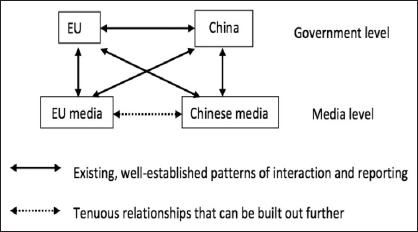
Thus, it seems that there exists a niche for projects focusing on direct, people-to-people dialogue in the media sphere, with the two-fold aim of improving understanding and mutual trust between Europe and China, while also achieving better mutual coverage.
From talking about each other to talking with each other: People-to-people programs in the media sphere
The London-based think tank ISD launched one such multi-annual project in 2011, ahead of the institutionalization of the high-level EU–China People-to-People dialogue in 2012. Organized in partnership with the Shanghai Jiao Tong University and the support of the Robert Bosch Stiftung, the Europe–China Media Exchange initiative has, since 2011, been aiming at creating opportunities for senior journalists from the EU and China to gain an informed insight into each other’s societies and to understand how their attitudes and actions are interpreted by the other. The project aims both to upgrade the participants’ knowledge about each other’s challenges and perspectives and to create an alumni network of senior figures that can be in regular contact. The following section will examine how this project worked toward improving mutual knowledge and mutual trust between Europe and China through its unique exchange model for media professionals.
At the core of the project lies the idea to deconstruct preconceived perceptions of China and Europe through improved reporting on a wide range of issues that are not necessarily highlighted in the respective media spheres. Through coverage of under-publicized issues, the idea is to facilitate the development of fresh, new narratives. In that sense, the project follows similar lines to what has been coined ‘peace journalism’, i.e., journalistic activity that is truth-, people-, and solution-oriented, which ‘identifies cumulative patterns of omission and distortion’, and is characterized by an ‘understanding, proactive and humanizing’ approach, rather than an ‘us and them’, reactive and dehumanizing one (Hackett and Zhao, 2005). The project differentiates itself from journalistic training programs since it is designed for mid-career to senior journalists who have already gained considerable experience in their field. The target group, however, is not necessarily composed of specialists of either Europe or China. Rather, the project seeks to ‘open the eyes’ of media professionals who would otherwise not be able to delve into these topics. Past experience has shown that the mixed knowledge of the geography participants are exploring is a bonus rather than an impediment, as it fosters intra- as well as inter-group information sharing. After two pilot tours, one in Chengdu (2011), one in London, Frankfurt, and Berlin (2012), the third edition of the program was held in Nanjing in 2013 and it was envisaged that the project would continue on a multi-annual basis. To live up to its ambition to provide access to a China/Europe that was ‘not in the headlines’, the project set out to seek innovative points of entry to provide participants with access to topics of interest.
In the framework of power devolution to cities in China, municipalities have gained considerable power and autonomy. Their responsibilities encompass a wide range of activities, from local infrastructure to public services delivery, primary and secondary education, and environmental protection. In fact, ‘China’s major cities enjoy the same status as provinces and have powerful political appointees as mayors’ (Tan, 2013). Simultaneously, European media coverage of Chinese mega-cities beyond Shanghai and Beijing (so-called ‘second-tier’ cities) remains scarce. Thus, partnership with municipalities was identified as a possible pathway to offer unique access, which would be impossible without the authorities’ support.
Second, for both EU and China journalists, although the number of their colleagues working as foreign correspondents in the other geography has widely increased, very few have actually had the opportunity to witness first-hand how the European or Chinese media operate, or to discuss the coverage of current affairs with European or Chinese counterparts. The lack of trust between the two parties is largely compounded by misunderstandings concerning media ownership and freedom of expression in both geographies. Thus, relationships with a range of high-profile print and online news organizations were built to enable both issue-specific debates and insights into the media landscape in Europe and China.
This model of ‘Reporting the under-reported: people and places’ worked well and enabled exceptional insights both in Europe and China. During the first few days of the tour, the participating media professionals together with journalists from their host country gained unparalleled access to a range of representatives from the private and public sector. For the China tour, jointly identified topics such as cultural preservation, social welfare, education, economic transformation, and urban development were explored both by European and Chinese counterparts in mixed teams. For the European tour, Chinese journalists job-shadowed their colleagues in various European media organizations such as BBC, The Economist, The Guardian, Google, or CNN. Both in China and Europe, this model gave media professionals the opportunity to explore issues they were less aware of in their respective constituency. A case in point was the following statement by a participating CNN reporter: ‘I don’t think my CNN colleagues in Beijing could have dreamt of getting as much access as we have had this week in six months’ (ISD, 2013).
The model has stood out for its ability to facilitate discussions with individuals ranging from high-level officials to everyday citizens. All participating journalists have highlighted that the quality of the visits and the openness of public and private sector executives throughout the so-called ‘immersion days’ had enabled them to gain insights they would not have had otherwise. By gaining the opportunity to go to press conferences with senior officials (e.g., with the Mayor of Chengdu, or Party-Secretary of Nanjing), the European participants obtained topical information first-hand, and could contrast it with discussions with students, local inhabitants, or entrepreneurs. When asked about the nature of the new insights gained through the program, participants named a variety of issues ranging from ‘the problems of urban development at a breakneck speed’ to ‘insights into private business, especially the New Economy’, which illustrates the wealth of in-depth knowledge and understanding generated by the program.
But beyond providing a ‘behind the scenes’ insight, the model has also stood out for its ability to facilitate a mutual learning process in which participants do not learn about one another but together and enrich each other’s reporting and articles through shared knowledge. The flexibility allowed within the programming has also enabled some of the participants to pursue ‘out-of-the-box’ stories, leading to original articles on architecture exhibits or art galleries, for instance.
Moreover, special attention has been paid to spreading the newly acquired knowledge to an audience as wide as possible. To enable a strong multiplier effect, participating journalists have been recruited from a mix of European countries (primarily Germany, France, and the United Kingdom) and several Chinese megacities (Chengdu, Nanjing, and Beijing) and have been required to publish at least one article drawn from their experience during the exchange. The wide readership of the publications and the high profile of the participating media organizations made a real snowball effect possible. On the European end, for instance, these publications included The Guardian, The Economist, CNN, Financial Times, Prospect Magazine, Le Figaro, Le Monde, Le Point, Die Zeit, Die Welt, Süddeutsche Zeitung, etc.
The project has thus been successful at improving participants’ knowledge about each other. Through their experience during the exchange, they acquired new information and collected facts and data that would not otherwise have been available to them. Going one step further, however, it is necessary to reach understanding. Indeed, ‘understanding’ is not merely the possession of information: it is the awareness of the connection between pieces of information. Operating on a deeper level than knowledge, understanding means having the ability to distinguish, explain, interpret, and summarize information and data. While the transmission of knowledge can be immediate, reaching understanding is usually a much longer process. Pursuing both improved knowledge and improved understanding is essential in the framework of the exchange. By enabling participating journalists to learn the commonalities they share and to realize their differences, the project permitted not only better knowledge but also better understanding of how the media operate on both sides, which is an important prerequisite to better frame the messages conveyed by the media in the respective constituencies.
One of the commonalities learnt by the participants over the course of the ‘immersion days’ as well as during the plenary discussions closing the program was that journalism is a profession affected by rapid change, itself catalyzed by the spread of social media. Traditional news organizations in China are similarly challenged by the spread of new media and the emergence of the citizen journalists than in Europe. Presentations addressing ways to integrate the new and old media (for instance, by a ZDF representative in Berlin, or a CNN reporter in Nanjing) were received with great interest, as these questions confronted journalists both in Europe and China.
Another commonality that came to light was that the two-way street between media and policy circles leads the profession to be subject to political pressures and often torn between its responsibility to truth and its responsibility toward societal/political stability. Plenary discussions showed that in China, the responsibility to preserve ‘harmony’ often leads to extra pressure on journalists, discouraging them to report on scandals or protests. But the European media have revealed themselves to be under pressure as well, especially regarding sensitive topics such as the protection of national security interests, as could be seen in the wake of the NSA scandal or even 10 years ago, when the New York Times reported on weapons of mass destruction in Iraq based on documents provided by the Bush Administration. In the face of those dilemmas, both sides underlined the importance of journalistic ethics and stressed their attachment to comprehensive and fair reporting, and to high standards in the writing of pieces, notably through the careful double-checking of information.
At the same time, participants gained the opportunity to openly and frankly discuss differences, such as the ways in which the media in Europe and China conceive of their role, and constraints under which they are working. Chinese journalists exposed the fairly recent market liberalization in the Chinese media sphere and the newly gained independence margins associated with it. They also stressed that media in China are expected to take on an educational role toward the people and promote certain moral values while discouraging others (van Pinxteren, 2013). Participants did not deny that the level of state control is drastically higher than in Europe, helping European participants to appreciate that Chinese journalists find themselves in an ambiguous position, qualifying both for being ‘kings without crowns’ (de Burgh, 2003: 814) and ‘dancing in shackles’ (He, 2008: 76). As Shirk (2011) mentioned, they are ‘caught between commercialization and control, journalists play a cat and mouse game with the censors’ (4). European participants reported in their feedback that these honest exchanges gave them a much more thorough understanding of the restrictions Chinese journalists work under. European journalists exposed the European conception of the media as a ‘Fourth Estate’, government watchdog and whistle-blower, charged with the mission of providing a critical counterbalance to power and exposing information to citizens in a transparent manner. Discussions on journalistic standards were put into an interesting light when the Chinese journalists’ visit to BBC in 2012 coincided with the crisis over accuracy in one of the BBC’s flagship TV news programs which led to the resignation of the BBC’s Director-General (O’Carroll and Brown, 2012). Witnessing the open debate about this on BBC programs and the attitude toward the editor who had been instrumental in revealing the mistakes made in the recent investigation, the Chinese visitors started to understand the core tenets of the European media scene.
The discussions also revealed that the impact of the social media on policy varied between Europe and China. In Europe, the traditional media still widely shape the debate and continue to be viewed as the prime providers of information, in contrast to the social media which act more as information distributors than information producers. In China, micro-blogging platforms such as Weibo produce many more narratives and act as counterpoints to the more tightly state-controlled media outlets, thereby gaining considerable influence over policy decisions in many instances (Tang and Sampson, 2012: 457).
The fact that visits during the ‘immersion days’ were undertaken in mixed groups also fostered better understanding of the other side’s interests and working methods. During the tours in China, Chinese journalists reported having learnt a lot merely by observing the types of questions asked by their European counterparts and the topics/angles they chose. During the closing session of the Nanjing plenary, an ECME alumnus from Nanjing Live stated: During this year’s exchange, I learnt a lot in the process of interviewing and visiting. I found some working methods and perspectives very interesting. I was very much impressed by the emphasis on humanity by our European counterparts. I think these experiences are inspiring for our future work. (ISD, 2013)
The Europe–China Media Exchange has thus successfully put into practice some of the lessons learnt from the comprehensive literature dealing with dialogue as a trust-building exercise. It strived to facilitate not only ‘technical dialogue’, focusing on the exchange of ideas and information, but also ‘true dialogue’, in ‘which participants willingly and openly engage in true relationship-building exchanges in which feelings of control and dominance are minimized’ (Buber, 1958; Cowan and Arsenault, 2008: 18). Interesting modifications in perceptions were recorded over the first 3 years of the program’s existence, hinting at the deepening of discussions and the reduction of stereotypes burdening the relationships, as illustrated by the following quotes: It is now one year since my trip to London and Berlin. Back then, probably because we were unfamiliar with each other at the time, the communication process was not that smooth. We worked really hard during a tense meeting about bias and stereotypes. I think this time the media exchange is not that plagued by prejudice or bias. This is definitely the goal of the media exchange. (ISD, 2013) We visited London and Berlin last year. A year later, we are here in Nanjing, my home town. I believe that we know more about each other and now share more common ground. (ISD, 2013)
Challenges and opportunities
Five cross-cuttings barriers hampering governance efforts defined by Ekstrom et al. (2011) can usefully be employed to look at the major challenges facing cross-cultural exchanges in the media sphere. These five barriers are depicted in Figure 2.
Five barriers to successful people-to-people dialogue programs in the media sphere.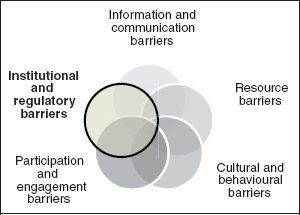
While four out of the five barriers are fairly common in cross-cultural exchanges, it will be argued that the fifth barrier, ‘institutional and regulatory impediments’, constitutes the most challenging one because of its political nature, and questions most prominently the contribution that people-to-people dialogues between Europe and China can make in the long run.
The first barrier is that of participation and engagement. A major challenge for the project is the recruitment of participants. To a certain degree, this is understandable given the fairly young character of the project and the time commitment implied for the journalists, who cannot always afford being away from their desks for an entire week. In addition, it is difficult to secure participation from journalists who would both have adequate language skills and the required seniority to be able to publish after the end of the tour (this issue being particularly marked in China). For the sake of the project’s continuation, trade-offs were made occasionally, such as including one official from a Chinese Publicity Department in the first Europe tour to secure the project’s continuation in China the year after. Because of the necessity to keep the group fairly small (around 10–12 participants from each constituency for each tour) to achieve best results in terms of conversations and relationship-building, the question of scalability and extent of project impact also arises.
Another challenge is that of adequate resourcing. While financial support from the European side was provided by the Robert Bosch Stiftung, funds provided over the first three years of the Europe-China Media Exchange did not fully cover staffing costs and additional support had to be found in the form of in-kind support provided by embassies or additional partners, which limited the organizers’ capacities to carry out certain initiatives.
Regarding information and communication barriers, language limitations sometimes created difficulties in mutual comprehension, especially during the immersion days. Occasional mistranslations or miscommunications from simultaneous translators created additional work and delays. Because of mis translation during a press conference given by Nanjing’s Party Secretary, for instance, a correct English transcript had to be formulated—however, it only reached the European journalists after some had already written their accounts of the press conference. Similarly, the partial mistranslation and misinterpretation of an article on Nanjing and the downfall of the city’s mayor reproduced on the BBC’s Chinese website, caused problems with the Nanjing authorities who demanded a correction and apology. Moreover, while channels of communication per se were not an issue in the planning, implementation, and reporting phase of the project, since social media platforms in China and Europe are different, this can complicate maintaining relationships and online networks in the long run (unless European journalists consider switching to online platforms such as Weibo, given that their Chinese counterparts cannot access Twitter, Facebook, or Youtube).
A third barrier which affected part of the planning for the exchange is a cultural and behavioral one. Indeed, partners on the Chinese side have repeatedly suggested framing the exchange as a ‘training program’ for Chinese journalists, which stands in contrast to the conception that the exchange is supposed to be one in which participants see eye-to-eye and learn from one another—rather than China taking up the position of a ‘student’ having much to ‘learn’ from Europe while Europe merely ‘discovers’ China. Although presenting the project in terms of ‘capacity building’ may well have been the right way to present it to media organizations in China and to win their approval to send some of their journalists to Europe, there is nonetheless caution on the European side to maintain the project’s specificity which distinguishes it from traditional media training exercises.
However, the core challenge for the project remains the fact that China is not a country with a free media scene. This meant that enabling the project to take place, avoiding inconclusive talking shops without ‘rocking the boat’, dealing with censorship and avoiding endangering foreign media implanted in China constituted some of the major difficulties that faced the program. They are also those which may most easily endanger its future implementation.
The first challenge, i.e., official acceptance and entry into China, is illustrated most obviously by the visa applications process. Although one of the Chinese hosting cities advised that all European journalists should apply for a business visa and indicate on the visa application form that the purpose of their visit was participation in a study tour and conference, several journalists were asked to sign a declaration that they would not undertake journalistic work while in China. This was in obvious contradiction with the purposes of the exchange. But it had to be accepted, since it would otherwise have jeopardized the whole project. In addition, concern to present the hosting city in a positive light led some of the European participants to feel frustrated by the ‘red carpet treatment’ received and the absence of light and shade during visits. Although this was of course a fair criticism, it was also conditional to the municipality’s partnership on the project.
More significantly, a second challenge is to move beyond superficial, formal statements during discussions. This can be difficult because participants need to be aware of fluctuating red lines and limits to free expression that have to be navigated carefully. As Fox and Godement highlight, the Chinese media is integrated into a wider effort to ‘weave a web of soft relationships with Europeans where the only requirement is not to rock the boat’ (2009: 36). Special attention thus had to be paid to formulations in the program and plenary agendas. From an organizational perspective, to facilitate not only technical but also real dialogue, one was attempted to create ‘safe dialogue spaces’ on the margins of the official program. These took the shape of social events or lunches, during which surveillance of participants in China was relaxed somehow. Ongoing governmental supervision in China also underlined the importance of the European leg in the overall programming. Indeed, as one journalist from The Guardian noted: It was obvious that Chinese journalists were being watched and reported on by colleagues at two levels in the process. That inhibited their ability to speak to us. I cannot suggest a way round this, except to bring these journalists over to Europe and continue the dialogue with them here. (ISD, 2013)
An additional challenge is that not all Chinese journalists are allowed to publish freely about their impressions gained from the European tour. Furthermore, the project had to be cautious not to endanger foreign media implanted in China. Because of legal and practical complexities, one English language TV channel, for instance, could neither employ a freelance cameraman nor spare a cameraman from its Hong Kong or its Beijing Bureau to accompany its European journalist during the Nanjing tour. Even the publication of the European journalist’s blog, articles and pictures created difficulties, because she did not travel on a journalist visa and publication of her material could cause problems for the medium’s accredited correspondents in China and thereby jeopardize its activities in China.
Because they are structural, these institutional and regulatory barriers, which are inherently linked to the laws and political system in China, can thus most significantly impede and delay processes within the Europe–China Media Exchange model.
Toward real collaboration and an EU–China media platform for cooperation and exchange?
Given the accomplishments of the program, an important question is: Where do we go from here? Where to next? And how can the structure be improved further? One key avenue could be the shift from mere dialogue toward real collaboration. To achieve this, three main criteria are to be fulfilled. First, collaboration takes place through lasting relationships (Cowan and Arsenault, 2008: 21). Only under this condition will the pooling of knowledge become ‘more than the sum of its elements’ and hold ‘the promise of creating something new’ (Desportes, 2014: 75). Second, collaboration requires the different stakeholders to come together and work collectively toward a clearly defined common goal, as opposed to just supporting each other in reaching each one’s goal (Cowan and Arsenault, 2008). Third, problem-definition, goal setting, and decision-making should be achieved through consensus (Ansell and Gash, 2007: 543). Cowan and Arsenault held that a key outcome of collaboration is its ability to ‘breed social trust, foster norms of reciprocity, and create stores of goodwill that can prove invaluable during times of crisis’, and that even across socio-political divides (2008: 23). This implies that programming needs to focus on ways in which long-term sustainability and a continuous information flow can be fostered to make the project more than merely a punctual and superficial exchange of views. It also means that program design may have to shift toward a more participatory approach fostering consensual decision-making, and that it may be beneficial to include activities in which participants pursue clearly defined common goals (Desportes, 2014: 75–77). Concretely, this means that the team-building dimension, co-research on common topics or ideally the co-authoring of articles should be encouraged more intentionally. The possibility to establish a reciprocal or co-authored guest column in each other’s newspaper for instance was explored in 2012 by journalists from the Evening Standard and Jinling Evening News, following that year’s Europe–China Media Exchange.
Finally, one additional idea may be to create an EU–China Media Platform for Cooperation and Exchange based on the model of the EU–China Higher Education Platform for Cooperation and Exchange launched by DG Education & Culture and the Chinese Ministry of Education, corresponding to the mixed approach by bringing together experts and stakeholders of different horizons on a regular basis to discuss specific issues in the field of higher education, identified as priorities by the EU and China, and submit recommendations to both parts to enhance future cooperation in these areas. (Fulda, 2013)
Conclusion
This article identified a lack of interpersonal interaction in the media sphere as one of the factors that may account for continued misperceptions and gaps in understanding between Europe and China. No matter how much technology expands, people-to-people dialogue is still vital to overcome prejudice on both sides, and projects bringing together media representatives are particularly well-placed to improve mutual knowledge and understanding between Europe and China. It suggested that ‘immersion days’ using innovative points of entry into the other’s environment and media scene have great potential to induce changes in perceptions, both at an individual and at a societal level, through the built-in multiplier effect of media publications reaching wide audiences. The ‘Europe–China Media Exchange’ set up by the ISD was used as a case to illustrate how such programs can have a greater impact than traditional conference formats. Achievements, but also lessons learnt have been analyzed: beyond participation, resource, communication, and cultural/behavioral barriers, institutional structures linked to the political context represent the most significant challenge faced by such undertakings. More intentional fostering of collaborative action and EU-wide support for media dialogue between Europe and China were suggested as possible ways to grow this type of exchange further.
Footnotes
Declaration of Conflicting Interests
The author(s) declared no potential conflicts of interest with respect to the research, authorship, and/or publication of this article.
Funding
The author(s) disclosed receipt of the following financial support for the research, authorship, and/or publication of this article: The author(s) received financial support from the European Commission under the LLP Jean Monnet Programme (Education, Audiovisual & Culture Agency) for the research, authorship, and/or publication of this article.