







Abstract
This study takes a theoretical approach of gatekeeping by assessing how transnational networks of news gathering indicate a shift in the conceptualization of journalism culture. Research on journalism culture, which has traditionally been conceptualized within a national system, is linked with the historical development of globalization to propose an analytical conceptualization of journalism culture in a transnational news-gathering environment. Based on empirical studies from the past six decades, the study presents three analytical levels of transnational journalism culture—evaluative, cognitive, and performative—that might provide a conceptual framework for empirical studies interested in news construction in a transnational space.
Introduction
Global market, borderless information technology, and transnational conglomerates are shaping a transnational world (Berglez and Olausson, 2011). Meanwhile, such a transnational world is faced with global challenges that ‘transcend local concerns and national systems, requiring transnational coordination and engagement to solve them’ (Reese, 2015: 2263). International challenges such as global health issues (e.g., Ebola, Zika virus) or global conflicts (e.g., ISIS, the European refugee crisis) are highlighted through global media outlets that provide an important connection among geographical spaces. Indeed, news coverage that focuses on global issues provides information that affects the awareness of international events (Aalberg et al., 2013) and connects audiences around the world with information that trigger engagement, empathy, solidarity, as well as fear.
In addition, global news organizations such as CNN and Al-Jazeera English benefit from new technologies, and as they are operating at a transnational level, they are relatively independent of domestic regulations and state-institutionalized political elites (Wojcieszak, 2007). Therefore, global media conglomerates can adapt global projects to local contexts, thereby providing global news to local audiences.
On one hand, the international news coverage shapes the public’s awareness of international events and the transnational coordination of countries and engagement (Aalberg et al., 2013). On the other hand, skeptics point to enduring national news prisms and limited audiences for international media and write about the myth of a ‘global village’, in that global media technology is ‘a necessary but not sufficient condition for global communication’ (Hafez, 2007: 2). Aside from global technology, journalists themselves play an important role as agents in a global public sphere: ‘The global journalist uses a diversity of sources and perspectives to promote a nuanced understanding of issues from an international perspective’ (Ward, 2011: 742). Indeed, journalism as a field is increasingly confronted by two perspectives: its vertical dimension to present news to a domestic audience and a horizontal dimension to cover the global and cosmopolitan perspective of a news story (Reese, 2008). Although national boundaries remain important criteria for editorial decisions, the horizontal dimension sheds light on how globalization has affected the profession of journalism. The interest of this theoretical inquiry thus lies in the shaping of journalistic cultures, from global and national contexts.
At the heart of this study is the concept of journalistic culture, defined as ‘a particular set of ideas and practices by which journalists legitimate their role in society and render their work meaningful’ (Hanitzsch, 2007: 369). In other words, journalistic cultures include all levels of journalistic gatekeeping that is ‘the process through which events are covered by the mass media, considering concepts on five levels of analysis’ (Shoemaker and Vos, 2009: 3). Journalistic culture is expressed at the individual level of gatekeeping in that journalists’ behaviors are guided by cultural norms and roles. On the routine and organizational level of gatekeeping, journalistic culture is shaped by the way journalists interact with sources, do research, find news stories, and relate those to their audiences. On the social institutional level and the social system level, journalistic culture is shaped by the economic, political, and legal system in which journalists operate.
As journalistic culture manifests in the gatekeeping process, this study asks how journalistic culture can be re-conceptualized in a global environment to empirically analyze the gatekeeping culture in a global news environment—in an environment where journalists seek out sources across borders (i.e., journalistic practices and routines that span geographical and cultural borders), engage with international issues, and inform a global audience on global challenges. The main question in the re-conceptualization is the reference point of society in the definition of journalistic culture. If ideas and practices are more informed by the interconnectedness of countries, how does that change journalistic culture and the way journalists render their work meaningful? Does the reference point of ‘meaningful’ change in a transnational news environment from a domestic to a global audience? Such a theoretical undertaking is crucial, as journalistic culture traditionally has been assessed from a within-country perspective or a cross-national perspective. That is, studies predominantly focus on the vertical dimension to explain gatekeeping decisions (Shoemaker and Vos, 2009) and the influence on news (Shoemaker and Reese, 2015). Meanwhile, conceptualizing transnational journalism culture is necessary to enrich a field that has been historically organized around analytical concepts, epistemologies, and evidence developed in the United States and Western Europe (Waisbord and Mellado, 2014).
Purpose of re-conceptualizing journalistic culture in a transnational environment
Journalism culture, defined as ‘a particular set of ideas and practices by which journalists legitimate their role in society and render their work meaningful’ (Hanitzsch, 2007: 369), examines how media organizations and journalists understand public governance and their role in society (Baker, 2002). Traditionally, journalism scholars have tended to conceptualize journalism culture as embedded in specific social systems and thus study journalism culture by comparing one country to another. For example, the focus on nation-based elements of journalism cultures becomes evident in a particular selection of several research designs. Studies on journalism cultures have examined journalists functioning in a particular social system such as a country unit (e.g., Keel, 2011; Marr et al., 2001; Weaver et al., 2007; Weaver and Wilhoit, 1986, 1996; Weischenberg et al., 2006) or a comparison of different journalism cultures based on geographical borders (Hanitzsch, 2011; Quandt et al., 2006). This direction of research is to be expected, considering that theories explaining levels of influence on news such as gatekeeping theory (Shoemaker and Vos, 2009) have rested on the assumption of five levels of influence, in which social systems (e.g., culture, nation-state, individual history of countries) represent the outermost level. On the other hand, theoretical and analytical models like gatekeeping theory have power to direct and organize the research findings. For example, the nation-state is considered one of the most influential variables to shape the individual professional attitudes of journalists (Hanitzsch, 2011). Explanations for the variation in role conceptions of journalist are typically based on the country as the independent variable. In fact, globalization has focused more on financial and entertainment flows rather than the changing role of journalism. Journalism has been tied closely to democratic structures, rooted in local communities (Reese, 2015). Meanwhile, globalization has affected journalism on all levels and offered global news-gathering spaces that need further theoretical and empirical exploration.
Therefore, this theoretical examination aims to conceptualize transnational journalism culture, the merging of domestic gatekeeping with global gatekeeping approaches, and explore its contribution to the gatekeeping literature in journalism studies. The study deconstructs the concept of transnational journalism culture and develops a conceptual definition of transnational journalism and journalistic culture. Finally, interrelated conceptual and operational definitions of those two concepts provide an analytical way of conceptualizing journalistic culture under the umbrella of a transnational journalism news-gathering environment.
Globalization and transnational journalism
Speaking of globalization, Waisbord (2013: 175) argued that it is ‘an inescapable phenomenon that seeps into every realm of society, politics, culture, or economics’. Media globalization is nothing new and has affected journalism around the world. Historically, the Western press has been the leader in journalistic culture development in other countries for more than two centuries. U.S. colonial newspapers regularly looked to the British and French press for inspiration on information and design (Waisbord, 2013: 179). The profession of journalism itself did not originate before the 1600s, and it has developed worldwide as a product of European colonial expansion (Schudson, 2013: 32). For example, the British Empire between the late 16th and 18th centuries had journalistic practices that shared many characteristics of what we consider transnational journalism today (Louw, 2005, 2010). Meanwhile, Ben Franklin’s Pennsylvania Gazette resembled the very few other U.S. papers of the day in printing largely foreign news and not dealing with local conversations (Schudson, 2013: 30). Papers that focused on local news became more common by the 1870s.
In the second half of the 19th century, U.S. and European news agencies maintained a powerful global presence. Schudson (2013) wrote that the global spread of journalism has been particularly influenced by American technological innovations from the 19th century and that American journalists invented and disseminated the practice of interviewing internationally. Meanwhile, the transnational effects of broadcasting became noteworthy during the late 1930s, when Great Britain and Germany used radio broadcasts to influence public opinion, particularly in the United States (Seib, 2006: 7–47). In fact, by September 1940, the BBC was offering more than 70 news broadcasts each day to audiences outside the United Kingdom. Ultimately, the British and the Americans, as the two great powerhouses of liberal capitalism, have effectively been the drivers of two centuries of globalization—with the British Empire being the organizing force of globalization’s first wave in the 19th century and the Pax Americana (Louw, 2010) being the organizing force of the second wave in the 20th century. Both empires have shared the same commitment to the processes of modernization, liberalization, and globalization (Louw, 2010: 37). And both have set the stage of what we know today as global journalism. However, what is different today is the massive scale and ease of access to news produced according to the conventions of mainstream news in the United States and Britain (Waisbord, 2013: 180).
The historical approach elucidates the various forms of transnational journalism and its manifestations on different levels of the gatekeeping process. For example, transnational journalism in reference to foreign correspondents refers to reporters that not only report news to home audiences from foreign cities but also adapt to the news-gathering principles of their foreign cities. This may simply result in foreign correspondents’ lack of access to sources as in the case of DC, because foreign media do not bring U.S. politicians any votes (Hellmueller, 2014). It may also result in strict rules on how to interview state department officials (e.g., on the record, background, deep background, off the record)—rules not familiar to journalists outside the United States and thus transcending national borders when foreign reporters acculturate to a foreign environment. Another aspect of transnational journalism consists of organizations that are institutionalized as a truly transnational undertaking, such as pan-Arab media organizations that do not necessarily coincide with nation-state boundaries (Hallin, 2009). For example, since 1980, Saudi princes and business partners have expanded their stakes in transnational media as part of ‘a radical transformation of the Arab media landscape and the rise of multiplatform conglomerates’ (Kraidy, 2011: 190), and that has led to the creation of the pan-Arab media system. The elements from both the Lebanese and Saudi media systems have been particularly powerful in shaping Arab media: ‘Saudi moguls with royal connections finance Arab media, while Lebanese journalists, producers, and managers populate the system’ (Kraidy, 2011: 178). Although both Lebanese and Saudi media play an important role in the contemporary pan-Arab media system, the two countries became part of transnational media at different historical periods. In the 1970s, more than 20 Lebanese dailies were read regularly outside Lebanon and about eight titles were distributed more widely outside than inside the country. On the other hand, Saudi Arabia faced external threats and military conflicts and developed a ‘transnational media capacity through various companies that it controls or influences’ (Kraidy, 2011: 189).
But although transnational media organizations have characterized the Arab journalism industry since the second half of the 20th century, Pintak and Ginges (2012: 431) pointed out the irony that ‘it was the launch of a government-financed television channel in 1996 that marked the beginning of the end of the professional schizophrenia that had defined Arab journalism for more than three decades’. Al Jazeera was created by the emir of Qatar, with the goal of shifting it out of the shadow of Saudi Arabia that dominated the Gulf region economically. The Arab television journalists had been trained by BBC’s ethos of balanced and independent journalism. Their goal was to be free from political interference that redefined Arab journalism. In the case of Al Jazeera, Arab journalists had found their voice and begun to portray the world from an Arab perspective, often combined with the mistrust of their governments. But what is most important about this case is that the influence of BBC values and ethics changed the system in a way that the organization started producing a perspective largely ignoring the wishes of the Arab governments.
The above example illustrates that transnational journalism can be conceptualized at different levels of analysis of the gatekeeping model. Transnational journalism from an individual perspective (i.e., foreign correspondents) or an organizational level (i.e., pan-Arab media or Al Jazeera) refers to journalistic gatekeeping beyond national borders, where journalists or media organizations are exposed to gatekeeping processes of more than one social system that shape news content (the one in which they gather news and the media system in which the news is aired or published). In the case of Al Jazeera, ‘virtually every Arab country expelled Al Jazeera’s news teams or shuttered its bureaus at one time or another’ (Pintak and Ginges, 2012: 431). These examples also reveal conceptual differences between global journalism and transnational journalism. Research on global journalism seeks to examine ideas or principles that unite journalism practices around the world, the so-called global space (e.g., Reese, 2008). On the other hand, what is described in this study as ‘transnational journalism’ is conceptually different. Transnational journalism describes how journalism can be understood from transcending national boundaries at some level of gatekeeping, while other levels remain domestic, so the local aspect may still define news output but is shaped by a transnational flow of information (e.g., foreign reporters). Transnational journalism allows investigation on the national and the transnational element simultaneously by taking into account a gatekeeping theoretical framework. For example, foreign correspondents transcend national boundaries by working in a foreign environment and adjusting their news-gathering routines to a foreign environment. In some instances, foreign correspondents apply a domestication strategy to help make their stories be understood by the audiences of the country in which their news organization is based. Domestication is an effect of transnational journalism. It is the process of localizing foreign information and presenting it in a relevant way to audiences (Esser and Hanitzsch, 2012) in that ‘media maintain both global and culturally specific orientations—such as by casting far-away events in frameworks that render these events comprehensible, appealing and relevant to domestic audiences’ (Gurevitch et al., 1991: 206).
What is most important for conceptualizing transnational journalism is the negotiation process of those transnational, national, and local elements simultaneously shaping gatekeeping that this study defines as transnational journalism. If news content is shaped by at least one level of the gatekeeping process happening outside the country or being influenced by other social systems and cultures (e.g., the sources journalists seek out), those news stories should be analyzed under the conceptual framework of transnational journalism that explains how those news stories were constructed. The gatekeeping process exceeds national boundaries and thus the news stories may not be explained by the social system in which the news is presented alone. If such transnational elements indicating the independent variable and contextual part of a research study are left invisible, the conceptual framework lacks explanatory power of the construction of the news story.
Theoretically, the analytical concept of transnational journalism takes into account the transnational logic of gatekeeping. The global logic of gatekeeping assumes that a third space arises from the merging of various social systems. Global journalism is often referred to as a ‘third space’, which Reese (2008: 241) described as ‘the reach, interconnectedness, and virtually real-time properties of a globalized media contribute to our experiencing the world as a whole’. Because more and more journalists around the world share the same idea of professionalism or ideals of press freedoms, a global logic is developing that is distinct from both transnational and domestic journalism. Whereas the nation is the primary focus of transnational journalism, at the organizational level of gatekeeping, global journalism draws attention to consensual norms that allow journalistic organizations to function globally (Reese, 2008: 248). At the individual level of gatekeeping, global journalism is interested in what standards of global press performance emerge.
Distinctions between global and transnational journalism become evident in the research questions that are posed. Both concepts present forms of journalism on the same continuum but offer different perspectives of analysis: If scholars are interested in the third space, the questions address what is global. For example, how do global organizations such as CNN International and BBC World Service operate and gatekeep news in an interconnected and digital world? Global journalism in such a sense refers to a global logic of gatekeeping based on the interconnectedness of social systems that create a global space (i.e., a third space), which is analytically distinct from domestic gatekeeping models (Figure 1).
Journalism gatekeeping in national, transnational, or global contexts. Note: The specific overlap of the figures is depicted for heuristic purposes only. The journalistic intersection of individual countries can lead to different forms of overlap.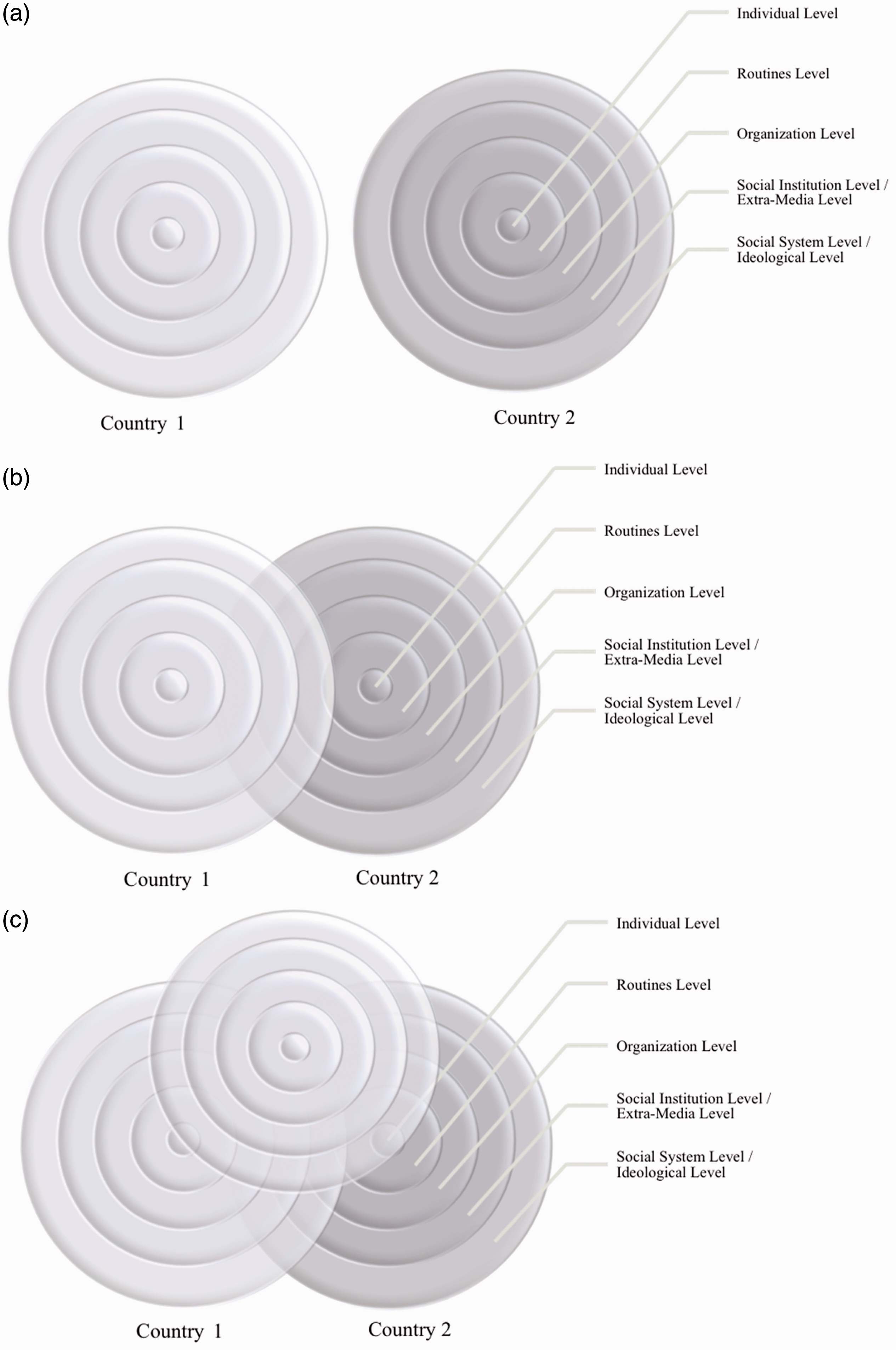
However, research questions on transnational journalism seek to understand how both foreign and national forces shape gatekeeping and try to assess the transitional gatekeeping process between domestic gatekeeping and global gatekeeping on that continuum. The conceptual framework of transnational journalism indicates that although global milieus transcend national borders, transnational journalism examines how those transcended elements are integrated into the gatekeeping process where local, national, and global forces intersect. Transnational journalism as an analytical concept is important because journalism studies have relied on geographical borders as the defining element of news output for many decades (refer to ‘gatekeeping in a national context’ in Figure 1), interpreting journalism as happening mostly within one social system (i.e., within one nation). On the other hand, global journalism indicates the symbiosis between two or more countries (refer to ‘gatekeeping in a global context’ in Figure 1). Meanwhile, transnational journalism captures the transition from national to global journalism that reveals important insights about journalism—as it is changing as a result of globalization (refer to ‘gatekeeping in a transnational context’ in Figure 1).
Comparative communication methods have mostly relied on comparing different media systems, with a system being conceptualized as a nation-state unit (Hanitzsch and Mellado, 2011) that can be re-conceptualized under the logic of transnational or global gatekeeping. Also, a comparative communication method involves the comparisons between a minimum of two macro-level cases (systems, cultures, markets, etc.); this differs from single research cases in that comparative research explains differences and similarities between objects of analysis based on the contextual conditions of those macro systems (Esser, 2013: 115). Comparative scholars define macro cases as ‘(conditions) that help to explain differences and similarities in the objects of analysis (outcomes) embedded in the different cases’ (Esser, 2013: 115). This is particularly important for the concept of transnational journalism, because boundaries to the explanations are based on how the boundaries for the macro cases are defined (whether by geographical boundaries or transnational elements).
Terminology for basic comparisons of Transnational Journalism Culture Phenomena.
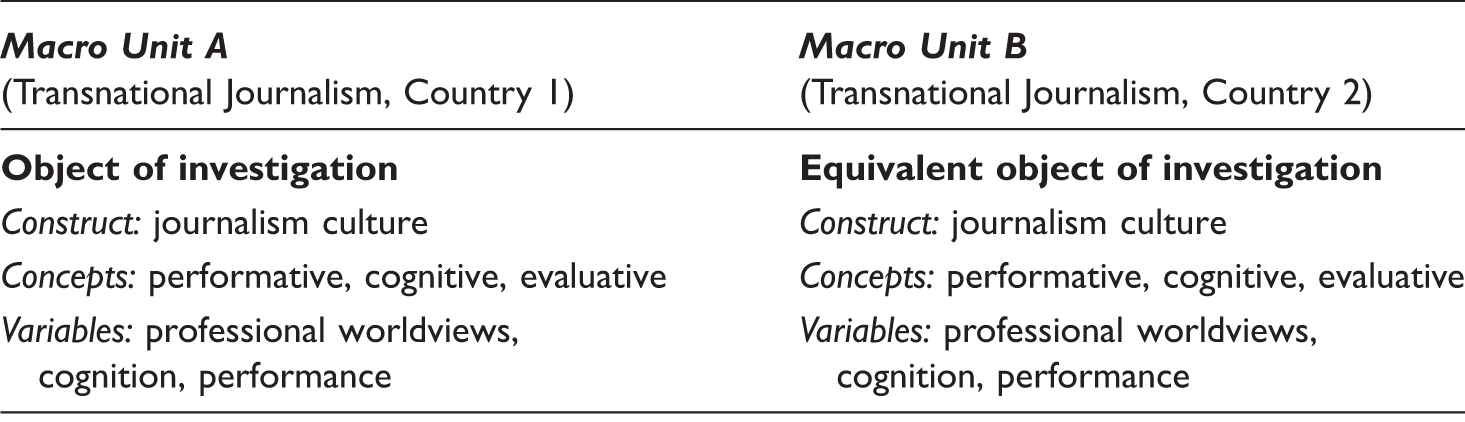
Note: Differences and similarities in journalism culture are attributed to two forms of transnational journalism macro units A and B.
Source: Adapted to the transnational context, based on Esser and Hanitzsch (2012: 5).
Conceptualizing transnational journalism culture on three levels
Having conceptualized the context of transnational journalism, the analysis now turns to the core concept of this analytical piece. The overall conceptualizing research questions can be as follows: How do global or transnational gatekeeping processes affect conceptualizations of journalism culture? Journalism culture is considered ‘a particular set of ideas and practices by which journalists legitimate their role in society and render their work meaningful’ (Hanitzsch, 2007: 369). In a transnational news environment, journalists’ meaning of society may entail different understandings: To what specific context are journalists referring to as ‘society’? Are journalists referring to a society from their home country where journalists were born and raised or where they were socialized (e.g., their first job), or is a transnational context creating its own logic of such a multicultural society?
The three levels of journalism culture.

Source: Adapted and revised from Hanitzsch (2007: 369).
Based on the levels of analysis, the argument toward an analytical model of transnational journalism culture unfolds in two stages. First, a theoretical argument moves scholarly thinking from the concept of journalistic culture with its strong focus on the evaluative component of journalism to reconsider the three levels of journalism culture (the cognitive, performative, and evaluative levels). In the second stage, the three levels of journalism culture are revisited under the assumption of a transnational gatekeeping context.
Journalism culture at the three levels
Hanitzsch’s (2007) theoretical piece published in Communication Theory has greatly contributed to contemporary understandings of how to operationalize journalism culture to make feasible comparative research on journalism professionalism. It has led to an increase in comparative research on journalism culture because its theoretical framework set the stage to examine differences and similarities among countries’ journalism culture. The evaluative level was deconstructed into three constituents—institutional roles, epistemologies, and ethical ideologies (Hanitzsch, 2007: 371)—and the attention of the empirical project that followed the theoretical conceptualization of journalism culture examined the evaluative level of journalism culture solely. This approach makes sense, because although much of journalism research has focused on the evaluative elements of journalism culture, few scholars have differentiated between levels of culture and its analysis and hence less knowledge exists in journalism studies on how the other levels can be theoretically conceptualized in regard to journalistic culture. Indeed, few scholars have referred to the different levels of journalism culture. For example, Schudson (2001) distinguished between practices and norms that inform journalistic practices. Taking a closer look at research inquiries in journalism studies, results reveal that journalism scholarship implicitly pays attention to the importance of the two of the three components of a journalism culture (evaluative and performative) at the expense of the cognitive level. Indeed, one strand of journalism research has focused on the performative level of journalism research investigating news values, news factors (i.e., indicators), source selection, and frames in news reports by content-analyzing performative elements of journalism (Iyengar, 1991; Strömbäck and Dimitrova, 2006; Tresch, 2009). The strand of research on the evaluative level of journalism culture has investigated journalists’ role perception or journalism’s institutional role (i.e., its evaluative component), defined as journalists’ perception of journalism’s social functions in society (Donsbach, 2008; Weaver et al., 2007). Those perceived social functions are assumed to shape the stories that journalists ultimately report, and thus the performative element functions as pre- or post-justification of such research interest rather than as the logic of empirical investigation. The implicit assumption that news content (i.e., the performative level) is a reflection of journalistic roles (i.e., the evaluative level) guides many research projects (Graber, 2002; Hanitzsch, 2011). Although it seems that ‘the way in which journalists define their jobs will affect the content they produce’ (Shoemaker and Reese, 1996: 101), a normative link between role conception and role enactment should be met with skepticism (Tandoc et al., 2013). In fact, media organizations are influenced by the demands of external factors, such as financial concerns and competition with other media (Shoemaker and Vos, 2009) that might hinder the overlap of journalists’ role conceptions and practice. Meanwhile, the large amount of scholarly interest in role conceptions may seem surprising, considering that levels of influences and gatekeeping theory (Benson and Neveu, 2005; Shoemaker and Reese, 1996; Shoemaker and Vos, 2009) actually argue that the individual level of the journalist has the lowest influence over news content. Considering that, it can be concluded that journalists’ role conceptions are hence subject to limits set by the level of routines of the workplace or the political system in which reporters operate. This is crucial, as Shoemaker and Reese (1996) argued the importance of understanding journalists with respect to their individuality and creativity but also within their larger institutional context, where the power of the individual expresses itself mainly through those occupational channels.
Scholars implicitly refer to the performative level of journalism culture, but one level of journalism cultures that remains almost absent of any scholarly discourse is its cognitive element, which is important for an analytical framework of transnational journalism culture. The cognitive level deals with interpersonal and intercultural relationships with sources and perception of news events. Findings from journalism studies are therefore complemented with research into intra- and inter-cultural communication to fully capture the cognitive level and its articulation in a transnational journalism setting.
The cognitive level: Journalists’ interpretations
At the cognitive level, journalism culture is shaped by interpretations and perceptions of journalists, which have become increasingly important to examine in the past several decades of research. The traditional role of journalists as gatekeepers who control the public’s access to information has shifted to a nonlinear, interactive idea of journalism in a networked society, particularly in the Western world. Digital technology enables a variety of people to take up reporting (Singer, 2010). Thus, journalists may no longer hold a privileged gatekeeping position but are instead thrown into a network of relationships. In a networked society, interactions and relationships with other information providers become salient. Singer (2007) argued that with journalism becoming increasingly less dependent on organizational structures, the reporter becomes more independent from organizational constraints. The journalist’s work then focuses on applying professional norms to relationships that he or she holds with sources and interactions within such a network. Hence, interpersonal factors become important when moving from a profession of gatekeeping to a profession that cultivates social relations. For example, journalists are more likely to grant favorable news coverage to credible sources, which can have serious implications for establishing media frames of their sources (Yoon, 2005). Studies reveal that journalists consider officials from their home countries to be more credible and newsworthy than officials from foreign countries (Yoon, 2005). Interestingly enough, studies in interpersonal communication have pointed to the exact same relationship between perceived homophily (i.e., similarity that a receiver perceives to exist between him and an information source) and source credibility (e.g., Allen and Post, 2004; McCroskey et al., 1975, 2006).
From a journalism perspective, Deuze (2005) theorized multiculturalism as an emerging professional ideology of journalism; thus, it seems helpful to begin thinking about perceptions and interpretations of sources based on intercultural communication research. Journalism as a profession has been legitimatized based on conventions of truth telling such as objectivity, autonomy, impartiality, and independence (Deuze, 2005), but the idea of journalists shaping news content seems to represent a distorting force of journalistic norms. Challenging questions have to be asked to understand the state of journalism in a transnational setting. For example, what does it mean to be independent if a journalist’s own background or patriotism is reflected in a story he or she writes?
Based on intercultural communication research, the answer seems more straightforward. Gudykunst and Kim (2003) pointed out that one’s cultural orientation acts as a filter for processing incoming and outgoing verbal and nonverbal messages. Neuliep et al. (2005: 44) took a same position: ‘To the extent that humans are ethnocentric, we tend to view other cultures (and microcultures) from our own cultural vantage point’. Not only does it influence their view of other cultures, but it also guides their interaction patterns. Most important, in a journalism context, perceptions of sources are shaped through cultural filters, because no message is interpreted apart from its source (McCroskey and Richmond, 1996). Intercultural communication research has shown that the more the source and the receiver have similar backgrounds (i.e., homophilous), the more likely it is for communication attempts to increase and for communication to be effective based on perceived source credibility (McCroskey et al., 1975). Research in journalism studies has pointed in a similar direction, arguing that journalists’ perception of source credibility is a strong predictor of source use (Schotz, 2008; Yoon, 2005). Intercultural research is different from cross-cultural research on which most of research on journalism culture is based (Hanitzsch, 2011) in that communication data from one culture are compared with equivalent data from another culture. In general terms, cross-cultural describes a comparison study between cultures, whereas intercultural refers to an interaction between people from different cultures (Gudykunst, 1985). Therefore, intercultural research findings are essential for building an analytical framework of transnational culture, as those studies assume the interaction between people or organizations from various cultures, whereas cross-cultural research examines how the national contexts affects journalism culture. In the early years of intercultural communication research, scholars assumed that communication in an intercultural setting would be different from an intracultural setting. However, studies extending and theorizing intracultural communication to intercultural settings found that there are many areas where findings from intracultural communication can be extended to intercultural settings (Gudykunst, 1985; Gudykunst and Kim, 2003; Klopf and McCroskey, 2007; McCroskey, 2002, 2003; Neuliep et al., 2005; Ting-Toomey and Chung, 2005). For example, in studying intracultural communication, Rokeach (1960) stated that social distance is determined by perceived similarity of beliefs between two persons (i.e., the more similar beliefs they share, the less their social distance). Brewer (1968) conducted an intercultural communication study among East African tribes and found similar findings: Social distance was found to vary most strongly, according to perceived similarity.
Decades of research in intercultural communication have revealed that perceptions of source credibility and similarity are two key concepts that influence people to initiate and maintain communication with someone (King, 1976; Neuliep et al., 2005; Wheeless, 1974). In a journalism context, dimensions that affect whom journalists communicate with have not been explored from an intercultural communication perspective on the cognitive level of journalism culture. In fact, Donsbach (2004) stated that most of the current models or theories of journalists’ news decisions concentrate on news factors, whereas studying the underlying processes leading to news judgment has been mostly absent. Donsbach (2004) further argued that a need to preserve one’s existing predispositions can explain news decisions. Rosenthal (1987) argued that journalists’ readiness to publish negative rumors about a politician varies significantly with their attitude toward this figure. The process of selective perception can hardly be separated from selective attention. German journalists, in particular, believe the influence of one’s predispositions on news decisions to be legitimate. Therefore, partisanship is more widespread among German journalists than journalists from the United States, the United Kingdom, Italy, or Sweden (Patterson and Donsbach, 1996).
Based on intercultural communication research, it can be concluded that the cognitive level is important in shaping journalism culture. In a transnational context, the cognitive element may explain why some sources are chosen over others and why sources are framed differently based on their background, their country of origin, and their similarity with journalists’ or a news organization’s own history and background. While journalists are embedded in an organizational and social system framework, such perceptions and interpretations of news events may be explained and shaped by organizational cultures and standpoints. The conceptual advantage of including the cognitive element of journalism culture is to explain that there is a difference between what journalists think of their normative role and how they report the news. That process is a news organization’s day-to-day sense making and judgment of sources and events to produce news stories for a specific audience.
The performative level: Journalistic practice in a transnational context
Meanwhile, Druckman (2001) suggested that journalists’ framing of stories may be unintentional. In other words, journalists might not be aware of the influences of their own predispositions. This may sound paradoxical, but it may well be that journalists have only begun to subscribe to their news organization’s corporate identity as a result of their professional socialization, with self-perceived independency conceptualized as a professional illusion (Hanitzsch and Mellado, 2011). Conceptualizing the performative level of a transnational journalism culture requires looking at constraints and differences in practical terms. For example, previous studies have concluded that foreign correspondents have less access to exclusive sources and are less frequently offered the opportunity to conduct personal interviews (Willnat and Weaver, 2003). Distinctions on the performative level are visible mainly because of the news context those journalists are reporting for and the news context they are living in that may diverge, such as a U.K. news organization having a daily deadline that conflict with the timing of press conferences in the United States because of the time difference. It can therefore be conceptualized that the performative element as the expression of journalistic work (i.e., news-gathering behavior) is mostly conceptualized in how they approach news reporting and how they report the news.
Furthermore, the performative level represents the level to be most likely observed by the public and a platform to articulate the cognitive and evaluative level of transnational journalism cultures. Through transnational cultural analyses, it is possible to observe those interaction patterns and reporting methods (i.e., performative level) and explain them through the cognitive and evaluative level: ‘Journalistic practices are shaped by cognitive and evaluative structures, and journalists—mostly unconsciously—perpetuate these deep structures through professional performance’ (Hanitzsch, 2007: 369). The ambiguity of professionals can be attributed to the constant blending of occupational and normative definitions (Waisbord, 2013). Whereas the performative level explains what journalism does, the normative discourse articulates what standards journalism should pursue. The blending of the two may hide the reality of the profoundly undemocratic news industry by ‘the self-serving justification of the prominent role of journalists in the mediated public sphere’ (Waisbord, 2013: 7). Hence, the proposed disentanglement in this study of the performative and evaluative level builds a deeper understanding of the analytically different elements of journalistic culture. Oftentimes, the journalism ideals that journalists would like to fulfill (such as objectivity and accountability) may not be realized, given the unique circumstances of media systems (Mellado and Van Dalen, 2014). Hence, the proposed analytical model of transnational journalism culture disentangles those levels, taking into consideration the different analytical notions of the performative and evaluative level of journalism cultures.
The evaluative level: The worldviews of transnational journalists
At the evaluative level, journalism cultures manifest in professional worldviews or role conceptions of journalists. Even though multiculturalism as a professional ideology has emerged on local, national, and global levels of reporting, it is most critical on global levels, where audiences still rely very heavily on media coverage because of a lack of immediate contacts. Journalists face choices about how to cover cultural conflicts and how to arrive at ethical judgments. Such choices are difficult and involve ‘hard choices between upholding our own cultural values and considering the values of other cultures’ (Ting-Toomey and Chung, 2005: 335).
At the evaluative level, the underlying assumption of the past 60 years was that the way journalists define their jobs would affect their performance (Mellado and Van Dalen, 2014). Thus, the evaluative level of journalism culture is much more operationalized than theorized because of the seeming transparency of the concepts on that level. For example, scholars seem to agree upon the common understanding of the two words, roles and conceptions (Vos, 2005). However, only recently have scholars pointed out a lack of agreement on the performative and evaluative levels of journalism cultures, making it the loci of empirical examination (Mellado and Van Dalen, 2014). This is particularly interesting when comparing journalists from various countries working next to each other in a transnational setting in which the performance of a particular journalistic ideology may become more difficult. For example, journalists who claim the existence of an objective and ultimate truth out there embrace an epistemology that resonates more strongly with justifying those truth claims empirically. For journalists to gain credibility, they strive to be more trustworthy on the ground and conduct personal interviews with their sources (Hanitzsch, 2007). However, if they now work in another environment as foreigners, such a manifestation of evaluative components becomes more difficult, as access might not in any case be granted to foreign correspondents. Thus, the transnational setting requires, more than ever before, conceptualizing journalism culture on three levels to capture the concept of journalism culture. Especially during transitional periods when new foreign correspondents are hired, the three levels may diverge because of dissimilarities to the contextual environment from where they began their journalism career.
Combining levels of transnational journalism culture enables scholars to explain journalistic performance by culture-specific variables such as country of origin, socialization in their home countries, and their perceptions and interpretations. Such an approach further examines the relationship among the three levels and enables an empirical investigation on the extent each level perpetuates its structures through another (e.g., how much the evaluative component is visible in journalistic performance). In developing an analytical framework of transnational journalism culture, the three levels are combined.
Combining the three levels: Analytical framework of transnational journalism cultures
The act of comparing cultures using the same dimensions has been criticized that it entails assumptions associated with the etic approach. An etic approach has been a contested area of discussion for its inherent bias toward societies and its lack of sensitivity to various cultures where a universal yardstick may not be easily used for measurement (Shearman, 2008). The emic approach, on the other hand, is an inductive approach and conceptualizes culture from its specific cultural context. The findings would not necessarily have to translate from one cultural context to another (Hanitzsch, 2007). The proposed analytical framework of transnational journalism culture makes both approaches possible: From an etic approach, dimensions can be studied that have been found universal, such as role conceptions or framing strategies as well as reporting methods. From an emic approach, the three levels could be studied from a bottom-up strategy by either observing the performance of journalists in a transnational setting and then defining categories that might be unique to that context or analyzing emerging categories from the data that have not been found in cross-cultural research and relating it to the cognitive, evaluative, or performative level of journalism cultures. To provide an analytical framework for either an emic or etic approach, the three levels are summarized and put into a contextual environment. The model presented in this study outlines the linkages among levels. Possible empirical questions to answer with this framework are as follows: How do correspondents’ perceptions matter for their interaction? (i.e., combining the cognitive with the performative level.) How do different truth-telling ideologies manifest in correspondents’ sourcing choices? (i.e., explaining the performative level with the evaluative level.) In the pan-Arab media system, how does the interpretation of news events based on the cultural background of those in management positions influence the way stories are covered for a presumably transnational audience?
To answer such research questions, scholars first have to define the macro-level unit—defining the country and its overlap with other countries by the logic spelled out in Figure 1. Taking the pan-Arab example, Lebanon might represent Country 1 and Saudi Arabia might represent Country 2. Although both are getting the news through transnational media organizations, they still remain independent media systems, which render the investigation of transnational journalism culture important. Explanation of differences and similarities of the results can then be contextualized by the transnational gatekeeping process, explaining in what way gatekeeping is based on transnational elements. Meanwhile, at the evaluative level, one could investigate whether journalists working for a transnational media organization become simultaneously more similar and different from journalists in their country of origin. At the organizational level, one could examine whether transnational news organizations mirror normative discourses of a particular country such as the United States, or a specific region, such as the Middle East.
This study’s theoretical analysis attempts to understand transnational journalism culture at its conceptual level and redefine its dimensional structure based on a transnational journalism context. The three levels provide the articulation of culture that journalism manifests. However, based on the theoretical examination of this study, the model needs to be revised. It makes sense to map the levels next to each other, but the word level implies that there is some kind of hierarchy in how the three levels should be conceptualized. In combining the three levels, a revised conceptualization of transnational journalism is presented that takes into account the implied notion of hierarchy and discusses the three levels and their interdependence (Figure 2).
An analytical model of transnational journalism culture (as expressed in a political beat context). Source: Hellmueller (2014); permission received for reproducing the figure here.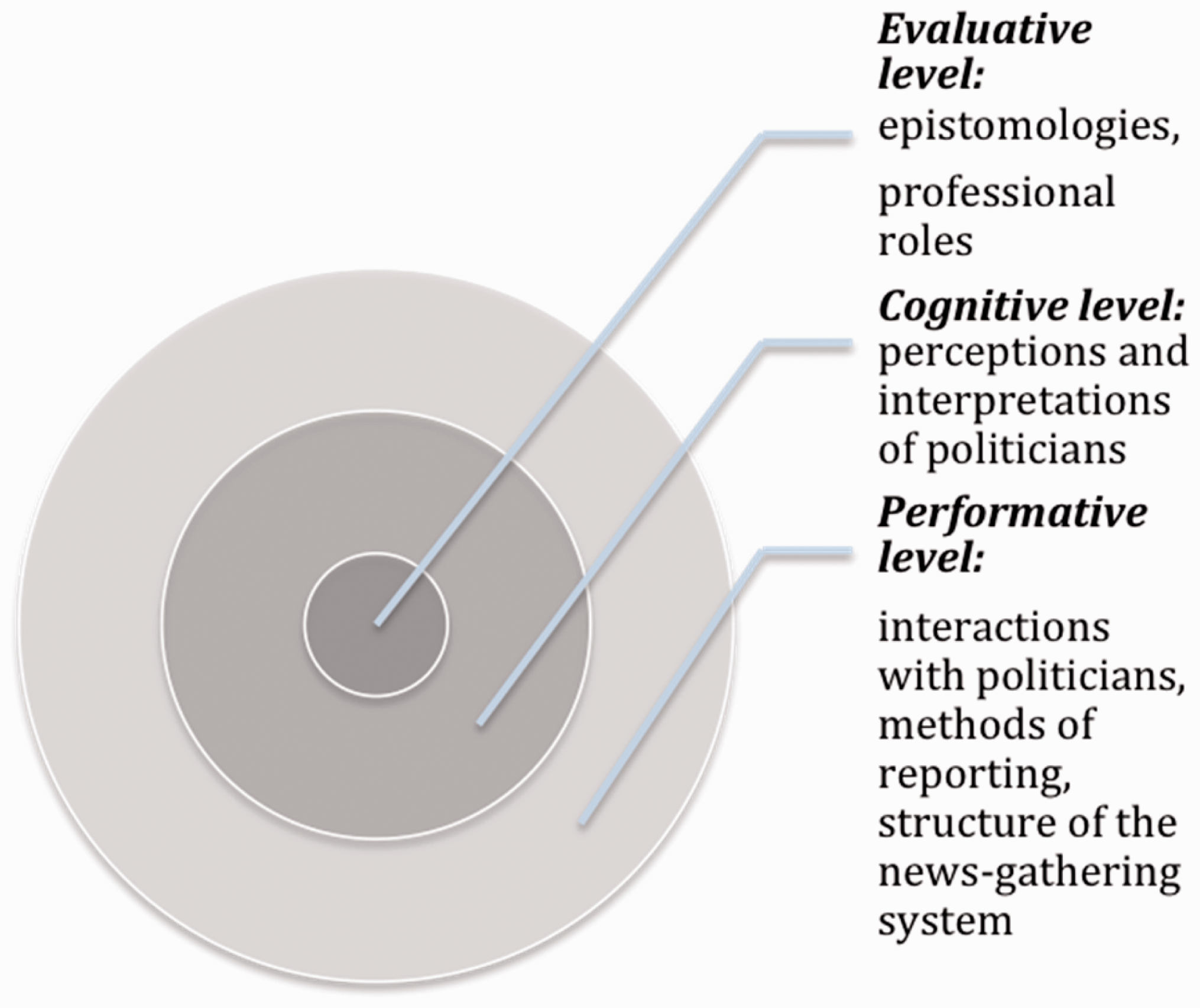
The innermost level is the core level of journalism culture (i.e., the evaluative level) because journalists’ profession is based on truth telling (Kovach and Rosenstiel, 2001). The evaluative level exists on a rather abstract level defining the practice of journalists but not in any instance journalists’ performance, as norms and values can conflict with organizational values or ideals. Evaluative ideas as the fundamentals of journalism are the tool and skill sets that set journalism apart from other fields and guarantee its autonomy from heteronomous forces. However, studies that combine the evaluative and performative levels of a journalism culture are very rare. These studies are much needed to understand journalism culture because of a normative assumption that underlines evaluative elements (i.e., that norms and roles should be evident in news outputs).
Cultural similarity plays an important role in how journalists define the credibility of their news sources (Hellmueller, 2014). For example, the more journalists perceive a source to think like them, share similar values, and express similar attitudes, the more likely they will perceive those sources as credible. However, the perfomative aspect matters in how those perceptions influence correspondents—particularly in how much autonomy they enjoy. Perceptions can further influence the way journalists or news organizations cover a source in the news. Thus, by peeling the layers of the transnational journalism culture model, an explanation can be found as to why performance and news content may vary depending on the cognitive level of the transnational journalism culture. The analytical model of transnational journalism culture offers the theoretical framework to examine explanations of why news content turns out the way it does.
Although any conceptual structure can be criticized for its selectivity (i.e., other dimensions might have provided a better explanation for a conceptual framework), the presented framework relies on journalism research from the past 60 years. Without doubt, the present scholarship probably includes mostly Anglo-Saxon literature because most research on journalism culture has been published in English-language academic journals. More comparative projects should be undertaken to understand the articulation of those three levels in other parts of the world and to study their expression through the combination and comparison of those levels with one another. The major advantage of the framework is that the thinking exercise started with transnational contexts. Globalization has affected journalists’ practices and thus has changed the way journalism culture is articulated in a transnational context for over 200 years. It is hoped that this study broadens the understanding of a key concept of journalism culture and thereby provides a better theorizing of how news is constructed when contextualized in a transnational journalism context. The significance of the proposed model lies in the analytical framework it proposes to distinguish among the three levels of journalism culture. Furthermore, it provides theoretical assumptions about how those levels are shaped in a transnational journalism environment to eventually explain the process of transnational gatekeeping.
Footnotes
Acknowledgement
The author would like to thank Dr. Tim P. Vos, Dr. Louis Bosshart and Dr. Lynda L. McCroskey for all their support with completing this doctoral research project.
Declaration of Conflicting Interests
The author(s) declared no potential conflicts of interest with respect to the research, authorship, and/or publication of this article.
Funding
The author(s) received no financial support for the research, authorship, and/or publication of this article.