







Abstract
The article offers a corpus-driven computer-assisted analysis of newspaper language immediately surrounding ‘im/migrant(s)’ in the Guardian, the Daily Telegraph and the Sun and their Sunday publications between 2011 and 23 June 2016. Drawing on moral panic and social representations theories, the study reveals that the newspapers increasingly ‘othered’ the European Union (EU) through constructing moral panics over ‘illegal’/‘EU’ ‘im/migrant(s)’ prior to the referendum, despite noticeable differences across them. It confirms that the EU was imagined as the origin and conduit of migrants entering the UK, especially by the two right-wing newspapers, constructing an antagonism between Britain and the EU, with implications for understanding the role of news media in shaping and signifying public discourses about Brexit. The conventional stigmatising norms labelling ‘immigrants’ have been adopted and extended to associate the object of the EU with the moral panics over ‘immigrants’, which reflects the changes in social representations of ‘immigrants’ and ‘the EU’.
Keywords
Introduction
Before Britons voted to leave the European Union (EU) on 23 June 2016, the European humanitarian migration crisis had exacerbated the long-term antipathy surrounding the UK’s EU membership, at the heart of which is the debate about whether the UK should stop free movement of EU migrants into Britain. How the British news media generally portrayed immigrants under such circumstances and, in particular, whether and how the aforementioned issues in social reality influenced the representation of immigrants can help us to understand the social role of news media.
This article offers a corpus-driven computer-assisted analysis of language immediately surrounding the terms ‘im/migrant(s)’ in the coverage of migration by the Guardian, the Daily Telegraph and the Sun and their Sunday counterparts between 2011, when the Arab Spring started, and 23 June 2016. Drawing on moral panic and social representations theories, the study reveals that the newspapers increasingly ‘othered’ the EU, through constructing moral panics over ‘im/migrant(s)’ prior to the referendum. It confirms that the EU was imagined as the origin and conduit of migrants entering the UK, especially by the two right-wing newspapers, constructing an antagonism between Britain and the EU with implications for understanding the role of news media in shaping and signifying public discourses about Brexit.
In the remainder of the article, we first discuss moral panic and social representations theories, so as to construct a theoretical framework for the study. We go on to explore the literature on media representation of immigrants as ‘the other’ and introduce the contextual background of the case in the UK. After discussing our methodological approach, we will present and discuss our findings, followed by a conclusion which will summarise the main arguments, discuss the limitations of the study and suggest future research.
Moral panics, social representations theory and media construction of ‘the other’
Moral panic and social representations theories jointly form the conceptual framework in this article. Moral panics refer to a situation in which ‘a condition, episode, person or group of persons emerges to become defined as a threat to societal values and interests’ (Cohen, 1972: 1). A moral panic is ‘an act of othering’ through labelling and defining deviance (Petros et al., 2006; Salmon, 2004; Venanzi, 2008; Young, 2009: 13). News media are an important type of ‘moral entrepreneurs’, who construct stigmatising norms defining people or things as ‘folk devils’ or ‘the other’ and promote them among a population (Cohen, 1972; Goode and Ben-Yehuda, 1994).
Social representations are ‘a specific way of understanding, and communicating, what we know already’, which means the symbolic representations and concepts of objects that embody certain meanings accepted by the public (Moscovici, 2001: 31). Such representations, which are dynamic and continually changing, conventionalise new concepts so as to prescribe them and make them recognisable and acceptable by the public (Moscovici, 2001: 22; Uphama et al., 2015). Social representations comprise three interrelated elements: ‘subjects or carriers of the representation’, ‘an object that is represented, a concrete entity or abstract idea’ and ‘a project, or pragmatic context, of a social group within which the representation makes sense’ (Bauer and Gaskell, 1999: 167–168).
A close connection exists between moral panics over, and social representations of, objects. Labels of objects leading to moral panics contribute to constructing their social representations (Venanzi, 2008), which can in turn integrate the accepted concepts or labels into newer concepts in a ‘pragmatic context’ (Bauer and Gaskell, 1999; Moscovici, 2001; Uphama et al., 2015; Venanzi, 2008). Therefore, the concept of ‘the other’ can be projected and conventionalised to create meanings for another ‘other’ in a context. There is an extensive literature studying how media construct moral panics over certain people and things in their coverage (such as Hall, 2006; Hall et al., 1978; Warner, 2013; for a summary see e.g. Critche, 2008; Hier, 2011). Yet, we need more research to probe how news media transfer stigmatising labels for one object onto another object, which may indicate changes in social reality over a particular period of time.
Moral panics and media representation of ‘immigrants’ as ‘the other’
Representations of immigrants have been negative – viewed either as a threat or as victims – in the media coverage of migration within and beyond the British context over the past several decades (Baker et al., 2008; Baily and Ramaswami, 2005; Every and Augoustinos, 2008; Gabrielatos and Baker, 2008; Hart, 2011; Horsti, 2008, 2013; Innes, 2010; Kaye, 1998; KhosraviNik, 2009, 2010; Leudar et al., 2008; Matthews and Brown, 2012; Moore, 2013; Nordberg, 2004; Van Gorp, 2005).
Not only has an image been created of a large number of ‘illegal’, ‘unchecked’ and ‘uncontrolled’ RASIM (refugees, asylum seekers, immigrants and migrants) but also the presentation of RASIM as criminals and even terrorists in news coverage, depicts migration and migrants as a threat to the national security of the host countries (Bhabha, 2002; Buonfino, 2004; Hart, 2013; Innes, 2010; Teo, 2000). Migration and RASIM are also portrayed as an economic burden, ‘a burden or a strain on resources’, and therefore threatening to the stability and sustainability of the social benefits system of the host country (Information Centre about Asylum and Refugees in the UK [ICAR], 2004). In the UK, immigrants and asylum seekers have been collectively presented as a threat to ‘UK security interests’ at three levels: a physical threat, an economic threat and a threat to identity and Britishness (Blinder and Allen, 2016; Caviedes, 2015; Innes, 2010; Greenslade, 2005; Moore, 2013). In addition, immigration is often described as a race and ethnicity problem that threatens the cultural values of the host countries (Adeyanju and Neverson, 2007; KhosraviNik, 2009; Krishnamurthy, 1996; KhosraviNik, 2009; Krishnamurthy, 1996).
While the threat frame is still dominant, RASIM are sometimes depicted in a sympathetic manner as victims of patriarchal systems (Horsti, 2013), wars, crises, genocides and authoritarian rule in their home countries (KhosraviNik, 2009) or of racism in the host country (Coole, 2002). This narrative, reflecting Western human rights values, could potentially construct a climate of humanitarianism (Horsti, 2013).
Such negative representations of immigrants, especially that of the threat, have turned immigration and immigrants into objects of moral panics (Banda and Mawadza, 2015; Boomgaarden and Vliegenthart, 2007; Chapkis, 2003; Erjavec, 2003; Finney and Robinson, 2008; Fitzgerald and Smoczynski, 2015; Karyotis and Patrikios, 2010; Light and Young, 2009; Longazel, 2012; Moore and Forkert, 2014). In Britain, moral panics over immigrants were closely connected with those over ethnic minorities in the 1970s and 1980s and later those over Islam, which historically is portrayed as a barbarian ‘other’ by the West (Said, 1978, 1985). Hall and his collaborators (1978) for example, systematically unpacked how news media helped construct moral panics over mugging and muggers – presented as mostly black youth in the late 1970s. Since the 1990s, as elsewhere in the West, immigrants have been associated with the stereotyped images of Muslims with an emphasis on their violence and deviance from the West, linking them to terrorism, seeing them as ‘home-grown’ terrorists or the ‘enemy within’. Such a link spreads anti-Muslim prejudice and Islamophobia in the British context (Ahmed and Matthes, 2017; Allen, 2017; Baker et al., 2012; Bleich et al., 2015; Hellwig and Sinno, 2017; Jaspal and Cinnirella, 2010; Moore et al., 2008; Morgan, 2016; Nickels et al., 2012).
Immigration issues in the UK: The context and the link between the EU and immigrants
A long history of migration has turned Britain into a multicultural and multiethnic society comprising diverse racial, religious and ethnic groups (Solomos, 1989). Social tensions, divisions and even conflict between British indigenous values and culture, and those of immigrants have appeared (Amin, 2002; Solomos, 1989; Vertigans, 2010). As well as cultural differences, the diverse economic interests of people of different social classes have resulted in divergent opinions surrounding immigration in the UK.
Lately there have been two opposing voices within Britain about immigrants. One view accuses migrants in general – and EU migrants in particular – of being free-riders and taking job opportunities and social benefits away from locals. The other view, which is pragmatic and instrumental, sees them bringing economic benefits and helping to relieve social burdens caused by the aging population in Britain. The two conflicting views associated with these ideas about the economic and social costs and benefits of immigration were crucial to the final result (Leave 52% to Remain 48%) of the referendum on 23 June 2016. 1
The tension between Britain’s desire to control its own national borders (and to tighten up on and reduce immigration) and the EU’s immigration and asylum policies is one main reason for the wish to withdraw Britain’s membership of the EU. With Britain being a member of the EU, EU migrants can relatively freely come to Britain to work and to live under the EU’s right of free movement. The notion that EU immigrants take away jobs from local residents and ‘scrounge’ social benefits has become an increasingly significant concern for the sector of the British population that voted in favour of leaving the EU in the 2016 referendum.
This concern is exacerbated by the European migrant crisis in which European countries struggled to cope with, and resettle, a huge number of migrants and refugees who travelled to the EU having escaped from conflicts in Afghanistan, the Middle East and Africa. The drowning of Alan Kurdi, a 3-year-old Syrian boy, in September 2015, became an icon of the humanitarian crisis. Although the UK has opted out of the EU policy of mandatorily accepting refugees, Britain nonetheless accepted ‘about 1,000 refugees from Syria under the Vulnerable Persons Resettlement Programme (VPR)’ and promised to ‘take in 20,000 by 2020’. 2 Associated with the arrival of refugees and migrants were concerns over security and cultural values, for example, worries about terrorists coming into the UK with refugees or beliefs that refugees had been recruited by Islamic State (ISIS), despite many of them were truly fleeing ISIS. 3 Indeed, the rapid rise of ISIS from 2011 and a series of terrorist attacks in the UK, France, the United States and other countries over recent years has woven a web of fear surrounding terrorism, which deepens the concerns over immigrants. The knowledge of how British news media represented immigrants under such circumstances between 2011 and 2016 has significant implications for understanding the relationship between news media and social representations of immigrants before the Brexit vote.
Data and methods
To address this aim, we undertook a three-step computational corpus-driven analysis of 50,581 articles on immigration issues published by the Guardian (short for the Guardian and the Observer), the Telegraph (short for the Daily Telegraph and Sunday Telegraph) and the Sun (short for the Sun and Sun on Sunday) between 1 January 2011 and 23 June 2016. These newspapers are among the most influential newspapers in the UK. Using the National Readership Survey’s (NRS) social grades, the Sun is a down-market tabloid with the largest circulation in the UK, drawing its readership mainly from lower social classes (C2/D/E), while the other two newspapers are most influential among those from the upper or middle classes (A/B/C1) 4 (Boykoff, 2008). In addition, the two right-wing newspapers – the Sun and the Telegraph – explicitly supported the campaign for Britain to leave the EU, while the left-wing Guardian advocated Remain. Their inclusion enables us to gain an insight into whether their attitudes towards the referendum, their political stances and their nature as quality newspapers or tabloids made a difference in the ways in which they depicted ‘im/migrant(s)’.
Information about the corpus.
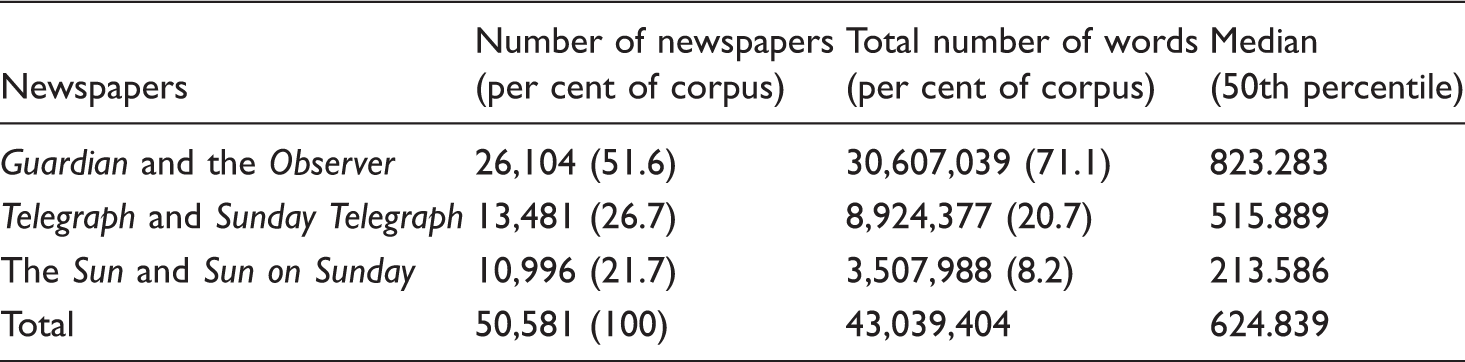
We built up and used a pipeline of computational tools comprising Elasticsearch, 5 Kibana, 6 SPSS and Nvivo. We used quantitative analytical methods (frequency, collocation and concordance) to find patterns, and qualitative analysis to interpret their meaning (Baker, 2006; Hansen, 2006). Our methodological approach is inductive, and the main arguments are based on the interpretations of the findings gained in the three steps of analysis.
Top 20 most frequently occurring content words immediately before ‘im/migrant(s)’.
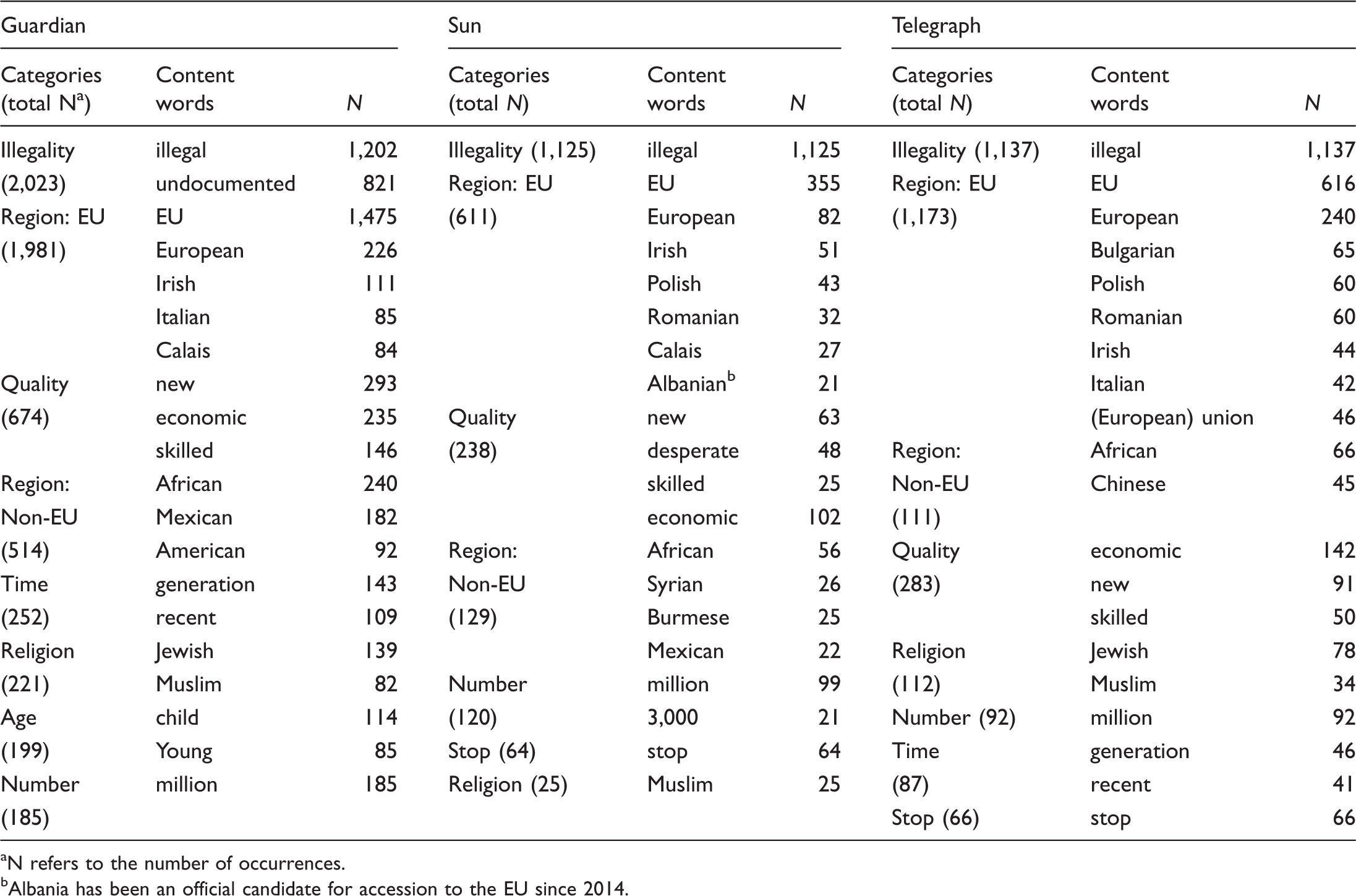
N refers to the number of occurrences. bAlbania has been an official candidate for accession to the EU since 2014.
Top 20 most significant content words within three-word window of ‘im/migrant(s)’.
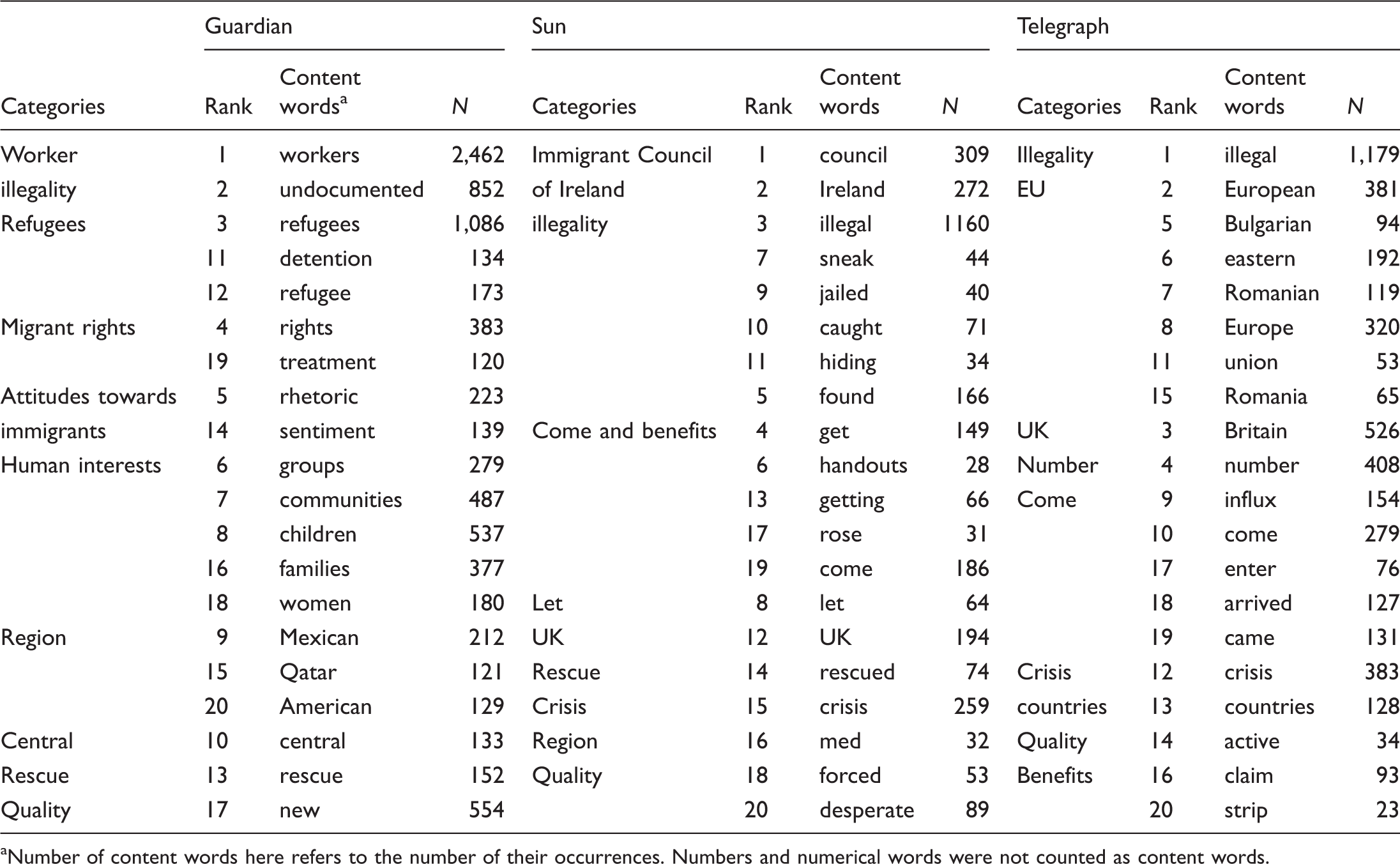
Number of content words here refers to the number of their occurrences. Numbers and numerical words were not counted as content words.
Themes arising from the cluster analysis of the concordance of ‘im/migrant(s)’ over the 6 years in the three newspapers
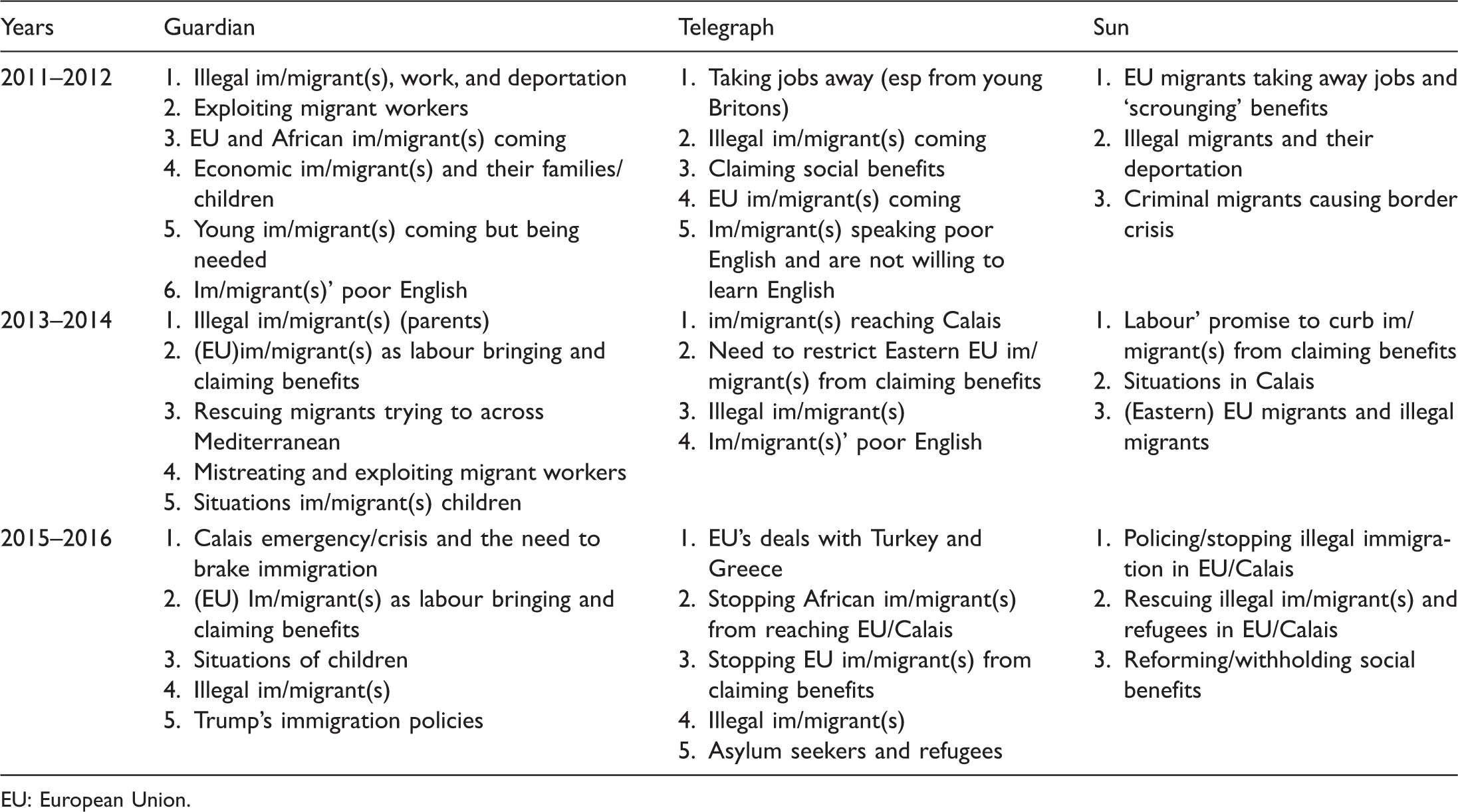
EU: European Union.
Finally, given his tragedy became an icon of the humanitarian crisis, we analysed the reports about ‘Alan Kurdi’ as a comparison to the general representations about ‘im/migrant(s)’.
A diachronic overview of the data
The apparent growth trend (Figure 1) in the number of reports published suggests the three newspapers gave an increasing amount of attention to migration issues as the June referendum approached. The number of mentions in the Guardian rocketed in September 2015 when the body of the Syrian boy, Alan Kurdi, was found on a beach, and then reached a zenith (1,086 reports) in October 2015 when Syrian refugees arrived at the British RAF base Akrotiri in Cyprus.
Respective trends of all reports in the three newspapers 2011–2016.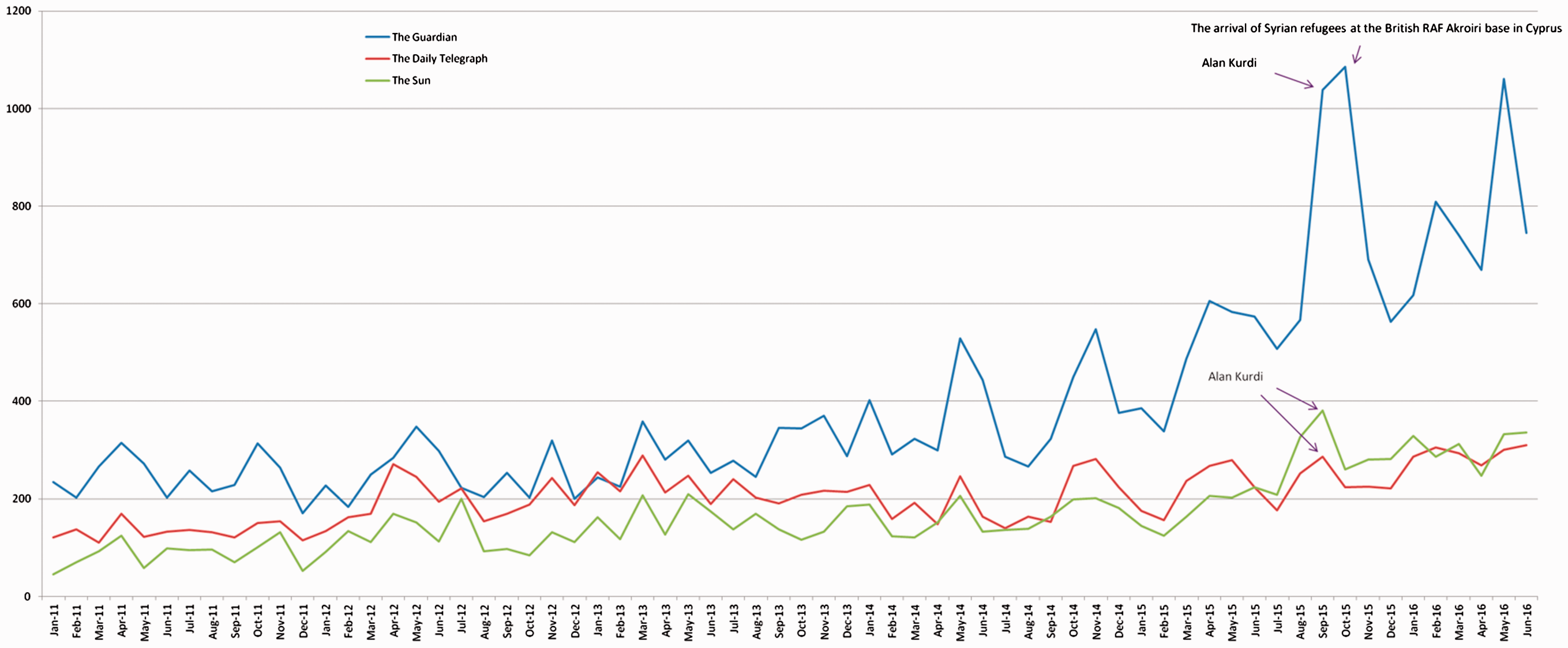
In June 2016, the Telegraph published the largest number of reports (310 reports). The mostly even distribution of its reports over time suggests the Telegraph did not show a particularly intensive interest in humanitarian issues such as the tragedy of Alan Kurdi.
In the Sun, the number of its reports reached a peak in September 2015 (with 381 reports) when the tragic story of Alan Kurdi was revealed, followed by a drop in October 2015. It had its second-highest peak in June 2016 when the UK voted to leave the EU.
Representations of ‘im/migrant(s)’, 2011–2016
Two salient topics: Illegality and EU im/migrant(s)
The salience of the illegality of im/migrant(s) and EU im/migrant(s) is prominent across the newspapers. From 2012, the attention given to EU immigrants increased and in 2016 even overtook that paid to illegal immigrants. This clearly suggests the growing importance of the EU–UK relationship in the newspapers’ representations of immigrants in the coverage of migration.
Illegality (mainly suggested by collocates ‘illegal’ and ‘undocumented’) is the top category of collocates that were most frequently used immediately before ‘im/migrant(s)’in the three newspapers, followed by the category of the region of the EU (Table 2). This corresponds with the trend over time of the top two most frequent content words immediately before ‘im/migrant(s)’ (Figure 2). In the whole corpus, ‘illegal’ is the number one adjective appearing immediately before ‘im/migrant(s)’ (total, 3,464 occurrences: the Guardian, 1,202 (35%); the Telegraph, 1,137 (33%), and the Sun 1,125 (32%)), while the adjective ‘undocumented’ is less prominent (total, 856: the Guardian, 821 (95.9%); the Telegraph, 29 (3.4%), and the Sun, 6 (0.7%)). Adding ‘illegal’ and ‘undocumented’ together, the Guardian comprises 47%, the Telegraph comprises 27%, and the Sun comprises 26% of the total occurrences. Comparing these proportions with those of the wordage of their articles in the whole corpus, we find that the Sun paid a disproportionately significant amount of attention to the illegality of im/migrant(s), followed by the Telegraph. In addition, the two terms ‘illegal’ and ‘undocumented’ slightly differ in meaning: the former implies a legal judgement that ‘im/migrant(s)’ have broken the law in entering or staying in the country, while the latter is more neutral and factual as it refers to the fact that ‘im/migrant(s)’ lack appropriate documents. Therefore, although the focus on the illegality of ‘im/migrant(s)’ is prominent in all the three newspapers, the fact that the two right-wing newspapers largely used ‘illegal’ to describe ‘im/migrant(s)’ shows they were more likely to criminalise ‘im/migrant(s)’ than the Guardian, which used ‘undocumented’ frequently from 2012, and even more intensively than ‘illegal’ from 2015 (Figure 2).
Top two most frequent content words before ‘im/migrant(s)’ for each year.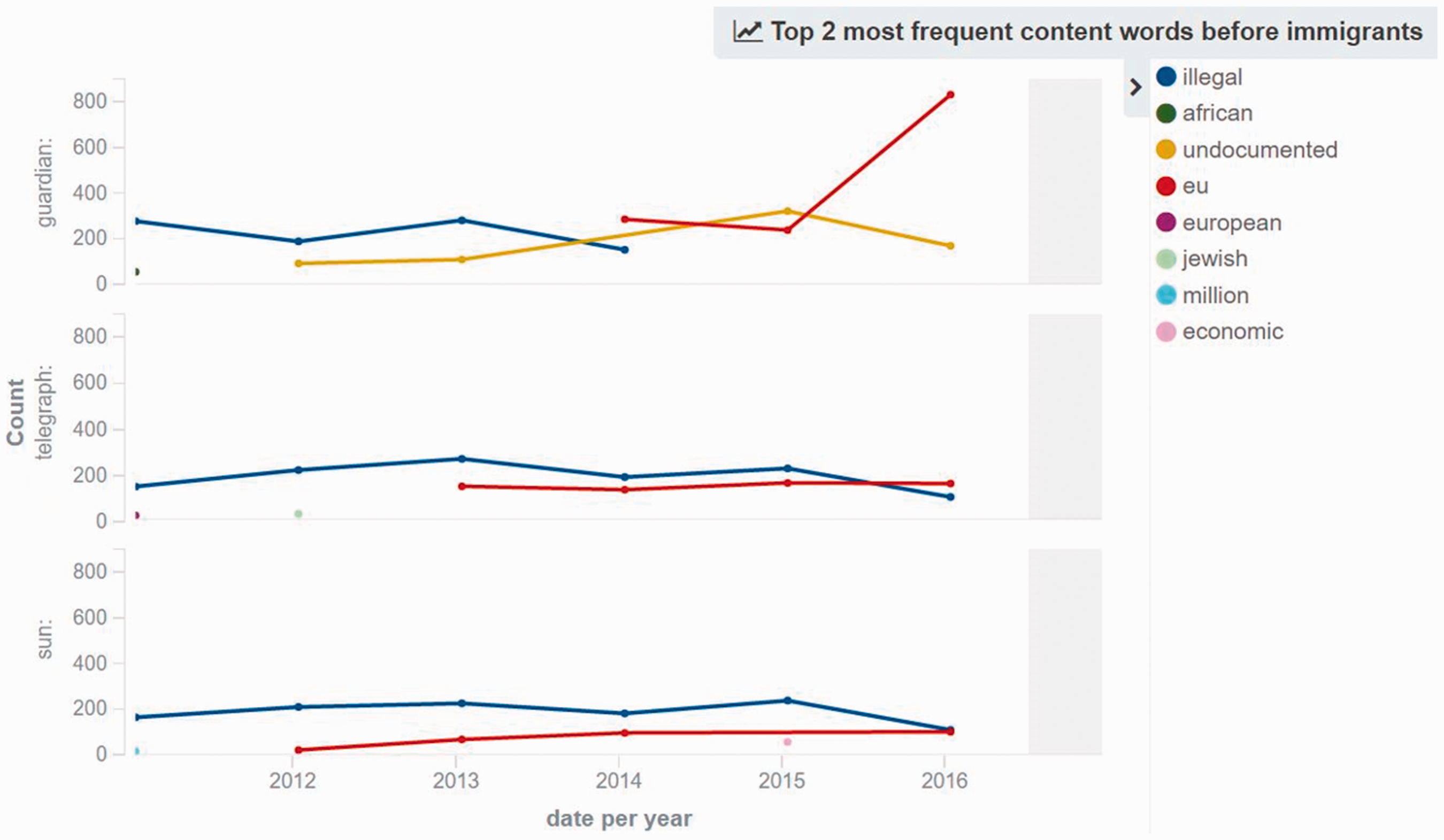
The topic of EU im/migrant(s) is also salient in the three newspapers. Figure 2 shows that the frequency of mentions of ‘EU’ started to increase from 2012 in the Sun, 2013 in the Telegraph and 2014 in the Guardian and peaked in 2016 in all newspapers. The changes in the salience of topics over time signal the developments in public opinion about related issues. In 2013, Cameron made a promise in the run-up to the general election to hold a referendum to decide Britain’s EU membership, which indicated the heated public attention paid to the UK–EU relationship around 2013. The central position of migration in the UK’s long, controversial relationship with the EU makes it unsurprising that the topic of EU immigrants formed the focus of the British media in their coverage of migration since then. The peak in the number of articles published containing either ‘EU’ or ‘European’ or ‘Europe’ in the three newspapers occurred in February 2016 when a number of important EU-related events took place, including the EU summit, the deal Cameron made in Brussels and the start of the Remain campaign.
In the corpus, the names of regions frequently appeared immediately before ‘im/migrant(s)’ (Table 2). The majority of the regions refer to the EU or countries in the EU – 79.4% (1,981 out of 2,495) in the Guardian, 82.6% (611 out of 740) in the Sun and 91.4% (1,173 out of 1,284) in the Telegraph. The occurrence of EU (countries) in the Guardian made up 52.6% of the occurrences in all the three newspapers, that in the Telegraph made up 31.2% and that in the Sun made up 16.2%, of the total occurrences (3,765) in the three newspapers. A comparison of these proportions with those of the wordage of their articles in the whole corpus (Table 1) also reveals that this topic was most salient in the Telegraph and least in the Guardian. In addition, among the top 1,000 most frequent words appearing one word before ‘im/migrant(s)’ in the corpus, the frequency of those words referring to EU or European countries is 4,364 occurrences (64.7%), while that of the words denoting the rest of the world is only 2,380 (35.3%). This reflects a disproportionately extensive attention paid by the newspapers to EU migrants during the sampled period. In reality, according to the statistics published by the Office for National Statistics (ONS), from 2011 to 2015, the estimated number of migrants from the EU countries was 1,023,000 and that from non-EU countries was bigger: 1,478,000. 10
The frequency analysis discussed above reveals the salience in the topics of illegal and EU im/migrants in the three newspapers’ coverage. Further analysis shows the three newspapers differ in developing themes surrounding the two topics.
The Guardian
The Guardian had more plural and somewhat mixed-toned themes arising from the cluster analysis of the concordance surrounding ‘im/migrant(s)’ (see Table 4) and exhibited more humanitarianism than the two right-wing newspapers. These are consistent with the findings arising from the collocation analysis of three words surrounding im/migrant(s) (Table 3). On the one hand, the themes of illegality of im/migrant(s), EU migrants and migrant children were consistent across the 6 years. The theme about English language was noticeable in 2011 and 2012. In 2015 and 2016, the theme of the Calais crisis became salient, which reflects the worries over the situation in Calais 11 and the need to put a brake on immigration, laying the foundations for moral panics over EU immigrants.
On the other hand, despite the salience of the topic of illegality, the Guardian showed sympathy to illegal im/migrant(s) (trying to cross the Mediterranean), migrant workers and migrant children, reflecting its humanitarian slant. For example, it portrayed illegal im/migrants as victims of trafficking and of exploitation. To take example (1), this sentence where the phrase ‘illegal immigrants’ appears is a quotation from Catherine Bearder, a Liberal Democrat MEP. The use of this quotation in the article implies implicit criticism of the police dehumanising illegal immigrants by ignoring the fact that they are the victims of human trafficking. The article aims to raise the public’s awareness of the potential that illegal immigrants – especially children – fall victim to criminal gangs.
(1) Too often, police forces ‘see the crime, not the person, they see them as illegal immigrants’. (‘Human traffickers “using migration crisis” to force more people into slavery’, Guardian, 19 May 2016)
This sympathetic tone matches the article’s humanitarian approach towards the drowning of Syrian child refugee Alan Kurdi. Although for all the three newspapers this tragedy suddenly appeared and then disappeared from the news agenda, Alan Kurdi received relatively the most extensive and long-lasting attention from the Guardian (Figure 3). It had 97 reports published in September and 17 in October 2015. His name continued to appear in 52 reports through to June 2016, while the other two newspapers stopped mentioning his name after February or March 2016. These reports sought to encourage the UK to ‘welcome many more refugees than Cameron suggests’ (3 September 2015) and criticised ‘Cameron’s moral failure over refugees’ (4 September 2015). It even published ‘a guide to helping’ refugees (17 September 2015) and launched the Guardian and the Observer charity appeal 2015 for refugees (24 November 2015).
Trends of reports mentioning ‘Alan/Aylan Kurdi’ between August 2015 and 23 June 2016.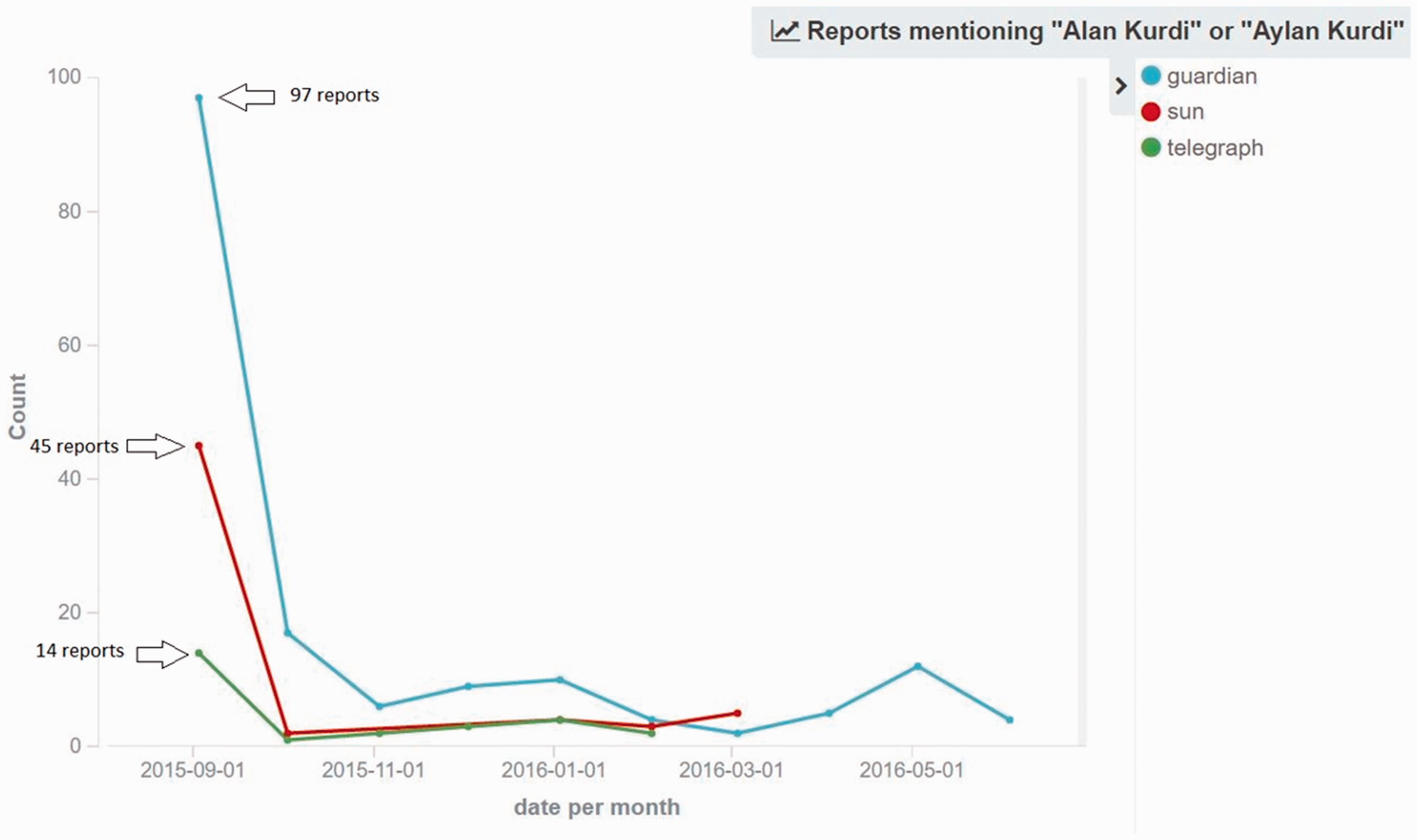
Likewise, the salient topic of EU im/migrant(s) was addressed in a way that distinguishes the need to prevent them from claiming benefits, from that of stopping free movement, as demonstrated in example (2):
(2) But Clegg said it was right to restrict access to benefits. He said: “We should protect the freedom to move to look for work in the EU. But the freedom to look for work across the EU is not the same as the freedom to claim” (‘Nick Clegg attacks Theresa May’s “illegal” plan for cap on EU immigrants’, Guardian, 16 December 2013).
This sentence appears in an article, the overall tone of which is critical of the idea of stopping EU citizens from coming to work in the UK, though supportive of restricting their access to benefits.
In addition, the Guardian constructed an image of EU im/migrant(s) as contributors by stressing the usefulness of ‘im/migrant(s)’ and how British society needs and can benefit from EU migrant labour, as shown in example (3):
(3) Migrant workers often fill gaps in sectors that locals have deserted, and they contribute a great deal to the prosperity of a country both in terms of economic and financial output, as well as services offered. (‘European watchdog accuses Britain of shameful rhetoric on migrants: Bulgarians and Romanians “treated like a scourge”, 30 March 2013, Guardian).
Even on the theme of inadequate English language proficiency, the Guardian argued those who cannot speak English properly may welcome English language training (rather than living idle lives and claiming social benefits) as poor English may prevent them from getting a job.
The Telegraph
The themes about ‘im/migrant(s)’ constructed in the Telegraph (Table 4) focused on illegality, EU im/migrant(s) taking jobs and claiming benefits, poor English proficiency, and the Calais crisis. In addition, Table 3 shows an image of crisis surrounding the ‘influx’ of ‘im/migrant(s)’, who are illegal or from Eastern European countries such as Romania and Bulgaria. The themes about illegality and EU im/migrant(s) were present across all these years. The Calais theme started to emerge in 2013 and 2014. The theme about their poor proficiency in English was prominent between 2011 and 2014, while the theme about the EU’s deals with Turkey and Greece appeared from 2015 and 2016.
An apparent trend in the right-wing broadsheet is the portrayal of illegal im/migrant(s) as culturally weird and morally wrong ‘folk devils’. Take example (4), in which a violent and cruel image is constructed for the illegal immigrant father. By quoting the judge’s words, which make assumptions about cultural differences, the report conveys a sense of a strange (and even morally wrong) culture that is different from the British one.
(4) The boy told the High Court Family Division in London he was hit with a ‘long belt’. The father, an illegal immigrant, said he would ‘slap’ the lad to ‘keep him disciplined’. Mrs Justice Pauffley said: ‘Proper allowance must be made for what is, almost certainly, a different cultural context.’(‘Migrants should be free to hit children, claims judge’, Telegraph, 9 June 2015).
Example (5) suggests the illegal immigrant here displays a dishonest and cheating nature, a similar moral failing:
(5) One of the cases where deportation was dropped is of an illegal immigrant convicted of organising Britain’s biggest sham marriage racket. (‘The foreign criminals we don't try to deport’, Telegraph, 21 July 2012).
In this example, the Telegraph blamed the government for failing to deport illegal immigrants and for being too soft on immigration issues.
In the Telegraph, the theme of EU im/migrant(s) has been prominent across all 6 years – and especially since 2013. It consistently blames EU im/migrant(s) for taking jobs away from Britons, lowering British wages and for claiming social benefits, thus portraying them as economically damaging. For these reasons, it is a strong advocate of shutting the border to the EU im/migrant(s).
From 2014, the Telegraph started explicitly promoting the campaign for Britain to leave the EU and close the borders. Particularly in 2015 and 2016, as a response to the crisis in Calais, the newspaper advocated tighter controls on immigration and asylum. No clear humanitarian responses were articulated by the newspaper, even in the cases involving deaths, as shown in examples (6)–(7)
(6) The death came amid reports that around 350 illegal migrants are caught every week trying to enter Britain. (7) The figures follow a spate of incidents in which migrants at Calais have evaded security measures and entered Britain in lorries, cars and caravans.
(‘Illegal migrant crushed on M25 after clinging beneath lorry from Calais’, Telegraph, 14 December 2014).
This report containing the two examples starts with the death of a man who tried to clamber down from his hiding place in a lorry. It then talks about the context in which illegal immigrants at Calais attempt to enter the UK by hiding in vehicles to escape border checks. No detailed background and context about him – such as his name, age, family, what happened before he was hiding in the lorry – is revealed. The only information about the victim is that he was from Sudan. By decontextualising and dehumanising him but contextualising his death within the Calais crisis, the focus of the report shifts from his tragedy to the Calais crisis and questions about the UK’s border control.
The newspaper even linked the Calais crisis and the desperation of illegal im/migrant(s) with the everyday lives of British people, as exemplified in example (8):
(8) The warning followed reports that a suspected illegal immigrant managed to hide behind the front seat of a woman’s Fiat Panda to enter Britain (‘On a booze cruise? Watch for migrants’, Telegraph, 19 November 2014).
This example was taken from a report that warns the British public that if they go Christmas shopping in Europe they should be aware of desperate im/migrant(s) who might try to get into their vehicles. At the end of the report a miserable and ‘appalling’ situation in Calais is described in terms of fears that the British border may not be properly controlled. The association between the desperation of illegal im/migrant(s) and the crisis in Calais with British people’s everyday lives is the sort of connection that contributes to creating moral panic over illegal immigrants and fears about the UK’s link to the EU.
The Telegraph apparently advocated a hostile response to illegal im/migrant(s) and urged the government to implement tighter control over the border, as indicated in example (9):
(9) ‘We want to make sure that people don't come here thinking they can actually just sort of overstay and become illegal migrants’, she says. ‘The aim is to create here in Britain a really hostile environment for illegal immigration’ (‘We’ll stop migrants if euro collapses; Home Secretary says emergency border controls are being drawn up by No 10 May prepared for rush of Greek migrants’, Telegraph, 25 May 2012).
For this reason, the newspaper held a negative attitude towards the EU’s negotiations with Turkey, as Turkish membership of the EU might make it easier for illegal migrants to enter the EU and then the UK.
Even its coverage of the death of Alan Kurdi reflects its stance in favour of closing the border. In the whole corpus, only 26 reports in the Telegraph mentioned the name ‘Alan/Aylan Kurdi’ by 23 June 2016. In all, 14 reports were published in September 2016, the remaining 12 reports were stretched over the next 5 months and the boy’s name was not mentioned again after February 2016. It is true that its first report (‘Washed up on a beach, the symbol of despair; Body of little boy carried from idyllic Turkish sands after family fails in attempt to escape Syria for new life in Europe’, Telegraph, 2 September 2015) is full of compassion and humanitarian sentiment in its description of the image and Alan Kurdi’s background; the phrase ‘humanity washed ashore’ is used. The report also blames EU politicians for failing to properly handle the migration crisis. However, the newspaper was soon arguing in its editorial that ‘a photograph of a drowned child will always be heart-breaking – but it should not change policy’ (Telegraph, 3 September 2015) and that the UK should not accept more Syrian refugees because of what had happened. The details in a report published on 8 September 2015 reveal that the family of Alan Kurdi were not among the most desperate refugees, and the newspaper argued that what the UK should do is offer tangible help for those in refugee camps, such as food, and even intervene militarily on humanitarian grounds in order to give Syrian citizens safe haven in the region, rather than welcoming them to the UK. The rest of its reports talk about how the image of Alan Kurdi touched many British citizens and motivated some to help Syrian refugees in a number of ways, including, foolishly, trying to smuggle an Afghani girl into the UK. In January 2016, the newspaper started to mention ‘Alan Kurdi’ in reports about migrant sex attackers. By then the newspaper no longer displayed any humanitarian sentiment in relation to this boy’s name. David Cameron’s compassion towards the boy was used as evidence to show his failings. Between February 2016 and 23 June 2016, the Telegraph never mentioned the boy again.
When frequently mentioning the ‘poor English’ spoken by im/migrant(s), the newspaper detailed the problems caused for British society by their poor English, such as the extra demands this places on state education, medicine, and the NHS, as shown in example (10):
(10) The poor English of some meant their GP appointments took ‘appreciably longer’, leading to longer waiting times. (‘Immigration: the uncomfortable truth’, Telegraph, 3 July 2013).
In example (11), the newspaper associated the English language with British culture and criticised the government for failing to demand that im/migrant(s) integrate into British culture and the British way of life, implying this may lead to divisions in British society.
(11) We do not blame immigrants for failing to integrate: the blame lies at the feet of our rulers for failing to set clear boundaries by requiring them to learn English, respect British culture and obey the house rules. (‘WHO IS TO BLAME FOR FRACTURED BRITAIN? David Cameron has admitted that society has become disjointed by mass immigration. It's about time, says Ruth Dudley Edwards’, Telegraph, 14 April 2011).
The Sun
The themes arising from the concordance analysis of ‘im/migrant(s)’ in the Sun (Table 4) show that it stressed mostly the illegality of im/migrant(s), and EU im/migrant(s) abusing the British welfare system. It also criminalises im/migrant(s) and highlights policing im/migrant(s) and a border ‘crisis’. Meanwhile, it gave attention to the humanitarian crisis in the Mediterranean and to refugee rescues. The themes of ‘illegality’, and EU im/migrant(s) ‘claiming social benefits’ was prominent from 2011 through to 2016. The focus on the Calais crisis started in 2013 and 2014. These correspond with the results of the collocation analysis (Table 3). Among the three newspapers, the most significant collocates of the Sun within the three-word window of ‘im/migrant(s)’ are the most negative – comprising ‘desperate’, ‘sneak’, ‘jailed’, ‘caught’, ‘hiding’ and ‘found’, which conveys an image of immigrants illegally entering Britain and being caught or arrested by the police.
The overall language in the Sun demonises illegal im/migrant(s) as ‘sneaking’ into the UK in huge numbers, being dangerous, costly and breaking the law and blames the government for letting numbers rocket and for allowing them to ‘exploit’ British taxpayers. It was strongly critical of the government and the legal system for allowing illegal immigration to ‘soar’ and of failing to deport illegal im/migrant(s). It even advocated scrapping human rights law, to cap the number of EU im/migrant(s) and to institute tighter controls over EU im/migrant(s) who live in the UK. Staying in the EU is blamed for illegal immigration, as represented in example (12):
(12) Mr Cameron knew years ago he could never control the numbers while remaining in the EU. Yet he shamefully continued promising voters he could. Net legal immigration has soared to 333,000 a year. Meanwhile mobs of illegal migrants force themselves aboard UK-bound lorries and ferries at Calais and only three boats patrol our entire coast hoping to stop others crossing the Channel (‘Don’t trust PM to curb immigration And don't trust him to reform EU … AND THEN MAKE SURE YOU VOTE LEAVE TOMORROW’, Sun, 22 June 2016).
On some occasions, however, the tabloid portrayed illegal im/migrant(s) as victims of smuggling. It gave noticeable attention and sympathy to the humanitarian crisis, which develops a humanitarian discourse that contrasts greatly with the general discourse about illegal im/migrant(s). When the body of Alan Kurdi was found on the beach on 2 September 2015, for example, the Sun reported this tragedy and described the video footage of Alan lying on beach in a report (‘They named baby Hope … but hope’s in short supply’), which relates the story of a baby born to a refugee mum in a rail station. Although not focusing on Alan’s tragedy, the newspaper vividly depicted the despair of those refugees and asylum seekers who fled war zones and were stranded in Budapest, as well as the migrants who died in capsized boats and trafficking. In this report, the Sun used ‘refugees’, ‘asylum seekers’ and ‘migrants’ but not ‘illegal im/migrant(s)’ at all. In this article the newspaper adopted quite a sympathetic tone and ended the story by quoting the remarks of Yvette Cooper, the Labour leadership candidate: ‘It is heart-breaking what is happening on our continent … We cannot keep turning our backs on this.’
The Sun used the name of ‘Alan Kurdi’ as a symbol of the refugee crisis in 59 newspaper, 45 of which were published in September 2015 and 2 in October 2015. The name was mentioned again in 12 reports between January and March 2016 and never appeared after March 2016. These reports mostly talked about the Syrian war and refugees, especially children, and the impact of Alan Kurdi’s tragedy on politics in the EU and the UK. No ‘illegal im/migrant(s)’ were mentioned in these reports. Overall, these reports expressed sympathy towards Syrian refugees portraying them as victims of war and later people trafficking and clearly distinguished them from illegal im/migrant(s). The main themes arising in these reports included stressing Britain’s moral duty to stop these wars and to offer homes to child orphans/refugees, urging people to join the Sun campaign for child refugees, blaming people smugglers and traffickers, and expressing compassion over the refugee tragedy.
This humanitarian tone however did not last long and was inconsistent with the overall tone about im/migrant(s) in the tabloid. From December 2015, when mentioning ‘child refugees’, the tabloid reverted to its hostile tone. For example, it talked about ten councils spending £36.9 million on ‘1,168 unaccompanied kids seeking asylum’ last year (22 December 2015) and ‘dangerous asylum seekers claiming to be children have assaulted their foster carers – stoking fears of a growing threat’ and called them ‘thugs’ (20 February 2016).
The language in the Sun largely portrayed the EU as a threat to the domestic prosperity and stability of the UK by establishing a binary opposition between the EU and the UK. On the one hand, EU immigrants, especially those from the Eastern European countries such as Poland, Bulgaria and Romania, were represented as perpetrators abusing the social benefits system in the UK throughout the 6 years. On the other hand, the EU was represented as a conduit through which a large number of Syrian refugees might come to the UK. The topics of ‘Calais’ – a historic symbol of the migrant crisis – occurred from 2014 and that of ‘refugee(s)’ appeared in 2016. When talking about ‘refugee(s)’, instead of discussing refugee policies or policies to help refugees, most of time the tabloid described the large number of desperate refugees trying to ‘illegally’ come to Europe and the UK and losing their lives in the journey or their wrongdoings and problems. While this can be sensational and trigger readers’ compassion, it does however also contribute to the argument that European countries were already struggling to cope with the refugee crisis and that the situation was exacerbated in 2014 and 2015; from this perspective, due to its EU membership, the UK was also being exposed to the refugee crisis. The association between the EU and a challenge to the UK amplifies such implications in terms of the threats to Britain’s economy and stability. For this reason, the tabloid promoted Brexit.
Discussion and conclusion
The findings reported above demonstrate that for more than 5 years after the Arab Spring and prior to the referendum, the three newspapers – especially the right-wing newspapers – largely adopted the conventional public norms to label ‘im/migrant(s)’ as being illegal, deviant ‘folk devils’ who threatened the wellbeing and security of British society; they gradually extended and projected such stigmatising labels and meanings onto the EU, associating it with the moral panics over ‘im/migrant(s)’ and therefore ‘othered’ it as a threat to the national security and prosperity of the UK. The concept of ‘EU immigrants’ became a symbol of the tension between the EU and the UK, reflecting the political concerns and the divided public opinion within the UK towards the EU.
The growing emphasis placed by the newspapers over these years on the EU as both a source of (Eastern) European migrants as well as a conduit through which illegal migrants and refugees flood into the UK – reflects the increasing UK–EU tension in social reality. It constructed an opposition between the UK and the EU through the prism of migration: that is, Britain needs to control migration, which is an urgent and pressing problem, but the EU stands in Britain’s way in doing so. This has ‘othered’ the EU, which is distinguished from ‘us’ – the UK. The salience of illegal and EU immigrants can be interpreted as the (perhaps unconscious) influence of perceived social representations, that is, public concerns and national interests. Such representations could in turn greatly influence their readers’ mindset about the referendum, especially in the case of the Sun, which enjoys the largest readership of any newspaper in the UK.
However, the political stances, market positions and attitudes of the three newspapers towards Brexit influenced the representations they employed. The representations in the Telegraph and the Sun clearly follow the threat framework, echoing one side of the arguments about immigrants. They portrayed illegal and EU immigrants as a social, economic and cultural threat and created moral panics over them. The Sun even demonised and criminalised illegal and EU immigrants. They criticised the government for being too soft on immigration issues and promoted closing the borders.
While the Telegraph almost entirely portrayed ‘im/migrant(s)’ as a threat, the Sun was remarkably schizophrenic in its tone: It occasionally adopted the language of moral duty. It for example expressed strong sympathy towards Alan Kurdi and child refugees, although this discourse soon shifted back to its generally hostile attitude towards im/migrant(s). Its pursuit of sensationalism and the commodification of suffering, in Höijer’s term (Höijer, 2004), may explain why it had this humanitarian discourse despite it being in conflict with its general discourse of defending the country from the threat of ‘im/migrant(s)’.
In the Guardian, there is more complexity in the language surrounding ‘im/migrant(s)’: while it portrayed the illegality of ‘im/migrant(s)’, the pressing situation in Calais and the need to control migration, it contributes to the construction of EU as a threat; but it also depicted a humanitarian image of illegal im/migrant(s) and portrayed EU labour as benefiting British society, although at the same time benefiting from the British welfare system. Instead of proposing to entirely shut the door to immigrants, the newspaper suggested offering official support or finding solutions at the policy level in order to solve potential problems. The language mixes a threat framework with a morally based victim framework which reflects its humanitarian tradition. It reserves the need to stop im/migrant(s) from claiming social benefits, but meanwhile stresses their usefulness and the fact they are needed by the economy, which reflects a pragmatic instrumental public discourse about EU immigrants: we should welcome them because we need them. This signals the other side of the arguments in British society about immigrants that sees them as helping to boost and sustain domestic prosperity.
The representations of ‘im/migrant(s)’ in the newspaper coverage discussed above signify the changes in their social representations. These newspapers picked up the conventional concepts about ‘im/migrant(s)’ and used them as the basis to prescribe new concepts about the EU referendum which ‘other’ the EU, which is coherent with social dynamics. This case therefore offers us an understanding of the role of newspapers in shaping and exemplifying public opinion about immigration in the UK. Not only does the press cater to public opinion but also public opinion may be influenced by the image of immigrants constructed and defined in newspaper coverage. It is thus worth asking whether and to what extent we should blame the press for Brexit.
This study is mainly based on a corpus-driven computer-assisted analysis of the language immediately surrounding ‘im/migrant(s)' in the newspaper coverage of migration. Although we have conducted a qualitative analysis of a randomly selected 5% of the concordance of ‘im/migrant(s)’ and of reports about Alan Kurdi, the interpretation in the study may be limited by the fact that no systematic qualitative analysis of full newspaper has been conducted. In future, it would be useful to combine this methodological approach with a qualitative analysis of a representatively selected sample of newspaper.
Footnotes
Acknowledgements
The authors would like to thank Colin Sparks for his comments on an earlier version of the article and Hauke Riesch for sharing thoughts about social representations theory. Thanks also go to the anonymous reviewers for their comments.
Declaration of Conflicting Interests
The author(s) declared no potential conflicts of interest with respect to the research, authorship, and/or publication of this article.
Funding
The author(s) received no financial support for the research, authorship, and/or publication of this article.