







Abstract
The Mediterranean island of Cyprus, the last divided country in Europe, faced a grave risk of plunging into war in September 2011. The reason behind this danger was represented as the confrontation over the excavation of hydrocarbon reserves found in the Eastern Mediterranean Sea. The main goal of this article is to explore the extent to which peace journalism was practiced, or not, by analysing the front-page stories of the prominent Turkish Cypriot and Greek Cypriot newspapers about this conflict. A review of peace journalism research reveals that researchers have mainly focused on war reporting. In order to address this deficit in peace journalism research, this article focuses on a case study where there was a risk for military confrontation. The combined sample drawn from six newspapers in the respective communities indicates a strong preference towards war journalism. As the analysis further shows, the newspapers from both sides failed to discuss peaceful solutions to the hydrocarbons conflict and they also failed to discuss the negative repercussions of a possible war related to the hydrocarbons conflict.
Keywords
Introduction
The Mediterranean island of Cyprus, the only divided country in Europe, is the host country of one of the longest-running ethno-politic conflicts in the world. For more than half a century Cypriots and the rest of the world watch in vain, the never-ending negotiation process aimed at finding a solution to the Cyprus Problem. The exploration of hydrocarbon reserves recently discovered in the Eastern Mediterranean Sea has only exacerbated the Cyprus Problem (Özgür, 2017). Indeed, not long ago, Cyprus faced danger of a military confrontation due to escalation of the hydrocarbons conflict in September 2011 (Emerson, 2012; International Crisis Group, 2012; Nathanson and Levy, 2012; Tziampiris, 2015). This is more puzzling since the hydrocarbon reserves are said to present an incentive for solving the Cyprus Problem. The colossal amount of alarmist media reports published on both sides of the divide, regarding the military confrontation risk in the Eastern Mediterranean, makes the analysis of media coverage of this particular case extremely unique and important.
Media’s role during ethno-political conflicts, wars and/or other peacebuilding efforts have been popular topics amongst communication scholars worldwide since the 1990s. Whilst many conclude that mass media usually fuels conflicts and damages peace-building processes (e.g., Lee, 2010; Siraj, 2008; Wolfsfeld, 2004), there is also a more optimist thinking amongst scholars that, if media plays a negative role in conflicts it can also play a positive one (İrvan, 2006). This is the Peace Journalism (PJ) approach – a new way of reporting conflicts and wars – that put in practice the possibility of media and journalists to give ‘peace a chance’ and transform conflicts in a non-violent way. In direct contrast to widely used War Journalism (WJ) approach in media, which focuses on reporting conflicts and wars like a spectacle (win-lose case), PJ approach aims to highlight peaceful resolutions to conflicts/wars for reaching out a win–win case (Lynch and McGoldrick, 2005).
Coming on the heels of the pioneering research of Lee and Maslog (2005), much has been researched about the journalist’s role during wars or violent conflicts. Lynch states that, ‘a significant cross-section of research in PJ has concerned itself with the business of war reporting’ (Lynch, 2015: 193). Furthermore, a recent study on PJ research reveals that the ‘majority of PJ studies examine media surrounding direct violence as it is occurring’ (Gouse et al., 2018: 2). There is a surprising lack of attention to the role of media and journalists during escalated conflicts with potential for military confrontation or violent outcome. Although there are rare cases in PJ research, where some scholars refer to events that bring several different countries to the ‘brink of a war’ (see Ersoy, 2016; Lee and Maslog, 2005; Lee et al., 2006; Siraj, 2008), they don’t adequately operationalise PJ research in favour of (a) exploring media’s role in such escalated conflicts; and (b) evaluating media’s possible role in further escalation or de-escalation of these kinds of conflicts. Whilst there is a significant contribution of PJ research to explore media–war nexus in Western contexts (Hussain and Siraj, 2019), the media–conflict nexus in escalated cases in non-Western contexts, such as Cyprus, is also under-explored.
This article adopts a comparative approach that focuses on the coverage of the hydrocarbons conflict in both the Turkish Cypriot (TC) and the Greek Cypriot (GC) newspapers. The main goal of the article is to explore the use, or abuse, of PJ, in domestic press coverage by analysing the front-page stories published in September 2011 – when the first drilling in the region for the hydrocarbon reserves was launched which in turn caused the so-called hydrocarbons conflict that quickly ‘escalated to a crisis’ (cf. Gürel et al., 2013). As such, this study, with its original empirical data and fresh insight, is an attempt to contribute to PJ research on two fronts. First, it attempts to supplement the rather limited scholarship on comparative PJ on global and local level – where vernacular/domestic press of conflicting parties are addressed. Although numerous comparative cross-national research in this field (e.g., Cozma and Kozman, 2017; Shinar, 2009; Workneh, 2011) only a few studies address print media of conflicting parties on specific cases (e.g., Baden and Tenenboim-Weinblatt, 2017; Ersoy, 2010; Lee, 2010; Lee et al., 2006; Lee and Maslog, 2005). Secondly, by focusing on an escalated conflict, it aims to fill a void in PJ research, in terms of operationalizing PJ, other than ‘war reporting’. More specifically, it proposes two sets of new variables/indicators to evaluate media-escalated conflict nexus.
Peace Journalism – A call for a revolutionary change in conflict reporting
Conflicts are inevitable and necessary for healthy democracies (Hamelink, 2006), combat however is optional (Max Lucade cited in Austin et al., 2012: 10). Then the key issue is how conflicts are approached by journalists and media: ‘competitive (win–lose model) or cooperative (win–win model)’ (cf. Kempf, 2008b). These two paths defined by Galtung (2008: 20) as ‘the low road, by far dominant in media, see conflict as a battle, and the battle as a sports competition [win–lose] … the high road the road of PJ focuses on conflict transformation … [therefore] the positive opportunities gain the upper hand – without recourse to violence [win–win]’. One of the most popular definitions of PJ is: ‘when editors and reporters make choices – of what to report and how to report it – that create opportunities for society at large to consider and to value non-violent responses to conflict’ (Lynch and McGoldrick, 2005: 5).
Whilst many works on PJ widely mention the concept developed by Johan Galtung in the 1970s, the very first published materials on PJ can be traced back to William Kempf in 1996 and later to Johan Galtung in 1998 (cf. Kempf, 2012a; see Kempf, 2008a). Considered the founding father of PJ, Galtung himself was not referring to PJ in his writings until late 1990s (see Galtung, 1992). It is in 1997 that Galtung first introduces PJ in a ‘table form’ during the ‘Conflict and Peace Journalism Summer School’ in Taplow Court (Lynch and McGoldrick, 2005). The table, which can be considered a stand-alone roadmap for journalists, compares ‘Peace/Conflict Journalism’ with ‘War/Violence Journalism’ across four key themes: Whilst the WJ approach is: (1) violence (2) elite (3) propaganda and (4) victory; the alternative PJ approach is: (1) peace (2) people (3) truth and (4) solution oriented (Lynch and McGoldrick, 2005). As a type of business, media prefers conflict-oriented stories because it sells better than stories about peace or cooperation (Melone et al., 2002), and there is an endless thirst for publishing stories about conflicts (Wolfsfeld, 2004), where ‘journalists constantly seek and exploit narrative tension’ (Pauly, 2009: 7), hence PJ is considered a revolutionary reform movement for conflict reporting (Lynch, 2013).
The theory and practice of PJ, of course is not free from criticism. The Conflict and Communication, an influential journal in the field, dedicated an entire volume titled ‘The Peace Journalism Controversy’ (Kempf, 2008a). One of the main criticisms levied against PJ is that it is incompatible with basic professional norms, such as objectivity and impartiality because it advocates ‘peace’ (Kempf, 2008c) and takes sides in conflict reporting (Loyn, 2008). It is obvious that the very name of PJ causes misunderstanding about its practices because it combines ‘peace’ and ‘journalism’ (Kempf, 2008c). As argued by Lynch and Galtung (2010: 17) however, ‘PJ is not peace advocacy’, rather it is ‘a serious, inquisitive, professional reporting, making conflict more transparent’. The objectivity issue on the other hand, which is an ‘evergreen issue in journalism studies’ (cf. Hanitzsch, 2008: 74) and one of the most important ethos of contemporary journalism, is heavily criticized (e.g., Berger, 2000; Hackett, 1984; Lynch, 2008). For Schudson (2003: 3) ‘news is not a mirror of reality. It is a representation of the world, and all representations are selective’ and for Carey (2009), what the public in general or journalists in particular refer to/define as ‘reality’, is a social construction. As such, Kempf (2012b: 2) modifies Lynch and McGoldrick’s famous definition as follows: ‘PJ is when editors and reporters are aware of their contribution to the construction of reality and of their responsibility to “give peace a chance”’. Lynch (2008: 63) also argues that ‘objective news’ functions in favor of WJ in three ways as ‘a bias in favor of event over process; a bias in favor of official sources and a bias in favor of dualism [two party reporting]’.
Besides the above-mentioned ontological discussions in western academic and journalistic contexts, PJ has other obstacles, to address and overcome (Ciftcioglu, 2017). It is widely argued that, when their home country/community is involved, journalists and the media approach conflict and wars from an ethnocentric/nationalist point of view (Hammond and Herman, 2001; Zandberg and Neiger, 2005). Journalists are also members of their societies and have been socialized into ethnocentric/nationalistic views (Ciftcioglu, 2017), hence they are ‘servants of their culture’ because they have to write news relevant and familiar to their society (Liebes, 2004: 1). Therefore, it is very difficult for journalists to be critical of wars or conflicts fought by their home country, because their ‘patriotism’ and ‘loyalty’ will be questioned (Rubin, 1990).
Indeed, whilst the proactive role of PJ for preventing violence or transforming conflicts in creative non-violent ways is well shined in theory, the PJ research failed to operationalize these proposed roles in practice/actual cases. Just as the 1991 Gulf War generated debates about the relationship between journalism and war which later facilitated the emergence of PJ (Zillich et al., 2011: 253), we expect that much-needed inquiry into the media coverage of the hydrocarbons conflict in Cyprus will generate debates about the relationship between journalism and war risks and contribute to expanding the framework for PJ and move it beyond the ‘business of war reporting’ approach to proactive conflict reporting for violence prevention.
Background: The Cyprus Problem
The ‘Cyprus Problem’ is an ‘intractable’ (cf. Bar-Tal, 2012) conflict between the TCs and the GCs – a conflict that resulted in inter-ethnic violence on several occasions. One of the main reasons behind the Cyprus Problem is the clash of nationalisms in pursuit of mutually exclusive goals. Widespread inter-ethnic violence amongst the two communities started during late the 1950s when the GC community increased its demands for ending British Rule and became more insistent on having unification with Greece [Enosis] (Kitromilides, 1979; Kızılyürek, 2002). The TC community counter reacted by supporting the idea of partition of the island [Taksim] with Turkey (Kızılyürek, 2016; Mavratsas, 1996). A bi-communal state named the Republic of Cyprus (RoC) was established in 1960 under the guarantorship of Britain, Turkey and Greece, after the island attained independence from British rule. However, the new state was seen by the nationalists in both communities not as the end of the road but rather the springboard to achieve their respective aims (Hoffmeister, 2006; Kızılyürek, 2008). The inter-communal violence that broke out in December 1963 led to the gradual separation of the two communities both physically as socially and this was cemented in 1974 with the de facto partition of the island following the military intervention of Turkey in reaction to a military coup backed by Athens against the Cypriot President Makarios (Kızılyürek, 2008; Papadakis et al., 2006).
The 1974 war physically and ethnically divided the island into two zones. The GC community on the southern side of the island maintained the internationally recognised title of the RoC – which joined the European Union (EU) in 2004. The TC community on the northern side of the island declared a new state in 1983 called the Turkish Republic of Northern Cyprus (TRNC) which is only recognised by Turkey. A significant opportunity to solve the Cyprus Problem was presented with the publication of a UN blueprint, the so-called ‘Annan Plan’ – which was submitted into a simultaneous referendum held in April 2004. Sixty-five per cent of TC votes were in favour, whilst 76% of the GCs rejected the plan. The more recent UN initiative to solve Cyprus Problem in Crans Montana, Switzerland in 2017 at a five-party meeting (including Britain, Greece and Turkey) was also unsuccessful.
The case study: Hydrocarbons conflict
The ‘hydrocarbons conflict’, as it became known internationally, refers to the dispute and tension between the RoC and Turkey about the ownership and exploration of the hydrocarbon reserves in the Eastern Mediterranean Sea. Though largely a trilateral affair between Turkey, the TRNC and the RoC, it is important to note that Greece and Israel are also at times implicated through their respective regional plans and aspirations. The core of the conflict can be summarised as the objection of Turkey and the TRNC of the exploitation of resources by the RoC in its Exclusive Economic Zone (EEZ). In 2011, when the RoC announced that it would start hydrocarbons’ excavations as early as 1 October, tensions between the RoC, Turkey and the TRNC escalated. GC controlled RoC’s claims were that it is their sovereign right to conduct hydrocarbons excavation in its own EEZ and that this has nothing to do with the Cyprus Problem. Turkey and the unrecognized TRNC, on the other hand objected, arguing that the offshore activities are ‘unilateral’ and ‘illegal’ because they deny the rights of the TC community to their share of the island’s natural sources. In short, they believe that the exploration should not commence until the Cyprus Problem is solved.
Whilst Turkey issued several warnings, ‘some would say threats’ (Faustmann et al., 2012: 5) that it would send warships to the East Mediterranean in order to stop offshore activities, the ROC took no heed. On 18 September 2011, American company, Noble Energy started hydrocarbons excavation on behalf of the RoC without any complications. Turkey, sent warships and war crafts to the region before and after the hydrocarbons search started, Israeli backed war crafts were also sent to the Mediterranean, in support of the ROC. Fortunately, there was no military confrontation. Whilst Noble Energy continued hydrocarbon excavations, Turkey sent its own research vessel, the Piri Reis, to the region escorted by warships. Furthermore, Turkey and the TRNC signed a ‘continental shelf delimitation agreement’ in order to jointly explore the Mediterranean. These efforts however did nothing to stop the RoC from continuing their offshore activities.
Due to the hydrocarbons conflict, the tension in the region escalated chances of a military confrontation in September 2011 (Yorucu and Mehmet, 2018: 95). Turkish military presence in the region (Demiryol, 2018) with aggressive rhetoric (Tziarras, 2019), instigated the RoC to make several military alignments with Greece and Israel to secure their position (Tziampiris, 2015). Hence, the threat of military confrontation was alive till this day. Since 2011, Turkey has issued several Navtexts (navigational warning) and sent several research vessels to the disputed areas accompanied by naval forces. This played a negative role in the Cyprus peace negotiations with the GC side suspending peace negotiations from October 2014 until April 2015 as a response (Tzimitras and Moran, 2018). However, the peace negotiations continued during the early phase of hydrocarbons conflict without any suspension (Özgür, 2017).
Since peace negotiations failed in July 2017, the hydrocarbons conflict created further tension amongst conflicting parties (Rubin and Eiran, 2019). RoC officials announced on several occasions that the Cyprus peace negotiations could not resume until Turkey stopped her offshore drilling activities (The National Herald, 2019). Turkey on the other hand maintains her position and argument that she will remain and continue counter drilling exercises to protect both her rights and that of TCs (Daily Sabah, 2019). Furthermore, a TRNC official, recently used a warmongering rhetoric about hydrocarbons conflict by saying that, ‘The Greek Cypriot administration [RoC] should be afraid of any [military] conflict, since it will lose, in case of an escalation’ (Anadolu Agency, 2019). It is beyond the scope of this article to address in more detail all the legal aspects of this conflict, or to decide which sides’ claims were rightful. Rather, this article will focus on the representations of this conflict and the war risk in the region by the TC and GC print media as a means of exposing the usage of PJ and/or WJ approaches by journalists in Cyprus.
Conflict reporting and Cyprus print media
The TC and GC press have had different functions throughout history, though both have been instrumental for the ‘struggle’ not only against the other community but also the ‘internal others’ who hold different political ideas (Panayiotou, 2006; Ünlü, 1981). It is also for this reason that journalism in Cyprus is called ‘national struggle journalism’ (cf. Bailie and Azgın, 2008). Furthermore, the print media of both communities either have close ties with political parties or are linked to them as party mouthpieces (Milioni et al., 2018). Journalism in Cyprus, in contrast to western cultures, is generally based on ‘opinions and advocacy’ (cf. Ünlü, 1981). Although in the post-referendum 2004, a growing interest developed amongst scholars in Cyprus to investigate the print media’s representations of peace negotiations and/or the Cyprus Problem (e.g., Avraamidou and Kyriakides, 2015; Avraamidou and Psaltis, 2019; Şahin, 2014) as well as the dissemination of the discourses related to nationalism and national identity (e.g., Çıraklı, 2018; Şahin, 2011), PJ research nonetheless remains limited (e.g.,Ciftci, 2014; Ersoy, 2013; Şahin and Ross, 2012) and comparative PJ research is rare (e.g., Bailie and Azgın, 2008; Ersoy, 2010). In fact, there is a lack in comparative media studies in general (for exceptions see Christophorou et al., 2010; Christophorou and Şahin, 2018). Drawing on aforementioned studies, one can conclude that, the majority of the print media on the island, much like the other media institutions in the rest of the world, are more interested in producing conflict-oriented news stories. There are of course rare occasions when print media, of both communities support the peace negotiations in Cyprus such as during the Annan Plan period (Avraamidou, 2017; Christophorou et al., 2010; Ciftci, 2014) and more recently the Mont Pelerin Talks in 2016 (Antoniades, 2017). Yet actions like these cannot be seen as practices of PJ. These are rather good examples of ‘peace advocacy’ and instances of strong party links or simply ‘peace propaganda’ (cf. Ciftci, 2014). Indeed, a critical reading of recent studies conducted with editors and journalists in TC print media (Ciftci, 2014; Ercan, 2019) reveals that there is a confusion about practising PJ and peace advocacy.
Research questions
The main research question, this study seeks to address is: To what extent was the coverage of the hydrocarbons conflict by TC and GC newspapers dominated by WJ or PJ approach? In order to answer this main research question, this study will seek to explore the following sub-questions: RQ1: What are the significant differences, if any, between TC and GC newspapers in terms of using PJ and/or WJ approaches in covering the hydrocarbons conflict? RQ2: How diverse is the sourcing of the TC and GC newspapers in covering the hydrocarbons conflict? RQ3: To what extent did TC and GC newspapers provide discussion, or non-discussion, of negative repercussions of a possible war? RQ4: To what extent did TC and GC newspapers use ‘escalating’, or ‘de-escalating’, oriented quotations in covering the hydrocarbons conflict?
Coding protocol and method
This is a comparative study based on a quantitative content analysis of stories published on the hydrocarbons conflict by the main TC and GC newspapers, during September 2011. As mentioned above, comparative media research and specifically comparative PJ research in Cyprus is rare. One of the main reasons behind this limitation is the language barrier – bi-lingual (Turkish-speaking and Greek-speaking) researchers are limited and the translation of media texts from one language to the other is time-consuming and costly. Hence, the authors of this article attained professional help from several translators and journalists from both communities to indicate relevant news articles. This study is limited to the coverage of September 2011 because the very first offshore hydrocarbons excavation started during this period, and tension amongst conflicting parties peaked. Furthermore, the pilot study conducted during the last quarter of 2011 reveals that there is a dramatic decrease in the frontpage coverage of the hydrocarbons conflict after September.
Three TC and three GC newspapers were selected for this study. These newspapers consist of a TC and a GC mainstream newspaper with highest circulation, a pair of left-wing newspapers (one from each community) and a pair of right-wing/nationalist newspapers (one from each community) in order to determine whether ideology was a factor in the choice of WJ or PJ. KIBRIS (KIB) newspaper is the leading TC newspaper, with no party affiliation (Ersoy, 2010) having the highest circulation it is considered as the ‘most influential’ (Şahin, 2011). PHILELEFTHEROS (PHI) is the oldest GC newspaper, with the highest circulation (Media Gnosis, 2011), it has no party affiliation but considered to take pro-government positions (Avraamidou and Psaltis, 2019). YENİDÜZEN (YEN) is a left-wing TC daily, that supports reunification of the island (Ersoy, 2010), and also mouthpiece of the Republican Turkish Party (CTP) – a pro-peace/left-wing political party in the TC community. HARAVGI (HAR) is a left-wing GC daily, mouthpiece of the AKEL – a pro-peace/left-wing political party of the GC community (Avraamidou and Kyriakides, 2015) who were in power back in 2011. VOLKAN (VOL) is a right-wing, nationalist TC daily (Şahin, 2014) who supports the division of Cyprus. SIMERINI (SIM) is a right-wing, nationalist GC daily taking ethnonationalist approaches towards the Cyprus Problem (Avraamidou and Psaltis, 2019). The unit of analysis was the front-page stories related to the hydrocarbons conflict.
A ‘Content Analysis Coding Sheet’ based on Galtung’s (1998) famous WJ and PJ chart has been utilised to better present the data collected. The model used for the coding sheet to determine PJ and WJ is adopted from Lee et al. (2006) and Shinar (2009). Whilst Lee et al. (2006) have 13 indicators for PJ and WJ, Shinar (2009) has 10 indicators. The present study adopted and used four of these indicators and the fifth and sixth indicators are developed specifically by this study for analysing the escalated conflicts. This study is limited to the six indicators below to specifically address the print media’s role in a case where there is a risk for military confrontation and violent outcomes.
For WJ: (1) Zero-sum orientation; (2) Focuses mainly on differences that led to the conflict; (3) Emphasis on elite and official sources; (4) Usage of military vocabulary/discourse; (5) No discussion of negative repercussions of a possible war; (6) Usage of escalating quotes. As for PJ: (1) Win–win orientation; (2) Focuses on common grounds that might lead to a peaceful solution; (3) Emphasis on ‘people sources’; (4) Absence of military vocabulary/discourse; (5) Discussing negative repercussions of a possible war; (6) Usage of de-escalating quotes.
A closer look to PJ and WJ indicators used in the quantitative PJ research confirms that majority of the indicators were developed to evaluate war reporting (see Appendixes of widely cited Lee and Maslog, 2005; Lee et al., 2006 and for a more recent study: Hussain and Siraj, 2019), that is why we adopted only four of the indicators for this specific case. On the first look, one might think that the fifth indicator proposed here is overlapping with some indicators used in other studies such as; ‘causes and consequences of conflict/war’ (Lee and Maslog, 2005; Siraj, 2008), ‘causes and effects’ (Hussain and Siraj, 2019) however whilst these indicators are referring to and aiming at analysing reporting on causes and consequences of already happened wars/conflicts – i.e., war reporting, our indicator specifically focus to analyse reporting on cases with a potential risk for war – i.e., escalated conflicts. We believe that it is crucial to evaluate media’s and journalist’s role in reporting an escalated conflict – from the normative point of view of the PJ, one might expect to read discussions about negative consequences of a possible war in such escalated conflicts as a warning to public and decision-makers.
All front-page newspaper items dealing with the hydrocarbons conflict in the month of September 2011 were coded. A coding sheet for each front-page story is filled and then computed for raw frequencies. A total of 231 front-page news stories were coded and analysed for the present study. One hundred twenty-three of these stories are from TC dailies – KIB (n = 22), YEN (n = 20) and VOL (n = 81) – and 108 of them from GC dailies – PHI (n = 29), HAR (n = 51) and SIM (n = 28). Eighty-two front-page stories (34 for TC newspapers and 48 for GC newspapers) were published as lead stories of the day (headlines), which is equal to 35.5% of the total sample. This indicates the importance given to hydrocarbons conflict by newspapers.
General findings: Newspapers escalating the conflict
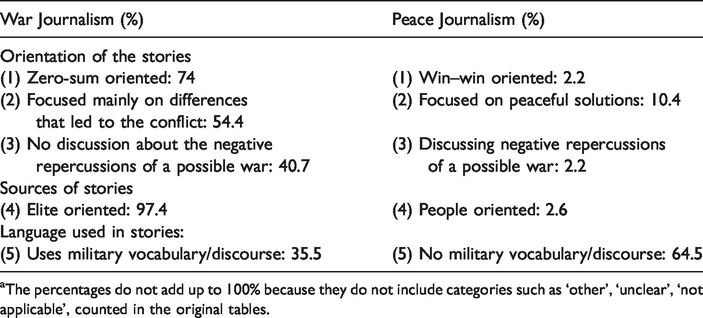
The raw frequencies computed for all 231 items analysed in the joint sample display a marked tendency towards WJ. Table 1 summarizes this tendency under three groups: Orientation of the stories, sources of the stories, language used in the stories. Of the 231 stories published by the six newspapers analysed, 74% of them are zero-sum oriented, whilst only 2.2% of the stories are win–win oriented. More than half of the stories focus on differences that led to the conflict and refrain from mentioning a peaceful solution (54.5%) to the hydrocarbons conflict. Stories that mention a peaceful solution is limited to 10.4%. Of these 231 stories, 40.7% (n = 94) is referring to the possibility of a hot episode/war and only 2.2% (n = 5) discuss negative repercussions of a possible war. The raw frequencies reveal that almost all of the stories published are using elite/official sources. Only 2.4% (n = 6) of the stories are ‘people-oriented’, which is one of the basic principles of PJ. The language used in the stories in terms of military vocabulary/discourse is also remarkable. More than one-third of the front-page stories (35.5%) used military discourse. Moreover, 22% of the front-page stories incorporated military discourse in their headlines or sub-headlines. However, it is important to note that ‘no military discourse usage’ (64.5%) is the only PJ indicator amongst the mentioned six indicators that have more frequency than its opponent.
War Journalism and Peace Journalism indicators in the total sample (raw frequencies, percentages N = 231). a
aThe percentages do not add up to 100% because they do not include categories such as ‘other’, ‘unclear’, ‘not applicable’, counted in the original tables.
The following extracts from front-page news’ headlines and sub-headlines illustrate the orientation towards WJ: ON ALERT FOR THE EEZ Cyprus’ and Greece’ military and navy are monitoring Turkey’s movements (Phileleftheros, leading GC daily, 12 September 2011) Piri Reis sailing to Cyprus accompanied by three frigates. THEY’VE GONE TOO FAR And threaten a crisis in the entire Mediterranean Sea. (Simerini, right-wing GC daily, 24 September 2011) GOVERNMENT ACTIONS SHIELD US Government actions at a political and diplomatic level have shielded the Republic of Cyprus’ sovereign rights to exploit its natural wealth against Turkish threats (Haravgi, left wing GC daily, 17 September 2011) RISING TENSIONS AS THE WAIT CONTINUES While the GC Defence Minister held a series of contacts in Athens, it has been reported that the Turkish navy have been sailing off the coast of Paphos (Kıbrıs, leading TC daily, 17 September 2011) WE ARE NOT BLUFFING Turkey once again warns Israel, UN and US-backed GC Administration. (Volkan, right-wing TC daily, 21 September 2011) ERDOĞAN: “We have rights up to the Indian Ocean” (Yenidüzen, left-wing TC daily, 28 September 2011) ‘GIFTS’ FROM CHRISTOFIAS EVEN BEFORE THE SOLUTION He offers TCs a dividend from the ‘profits’ (Simerini, 23 September 2011) [GC Government Advisor] Toumazos Tsielepis: ‘Hydrocarbons are a solution incentive for both communities’ (Haravgi, 25 September 2011) EU Representative Androulla Kaminara said to KIBRIS TV: THE ONLY WAY OUT IS TO SOLVE THE CYPRUS PROBLEM Kaminara who mentioned that she closely followed developments regarding the petrol issue [hydrocarbons], calls on both sides to focus on solving the Cyprus Problem. (Kıbrıs, 17 September 2011)
Comparative findings
The frequencies computed for the 123 items analysed in the three TC newspapers compared with the 108 items analysed in three GC newspapers indicate that from a cumulative point of view, newspapers on both sides have similar scores.
The orientation of the stories
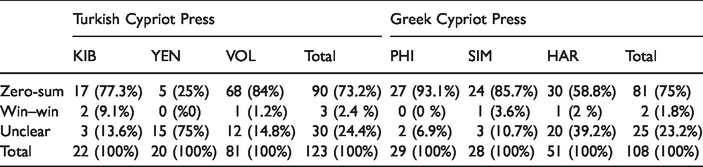
Of the 123 stories published by TC newspapers, 90 (73.2%) of them are zero-sum oriented. Only three stories published are win–win oriented (2.4%). GC newspapers have a similar score. Of the 108 stories published, 81 (75%) of them are zero-sum oriented and only 2 stories published are win–win oriented (1.8%). Amongst TC newspapers, VOL has the highest percentage 84% (n = 68) of its stories represented from a zero-sum perspective. KIB has a similar score, having 77.3% (n = 17) whilst YEN has the lowest score by having 25% (n = 5). YEN has no stories published from a win–win approach, KIB has two stories (9.1%) and VOL has one story (1.2%). Amongst GC newspapers PHI has the highest percentage, 93.1 (n = 27) of its stories represented from a zero-sum perspective. SIM follows PHI, with 85.7% (n = 24). HAV has more stories published from a zero-sum perspective (n = 30) but in terms of percentage to total stories it published (58.8%), it is in third rank. Table 2 presents the zero-sum and win–win orientation of the newspapers.
Comparison of Turkish Cypriot and Greek Cypriot newspapers in terms of zero-sum or win–win orientation.
Focus on differences that led to conflict or to a peaceful solution option
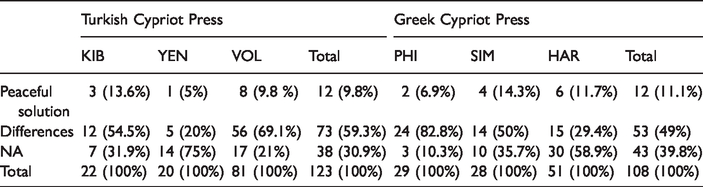
Of the 108 news stories published by GC newspapers, only 11.1% (n = 12) focus on a peaceful solution to hydrocarbons conflict and almost half of the stories (49%) fail to mention any peaceful solution by focusing on the differences that led to the conflict. TC newspapers have a similar score; only 12 stories (9.8%) out of 123 focus on a peaceful solution and 73 stories (59.3%) refrain from mentioning any peaceful solution at all. Interestingly enough, amongst the TC newspapers analysed, extreme right-wing VOL had the highest number of stories (n = 8) that focuses on a peaceful solution, which is equal to 9.8% of its total number of stories. It is important to note that VOL published almost four times more front-page stories (n = 81) than other TC newspapers analysed. KIB had three stories (13.6%) as such and YEN a mere one (5%). The frequency of stories that focus on differences amongst conflicting parties instead of any peaceful solution or common ground option, is significant a mongst TC newspapers. VOL had 56 stories (69.1%) as such, and KIB had 12 stories (54.5%). YEN had five stories (20%). Amongst GC newspapers, HAR has six (11.7%), SIM has four (14.3%) and PHI has two (6.9%) front-page stories that focus on a peaceful solution to the hydrocarbons conflict. PHI had the most significant percentage (82.8%; n = 24) amongst all the other newspapers not referring to any peaceful solution and focused on differences amongst conflicting parties. Exactly half of the stories (num = 14; 50%) of SIM and 15 stories (29.4%) of HAV refrained from focusing on a peaceful solution. Table 3 shows the tendency towards the focus of newspapers on differences that led to the conflict.
Referring to any peaceful solution or differences.
Negative repercussions of a possible war
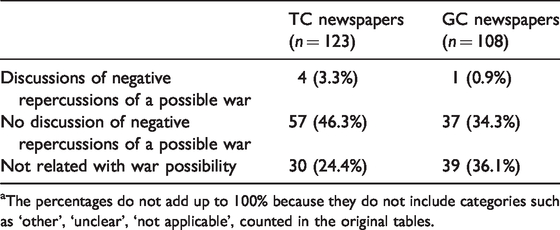
By using the two indicators developed for this study, ‘No discussion of negative repercussions of a possible war’ (WJ) and ‘Discussing negative repercussions a possible war’ (PJ) we are able to analyse newspapers attitudes during escalated conflicts further. Both TC and GC newspapers failed to discuss or refer to negative repercussions of a possible war/hot episode related to the hydrocarbons conflict. Only 3.3% (n = 4) of the total stories published by TC newspapers discussed negative repercussions of a possible war on their front-page. Of the 123 stories published by three TC newspapers, 46.3% (n = 57) of them refrained from referring to such discussions. Only one story (0.9%) published by GC newspapers, referred to negative repercussions of a possible war, and 37 stories (34.3%) were not referring to any negative repercussions of a possible war. Table 4 shows newspapers attitudes towards the possibility of a war related to the hydrocarbons conflict.
Discussions of negative repercussions of a possible war. a
aThe percentages do not add up to 100% because they do not include categories such as ‘other’, ‘unclear’, ‘not applicable’, counted in the original tables.
Usage of military vocabulary/discourse
Newspapers on both sides of Cyprus’ divide have a remarkable preference to use military vocabulary/discourse while covering the hydrocarbons conflict. What is meant by military discourse or vocabulary in this study is the usage of words which are associated with, or evoke, war, hot episode or militaristic solutions to this conflict. The following extracts from front-pages are some examples amongst many using military discourse/vocabulary: TURKISH MANOEUVRES Erdoğan increases deployment of naval forces around Cyprus using breach with Israel as a pretext (Haravgi, 07 September 2011) TURKEY DETERMINED TO GO TO EXTREMES Turkish navy will be seen much more frequently in the waters of the Eastern Mediterranean, says Tayyip Erdoğan. (Simerini, 08 September 2011) ISRAEL SENDS OUT FIGHTERS Reply in the same language – Messages in the skies around Cyprus Two Israeli fighters yesterday sent a strong double message to Turkey, using the language that may be better understood by Erdoğan, saying that the provocations won’t be tolerated. (Phileleftheros, 29 September 2011) ISRAEL AND US WARSHIPS IN THE MEDITERRANEAN It has come to our attention that Israeli warships have been patrolling waters between Lebanon, Israel and Cyprus. Information coming in reveals that US warships are being fuelled by tanker ships belonging to the US Navy’s 6th fleet (Volkan, 14 September 2011) SECOND STEP: NAVY While Turkey takes its first step by signing a continental delineation agreement with the TRNC, Noble’s platform reaches the Aphrodite block. It seems that the GC Administration is determined to go ahead with hydrocarbons exploration activities but Turkey is determined to stop it from going ahead. (Kıbrıs, 16 September 2011) DRILLING STARTED It is reported that Turkish warships only monitor the drilling activities from the international waters … (Yenidüzen, 20 September 2011).
War journalism indicator: Military vocabulary usage on the front page. a
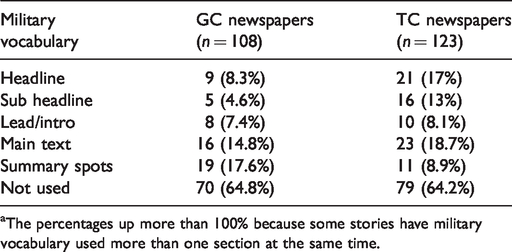
aThe percentages up more than 100% because some stories have military vocabulary used more than one section at the same time.
Sources of stories
When it comes to quoted or referred sources in the news stories, results reveal that almost all stories are elite oriented. Whilst TC newspapers had only five stories (4%) that are referred to/quoting from non-officials, GC newspapers had only one story (0.9%) as such. Three of total six stories quoted academics whilst the other three quoted non-official experts. Content analysis also reveals that 57.5% (n = 133) of the total sample analysed has official announcements and/or reactions by politicians’ as the core of their news stories. From the analysed newspapers, TC press has 67 news stories (54.4%), with politicians’ statements as the central piece of the article, whilst GC newspapers have 66 (61.1%) as such.
Preference of quotes: Escalating or de-escalating
Using ‘escalating’ and ‘de-escalating’ quotations are second set indicators developed for this study, to understand the approach of the newspapers towards the hydrocarbons conflict. With an escalating quote, the present study refers to (a) quotations that have the direct/indirect reference of solving the hydrocarbons conflict with use of military force or violence; (b) quotations that are focusing on one’s own rightfulness; (c) quotations that reflects the hydrocarbons conflict as a zero-sum game; (d) quotations that accuse the other side (antagonism) for being responsible for the hydrocarbons conflict. Briefly, these quotations are in favour of increasing tension amongst conflicting parties. The following extracts represent some of the escalating quotes used in the analysed press: Turkish EU Affairs Minister and Chief Negotiator Egemen Bağış in relation to reports that the Israeli Airforce has switched to Alarm B said … “They are well aware of Turkey’s sensitivities. I’m leaving Turkey’s potential to their creative imagination” (Volkan, 14 September 2011) Responding to a question as to how the Turkish navy will react regarding if GCs’ drilling activities are not halted, the source said, “the Turkish Side has not intervened in the drilling activities because it did not want to be the first to fire. However, we too have a right to carry our exploratory drilling in bloc 12 and when Piri Reis arrives in the bloc, the Turkish navy will be accompanying it. If they have the strength, the GC side will intervene and stop us.” (Kıbrıs, 25 September 2011) ERDOĞAN: “IT IS NOT DRILLING, IT’S SABOTAGE” (Yenidüzen, 29 September 2011) Turkish Finance Minister Mehmet Şimsek … said that, “we will do what is necessary to protect our rights and the rights of Turkish Cypriots”, subsequently stressing that, “we cannot rule out anything”, although, as he quotes, “a military confrontation is not desirable”. (Phileleftheros, 30 September 2011) [Turkey] have in fact gone too far where Erdoğan himself has threatened that if we don’t stop the explorations, Turkey will “do what is necessary”, placing the responsibility on the GC side … (Simerini, 24 September 2011) President Christofias responded strongly to Turkey’s provocations, calling on the National Guard to be “vigilant and prepared” to deal with Turkish arrogance and the threats … (Haravgi, 10 September 2011) [TRNC] President’s special representative Özersay said: “If we find petrol, we are ready to share” (Kıbrıs, 27 September 2011) Here is the proposal of [TRNC] President Eroğlu: 1) Simultaneous interruption of all related activities until the Cyprus problem is solved. 2) Establishment of an informal committee, if the GC side insists on continuing explorations … 3) The revenue we will get from explorations will be used only for financing the settlement of Cyprus problem and won’t be used under any circumstances for armament … (Volkan, 25 September 2011) Eroğlu said: “The natural richness’ around Cyprus belongs to both TCs and GCs” (Yenidüzen, 22 September 2011) [President Christofias] noted that the United Federal Republic of Cyprus, in which GCs and TCs will jointly govern, will exploit the natural resources of the country for the benefit of both communities. “This”, President Christofias added, “was an arrangement we agreed upon in the peace negotiations. Natural resources and their exploitation will be the federal government’s responsibility, which through its budget will distribute the revenue to both communities’ federal units”. (Haravgi, 19 September 2011) Erdoğan himself yesterday announced the agreement, which was signed in a rush in New York. At the same time, he also announced the end of the absurdity that he himself initiated over many days, stating that “Turkey won’t create a crisis and tension in the region, but will act ‘wisely’” (Simerini, 22 September 2011) Speaking from the podium of the General Assembly of the United Nations yesterday, President Christofias, stated that “the possible discovery and extraction of hydrocarbons will be one more powerful incentive for GCs and TCs to reach a fair, workable and viable solution to the Cyprus problem soon”. (Phileleftheros, 23 September 2011)
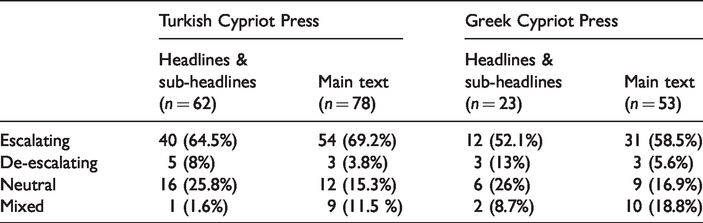
In the main texts of front-page stories, frequency of escalating quotes increased for newspapers from both sides. The number of front-page stories that have quotations in their main texts, published by TC newspapers is 78 (63.4%). Amongst these, 54 stories (69.2%) have escalating quotes from elites and only 3 stories (3.8%) have de-escalating quotes. As for the GC newspapers, the number of front-page stories using quotations in their main text is 53 (49%). Amongst these stories, 31 (58.5%) of them have escalating characteristic and 3 (5.6%) of them have de-escalating characteristics. Table 6 summarizes the usage of escalating and de-escalating quotes.
Usage of escalating and de-escalating quotes on front-page stories.
Discussion of findings
To what extend was the coverage of the hydrocarbons conflict by TC and GC newspapers dominated by WJ or PJ approach? This is the major research question posed by this study. The combined sample analysed for all six newspapers from both communities (Table 1) indicates a strong preference towards WJ. Amongst the six indicators of peace and WJ analysed for this study, five of the WJ indicators are overwhelmingly having more frequency than PJ indicators. This study shows that the most dominant WJ indicator is elite orientation, followed by zero-sum orientation, focused on differences, no discussion about negative repercussions of a possible war and finally usage of military discourse. Interesting to note that some indicators for PJ, like: win–win orientation, discussing negative repercussions of a possible war, and people-orientation are less than 3%. This clearly represents that both TC and GC newspapers are practicing WJ, whilst covering the hydrocarbons conflict. Another striking result of this study is that, ideological positions of the newspapers did not play a visible/effective difference in the reporting of the hydrocarbons conflicts. Newspapers from different ideological positions across the divide have more or less the same WJ approach towards the hydrocarbons conflict. Almost two-thirds of the total front-page stories analysed featured no military discourse and this is the only PJ indicator that dominated the frequencies. However, having 35.5% of the front-page stories using military discourse in a case where there was high risk for a potential war/hot episode, cannot be underestimated as a significant form of WJ and sensationalism. The present study clearly shows that; the newspapers from both sides, failed to refer/discuss peaceful solutions to the hydrocarbons conflict and they also failed to refer/discuss negative repercussions of a possible war related to the hydrocarbons conflict.
Research question one asked whether front-page news coverage of the hydrocarbons conflict in TC and GC newspapers differed significantly in using PJ or WJ approach. A significant tendency towards WJ is apparent for newspapers of both communities. Table 7 shows a summarized version of the earlier tables, featuring the commonalities and differences of TC and GC newspapers. Newspapers on both sides have similar scores in almost all indicators, except two. Frequency for focusing on differences and no discussion about negative repercussions of a possible war is higher for TC newspapers.
War Journalism or Peace Journalism: Summary of similarities and differences between Greek Cypriot and Turkish Cypriot newspapers. a
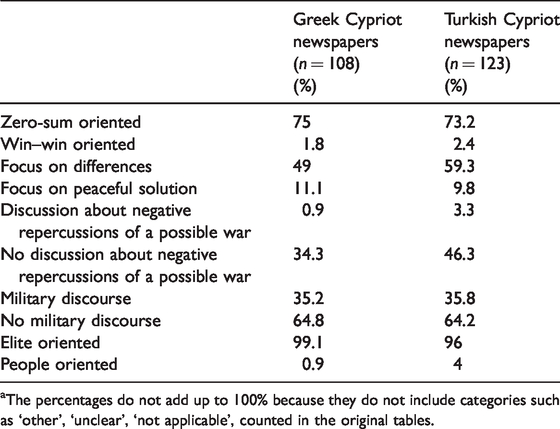
aThe percentages do not add up to 100% because they do not include categories such as ‘other’, ‘unclear’, ‘not applicable’, counted in the original tables.
The second research question was: How diverse is sourcing by TC and GC newspapers for covering the hydrocarbons conflict? As it is clearly shown in Tables 1 and 7, almost all stories analysed for this study are elite oriented. Media landscape and journalism culture in both communities is in favour of referring/quoting elite/official sources. For this specific case, the findings are not in favour of PJ due to fact that 97.4% of the sources are elites. This study shows that reporting elites’ point of view as facts is a habitual approach of journalists in Cyprus.
The third question posed was whether TC and GC newspapers provided discussion (PJ), or non-discussion (WJ), of the negative repercussions of a possible war. The combined analysis of newspapers from both sides shows that journalists very rarely wrote about the negative repercussions of a possible war due to the hydrocarbons conflict. This is a deplorable but good example of how the ‘national struggle’ mentality is deeply rooted amongst journalists on both sides of the divide. Journalists in Cyprus prefer to sensationalise the threat of war ensued by the hydrocarbons conflict rather than discuss the negative repercussions of a possible war. The aim of creating these two new indicators is also to give room for discussing the role of PJ in the prevention of violence in times of war risks. The findings of this study bring to light the need for developing new complementary strands for PJ for reporting escalated conflicts.
The fourth question asked whether the quotes used on front-page stories related to the hydrocarbons conflict were escalating or de-escalating oriented. The findings of this question, with combination of the findings of the previous question, form a better understanding of the decisions made by TC and GC newspapers in terms of escalating or de-escalating the conflict. More than 50% of the quotes used in headlines/sub-headlines or main texts of front-page stories on both sides have escalating orientation. The frequency of escalating quotes for the TC press is remarkably higher compared to GC newspapers but when it comes to percentages compared to total stories published on each side, the scores are similar. The tendency to quote escalating oriented statements from elites in covering the hydrocarbons conflict can be read as an important sign about the newspapers being mouthpiece of elites.
Conclusion and recommendations
Cyprus has been locked in an intractable conflict for almost half a century and could benefit greatly from conflict transformation: PJ has a fundamental role to play by opening space for the interests and points of view of all stakeholders. This can be facilitated through the practice of PJ where non-violent options to the resolution of conflicts are revealed. PJ can reduce the distance between journalists, address media workers and journalists from both communities and encourage media to accentuate the sort of reporting that represents the multiplicity of voices rather than reducing discussion and debate to a win/lose, zero-sum mentality. Jake Lynch, argues that, journalists in several countries – including Cyprus, who are affected by violent conflict in the past and still have tensions due to proacted conflicts, ‘have often evinced an appetite for PJ’ (Lynch, 2016: 201). The findings of this case study, however, clearly show that this is not the case in Cyprus. In fact, TC and GC newspapers covered the hydrocarbons conflict through ‘zero-sum’ and ‘us vs. them’ approaches, where the possible use of militaristic force to solve this conflict is uplifted and legitimized. It is obvious that TC and GC newspapers failed to present peaceful solutions to this conflict. Moreover, with their front-page stories they helped to escalate the tension amongst parties. Newspapers from both sides, instead of acting as watchdogs, prefer to support their politicians’ official policy about the hydrocarbon reserves by heavily rely on elite sources. Another interesting finding of this study is that, ideological differences amongst newspapers, make almost no difference when it comes to reporting this specific conflict. However, the authors of this study believe that further studies can address the issue of ideology in more depth to reveal the usage of language in conflict escalation and de-escalation. There is growing interest for PJ in Cyprus, but in order for it to flourish a lot more effort needs to be put into understanding PJ and training journalists (Ciftcioglu, 2017). This, in turn, will guide efforts toward further academic inquiry and professional interest into PJ in similar conflict-settings and beyond.
Footnotes
Acknowledgements
The authors would like to thank Dogus Ozokutan, Mashoed Bailie, Yeliz Shukri, Emin Hikmet, Mustafa Cirakli, Muharrem Amcazade, Tugberk Kaya, Kemal Tozer, Eliz Tefik, Memduh Erismen and the two anonymous referees for their valuable comments and contributions to the earlier versions of this article.
Declaration of Conflicting Interests
The author(s) declared no potential conflicts of interest with respect to the research, authorship, and/or publication of this article.
Funding
The author(s) disclosed receipt of the following financial support for the research, authorship, and/or publication of this article: This article was completed with the support of an EU scholarship grant received by co-author Vasvi Ciftcioglu in academic year 2017/2018 for his PhD research visit to Northumbria University under the supervision of Dr Ibrahim Seaga Shaw. The EU Scholarship Programme for the Turkish Cypriot community project is funded by the European Union and implemented by the British Council.