







Abstract
Although extensive research has been conducted into the role of the media in fighting corruption, media organisations and journalists themselves are not immune to it. The issue of corruption in the media remains understudied and has thus far mainly focused on case-studies of specific countries characterised by corruption as a core societal characteristic, as well as of under-developed and developing countries. This study focuses on the issue of media corruption in Europe, based on a comparative analysis between countries of the South and North, investigating the impact of the global economic crisis on media corruption. The research presents clear evidence of increased indications of media corruption in the North of Europe in comparison to the media systems of the European South, the area most affected by the global economic crisis.
Introduction
The media’s ‘watch-dog’ role in fighting societal corruption has been the focus of scientific analysis since the early years of mass communication research. Whereas much has been written on several forms of corruption in general, media corruption in particular seems to have been understudied. According to Spence (2008), this oversight is partly because the concept of corruption in the media is not well understood or clearly defined, or too narrowly defined in terms of either corporate financial misfeasance, as in the case of Enron, or abuse of political and public office for private gain, as in the case of Watergate.
The media and journalists themselves are not immune to corruption, although this issue has thus far mainly focused on case-studies of specific countries characterised by corruption as a core societal characteristic, such as Italy (Giglioli, 1996; Nielsen, 2003).
Traditionally, the issue of media corruption in Europe has been examined in relation to indirect government control over the media (e.g., in West European democracies) and direct government control over the media (e.g., in former Communist countries in Eastern and Central Europe) (Price, 2019; Pring, 2016). However, in the aftermath of the Great Recession in 2007, the notion of corruption has been revisited in regards to western democratic states. Research has documented that although corruption may be tolerated when the economy is doing well, this is not the case during and after times of crisis (Obydenkova and Arpino, 2018).
This study aims to investigate the existence of features of media corruption in Europe, based on a comparative analysis between countries of the South and North, and, specifically, the impact of the global economic crisis upon indications of media corruption. The originality of the study lies in the fact that it presents clear evidence of increased indicators of media corruption in the North of Europe compared with the South, the area most affected by the economic crisis. As such, this study overturns the existing published research regarding media corruption that centres on the argument that such corruption increases in parallel with economic crises around the world.
Literature review
Corruption in the media: Global perspectives
Corruption in the media is usually manifested in two main forms: First, via misbehaviour and malpractices of media, in general, and journalists, in particular. According to Transparency International (Transparency International, 2010/11; Mendes, 2013), the most evident forms of media corruption are bribery in the form of cash for news, staged or fake news, gifts and concealed advertisement, nepotism and media capture, perceived as the power of media owners to influence governmental decisions and/or accept bribes in exchange for favourable coverage (see also Besley and Prat, 2006).
Second, media corruption can be a means by which government (or power groups) control the media within a society. This manifests itself in various forms across different time periods and countries. For example, government and political parties have been the main patrons of many English newspapers since the 18th century (Curran and Seaton, 2003).
A more worrying situation can be observed in Italy, which has traditionally lacked both the high quality titles willing to engage in high-profile investigative journalism and the long lower quality tail which constitutes a barrier to complete political capture (Besley and Prat, 2006). Silvio Berlusconi, the leader of ‘Forza Italia’, became prime minister in 1994 but retained a monopoly holding of the national television and media resources of the country (Statham, 1996). Historically, the country’s media landscape exhibited indicators of a deeply worrying and corrupted environment, with evidence of clientelism prevailing in the sector throughout the 20th century. For instance, the public broadcaster, Radiotelevisione Italiana (RAI), was essentially under the control of the ruling Christian Democratic Party in the 1950s and 1960s. In the 1970s, when a broader coalition was formed and the ‘historic compromise’ allowed the ‘Partido Communista’ to share in the ‘lottizzazione’ – the division of political power and benefits – control of RAI was divided among the parties, with the Christian Democrats retaining control of one channel, the ‘secular parties’ the second and the Communists the third (Iosifidis and Papathanassopoulos, 2019). In recent years, the board of directors of RAI has been reduced in size, making proportional representation impossible, which may require a degree of de-politicisation of appointments to the board (Hallin and Papathanassopoulos, 2000).
Clientelism in the media landscape as a means to control the sector seems to be a prevailing characteristic for several western countries (Hallin and Mancini, 2004), and is provocatively evident in the wider area of the Mediterranean countries. In Malta, the state, the political parties and the Church own radio and TV stations, confirming the strong presence of political institutions in the media scene (Borg, 2007: 254). Similarly, Portugal and Spain have exhibited evidence of clientelism in past and recent years (see analysis in Berges, 2017; Costa e Silva and Sousa, 2017) whereas in Greece and Cyprus, media entities that developed in parallel with the state have been presenting identical patterns of vulnerabilities (Maniou, 2017; Papathanassopoulos, 2007).
Assessing features of media corruption
Besides typical forms of media corruption – ‘the abuse of public power for private benefit’ (Liu, 2016; Rose-Ackermann, 1997) – there are several features in contemporary societies that can put media’s integrity and autonomy at risk and make them vulnerable to corruption, as a means of government control over the media and the information they disseminate.
Efforts to control the flow of information to the public are traditionally perceived as a typical form of media control. Blocking websites and prohibiting access to social media platforms (e.g., in China and Turkey) in recent years seem to be mainly observed in developing countries (Mendes, 2013). Similar concerns are strengthened by developments in countries such as Libya and Egypt where social media, such as Twitter and Facebook, played a major role some years ago in forcing a change of government (Fourie et al., 2013). However, attempts in western countries to restrict media freedom have also raised serious questions. David Cameron’s announcement during the UK’s 2011 riots that he was considering shutting down social media shocked the international information community and raised questions of how far below the surface of the world’s established democracies censorship really lies, and how freedom of access to information and freedom of expression bodies should respond (Dick et al., 2012). The European Centre for Press and Media Freedom, in their study on investigative journalism (Ukrow and Iasino, 2016), showed that while the countries examined protect freedom of expression on the constitutional, statutory and self-regulatory level, restrictive rules on the freedom of the press and media also exist. In France, the prime minister has the power to extensively monitor the French population without judicial control, which compromises the protection of journalists’ sources and has a potentially chilling effect on whistle-blowers. Poland’s surveillance law passed in 2016 expands the enforcement agencies’ access to citizens’ internet and telecommunication usage data without prior judicial review or approval. Poland has also adopted an anti-terrorism law and a law on public service media, both of which curtail freedom of expression. Switzerland’s Intelligence Service Act, allowing the Swiss intelligence service to monitor private communications, has also passed a relevant referendum. The Spanish Parliament, likewise, adopted a public security law which allows the government to sanction journalists for taking pictures or filming police forces in the exercise of their duties (see also, Clark and Grech, 2017).
Furthermore, media pluralism – interpreted as the plurality of viewpoints and perspectives in the media (Karppinen, 2013: 2) that can potentially support and promote different or conflicting ideas – is also crucial when investigating the level of media corruption. The existence of a variety of media potentially able to freely criticise governmental initiatives as well as the existence of different media perspectives regarding these initiatives are significant in assessing the level of media corruption.
Safeguarding the ‘watch-dog’ role of the media is essential in the battle against corruption. This role is particularly important during democratic transitions, when the media are still asserting their autonomy from government and helping construct the new rules of engagement with officials (Coronel, 2010).
In addition, the level of autonomy journalists enjoy within the media system in which they operate is of equal importance. Attempts to harass journalists are not exclusively conducted by authoritarian regimes in underdeveloped and developing countries, although these are considered direct and are easier to trace. China, Mexico and Turkey show clear evidence of such cases. However, attempts to harass journalists can also be traced in western democracies. Löfgren Nilsson and Örnebring (2016) examined the situation in Sweden, a country with strong de facto and de jure safeguards of journalistic freedom and autonomy. Their findings from a representative survey of Swedish journalists on the extent of harassment, the forms of harassment, and the consequences of intimidation and harassment showed that a third of the respondents had experienced threats at work, and an overwhelming majority said they had received offensive and insulting comments. Intimidation and harassment also had consequences, both professionally and personally, such as fear and self-censorship.
Self-censorship can, in certain cases, have some value for professional journalists but codes of ethics tend to encourage it only in regards to sensitive issues (e.g., transmission of unnecessarily violent images, publication of redundant intimate details regarding criminal attacks). In all other cases, self-censorship can be a severe obstacle to a healthy media system. This study adopts the definition offered by Clark and Grech (2017: 11), who argue that self-censorship is interpreted as the control of what one says or does in order to avoid annoying or offending others but without being told officially that such control is necessary. In this context, in crisis-ridden countries such as Cyprus, Greece and Spain, the new working environment that has emerged has ousted experienced and more highly-paid professionals, resulting in phenomena of insufficient advocacy of the professional relations code and even of the journalistic code of conduct, leading to the ‘pauperisation’ of younger trainee journalists. This lack of job security constitutes a source of corruption and self-censorship for journalists, causing an internal, self-fuelled crisis (Iordanidou et al., 2020).
Finally, media bias is also an important feature for measuring corruption in the field. For the purpose of this study, we adopt the definition of media bias offered by Gehlbach and Sonin (2014), who state that media bias is the extent to which the media misreport the news in favour of government interests (p. 163). Their study emphasises a fundamental constraint facing any government that hopes to control media content: bias in reporting reduces the informational content of the news, thus decreasing viewership among those who value that information (p. 170).
The issue of trust emerges as a core element when discussing corruption in general and media corruption in particular. Uslaner (2002, 2008) argues that the relationship between them goes both ways: from low levels of trust to high rates of corruption and then back to less trust. A more recent study conducted by Graeff and Svendsen (2013) shows that low trust may lead to high levels of corruption, but there is no ‘reverse’ causality of corruption on trust. In the case of the media’s freedom to present a variety of different opinions and to express criticism of government activities, the level of journalistic autonomy and the existence of media bias can be directly associated with the level of trust they tend to enjoy. As such, trust towards the media can be directly associated with their perceived level of corruption. Added to all these, recent studies showed that the majority of European countries have experienced a significant decline in institutional trust following the Great Recession (Armingeon and Guthman, 2014; Bartels and Bermeo, 2014); in other words, citizens tend to withdraw their trust from national level political institutions (such as the media) when perceived economic performance is poor (Obydenkova and Arpino, 2018).
The effects of the economic crisis on corruption in different media systems
Social, political and economic differences between South and North, and East and West have led to the formation and development of different media systems (Bennett, 2015; Hallin and Mancini, 2004). In their classic study Four Theories of the Press, a comparative analysis and presentation of news media, Siebert et al. (1956) underline that the press always takes on the form and tone of the social and political structures within which it operates. Consequently, different media systems around the world share a common characteristic: all of them depict the vulnerabilities of the societies within which they operate. As such, it is logical to assume that media systems tend to depict corruption where it already exists as a social characteristic. Of course, news media theory has gone a long way since then, while societies have had to face a series of crises that have altered many of their internal characteristics and affected their media systems.
In Europe, social and political differences between North and South have been clearly evident throughout the continent’s long and tumultuous history. As such, national media systems tend to present different characteristics both in their development pace as well as in codes of practice and conduct (Kelly et al., 2003; Rooke, 2013). In a more recent classic study of different media systems, Hallin and Mancini (2004) classify western media systems in three distinct models: the Mediterranean or Polarised Pluralist (which prevails in the countries of Southern Europe), the North/Central European or Democratic Corporatist (which prevails across northern continental Europe) and the North Atlantic or Liberal model (which prevails across Britain and Ireland). As Hallin and Mancini state: ‘The Liberal model is characterized by a relative dominance of market
mechanisms and of commercial media; the Democratic Corporatist
model by a historical co-existence of commercial media and media tied
to organized social and political groups, and by a relatively active but legally
limited role of the state; and the Polarized Pluralist model by integration of the
media into party politics, weaker historical development of commercial media
and a strong role of the state’ (p. 11).
It is only logical to assume that media systems in the South of Europe are more vulnerable to governmental control in comparison to those of the North, whereas media in the North tend to enjoy more freedom than their counterparts in the South. In a more recent study, Färdigh (2010) argues that the traditional idea where countries marked with a high level of democracy also have high levels of media freedom, and that countries with a low level of democracy have oppressed and cowed media is both excessive and very simplistic. In fact, his study indicates that the limits and criteria by which countries are placed into each ideal model are somewhat diffuse, while the overall variations within Europe are likely to decrease.
The Great Recession of 2007 may have provided the trigger for the actualisation of this argument. While it initially emerged in 2007 in the US, the economic crisis became evident after 2009 in Europe; after a period of economic and banking turmoil, Greece was the first European country to impose a Memorandum of Understanding with strict economic measures in 2010, followed by Ireland, Portugal and Spain. Overall, while it was evident around Europe, the Great Recession mainly affected the European South, as shown in the list of European countries’ GDP provided by the International Monetary Fund’s World Economic Outlook (2018). 1 In this light, the crisis has added new facets to our thinking about how regional problems in Europe are being approached; Unemployment, social exclusion, resilience and the capacity of countries to withstand the effects of fiscal austerity have become prominent issues, constantly climbing up the policy agenda (Cuadrado-Roura et al., 2016).
As part of the existing socio-political system, the media themselves were deeply impacted by the economic crisis on many levels, while modes and characteristics of national media systems were significantly altered (Balcytiene and Juraite, 2015; Berges-Saura and Papathanassopoulos, 2015; Maniou and Photiou, 2017). Gradually, they were forced to suffer certain effects in terms of management and organisation, which entailed losses in readership/viewership, advertising revenue and overall profits, endangering their survival and future prospects (Maniou and Seitanidis, 2018). In addition, Mercille (2014) sheds light on another aspect of media involvement in the economic crisis, since the media played an important ideological role in presenting the policies of economic and political elites in a favourable light during the crisis, even if the latter’s aim had been to shift the burden of adjustment onto citizens. Although Mercille’s analysis does not focus on issues of corruption but on the overall case study of Ireland’s economic crash, the characteristics observed in the country’s media coverage of the crisis seem to coincide with the characteristics of corruption considered earlier in this analysis.
It is well documented that economic crises in general tend to increase levels of corruption. High levels of media corruption would be more likely to appear in economically weak countries, since the phenomenon is directly related to limited financial resources and market failures (Odugbemi and Norris, 2010). Several relevant examples exist around the world. Jain (1998) argues that the high levels of corruption observed in Mexico can be directly related to the country’s financial problems (see also, Committee of Foreign Affairs, 1984). Dornbusch and Edwards’s (1991) analysis for Latin America attributes the region’s proclivity towards macroeconomic mismanagement to ‘certain economic policies,’ in which evidence of corruption was widespread (Jain, 1998).
The global economic crisis of 2007 affected levels of overall corruption, which increased in line with the depth of impact of the economic crisis observed in every country (Ivlevs and Hinks, 2015). In a case study analysis of Iceland, the country that, among the developed nations, was hit the hardest by the economic crisis, Vaiman et al. (2010) argue that evidence of corrupt practices was observed in the public sector several years before the fall of the national economy. Obydenkova and Arpino (2018) argue that the growing number of corruption scandals after 2007 became a central focal point for the population of a number of European citizens (e.g., the so-called Lagarde list scandal in Greece and the property bubble scandals in Spain), while the quest for the causes of corruption and the need for anti-corruption strategies were widely discussed within society (p. 597).
In the light of this theoretical analysis, the hypotheses for this study are the following:
Hypothesis 1: 1H0: The Great Recession had a direct effect on levels of media corruption in Europe. 1H1: The Great Recession had no effect on levels of media corruption in Europe. 2H0: There are differences in features/indications of corruption among the different European media systems, depending on the state of the economy. 2H1: There are differences in features/indications of corruption among the different European media systems, but they do not depend on the state of the economy.
Research questions, method and scope of study
The study seeks to answer the following research questions: RQ1: To what extent has the global economic crisis (Great Recession of 2007) affected features/indications of media corruption in North and South Europe? RQ2: What are the differences in features/indications of media corruption between North and South European countries?
Data and measures
The data for the analysis were collected from the V-Dem dataset (Coppedge et al., 2018a; Pemstein et al., 2018) and cover the period 1993-2017. V-Dem is one of the largest ever social science databases, containing over 19 million data points. At April 2018, the dataset covered 201 countries from 1787 to 2017. V-Dem draws on theoretical and methodological expertise from its worldwide team of experts to produce data in the most objective and reliable way possible. Approximately half of the indicators are based on factual information obtainable from official documents. The other half consists of more subjective assessments. On such issues, typically five experts per country provide ratings (Coppedge et al., 2018a). In order to examine and compare media corruption across groups, we focused on the media part of the V-Dem dataset. We utilised different variables from the media section in the V-Dem dataset that capture both print and broadcast traditional media. The period 1993-2017 was selected because the relationship examined in this study is more relevant in recent years and since we want to capture whether it altered after the global economic crisis.
To test our hypotheses, a number of t-tests were conducted to compare the means across groups as well as means within each group, before and after 2009 (the year when the global economic crisis became evident across Europe with the first MoU imposed in a European country, as earlier discussed). Additionally, a number of OLS regressions were performed on the two different groups of countries to examine what affects media corruption within each group. The data were analysed using the statistical programme SPSS.
Dependent variable
In order to capture media corruption, we use the variable media corrupt in the V-Dem dataset (Coppedge et al., 2018a; Pemstein et al., 2018), which measures whether journalists, publishers and/or broadcasters accept payments in exchange for altering news coverage (Coppedge et al., 2018b; Pemstein et al., 2018), in other words what is described as the most common direct form of media corruption in this work. 3 While there are various indicators of media corruption as earlier analysed, ‘accepting cash in exchange for editorial content’ seems prevalent around the world as a direct form of media corruption (Eigen, 2002) and no region seems to be immune to it (see also International Public Relations Association, 2002 4 ). This indicator is used here in line with previous empirical research regarding media corruption on a global scale. 5
The V-Dem methodology generates a measure that is converted to an interval by the measurement model used (Coppedge et al., 2018c). In the total sample, this variable is an interval measure that runs from −2.92 to 3.52, a higher score/number indicating higher levels of corruption.
Independent variables
The independent variables used as features/indicators of media corruption are the following: government censorship effort, internet censorship effort, print/broadcast media critical, print/broadcast media perspectives, harassment of journalists, media self-censoring, and media bias.
Government censorship effort is a variable generated by the question: “Does the government directly or indirectly attempt to censor the print or broadcast media?” As the V-Dem codebook (Coppedge et al., 2018b) explains, indirect forms of censorship might include politically motivated awarding of broadcast frequencies, withdrawal of financial support, influence over printing facilities and distribution networks, selected distribution of advertising, onerous registration requirements, prohibitive tariffs, and bribery. The measure used is not concerned with censorship of non-political topics, such as child pornography, data privacy Acts, statements offensive to a particular religion, or defamatory speech, unless this sort of censorship is used as a pretext for censoring political speech. This variable is an interval that runs from −2.37 to 3.61 in our sample, with censorship decreasing as the value increases. Internet censorship effort refers to the variable generated from the question: “Does the government attempt to censor information (text, audio or visuals) on the internet?”
Print/broadcast media critical and Print/broadcast media perspectives are variables based on the following questions: “Of the major print and broadcast outlets, how many routinely criticise the government?” and “Do the major print and broadcast media represent a wide range of political perspectives?”, respectively. Both variables, according to the methodology followed, are converted to intervals by the measurement model (Coppedge et al., 2018d), higher values indicating higher levels.
The variable harassment of journalists is based on the question: “Are individual journalists harassed — i.e., threatened with libel, arrested, imprisoned, beaten, or killed — by governmental or powerful nongovernmental actors while engaged in legitimate journalistic activities?” (Coppedge et al., 2018b; Pemstein et al., 2018). The variable is an interval, with higher values indicating lower harassment.
The V-Dem dataset creates the variable Media self-censoring using criteria, according to the codebook, centred on the question: “Is there self-censoring among journalists when reporting on issues that the government considers politically sensitive?” (Coppedge et al., 2018b). This variable generated an interval that runs from −2.41 to 3.21 in our sample, with higher scores indicating lower levels of self-censoring.
Finally, Media bias is a variable created from the question: “Is there media bias against opposition parties or candidates?” As earlier mentioned, the variable is an interval created by the measurement model (Coppedge et al. 2018d) with higher scores indicating increased bias.
Findings
Media corruption in Europe: from the South to the North
The descriptive findings clearly show that levels of media corruption are higher in the European North than in the European South for the whole time period studied (1993–2017). Even with the exclusion of Italy (according to the Global Corruption Index-2018 it presents a high score of corruption, as earlier mentioned), results remain unaltered.
In order to empirically see where changes occur, we have performed a time series analysis to document the changes of media corruption over time and across the two groups of countries. The results are presented in Figures 1 and 2.
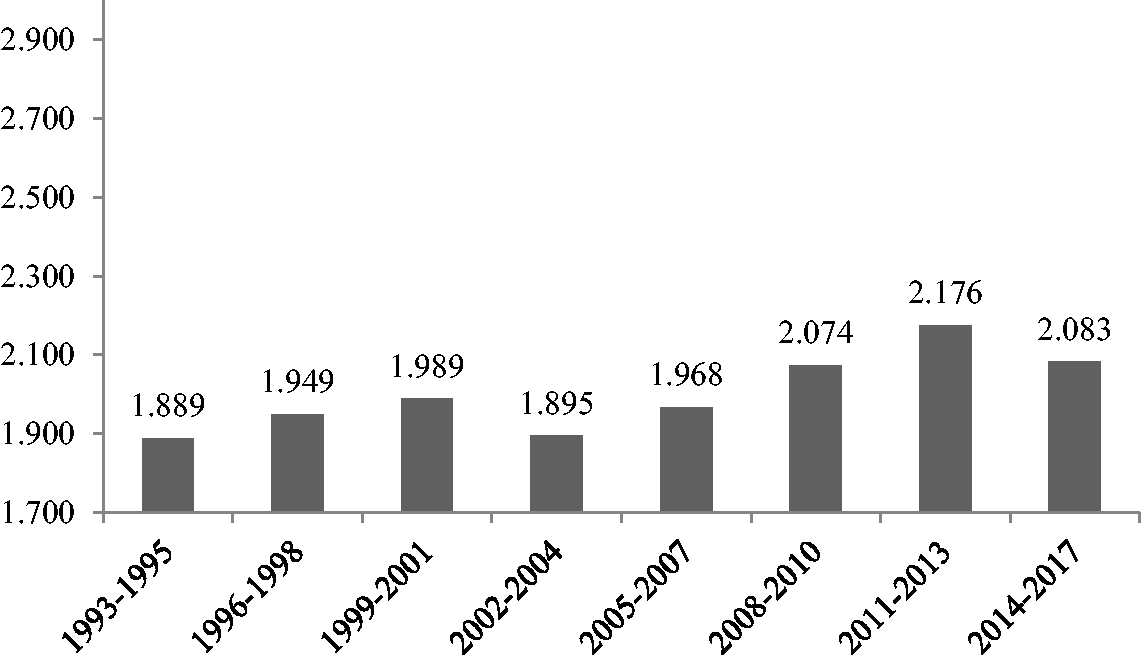
Mean Corruption through time – South Countries.
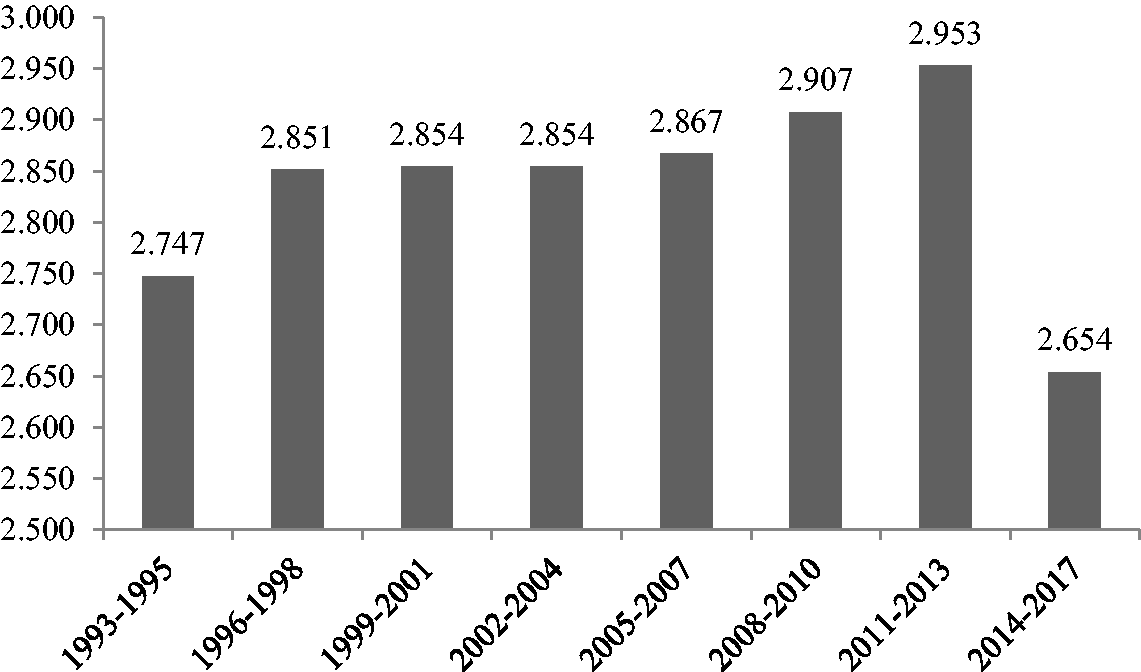
Mean Corruption through time – North Countries.
Figure 1 presents mean corruption through time for the Southern countries. In the South, corruption is relatively stable, drops a bit in the 2002–2004 period and it significantly increases after the 2008 period. It declines a bit after 2014, but does not reach the levels before 2008.
In Figure 2 we see corruption through time for the Northern countries. In the North there is no much difference in the levels of corruption through time with the exception of the last time period 2014–2017 in which we observe a decline. Comparing the two Figures we can conclude that in all time periods, higher levels of corruption appear in the Northern countries, but in the South there is more variation in the mean values between time periods. After 2008, corruption in both groups increases.
Table 1, also indicates, the South presented lower levels of media corruption before the economic crisis than the North; however, after the onset of the crisis, media corruption remained almost at the same level in the North (2.86 before, 2.82 after) while it rose significantly in the South. 6
Media corruption in Europe.
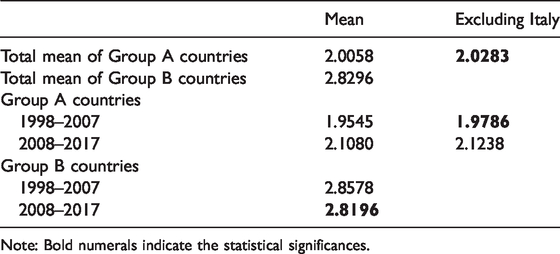
Note: Bold numerals indicate the statistical significances.
A descriptive analysis of features that may indicate the level of media corruption in Group A countries shows that the critical approach of print/broadcast media is the only one that differentiates when Italy is added into the sample (Tables 2 and 3). As Table 3 indicates, a critical approach of print/broadcast media towards the government seems to increase when Italy is excluded from the group data measurement. Additionally, media self-censorship is also important, as shown by the descriptive analysis. As Tables 2 and 3 indicate, when Italy is excluded from the group data analysis, media self-censorship means seem to significantly increase.
Descriptive findings (Greece, Italy, Ireland, Spain, Portugal and Cyprus – Group A countries) for all years.
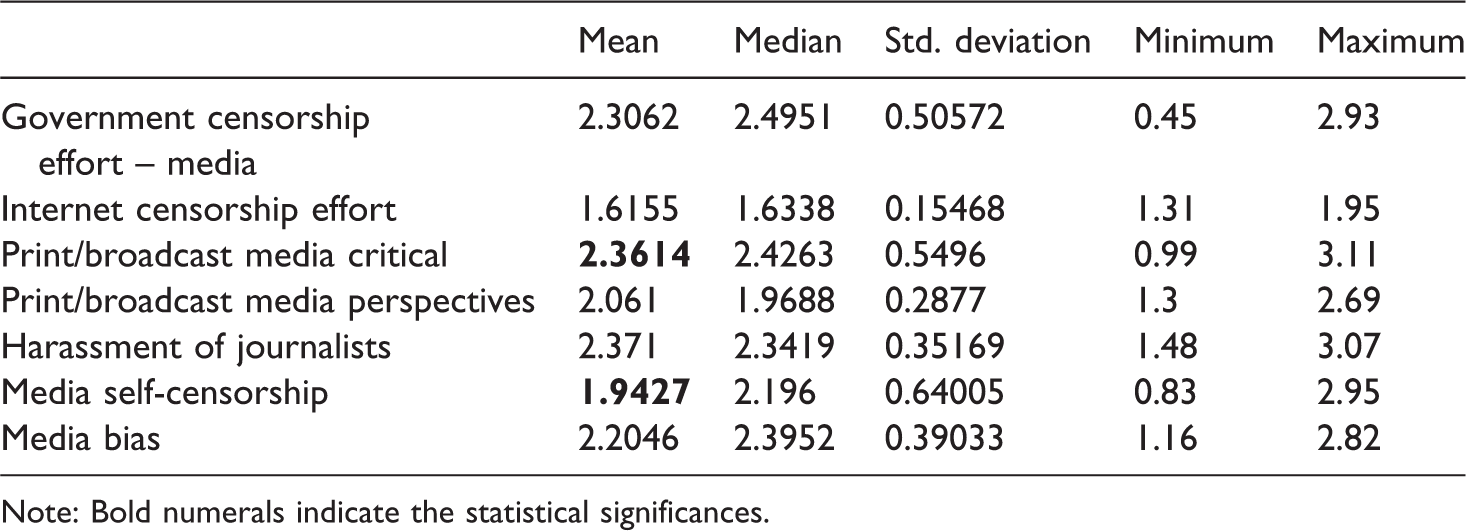
Note: Bold numerals indicate the statistical significances.
Descriptive findings (Greece, Ireland, Spain, Portugal and Cyprus – Group A countries excluding Italy) for all years.
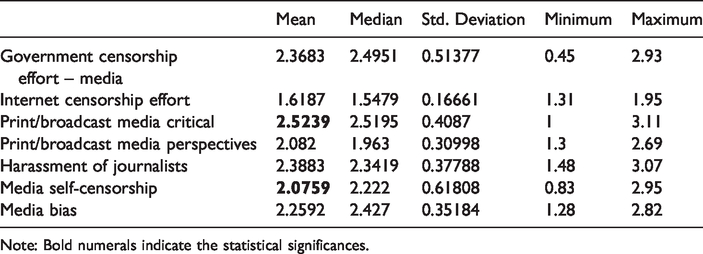
Note: Bold numerals indicate the statistical significances.
Regarding the descriptive analysis for Group B countries, the findings of the study indicate that almost all variables that may affect media corruption seem to present higher levels than those of Group A countries, as Table 4 shows. To this end, the most important differences are observed in the variables ‘government censorship effort towards the media’ (2.30 in Group A, 2.78 in Group B), ‘harassment of journalists’ (2.37 in Group A, 2.84 in Group B) and ‘media bias’ (2.20 in Group A, 2.34 in Group B). These findings show that Group B countries are faced with a higher level of features indicating media corruption.
Descriptive findings (Germany, UK, Netherlands, France and Sweden – Group B countries) for all years.
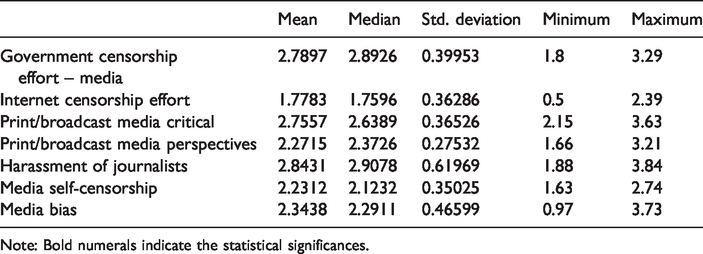
Note: Bold numerals indicate the statistical significances.
Media corruption in Europe before and after the economic crisis
In order to test and thoroughly examine the descriptive findings, a t-test for comparison of the means between the two Groups was conducted. As shown in Table 5 (columns 2 and 3), the t-test analysis verified that the most important variables that present statistically significant differences between the two groups of countries are ‘government censorship effort towards the media’ (p = 0), ‘internet censorship effort’ (p = 0), ‘print/broadcast media critical attitude’ (p = 0), ‘media self-censorship’ (p = 0), ‘media bias’ (p = .008) and ‘harassment of journalists’ (p = 0).
T-test of all countries for all years.
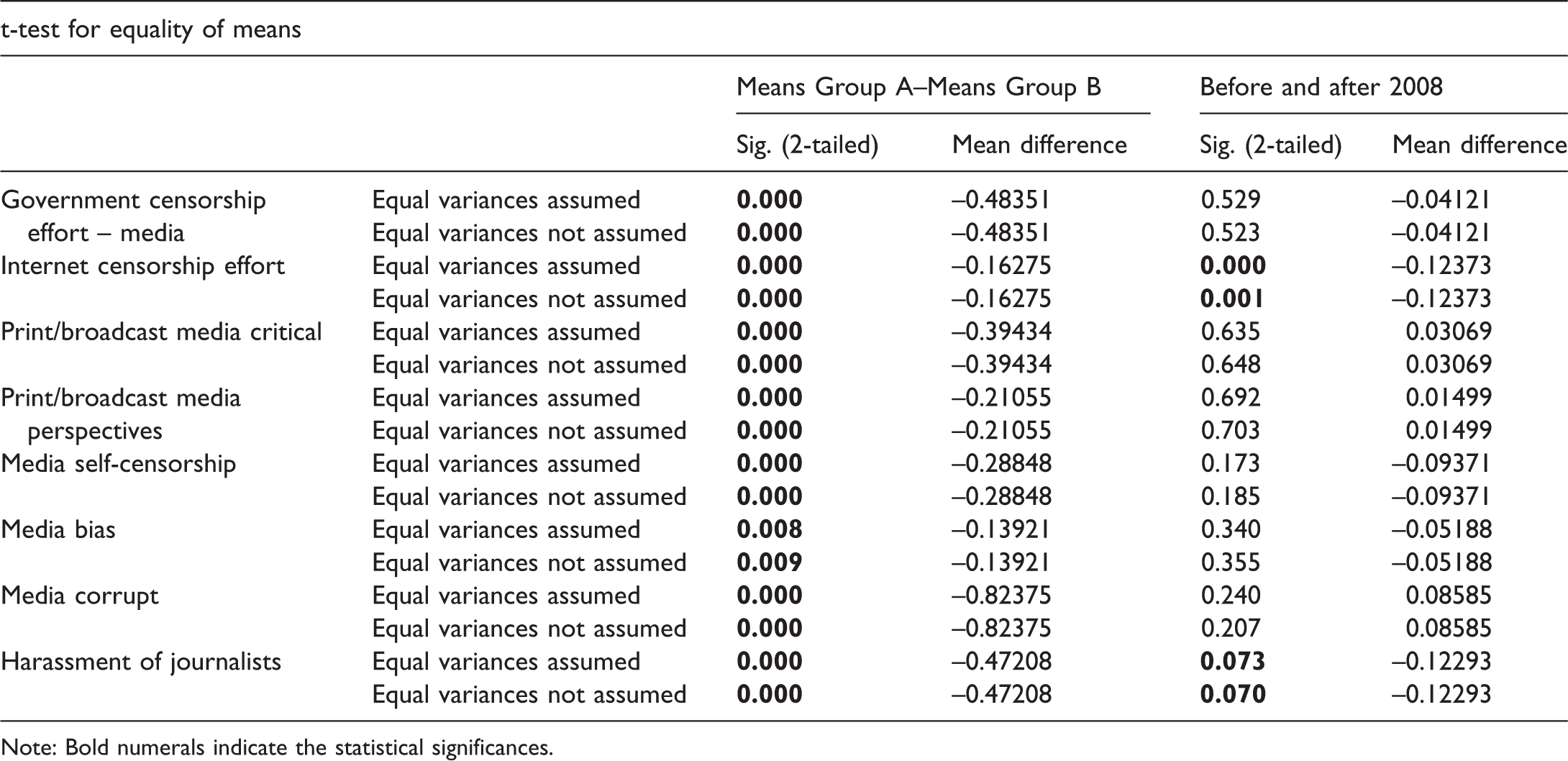
Note: Bold numerals indicate the statistical significances.
In order to test whether the above mentioned findings present any statistical differences before and after the onset of the economic crisis, a second t-test was conducted for the years before and after 2009. As Table 5 also shows (columns 4 and 5), for all countries, after the onset of the economic crisis, the most significant variables indicating media corruption are ‘internet censorship effort’ (p = 0), and ‘harassment of journalists’ (p = .07).
A t-test analysis was further used to examine the most important features indicating media corruption in Group A and B countries, before and after 2009. As Table 6 clearly shows, the significant features that differentiate before and after the crisis for the countries of the ‘poor’ South (columns 2 and 3) seem to be ‘internet censorship effort’ (p = .004), ‘media bias’ (p = .011), and ‘harassment of journalists’ (p = .043). The t-test analysis for Group B countries before and after 2009 yielded statistically significant differences only for the variable ‘internet censorship effort’ (p = .007) as shown in Table 6 (columns 4 and 5). These results indicate that no specific differences can be identified in the countries of the ‘rich’ North regarding features of media corruption before and after the onset of the economic crisis.
T-test for the years before and after 2008 for countries of Group A and Group B.
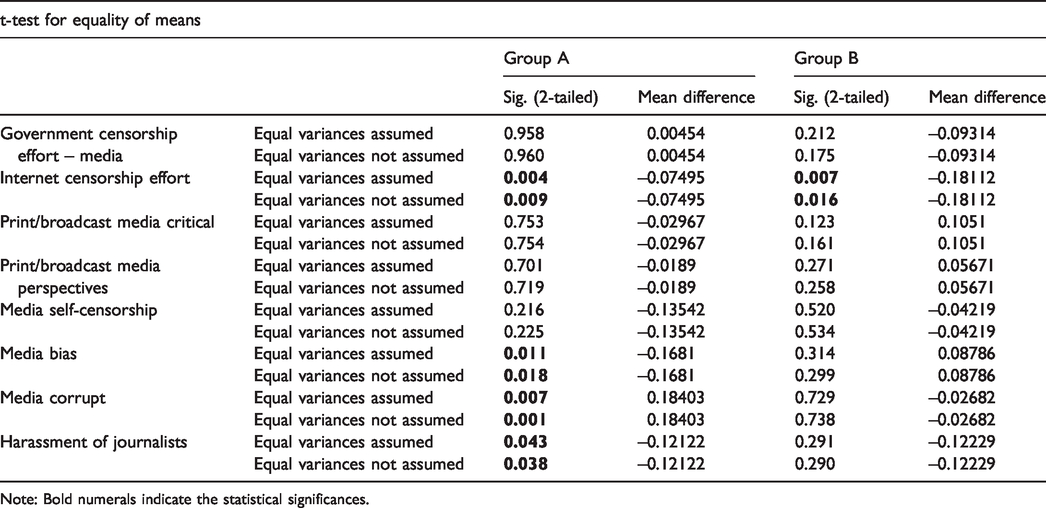
Note: Bold numerals indicate the statistical significances.
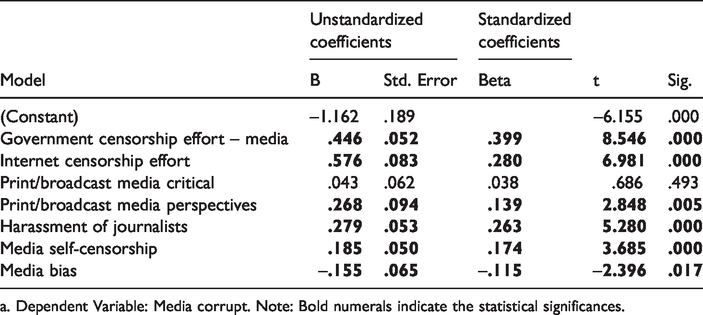
The final statistical analysis included a regression estimation for all countries. Table 7 shows that for both groups, the important features indicating media corruption between the years 1993-2017 are ‘government censorship efforts’ (p = 0), ‘internet censorship efforts’ (p = 0), ‘print/broadcast media perspectives’ (p = .005), ‘harassment of journalists’ (p = 0), ‘media self-censorship’ (p = 0) and ‘media bias’ (p = .017).
Regression analysis for all countries.
a. Dependent Variable: Media corrupt. Note: Bold numerals indicate the statistical significances.
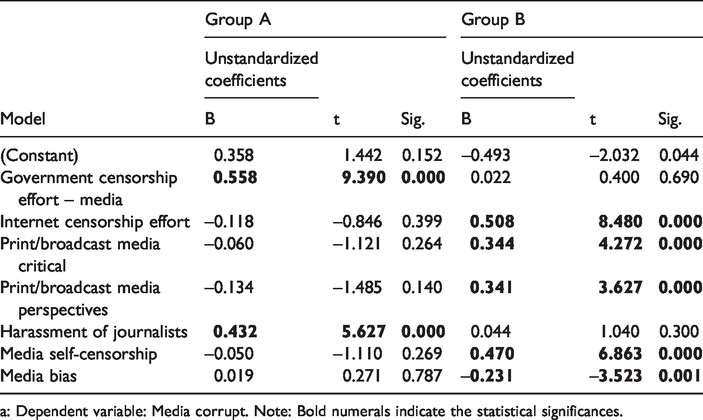
However, a further regression analysis shows that the above mentioned variables present important differences between Group A and Group B countries. As Table 8 indicates, for the countries of the South in Europe, media corruption is mainly indicated by ‘government censorship effort’ (p = 0), and ‘harassment of journalists’ (p = 0).
Regression analysis for countries of Group A and Group B.
a: Dependent variable: Media corrupt. Note: Bold numerals indicate the statistical significances.
Media corruption in the North of Europe seems to be mainly indicated by different features. As Table 8 shows, all variables appear to be statistically significant with the exception of ‘government censorship efforts’ and ‘harassment of journalists’ (p > .05), the two features that indicate media corruption in Group A countries.
Discussion
Although indications of media corruption might be expected to occur more often in countries with economic problems (Odugbemi and Norris, 2010), this study shows that levels of media corruption are higher in the European North than in the countries of the European South for the whole time period studied (1993–2017). This is a highly significant outcome of the analysis, since countries of the European South were mainly affected by the economic crisis and, as such, indicators of media corruption were expected to increase, following the increased levels of overall corruption in the broader area.
Surprisingly enough, the European South presented lower levels of media corruption than the North even before the economic crisis. In addition, after the onset of the crisis, media corruption remained almost at the same levels in the North while it rose significantly in the South. Both the descriptive statistics and the t-test (before and after 2009) show that media corruption did not experience much change in the North (with respect to the mean). The mean value was 2.83 before 2009 and 2.76 after. Also the t-test suggests no significant differences in the mean of media corruption before and after 2009 (significance levels of the test are 0.729 and 0.738).
The interesting finding is that the exclusion of Italy, a typical example of a European country with historically high levels of media corruption, resulted in higher levels of indications regarding media corruption for the South before the crisis based on the descriptive statistics analysis.
Regarding the features that reflect media corruption in Europe, the most important ones appear to be ‘government censorship effort towards the media’, ‘internet censorship effort’, ‘print/broadcast media critical attitude’, ‘media self-censorship’, ‘media bias’ and ‘harassment of journalists’. As expected, these features were highly affected by the economic crisis and, as such, after its onset, only ‘internet censorship effort’, remained an important indicator of media corruption.
Regarding the countries of the European South, important differences before and after the economic crisis were observed in ‘internet censorship effort’, ‘media bias’ and ‘harassment of journalists’. On the other hand, the analysis for the European North before and after 2009 yielded statistically significant differences for ‘internet censorship effort’ indicating that no specific differences can be identified in the countries of the North regarding media corruption before and after the onset of the crisis.
After the crisis, while in the South differences regarding indicators of media corruption were observed only in ‘government censorship effort’, ‘print/broadcast media perspectives’, ‘harassment of journalists’ and ‘media self-censorship’, in the North all variables tested appear to be statistically significant with the exception of ‘government censorship efforts’.
Regarding the first hypothesis, t-tests show that the mean levels of corruption do experience significant differences between the two groups of countries. Comparative analysis suggests though that the levels of media corruption are higher in the North for the period under investigation. Additionally, after the onset of the crisis, media corruption remained almost at the same level in the North, while it rose significantly in the South. Even so, the mean levels of media corruption still remain higher in the North countries group.
As far as the second hypothesis is concerned, a regression analysis shows that there is an increase/decrease in features indicating media corruption between the South and the North of Europe. Based on this, we can argue that there are differences in features/indications of corruption in the European media systems but they do not depend solely on the state of the economy in every national media system. While during the Great Recession, features/indications of media corruption seem to have significantly risen in countries of the South, in countries of the North levels of media corruption remained at a higher level despite the wealthier state of these countries’ economies.
Conclusions
Based on these findings, we can conclude that, while media systems in the North of Europe seem more eager to fight corruption, they themselves appear to be far less immune to it. That is not to argue that media corruption in the South has decreased in recent years; indeed, its features tend to rise in accordance with discrepancies provoked by the economic crisis. This study shows that media corruption overall is a phenomenon whose level is related more to the distinctive features of the national media system, among other factors, than to the state of the economy in which this system operates.
Moreover, this study indicates that defining media corruption only in terms of public office for private gain seems to be a rather vague and restricted approach in recent years. A series of other features, such as bias and self-censorship, efforts to control the media, lack of pluralism and their limited potential to criticise the government (or other power groups) also point towards increased levels of corruption and, consequently, to less trust towards the media (although this characteristic also needs further investigation in order to safely argue for a relationship between corruption and trust after the Great Recession).
Although features/indications of media corruption and their level of manifestation may vary among different countries and their respective media systems, it is a reality (although not always immediately evident) not only in weak states but also – and perhaps even more so – in stronger ones. The negative political connotation accompanying the segregation between the North and the South in Europe offers a helpful example in this argument. Countries in the South of Europe, although expected to present increased levels of corruption due to the political implications of the economic crisis after 2007, overall proved to be more immune to it than their stronger counterparts in the North. We need to re-examine the central thesis regarding corruption and its potential to rise in parallel with economic crises around the world. Moreover, corruption in the media sector can no longer be perceived as a core characteristic only of economically weaker states; there is a significant need to further investigate its correlation to other social and political dimensions.
Footnotes
Declaration of Conflicting Interests
The author(s) declared no potential conflicts of interest with respect to the research, authorship, and/or publication of this article.
Funding
The author(s) received no financial support for the research, authorship, and/or publication of this article.
