







Abstract
This study conducted a content analysis of 442 television advertisements from Hong Kong, Japan, and South Korea to determine their representations of ‘Others’. Findings reveal that in East Asian advertisements, Others are overrepresented, mostly non-celebrities, and depicted in major roles, which is in contrast to previous studies in the United States where ‘Others’ are generally shown in minor or background roles. The results also reveal that Others are predominantly white, demonstrating the importance of whites in these societies and representing some type of racial/ethnic hierarchy. However, Others are also depicted as separate from the majority population. For example, they are usually depicted abroad rather than in a local setting, and they rarely interact with the local population, which sends a message of exclusion and might lead to the conclusion that they do not belong to their respective location. Possible effects and practice implications of these findings are discussed.
This article provides a new perspective on representations of ‘Others’ 1 in television advertisements and shows that taken-for-granted assumptions about representations (such as the under- and misrepresentation of minorities) might not be applicable in a different cultural context. Thus, this article is an excellent starting point for rethinking what we know about such representations and for creating a universally applicable theory about the representation of Others in advertising and other media. Research on representations of ‘Others’ has predominantly analyzed advertising in the United States (Coltrane and Messineo, 2000; Mastro and Stern, 2003), but few studies have analyzed advertisements in other parts of the world, including East Asia (Hagiwara, 2004; Prieler, 2010, 2012). However, to better understand the overall workings of representations and to develop universally applicable theories, research in different countries is necessary (for further discussion, see Esser and Hanitzsch, 2012). The East Asian context is of special interest for such an analysis because in most studies on Others, non-whites are analyzed; in this study the roles are reversed, which will reveal whether there are global patterns in the representation of Others and the implications this might have for advertising.
In addition, representations of Others are also an important social concern because they indicate the value of Others in society (Harwood and Anderson, 2002) and potentially teach this information to the audience (Bandura, 2009), which can have real life consequences. In fact, research has shown that media representations affect the way Others are perceived by themselves and others (Mastro et al., 2008; Tukachinsky et al., 2017). These representations are becoming even more pressing issues in East Asia, due to demographic changes. While only about 2% of the residents in Japan and South Korea, and 6% of the residents of Hong Kong, were from other races/ethnicities at the time the study was conducted, this number is rapidly increasing. For example, this percentage is expected to increase to 10% in South Korea by 2050 (Korea Times, 2011). Such changes make the analysis of representations of Others in the East Asian context even more important.
Several theories are relevant when analyzing Others in television advertisements. Some of these theories state that advertising reflects society and culture (Frith and Mueller, 2010), such as ethnolinguistic vitality theory (Giles et al., 1977). Ethnolinguistic vitality theory analyzes a group’s importance in society based on status, demographics, and institutional support, which includes the group’s representation in the media. Thus, media representations can indicate a group’s value and respect in society, but are only one way to evaluate a group’s strength. Frequent and positive representations indicate a group’s vitality, strength, and influence in society. In contrast, negative and rare representations indicate the group’s lack of influence (Abrams et al., 2003; Harwood and Anderson, 2002). Ethnolinguistic vitality theory claims that media representations can be analyzed for understanding the role and influence a social group has in society.
Analyzing representations of Others is also important because of possible effects of advertisements (Pollay, 1986). Content analysis is an important first step in understanding the possible impact of the media (Riffe et al., 2019). Two theories that help us understand the possible effects of advertising are social cognitive theory and cultivation theory. Social cognitive theory (Bandura, 2009) states that learning can occur not only in direct ways, but also through vicarious observations, such as watching television. People learn their behaviors using observations of, for example, how racial and ethnic groups are represented and also members of a particular race/ethnicity may learn about appropriate behavior and roles for their respective race/ethnicity. Cultivation theory (Gerbner, 1998) claims that television and other media creates often-distorted views of reality, particularly among heavy viewers, which may lead to changes of behavior, norms, and values that are consistent with those provided on television. For example, those who watch a lot of television may believe that blacks comprise a large number of criminals because they often see criminals on television who are black (Dixon and Linz, 2000). Subsequently, the audience may gain negative feelings about this group. In conclusion, both theories emphasize the social influence of media images and were confirmed by previous research showing that media influence how Others perceive themselves and how they are perceived by others (Mastro et al., 2008; Sakuma and Hiyoshi, 2016; Tan et al., 2010; Tukachinsky et al., 2017).
Literature review
Based on the vast amount of literature on the representation of race and ethnicity in television advertising, the following review will mostly focus on recent research and studies in East Asia. While there have been some studies on Japan (Hagiwara, 2004; Hiyoshi, 2001; Kozakai, 1996; Prieler, 2010), there have been only few on South Korea (Prieler, 2012) and China, and none on all three places.
Numerical representation
Numerical representation might indicate the importance of a social group within society. Such representations can affect knowledge and perceptions of these groups, for example, the number of people of a social group might be underestimated if the number of races/ethnicities in disproportionately low on television (Gerbner, 1998). While researchers have studied the numerical representation of races/ethnicities in television advertisements, only few studies in the United States have conducted research on multiple racial/ethnic groups. One such example is Coltrane and Messineo (2000) who found a dominance of white characters (86%), followed by black (11%), Asian American (2%), and Latino characters (1%). Mastro and Stern (2003) reported similar results finding 83.3% white, 12.4% black, 2.3% Asian, 1.0% Latino, and 0.4% Native American. This representation was similar to the demographic reality of the United States except for the clear underrepresentation of Latinos. However, other studies found an overrepresentation of some groups – for example, Licata and Biswas (1993) found 35.2% of ads included blacks, while Bristor et al. (1995) found that 45.2% of ads included blacks.
However, this article focuses on the racial/ethnic representations in East Asia television advertisements.” A study on Japan has found that 15% or more of TV ads included Others (18.6% in 2003; 15.0% in 1993) (Hagiwara, 2004). Representations of whites dominated (72.9% in 2003; 78.0% in 1993), followed by East Asians (10.6% in 2003; 9.3% in 1993), and black people (3.7% in 2003; 3.2% in 1993); approximately 10% of ads included other races/ethnicities in both years. Hiyoshi (2001) discovered that 21.2% were foreigners in 2000 (14.6% in 1995). Within these foreigners, again the majority were whites (70.6% in 2000; 64.1% in 1995), followed by blacks (5.8% in 2000; 6.4% in 1995), and Asians (10.3% in 2000; 19.8% in 1995). Research on South Korea found similar results (Prieler, 2012). 17.5% of TV ads included foreigners, which were dominated by whites (80.0%), followed by blacks (7.7%), and East Asians (1.5%) – 10.8% included multiple racial groups. Thus, Others (especially white Others) were clearly overrepresented in South Korea and Japanese television advertisements when considering that only approximately 2% of the population are racial/ethnic Others in these countries and these individuals are mostly of Asian descent. Despite a clear tendency in the results in Japan and South Korea, we formulate a research question based on the scarcity of research in South Korea and China:
Relationships between ‘Others’ and different variables.

aProduct categories ‘Computer/Information/Communications’ and ‘Travels/Hotels’ were collapsed into the category ‘other’ due to low numbers.
Gender, celebrities, and role
Numerous studies have been conducted on gender representation (Eisend, 2010; Furnham and Paltzer, 2010). Coltrane and Messineo (2000) revealed gender differences in representations of racial groups in the United States where Asians and Hispanics were predominantly women and whites and blacks were predominantly men. Similarly, Licata and Biswas (1993) reported that blacks were predominantly men. By contrast, Taylor and Stern (1997) found more men than women for all minority groups. Mastro and Stern (2003) also reported that there were more men represented in all racial/ethnic groups except Latinos. In contrast, some studies on Japan found equal gender distribution of Others (Kozakai, 1996), while other studies found that blacks were mostly men (Hagiwara, 2004), and whites and blacks men and Asian women (Hiyoshi, 2001). In South Korea, most Others were men (60.0%), while substantially fewer were women (12.3%), and a few ads included Others of both genders (27.7%) (Prieler, 2012). Based on these findings, we formulate the following research question:
Racial/ethnic interaction, setting, and product category
Interaction between people can provide additional information about what is expected from people within society. Similarly to the type of roles, being depicted alone or with other groups may indicate the perceived value of people. In a study in the United States, Maher et al. (2008) reported that whites and Asians appeared mostly without another ethnic group; in contrast, Hispanics and blacks mostly appeared with other ethnic groups. Similarly, Stevenson and Swayne (1999) reported that blacks were mostly shown separately from whites (63%) in business-to-business direct mail photos. Research on Japan found that Others did not interact with Japanese (72.7% in 2003; 80.0% in 1993) (Hagiwara, 2004). Similarly, research on South Korea (Prieler, 2012) reported that 64.6% of Others were shown alone, 21.5% with other racial/ethnic Others, and only 13.8% interacted with Koreans. Thus, we formulate the following research question:
Setting is a popular category of analysis in content analysis (Furnham and Mak, 1999). The representation of Others in settings can communicate to the audience that the lives of Others are limited to certain settings and associated activities. A study in the United States reported that Asians were depicted at work, whites at home, and Latinos mostly outdoors (Mastro and Stern, 2003). In South Korea (Prieler, 2012), Others were mostly found in outdoor settings (46.2%), followed by the home setting (27.7%). In Japan, Hagiwara (2004) did not analyze the setting in which Others are shown except to determine whether it was foreign. Following Hagiwara’s research and realizing that interpreting traditional settings (home, workplace, outside, etc.) in the context of Others is not that meaningful, this study decided to analyze the setting in a different way. It investigated whether Others were shown in the respective East Asian place or abroad, possibly indicating the place to which they belong. Thus, we formulate the following research question:
Method
We have recorded a one week sample in Hong Kong, Japan, and South Korea in April, 2012. We have decided to record only prime time television, since this time slot is the most watched period and thus potentially most learned from. After investigating the definitions of prime time in the three cultures, the recording time was determined as from 7:00 p.m. to 11:00 p.m. The recordings were divided into one-hour blocks, and the television channels were randomly assigned to these time slots to produce a representative sample (Cheng, 1997). In Hong Kong, we recorded only TVB Jade (market share: 55.8%), since a pretest showed that the second major station, ATV Home, resulted in only five ads during a 12-hour coding test. In Japan, we recorded all main commercial television stations: Fuji TV (market share: 18.7% in 2009), NTV (18.6%), TV Asahi (16.9%), TBS (14.6%), and TV Tokyo (7.0%). In South Korea, we recorded the three main commercial television stations that broadcast television advertisements: KBS 2 (12.2%), MBC (11.6%), and SBS (11.2%) (WARC, 2012). Duplications were not controlled because repeated viewings of the same advertisement represents the reality of television viewing and repetition is a major aspect of the learning process as stated by social cognitive theory (Bandura, 2009). Following these steps led to 709 television advertisements in Hong Kong, 775 in Japan, and 550 in South Korea. Of these advertisements, 195 included other races/ethnicities in Hong Kong, 115 in Japan, and 132 in South Korea. These groups served as our samples.
Our research included three bilingual student pairs from each studied culture and did not include any researchers. Coders were trained on the coding manual for approximately ten hours and were blind to the hypotheses. One author supervised the coder training in all three societies and the coding manual was developed using comments from all participants. Intercoder reliability coefficients were measured by Krippendorff's alpha coefficient (Krippendorff, 2018). After the coders finished a pilot test consisting of 50 television advertisements that were not included in the final sample and reached a reliability of above α = .80 for each reported variable, they began coding the sample independently (see also Prieler et al., 2017). All variables in the final sample had alpha values above .70, which is regarded as sufficient (Hayes, 2005).
Variables
The variables used in this study were developed based on a large-scale literature review from a previous work (Prieler, 2012). These variables include the race/ethnicity of the Others, their gender, whether they are celebrities, their importance (role) in the advertisement, their interaction with people of the majority race/ethnicity, the place in which they are shown, and the product category for which they are advertising.
Race/Ethnicity. When appearing in an advertisement, the characters’ race/ethnicity was coded as (1) white, (2) black, (3) East Asian (but non-Korean/non-Japanese/non-Chinese, depending on the country in which the advertisement was broadcast), (4) other, or (5) multiple races/ethnicities (i.e., more than one race/ethnicity appeared in an advertisement).
Gender. Gender was coded as (1) men, (2) women, or (3) both (men and women).
Celebrity. A celebrity is a person who is recognized in a society or culture, such as sports stars, actors, singers, or television personalities. Coders do not need to remember the name of the celebrity, however, coders should be sure that they recognize the person. This study distinguished between advertisements where (0) the Other is not a celebrity, (1) the Other is a celebrity, and (2) both (the advertisement includes an Other who is a celebrity and one who is a non-celebrity).
Role. The role of Others was divided into a (1) major role, (2) a minor role, and (3) a background role. In the case more than one Other was depicted, the most prominent role was coded. A character with a major role is very important to the advertisement, typically speaking, and often depicted in the foreground or holding the product for at least five seconds. A character with a minor role is generally not difficult to find during the casual viewing of the ad, has minimal speaking role, and is present for more than two seconds at one time or several times throughout the advertisement. A character with a background role is unlikely to get noticed during a casual viewing of the advertisement, does not speak, and could easily be replaced by virtually any other person (Prieler et al., 2017).
Racial/Ethnic Interaction. Racial/Ethnic interaction was defined as the interaction between/among characters of different races/ethnicities. Interaction was coded when people were in the same shot and their faces were visible. Forms of interaction include speaking, playing together, eye contact, dancing the same dance, etc. This study differentiated between advertisements with a (1) single Other (alone), (2) not mixed, i.e., either Others only or Others and the majority race/ethnicity (Chinese, Japanese, Korean) but with no interaction taking place, and (3) mixed (Others and the majority race/ethnicity are interacting).
Setting. Settings were divided into (1) abroad, (2) home (i.e., Hong Kong/Japan/Korea), (3) other (i.e., unclear, artificial, etc.). If several settings appeared, the most prominent one was coded.
Product Category. Based on a pilot test in Hong Kong, Japan, and South Korea, 18 categories were selected for this study: (1) body care/toiletries/cosmetics/beauty products, (2) pharmaceuticals/health care products/medicine/food supplements, (3) household cleaning products/kitchenware, (4) non-alcoholic drinks, (5) alcoholic drinks, (6) foods/snacks, (7) restaurants/coffee shops, (8) retail outlets, (9) household appliances (except entertainment)/furniture/interior, (10) home entertainment, (11) mobile phones/providers, (12) computer/information/communications (not including mobile phones), (13) real estate/housing, (14) automotive/vehicles/transportation/accessories, (15) finance/insurance/legal, (16) travel/hotels, (17) fashion/clothing/accessories, and (18) other.
Results
Numerical representation
Analyzing the numerical representation of Others in Hong Kong, Japan, and South Korea revealed that 27.5% of television advertisements in Hong Kong included Others, 14.8% in Japan, and 24.0% in South Korea (Table 1). RQ1a asked more specifically which Others are dominant within East Asian television advertisements. Whites clearly dominated in all three samples (65.6% in Hong Kong, 62.6% in Japan, 51.5% in South Korea). This was followed by East Asian people who were not from the respective locality (11.8% in Hong Kong, 24.3% in Japan, 6.8% in South Korea), blacks (3.6% in Hong Kong, 4.3% in Japan, 5.3% in South Korea), and a few other racial/ethnic groups who were represented in Japan (1.7%) and South Korea (3.0%). Finally, several ads included multiple races/ethnicities (19.0% in Hong Kong, 7.0% in Japan, 33.3% in South Korea). RQ1b asked whether Others in East Asian advertisements are under- or overrepresented compared to demographic reality. Based on the fact that approximately 2% of the population in South Korea and Japan and 6% in Hong Kong were Others (predominantly from other Asian countries) at the time of the recordings, all Others were overrepresented in television advertisements; this was especially true in the case of whites.
Gender, celebrities, and role
RQ2 asked whether there is a predominance of men or women among Others in East Asian television advertisements. This question led to mixed results. While there were more women than men shown alone in Hong Kong (30.3% vs. 19.5%) and Japan (33.9% vs. 26.1%), there were more men than women in South Korea (28.8% vs. 9.1%). However, approximately half of all ads with Others included both men and women (Hong Kong: 50.3%, Japan: 40.0%, South Korea: 62.1%). We have not further broken down the results by race/ethnicity here or in the following because (except for whites) there were extremely few Others.
RQ3 asked whether Others are predominantly celebrities or non-celebrities in East Asian television advertisements. The findings were consistent for all three samples: Non-celebrities dominated in Hong Kong (77.9% vs. 16.4%), Japan (63.5% vs. 33.0%), and South Korea (78.0% vs. 15.2%). In a few ads, celebrity and non-celebrity Others appeared together (Hong Kong: 5.6%, Japan: 3.5%, South Korea: 6.8%).
RQ4 asked whether Others predominantly appear in major, minor, or background roles in East Asian television advertisements. In all three samples, the situation was similar with the majority of Others being depicted in major roles (Hong Kong: 69.2%, Japan: 62.6%, South Korea: 55.3%), followed by minor roles (Hong Kong: 30.8%, Japan: 35.7%, South Korea: 19.7%), and background roles, which occurred more often in South Korea (25.0%) than in Hong Kong (0.0%) and Japan (1.7%).
Racial/ethnic interaction, setting, and product category
RQ5 asked whether Others predominantly appear with the majority group (i.e., Chinese, Japanese, South Korean), with other racial/ethnic Others, or alone in East Asian television advertisements. In all samples, Others interacted less with the respective majority group (Hong Kong: 34.4%, Japan: 38.3%, South Korea: 41.7%) than being represented alone (Hong Kong: 34.4%, Japan: 23.5%, South Korea: 8.3%) or with other racial/ethnic Others (Hong Kong: 31.3%, Japan: 38.3%, South Korea: 50.0%).
RQ6 asked in which setting the highest number of Others appear in East Asian television advertisements. In all three samples, Others were predominantly represented abroad (Hong Kong: 70.3%, Japan: 45.2%, South Korea: 82.6%). This was followed by other settings such as those that were unclear or artificial backgrounds (Hong Kong 21.0%, Japan: 33.9%, South Korea: 0.8%) and then in their respective location, i.e., in Hong Kong (8.7%), Japan (20.9%), or South Korea (16.7%).
RQ7 asked which product categories Others predominantly advertise in East Asian television advertisements. No clear pattern emerged for all three samples. However, Others predominantly advertised for body care/toiletries/cosmetics/beauty products in Hong Kong (29.7%) and Japan (26.1%), but not in South Korea (3.0%). The same was true for foods/snacks (Hong Kong: 22.1%; Japan: 16.5%; South Korea: 0.0%). Other strong categories were finance/insurance/legal in Hong Kong (9.7%), which was also true in South Korea (31.1%). In Japan, non-alcoholic drinks (11.3%) and cleaning products/kitchenware (8.7%) were also strongly advertised. In South Korea, automotive/vehicles/transportation/accessories (15.9%) and mobile phones/providers (10.6%) were product categories heavily advertised by Others. However, since these percentages do not reveal anything about the importance of Others within a product category and the product categories that Others advertise may also be the strongest ones in the whole sample, we also analyzed the percentages of Others within each product category (Table 2). Here again, no clear pattern emerged, but in Hong Kong, several product categories included a large number of Others: mobile phones/providers (100%), fashion/clothing/accessories (72.7%), alcoholic drinks (71.4%), home entertainment (66.7%), travels/hotels (42.9%), finance/insurance/legal (34.5%), and foods/snacks (30.5%). In Japan, mobile phones/providers (36.4%), travels/hotels (33.3%), and fashion/clothing/accessories (38.1%) were also strong. In South Korea, the following categories had a larger percentage of Others: computer/information/communication (100%), real estate/housing (66.7%), automotive/vehicles/transportation/accessories (51.2%), home entertainment (50.0%), finance/insurance/legal (39.4%), household appliances/furniture/interior (37.5%), and cleaning products/kitchenware (33.3%).
Percentage of ‘Others’ within each product category.
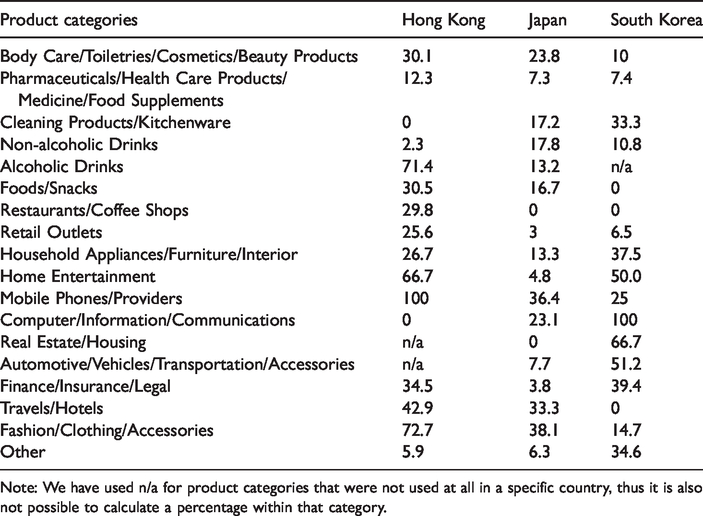
Note: We have used n/a for product categories that were not used at all in a specific country, thus it is also not possible to calculate a percentage within that category.
Discussion and conclusion
Numerical representation
East Asian television advertisements used a substantial number of Others. When considering that only approximately 6% were Others in Hong Kong (while accounting for 27.5% in TV ads) and approximately 2% in Japan (14.8% in TV ads) and South Korea (24.0% in TV ads) at the time of the recordings, Others were overrepresented in all three samples. Within Others, it was whites who clearly dominated, being represented more often than all other racial/ethnic Others together. Such representations clearly indicate the importance and value of Others (particularly whites) in these three societies, as indicated by ethnolinguistic vitality theory (Abrams et al., 2003; Harwood and Anderson, 2002). Previous research on South Korea and Japan has found similar results (Hagiwara, 2004; Prieler, 2012).
It is striking that Others (particularly whites) are so often represented in television advertising, even though they are essentially absent from East Asian societies. There might be different reasons for this phenomenon, including the fact that whites are the standard of beauty in many Asian countries (Murray and Price, 2011; Russell, 2017; Schekendiek et al., 2013), which might be connected with the overall influence of Western media and the predominance of Western models. Such a Westernization of beauty ideals can be seen in several Asian countries, including in Hong Kong (Murray and Price, 2011), Japan (Russell, 2017), and South Korea (Schekendiek et al., 2013). In the context of Japan, several scholars argued that Caucasian beauty is so normalized that Japanese do not want to look more Caucasian but instead want to follow what they perceive to be a universal norm of physical attractiveness, which is not perceived as Caucasian anymore (for a summary, see Russell, 2017). Thus, ‘Japanese aspiration toward caucasian physical characteristics is only obliquely presented as such; instead it is couched in terms of transcendent, deracialized, universal (though implicitly western) norms of beauty, sophistication, and cosmopolitanism’ (Russell, 2017: 25). These associations might be related to the fact that whites are predominant in an artificial ‘racial/ethnic hierarchy’ adopted from the West (Cha et al., 2016; Prieler, 2010; Russell, 2017; Sugimoto, 2014) – a hierarchy that is similar to the one represented in East Asian television advertisements, in which whites are greatly overrepresented.
Although numerical representation may indicate importance to some degree, what is more important is the actual portrayal of the various social groups, since the high usage of stereotypical or negative representations of social groups might even have negative consequences. For example, research conducted in the United States reported that while the numerical representation of blacks was similar to the proportion of the actual population, television advertisements nevertheless depicted racism (Bristor et al., 1995). Similarly, a study in Japan showed that despite the overrepresentation of white people, they were depicted in rather stereotypical and negative ways (Prieler, 2010).
Gender, celebrities, and role
An important question is whether Others are associated with a specific gender. For example, previous research has revealed that in advertising, more whites and blacks were men in the United States, while more Asians and Hispanics were women (Coltrane and Messineo, 2000; Licata and Biswas, 1993). These findings were partly replicated in a study on Japan (Hiyoshi, 2001). Although we were not able to differentiate gender predominance using the various racial/ethnic groups (based on small numbers of non-white Others), our study has demonstrated that in South Korea, male Others were more often depicted than female ones. This is in line with studies on male whiteness (and the majority of Others in our sample are whites) and a previous study on South Korea (Prieler, 2012). By contrast, more female than male Others were depicted in Japan and Hong Kong. These gender differences reflect research that showed that most biracial whites in Japan are biracial female fashion models and entertainers, whereas the most popular biracial whites in Korea are men with a Western parent (Ahn, 2018). There might also be more practical reasons at work, namely, that in Japan and Hong Kong, advertisements for beauty products are dominant, and these advertisements mostly feature women, but this was not the case in South Korea. Whatever the exact reasons, the audience might also learn which gender among a specific race/ethnicity is more valued by a society (Abrams et al., 2003; Harwood and Anderson, 2002) and potentially learn from such associations of gender and race/ethnicity. For example, they might favor a particular gender within a racial/ethnic group based on what they learn from watching media as suggested by social cognitive theory (Bandura, 2009). That is, based on what they learned in advertising, South Korean audiences might value white men more than women, while white women might be more valued in Japan and Hong Kong at least in some contexts, such as in the area of beauty. In other words, media communicate the value of different groups and the audience learns from that, which can also have an influence in real life when encountering these groups. This might lead, for example, to a preference for white male English teachers in Korea and white female models in Japan and Hong Kong.
Previous studies have revealed that celebrities are important in East Asian advertisements with figures of 50% or more in South Korea and Japan (Choi et al., 2005; Hagiwara et al., 2009; Lee and Choi, 2012; Praet, 2009). In contrast to these findings, celebrities played only a small role among Others in all three advertising samples in which non-celebrities clearly dominated. This finding is in accordance with previous research on South Korea and Japan, which only showed scant usage of celebrities among Others (Mueller, 1992; Prieler, 2012) and indicated that celebrities are generally only strongly used when they are Chinese, Japanese, or Korean models. It might simply be too expensive to use a large number of (international) celebrities in television advertisements. However, this result also shows that Others have enough value to be shown in advertisements even when they are non-celebrities.
As mentioned, the number of people represented is not a perfect indicator of social importance. The role Others are represented may be a better indicator of the perceived importance. In this study, Others were mostly represented in major roles. Depicting whites predominantly in major roles is in accordance with the literature in the United States (Coltrane and Messineo, 2000; Taylor and Stern, 1997) as well as Japan and South Korea (Hagiwara, 2004; Prieler, 2012), which also depicted the majority of Others (who were also predominantly white) in major roles. Such a finding might indicate the perceived social value of Others in East Asia, and remembering that the majority of the sample were white people, this argument is especially true for that group. One reason why the majority of Others are depicted in major roles may be because they are used to attracting attention. Others may have enough importance to be presented alone and attract attention which is in line with ethnolinguistic vitality theory (Abrams et al., 2003).
Racial/ethnic interaction, setting, and product category
Racial/ethnic interactions can reveal substantial information about a racial/ethnic group’s acceptance and image within a society. All three samples presented Others as interacting less with the respective majority group than being shown alone or only with other racial/ethnic Others. This may be an indication that Others are still regarded as different and rarely interact with locals. Such representations are problematic, since they do not encourage interaction with Others and might suggest that Others are different from locals. Depicting them as separated from locals does not support the idea of bringing cultures together but drives them further apart. From such depictions, the audience might learn that Others are different from locals and that it is better not to interact with them (Bandura, 2009). This overall finding is in line with some literature in the United States demonstrating that minority groups are depicted as separate from the majority group (Stevenson and Swayne, 1999). It also agrees with research in Japan and South Korea where Others overwhelmingly did not interact with Japanese and Koreans, respectively (Hagiwara, 2004; Prieler, 2012). However, these representations can also be interpreted in a more positive way, i.e., Others being depicted alone might indicate their value to advertisers.
Audiences can learn from the setting that social groups are confined to certain places (Furnham and Mak, 1999). Similarly, as in the case of racial/ethnic interaction, the settings in which Others were depicted provided a picture of exclusion because the majority of Others were shown abroad and only few were depicted in the respective location, i.e., Hong Kong, Japan, or South Korea. The only place in which Others were strongly integrated into a local setting was Japan. Such representations clearly teach an audience that the place of Others is not in the respective location but abroad, and this is where they (should) belong. While there might be various reasons for these representations, the audience (either locals or Others) receives a clear message from them, namely, that Others are represented differently and as outsiders and nearly never as members of the community.
The association of certain product categories with social groups may indicate the competencies and values of those groups (Mastro and Stern, 2003) and can lead to distorted perceptions of them. Overall, however, no clear patterns emerged for all three samples. Since the percentages of product categories within advertisements that included Others tell us little about their prevalence, we focus in this discussion particularly on the results based on the percentage of racial Others within each product category. Others were strongly present in ads for the product categories body care/toiletries/cosmetics/beauty products and fashion/clothing/accessories in Hong Kong and Japan, which might be connected with the fact that (white) Others are associated with beauty in East Asia (Murray and Price, 2011; Russell, 2017; Schekendiek et al., 2013). In South Korea and in Hong Kong, many ads for the product category finance/insurance/legal used Others, which is in line with previous literature (Prieler, 2012). Such ads might seek to emphasize the internationality and global quality of their products. The same might be true for electronics-related products, such as home entertainment (in Hong Kong and South Korea), mobile phone/providers (in Japan and in Hong Kong), and computer/information/communication (in South Korea). Automotive/vehicles/transportation/accessories included many Others in South Korea, which is in line with previous research in Japan (Hagiwara, 2004). The association of (locally manufactured) automobiles with (generally white) Others also seeks to use whites as signifiers of cosmopolitanism and globalness in East Asia and thus enhance the perceived quality of the product (Ahn, 2015; Chang, 2008; Prieler, 2010). Such ads imply that these (locally manufactured) automobiles are also popular abroad and are thus in line with Western quality. Finally, advertisements for travels/hotels used many Others in Hong Kong and Japan, which is only natural because many travel ads depict foreign places and their people.
Conclusion
This article illustrates the ways in which Others are represented in East Asian television advertising. While there were percent differences in the three samples, they had many overall similarities. Others were highly overrepresented compared to demographic reality, which was especially the case for whites, who were dominant among the Others. This indicates their value and importance in East Asian societies. Others were mostly depicted as non-celebrities and held major roles; they were usually separate from the majority population – all of these findings demonstrate that Others are valuable enough to be shown in TV ads even as non-celebrities, in major roles, and alone – this is in line with ethnolinguistic vitality theory (Abrams et al., 2003; Harwood and Anderson, 2002). Keeping in mind that the majority of Others were white, this value especially refers to that racial/ethnic group. This is certainly connected with the overall positive perception of whites and the West. Whites are not only considered the standards of beauty but also the bearers and signifiers of innovation, style, modernism, cosmopolitanism, globalness, and newness – attributes that enhance the perceived quality of the product (Ahn, 2015; Chang, 2008). The clear dominance of whites represents some type of racial/ethnic hierarchy in East Asian television advertisements, which is based on Western racial/ethnic hierarchies (Prieler, 2010; Sugimoto, 2014). The placement of whites at the top of this Othered order is certainly evidenced quantitatively, as whites are depicted more often than all other people combined and are clearly overrepresented in comparison to demographic reality. This hierarchy and othering not only exists in East Asian television advertisements but can also be found in East Asian cultural thought and is a major part of constructing identities in Hong Kong, Japan, and South Korea.
However, the othering of racial/ethnic Others also works rather similarly in Hong Kong, Japan, and South Korea despite their differences in history, economical situation, and culture. Having the Other depicted as separate from the majority population is not only an indication of their potential value (to be shown alone) but also indicates that they are represented as different and separate from the local population. Similarly, the finding that Others were mostly depicted abroad might be interpreted that they do not belong to the respective location, which is a form of exclusion. Given that these representations affect the way in which the audience perceives these groups as suggested by social cognitive theory and cultivation theory (Bandura, 2009; Gerbner, 1998), representational changes should be made to further the inclusion of Others through their representations in television advertisements. Such improvements are even more important now given that the population of Others is increasing in East Asia.
In contrast to these consistent findings between the samples, there were no consistent findings for the predominant gender (more men in South Korea, more women in Hong Kong and Japan) or the product categories associated with Others between all three samples. The latter, however, showed some commonalities between two samples – i.e., Others predominantly advertised for fashion/clothing/accessories and body care/toiletries/cosmetics/beauty products in Hong Kong and in Japan, which might be connected with the above mentioned fact that whites are associated with beauty in East Asia. In contrast, in South Korea fashion and beauty might be less associated with Others and also the results for food/snacks highly differs compared to Japan and Hong Kong.
The results of this study are striking, since Others or minority groups are generally underrepresented or represented in accordance with demographic reality in countries like the United States. However, some racial/ethnic Others (particularly whites) are strongly overrepresented in East Asian advertising. There might be several reasons for such overrepresentations, particularly the fact that whites are often associated with beauty and considered signifiers of innovation, modernism, globalness, and newness (Ahn, 2015; Chang, 2008; Russell, 2017) following a ‘racial/ethnic hierarchy’ (Cha et al., 2016; Prieler, 2010; Sugimoto, 2014).
Based on these differences in the representation of Others in Western countries and in East Asia, it is necessary to reconsider what we know about representations of Others in the (Western) media. The cases of East Asian advertisements show that minority groups can be strongly overrepresented and portrayed in positive ways. What counts more for the representations than actual demographic numbers is the value, respect, and status of a certain group in society (Abrams et al., 2003; Harwood and Anderson, 2002). Based on our analysis, such value and respect goes beyond the group members within a particular society, but should be seen in a global context. Thus, while whites are limited in the actual demographic reality and play a small role in East Asian societies, they are highly valued in these societies, which is related to history, economics, politics, and entertainment. Thus, the role of whites in East Asian advertisements is rather different than the roles of minority groups, for example, in the United States. This seems to be closely connected with the fact that it might not be sufficient to consider the value and respect of a group within a society and that more global considerations are of importance. Such an analysis of cross-cultural representations of Others in media might lead to a universally applicable theory, which scholars can try to further develop in the future.
Finally, from the perspective of social responsibility, advertising practitioners are called to raise the number of underrepresented groups of Others and also question the reasons why whites are overrepresented in advertisements, which can be interpreted as a form of racial/ethnic stereotyping that may lead to the reinforcement of such stereotypes and the self-stereotyping of these groups (Bandura, 2009; Gerbner, 1998). Since self-regulation seem not to be successful in implementing unbiased representations of Others, we suggest that advertising councils and professionals should outline clearly defined recommendations about how Others should be represented in advertisements.
Limitations and future research
Despite these results, as in every study, this study also has limitations, for example, connected with the method used, i.e., content analysis. While we have gotten a better idea about the representations of Others, we still do not know whether Others are depicted in positive or negative ways. Thus, future research should conduct more qualitative analysis of the representation of Others. Additionally, content analysis can only assume effects. Thus more studies should analyze the effects of different representations of Others (for already existing studies, see Sakuma and Hiyoshi, 2016; Tan et al., 2010; Tukachinsky et al., 2017). Our study only included advertisements during primetime and no programming, such as news or shows. Thus, future research should also compare representations in advertising with representations in other media and also analyze representations in new media advertising, which has become increasingly important. Finally, the sample of this research is already several years old. However, we have observed that the situation of Others has not changed much and this is confirmed by other recent research still showing the same hierarchies in advertising and other media (e.g., Cha et al., 2016; Russell, 2017). Future research should analyze these representations again in the context of East Asia as well as in other geographic locations to further the development of a universally applicable theory of representations of Others. Despite these limitations, this study improves our understanding of the representation of Others in East Asian television advertisements and can be used as a basis to theorize rules underlying the representation of Others globally.
Footnotes
Declaration of conflicting interests
The author(s) declared no potential conflicts of interest with respect to the research, authorship, and/or publication of this article.
Funding
The author(s) received no financial support for the research, authorship, and/or publication of this article.
