






Abstract
The article investigates news coverage and media framing of the Syrian refugee debate as a public opinion issue in US local news in 2015. The sheer number of refugees created an unprecedented humanitarian crisis as millions of civilians settled in neighboring countries, and a significant number of them embarked on a perilous journey to seek refuge in European countries. The political response to the Syrian refugee crisis was divided, but public attitudes shifted after the terrorist attacks on Paris in November 2015 with calls for more restrictive immigration policies and smaller refugee quotas. In the US, GOP leaders demanded “extreme vetting” and “screening” of refugees and many opposed resettling the modest number of refugees the Obama administration promised to let in. The study analyzes local news coverage variation across the States that welcomed, not welcomed or did not commit to accepting Syrian refugees at the height of the Syrian refugee crisis in 2015 and 2016. The findings of the study demonstrate that the editorial framing of the Syrian refugee crisis downplayed the global responsibility and international commitment of the US, highlighted the administrative costs and framed them as security threats. The implications of these frames are discussed.
Introduction
Communications scholarship has long been captivated by the potential role the media play in shaping public opinion and public policies. Some scholars have argued that the media’s construction of “crises” may effectively create an atmosphere of “moral panic” in which public attitudes harden and support tough policies on crime and immigration (e.g., Cohen, 1972). Politicians may use the media’s stereotypical coverage of social problems, like crime, “illegal” immigration, refugees, and terrorism, to justify undemocratic and restrictive policies. In the aftermath of 9/11, for instance, the Bush administration deployed a “politics of fear” to “sell” the “war on terror” and invasion of Iraq to the American public (Altheide, 2006; Kellner, 2003). Other scholars have honed in on the media’s construction of these social issues and argued that the media’s framing of important issues like immigration influences public attitudes, as elites seek to wield the media to promote their own frames using powerful narratives (see Entman, 2004).
News media coverage of immigration understandably ebbs and flows depending on the saliency of immigration as a public issue. A fierce debate took shape in the US as the Syrian refugee morphed from a regional Middle Eastern emergency into a global humanitarian crisis in 2015. Millions of Syrian refugees flee their country en masse to escape the civil war and violent terror of the Islamic State group raging since 2011. The Syrian refugee crisis debate rekindled the ideological alignments and exposed the fractured historical approaches to immigration, as US media and elites presented competing narratives and frames of the refugee crisis.
In this paper, we examine the Syrian refugee debate as a public opinion issue and US local media coverage. The sheer number of refugees created an unprecedented humanitarian crisis as millions of civilians settled in neighboring countries, and a significant number of them embarked on a perilous journey to seek refuge in European countries. In Europe and the United States, political response to the Syrian refugee crisis was divided, but public attitudes shifted after the terrorist attacks on Paris in November 2015 with calls for more restrictive immigration policies and smaller refugee quotas. In the US, Republican leaders demanded “extreme vetting” and “screening” of refugees and many opposed resettling the modest number of refugees the Obama administration promised to let in. The current study investigates how local news coverage varies across the States that welcomed, not welcomed or did not commit to accepting Syrian refugees at the height of the Syrian refugee crisis in 2015 and 2016. The study focused on the editorials of the newspapers as they implicitly represent the opinions and subjective viewpoints of the newspaper on daily issues unlike news articles (Golan and Lukito, 2017; Ryan, 2004). We explore the role of terrorism and national security discourse in the framing of issues surrounding refugees in US local newspapers. As our review below indicates, the Syrian refugee debate has to be situated within the United States’ historically complicated and racialized immigration policies.
The Syrian refugee crisis and the Paris attacks
Syria descended into a brutal civil war after the regime’s harsh crackdown led to high profile military defections leading to the founding of the Syrian Free Army in July 2011 (Al Jazeera, 2018). Syrian civil war quickly deteriorated into a military quagmire where armed sectarian factions, terrorist organizations and foreign militaries, including the ISIS, fiercely battled for territorial control. The chaotic violence and civilian bombing, spearheaded by Assad regime forces, eventually displaced more than millions of Syrian civilians who crossed the border to neighboring countries including Lebanon, Jordan, and Turkey. The United Nations has adopted a formal definition of who qualifies as a refugee, according to Article 1(A)(2) of the 1951 Geneva Convention on the Status of Refugees and as amended by its 1967 Protocol, is defined as someone who: owing to well-founded fear of being persecuted for reasons of race, religion, nationality, membership of a particular social group or political opinion, is outside the country of his nationality and is unable or, owing to such fear, is unwilling to avail himself of the protection of that country; or who, not having a nationality and being outside the country of his former habitual residence, is unable or, owing to such fear, is unwilling to return to it (UNHCR, n.d., “Emergency Handbook”).
Distribution of Syrian refugee resettlement in the US (2011–2020).
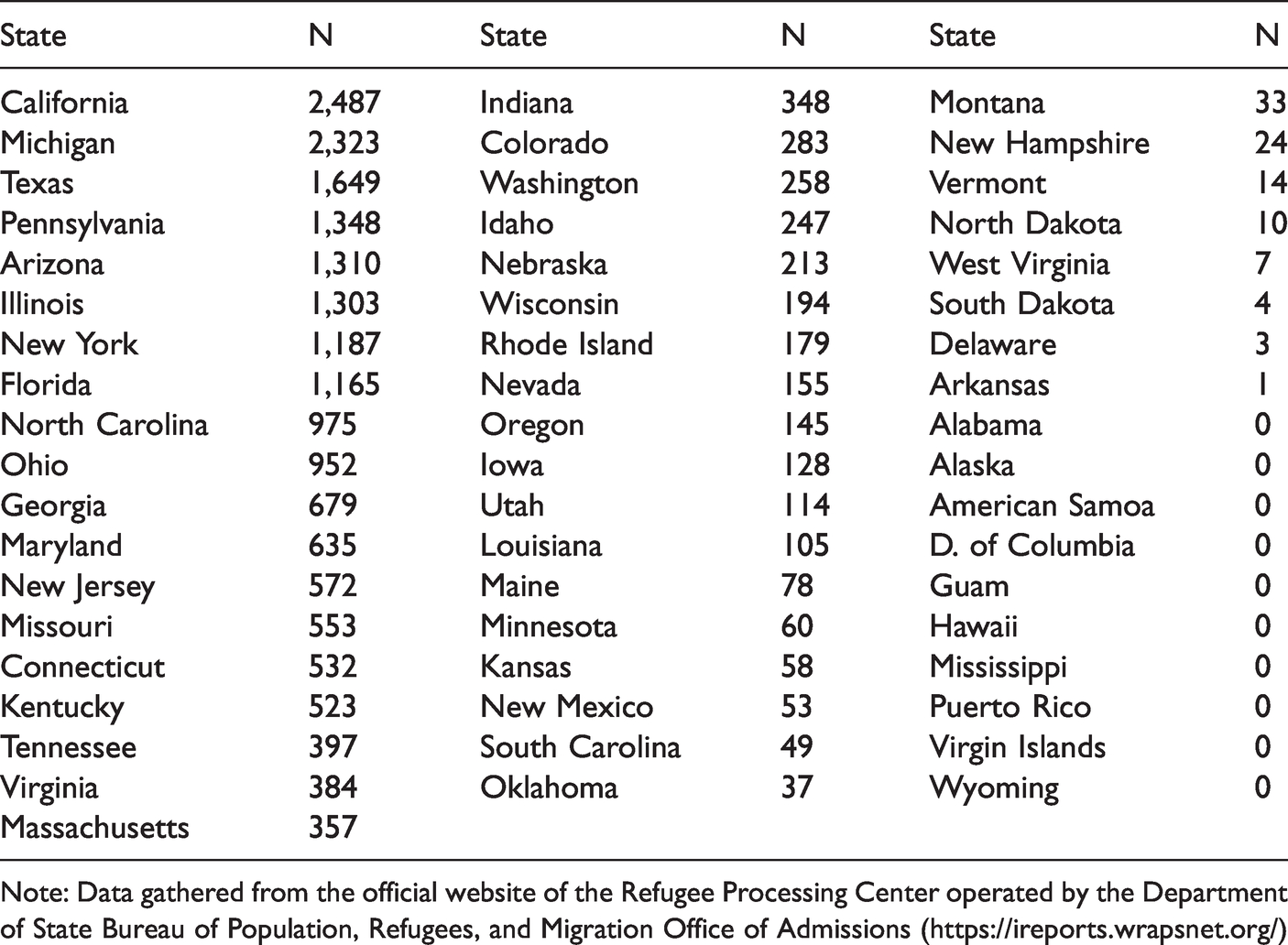
Note: Data gathered from the official website of the Refugee Processing Center operated by the Department of State Bureau of Population, Refugees, and Migration Office of Admissions (https://ireports.wrapsnet.org/)
Seeking refuge in Western European countries, Syrian refugees undertook dangerous sea journey and in September 2015 attracted global attention as iconic photos of Aylan Kurdi, a drowned Syrian toddler washed ashore, shocked the world and sparked an outcry (BBC, 2015). News reports and photographs of refugees and migrants crossing the border into Western Europe on foot, some of them dying in their perilous journey, others violently tackled by soldiers, or the video of a Hungarian camerawoman tripping and kicking a Syrian father, confirmed the extent of the humanitarian crisis and international calls to help these refugees (Mackintosh, 2017).
The influx of Syrian refugees and migrants created a humanitarian crisis and also a fierce political debate in Europe and the US about how to cope with refugees. In the United States, political leaders’ response to the Syrian refugee crisis was divided. Despite his anti-immigration rhetoric and his promise to build a border wall on the US southern border with Mexico to stop immigration, then-candidate Donald Trump indicated his lukewarm support for taking in some Syrian refugees on “a humanitarian basis” (Gass, 2015). Other Republican candidates were torn between their hardline policies on immigration and the demands to respond to the unprecedented humanitarian crisis and the plight of Syrian refugees. As Russell Berman of The Atlantic reported: Ohio Governor John Kasich is supporting the Obama administration’s plan to admit 10,000 more refugees from Syria in the next fiscal year. Lindsey Graham has said the U.S. should take an unspecified “fair share” of refugees, while Marco Rubio has said only that he is “open” to the possibility (Berman, 2015).
The “screening” of refugees became a paramount demand in the political debate surrounding Syrian refugees, as the alarm was sounded after one of the perpetrators of the Paris terrorist attacks in November 2015 was suspected of using a fake Syrian passport. The Paris attacks had left 121 dead and led to an intense backlash against refugees and immigrants in Europe. The Guardian’s headline “Paris attacks: European leaders link terror threats to immigration” (Traynor, 2015), succinctly summed up the political repercussions of the terrorist attacks on Syrian refugees and immigrants as Germany’s Chancellor, Angela Merkel, and others were criticized for their “policy of openness towards refugees.” Right-wing politicians called for tighter borders and smaller refugee quotas (Plucinska, 2015). In the US, there was a backlash from GOP leaders and presidential candidates. Vox and other media outlets reported that GOP candidates Ted Cruz, Mike Huckabee, Ben Carson, and Rick Santorum “cited the Paris attacks to justify closing the borders to more Syrian refugees” while other GOP contenders claimed that ISIS could “infiltrate the country by hiding among refugees” (Chappellet-Lanier, 2015: n.p.). In line with the shift in the political debate, the U.S. public opinion on Syrian refugees has also significantly changed after the Paris attacks (McElvein, 2016). According to a survey conducted in September 2015, 75 percent of respondents supported the Obama administration’s proposition to accept 10,000 refugees into the U.S. However, a survey conducted in the wake of November 2015 Paris attacks found that 53 percent of Americans said that the U.S. should stop accepting refugees (Bloomberg Politics Poll, 2015).
It was thus unsurprising to witness the criticism directed at the Obama administration’s public commitment to admit at least 10k Syrian refugees from the GOP state politicians and governors who opposed the Obama refugee resettlement plan. Thirty-one States, more than half the nation’s States, openly protested re-settling refugees in their States. Gov. Mike Pence of Indiana, who went on to become Donald Trump’s Vice President, publicly refused the planned relocating Syrian refugees and insisted that his “first responsibility is to ensure the safety and security of all Hoosiers” (Healy and Bosman, 2015) Ohio Gov. John Kasich shifted his earlier “welcoming” position that backed Obama’s plan to allow Syrian refugees to resettle in his State after the Paris attacks (Rappeport, 2015). Other governors and States opted for silence or remained non-committal about re-settling Syrian refugees, but Colorado and a handful States embraced and welcomed Syrian refugees. Based on media reports and other public data, we categorize States according to their declared position vis a vis the Syrian refugee resettlement plan, as welcoming, unwelcoming or non-committed in Table 2.
US State Governors’ view on the refugee issue.

The resettlement of Syrian refugees constituted a part of the discussions during the American election campaign in 2016 and the public attitudes towards the refugees were shaped through these political debates. Earlier polls showed that 60% of Americans were against the idea of accepting refugees from Syria (Jones, 2015), and the rate of Americans thought that the U.S. have a responsibility to accept Syrian refugees decreased from 56% to 51% (Hartig, 2018). As the number of Americans welcoming the Syrian refugees decreased, the gap between the attitudes of Republican and Democratic voters has increased in recent years. From 2017 to 2018, the rate of acceptance by Republicans decreased from 25% to 22% while the rate of Democrats accepting the Syrian refugees increased from 62% to 68% (Hartig, 2018).
In parallel with the political debates, media coverage on Syrian refugees has created a significant impact on public attitudes. Since the beginning of the refugee crisis, the press could have played a constructive role in shaping the public attitudes by communicating what was happening, who was affected and what was needed the most (Trilling, 2019), as well as holding the governments to account by calling them to adhere to human rights norms and international conventions on refugee rights. However, research has shown that refugees and migrants have frequently been framed negatively, rather than the humanitarian aspects of the refugee crisis or the benefits of immigrants to host societies (Berry et al., 2015). More specifically, Allwright (2018), compared media framing of refugees in Canada and the United States by using 850 news articles from each country published since the beginning of the Syrian civil war and found that American newspapers portrayed refugees more negatively than Canadian newspapers. As a result of this “fragmented and contradictory media coverage of the crisis”, as Trilling (2019) commented, public attitudes have been shaped through myths against refugees such as perceived threat of terrorism caused by refugees in host countries and negative impacts on their economies.
Research rationale and questions
As anxieties about new immigrants and national security concerns intertwine in US immigration debates, public attitudes and restrictive policies have echoed the larger “risk” and “security” discourse surrounding immigration, border control and surveillance (Bigo, 2002). The Syrian refugee crisis in 2015 and 2016 resurfaced these tensions about security and, to some extent, race in public discourse on immigration. This study explores how the Syrian refugee debates fit in the larger media coverage and public discourse surrounding immigration and refugees in the US in 2015 and 2016. The background review revisited the racialized backdrop, and outright race-based discrimination tinging public debates about refugees and immigration in the US. The Syrian refugee debate coincided with a highly publicized terrorist attack on Paris on 13 November 2015. We argue that heightened public concerns about terrorism following ISIS orchestrated or sponsored attacks may lead to the prominence of national security framing over global responsibility and humanitarian frames in media reporting on the refugee crisis. We investigate whether and how these terrorist attacks on Paris have shifted the framing of Syrian refugees in US local news. Our focus on local news addresses an apparent research lacuna regarding the role of local media in facilitating public debate or local publics’ understanding of national issues, such as immigration and terrorism. We focus on local news editorials tackling the Syrian refugee debate given this insufficient scholarly attention to local media, and also in order to gain a better sense of how local news frame echo or diverge from local politics. Our focus on the local media enabled us to conduct a comparative analysis of the media coverage in different States of the US which have differential approaches towards Syrian refugees (i.e. unwelcoming, welcoming, and uncommitted).
To better understand the range of views available, we focus on editorials because – unlike regular news reports – their mandate is to offer more of opinion-based, subjective viewpoints on issues of the day (Golan and Lukito, 2017; Kahn and Kenney, 2002; Ryan, 2004). Based on this rationale, we investigate the following research questions:
Method and procedures
Data collection
This study focuses on the framing of the Syrian refugee crisis in US local newspapers during the presidential primaries in 2015-2016. During this period, the political debate surrounding the Syrian refugee crisis became more animated due to at least two watershed moments in the Syrian crisis. The Syrian refugee crisis reached extensive international media coverage as footage and photos of hundreds of thousands of refugees streamed into European Union countries. While Germany became a model of hospitality, the mistreatment of refugees in Eastern European countries became symbolically enmeshed in a Hungarian reporter who kicked a Syrian refugee trying to cross the Hungarian border (The Guardian, 2015). The refugee crisis shocked the world as the tragic pictures of a drowned Syrian toddler washed ashore, and a Turkish police officer held his lifeless body in early September 2015 (Smith, 2015). International response to the refugee crisis became more sympathetic as donations surged and world leaders expressed regret and sorrow at the crisis. On November 13, 2015, coordinated terrorist attacks on Paris became a major vent that entangled the Syrian refugee crisis as one of the perpetrators became suspected of entering EU borders as a Syrian refugee. As Table 2 illustrates, several governors in the US publicly declared their opposition to welcoming Syrian refugees using the Paris terrorist attacks as justification. In the meantime, the US presidential primaries had begun in earnest and the Republican candidates frequently debated the Syrian refugee crisis.
The above timeline thus constitutes a crucial period in the Syrian refugee debate and its media coverage. Our data collection was evenly split between the period prior to the Paris attacks of November 13. We collected 12 weeks of local news coverage from 21 August to 13 November 2015 and another 12 weeks local news covering the period between 14 November 2015 and 6 February 2016. We used LexisNexis Academic to search for editorials about Syrian refugees in U.S. Newspapers. We first identified editorials published from 21 August 2015 to 13 November 2015 and from 14 November 2015 to 6 February 2016 separately, using the search term “Syrian refugees.” We removed editorials published in national newspapers as we focused on the framing of the Syrian refugee crisis in local newspapers. We identified 21 local newspaper articles from the first period and 79 articles from the second period under study. We, then, grouped those editorials separately under three categories according to their sources: 1) local newspapers from the States whose governors accept Syrian refugees, 2) local newspapers from the States whose governors oppose them coming in, and 3) local newspapers from the States whose governors neither accept nor reject the resettlement of Syrian refugees in their States. We used Fantz and Brumfield’s (2015) CNN article to identify governors’ opinions on Syrian refugees. The data was collected in April 2018.
Framing analysis
Research has explored the mediated construction of these social issues and contended that the media’s framing influences public opinion, while elites seek to wield the power of the media to promote certain “frames” over others. Framing involves three major steps: definition, diagnosis, and remedies/solutions. Problem definition: defining the issue at hand, 2) diagnosing the problem, and 3) providing a resolution to the problem. Framing research indicates that different parties (elites, activists…) struggle to advance their own definition of the problem (Entman, 1993), and when it comes to immigration in the US, some of the struggles have emerged when labeling immigrants. As Merolla et al. (2013) argue, taking into account the political leanings and other audience predispositions, news coverage describing immigrants as “illegal,” “unauthorized” or “undocumented,” may influence how the public perceives these immigrants. Each term carries significant emotional baggage and is bound to invoke certain stereotypes about immigrants, whether they are deserving of sympathy and whether they should be granted rights or not. Our framing analysis adopted Entman’s (1993: 52) conceptualization of framing as the selection of “some aspects of a perceived reality to make them more salient, thus promoting a particular problem definition, causal interpretation, moral evaluation, and/or treatment recommendation”. Our framing analysis focuses on how the Syrian refugee issue was “defined” in the news coverage, the root causes of the refugee crisis, and what various “solutions,” if any, were proposed to resolve the crisis. Following the methodological insights of prior framing research, we identify the salient “aspects” of the coverage of the Syrian refugee crisis by analyzing the language used to describe the Syrian refugees.
We conducted a thematic analysis to identify the frames used in the coverage. After an analysis of random editorials covering the refugee crisis, we recognize that multiple frames might be used to “frame” and explain the “crisis” to readers. We identify and explore in-depth how four main over-arching frames that have been predominantly employed in the coverage of the Syrian refugee issue to American readers: The national security frame, the human-interest frame, the administrative frame, and the global responsibility frame. By the national security frame, we refer to how editorials might explain the Syrian refugee crisis within the larger context of Syria’s military and political conflict and insurgency, and the threats posed to US national security. The violent conflict has caused untold number civilian deaths and the displacement of millions of civilians who fled to neighboring countries and Western Europe. Since it is likely the chaotic refugee situation might be exploited by ISIS, and because of the difficulties in determining legitimate refugee claimants, Syrian refugees could threaten the national security of the US. Below statement is an example of a “national security” frame which is a part of an editorial that was published in a local Kentucky newspaper after the Paris attacks: It is worth noting that one of the terrorists responsible for the attack came across Europe into France with other Syrian refugees. That brings us to the point of this editorial. Obama has said that he will allow 10,000 Syrian refugees to come into our country next year after they are properly vetted. We fear the federal government doesn't know how to properly vet these refugees coming into our country. In our own city in 2011, two Iraqi nationals were arrested for attempting to provide money and weapons to terrorists in Iraq. The fingerprints of one matched an improvised explosive device found in Iraq. West Virginians are known as a friendly and welcoming people. The Syrian refugees are fleeing a horrible situation. For humanitarian reasons, West Virginia needs to do its part. Although President Barack Obama has said the United States will accept 85,000 refugees this year, including 10,000 from Syria, getting in will be far from easy. Refugees must first receive a referral from the Office of the U.N. High Commissioner for Refugees, which typically recommends only 1 percent of applicants. Refugees are then screened by U.S. agencies including the Department of Homeland Security. The process can take 18 to 24 months or longer. It's difficult to imagine an FDLE screening process that would be more strenuous. Given the United States' limited likely impact on the crisis even if it accelerates clearance for refugees, the country must do more to help Germany and other nations welcoming the migrants.
Data coding and intercoder reliability
The final dataset included a hundred editorials. All editorials were coded by two of the co-authors based on a coding scheme which includes the name of the newspaper, the state where the newspaper is published, the title of the editorial, and the frame or frames identified in the editorial. The editorials were carefully read by the coders and the frames were identified based on their agreed upon definitions described in the previous section. In coding the editorials, the authors agreed on a coding strategy to focus on how the editorials framed the Syrian refugee issues, facts, or discussions rather than focusing on what they reported (e.g., what politicians said, refugee settlement processes, what happened after or before the Paris attacks). In other words, the coders looked at the tone of reporting and how the editorial framed an incident or a discussion pertaining to Syrian refugees. The inter-coder reliability analysis revealed a high agreement between the two coders in coding the frames (Kappa= 0.922). After further discussions, all disagreements were resolved, and agreed-upon codes were used for the analyses.
Findings
Editorial framing of the Syrian refugee crisis and the Paris attacks
The first stage of the study set out to understand the editorial framing of the Syrian refugee crisis in US local newspapers, and we specifically, asked RQ1: How did local newspapers in the US frame the Syrian refugee debate before and after the 2016 terrorist attacks in Paris? To address this question, we gathered data from a diverse sample of editorials published in US local newspapers from States across whose governors belong to a diverse ideological spectrum. Our framing analysis thus examined in their entirety of the sample of US local news editorials, regardless of the ideological differences among their home States and political leadership. Table 3 below summarizes the distribution of these editorial frames across the US before and after the attacks, demonstrating the resilience and persistence of the human-interest frame despite the terrorist attacks in Paris. The attacks did, however, coincide with a remarkable rise in the national security and the administrative frames, and a decrease in the global responsibility frame (see Table 3).
Editorial frames before and after the Paris Attack.

Note: Some editorials involved more than one frame; some others did not involve any of the frames under study.
The analysis indicates that editorial framing of the refugee crisis in US local news clearly privileged the human-interest frame about half of the sample of the editorials. The Paris attacks did not appear to create a shift in this frame although a negligible decline in the percentage of editorials with human-interest frame did indeed happen in the “post-Paris attacks” coverage (from 48% to 47%). The administrative frame constituted the second major editorial frame of the Syrian refugee crisis at 19%. The data reveal a spike in the number of editorials discussing the refugee crisis from within this frame in the aftermath of the Paris attacks from 10% to 22%.
The data reveal an interesting dynamic among the other major editorial frames. On the one hand, the global responsibility frame showed up in 38% of the editorials tackling the Syrian refugee crisis prior to the Paris attacks, only to experience a significant drop to 10% in the period after the attacks. On the other hand, the reverse trend took place in the editorial framing as the national security frame gained more space in the editorial coverage from 14% prior to the attacks to 19% after the attacks.
Editorial frames of the Syrian refugee crisis and state politics
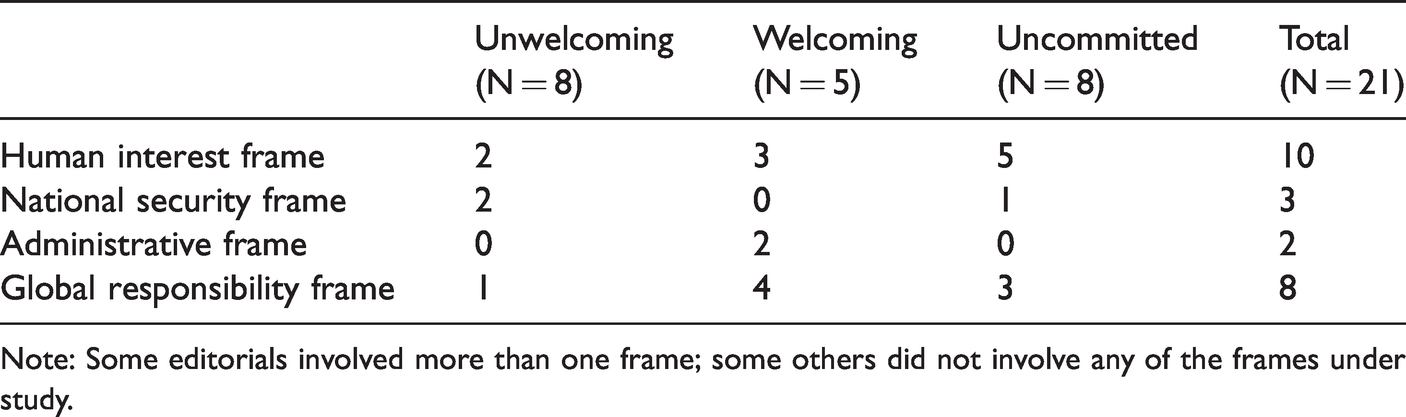
The second stage of the study examined the editorial framing of the Syrian refugee crisis along ideological lines, and specifically addressed RQ2: How did local news framing of the Syrian refugee debate vary among States that welcomed, did not welcome, or did not commit to hosting these refugees? As explained in the method, our sample consisted of a total of N = 100 editorials with 21 editorials published prior to terrorist attacks and 79 editorials published in the period after the attacks. We further categorized these editorials along with the publicly available data identifying States/governors as welcoming, not welcoming, or did not commit to hosting Syrian refugees. Out of 21 editorials that were published before the attacks, eight editorials were published in newspapers from unwelcoming States, five editorials from welcoming States, and another eight from uncommitted States (see Table 4).
Editorial Frames before the Paris attack.
Note: Some editorials involved more than one frame; some others did not involve any of the frames under study.
The editorial coverage published prior to the attacks shows that the human interest and the global responsibility frames visibly dominate the editorial framing across all three State categories. In terms of frame prominence, the human interest and the global responsibility frames were more likely to be encountered in “welcoming” and “uncommitted” States, respectively, and the national security is more likely to be associated with editorials from “unwelcoming” states.
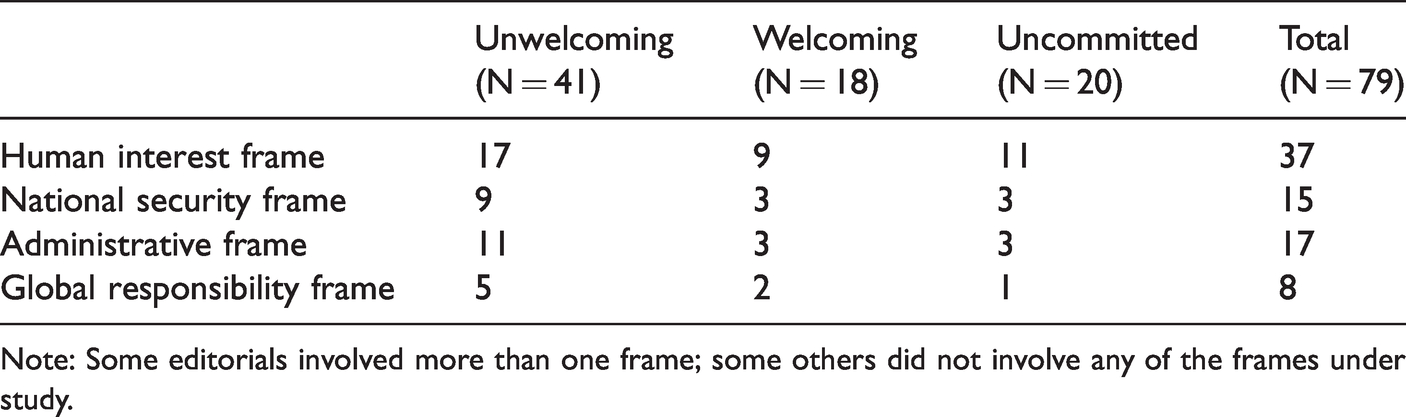
The editorial framing of the Syrian refugee crisis remarkably shifted in the post-Paris attacks among different State categories (see Table 5). While the human-interest frame’s prominence persisted across all State categories hovering around half of the editorials, the rise of the national security frame appears palpable in all States. Within the editorial coverage emanating from “unwelcoming” States, the national security and administrative frames are comparable in their sudden rise. Equally significant, the global responsibility frame precipitously declined in the overall editorial coverage.
Editorial frames after the Paris attack.
Note: Some editorials involved more than one frame; some others did not involve any of the frames under study.
The inclination towards national security and administrative frames become more visible when the editorials are qualitatively analyzed. In an article published after the Paris attack in the Washington-based The Columbian, for example, the editor concluded: No process is foolproof. No amount of vetting can ensure that a refugee is not a terrorist or a potential terrorist. For now, it is reasonable to press the pause button and re-examine the nation's vetting program for Syrian refugees. While the issue of accepting Syrian refugees is very divisive right now, just imagine what would happen if something like the Paris terrorist attacks happened here. Both sides would be crying out: How could we allow this to happen? Given the savage attacks on innocent civilians that we've seen in Paris, San Bernardino and elsewhere; Islamic radicals' promise to infiltrate refugee populations; and frequent unwillingness among many migrants to assimilate to the host culture. While most Americans desire a “robust” debate on the subject, they'd prefer a “rigorous” screening process – something that still seems lost in translation at the White House.
Discussion and conclusions
The major findings of the study include the persistence and resilience of the human-interest frame – despite the terrorist attacks in Paris – in local news editorials. The human-interest frame tends to highlight individual stories of refugees, their journey and predicaments and also their group suffering as they fled their war-torn country in droves to live in refugee camps and seek safe havens elsewhere. Given the polarizing nature of immigration and refugee debates, the resilience of the human-interest frame in the editorial coverage of local news nods to the unprecedented suffering and scope of the Syrian refugee crisis. The massive numbers of Syrian refugees flowing into Europe, tragic cases of Syrian refugees dying to escape from their homeland contributed to the resilience of the human-interest frame. Moreover, we argue, the fact that the human-interest frame appeared to survive the climate of fear following terrorist attacks in Paris and elsewhere as well as mounting security concerns about the ISIS threat testifies to the ability of local news to transcend the politics of fear and the language of security threats.
The landscape of local news remains complex and does not entirely ignore the reality of terrorist threats, as our findings reveal the resurgence of the national security frame in the period following the Paris attacks. The national security editorial frame’s resurgence in local news crosses political boundaries identified among “unwelcoming,” “welcoming”, and “uncommitted” States, or the conventional ideological divide between Red and Blue States. The reappearance of the national security editorial framing of the Syrian refugees can be ascribed to perceptions of risk and security threats that have inflamed American public attitudes toward immigration and government policies.
In addition to framing Syrian refugees as a national security threat, concerns about the flow of Syrian refugees into the U.S. became manifest in the precipitous decline of the global responsibility editorial frame cutting across the political divide amongst States. Similarly, the rise of the administrative editorial frame in the unwelcoming and uncommitted States echoes their public concerns about refugees, and U.S. voters’ support for restrictive immigration and refugee policies. While race and ethnicity of Syrian refugees were not visibly influential in the editorial framing, researchers cannot ignore the fact that racial prejudice has infused public attitudes towards immigration and re-enforce race-based immigration policies. For instance, public opinion surveys consistently support restricting the flow of immigrants of color (Simon and Lynch, 1999). Other empirical research findings have confirmed that immigrants’ ethnicity and race significantly influence public attitudes toward immigration. In their experimental study, Brader et al. (2008) conclude that group cues about the ethnicity of immigrants triggered negative emotions towards Latino immigrants. They explain that “citizens felt more threatened by Latino immigration, not European immigration, and this feeling prompted requests for information, and led people to send anti-immigration messages to Congress” (Brader et al., 2008: 975). Public concern about Latino immigration might be ascribed to how this racialized group has become associated with negative stereotypes including their inability to “assimilate” and become Americanized, compared to White European immigrants (Brader et al., 2008). Latino immigrants have been stigmatized in other ways by being tied to crime and criminality and claims of over-reliance on state/public benefits. These racist stereotypes heighten public concerns and drive public opinion’s support for restrictive policies that target Latino immigrants, such as Proposition 187 (Garcia, 1995). Given the entrenched racial tinge in the immigration and refugee debates in the US, Syrian refugees joined the historical list of undesirable immigrants.
The administrative and national security threat framing of Syrian refugees coincides with American public opinion’s negative attitudes toward letting in more Syrian refugees (Hartig, 2018; Jones, 2015). This raises a question about whether race has subtly become an underlying subtext for restrictive immigration policies and antipathy towards Syrian refugees. We wonder whether race has implicitly influenced those attitudes since we agree with scholars who have linked American public attitudes vis a vis immigration, specifically the racial discrimination that has been primarily directed against non-white immigrants, to unresolved racial tensions and racial animus in American society. Not only did the founding of the United States further disenfranchised Blacks, perpetuating slavery and other forms of racial discrimination, but the founding document excluded Blacks from belonging to the new nation: African Americans and their descendants were denied citizenship until 1866 with the passage of the Fourteenth Amendment of the US Constitution that formally granted citizenship to anyone born in the United States (Garcia, 1995). While the Civil Rights movement led to more legal gains for African Americans, anxiety about the racial make-up of the United States and perceived threat to whites manifested itself as discriminatory practices against immigrants and “foreigners.” As Johnson (1998) explains, the US government’s massive “Operation Wetback” that deported Mexican immigrants occurred at a time when African Americans scored a landmark legal victory in Brown v. the Board of Education that formally repealed the “separate but equal” segregation practices. In other terms, “maintenance of the racial status quo serves as the unifying theme” to justify restrictive policies against non-white immigrants (Johnson, 1998: 1117).
Overall, despite attempts to empathize with the plights of Syrian refugees through the predominance of the human-interest frame, the editorial framing of the Syrian refugee crisis in local media downplayed the global responsibility and international commitment of the US, highlighted the administrative costs, and raised security threats. This framing has implications on the media’s episodic attention to, and treatment of immigration and refugee issues, and the public understanding of the effects of immigration on the country. Sociologists have argued that the media’s construction of “crises” may effectively create an atmosphere of “moral panic” in which public attitudes harden and support tough policies on crime and immigration. To illustrate, “illegal” immigrants have been depicted as a “threat,” then stereotyped in media stories as illiterate, deviant and criminal, leading to immigration crusaders, what Cohen refers to as “moral entrepreneurs,” who advocate and push for restrictive policies to “resolve” the “crisis.” Of 1,848 Associated Press stories and 2,614 stories in The New York Times on immigration published from 1980 to 2007, Suro (2009: 2) concluded that 79 percent and 86 percent in each of these outlets, respectively, dealt with immigrant illegality or “fit into the framework of illegality”. Given this crisis reporting fueled by the Paris attacks, the editorial framing failed to effectively humanize Syrian refugees or depict them as deserving of sanctuary. They have merely joined the list of underserving and unworthy victims of wars and natural disasters.
Our conclusions echo findings from Slovic et al. (2017) who argued that despite the abundance of visual evidence, such as the iconic photograph of Aylan Kurdi, public empathy for the plight of Syrian refugees ebbed. Findings from Dimitrova et al. (2018) regarding Turkish and Bulgarian newspapers framing Syrian refugees as a threat are comparable to our findings of the national security threat framing of Syrian refugees in US local news. Years after the Syrian refugee crisis and the Paris Attacks of 2016, for instance, mainstream media coverage of “illegal” immigrants in the US shows the persistence of the “crisis” narrative and the responsibility of the media in fueling moral panics around the issue of immigration. Furthermore, given the divergent framing in local newspaper editorials, our findings suggest a partisan angle in these newspapers may explain why these newspapers tended to reflect the State's overall political direction. Future research would benefit from exploring how refugee coverage and partisan local news are interconnected, which will inform local journalism theory.
In conclusion, mainstream media outlets bear more responsibility to humanize refugees and immigrants despite a charged political climate hostile to immigrants and refugees. On the upside, the study demonstrates that members of the press have not abdicated the Fourth Estate principle as the prevalence of the human-interest framing of Syrian refugees indicates. The study highlights the significance of race and security in the immigration debate on refugees. While national security editorial framing of Syrian refugees might belie racial and anti-Muslim overtones, it did not create a moral panic about refugees thereby resisting the politics of fear. Looking to the future, however, the decline in the global responsibility framing of the Syrian refugee crisis deserves further analysis and scrutiny. The press’s responsibility to hold the powerful to account means that media coverage has to highlight the importance of adhering to international conventions and human rights norms that protect immigrants and refugees as well as exposing US government’s flagrant attempts violating such norms. Future studies have to grapple with these issues as media scholars and others study the causes triggering public opinion support for restrictive immigration and anti-refugee policies.
Footnotes
Author's note
Aziz Douai is now affiliated with School of Journalism, University of Regina, Canada.
Declaration of conflicting interests
The author(s) declared no potential conflicts of interest with respect to the research, authorship, and/or publication of this article.
Funding
The author(s) received no financial support for the research, authorship, and/or publication of this article.
