







Abstract
This comparative study analyses how Brazil, Russia, India, China, and South Africa (BRICS) is represented in the media of China and India, the coalition's two most populous and influential members. While BRICS has been extensively examined in political science and international relations, its communicative dimensions remain underexplored. To address this gap, the study introduces a proactive-reactive analytical lens to capture how media frame BRICS along a continuum, from a driver of change to a response to external crises. A quantitative content analysis of 2556 articles published between 2020 and 2024 in China Daily, People's Daily Online, The Hindu, and The Times of India was conducted. Articles were coded for type, focus, topic, news geography, and proactive/reactive orientation. Findings reveal a clear divergence. Chinese outlets were more likely to adopt a proactive orientation, emphasising institutional innovation, multipolarity, and collective advancement, particularly around BRICS summits. By contrast, Indian news organisations more often framed BRICS in reactive terms, focusing on crisis diplomacy and balancing imperatives. The proactive-reactive dimension offers a comparative lens for understanding how divergent media systems narrate global governance, underscoring both the possibilities and limits of South-South communication.
Keywords
Introduction
Since its first summit in 2009, the coalition of Brazil, Russia, India, China and South Africa (BRICS) has positioned itself as an advocate of multipolarity and a more equitable system of global governance. While its origins can be linked to longer histories of postcolonial demands for political and informational decolonisation, the 2008 global financial crisis was a decisive catalyst. That crisis exposed the limitations of the ‘Washington Consensus’ and spurred BRICS states to demand reforms in institutions such as the International Monetary Fund (IMF) and the World Bank, aiming to secure fairer representation for the Global South (Serra and Stiglitz, 2008). Institutional innovations followed: the creation of the New Development Bank (NDB) and the Contingent Reserve Arrangement (CRA) in 2014 provided collective mechanisms to reduce reliance on the US-led ‘Bretton Woods system’ (Armijo and Roberts, 2014).
According to a report by the World Economic Forum, BRICS members collectively contribute about 37.3% of global GDP in purchasing power parity (PPP) terms and account for over 40% of the world's population (Feingold, 2024). Although BRICS’ efficacy as a vehicle for Global South solidarity remains constrained by differences in political systems, divergent global ambitions and geopolitical rivalries, especially India-China tensions (Costa Vazquez, 2021; Verma, 2024; Verma and Papa, 2021), these figures underscore its economic and demographic significance. These dynamics have also coincided with a fall in the G7's share of world GDP, prompting some observers to label BRICS a ‘de-dollarisation coalition’, laying groundwork for a more diversified financial order (Liu and Papa, 2022).
Despite its prominence, BRICS scholarship remains predominantly situated in political science and international relations, with emphasis on institutional evolution, economic weight, and geopolitical significance (Cooper, 2022). The communicative dimensions of BRICS are far less studied, even though concerns about information imbalance have long been central to global communication debates, from the MacBride Report (MacBride, 1980) to contemporary analyses of news flows and the Global South (Thussu, 2022; Thussu and Nordenstreng, 2015, 2020; Wasserman, 2018). Some recent work has begun to examine mediated conversations and news geographies within BRICS (Santos and Cazzamatta, 2025), yet systematic analysis remains scarce. Even within communication research, most contributions have focused on the nation-branding strategies of BRICS members (Li and Marsh, 2016) rather than on how the coalition itself is projected to domestic or global audiences. This leaves a notable gap: lack of a systematic study of its media representation and particularly its intra-BRICS dynamics.
This gap is particularly striking in the cases of China and India, the two largest economies and populations in the grouping. Both aspire to leading roles in global governance and operate increasingly ambitious international media platforms, yet they are structured around different institutional and political logics. China's media are state-aligned while India's are commercially driven. However, this distinction should not be read as implying full press autonomy in India. Since 2014, scholars and press-freedom monitors have noted growing political pressure, regulatory constraints and the rise of hyper-nationalist narratives in Indian journalism (Kumar, 2023b). India was ranked 157th out of 180 countries in the 2026 World Press Freedom Index (Reporters Without Borders, 2026). Nevertheless, this combination of media-system difference and political constraint makes the two cases especially valuable for a comparative analysis of how BRICS is constructed within their national media.
To understand the above, the paper introduces the distinction between proactive and reactive coverage as an analytical lens. Proactive reporting frames BRICS as a driver of global change, highlighting leadership, institution-building, and collective agendas. Reactive reporting frames BRICS in response to external events, crises, or Western commentary. By applying this distinction to a comparative content analysis of Chinese and Indian media, the study makes an original contribution in three respects: (a) drawing on a quantitative content analysis, it provides one of the first systematic comparative analyses of how BRICS is projected in the media of its two central members, (b) it develops proactive-reactive orientation as an analytical framework combining insights from strategic narratives, discourse/soft power, and agenda-building, and (c) it extends attention to the communicative practices that give meaning to the coalition. In doing so, this paper situates BRICS not only as a political and economic project but also as a mediated project, whose articulation varies across national contexts, revealing both the possibilities and the limits of South-South communication in the contemporary global order.
Literature review
BRICS media and the India–China framework
As discussed above, BRICS nations have developed strategic alliances across multiple domains. A shared concern has been the global information order, long dominated by Western powers and characterised by asymmetries in representation. In the 1970s, developing countries pressed for the New World Information and Communication Order (NWICO) under UNESCO, which sought to diversify global voices and reduce the one-way flow of information from ‘the West to the rest’ (Joynes et al., 2026; Thussu, 2018). Although never fully institutionalised, NWICO's concerns resonate in contemporary BRICS discourse, particularly in calls for more balanced communication structures (Kumar, 2025). It is in this context that member states have launched international news platforms such as Russia Today (RT), China Global Television Network (CGTN), and India's World Is One News (WION) to present alternative perspectives. Within this media landscape, China and India stand out for their contrasting systems and distinctive approaches to projecting BRICS.
China's engagement with BRICS has been closely tied to its broader international communication strategy. As part of its ‘going out’ policy, China has expanded the global footprint of its media organisations, establishing production centres in America, Africa, and Europe (Marsh et al., 2023). Xinhua, China's largest news conglomerate, now operates more than 30 bureaus across Africa, illustrating Beijing's ambition to contest Western dominance in global information flows. Chinese outlets often frame their international reporting as a form of ‘constructive journalism’, emphasising solutions and development over conflict or crisis. A global assessment by Freedom House found that China's efforts to expand its media influence were rated as ‘high’ or ‘very high’ in more than half of the 30 countries surveyed (Cook, 2022).
These global ambitions intersect with China's presentation of BRICS. Chinese media narrate the coalition as a cooperative and future-oriented project (Lukin and Xuesong, 2019). Scholarship highlights this through the concept of ‘discourse power’, which refers to the ability to shape norms, terms, and interpretations in international fora (Hung-jen, 2015; Oud, 2024). From this perspective, BRICS is not merely an economic or diplomatic forum but also a communicative platform through which China advances the themes of multipolarity, development, and inclusivity (Han and Papa, 2024; Lee and Sims, 2025). Yet, as Santos and Cazzamatta (2025) note, greater media capacity has not necessarily led to convergence across member states: while Chinese outlets project BRICS as a unified and strategic coalition, media in other BRICS countries often present diverging emphases, limiting the scope of communicative cohesion.
India, now the world's most populous country, has experienced a remarkable transformation of its media industry since the 1990s. Liberalisation and market reforms opened the sector to foreign investment, enabling the launch of 24/7 news channels and the rapid growth of private players. Early ventures such as Star News (backed by Rupert Murdoch's News Corporation, later renamed ABP News) and Times Now (a joint initiative between the Times Group and Reuters) marked the beginning of an unprecedented expansion. India has undergone dramatic expansion across outlets and audiences, positioning it as a large and growing media landscape (Chadha, 2017).
Although support for nationalist narratives has been observed in the Indian media, often catering to domestic politics (Kumar, 2023a), Indian outlets have increasingly sought to project perspectives beyond national borders. English-language broadcasters such as World Is One News (WION), available in nearly 190 countries, and India Today, accessible in over 70, present Indian interpretations of international affairs. Channels like Republic TV explicitly position themselves as challengers to ‘Western media hegemony’, offering Indian-framed narratives on issues such as the Russia-Ukraine conflict (Kumar and Thussu, 2024). Alongside these private initiatives, India's state broadcaster Doordarshan has announced plans to expand its global presence to tell ‘India's story’ (The Hindu, 2021) by establishing bureaus in 15 countries.
These developments are part of a rapidly growing media and entertainment sector, which expanded by 20% in 2020 and is projected to reach $100 billion by 2030 (Press Information Bureau, 2022). For BRICS, this internationalisation has important implications. While Chinese media coverage of BRICS tends to foreground discourse power and project institutional reform, Indian outlets pursue a more commercially inflected but increasingly global approach, using BRICS as one among several platforms for international visibility and soft power projection. This distinction offers a comparative framework for analysing how India and China, despite their centrality in BRICS, articulate divergent communicative practices within the coalition.
Analytical framework
This study develops an analytical framework to examine how media in BRICS countries construct narratives about the group's role in global politics. At the centre of our approach is the distinction between proactive and reactive coverage. Proactive reporting refers to stories that frame BRICS as an initiative shaping the future, highlighting leadership, institution-building, and collective agendas. Reactive reporting refers to stories that frame BRICS mainly in response to external events, pressures, or criticisms, often originating in the West.
To develop this distinction, we draw on three strands of scholarship. The first is strategic narratives, which explains how storylines structure understandings of the past, present, and future in world politics. The second is discourse power and soft power, which captures national approaches to projecting influence through communication. The third is agenda-building, which identifies the mechanisms through which media either originate political frames or respond to external cues. By drawing from these traditions, we operationalise a framework that captures how proactive and reactive orientations emerge in BRICS media coverage.
Strategic narratives
Narratives are storylines developed by states, institutions, or media to explain the past, interpret the present, and anticipate the future (Miskimmon et al., 2013, 2017). They matter because they shape how domestic and international audiences understand global politics and can influence both legitimacy and policy (Roselle et al., 2014). Proactive coverage corresponds to strategic narratives: it looks forward, articulates institutional roles, and projects visions of multipolarity. Chinese and Russian reporting on BRICS summits, for example, frequently presents the grouping as a driver of global governance reform and frames it as a form of resistance while also projecting their national identity (Grincheva and Lu, 2016). Reactive coverage corresponds to situations where narratives are framed in response to events or issues that have already occurred, such as Indian media emphasising its role in resolving global crises and promoting geopolitical superiority (Kumar, 2023b; Kumar and Thussu, 2024).
Studies of summit diplomacy, too, confirm the importance of narrative positioning in multilateral contexts. Research on EU and G20 summits, for instance, shows how host-country media deploy forward-looking narratives to project leadership, while international outlets often frame events more reactively (Hameiri and Jones, 2015; Volkmer, 2014). Dang (2025) further illustrates this dynamic, showing how Chinese media framed ASEAN as a ‘cooperative, open, and innovative economic partner’ (p. 239), underscoring the proactive use of strategic narratives to build regional legitimacy.
This literature suggests two observable indicators for distinguishing proactive and reactive coverage. First, temporal orientation, where proactive narratives are future-oriented and project institutional trajectories, while reactive narratives are event-driven and anchored in immediate developments. Second, reporting focus, where proactive coverage emphasises institution-building and long-term cooperation, whereas reactive coverage foregrounds crises, conflicts, or external pressures. For instance, summit reporting that highlights future BRICS expansion or institutional reform reflects a proactive narrative, while coverage linking BRICS to ongoing conflicts or diplomatic tensions reflects a reactive orientation. For example, an article in People's Daily Online (Xu, 2024) puts that ‘cooperation among BRICS countries in energy transformation and green, low-carbon initiatives is becoming increasingly close’, projecting BRICS as a future-oriented project promoting technological innovation. Differently, an Indian news article (Rajghatta, 2025) outlines the expansion and development of BRICS in recent years, building upon US President Trump's criticism of the group.
Discourse power and soft power
Discourse power refers to the ability to shape norms and meanings in international politics (Hung-jen, 2015; Oud, 2024). It is a core priority in Chinese foreign policy, often articulated in terms of the need to ‘tell China's story well’ (Xu and Gong, 2024). Chinese news outlets highlight multipolarity, development, and inclusivity in international communication (Teo and Xu, 2023). These themes correspond to proactive narratives that position BRICS as a platform for global reform (Lee and Sims, 2025). India, meanwhile, mobilises ‘soft power’ (Nye, 1990, 2004) to frame BRICS as a platform for status-seeking and soft-power projection regularly spotlighting cultural diplomacy (e.g., BRICS Film Festival), education exchanges (e.g., BRICS Network University), creative-industry ties and leading the Global South (The Times of India, 2016). Both discourse power and the soft power model emphasise how nations attempt to attain influential positions in international politics and communication.
From this perspective, a second key indicator emerges: the attribution of agency. In proactive coverage, BRICS or its member states are positioned as primary actors shaping global outcomes, reflecting attempts to project discourse or soft power. In reactive coverage, agency is more often assigned to external actors, such as Western states, global crises, or geopolitical rivals, with BRICS positioned as responding to these developments. For example, an article in the Times of India focuses on the Land Restoration Partnership of BRICS nations (Mohan, 2025) framing BRICS as advancing multipolarity and assigning agency internally. In contrast, another article (Press Trust of India, 2023) highlights the damage caused to the global economy by the new wave of protectionism and the positive role that the BRICS can play, situating BRICS within responses to conflicts or crisis. This article reflects externally driven agency.
Agenda-Building
The proactive-reactive distinction also connects with theories of media-politics relations. Cobb and Elder (1971) lay the groundwork by conceptualising how media build agendas, while Walgrave and Van Aelst (2006) remind us that media's influence is often context-dependent and reactive. Agenda-building examines how various actors influence which issues gain prominence in the media (Lang and Lang, 1981). In the Chinese context, agenda-building operates in a more institutionalised and hierarchical form, where central agencies such as the Publicity Department play a direct role in shaping both issue salience and framing (Wilbur, 2021). In contrast, agenda-building in the Indian context is more decentralised and shaped by interactions among media organisations, market dynamics and state and non-state actors (Relly and Pakanati, 2021).
Therefore, agenda-building further refines the above-discussed distinctions by highlighting two additional indicators: sourcing patterns and the origin of news cues. Proactive coverage tends to rely on internal sources, such as official communiqués, domestic experts, and summit statements, indicating that agendas are generated within the BRICS framework. For instance, a Chinese news story (Cao, 2025) uses quotes from Chinese and Brazilian leaders to highlight the role of the BRICS nations in bilateral cooperation, positioning agenda with the BRICS framework. Reactive coverage, by contrast, relies more heavily on external sources, including foreign officials, international organisations, and Western media commentary, reflecting responsiveness to external agendas. A news article in China Daily (Jiang, 2025) uses two Japanese experts’ statements which criticises the United States’ protectionist stance and emphasised the role of multilateralism. BRICS, in this article, is articulated as one of approaches to uphold genuine multilateralism, economic development, and co-prosperity.
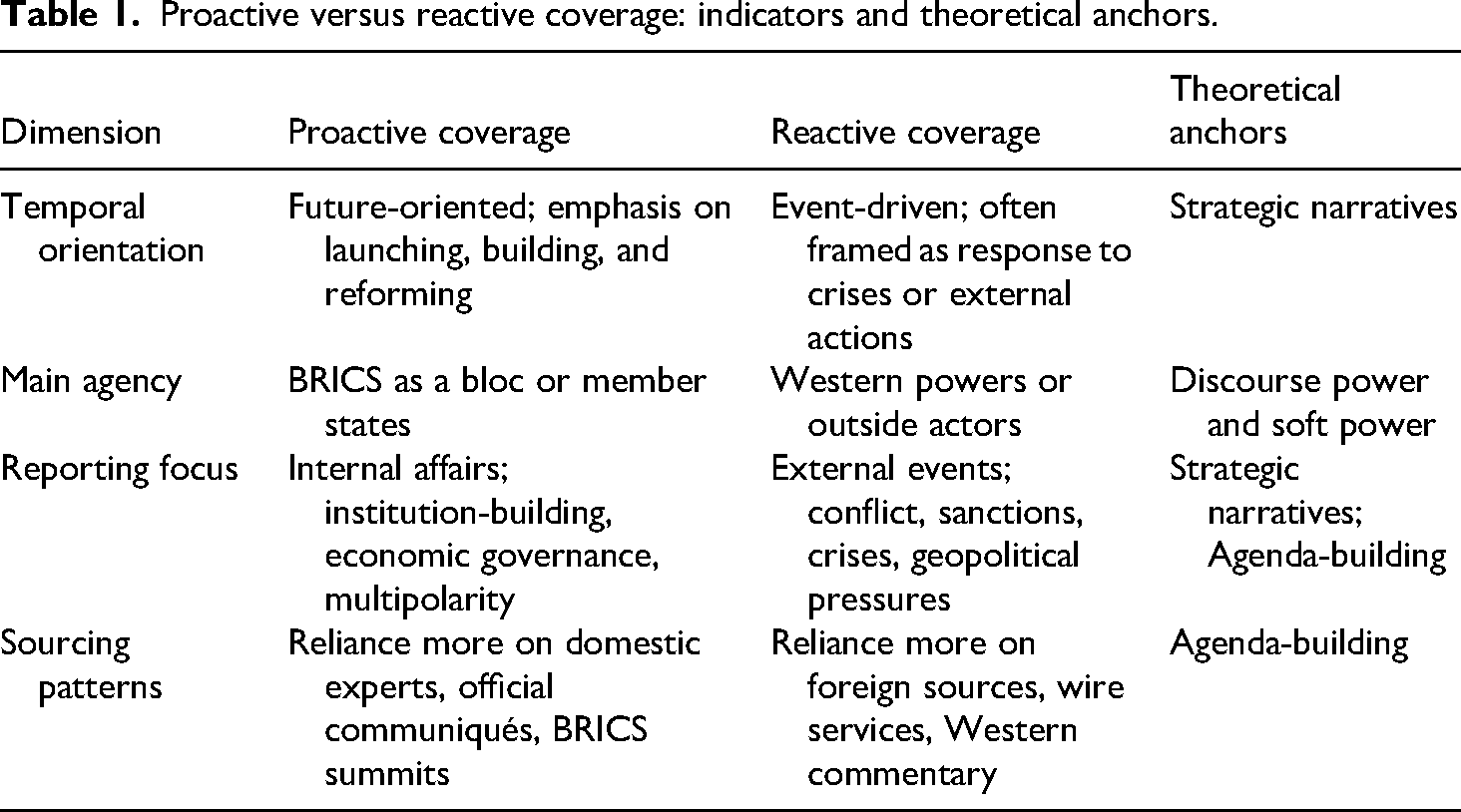
Drawing these strands together, the proactive-reactive distinction can be operationalised through four observable dimensions: temporal orientation, main agency, reporting focus, and sourcing patterns. Each dimension corresponds to one or more of the theoretical traditions discussed above, including strategic narratives, discourse/soft power, and agenda-building, and provides a systematic basis for coding media coverage. Table 1 summarises these indicators and their theoretical anchors.
Proactive versus reactive coverage: indicators and theoretical anchors.
Proactive-reactive as a continuum
Although described as distinct categories, proactive and reactive coverage should be understood as ends of a continuum. Stories vary in degree depending on temporal orientation, main agency, reporting focus, and sourcing patterns. Proactive indicators include forward-looking language, the primacy BRICS or member states, emphasis on institution-building or economic reform, and reliance on domestic experts or official communiqués. Reactive indicators include backward-looking or event-driven frames, the primacy of Western or external actors, emphasis on crises or conflicts, and reliance on foreign sources. This continuum helps explain differences across countries and across time.
Therefore, this framework integrates insights from the three concepts discussed above to operationalise proactive and reactive coverage. Proactive reporting is defined here as future-oriented, agenda-setting, and institution-building, while reactive reporting is defined as event-driven, externally cued, and defensive. In practice, temporal orientation and main agency are suggested to serve as the primary criteria because they most directly capture whether BRICS is presented as initiating action and projecting a future-oriented role, or instead as responding to external developments and actors. By contrast, reporting focus and sourcing patterns function as secondary criteria because they reinforce and help verify this distinction. The following section outlines how these categories were applied in the comparative content analysis of Chinese and Indian media coverage of BRICS.
Method
This study employed a quantitative content analysis and conducted a census of English-language news articles mentioning ‘BRICS’ published between 1 January 2020 and 31 December 2024 in four national newspapers: China Daily, People's Daily Online, The Hindu, and The Times of India. These news outlets were selected for their leading status, with high circulation and influence in their respective national markets, and to enable a balanced comparison across two Asian BRICS states. The analysis period (2020–2024) began shortly before the outbreak of the COVID-19 pandemic and ended after the BRICS summit held at the end of October 2024. This timeframe offers a longitudinal perspective to reveal how media attention to the BRICS countries fluctuates over time, while also exploring the subtle links between external factors and the BRICS coverage, such as the Galwan Valley clash between India and China, the COVID-19 pandemic, the Russia-Ukraine war, and the Israel-Palestine conflict (Chaulia, 2021; Hall, 2025; Schirm, 2023). These events provide analytically valuable moments to observe whether media construct BRICS as a stable institutional project or as a reactive diplomatic platform. Recent scholarship suggests that India has increasingly adopted a strategy of soft balancing vis-à-vis China within multilateral forums (Hall, 2025). This raises an important empirical question: whether Indian media narrate BRICS as a strategic platform or as a constrained diplomatic space. Articles were mainly retrieved via the ProQuest database using ‘BRICS’ as the sole keyword. Some data from People's Daily Online in the database was missing for the second half of 2022 and 2023, and the study supplemented missing data using the search function of the People's Daily Online. After careful deduplication and screening, the final sample comprised 2556 items: 722 from China Daily, 1003 from People's Daily Online, 408 from The Hindu, and 423 from The Times of India.
Coding scheme and variables
Drawing on existing research on the media coverage of BRICS (Santos, 2024; Santos and Cazzamatta, 2025), this study used a series of variables to examine the dynamics of BRICS-related news articles. We developed a detailed code book delineating six variable categories:
Basic metadata (Coder_ID; Article_ID; Newspaper_ID; Reporting Country; Date; Word Count) Article Type (straight news, feature, opinion, brief, interview, and other) BRICS Focus (central or partial) Topic (e.g., diplomacy, economics, and security) News Geography (up to the first five countries or regions per article) Proactive or Reactive Reporting.
Coding was carried out by seven trained coders, who completed codebook-based training sessions to ensure consistency. After completing three rounds of training, each coder worked independently on a subsample of 120 articles. Subsequently, Krippendorff's α (Hayes and Krippendorff, 2007) was used to evaluate intercoder reliability, and with a minimum value of α = 0.72 for each. This demonstrates the consistency of inter-coder reliability in the study, and the variable-specific coefficients presented below:
Article Type (α = 0.75): The coders classified articles based on the genre of the article. BRICS focus (α = 0.95): This variable was employed to examine whether BRICS is at the heart of the reported issue. Topic (α = 0.81): The coders used this variable to capture each article's main topics. According to training sessions, coders tried to find a single central topic whenever possible. If there are two clear topics, coders labeled articles with two topics. News Geography (α = 0.79): This variable captures the articles’ geographic focus. Coders identified the countries or regions and recorded up to five, in order of appearance. Proactive or Reactive Reporting (α = 0.72): This variable is used to capture how news media frames and prioritises stories. In the context of BRICS coverage, these terms denote different approaches to journalism. Based on the conceptual framework previously proposed, in practice, coders prioritised making judgments based on temporal orientation and main agency. When these two dimensions were not sufficiently clear, coders used reporting focus and sourcing patterns to further classify.
Results
This study employed descriptive and comparative frequency analyses to map emphases and shifts and compare proactive or reactive reporting across nations and over time. Time series plots illustrate fluctuations in coverage throughout the study period.
There is a highly significant association between country and reporting orientation (see Table 2). Chinese news outlets published 790 proactive and 935 reactive pieces (45.8% vs. 54.2%), whereas Indian organisations ran 197 proactive and 634 reactive stories (23.7% vs. 76.3%). Chinese media coverage of BRICS was significantly more proactive relative to Indian news outlets, a difference that is statistically significant (χ2(1) = 115.1, p < .001) and aligns with broader narratives of China's proactive orientation in the BRICS grouping (Han and Papa, 2024; Lee and Sims, 2025).
Proactive or reactive reporting in Chinese and Indian news outlets coverage of BRICS.

Reports on BRICS in China and India showed similar characteristics in terms of article types (see Table 3). Straight news and briefs together account for 74.9% of all news coverage in China, while in India they account for 74.0%. These figures show that both Chinese and Indian news organisations relied predominantly on straightforward reporting formats to cover BRICS.
Article types in Chinese and Indian news outlets coverage of BRICS.

This reporting tendency was closely related to another characteristic of BRICS coverage: BRICS news was summit-driven. Time series analysis reflects this point (see Figure 1). This analysis reveals how major upticks in both proactive and reactive BRICS coverage aligned with the timing of annual BRICS Summits and related landmark events between 2020 and 2024. In each case, leading Chinese and Indian news outlets showed clear spikes in story counts during the months when their countries hosted or when the BRICS held its annual leaders’ meetings, notably in November 2020 (virtual), September 2021 (virtual, hosted by India), June 2022 (Beijing, China), August 2023 (Johannesburg, South Africa) and October 2024 (Kazan, Russia). These peaks validate that BRICS media coverage in China and India remains tightly synchronised with the annual leader meetings.
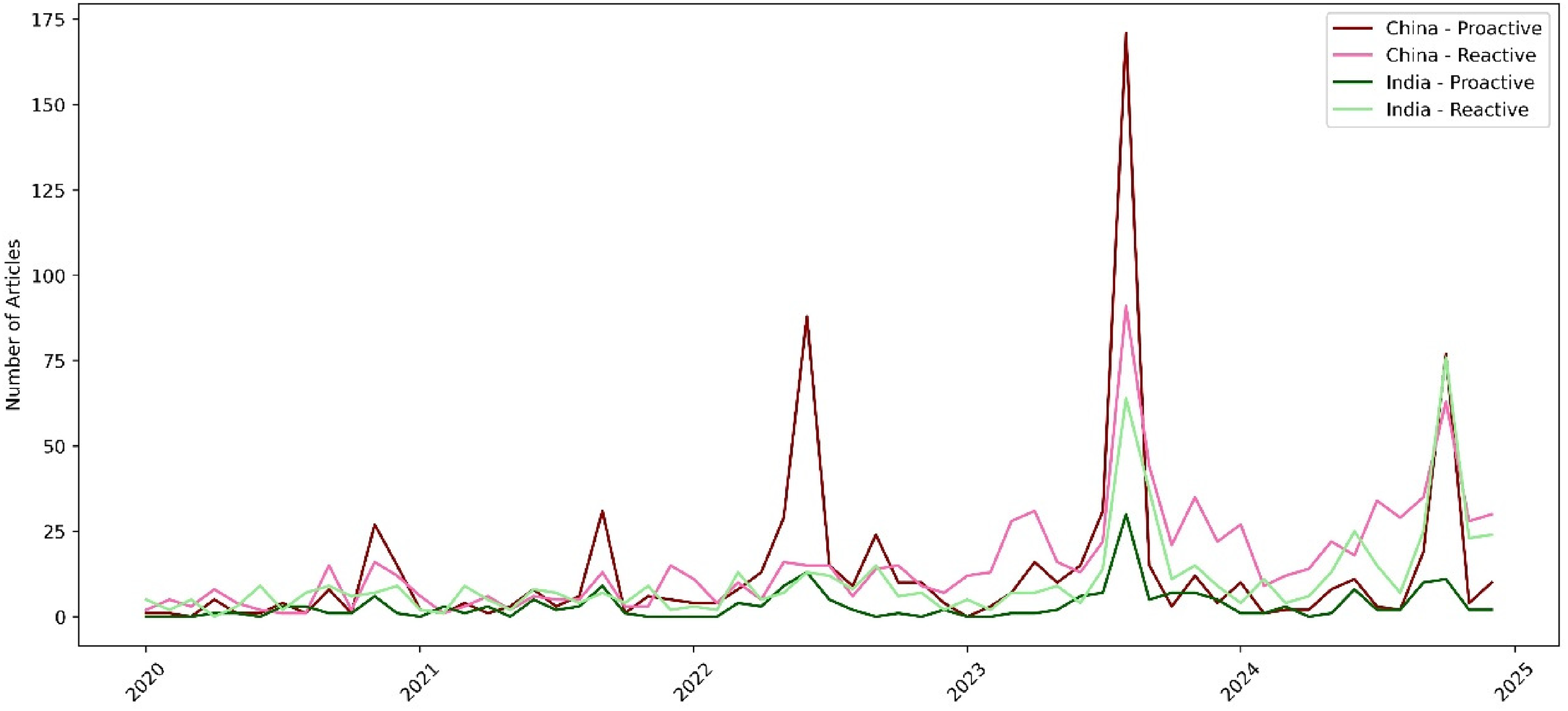
Temporal distribution of proactive and reactive articles in China and India.
It can be observed that during the summits China's reporting shifted from primarily reactive reporting to mainly proactive reporting. For instance, there were 88 proactive articles and 15 reactive articles in June 2022, and 171 proactive articles and 91 reactive articles were published in August 2023. Meanwhile, the number of articles in India also surged, but the trend of reactive reporting remained dominant. China's media clearly pivoted toward development and strategic goals around key BRICS milestones, whereas India's coverage remained predominantly event-driven throughout. This could be attributed to the different media systems in the two countries, especially the different relationships between the news media and the government. Chinese media usually represent the ‘official orthodox voice’ (Wang et al., 2018) while Indian media akin to liberal model. In this way, Chinese reporting has placed greater emphasis on BRICS as a strategic project.
It is notable that reports on BRICS have surged since 2023. To a certain extent, this challenges the idea that BRICS is a limited alliance between China and Russia (e.g., Glosny, 2010; Santos, 2024). BRICS is positioned as a strategic multilateral platform for New Delhi to enhance India's credentials, foster South–South cooperation, and balance ties with both Western and non-Western partners (Kumar et al., 2022; Verma, 2024).
To compare the differences and similarities between media coverage of BRICS in China and India, this study also explored the most discussed countries and regions in their coverage. In proactive reporting (see Figure 2), Chinese coverage generally covered the core BRICS countries and new members more extensively than Indian reporting did: Brazil appeared in 53.9% of Chinese news articles versus 46.7% of Indian ones; Russia in 68.1% of Chinese versus 73.1% of Indian; South Africa in 56.8% of Chinese versus 49.7% of Indian; and the new BRICS members, including Egypt, Ethiopia, Iran, and the United Arab Emirates, 1 in 12.8% of Chinese versus 5.6% of Indian coverage. Reactive coverage (Figure 3) showed a similar pattern: Brazil, South Africa, and the new members received higher reporting frequencies in Chinese media than in Indian media; by contrast, Russia appeared in 39.7% of Chinese versus 48.5% Indian reactive reporting.
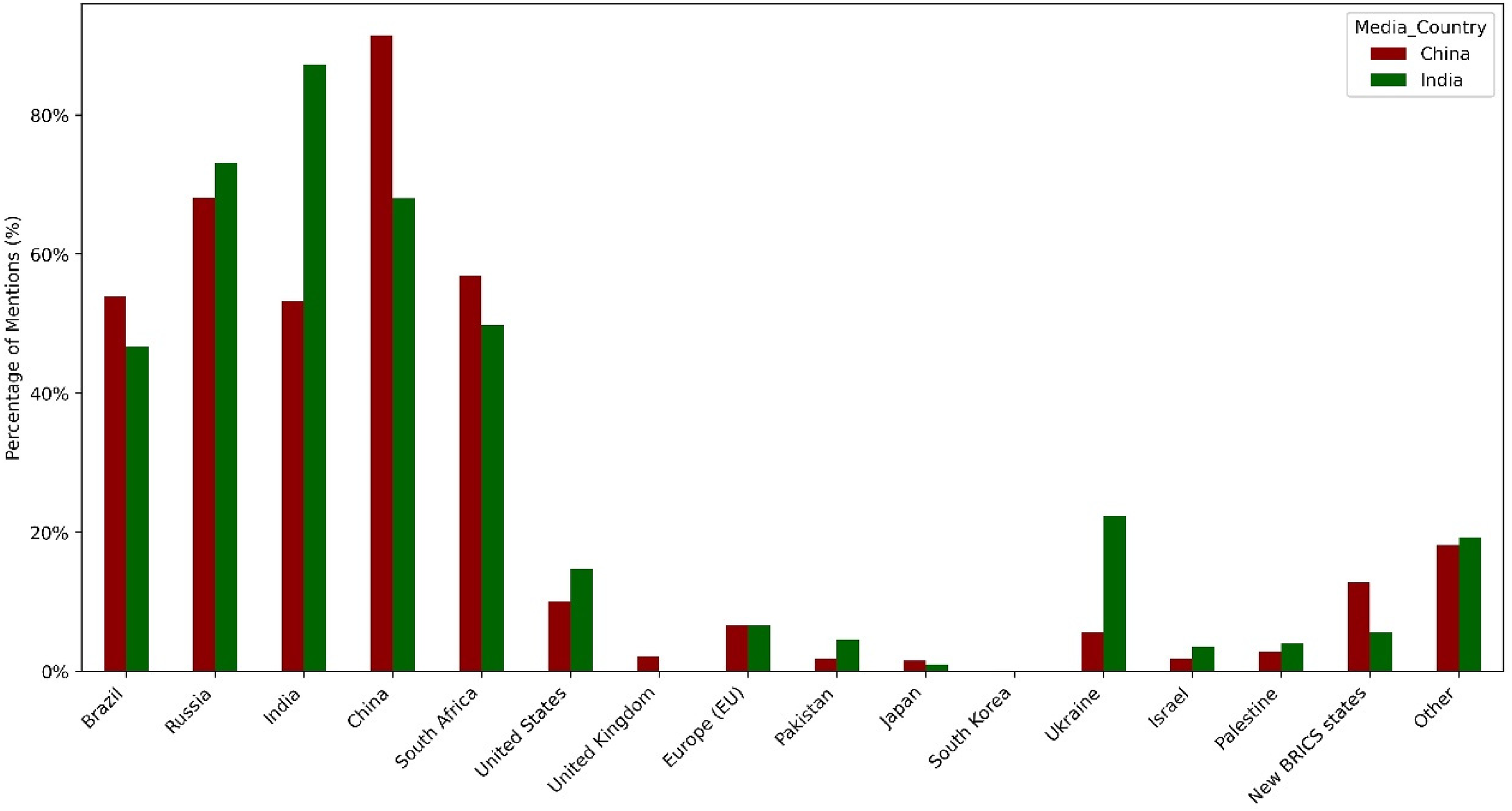
Countries mentioned in proactive coverage by Chinese and Indian media on BRICS.
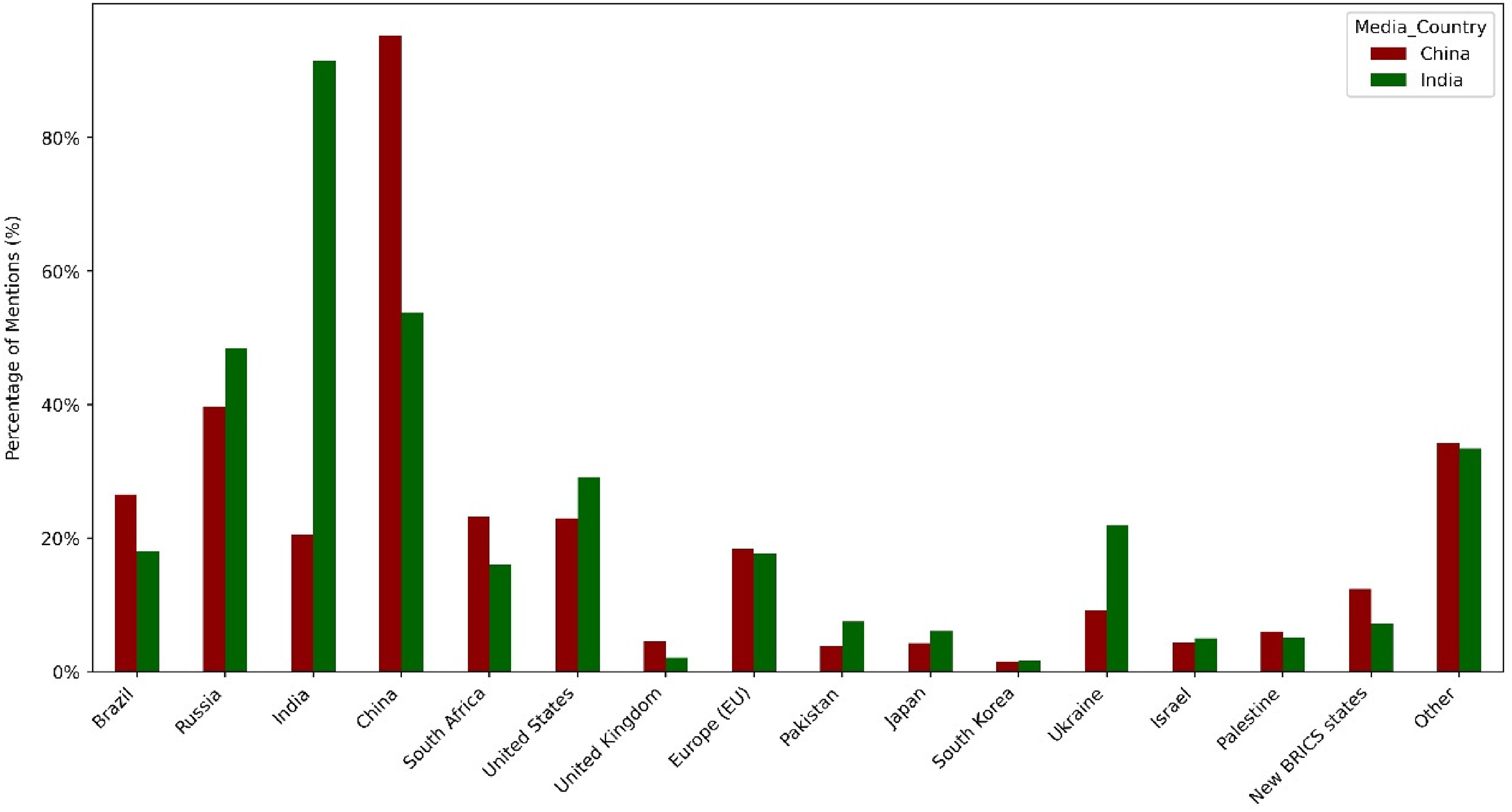
Countries mentioned in reactive coverage by Chinese and Indian media on BRICS.
These differences, again, challenge the notion that BRICS is merely an alliance between China and Russia. Chinese reports on BRICS mentioned both new and old members of BRICS more evenly, without particularly highlighting Russia. This echoes China's efforts to construct BRICS as a unified bloc to achieve common development (Lukin and Xuesong, 2019).
Importantly, it can be noted that Russia was mentioned more often in Indian coverage, and at the same time, Ukraine appeared in 22.3% of Indian proactive articles and 21.9% of Indian reactive ones. The corresponding percentages for China's reporting were 5.6% and 9.2%. This is also reflected in Figures 4 and 5: 4.6% of India's proactive news coverage and 3.8% of its reactive coverage focused on violent conflicts involving BRICS countries, while the corresponding figures for Chinese media were 0.3% and 0.5%. In the articles mentioning Russia and Ukraine, Indian media often covered India's calling for negotiations and ceasefire within the framework of BRICS. This was specifically relevant to India's national interest: strategic partnership with the USA since the 2000s (Mukherjee, 2020) with a glitch during the second term of President Donald Trump and at the same time also adopting a ‘multi-alignment strategy’ (Pant and Super, 2015).
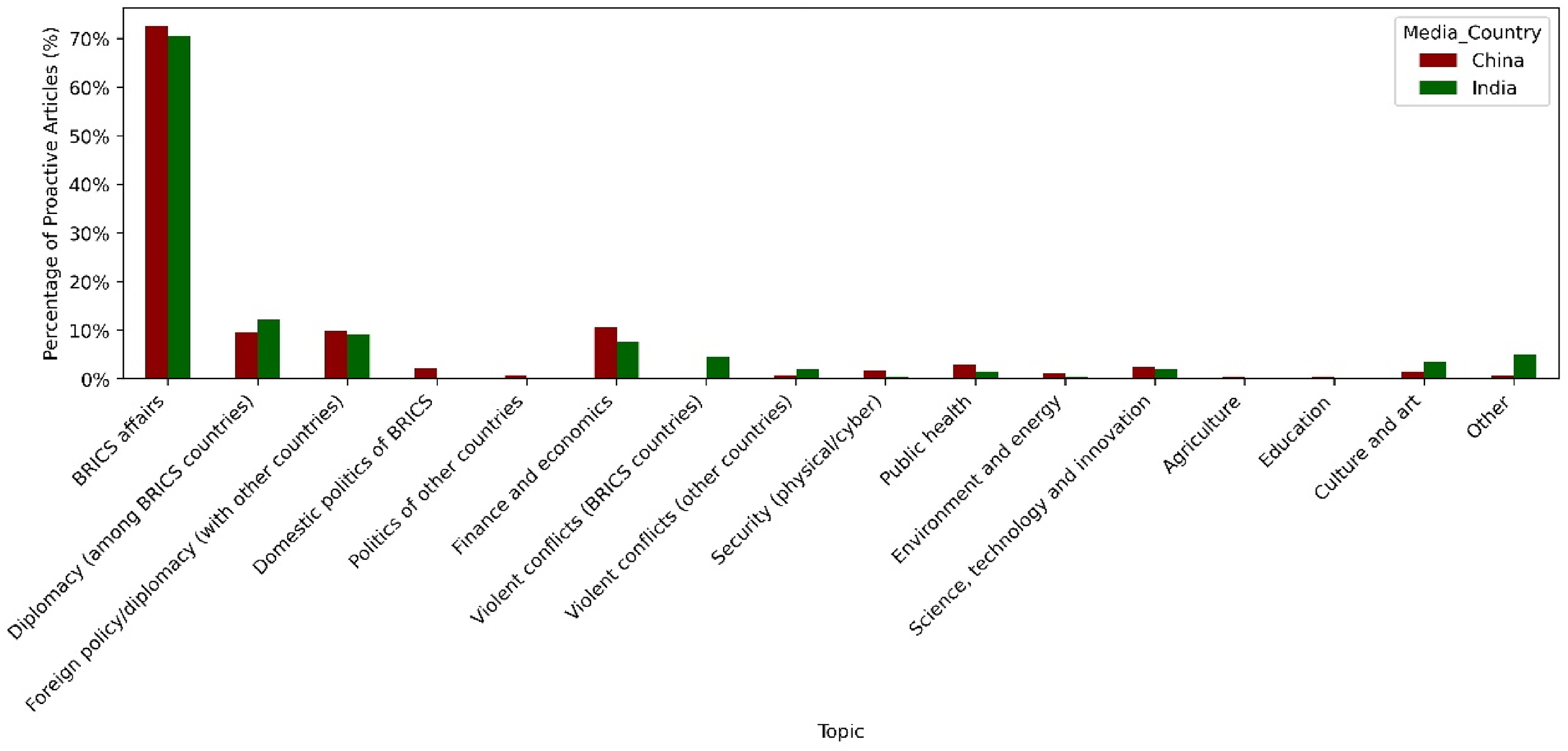
Topics mentioned in proactive coverage by Chinese and Indian media on BRICS.
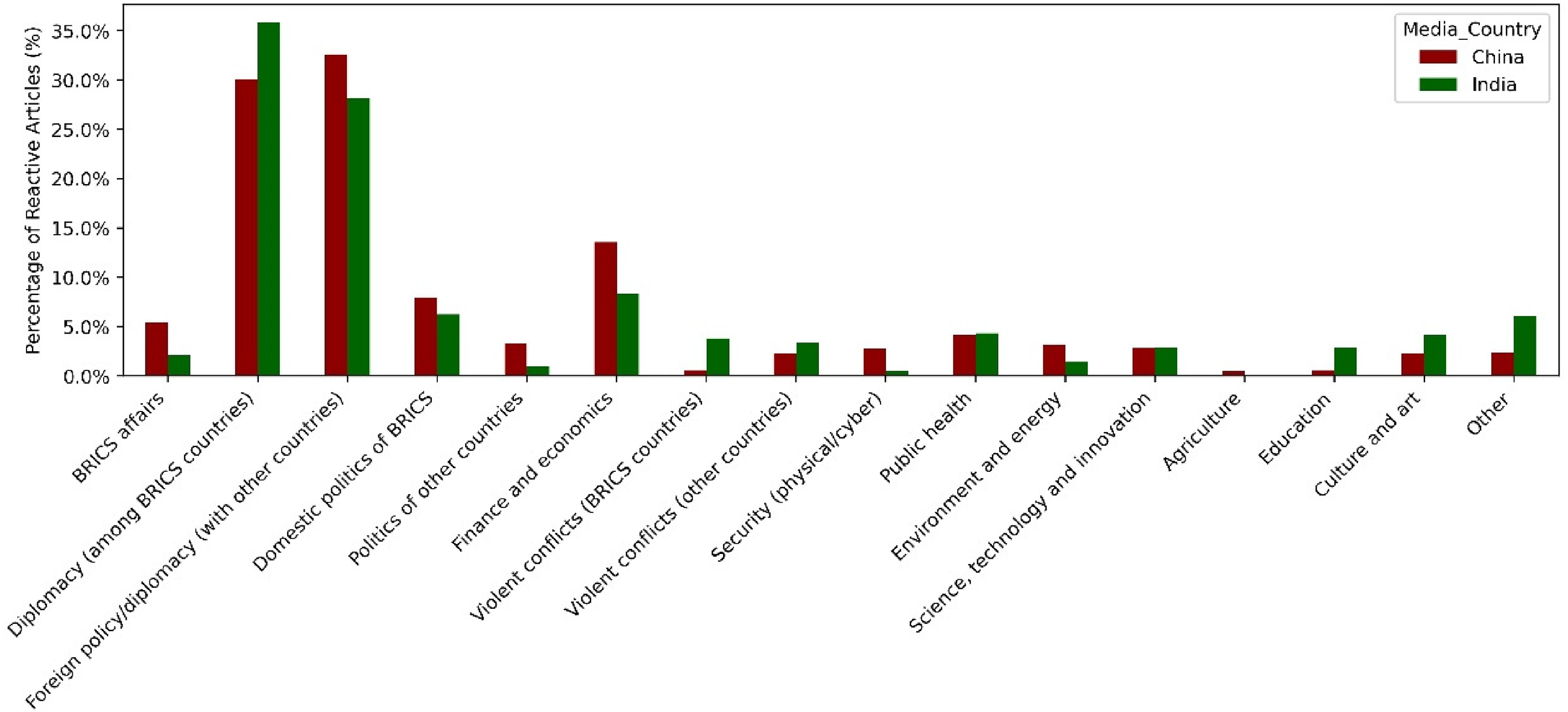
Topics mentioned in reactive coverage by Chinese and Indian media on BRICS.
This study also classified article topics into proactive and reactive reporting, highlighting similarities and differences between Chinese and Indian coverage. In both countries’ proactive reporting, BRICS affairs, that is, explicit activities and collaborations within the BRICS framework dominated (see Figure 4), echoing arguments that BRICS represents an alternative order (Schirm, 2023) and a platform for the Political South. In reactive coverage (see Figure 5), 30.1% of Chinese articles focused on intra-BRICS diplomacy while 32.6% on China's diplomacy with non-BRICS states. Similarly, 35.8% of Indian articles addressed diplomacy with BRICS members, while 28.2% examined India's diplomacy beyond BRICS. Both framed BRICS as central to South-South cooperation.
However, Chinese and Indian news outlets have different focuses in other topics. In both proactive and reactive reporting, China's reporting showed more interest in finance and economics than India's: 10.6% of Chinese proactive articles versus 7.6% of Indian ones; 13.6% of China's reactive coverage and 8.3% of India's. These numbers reveal that broad economic activities were linked to BRICS cooperation in China's media coverage, which is in line with China's attention to economic development with the BRICS framework (Lukin and Xuesong, 2019).
Indian media coverage, on the other hand, reveals that apart from politics and economics, there was also an attention on education (2.9%) and culture and art (4.6%). In contrast, data on reactive news reporting in China shows that 0.5% is related to education and 2.3% is related to arts and culture. This could be attributed to India's push for internationalising its education also reflected in global cooperation in scientific research (Fan et al., 2022). Furthermore, the export of cultural products such as films has been an important component of India's efforts to enhance its international influence (Chatin and Gallarotti, 2019; Thussu, 2013). Also, India had explicitly emphasised the importance of cultural exchange and cooperation among BRICS members (Press Information Bureau, 2024). In such a context, Indian media's attention to these topics suggests that BRICS might be viewed by India as a soft-power platform through which it can attract and persuade partner countries by launching cooperative projects, educational exchanges, and cultural initiatives.
Figures 6 and 7 look into the internal differences within the two countries to reveal some similarities in two countries’ reporting patterns on BRICS. In both countries, ‘BRICS affairs’ leads proactive articles, 72.7% in China and 70.6% in India, demonstrating a shared emphasis on summit agendas and collective narratives. In their reactive reporting, Chinese and Indian outlets similarly rely on diplomacy tags, both intra-group and with external partners, to cover the routine business of high-level meetings and state visits. Furthermore, in comparison within each country, the economy remains the most frequently discussed topic outside of diplomacy. For India, deepening cooperation within the BRICS framework could also serve as a new engine for sustained economic growth (Chaturvedi and Saha, 2019).
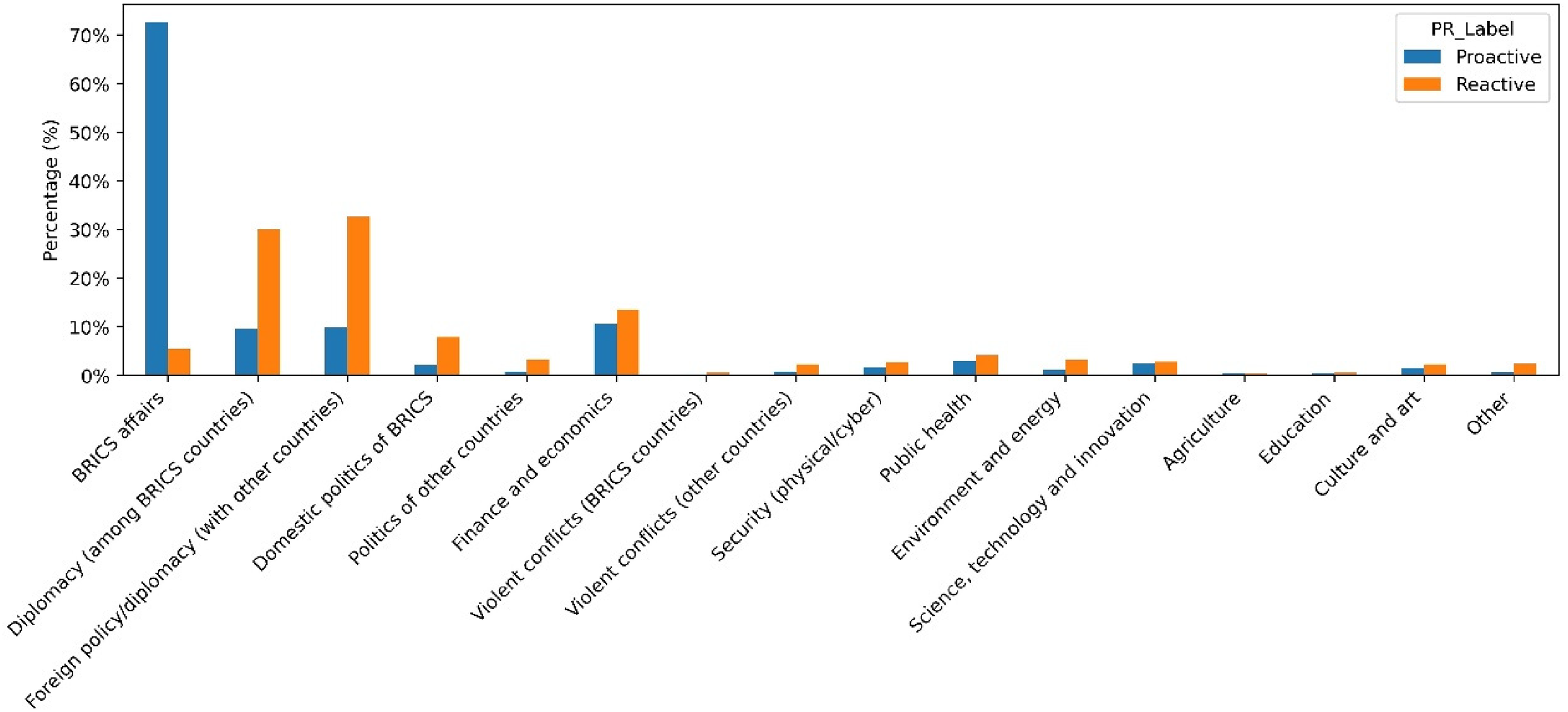
Topics mentioned in proactive and reactive coverage by Chinese media on BRICS.
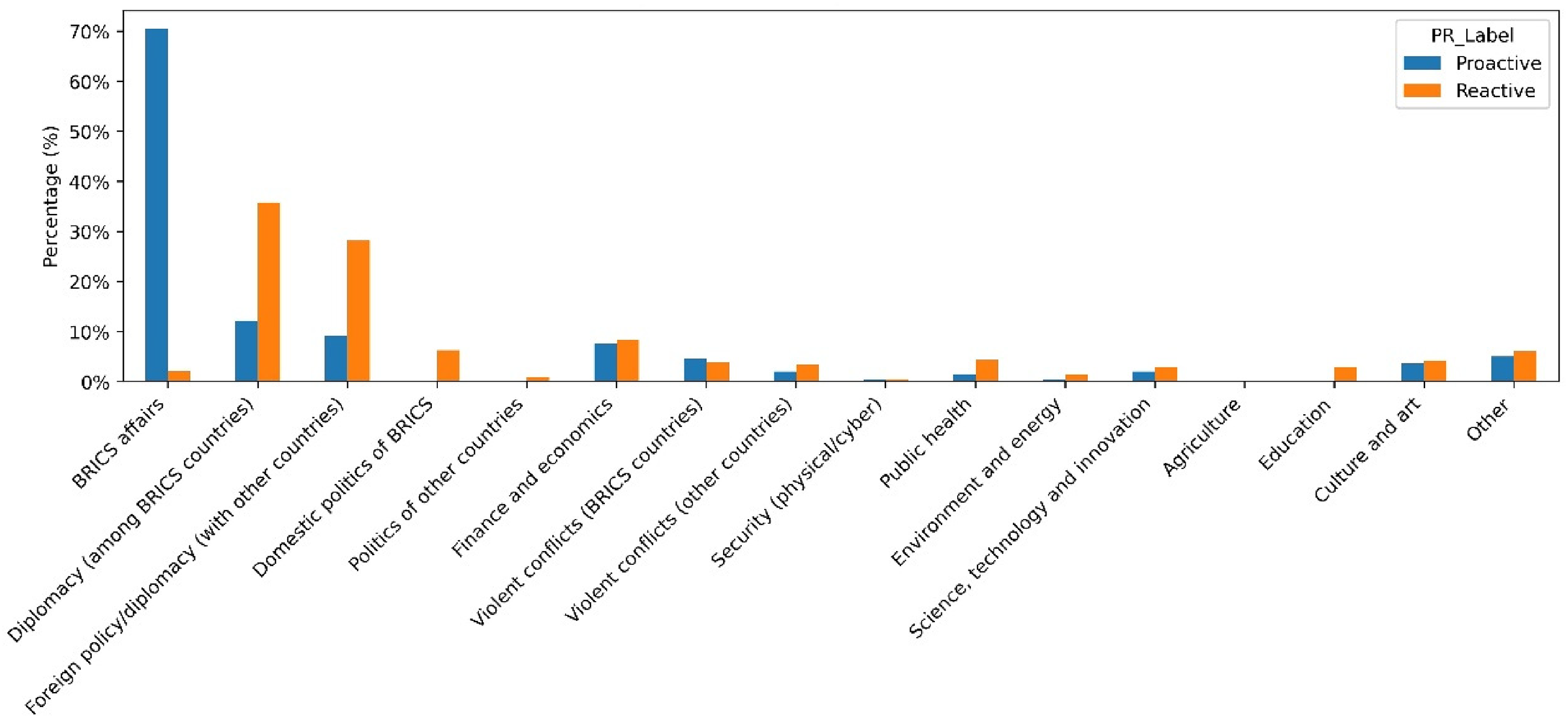
Topics mentioned in proactive and reactive coverage by Indian media on BRICS.
Discussion
Scholars have long debated whether coalitions of the Global South can generate communicative power in an environment where Western media flows remain dominant (Santos and Cazzamatta, 2025; Thussu, 2022). Such debates are particularly relevant in contexts where media narratives help make claims about multipolarity visible and meaningful (Chaturvedi and Saha, 2019; Kumar, 2025; Thussu and Nordenstreng, 2015; Kumar and Thussu, 2026). Yet, relatively little attention has been paid to how BRICS is represented in the media of its member states. This study addressed that gap by introducing the distinction between proactive and reactive coverage, and by applying it to a comparative analysis of Chinese and Indian news reporting.
The findings reveal clear contrasts. Across the dataset, Chinese coverage displayed a near balance but leaned slightly toward proactive frames (45.8% proactive, 54.2% reactive), with strong peaks of proactivity during summit periods such as June 2022 and August 2023. Chinese outlets highlighted institutional reforms, multipolarity, and the expansion of membership, situating BRICS as a platform for global governance reform. By contrast, Indian coverage was overwhelmingly reactive (23.7% proactive, 76.3% reactive). BRICS was largely framed through external issues, particularly the Ukraine war, and India's balancing role between the USA, Russia, and China. Cultural diplomacy and education exchange appeared, but typically as secondary frames. Both countries’ coverage was summit-driven and dominated by straight news reports rather than opinion pieces, suggesting a shared reliance on event-based news logic.
Chinese reporting demonstrates how proactive coverage functions in practice. During summit periods, Chinese outlets such as China Daily and People's Daily Online consistently highlighted BRICS as an engine of global change. Stories emphasised the emergence of entities such as NDB, the CRA, and the 2024 expansion of BRICS as markers of institutional maturity. Coverage tended to adopt a future-oriented temporal frame, signalling new possibilities rather than reacting defensively.
This aligns with scholarship on strategic narratives, where actors seek to structure understandings of the past, present, and future of international order (Miskimmon et al., 2013). This logic could be applied to comprehend the Chinese coverage of BRICS: the grouping as both a critique of Western-dominated structures and as a constructive alternative. Importantly, the findings also reflect the Chinese emphasis on discourse power. China's state-aligned media functioned as vehicles for projecting the long-held viewpoint that considers BRICS as a multipolar, inclusive, and reformist group (Lee and Sims, 2025; Lukin and Xuesong, 2019).
This proactive dynamic is consistent with scholarship on other multilateral initiatives. For example, research on China's coverage of the Belt and Road Initiative shows that state-aligned outlets framed the project as a vehicle for cooperative development, embedding China's leadership within a forward-looking vision of global order (Chu et al., 2025). Similar patterns have been noted in studies of summit diplomacy more broadly, where proactive media narratives position host countries and coalitions as agenda setters rather than passive respondents (Miskimmon et al., 2017).
Chinese media engages in more proactive agenda-building, compared with Indian media, by projecting BRICS as a cooperative platform for multipolarity, but the external resonance of these narratives remains uncertain. Indian media, on the other hand, reflected a strong reactive orientation. Over three-quarters of the articles coded for this study fell into this category. Reporting was heavily event-driven, triggered by crises such as Russia's invasion of Ukraine. BRICS was often invoked as a platform through which India could perform its balancing role, underscoring its ties with Russia while accommodating its growing partnership with the United States. This pattern reflects the logic of agenda building. Media coverage was closely tied to elite cues and external debates, rather than originating long-term strategic narratives. In a pluralist and commercially competitive press system foreign policy stories compete with domestic political and commercial priorities (Baig and Mushtaq, 2016).
Nevertheless, Indian media did not ignore the symbolic potential of BRICS. Some reporting highlighted soft power dimensions such as cultural diplomacy, initiatives related to education, etc. These storylines pointed to BRICS as a stage for India's global visibility. However, they rarely appeared proactively; instead, they were reactive to summit announcements or Western commentary. This suggests that while India aspires to a larger role/status on the global stage, its media enact this ambition through reactive rather than proactive framing.
These differences suggest that China and India do not merely report BRICS differently; they appear to perceive it differently. Chinese coverage treats BRICS as an order-shaping platform through which China can project multipolarity, institutional reform and Global South leadership. Indian coverage, by contrast, presents BRICS more cautiously as one forum among several through which New Delhi manages strategic autonomy, Russia ties, Western partnerships and China-related anxieties. Put differently, China's reporting is more proactive because BRICS aligns with its challenge to existing Western-dominated global hierarchies. India's coverage is more reactive because New Delhi engages BRICS through strategic flexibility rather than bloc-based opposition, balancing relations across the USA, Russia and China while pursuing issue-based cooperation. This reactive orientation should also be read against India's ambivalent engagement with BRICS under Modi-era foreign policy, shaped by concerns over China's growing influence within the grouping and India's preference for strategic autonomy (Kumar, 2023c). Thus, differences in media narratives reflect not only contrasting media systems but also divergent foreign policy logics.
Despite differences, the findings also identify shared features. Both Chinese and Indian coverage was, to an extent, summit-driven, with peaks around major events. This reflects the broader tendency of international organisations to enter media agendas primarily at moments of diplomatic performance. It also suggests that BRICS itself has not yet generated continuous news value outside summitry. Moreover, coverage in both countries was dominated by straight news and brief reports. Opinion pieces, editorials, or in-depth analyses were relatively few. This indicates that BRICS coverage often remained descriptive, privileging official statements and summit outcomes. In both cases, media largely refrained from developing deep interpretive narratives, though Chinese outlets did so more than Indian ones. These similarities show how event-driven news values shape coverage even across divergent media systems.
Proactive-Reactive as an analytical lens
The above-discussed findings and comparative analysis underscores the analytical value of treating proactive and reactive coverage not as binary categories but as a continuum (Figure 8) of orientations that media draw upon in representing international coalitions. By applying this lens, three dimensions become particularly visible in the coverage of BRICS across the Chinese and Indian media.
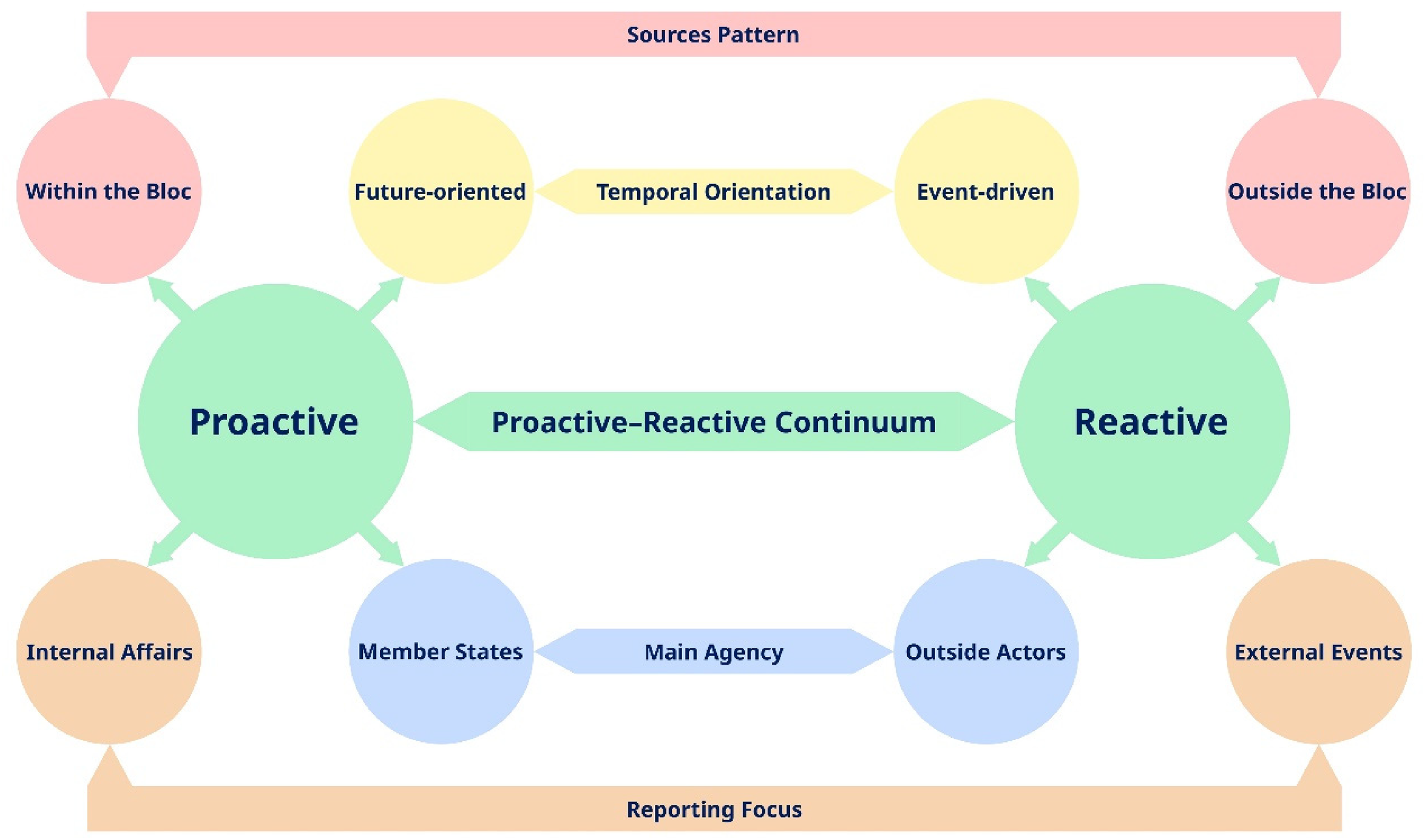
The proactive-reactive continuum.
First, the lens highlights structural contrasts in media systems. In China, where media are closely aligned with state priorities, coverage relatively gravitated toward the proactive end of the continuum. News outlets focused on summits, framed BRICS as an institutional innovator, and often emphasised the agency of the coalition itself or to member states collectively. This reflects the logic of agenda-building, where political elites set the narrative and media amplify it. In India, by contrast, its competitive outlets, which aim to capture more audience's attention, indexed coverage to external issues, such as conflicts and diplomacy outside the BRICS framework, and how it could be relevant with BRICS, often positioning BRICS and India as reactive actors. This contrast suggests that differences in media structure shape not only the volume of BRICS coverage but also the narrative logic through which the coalition is made meaningful.
Second, the lens foregrounds temporal orientation. Chinese reporting consistently projected into the future. The 2022 and 2023 summits were covered not just as events but as platforms to launch initiatives and expand membership. By contrast, Indian coverage remained tethered to the present and immediate past. Reports stressed India's balancing act amid geopolitical tensions (e.g., mediation in Russia–Ukraine conflict) rather than projecting long-term visions for BRICS. This shows how temporal framing itself becomes a marker of communicative orientation: proactive narratives anticipate and shape, while reactive ones respond and adjust.
Third, the lens sharpens our understanding of thematic emphases and geographic orientation. On themes, Chinese outlets consistently focused on economics, finance, and institutional reform, embedding BRICS within broader narratives of collective development and multipolarity. Indian coverage, by contrast, devoted greater attention to culture, education, and soft power initiatives, reflecting a tendency to treat BRICS as a platform for visibility and status-seeking rather than structural transformation. These thematic patterns were reinforced by divergent geographic orientations: Chinese reporting referenced BRICS member states more evenly, including new members of BRICS, whereas Indian coverage indexed more on Russia and Ukraine, tethering BRICS narratives to the immediacy of geopolitical crisis. These thematic and geographic emphases underscore how proactive coverage situated BRICS within a broad institutional horizon, while reactive coverage placed the focus on specific tensions and external flashpoints. These patterns reinforced the orientation of coverage: proactive story-built authority from within, while reactive ones derived legitimacy from external reference points.
These patterns also show that the proactive-reactive lens does more than categorise coverage; it helps interpret variation across structural, temporal, and thematic dimensions. The distinction helps us see why the same coalition is narrativised as a proactive driver of reform in one media system and as a reactive forum for crisis diplomacy in another.
Conceptually, the value of the proactive-reactive lens lies in its role as a heuristic device. We emphasise that rather than functioning as a fixed typology, it operates as a continuum that draws together insights from strategic narratives, discourse/soft power, and agenda-building into a single comparative frame. This enables us to move beyond binary distinctions between state-aligned and pluralist media systems, showing instead how orientations toward the future or toward external events structure media coverage.
Conclusion
This study has examined how BRICS is represented in Indian and Chinese media through a comparative content analysis. By introducing the distinction between proactive and reactive coverage, it offers a way of interpreting how media systems position the coalition within global politics. The findings point to a clear divergence. Chinese outlets consistently frame BRICS in forward-looking terms, emphasising institutional development, multipolarity, and collective advancement, particularly around summit diplomacy. Indian coverage, by contrast, more often situates BRICS within moments of crisis, external commentary, and strategic balancing. These patterns suggest that BRICS does not operate as a uniformly narrated project but is instead articulated differently across national media contexts.
The study makes three contributions. First, it extends scholarship on BRICS by foregrounding its communicative dimensions, showing how media narratives shape the coalition's perceived purpose and trajectory. Second, it develops a proactive–reactive analytical lens that provides a useful heuristic for comparative media analysis in multilateral contexts. Third, it contributes to debates in international political communication by demonstrating how differences in media systems are reflected in distinct ways of narrating global governance.
Narratives of cooperation, reform, and multipolarity gain significance only as they are circulated, reinforced, or contested through media. In this sense, the study highlights a key tension within South–South communication: while BRICS as a political project aspires to collective voice and alternative ordering, its media representations remain uneven and nationally inflected. Future research could extend this analysis by incorporating other BRICS members or by examining how these patterns unfold across television and digital platforms. The proactive–reactive lens may also be applied to other multilateral forums, offering a way to compare how similar or different coalitions are narrated across different media systems.
Footnotes

Funding
The authors disclosed receipt of the following financial support for the research, authorship, and/or publication of this article: The research is funded by the Start-up Research Fund of Beijing Normal-Hong Kong Baptist University (UICR0700112-25 and UICR0700115-25).
Declaration of conflicting interest
The authors declared no potential conflicts of interest with respect to the research, authorship, and/or publication of this article.