







Abstract
Tinselling and Grangerising were popular nineteenth-century hobbies. Both involved adding decoration to existing objects: tinsellers added coloured foils, fabrics and textured metal pieces to black and white or coloured prints, while grangerisers added illustrations and other information to printed books. The stage and popular theatrical personalities proved popular subjects for both. In this essay, I argue that understanding of the processes involved in tinselling and grangerising can aid a fuller understanding of the dynamics, practices and reception of the theatre of the time.
Keywords
His pay may be counted better by pence than by shillings, and the greater part of this passes on Saturday nights, from himself to the family existence fund, the odd pence he obtains for overtime, or by chance, he saves for a treat at the theatre, where he studies costume and expands his ideas of the beautiful upon tinsel pictures, which form the pride of his household walls.
1
Eliza Cook’s Journal (1850) The Grangerites are the people who enlarge a book in itself of little value, by inserting into its pages plates, playbills, street ballads and broadsides, pamphlets, autograph letters, newspaper clippings […] There is no limit to the Grangerite’s art, except the impossibility of finding more material to incorporate, or the desire of the toiler to end one labour of love in order to devote himself to another which has been too long neglected.
2
Standard (1885)
The ephemerality of theatrical performance is a familiar conundrum for the historian who seeks to capture its ghosts and tell their stories. Frequently, it is in remnants of its visual culture that we discover theatre performance’s most immediate traces. Set designs and set boxes, photographs and prints, costume designs, fabric swatches, theatre spaces and stage props together tell us something of an act of performance that occurred in the past. In the evidence surrounding colour, form, space, embodiment and movement captured in these objects the transitory event we seek comes more closely into focus. Yet this evidence, too, is unstable. Its materiality is not only touched by time, through colour fade, chips, paper decay or missing elements, it also sits out of its own time. Each image or object represents an isolated part of the wider networks of visual culture within which it functioned as an element of a theatrical performance event. Attempts to negotiate the absences inherent in each piece of evidence, and to understand the multiple visual significations of theatrical images and objects in their time, necessitate broader engagement with the theatrical productions, aesthetics and managements for which they were created. Each set, costume and lighting plot was embedded in the creative and industry practices and cultural trends of a moment. Theatre was a site of constant change and development. Each set of aesthetics – commercial or avant-garde – was historically specific. This process, of what Tracy C. Davis has identified as the ‘hatching in’ of context, further requires that we seek an understanding of those who witnessed the theatrical event; the bodies of spectators who were literate in the particular historical – and local – languages of visual culture that we now encounter, channelled through an archival or museum object, from a distance. 3 In this article, I engage with the widely accepted connection between theatrical iconography and spectacle and wider visual culture. I am interested in how an interdisciplinary approach to particular remains of theatre’s visual culture and the processes by which objects were created might offer us a better understanding of the live performance event we relentlessly seek.
Accessing data about audiences proves a great challenge, one that remains under represented in scholarship, perhaps because of the diverse and sprawling research programmes that it demands. 4 Within the field of theatre history, discussions of audiences have remained wary of generalisations. Nonetheless, over the last decade scholars have identified a body of knowing, sophisticated spectators that characterised and defined mid-Victorian theatre and music hall, including those Jacky Bratton evokes in her reading of an 1843 playbill for the Royal Albert Saloon and Standard Tavern and Tea Gardens in Shoreditch. Bratton’s description of a group of spectators who would, and could, follow eclectic evenings of entertainment that demanded they ‘surrender to and withdraw from dramatic illusion’; demonstrate their ‘admiration for the visual effects’ and give ‘applause for the individual feats of skill [that] would ebb and flow throughout the night’ highlights their visual literacy. The sophisticated and complex ways of seeing audience members brought to each theatrical event were ‘effortlessly deployed’, Bratton argues, because, as audiences, they were ‘well educated in what they were witnessing’. 5 How these spectators saw what they saw on the stage before them depended on the wider circulation of visual culture that they encountered on a day-to-day basis. The nineteenth century’s cultural industries were moulded and fostered by a thriving interface between the visual and performing arts. Mirroring and engaging with the social and technological developments of modernity, popular theatrical entertainment channelled an ever-shifting aesthetics of spectacle. Unapologetically contemporary, the wide cultural references that were fused together in popular theatrical performance were targeted at this visually sophisticated audience base.
The ephemeral modes of spectatorship and rapidly changing taste that prompted and characterised theatrical entertainments are intangible, undocumented. The popular reception of a mass reproduced image or a celebrated theatrical moment remains elusive. Sales figures, critical responses, ticket sales and artistic memoirs tell us little about the appeal. Many questions remain. What was it that was popular about a particular image or aesthetic? What sold an image to a contemporary audience? How was it viewed by its contemporaries? What did they see? Taking two popular hobbies that spanned the nineteenth century, tinselling and grangerising, this article explores ways of addressing and reflecting on the visual literacy of audiences, and of understanding and working with the multiply mediated representations of theatre’s visual past that are encountered by researchers of theatre and performance history. 6 Each object I discuss can be usefully understood as a palimpsest: a layered, carefully constructed series of responses to, and interpretations of, stage culture.
Making tinsel pictures, or tinselling, was a popular early- to mid-nineteenth-century hobby. The craze peaked in the 1830s and 1840s and began to tail off in the late 1870s. Starting with a plain or coloured print, widely and cheaply available at printers and stationers, the home-tinseller added paints, fabrics and metallic foils, creating a bright, collaged, light-reflective image. Popular during the same period, grangerising was also concerned with the domestic customisation of a commercially produced object. The Grangerite began with a book, ordinarily a single volume publication, and purchased and inserted additional prints and illustrations that they understood to complement or extend the original subject matter. Although rooted in the flourishing print industries of late-Georgian London, both hobbies came to be closely connected with the theatre. The subjects of the majority of tinsel pictures and of many grangerised books were theatrical celebrities and popular plays and stage roles. Each theatrical tinsel picture and grangerised book reveals an individual process and traces of a spectator’s active engagement with the theatre industry through a leisure activity. There were cost implications to each hobby. Tinselling was a cheaper activity. The widespread availability of its tools and accessories that is indicated through their survival in archival and museum collections signals its popularity and commercial success. Grangerising was a more costly activity that not only involved the purchase of the original book, but also the collection of a series of prints to add in to the text. Through the new works created by tinsellers and Grangerites and the choices that they made in these creations, many responses to the theatre industry and visual culture of a moment are encapsulated. Understood paratextually, tinsel pictures and grangerised books offer a window on those elusive ‘well educated’ audiences and capture traces of their active visual literacy. As Eliza Cook’s Journal’s 1850 description of the Errand Boy who treats himself to an evening at the theatre, studies costume and returns home to ‘expand[s] his ideas of the beautiful upon tinsel pictures, which form the pride of his household walls’ signals, these are objects that were created in dialogue with stage performances, by those who knew them. 7
‘It Takes a Long Time to Kill Certain Hobbies; In Fact, Some Hobbies Refused to be Killed’ 8
The popularity of theatrical prints dates back to the first decades of the nineteenth century and printer-stationers including J. K. Green (1790–1860), William West (1783–1854) and Orlando Hodgson (c.1801 Unknown). Although it remains unclear when the very first tinselled pictures appeared, the idea had caught on by the 1820s.
9
The subjects depicted on tinsel pictures were not limited to stars of the stage. They also included members of the monarchy, highwaymen and religious subjects and iconography. Nonetheless, it is repeatedly noted that theatrical celebrities were the most common choice of subject for a tinsel picture.
10
Charles J. Tibbits, writing for the London Magazine in the early years of the twentieth century, recorded that: The subject of the [tinsel] picture is almost always an actor or actress, a general, or a Monarch. I put actors and actresses first, let me hasten to say, not out of any republican sentiment, but because as subjects for the tinseller they easily surpassed all others in popularity. At least nine pictures out of ten are the portraits of some favourite actor or actress, and as the ‘heavy drama’ affords most opportunity for splendour the tragedian is naturally most common.
11
Prints of theatre performers were widely available, cheap and marketed initially at the working and lower-middle classes for collection and home display or – in the case of the plain prints – for home colouring. Further embellishment was, in many ways, a logical evolution of this new, but quickly established wing of the print industry that focused on the popular London stage for its material. We know from examples in collections that from early on in the nineteenth century, buyers began not only colouring, but also enriching their print by adding fabrics, foils, leather and feathers to further ornament the image of the stage performer in front of them.
14
Later, the process became more commercialised and an ‘almost bewildering’ array of materials were made available to the tinseller.
15
Trade catalogues document the mass production of coloured tinsel pieces and dies for punching accessories, while store display cards evidence the range of tinsel shapes and colours available.
16
Tinsellers could buy pre-cut pieces including anchors, stars and harps, fashioned from gilt paper in a range of colours, at the cost of two-penny a packet.
17
The silks and satins needed to fashion skirts, trousers and cloaks were available in small pieces. Each was priced individually.
18
While the prints were cheap, producing a tinselled picture was not. In a 1922 article in the Billboard H. R. Barbor identified the tinsel picture as evidence of the love for the stage in the mid nineteenth century: By cutting out the coat of a gallant or the dress of a leading lady and pasting silk, velvet or cloth on the back so as to show thru the aperture, a realistic dressing of the favourite was obtained. […] But the decoration did not end here. Special dies were made which turned out embossed silver and gold tinsel patterns, swords, jewels, chains, armor and ornaments of all kinds and these were patiently gummed on to the prints by the worshipers of the theatrical idols. This was not merely a labor of love – it was expensive. Often workingmen would spend many shillings in perfecting a tinsel picture and they were wont to buy two or three pennyworth each of which went to the making of these portraits and is evidence of a sincere love of the theatre and of those who trod the boards.
19
There was a bookseller’s at the corner of the street […] an odd, squeezed up shop, full of startling tinsel pictures, and penny-murder sheets, with copies of verses and serial stories that ran on for one hundred and four weekly numbers, and comprised something awful in each.
20
The Late-Georgian Theatrical Celebrity and the Tinsel Picture: Charles Mayne Young
A case study of an image of Mr Charles Mayne Young, a popular late-Georgian actor, in the role of Rolla from Richard Brinsley Sheridan’s five act tragedy Pizarro (1799) serves to illustrate this sense of the tinsel picture as visual testament to the adulation felt for certain performers (Plate 1). It is an early Orlando Hodgson print dating from the 1820s and one that turns up reasonably regularly in archive collections of theatrical prints, as well as tinselled pictures. Hodgson was part of the second wave of London printers who turned to theatrical culture and the tinsel print industry in the early nineteenth century, arriving on the London scene in the early 1820s. He was a versatile artist, as well as a print and toy theatre maker, known for his satirical political cartoons, as well as for his representations of theatre performers. Born in 1777 and retiring in 1832 Charles Mayne Young was a versatile actor, noted for his equal strengths across comedy and tragedy. He began his career in the provinces, making his London debut in 1807 at the Haymarket Theatre. His first performance of Rolla was in 1824 at the Theatre Royal, Covent Garden and it became his most celebrated role and one he revived regularly for the next five years.
Tinsel Picture of Mr Young as Rolla (Orlando Hodgson, 1820s), Courtesy of University of Bristol Theatre Collection.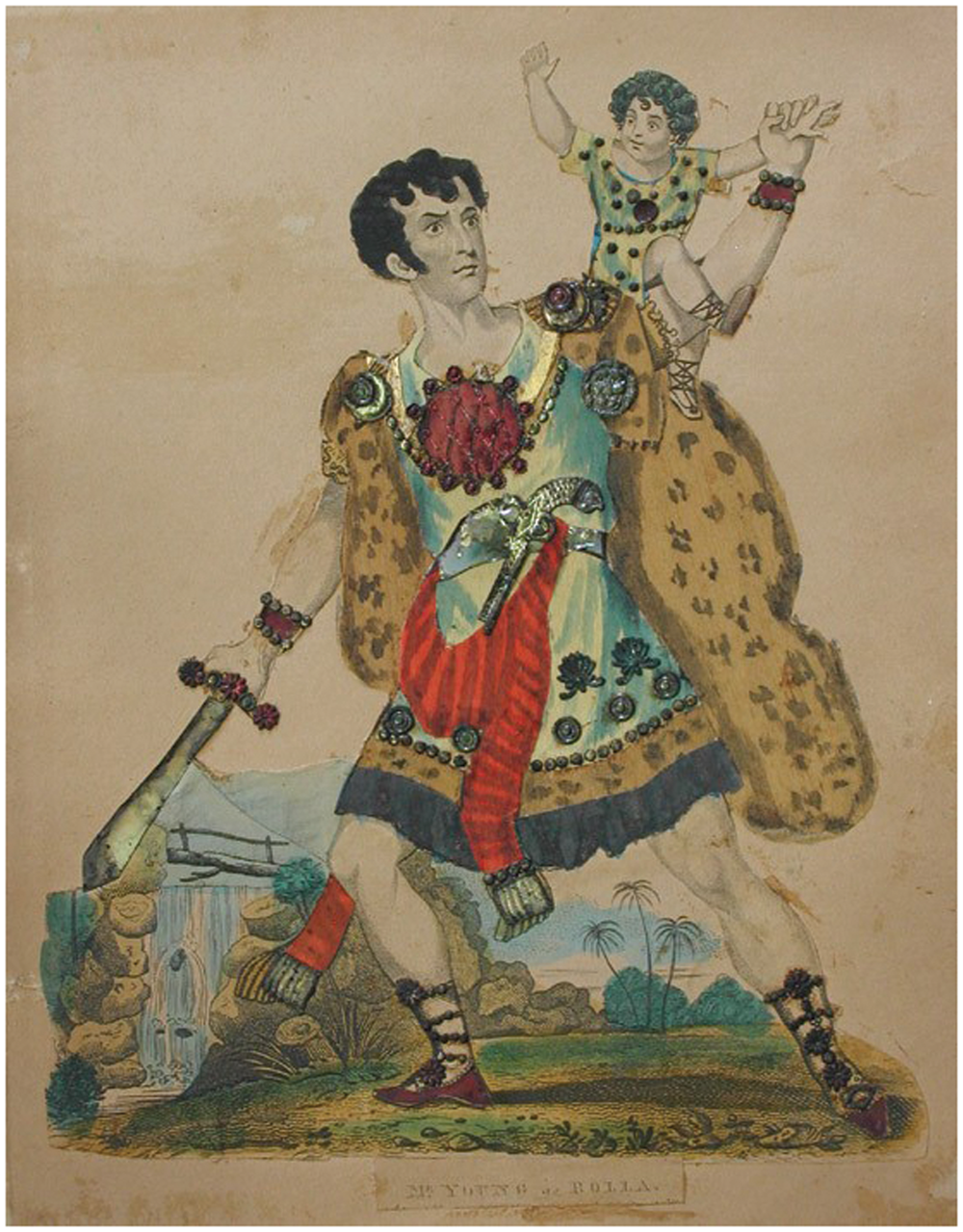
Pizarro is a sensational stage drama that tells of the conquest of Peru by the Spanish conquistador Francisco Pizarro. Rolla – Young’s role – led the Peruvians against Pizarro the Conquistador and the Spanish army. At his side was Pizarro’s ex right-hand man, Alonzo – who defected, voting with his feet for the integrity of the Peruvians against the pillage of the Spanish. To complicate things further, Alonzo’s arrival in the Peruvian camp prompted the split of Pizarro and his lover Cora. Cora fell quickly for Alonzo, Pizarro nobly stepped aside to ensure Cora’s happiness and witnessed Alonzo and Cora marry and produce a son. In a spectacular battle scene Rolla saves the Peruvian king’s life and Alonzo is wounded and captured. Rolla enters the camp disguised as a priest and gains entry to Alonzo’s cell. In the cell they switch clothes and Alonzo escapes. Rolla is discovered and after winning a verbal confrontation with Pizarro through his demonstration of honour and dignity, he is permitted to walk freely from the camp. While Rolla and Pizarro are engaged in their war of words, Alonzo and Cora’s child has been seized by Spanish soldiers and brought to the Spanish camp. Rolla sees the child and demands its release. Pizarro refuses. Rolla grabs the child and flees. He escapes but is shot en route by Spanish soldiers and mortally wounded. He makes it back to the Peruvian camp in time to return the child (the moment depicted here), before dying at Alonzo’s feet. The sensational narrative was accompanied by a series of opulent scene designs: forests, mountain passes, campaign tents and battles and enhanced by stirring incidental music. In addition to its regular production history, Pizarro was a popular choice for toy theatre makers and theatrical prints. 22 The play was a popular sentimental drama with a visual impact that spectators appreciated enough to want to recreate it at home in various ways.
Young’s performances of Rolla were highly praised: the Examiner’s conclusion that ‘no one at present can do more justice’ to the declamation of Rolla ‘either in the way of dignity or justice’ than Mr Young, who ‘was received with immense applause’ is representative. 23 In 1834, two years after Young’s retirement, the actor Mr Vandenhoff made his first appearance as the Peruvian leader. The Morning Post was concerned, recalling ‘the splendid declamation of Mr Young and the high romantic passion he threw into every scene’, and questioning whether another performer could achieve such an ‘exaltation of the character’. 24 Young’s immortalisation in tinsel, assured by the anonymous hand that created this tinsel picture, is part of the same adulation that we see here in the press, its embodiment. Many contemporaries and historians have noted the pre-illustrated press status of early tinsel prints and suggested that early tinsel prints are a substitute for the later pin-up photograph or poster of stage favourites. They are, however, of greater interest than a documentation of celebrity. It is possible, of course, that this is a recycled print, tinselled later in the nineteenth century, but it is also likely that the anonymous tinseller that lovingly embellished this print was someone who saw Young play the role.
Looking more closely at the subjects and embellishments of tinsel pictures gives a clearer understanding of the multiple mediations of performance embedded in these objects. They speak in various ways. Straightforward consideration of the performers who were repeatedly represented, and the roles that they were regularly portrayed in, yields information about fame, repertoire and the market for tinsel pictures. 25 In addition to their subject matter and the personalities depicted, the images capture information about costume, props and gesture. The moment of the play chosen for representation in the print also offers some insight in to the moments audiences favoured in stage dramas, which may, or may not, reflect what can be gleaned from textual or scenic evidence, or from reports from reviewers. While this information needs to be treated with due caution, and addressed with dominant portraiture conventions in mind and an appreciation that the mass production of pre-made tinsel pieces that printers had a vested interest in selling may well have impacted on the ways in which some elements of the original prints were designed, these images offer some evidence of theatre performance. In addition to these ways of approaching the tinsel picture as a visual object, prioritising the process of tinselling locates each picture as testament to the imprint that the visual culture of the stage left in the mind of its many spectators and cements its presence amid a wider world of visual culture and leisure. The pictures are transformed by candlelight. In the flickering, warm glow of a candle the metallic foils gleam, reflect light and reveal texture as they would have done before the advent of electricity. Switching the light around them draws attention to the need for the recognition of process. Tinsel prints were the result of active spectators immersed in the visual culture of their day, and of theatre performance as an ephemeral event interpreted in multiple ways across theatres, seasons and performances.
By the mid-nineteenth century, ‘tinsel’ had become a pejorative term, representative of excess, of glamour, of glitter and a popular aesthetic. In the press of the mid 1850s, the word is used to convey cheap costumes and effects, to hint at recycling and limited budgets. In a celebratory response to an Adelphi Theatre production of The Pearl of the Ocean in December 1847 the reviewer highlighted that such a ‘magnificently got up fairy extravaganza’ had not been seen in London ‘for a long time’. Its key strength was ‘the mounting of the piece’; deemed to be ‘no mere gilt paper and tinsel work’. 26 The word increased in resonance over the century, increasingly used to capture the essence of the commercial theatre industry for those who were concerned about the status and outputs of the British stage. Simultaneously, tinsel pictures dating from earlier in the 1800s became sought after collectors’ items as art objects, distanced from their origins. Tinselling became a hobby more widely undertaken across the class spectrum, with tinsel kits offered as free gifts in magazines targeted at school-age boys. Perhaps this explains to some extent the lack of scholarly interest in the theatrical tinsel picture, its status as ephemera connected with the popular and the mass audience. When understood as moments of interaction, of an ‘act and practise of relating’ they form a key element in developing narratives. 27 In this process, it is possible to access different narratives, produced by different sets of hands and voices.
‘Against the Grangerites Bibliophiles have Preferred a Charge of Vandalism’ 28
If an occasional visit to the theatre and the tinselling of pictures were pastimes that filled the scant leisure time and emptied the pockets of the Errand Boy and his peers, grangerising offered a hobby for the individual with ample time on her or his hands and a respectable amount of disposable income. Coming to the fore in Britain in the second half of the eighteenth century, grangerising remained a popular pastime for around a hundred and fifty years. Starting with a printed edition of a text – ordinarily a biography, or a history – the Grangerite would seek out and add other relevant material, most commonly in the form of prints. Following the early modern European tradition of commonplace books and echoing the later nineteenth-century popularity of illustrated pocket diaries, the grangerised book was concerned with ideas about knowledge making and narrative production, as well as collection. Each grangerised text offered a different way of telling long-past and recent histories, with the Grangerite putting together additional narratives and greater contexts to those that were contained in the original printed work. 29
Presented by the Grangerites amid discourses of edifying and intelligent knowledge creation and artistic and bibliophilic connoisseurship, grangerising was understood by many others (in particular the publishing and printing industries) to be an obsessive process of desecration and cultural vandalism. In following the hobby, grangerisers were cast as ‘book breaker[s]’, rather than ‘book preserver[s]’; ‘collector[s] whom librarians look at askance’. 30 By the 1820s, this reading of the pastime as disreputable and damaging had been made widely familiar by the literary press. From the earliest accounts, a language familiar from descriptions of theatrical villainy encircled the Grangerite. In 1811, the Literary Panorama, alarmed by the recent rise in grangerism, considered it their responsibility to issue a clear warning against the prowling Grangerite. The key concern of the article was the Grangerite’s outward appearance; he (and it was consistently a he) was indistinguishable from any trustworthy member of the affluent classes. ‘Since the rage has prevailed for forming collections of portraits’ the editorial noted ‘it is not uncommon for gentlemen assuming the character of the greatest respectability […] to find themselves unable to resist the temptation which presents itself in the shape of a scarce portrait prefixed to the tomes of an author’. 31 The focus of this anxiety haunted the majority of accounts of the Grangerite and was reiterated explicitly in the London Quarterly Review’s 1828 depiction of the ‘thorough-bred Grangerite, who, without pity or remorse, plunges his trenchant scissors into the very abdomen of the tome’. 32 While the working-class tinseller occupied him or her-self with a hobby that created something new from mass produced materials and that was broadly identified as an edifying and productive diversion, the outwardly respectable gentleman who used his greater portion of leisure time to grangerise undertook a pastime that attracted disdain and despair.
In spite of the dubious status of the pastime, grangerised books have proved popular items with collectors from the mid 1880s; the finished products are recognised as items of cultural capital in a way that disconnects with the response to the process. The description of Grangerites as ‘book breaker[s]’, rather than ‘book preserver[s]’; ‘collector[s] who librarians look at askance’ (cited above) comes from an account of a sale at Sotheby’s in January 1885, making it clear that concerns over the hobby had not receded during the century. 33 Seemingly, however, the grangerised texts had been separated out from the hobby and become highly sought after, in a similar way to the theatrical tinsel picture today. What also emerges from records of auction houses in the final decades of the nineteenth century is that the grangerised book became closely connected with theatrical portraiture and ephemera and that grangerised books on these themes were popular with collectors. In December 1885 at Christie’s a grangerised edition of Colley Cibber’s Apology for his Life, illustrated with one hundred and fifty-three portraits, was followed by a lot consisting of a collection of portraits of David Garrick and other actors and actresses. A 1904 Sale in London featured an edition of Sidney Lee’s 1898 biography, the Life of William Shakespeare. Originally published as one volume, the grangerised version consisted of four volumes, expanded through the addition of two hundred and fifty-four additional illustrations. These extra illustrations included ‘a series of portraits of actors and actresses who have played Shakespeare’ from Booth (Edwin Booth, 1833–1893) to Macready (William Charles Macready, 1793–1873), highlighted in the sales catalogue. As opposed to grangerised texts sold on the quality of the printmakers and illustrators, these texts were sold on their subject matter and the personalities included. It is hard to trace the number of grangerised texts dedicated to theatrical figures and themes. Few are catalogued as such, although many researchers of theatre history will have encountered them during their archival research. Nonetheless, press accounts indicate that the grangerised theatrical text was a familiar and popular form.
Perhaps the most high profile of the theatrical Grangerites was the playwright Henry Herman (1823–1894). Herman owed his success to his late-Victorian melodramas, including his co-authorship with Henry Arthur Jones of The Silver King (1882). In January 1885, a large part of Herman’s dramatic library was put up for sale at Sotheby’s. The lots included several grangerised texts and it was these items that attracted the most press attention and raised the greatest sums. At the peak of the sale, a celebrated version of Frederick Hawkins’ 1869 biography, the Life of Edmund Kean, expanded from one volume to four volumes through Herman’s grangerising, was bought on behalf of the actor Henry Irving for one hundred and fifteen pounds, no insignificant sum. 34 It was not the only grangerised book that Irving collected, several featured in the sale of his effects after his death, all of which, again, raised significant amounts of money. 35 While some of the value accorded to these objects is undoubtedly down to the accrual of provenance and intra-industry interest, there is a deeper and more intrinsic connection between the theatre industry and the grangerised book operating beyond mere questions of ownership.
The prints and portraits included in grangerised theatrical texts spanned the professional and production histories of theatres, plays, playwrights and performers, but came up to date in the inclusion of current stage celebrities. Moving away from the original model of extra-illustration connected with the grangerised book, they also often included correspondence, excerpts from first drafts of plays, playbills or other works and autographs, reflecting the Standard’s 1885 description of grangerising: The Grangerites are the people who enlarge a book in itself of little value, by inserting into its pages plates, playbills, street ballads and broadsides, pamphlets, autograph letters, newspaper clippings […] There is no limit to the Grangerite’s art, except the impossibility of finding more material to incorporate, or the desire of the toiler to end one labour of love in order to devote himself to another which has been too long neglected.
36
Tinselling, Grangerising and New Ways of Seeing
Tinselling and grangerising are not the only late-Georgian and Victorian hobbies that offer some insight into their creators’ ways of seeing. Other leisure activities including decoupage screens and scrapbooking were similarly focused on an individual’s drawing together, interpretation and organisation of visual culture.
37
These activities predated and occurred alongside the earliest of the theatre collectors whose obsessions have formed the base of the richest and most comprehensive theatrical collections scholars can work with today. They offer alternative narratives about repertoire, celebrity and popular theatrical performance. However, the tinsel picture and the grangerised book do have a particularly strong and enduring connection with the theatre industry that is embedded in the inseparable links between the stage and visual culture.
38
The art historian Jonathan Crary has identified the early nineteenth century as a moment of complete paradigm shift in visual culture, one that can be marked by its absolute rupture with the previously dominant classical models of seeing. This was, he argues: [f]ar more than simply a shift in the appearance of images and art works, or in systems of representational conventions. Instead it was inseparable from a massive reorganisation of knowledge and social practices that modified in myriad ways the productive, cognitive and desiring capacities of the human subject.
39
Together the active processes of tinselling and grangerising present us with a conceptual model for bringing together the circulating networks of textual and visual images that created and surrounded theatre events. Foregrounding ways of working that embrace ways of seeing as historically specific processes enables a distinct encounter with the chaos and collision of images that is involved in the visual literacy and theatrical activity of a period. In the case of the tinsel picture and the grangerised book, considering how people took theatrical images and re-made or re-contextualised them at home suggests that while narrative order might be central to the comprehension and organisation of the histories we construct, understandings of theatrical moments – a performance, a season, a trend – perhaps benefit less from linearity than from an understanding of these sprawling networks. 42 This approach bears the imprint of a step change in intellectual ‘ways of seeing’ over the last fifteen years, with the move towards interdisciplinarity that has characterised the Humanities and, crucially, been prioritised by funders in its fields. Taking our lead from the ways of seeing that we can trace in past popular practices, and evading the entrenched disciplinary boundaries they necessarily span, we are presented with a figurative blank page on which, following Joe Moran, ‘problems and issues that cannot be addressed or solved within the existing disciplines’ can be laid out and modelled. A process that is Moran (following Roland Barthes) argues, ‘always transformative in some way, producing new forms of knowledge in its engagement with discrete disciplines’. 43
Challenging our readings of theatre’s history by engaging with evidence visible in and amid the layers of the other viewings and readings inherent in tinselling and grangerising’s processes and objects raises the possibility of witnessing, from a distance, a set of active engagements with the stage. Moreover it offers an opportunity to interrogate how we might approach such archival material in new ways in order to make greater sense of the myriad meanings it contains. Embracing the multi- and inter-disciplinary ways of seeing used on a daily basis by our spectator ancestors could open our own contemporary scholarly eyes to colours, textures, connections, gestures and light that might not have attracted our attention before.