







Abstract
This paper considers Sarah Siddons’s cross-gender performances as Hamlet in relation to critical fascination with the character’s interiority in the early Romantic era. An examination of the responses to Siddons’s Hamlet in the context of late eighteenth- and early nineteenth-century studies of the play reveals that Siddons’s contemporaries saw the actress’s femininity and acting methods as particularly effective for conveying the sensibility and irresolution that became increasingly associated with Hamlet in literary criticism of the period. In particular, the responses to Siddons’s performances emphasise Hamlet’s first encounter with his father’s Ghost, a scene often considered the focal point of definitive performances by actors like Thomas Betterton, David Garrick, and Siddons’s brother, John Philip Kemble. The fact that these commentators describe Siddons’s Hamlet as superior to her brother’s and praise her reactions in the Ghost scene suggests that Siddons succeeded in creating a dramatic interpretation of the character that aligned with the Romantic focus on Hamlet’s inner life.
By the early nineteenth century, Hamlet had become arguably Shakespeare’s most iconic character. On the stage, the part was associated with a long line of famous Shakespearean actors, including Thomas Betterton, David Garrick, and John Philip Kemble. Though rarely mentioned in stage histories of the play, the great tragedienne Sarah Siddons, Kemble’s even more famous sister, was another illustrious performer to play Hamlet. Siddons never performed the role in London, but the few existing responses to her performances suggest that her appearances as Hamlet were well received and taken quite seriously by the public. 1 The three most extensive reflections on her Hamlet – an entry in Robert Rainey’s diary from 1802, James Boaden’s Memoirs of Mrs. Siddons (1828), and Ann Radcliffe’s essay ‘On the Supernatural in Poetry’ (1826) – praise Siddons’s rendering of the character and claim that she even surpassed her brother in the role. These responses call particular attention to Hamlet’s reactions to his father’s Ghost in Act 1, a part of the play that was considered a hallmark of the performances by Betterton, Garrick, and Kemble. The fact that these texts compare Siddons’s Hamlet favourably to Kemble’s and praise her acting in the pivotal Ghost scene suggests that she was able to transcend gender boundaries to excel in a part closely associated with many distinguished male actors.
In this essay, I examine Siddons’s performances as Hamlet in relation to the growing emphasis on the psychology of Shakespeare’s characters in literary criticism of the early Romantic period. While studies of Hamlet earlier in the eighteenth century tended to evaluate the play according to neoclassical rules of drama, the interpretations that began to emerge in the last decades of the century focused less on the plot and more on the hero’s inner life. Critics celebrated the play for its masterful portrayal of Hamlet’s psychological complexity and began to emphasise certain character traits, particularly his sensibility, melancholy, and irresolution. These late eighteenth-century studies laid the foundations for the influential Romantic interpretations of Hamlet as the paralysed ‘man of genius’ by writers like Johann Wolfgang von Goethe, Samuel Taylor Coleridge, and William Hazlitt. 2 By comparing the responses to Siddons’s Hamlet to critical essays by William Richardson, Henry Mackenzie, and Thomas Robertson, I argue that contemporary observers found Siddons’s femininity and methods of acting particularly effective for conveying the delicacy, sensitivity, and intense feeling that became increasingly associated with Hamlet in the late eighteenth and early nineteenth centuries. 3 The Prince’s first encounter with his father’s Ghost in Act 1 plays a key role in setting the tone for the performance and representing the character’s interiority because it showcases the actor’s ability to communicate the character’s inner turmoil through physical reactions to the apparition. Siddons’s celebrated skill for portraying conflicting emotions and psychological distress in Shakespearean roles like Lady Macbeth seems to have been ideal for playing a character increasingly defined by his inner life.
Further, I argue that the responses to Siddons’s Hamlet suggest that early Romantic audiences saw the actress as exceling in the role in spite of and because of her gender. On the one hand, the commentary implies that Siddons succeeded as Hamlet because her extraordinary genius as an artist allowed her to transcend the issue of gender. Nonetheless, the commentators’ remarks about the actress’s distracting ‘feminine gait’ and ambiguously gendered costume – as well as the allegations of sexual impropriety that resulted from her Hamlet performances in Dublin – suggest that the actress’s female body remained an obstacle for some spectators who saw her in the role. In Boaden’s words, ‘were [Mrs. Siddons] but a man, she would exceed all that man has ever achieved in Hamlet’. 4 In one sense, moreover, Siddons’s cross-gender performances epitomised the dangers that many Romantic writers associated with representing Shakespeare’s characters on stage. In playing Hamlet, Siddons not only gave a physical form to a character that critics like Coleridge, Hazlitt, and Lamb believed should only be brought to life in the reader’s imagination but she also degraded the character by associating him with the female sexuality associated with breeches roles.
On the other hand, the responses to Siddons’s Hamlet claim that the actress’s specifically feminine sensitivity and tenderness allowed her to portray Hamlet’s thoughts and emotions in a vivid and powerful way. In making this claim, the commentators draw on eighteenth-century medical and cultural theories of sensibility and the belief that women were more innately sensitive and emotionally expressive because of their more delicate and impressionable nervous systems. 5 For contemporary spectators like Rainey, Boaden, and Radcliffe, Siddons’s acute feminine sensibility gave her an advantage in rendering Hamlet’s interiority and made her subjective responses, particularly to the Ghost, more convincing and moving than in Kemble’s acclaimed performances. While Siddons’s female body keeps her from becoming ‘an unrivalled Hamlet’, 6 it is also her female body that endows her with the sensibility to become ‘the finest Hamlet who ever appeared’. 7 The responses to Siddons’s cross-gender performances thus explore the possibility that the actress could successfully embody the Romantic Hamlet celebrated by literary critics of the period. As the great Shakespearean performer of the age, Siddons succeeds as Hamlet regardless of her gender, and yet paradoxically her success in the role is precisely because she is a woman.
Siddons as Hamlet: From Worcester to Dublin
Siddons was not the first actress to attempt the part of Hamlet. Throughout the eighteenth century, actresses occasionally played male roles because of the popularity of breeches parts, which offered audiences the chance to see women perform in form-fitting breeches. 8 In Women as Hamlet: Performance and Interpretation in Theatre, Film and Fiction, Tony Howard notes that the first allusion to a female Hamlet occurs in the colourful autobiography of the actress Charlotte Charke, who claims to have played the part while traveling with a small theatre company when no male actors were available to play the role. 9 In 1741, Fanny Furnival became the first woman in the official theatre record to play Hamlet when she performed the part at the Smock Alley Theatre in Dublin. During the last decades of the eighteenth century, moreover, several actresses are known to have played Hamlet in provincial theatres throughout England and Scotland. According to Howard, these performances often occurred on benefit nights when actors ‘could try parts denied them by the casting system and novelty might boost their earnings’. 10 By the early nineteenth century, however, some critics had begun to complain about the number of women playing male roles. 11 One such complaint, written by Leigh Hunt, specifically attacked the actress Jane Powell for ‘her frequent whim of assuming the character of Hamlet’. 12
Since it was not that unusual for women to play male roles, Siddons’s performances as Hamlet may not seem particularly noteworthy. Nonetheless, it is striking that she played the role at both the beginning and the end of her career. 13 In other words, she did not play the part only before she became famous in London and was subject to much public scrutiny or only after she became famous and earned the creative licence to choose more experimental roles for herself. In her early days playing in provincial theatres, the part of Hamlet was part of her standard repertoire. She is known to have played Hamlet in Worcester (1775), Manchester (1777), Birmingham (1777), Liverpool (1778), Bristol (1781), and Edinburgh (1781). 14 Nearly two decades later, at the height of her fame, she played Hamlet in Dublin in 1802 and 1805. 15 Incidentally, Hamlet was one of the roles mentioned in the letter that brought her to the attention of David Garrick, the leading Shakespearean actor of the period. 16 In August 1775, the Reverend Henry Bate wrote to Garrick in praise of Siddons’s acting and teasingly observed, ‘Nay, beware yourself Great Little Man, for she plays Hamlet to the satisfaction of the Worcestershire critics.’ 17 Although this remark may have been more of a comment on the tastes of Worcester audiences than a tribute to Siddons’s performance, it is significant that the actress received early recognition for her appearances as Hamlet and was compared, however jokingly, to Garrick, the most famous Hamlet of his day.
Siddons’s decision to return to the part of Hamlet in Dublin late in her career is intriguing in part because she never had much success in roles that required her to cross-dress.
18
As Rosalind in As You Like It, for example, Siddons was unfavourably compared to the actress Dorothy Jordan, who excelled in comic roles and breeches parts.
19
Siddons’s performance as Rosalind was particularly criticised because of her choice of dress; in the scenes where the heroine disguises herself as a boy, Siddons wore an androgynous costume that concealed her legs from view.
20
Fiona Ritchie writes that the negative responses to Siddons’s Rosalind indicate that her performance ‘was unsatisfactory because the costume she adopted in cross-dressing, while sufficiently different from the clothes she wore for the rest of the part to make a distinction, did not adequately convey that she was dressing as a man’.
21
This costuming choice may have also disappointed London audiences because of the expectation that breeches roles would involve the spectacle of the actress’s legs. Woo observes that Siddons’s Rosalind costume seems to have been similar to the outfit she wore to play Hamlet in Dublin in July of 1802.
22
The Dublin costume, which is depicted in detail in a drawing by Mary Sackville Hamilton, included a long black cloak that came down to her ankles (see Figure 1). Robert Rainey, the diarist who attended the 1802 performance, writes that Siddons wore ‘a long black scarf which was very nearly the equivalent of a petticoat’.
23
For this observer, Siddons’s Hamlet costume had distinctly feminine overtones.
Mary Sackville Hamilton, ‘Mrs. Siddons’s Dress as Hamlet. Act Ist Scene II. “Aye Madam, it is common”. July 27th, 1802’. © Trustees of the British Museum.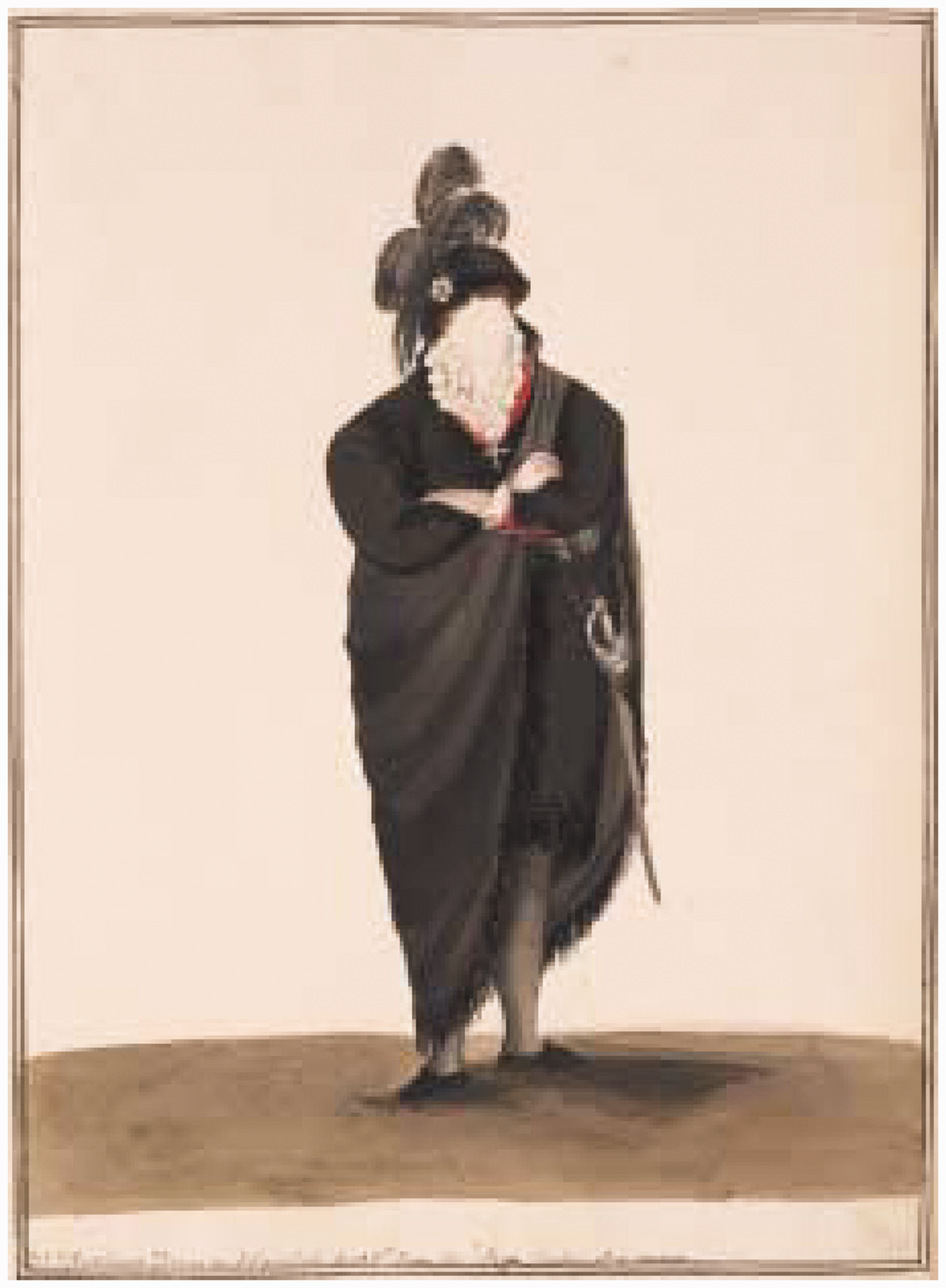
Because Siddons’s androgynous Rosalind costume was so strongly criticised, it is perhaps surprising that the actress chose to play a role as iconic as Hamlet in an outfit that at least one spectator found to be ambiguously gendered. Nonetheless, Siddons perhaps had reason to believe that her Hamlet would be better received than her performances as Rosalind. It was clearly a role that she performed with some frequency early in her career, and she may have felt that it was better suited for her talents as a primarily tragic actress than a comic breeches role in which Jordan could easily outshine her.
24
Furthermore, while Siddons’s original Rosalind costume obviously differed from the standard set by other actresses, her Hamlet costume may not have been that different from what other actors of the period wore to play Hamlet. In fact, the costume depicted in Hamilton’s sketch closely resembles the costume shown in Sir Thomas Lawrence’s famous painting of Kemble as Hamlet.
25
According to most stage histories of the play, Kemble was the first actor to wear ‘period dress’ while playing Hamlet rather than the ‘modern court dress’ that Garrick and other actors had worn before him.
26
Alan R. Young explains, Kemble broke with tradition and wore a costume suggestive of Elizabethan dress, the so-called Vandyke costume, that included […] a sleeved doublet, trunk hose, tights, and a lace collar, with a baldric to support a sword. To this he added for crucial scenes the long, enveloping, dark cloak and the bonnet with its tall black plumes.
27
Nonetheless, Siddons’s Hamlet performances were not entirely free from scandal. In 1809, Catherine Galindo wrote a public letter charging Siddons with having an affair with her husband, the Dublin actor-manager who played Laertes to Siddons’ Hamlet in 1802 and 1805. In her letter, Mrs Galindo accused Siddons of proposing herself in the role of Hamlet while in Dublin ‘for no other purpose than to be taught fencing by Mr. G. for by doing so you had an excuse to have him constantly with you, to the exclusion of my company’.
31
In January 1810, The Dublin Satirist published a cartoon in response to the scandal featuring Siddons, dressed in Hamlet attire, fencing with Galindo while his wife watches in horror from behind a curtain (see Figure 2). The caption reads ‘A palpable hit!!!’, a line taken from the fateful fencing match between Hamlet and Laertes in the final act and used to insinuate a physical relationship between Siddons and Galindo. Like Hamilton’s drawing, the cartoon shows Siddons wearing a large hat with feathers and a cloak over a doublet, two key features of the Vandyke costume. The cartoon, however, does not depict Siddons’s cloak as concealing her body from view and instead greatly exaggerates the size of the middle-aged actress’s backside in breeches. While Siddons’s sword points to Galindo’s heart, his sword suggestively points between her legs. With its obvious innuendoes and unflattering depiction of Siddons in breeches, the cartoon clearly underlines the enduring implications of cross-dressing for women. ‘The Galindo Affair’ made clear that even an actress as revered as Siddons could face ridicule and sexual suspicion, especially when performing more daring and gender-defying roles.
32
It is therefore all the more remarkable that spectators like Rainey and important writers like Boaden and Radcliffe chose to regard Siddons’s cross-gender Hamlet as a serious artistic endeavour – especially at a time when critical interest in the play and its protagonist was reaching new heights.
‘A Palpable Hit!!!’ The Dublin Satirist, January 1810. Harvard Theatre Collection, Thr 489.3.29. Houghton Library, Harvard University.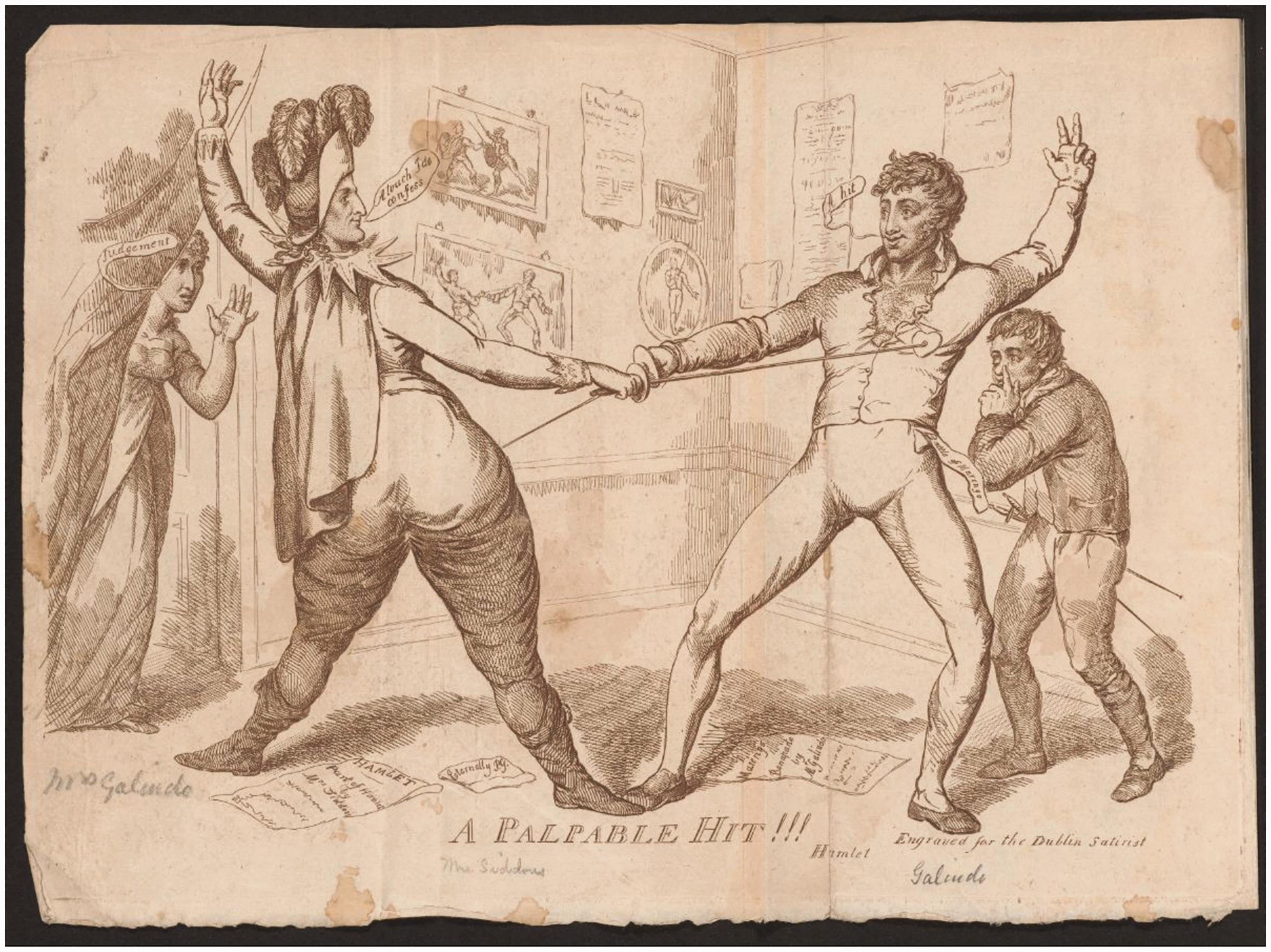
The Emergence of the Romantic Hamlet
During the decades when Siddons was performing Hamlet, studies of Shakespeare’s play began to demonstrate a new fascination with the hero’s interiority. Earlier in the eighteenth century, critical responses to Hamlet tended to follow the ‘beauties and faults’ approach typical of Shakespeare scholarship of the period and evaluated the play according to the neoclassical principles of drama. 33 Samuel Johnson, for example, praises many features of Hamlet but concludes that overall the play does not adhere to the rules of probability, decorum, and poetic justice. For Johnson, the Ghost’s appearance and Hamlet’s assumed madness do not have ‘adequate cause’, Hamlet’s behaviour is inconsistent and unbecoming for a prince, and the ending violates the laws of ‘poetical justice’. 34 By the end of the eighteenth century, however, critics had become less focused on the plot and more interested in the psychological complexity of Shakespeare’s character. Amy Muse explains that ‘in the late eighteenth century, the interpretive arts of acting and literary criticism (in conjunction with the development of the novel and the autobiography) became particularly interested in exploring ways to externalise or make manifest the interior life of characters’; as a result, ‘Hamlet became a favorite text to interpret because it was reinterpreted as a play about consciousness, the unfolding of a mind through soliloquies and often paradoxical (in)action.’ 35
According to Brian Vickers, the studies of Hamlet by William Richardson, Henry Mackenzie, and Thomas Robertson epitomise the character criticism that emerged in the late eighteenth century and represent an important bridge between neoclassical critiques of the play and influential Romantic interpretations of Hamlet. 36 Although they wrote at different times over three decades, Richardson, Mackenzie, and Robertson each focus on Hamlet’s subjectivity and describe the hero as a young man of great virtue, intellect, and deep feeling. Richardson frames his chapter on Hamlet as an analysis of the inner workings of the hero’s mind. 37 According to Richardson, Hamlet’s ‘exquisite sense of virtue’ makes him feel the treachery of his mother and uncle so keenly that he longs to carry out his revenge; at the same time, his high moral principles demand absolute proof that Claudius has killed his father before he can act. 38 Rather than focusing on Hamlet’s ‘moral excellence’, 39 Mackenzie, in his 1780 essays for the dramatic periodical The Mirror, describes Hamlet’s melancholy and ‘extreme sensibility of mind, apt to be strongly impressed by its situation, and overpowered by the feelings which that situation excites’. 40 For Mackenzie, Hamlet is a character ‘endowed with feelings so delicate as to border on weakness, with sensibility too exquisite to allow of determined action’. 41 In his 1790 essay ‘On the Character of Hamlet’, Robertson similarly praises Hamlet’s ‘exceedingly high elevation of soul, an exquisite sensibility to virtue and vice, and extreme gentleness of spirit and gentleness of disposition’. 42 He ultimately declares, ‘Hamlet … was not formed for action. Upon the fluctuation of his mind between contriving and executing, between elevation, sensibility, and gentleness, hangs the whole business of tragedy.’ 43 For Richardson, Mackenzie, and Robertson, the substance of Shakespeare’s play unfolds within the mind of its eponymous hero rather than through the events of the plot. By transforming Hamlet into a figure of interiority and inaction, these writers begin to question whether such a character can be acted on stage at all.
As Paul S. Conklin notes, the essays of Richardson, Mackenzie, and Robertson anticipate the more famous Romantic readings of Hamlet as an emotionally fragile, intellectual, irresolute, and possibly even unmanly figure who becomes paralysed when confronted with the prospect of revenge.
44
In Wilhelm Meister’s Apprenticeship, Goethe’s protagonist observes that in Hamlet ‘a lovely, pure, noble and most moral nature, without the strength of nerve which forms a hero, sinks beneath a burden which it cannot bear and must not cast away’.
45
According to Coleridge, Hamlet demonstrates Shakespeare’s familiarity with ‘mental philosophy’ and shows the workings of a mind affected by an ‘overbalance of imagination’. Because of his ‘morbid sensibility’, Hamlet becomes ‘a creature of meditation, and loses the power of action’. 46
Similarly, for Hazlitt, ‘Hamlet is as little of the hero as a man can well be’; his ‘is not a character marked by strength of will or even of passion, but by refinement of thought and sentiment’.
47
As Hamlet came to be seen as a work about the inner life, critics also began to claim that its complexities could not be adequately conveyed through performance, a reflection of the period’s antitheatrical attitudes. Prominent Romantic writers like Coleridge and Hazlitt, though avid theatregoers themselves, argued that Shakespeare’s plays were best interpreted through the private act of reading rather than through dramatic representation on the stage. Hazlitt, for instance, observes, ‘We do not like to see our author [Shakespeare]’s plays acted, and least of all, Hamlet. … Hamlet himself seems hardly capable of being acted.’
48
In his 1811 essay on the unfitness of Shakespeare’s plays for the stage, Charles Lamb writes that ‘What we see upon a stage is body and bodily action; what we are conscious of in reading is almost exclusively the mind, and its movements.’
49
For Lamb, the embodiment of Shakespearean characters on stage reduces the poet’s ideal to ‘the standard of flesh and blood’.
50
Lamb writes, Why, nine parts in ten of what Hamlet does are transactions between himself and his moral sense, they are the effusions of his solitary musings … how can they be represented by a gesticulating actor, who comes and mouths them out before an audience, making four hundred people his confidants at once?
51
Embodying the Romantic Hamlet
The responses to Siddons’s Hamlet reflect the Romantic view of Hamlet that was emerging in literary criticism of the period. In their discussions of her performances, Rainey, Boaden, and Radcliffe all focus on the actress’s exceptional ability to render Hamlet’s interiority and associate the character with introspection and irresolution. Siddons’s gender, however, complicates the reception of her performances. On one level, Siddons’s gender works against her claim to serious recognition for her endeavours; her female body and androgynous costume prevent commentators like Rainey and Boaden from unequivocally endorsing her as the best actor for the part. What is more interesting, however, is the fact that these writers also claim that Siddons’s gender helps in conveying the character’s rich inner life onstage. Claudia L. Johnson observes that by the nineteenth century the character of Hamlet was celebrated for traits once coded as feminine – sensitivity, refinement, depth of feeling – that became acceptable and desirable masculine attributes over the course of the eighteenth century. 52 Hamlet’s association with traditionally ‘feminine’ traits seems to have made the role more accessible to actresses than other male Shakespearean parts from the eighteenth century on. 53 More specifically, the gendered view of sensibility that emerged in late eighteenth-century medical discourse held that women were by nature more emotional and empathetic than men because of their weaker nerves, which made their bodies more responsive to the distresses of their minds. 54 According to Rainey, Boaden, and Radcliffe, Siddons’s heightened capacity for feeling as a woman becomes an advantage when playing a character increasingly defined in terms of his emotional life. For these observers, it was by bringing both her remarkable talents as a performer and an innate female sensibility to Shakespeare’s character that Siddons succeeded in giving an especially evocative performance of the introspective Hamlet of the early Romantic era.
The only direct account of one of Siddons’s elusive Hamlet performances was recorded in a diary by Robert Rainey, a Dublin stockbroker and theatre enthusiast who attended the July 1802 performance.
55
Rainey writes, In the first scenes she seemed oppressed with the novelty of her appearance … her voice was weak, and I expected a very indifferent performance of the character. But she soon recovered herself, and the audience was rapt, in admiration of her excellence. Her superiority, even to her brother, was first discernible where the secret of the Ghost’s appearance is disclosed to Hamlet. After the first expression of astonishment at the relation, he remained lost in thought; you might trace in imagination the progress of this wonder and his half-formed suspicions, till roused from his reverie by the sudden idea of personally communicating with the Spectre, he declaims his purpose to his companions. From this scene she enters with wonderful judgment into the feelings of this very difficult character.
56
In his Memoirs of Mrs. Siddons, Boaden comments extensively on Siddons’s performances as Hamlet, though he admits he never actually saw her in the role and can only speculate about how she played the part. He begins with the observation, ‘It may hardly be suspected by the followers of her maturer efforts, that one of her most applauded parts at Manchester was the character of Hamlet.’ ‘I do not imagine on our larger stages’, he continues, ‘that Mrs. Siddons was ever desired in that or any other male character’.
58
By indicating that it would be inappropriate for Siddons to play a male role in a major theatre, Boaden implies that the actress’s decision to play Hamlet was a bold and uncharacteristic choice. His remark also leads the reader to believe that Siddons only played Hamlet in the provinces before she became famous. He does not mention the later Dublin performances, perhaps to avoid reminding his readers of ‘the Galindo Affair’ and the alleged reasons for Siddons’s interest in playing Hamlet. Nonetheless, Boaden proceeds to imagine her performance in detail; ‘[I] can see very clearly where and how she would differ from her brother, Mr. Kemble’, he observes, Where Horatio and the rest describe the appearance of the spectre, I should think the real feminine alarm at such a mysterious seeming, would carry up the expression of countenance higher than it has perhaps ever illumined even the powerful features of Kemble. The ‘Armed say you?’ and ‘I’ll watch to-night,’ with an ardour that sunk the remaining day before it, were probably points amazingly impressive. As she heard a narrative at all times better than one was ever told, so I conceive her breathless attention to the spirit during his disclosure, again benefited by sex itself, would as before be transcendent. The famed soliloquy, To be or not to be, from the quality of her organ, would be more like audible rumination, than Kemble’s, who declaimed it in the higher tones of his voice, and lost the cast of thought.
59
Radcliffe’s ‘On the Supernatural in Poetry’ alludes to Siddons’s Hamlet in a more literary context. This text, written around 1802 but published posthumously in 1826, contains a dialogue between two characters who discuss several Shakespearean plays during a conversation on art and ‘the supernatural’.
61
Like Boaden, Radcliffe may not have actually seen Siddons play Hamlet, though F. W. Price claims that she may have seen the actress’s Hamlet performance in Bristol in 1781 while she was living in Bath.
62
Regardless, the novelist greatly admired Siddons, whom she saw perform on numerous occasions.
63
After praising Siddons’s sublime performances as Lady Macbeth, one of the characters states, Mrs. Siddons, like Shakespeare, always disappears in the character she represents, and throws an illusion over the whole scene around her. I should suppose would be the finest Hamlet that ever appeared, excelling even her own brother in that character; she would more fully preserve the tender and refined melancholy, the deep sensibility, which are the peculiar charm of Hamlet, and which appear not only in the ardour, but in the occasional irresolution and weakness of his character – the secret spring that reconciles all his inconsistencies. A sensibility so profound can with difficulty be justly imagined, and therefore can very rarely be assumed. Her brother's firmness, incapable of being always subdued, does not so fully enhance, as her tenderness would, this part of the character.
64
Although these three reflections on Siddons’s Hamlet take very different forms, Rainey, Boaden, and Radcliffe all respond in similar ways to the issue of Siddons’s gender. These texts all imply, somewhat paradoxically, that Siddons succeeds as Hamlet both in spite of and because of her gender. On the one hand, Siddons’s extraordinary genius makes her superior to all other actresses and gives her the ability to succeed even in one of the most difficult male roles in the English canon. The only obstacle to her complete success is her female body, which distracts from her performance by calling attention to the difference in gender between character and performer. Only when Siddons’s Hamlet is treated as more of an idea than an actual stage production, as in Radcliffe’s more literary text, does the physical presence of her body onstage escape mention. On the other hand, Siddons’s specifically feminine capacity for feeling allows her to convey Hamlet’s interiority in a way male actors cannot. For these writers, Kemble’s masculine ‘firmness’ and ‘powerful features’ are not suitable for expressing some aspects of the character. Conversely, Siddons’s female body – endowed with a woman’s delicate nerves and increased susceptibility to emotion – has the potential to become an effective instrument for articulating Hamlet’s ‘exquisite sensibility’. In his History of ‘Hamlet’ Criticism, Conklin dismisses the ‘psychologizing’ readings of Richardson, Mackenzie, and Robertson because he finds them too far removed from the dramatic tradition. He states, ‘I have found no evidence that could lead me to believe that the frustrated, paralyzed Hamlet of the Romantic critics had any counterpart on the stage’ in the late eighteenth and early nineteenth centuries. 66 The responses to Siddons’s Hamlet, however, suggest that a woman playing the character – or at least Siddons playing the character – conveyed to audiences many of the character traits that literary critics had begun to ascribe to the figure. Siddons’s cross-gender performances captured ‘the romantic Hamlet on the threshold of the nineteenth century – a virtuous prince with a sensitive soul in a situation of great distress’. 67
Siddons, Kemble, and the Ghost of Hamlets Past
Perhaps the most striking feature shared by the three discussions of Siddons’s Hamlet is the comparison of the actress to her brother, ‘the Hamlet of his generation’. 68 Throughout their careers, Kemble and Siddons were closely associated with one another and frequently collaborated on stage. Because of the difference in gender, however, they never competed for the same parts. Siddons’s Hamlet performances thus presented a unique opportunity: the chance to witness – or, as in the case of Boaden and Radcliffe, the grounds to imagine – how the two siblings would differ in their interpretation of the same character. When Kemble first appeared as Hamlet in London in 1783, Siddons was already an established star. According to Boaden’s biography of Kemble, contemporary audiences immediately recognised the actor’s similarity to Siddons in terms of his appearance and acting style. ‘On Mr. Kemble’s first appearance before the spectators [as Hamlet]’, Boaden writes, ‘the general exclamation was “How very like his sister!” and there was a very striking resemblance’. 69 Early in his career, Kemble played Laertes to his sister’s Hamlet in Manchester, ‘a piece of casting’, Robert Shaughnessy observes, ‘which gives a good indication of where her reputation stood in relation to his’ in 1777. 70 Even later in their careers, however, Siddons was often seen as the superior performer. Leigh Hunt, for example, scathingly declared that Kemble ‘was no more to be compared to his sister than stone is to flesh and blood’. 71 Hazlitt specifically criticised Kemble for failing to capture the Romantic Hamlet; ‘The character of Hamlet is made up of undulating lines’, he observes, ‘it has the yielding flexibility of “a wave o’ the sea.” Mr. Kemble plays it like a man in armour, with a determined inveteracy of purpose, in one undeviating straight line.’ 72 For these critics, Kemble’s formal style of acting was not suited to the character of Hamlet. 73 Given Hunt’s disparaging remarks about Jane Powell’s Hamlet, it seems clear that he would not have approved of any actress playing Hamlet; however, his preference for Siddons’s acting over her brother’s suggests that her methods did more to bring her characters to life on stage.
Rainey, Boaden, and Radcliffe specifically claim that Siddons would surpass Kemble as Hamlet because she would give a more perceptive portrayal of the Prince’s inner life. George Joseph Bell, who took detailed notes on many of Siddons’s performances, states that even the actress’s readings from Hamlet created a powerful impression of the character’s interiority; he writes, ‘Mrs. Siddons in reading “Hamlet” showed how inimitably she could by a mere look, while sitting in a chair, paint to the spectators a horrible shadow in her mind.’ 74 ‘Why can’t [Kemble] learn from his sister?’ he lamented. 75 Woo observes that while both Siddons and Kemble were known for ‘sustaining and developing emotions’ over the course of a play, ‘Siddons … could convey a wider range of emotion than could Kemble, and delved more deeply into her characters’ psychology.’ 76 According to Woo, Siddons’s most significant attribute as a performer was ‘an interiorized, imaginative creation of her character’, which aligned with ‘the Romantic preoccupation with a psychologized view of character’. 77 For her performances as Lady Macbeth, she researched the part by studying somnambulists and later wrote a critical analysis of the character that revealed how she imagined a backstory that helped her sympathise with the infamous heroine. 78 The attention to conflicting emotions and details of characterisation that Siddons demonstrated through her preparation for the role of Lady Macbeth suggests that she may have approached the part of Hamlet with the same emphasis on interiority.
In particular, Boaden and Rainey claim that Siddons established her superiority to Kemble through her reactions to the Ghost in the first act. Their accounts focus on similar moments from the play – namely, the conversation with Horatio, Marcellus, and Bernardo when Hamlet learns of the Ghost in Act 1, scene 2 and his meeting with the Ghost in Act 1, scenes 4 and 5. Although Radcliffe does not refer directly to the Ghost scene in her musings on Siddons’s Hamlet, she discusses the Ghost and the conversation with Horatio elsewhere in the essay. 79 Furthermore, Norton writes that of all the episodes from Shakespeare’s plays, Radcliffe was most fascinated by the ghost scenes in Hamlet and frequently returned to them in her writing. 80 In performance, Hamlet’s first glimpse of the Ghost in scene 4 is especially crucial. Marvin Rosenberg writes, ‘Hamlet’s response is our main touchstone: we experience with him. He must first of all, for us, see a ghost. This is the act that separates the great actors – and imaginers – from the rest.’ 81
Eighteenth-century audiences also considered the first encounter with the Ghost ‘the act that separates the great actors … from the rest’. David Farley-Hills writes that George Stubbes, in his 1736 remarks on Hamlet, describes ‘Hamlet’s interview with the Ghost … as “the sublimest scene in the whole piece” – and indeed this seems to have been the general view throughout the eighteenth century’. 82 The scene was especially important onstage and often the focal point in accounts of performances by famous actors. In the Restoration period, Betterton’s interpretation of Hamlet’s interactions with the Ghost made a powerful impression on many spectators. Colley Cibber writes of Betterton’s performance in the scene where Hamlet first sees the Ghost, ‘he open’d with a pause of mute amazement! Then, rising slowly, to a solemn, trembling voice, as he made the Ghost equally terrible to the spectator, as to himself!’. 83 The actor Barton Booth confirmed Cibber’s impressions; he once declared, ‘When I acted the Ghost with Betterton, instead of my awing him, he terrified me.’ 84 By all accounts, Betterton made Hamlet’s encounters with the Ghost a particularly memorable feature of his performances.
In the 1740s, Garrick became the actor most associated with the role of Hamlet. Austin Brereton writes that Garrick, like Betterton, made his greatest effect in the scenes with the Ghost … When Garrick left the stage after Hamlet’s first scene with the Ghost, the deafening applause of the audience continued until the impressive reappearance of the two characters.
85
turns sharply and at the moment staggers back two or three paces with his knees giving way under him … His whole demeanour is so expressive of terror that it made my flesh creep even before he began to speak.
87
After his successful 1783 London debut, Kemble became the definitive Hamlet, a position that he held for most of the years that Siddons was performing on the British stage. As in Garrick’s performances, the Ghost became an effective device for revealing the character’s interiority. According to Boaden, Kemble broke with tradition at the end of Act 1, scene 3 by dragging his sword behind him rather than keeping it pointed at the Ghost, as Garrick had done. For Boaden, ‘to retain [the sword] unconsciously’– rather than attempting to defend himself from the Ghost – ‘showed how completely [Hamlet] was absorbed by the mystery he was exploring’. 89 A spectator named H. Martin who attended one of Kemble’s performances as Hamlet in 1802 was particularly struck by the actor’s responses to the Ghost in Act 1. Martin writes of the first encounter between Kemble’s Hamlet and his father’s Ghost, ‘His astonishment was great when the spectre appeared, and so it should be; but it hardly seemed acted astonishment.’ 90 Martin also describes how Kemble’s Hamlet responds when he first learns about the Ghost in Act 1, scene 2, a moment that Boaden and Rainey also describe in their accounts of Siddons’s performances. He observes, ‘His perplexity when the tale of Horatio Kemble’s Hamlet and Marcellus began – his fixed mute attention – not a finger moved.’ 91 Nevertheless, Rosenberg notes that some spectators criticised Kemble’s acting in this scene for being too restrained and formal. 92 A critic in the Courier wrote, ‘his limbs are carefully poised, and his arm extended so as to produce an elegant attitude, rather than to act in unison with the awful harrow which the poet’s words infuse’. 93 In any case, the fact that most accounts of Kemble’s performances make special mention of his reactions to the Ghost suggest that this scene remained the centrepiece of an actor’s performance in the late eighteenth and early nineteenth centuries.
For Boaden and Rainey, Siddons’s responses to the Ghost are central to her success in the role of Hamlet. According to Rainey, Siddons proved her superiority to Kemble when the ‘Ghost’s appearance is disclosed to Hamlet’ in the second scene. After expressing ‘astonishment’, Hamlet ‘remained lost in thought’; nonetheless, the spectator ‘might trace in imagination the progress of this wonder and his half-formed suspicions’. The success of Siddons’s performance begins with her ability to convey the progress of the character’s emotions as he processes the information about the Ghost. Similarly, Boaden supposes that ‘real feminine alarm at such a mysterious seeming’ would be particularly effective and imagines ‘her breathless attention to the spirit during his disclosure’ as ‘transcendent’. In addition to extoling Siddons’s brilliance as a performer, Rainey and Boaden also imply that Siddons’s gender would elevate her performance above Kemble’s in the scenes with the Ghost. In particular, Boaden’s remarks about ‘real feminine alarm’ and ‘breathless attention to the spirit … benefited by sex itself ’ draw on prevailing assumptions that women were more susceptible to fear of the supernatural because of their ‘weak nerves and impressionable imaginations’. 94 For Boaden, Siddons’s biological femininity would help in expressing Hamlet’s fear and fascination when confronted with the Ghost. Once again, the female body that Rainey and Boaden describe as an obstacle to Siddons’s success is also part of the reason that these commentators suggest that she could be ‘an unrivalled Hamlet’ and ‘exceed all that man ever achieved in Hamlet’.
As Hamlet’s psyche becomes the focus of the play, moreover, the Ghost becomes increasingly important because of its role in establishing the protagonist’s conflicted emotional state. In his 1774 commentary on Shakespeare’s characters, William Richardson notes that after the interview with the Ghost ‘the condition of Hamlet’s mind becomes still more curious and interesting’.
95
In one of his essays for the Dramatic Mirror, Henry Mackenzie observes, The incident of the Ghost […] not only produces the happiest stage effect but also of the greatest advantage in unfolding that character which is stamped on the young prince at the opening of the play. In the communications of such a visionary being, there is an uncertain kind of belief, and a dark unlimited horror, which are aptly suited to display the wavering purpose and varied emotions of a mind endowed with a delicacy of feeling that often shakes its fortitude, with sensibility that overpowers its strength.
96
Rainey, Boaden, and Radcliffe not only describe Siddons as surpassing her brother in a celebrated male role but they also suggest that she gave the more adept interpretation of Shakespeare’s play. When Rainey describes how Siddons ‘enters with wonderful judgment into the feelings of this very difficult character’, his acknowledgement that Hamlet is a challenging part gives more weight to his admiration of Siddons, who, were it not for her ‘feminine gait’, ‘would be an unrivalled Hamlet’. Boaden praises Siddons for speaking Shakespeare’s language the way it should be spoken; her soliloquies would be more like ‘audible rumination’ than her brother’s declamations, which ‘lost the cast of thought’. For Boaden, Siddons’s Hamlet would allow audiences to look past the actor declaiming onstage to focus on the character thinking aloud in private. Like so many Romantic critics, Radcliffe preferred reading Shakespeare’s plays to seeing them performed. 97 For her, ‘a sensibility so profound [as Hamlet’s] can with difficulty be justly imagined, and therefore can very rarely be assumed’. Nonetheless, she imagines Siddons as that rare performer capable of doing justice to Shakespeare’s character – ‘the finest Hamlet that ever appeared’. For Radcliffe, and perhaps for Rainey and Boaden as well, Siddons’s Hamlet surpasses Kemble’s because her stage performance comes closer to rendering the character as he exists in the reader’s imagination.
Siddons’s Hamlet and Romantic Antitheatricality
Unfortunately, the commentators on Siddons’s Hamlet give very little insight into how the actress actually used her body to convey the character’s thoughts and emotions throughout the play. Unlike Lichtenberg’s minute account of Garrick’s initial reactions to the Ghost or Boaden’s detailed commentary on Kemble’s innovative use of his sword, Rainey provides almost no details about Siddons’s physical gestures and expressions during the performance. When Rainey and Boaden do discuss Siddons’s physical movements, they end up describing her ‘feminine gait’ and male costume as restricting her movements and inhibiting the spectator’s appreciation of the character. In this sense, Siddons’s Hamlet performances could be seen as epitomising the threat that critics like Lamb associated with the staging of Shakespeare’s plays, since, according to at least two male commentators, the novelty of a woman playing the part foregrounded ‘the body and bodily motion’ more than if it were a man performing the role. In playing Hamlet, moreover, Siddons not only reduced the character ‘to the standard of flesh and blood’ but also joined Shakespeare’s character with her own female physicality. As the crass caricature in The Dublin Satirist makes clear, the linking of Siddons’s female body to the character of Hamlet through cross-dressing led some of her contemporaries to sexualise the performance and thus trivialise her achievement in the role. Tellingly, for Hazlitt, the ideal performance of Hamlet was not a stage performance at all but rather Siddons’s public readings of the play after her retirement from the stage; ‘No scenic representation that I ever witnessed’, he writes, ‘produced the hundredth part of the effect of her reading Hamlet. This tragedy was the triumph of her art.’ 98 His prejudice against ‘scenic representation’ complicates his deep admiration for Siddons’s genius, which, for Hazlitt, reaches its greatest heights when her body is no longer part of the performance.
Julie A. Carlson has argued that Romantic antitheatricalism was ‘a misogynistic reaction against the visibility of “public women” in the theatre’ and, in particular, against Siddons’s supremacy as the most celebrated performer of the Romantic era. 99 Although writers like Hunt and Hazlitt treated Siddons as an exception to their general prejudices against actresses and extolled her in terms that tended to downplay her female body or ‘disembody her altogether’, the fact that she was clearly the preeminent Shakespearean actor of the day threatened male control over the interpretation of Shakespeare. 100 For male Shakespearean critics, ‘The heresy of “Siddonalatry” is that she rivals and betters the bard.’ 101 Siddons’s performances as Hamlet, though far less famous or influential than her acclaimed performances in Shakespearean roles like Lady Macbeth, are particularly emblematic of the challenge she posed to the male dominance of Shakespeare. First, her Hamlet performances had the potential to expose as ‘feminine’ the very attributes that the male Romantic writers valued in the character. By implying that Siddons’s gender gives her an advantage in depicting Hamlet’s sensitivity, delicacy, and inwardness, Rainey, Boaden, and Radcliffe raise the possibility that these qualities of Hamlet might be best expressed by a performer with a woman’s feelings and experiences. As Howard discusses in his study of women playing Hamlet, over the course of the nineteenth century critics and performers became increasingly fascinated with Hamlet’s potential ‘femininity’. 102 This questioning of Hamlet’s gender – and by extension, the exclusive right of male actors to play him and male readers and critics to identify with him – is already implicit in Siddons’s appearances as Hamlet. Her cross-gender performances threaten to feminise the Shakespearean hero most central to the male Romantic imagination.
Second, the reception of Siddons’s Hamlet further testifies to the remarkable power of her acting and her status as the embodiment of Shakespeare in the early Romantic age. 103 By agreeing that Siddons would outshine Kemble and all other male actors in some if not most aspects of the role, Rainey, Boaden, and Radcliffe all suggest that the performer best suited for the ‘very difficult character’ of Hamlet happens to be a woman. The fact that commentators like Boaden cannot resolve whether Siddons’s gender would help or hinder her in the role suggests that it is ultimately a quality of Siddons’s acting rather than an essentialised femininity that gives her the potential ‘to exceed all that man has ever achieved in Hamlet’. According to Radcliffe, this quality of Siddons’s acting was her ability to immerse herself in her characters to the point that she seemed to transcend her gendered and physical identity; ‘Mrs. Siddons, like Shakespeare’, her character observes, ‘always disappears in the character she represents, and throws an illusion over the whole scene around her’. By beginning her discussion of Siddons’s Hamlet with this remark, Radcliffe implies that Siddons’s acting had the power to compel spectators to disregard the identity of the performer and think only of the character embodied on stage. For Radcliffe, Siddons is the ideal performer because, like the protean Shakespeare, she ‘disappears’ into her characters, regardless of their gender.
Significantly, Radcliffe’s description of Siddons’s skill as a performer also daringly equates Siddons and Shakespeare as artists – ‘Mrs. Siddons, like Shakespeare’ – a clear testament to the actress’s exceptional status in the early nineteenth century. Critics like Laura J. Rosenthal have argued that Siddons received greater recognition for her artistic achievements than previous actresses because of the way in which she successfully aligned herself with certain ‘masculine’ qualities while also fashioning herself into an icon of female virtue and respectability. 104 The Romantic conception of Hamlet provided an ideal role for Siddons to demonstrate her capacity to portray ‘masculine’ intellect, dignity, and grandeur without sacrificing the ‘feminine’ tenderness and fragility that she foregrounded in other roles and even claimed to have made central to her conception of Lady Macbeth. 105 Rosenthal argues that by performing ‘a specifically sentimental masculinity’ and ‘a specifically maternal femininity’ Siddons was able to receive recognition as a ‘genius’, a category of achievement usually reserved only for men. 106 One admirer wrote of Siddons, ‘Not even to Garrick […] shall her Genius bow / But struggles for the honours on his Brow.’ 107 Through her performances in tragic Shakespearean roles, moreover, Siddons became increasingly aligned with Britain’s first original genius. As Jonathan Bate has argued, ‘genius was a term invented in order to account for what was peculiar about Shakespeare’. 108 Furthermore, Shakespeare’s ‘genius’ became increasingly associated with Hamlet, ‘his outstanding creation’. 109 In his 1790 essay, Robertson declares that in Hamlet, ‘The world, for the first time, saw a man of genius upon the stage.’ 110 Siddons’s return to the part of Hamlet late in her career shows the actress daring to align herself with Shakespeare’s ‘genius’ far more overtly than she could through any other Shakespearean role. Although she never played Hamlet in London, her success in the part in Dublin reveals that audiences were willing to embrace her in a role closely connected not only to Kemble but also to Garrick, the most eminent Shakespearean of the previous era. The effusive responses to Siddons’s Hamlet make clear that her audiences believed they were seeing a ‘woman of genius’ on the stage.
Footnotes
Acknowledgements
I am grateful to the Social Sciences and Humanities Research Council of Canada for funding which enabled me to write and research this article. I would also like to thank Fiona Ritchie of McGill’s Department of English for her invaluable guidance and feedback during the development of this article.