







Abstract
From a historiographical point of view, the Italian diva Eleonora Duse (1858–1924) as an actress-manager offers an original case study in relation to her only film performance in Cenere (Ashes, 1916). This is a film adapted from the eponymous novel by Grazia Deledda (Nobel Prize for Literature in 1926). In the 1910s, when Duse decided to work in the Italian film industry, she was a celebrity and her name was a guarantee of success for the Ambrosio Company in Turin. The film producers wanted to use her celebrity in order to ensure success at the box office. As an actress-manager with a long and acclaimed international career in the theatre, Duse knew this mechanism very well, but her position was contrary to their expectations. In fact, she aimed to present herself as an anti-diva, with her wrinkle-furrowed face and white hair, proposing a fascinating artistic creation based on the ‘mother roles’ that she had created for the theatre. This paper explores new elements concerning the position of Duse as an actress-manager for the Italian film industry in the 1910s. It is focused on her strategy of reiterating her stage success in playing a mother. On film, she did not want to be an instrument used for commercial purposes, and she did not want to create a common popular diva film. With Cenere, Duse's capability as an actress-manager can be seen in her creation of this non-conventional, poetic role for the silent film industry in wartime Italy.
From a historiographical point of view, the Italian diva Eleonora Duse (1858–1924) offers an original case study of an actress-manager who transitioned from stage to screen. She made her only film appearance in Cenere (Ashes, Italy 1916). This was a film adapted from the eponymous novel by Grazia Deledda (Nobel Prize for Literature in 1926). 1
At the beginning of 1909, at the age of fifty, Duse announced her retirement from the stage. In Italian terminology, Duse was a figlia d'arte, a descendant from a traditional family of actors. She was the most acclaimed Italian artist of her time, but was tired because much of her life had been spent on the stage. Although her choice seemed to be sudden, it was the result of long meditation and driven by health reasons. For the first time, and far from the theatre, she understood the depth of her artistic vocation. Duse consequently returned to the stage in 1921. She spent the last four years of her life on tour, in Italy and abroad, amazing audiences with her immense talent. Her return to the stage took place in Turin, at the Balbo Theatre, on 5 May 1921, with The Lady from the Sea by Ibsen. 2 Between 1909 and 1921, this long theatrical silence was broken only by the film Cenere, realised in the summer of 1916 and released in March 1917.
In the 1910s, when Duse decided to work in the Italian film industry, she was a celebrity. Her name guaranteed audiences for the Ambrosio Company in Turin. Duse knew the film producer Arturo Ambrosio (1870–1960) quite well; she agreed to work with him because the Ambrosio Company had a good reputation and a distribution network that reached into many foreign countries. Evidence of this respectability lay in the company's choice of film subjects. These were never banal films but works that guaranteed a certain cultural capital. Moreover, the company had a solid economic basis, huge capital, and was financially stable. In this combination of elements, we can locate a nascent sign of Duse's skilful position as an actress-manager. In fact, she wanted to ensure her work in the Italian film industry was supported (and even bolstered) by a savvy selection of film producer. 3 Her decision was certainly compatible with the rapidly increasing demands of the popular market for moving pictures, especially in Italy.
On the other hand, Duse was conscious that Ambrosio wanted to use her presence as a prima donna, because celebrity was essential at the box office. It was a question of commercial business: her name had always been an attraction that signalled a debut, a new production or a tour. In the 1910s, this theatrical mechanism was translated for Italian cinema. Duse's inaugural screen performance was a celebrated event for audiences. ‘La Duse’ was not only the most famous Italian actress in the world, but also a model for a new generation of theatrical artists.
La Duse and the Ambrosio Company
At the beginning of the twentieth century, Italian theatre was experiencing a phase of successive crises. This was due to a variety of reasons: the rising prominence of film, the great evolution in the cinema market and the tendency of playwrights to follow the audience's burgeoning interest in the individuation of dramatis personae. Added to this was the rise of director-oriented productions, where the importance of the ensemble's performance replaced a focus on the actor's individual performance and skills. Thanks to her experience on the international stage, Duse was conscious of the powerful effect of films on audiences, and wanted to test herself in this new field. In contrast to Duse, there were many artists who were unaware that the theatrical crisis was not a temporary one; unlike former movements of transition from one generation to another, the increasing importance of film was a new development in the theatre. Indeed, with respect to the case of early cinema and its relationship to the stage, the theatrical crisis was definitive.
Moreover – and thanks to her years of experience – Duse knew the managerial business of her producers. Her position was, however, contrary to the expectations of the Ambrosio Company. In Duse's case, we can find another indication of her cleverness as an actress-manager: she wanted to protect her image and theatrical career with a cultural strategy that presented herself as a theatrical anti-diva. Duse did not want to hide her age nor disguise the signs of ageing. With her wrinkle-furrowed face and white hair, she therefore proposed for the role of Rosalia a fascinating artistic creation based on the ‘mother roles’ that she had created for the theatre in the past. Rosalia is a simple woman, a peasant born in Sardinia. She was very far from the refined women of the French dramas, such as Fernanda, Odette and Frou Frou or the Ibsenian women such as Hedda, Nora and Ellida. In her study of the character, Duse maintained the rural and social dimension of Rosalia. She underlined her sorrow as a woman and a mother, marking the physical and emotional transition from youth to old age.
In the 1910s, Duse was conscious that her name was intimately linked to the theatre and that her style of acting was admired across the world. The importance of her artistic past is evident in Cenere. This film reveals the aesthetic implications of her passage from the stage to screen. Accordingly, in her definition of cinema as l'art du silence (the silent art), Duse was able to illustrate an artistic strength to the absence of the actor's voice on screen. She accentuates the power of gesture and argues that this has a universal capability of engaging audiences. 4
During the Great War, Duse carefully observed many actors on screen. She had received invitations from several film producers to perform in film, but she did not like the star system and its commercial productions. In accepting a contract with the Ambrosio Company, she therefore had a precise purpose: silent film had to provide her with a way to explore acting anew, particularly as it came during a period of absence from the stage. Her involvement with film had to be a poetic one, able to reach the soul of Italians during the conflict of the First World War. She avoided the logic of business and wanted to celebrate intimate human feelings with a dramatic story based on a poor mother and her son.
Duse called the film producers ‘monsters’, because with Cenere they wanted a star cast similar to the popular diva films of the period. 5 Duse instead wanted the film to be avant-garde; her choices in terms of style were contrary to the producers she was working alongside. After lengthy negotiations, however, she chose the subject for her film and began to work on the script.
The plot of Cenere is quite simple: Duse plays the role of Rosalia Derios, who bears an illegitimate child and is then abandoned by the child's father. Realising that she is unable to support the child, Anania, Rosalia gives him to her former lover to raise, deciding to have no further involvement in his life. The only thing that she leaves the child as a token of remembrance is an amulet. Her son grows up but is haunted by the absence of a mother that he cannot recall. As time goes by, he becomes more and more obsessed with finding Rosalia, abandoning his career to find her, which eventually he does (Figure 1). He wants to reunite his family and asks his fiancée (played by Nietta Mordeglia, making her screen debut and later to become Mari's wife) if his mother can come and live with them when they are married. She refuses. Torn between his love and his duty to his mother, he abandons his fiancée. Racked with guilt and shock, Rosalia is unable to face the sacrifices made by her estranged son and she commits suicide.
Rosalia (Eleonora Duse) with Anania (Febo Mari) in a frame from Cenere.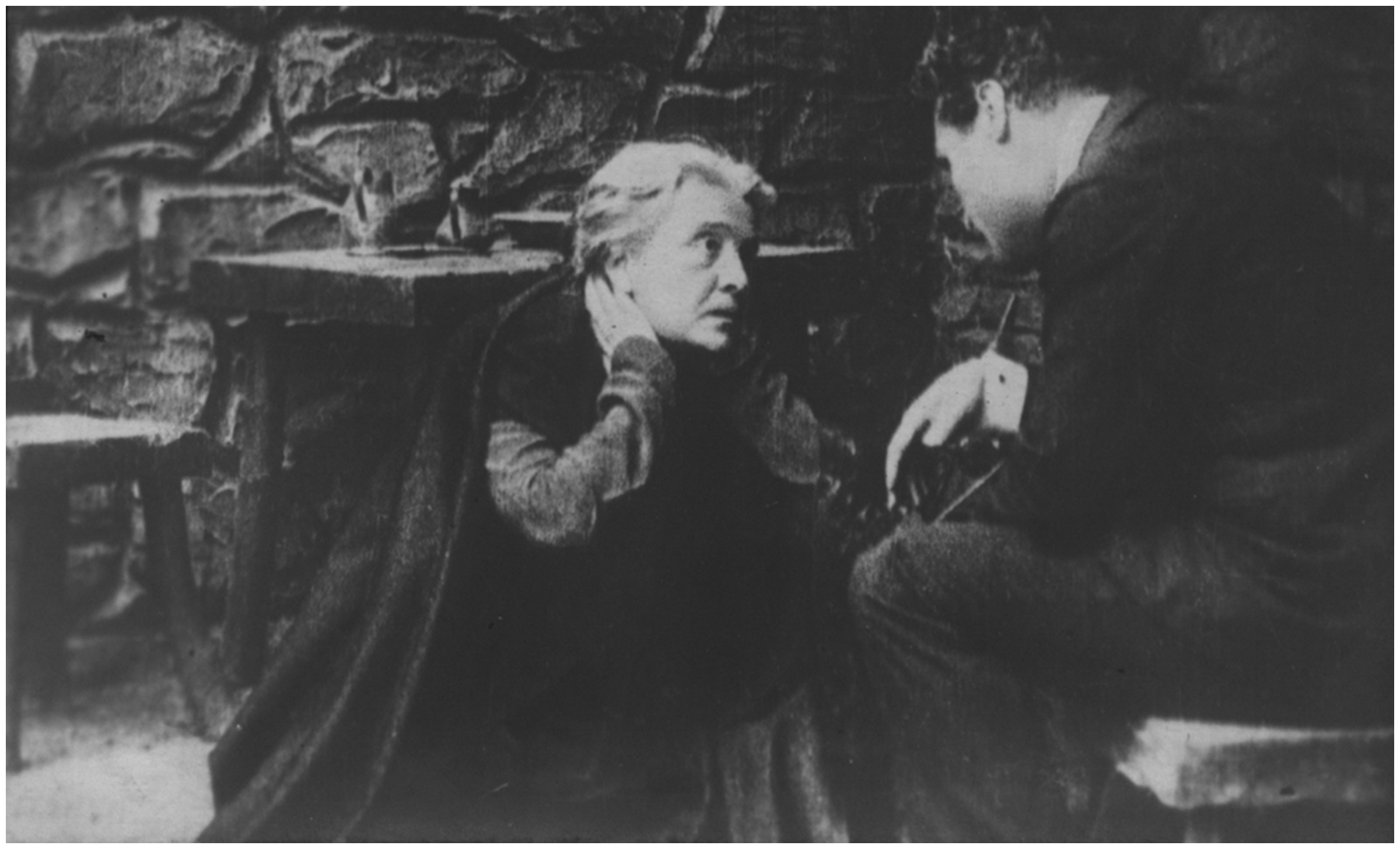
Duse cast the handsome young actor-director Febo Mari (1881–1939) in the role of Anania. She refused the possibility of involving a young actress in the film to reconstruct the troubled youth of Rosalia. Instead, at the beginning of the film (when the young mother decides to abandon her son), she preferred to use a veil on her face to hide her real age. In the central and the final part of the film, Duse was free to express the feelings of the old Rosalia – from the contrition for her sin to the tragic decision to commit suicide.
The film producers complied with Duse's wishes, but they were not sure that the mother–son story would be appreciated. During wartime, the taste of the public went in another direction: the most popular films were those based on stories of lovers or mythology, and the beauty of the main characters (male and female) was very important. Cenere can therefore be considered Duse's challenge to the Italian film industry of the 1910s. For her film, Duse firmly wanted a story focused on the mother–child relationship: in her opinion, this would touch the hearts of audience members during the First World War. This was her impression both as an actress-manager and as a woman. 6
A Mother on the Screen
Even if her character in Cenere is clearly derived from the theatrical role of the mother, Duse tried to explore the role in the context of a new medium. She adapted her acting style to film, creating new ways to perform which were less emphatic than those of her contemporaries. This experimental approach was not appreciated or understood by audiences.
With Cenere, Duse created an ideal dialogue with mothers: with those who had abandoned their children, those who had a problematic relationship with their children and those who had their sons serving on the front. In fact, Cenere reveals the inner conflict that induces a mature woman to re-visit the most terrible episode of her life: the abandonment of her innocent child. And, by extension, the film reveals the inner conflict of the young son in seeing and returning to his mother again after so many years. Duse's role as mater dolorosa was sincere, and we can consider it the result of an personal choice that was not driven by the commercial logic of the producers. 7
The selection of Deledda's novel Cenere for her first film is another important one, revealing Duse's temperament as an actress-manager. In fact, in her long career on the stage and as a director of her company, she had freedom to choose the authors as well as the plays of the repertoire she would perform. Obviously, she was also the leading character because she was the prima donna. In fact, Duse is considered to be the last representative – and her art one of the highest achievements – of the Italian theatrical tradition of the grande attore. This privilege, the prerogative of choosing a part by contract, was one of the traits of the opera system that was adopted by the major theatre companies of the nineteenth century. 8
The importance of Duse's status in the theatre is important for film. This is especially true if we consider her a precursor to the contemporary theatre director. Duse was the owner and the manager of her company, and she chose her repertoire and distributed all roles. Moreover, as an actress-manager she had full financial responsibility for the company. In contrast to the later system based on public or private subsidies, she had to find strategies to attract and create strong and ongoing relationship with audiences. Touring abroad provided her company with new opportunities for funding and experimentation and was also used to build or reinforce the reputation of the company. 9 This explains the complexity of Duse's work. It was artistic as well as managerial. Her engagement in the Italian film industry in the 1910s testifies to this. On the stage, she had the responsibility to perform, and she wanted this same authority on the screen.
In Deledda's novel, there are various elements that may have influenced Duse and her choice of subject for the film. This is especially true in relation to the plays in her repertoire. In fact, Cenere summarises the main themes of the French dramas of the nineteenth century that were so important for Duse's success and her tours: the adulterous affair between a married man and an orphan girl, the constant presence of the legitimate wife (betrayed but never abandoned by the unfaithful husband), the birth of a ‘child of sin’, and the difficult life of a ‘lost woman’. 10
In the film, the motivation for the mother abandoning her child is the poverty-stricken life that Rosalia leads and her inability to assure a respectable education for her son. In the novel, the reason for this act of abandonment is Rosalia's decision to escape with another man. Anania consequently grows up in the house of his father, enjoying a life of good social standing. This situation creates conflict in the young son. As Deledda's book details, in his childhood, Anania wanted to be a soldier. This part was cut in the film. Instead, on the screen, we see only Anania's period as a student in Rome, where he was a very good pupil.
Filming Rural Life in Sardinia
Officially, Cenere was directed by popular actor-director Febo Mari. The finances for the production appear to have largely been raised by Duse herself, via her many wealthy contacts and admirers. Duse signed a contract with the Ambrosio film company for a single film and entered into partnership with them so that she would become a co-producer on the film. The contract gave her complete artistic freedom and guaranteed her a return of half of the box-office takings. Duse also received an advance payment of 40,000 lire, with a further 20,000 lire for her expenses. Mari was a great admirer of Duse's, but he might not have been the most appropriate choice of director. As it was her first experience in film, Duse thought working with a young and talented actor meant she could be his director, as opposed to vice versa.
Even if Cenere constituted her debut film, however, Duse's approach to the art of cinema was pragmatic and straightforward. As an actress-manager, she considered all the production-related tasks, and she also had a preconceived visual idea of the film. In retrospect, we can consider Duse a precursor to our contemporary filmmakers: she had great enthusiasm, and, in her artistic research, she tried to realise her project by considering all of its complex aspects. For instance, Duse paid particular attention to the film's posters. One of them presents Duse as a sinner-pilgrim in search of redemption (Figure 2). Note that her hands are almost joined in religious manner, a gesture that seems to anticipate her recitative style of the 1920s – this gesture belongs in the category of so-called ‘spiritual acting’.
11
Poster for Cenere.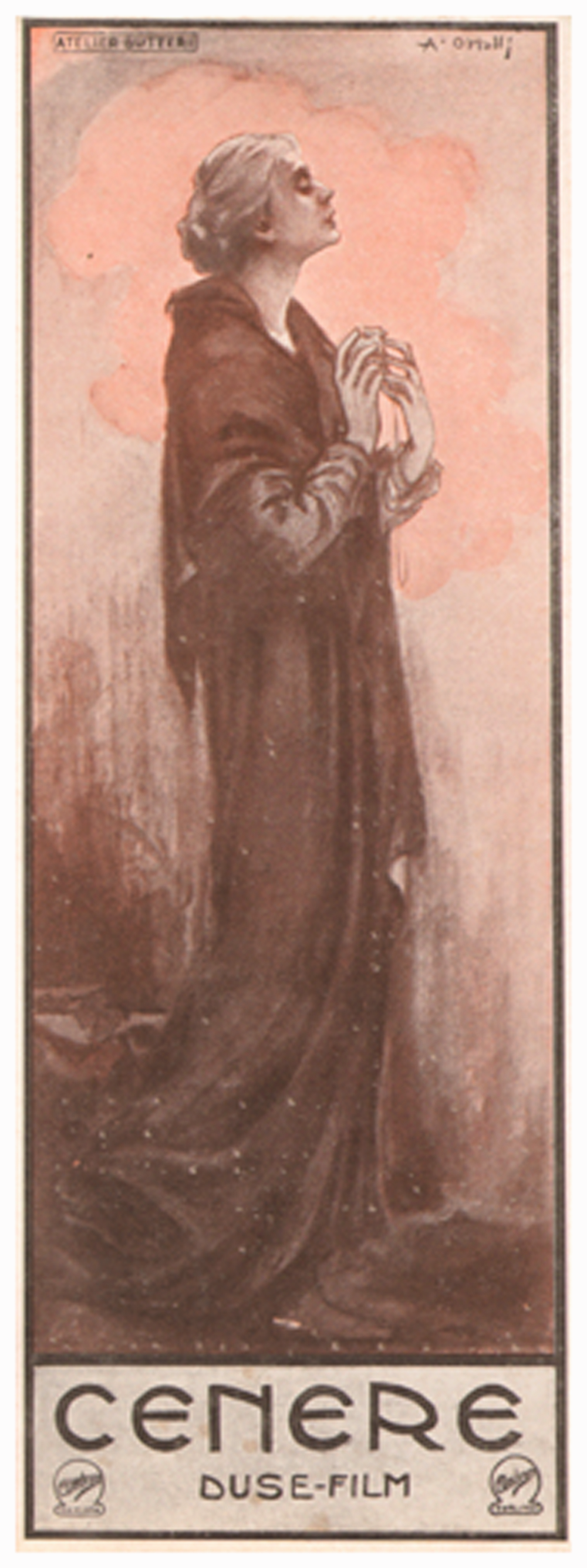
In preparation for her film production, Duse continued her research into Sardinian history and culture. She collaborated with author Paolo Orano (1875–1945), who had already established himself as a screenwriter. Furthermore, Duse continued to visit the cinema as often as she could. To immerse herself in the world behind the camera, she arranged a visit to the Cines studio in Rome. It was here that she met with the members of a film crew and studied the work that they performed behind the scene. Duse must have believed that in order to make a successful film debut she needed to understand as many aspects of filmmaking as she possibly could. 12
Until 1909, Duse had always maintained contact with her family, friends and colleagues when she was on tour, writing many telegrams every day. This activity was a typical element of her practical personality as an actress-manager. It was also the most immediate form of communication that was available at the end of the nineteenth and the beginning of the twentieth century, and it was able to cover great geographical distances. When she retired, Duse had time for the more elaborate process of letter writing. The many letters that she wrote to her daughter Enrichetta Marchetti Bullough (1882–1961) – who lived in Cambridge, Massachusetts with her husband and two children – are likely the most intimate and sincere documents about Duse's work in the Italian film industry in the 1910s. Cenere is one of the most important topics of their correspondence, so these documents can also be considered a sort of diary of the film's production process.
Duse's initiation in cinema was triggered by a proposal made by the American director David Wark Griffith (1875–1948), who invited Duse to work in the United States in 1915. 13 Her project with Griffith remained unrealised, but it became a kind of licence to venture into a new medium and a new artistic field. Griffith's proposal might be considered the spark that set aflame her already innate desire to work in the industry. The medium of film constituted a new artistic challenge for Duse, and it was also a new means of proving her worth as an actress-manager. She had done business with many theatre impresarios by 1915, and she would now negotiate with film producers.
Duse's daughter Enrichetta was not in favour of her mother's intention to return to work and to travel to California. Even if Duse did not go into film then, however, it did not take long for her interest and ambition to take over. In a letter written in March 1916, Duse already explained the plot of Cenere to her daughter. She had the interesting notion that the film adaptation would function as a living illustration of the novel; she saw it as a process of shifting the words on paper to images on the screen. 14
The novel itself is set in Sardinia and describes how the inhabitants of the island endure a hard rural existence. In order to maintain both the rural setting and a thematic coherence with the novel, Duse considered the possibility of shooting the film in Sardinia. She wanted the film to depict the locus of poverty genuinely, and the landscapes to reflect accurately the descriptions of misery and hardship in Deledda's novel. 15 Duse's health and the dangers of the First World War (and in particular the risk of ships being torpedoed) made shooting the film in Sardinia virtually impossible. Instead, Duse opted to spend time in the town of Viareggio in Tuscany, where she prepared for her work on the screen physically, spiritually, and technically. The film was planned to be shot in the summer, from mid-July to August, and Duse now asserted the agency that she had known on the stage as an actress-manager under a new title, that of actress-producer, to scout and decide on the film shoot's location: the mountain villages near Turin.
The Composition of a Work of Art
By the spring of 1916, the contract between Duse and the Ambrosio film company had been rewritten many times. She wrote to her daughter about the voracity of the people in the film industry. The official contract was finally ready in June 1916 by which time Duse's physical health was no longer at its best. She was sure, however, that working would be the best solution to improve her health. As mentioned before, Duse's contract with Ambrosio was for one film only, and she was appointed as a co-producer. In this way, Duse would be able to assert her artistic agency freely and could also secure significant financial returns from Cenere.
Overall, Duse was satisfied with her choice of the film's producer, considering Ambrosio the most appropriate collaborator for her debut on the screen. The Ambrosio Company assured her that the film would receive extensive international distribution and Duse received the company's best technical support on Cenere. The only worry Duse had was for the cameraman, as she had some difficulties establishing a working relationship with him. She was aware that the film marked her debut in the Italian film industry and felt a mixture of emotion and fear. 16 Her contract stipulated that she had the right to choose, so she effectively imposed her point of view during the film's production. For instance, she wanted to avoid close-ups because she preferred her face to be in shadow. Duse was not only a co-producer but also the star of Cenere and she wanted to assert her control over each phase of the film's production, from a technical, artistic and managerial point of view.
Duse even visited the dark room in Turin with Ambrosio and was amazed by its mystery. As a celebrated and experienced artist, she was critical of her own work, especially since it was her first time on film. She had not previously seen her image projected on a screen, and it had an unnerving effect on her. 17 That the film was silent made her self-criticism even more complex: Duse was immediately made conscious of the immense power of the screen in its amplification of all of the smallest details. Indeed, on the stage, these details are typically lost due to the distance between the actor and the audience.
Moreover, for the first time in Duse's acting career, she was involved in a plot that did not proceed in its natural sequence. Whereas a theatrical performance has a natural and logical development, Cenere, and most films for that matter, was not shot in sequence. Duse therefore had to adapt and develop her onscreen character differently – especially for the passages with a young Rosalia and a more mature Rosalia. This was also partly the reason that Duse insisted on remaining veiled by shadows throughout the shoot. Her elusiveness was not intended to hide her ageing face without make-up, but rather a spiritual strategy to underline the role of the mother. In other words, it was Duse's aesthetic choice for the revelation of her character (Figure 3). She additionally requested the presence during the shoot of cellist Livio Boni (1884–1963) to help with the spiritual mood of the character. Music would help the actors, but it might also translate to audiences since silent films would be screened with live musical accompaniment.
18
Rosalia (Eleonora Duse) in a frame from Cenere.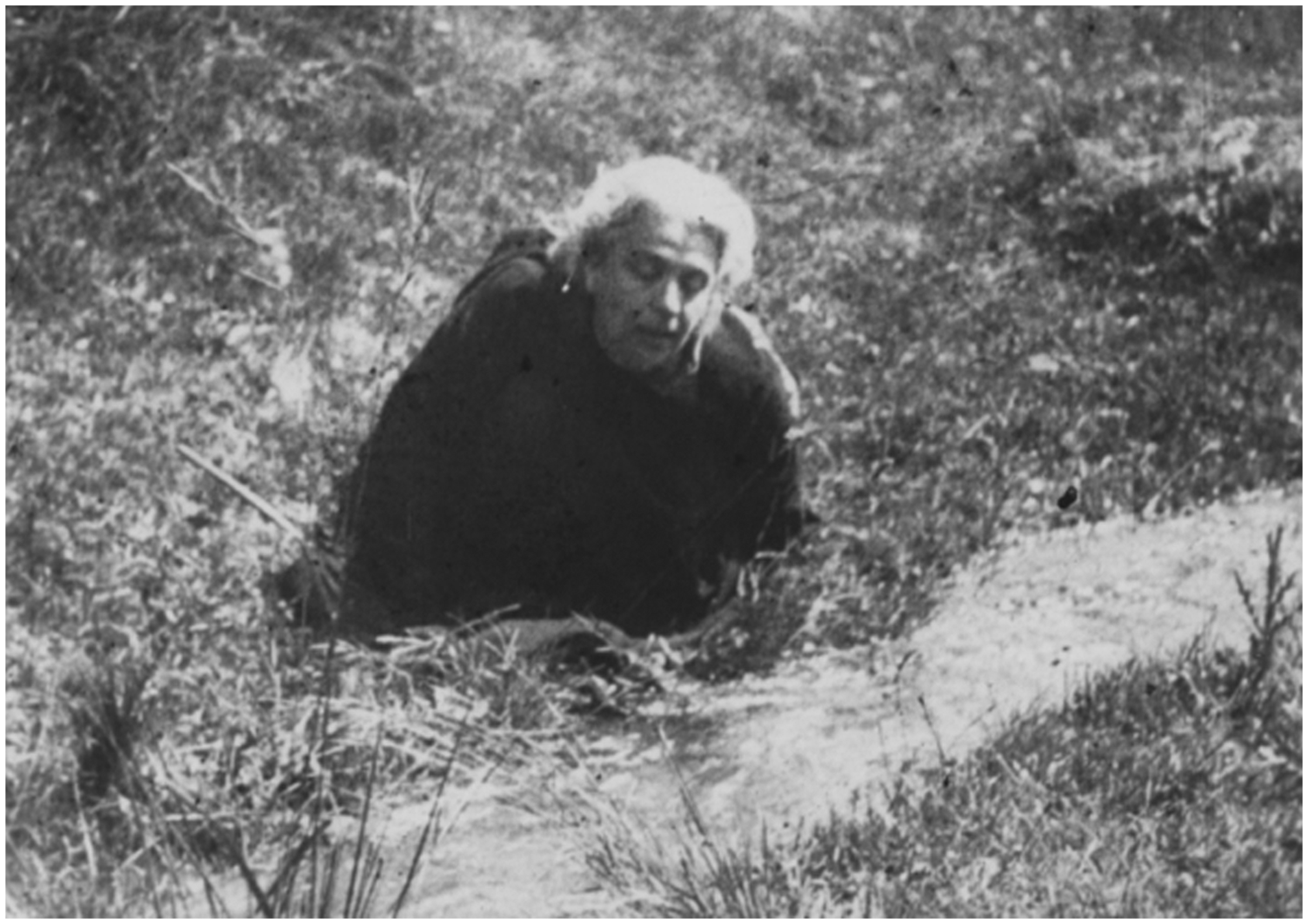
Duse felt revived by working on Cenere. Her judgment evolved from the point of view of the actress to that of the audience and one might also say that her perfectionism was too advanced for the Italian film industry in the 1910s. She wanted to reshoot certain scenes, but it was impossible for Ambrosio to allow this because of the high cost of film production. Duse's request, however, was not motivated by finance but by her ideas on aesthetics and the way she appeared on screen. Indeed, Duse's global success was not only due to her immense talent in acting, but also due to her constant, intelligent management of her image in both her artistic and her private life. She tried to protect and manage her image in her first onscreen performance, because it was an intimate part of her celebrity.
By being closely invested in the film's cinematography, Duse also revealed herself as a director of Cenere, as she wanted total responsibility for the final look of the film. This further involvement brought about a change to her contract and also caused a delay in payment. Duse was concerned with her financial situation and this aggravated her in the months following the shoot of the film. Producer Ambrosio and lawyer Giuseppe Barattolo (1882–1949) were sure that the distribution of Cenere would be a success all over the world, but their plan was undermined by the atrocity of the war and the distributional difficulties that followed it.
In September 1916, the shooting of Cenere concluded, but Duse remained critical of the film. She first saw the film in a small theatre at a private screening and continued to notice faults with it, even though the general impression had been that it was a beautiful film. In the actress's opinion, the most innovative element that she brought to the Italian film industry of the 1910s was her onscreen silence: throughout the whole film, Duse's character never talks. Her mouth remained closed and she indicated ‘yes’ or ‘no’ by nodding or shaking her head. Duse realised that the silent film was a powerful form of expression with a great future, for it had the ability to reach people across the world. For all of her theatrical tours, she had always spoken the Italian language on stage and understood the importance of the artistic possibility to go beyond the limits of the word with gesture – the international language of the actor. In Duse's opinion, film was a universal language, allowing audiences to find the inner meaning of the otherwise spoken word. 19
In October 1916, Duse finally did obtain permission to reshoot some scenes of Cenere, and, thanks to Deledda, three small villages were found near Viareggio in the Apuan Alps. The inhabitants were peasants from Sardinia (although the men had emigrated to America or were fighting as soldiers during the First World War) and Duse thought that it could be a good proxy for the island. Duse developed an obsession with the setting of the film, wanting to recreate the Sardinian context of the novel in the most credible way. She eventually grew more weary because of all the supplementary work she took on, but was satisfied with the changes it enabled.
After the production of the film, Duse's bold temperament became evident in her quarrel with Ambrosio. She expressed her disappointment in his handling of the commercial and economic side of their production; she considered him a good worker and honest man, but she could not cope with the conditions of their contract changing as much as it did. Seeking payment for her work, she discovered another side of his character, one of deceit. Duse and Ambrosio seem to have had a business misunderstanding due to the genuine difficulties of the wartime period. The distribution of the film was slow and the declaration of war against Germany caused financial problems for the Italian film industry. Duse invoked the sanctity of their contract, but Ambrosio changed it and the issue became highly complex even for the lawyers. Duse wanted appropriate economic remuneration and did not accept these sudden changes to her contract, not even in the context of a world war.
Meanwhile, the staff and the female production crew asked Ambrosio if they could see the film. Duse was satisfied when she gauged their response; she felt an especially spiritual communion with the mothers in her audience. She hoped that Cenere would be a success of ‘Art’ and emotion and announced to her daughter that she was ready for her second film: she wanted to adapt Ibsen's The Lady from the Sea. This production was never realised because Ambrosio did not want to work with Duse again. He considered her requests too demanding to satisfy and her temperament too determined. 20
Conclusion
Cenere was ultimately released in the spring of 1917. The Great War impacted Italian history greatly and so inevitably the film did not do well at the box office. Duse went against the mainstream in her conception of film as an artistic product, and audiences did not understand her vision. From Duse's point of view, Cenere was probably not a complete disaster. In her long artistic career on the stage, she was conscious that the most advanced or revolutionary performances had the risk of being misunderstood by an audience; or rather, only some in the audience were able to understand its deeper meanings. For example, as an actress-manager, she dared to perform Ibsen. She was the first, and is still the most important, Italian actress of the Ibsenian theatre.
Duse's film debut did not cause as much of a sensation as her return to the theatre did in 1921. As an artist of the stage, Duse had always been obsessed with leaving a tangible trace of her art behind, an eternal sign able to overcome the ephemeral nature of theatre. In many of her private letters, Duse mentioned the oblivion which befalls the art of an actress after her death. It is a sort of curse hanging over her head. This is understandable if we consider that she lived in a period when the only tangible signs of theatrical performance were photos and writings such as theatrical criticism, articles and books. Gabriele d'Annunzio's novel Il Fuoco (The Flame of Life; Treves, 1900), 21 inspired by the author's relationship with Duse, is particularly important for the memory of Duse's art, because she never wanted to write memoirs or autobiographies.
Duse lived for her art and knew that the death of a stage artist was also the death of her art. Until the end of her life, she did not realise that Cenere was an immortal testament to her art and that the film would become the everlasting product of her work as an actress. She was such a perfectionist and so disappointed when the film was released that she did not appreciate its symbolic value, especially for ensuing generations of spectators.
In film history, Duse is generally considered ‘a passing star’. This analysis of her work as an actress-manager can help us understand her deep involvement in Cenere and her ideas on the silent film. It aims to bring historical justice to her multivarious work, not only to her endeavour as an actress. Duse played a leading role in the choice of the subject, the writing of the script, the work on the set and the final cut of the film.
Cenere will be remembered because it is the only film that features Eleonora Duse. The uniqueness of the production will always be emphasised, and this helps us to understand the essence of the film itself. Representing Duse's single engagement with the Italian film industry, it now belongs to history. The film's impact during the years of the First World War as well as its influence on Duse's decision to return to the theatre in 1921 and on her acting style in her final years on stage are important elements of inquiry. A century after the film first appeared, we can therefore appreciate Cenere's significance.
If we consider the film from a contemporary standpoint, we realise that Duse had the courage to be veiled in shadows on the screen. From a certain point of view, her decision denied the faculties of the new medium and went against the expectations of the audience. Yet after a century, this reticence is seen to mark the absolute modernity of Cenere. In fact, for a real comprehension of the film, it has to be analysed through the eyes of Duse's audience, with a contemporary eye upon posterity.
With Cenere, Duse's competencies as an actress-manager translated into that of an actress-producer to create an unconventional, poetic product for the silent film industry in wartime Italy. In the 1910s, few thought about the obstacles Duse faced in her first delicate transition from theatre to cinema. Writing today, we can trace and divulge the difficulties of serious performers who made that transition, many without a great deal of success. 22 Thanks to Cenere, we clearly understand that a film offers one form of immortality. This is the lesson that Duse offers to contemporary audiences as an actress-manager and actress-producer.