






Abstract

In the 1870s, the obituary column of the New York Clipper, a leading theatrical and sporting journal, was headlined ‘Death’s Doings’. Death has been exceptionally busy in the fields of theatre studies and theatre history in recent years. We have lost such leaders in the field as Virginia Scott, Rob Erenstein, Michael Booth, Victor Emeljanow, Simon Trussler, Philip Zarrilli and Don Wilmeth.
Of these, Don was the Americanist par excellence. Although his first important monograph was on George Frederick Cooke and one of his areas of expertise was George Bernard Shaw, he was the acknowledged ‘dean of American theatre history’. The Cambridge Guide to American Theatre and The Cambridge History of American Theatre appeared under his co-editorship, and for CUP he managed the series ‘Studies in American Theatre History’. (He later helmed a similar series for Palgrave Macmillan.) He also co-edited volumes on Augustin Daly and William Gillette for CUP’s British and American playwrights series.
Don’s manifold professorial activities were a hyperthyroid version of a North American faculty member's duties; for thirty-six years he not only taught undergraduate and postgraduate students at Brown University in Providence, Rhode Island, he directed plays, acted in them, served as chair of his department, solicited collections for the library, organised conferences and exhibitions, founded prizes and advised the local theatre The Trinity Repertory Company. These were supplemented by his involvement with innumerable scholarly organisations, most notably the American Society for Theatre Research.
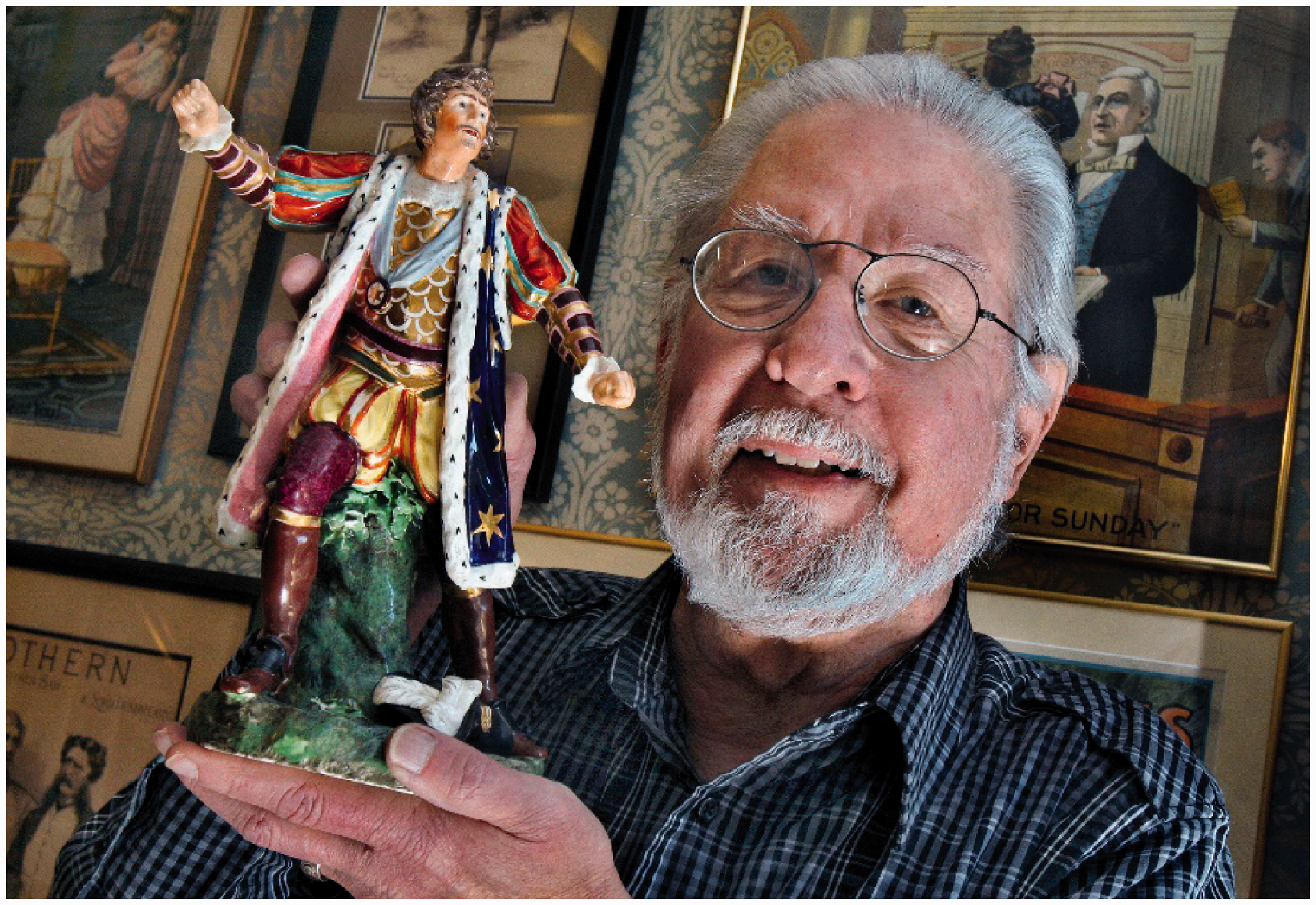
Don was among the first contingent of scholars to give serious attention to the study of popular entertainment. His bibliographies and glossaries were pioneering reference works in the field. His study of the image of the Native American in drama was ground-breaking. He curated the Smith Magic Collection held at Brown, and possessed an encyclopaedic knowledge of circus, tent shows and the Wild West. Public Television sought him out as an expert for its documentaries on vaudeville, Annie Oakley and Houdini, for he was a genial and eloquent speaker, rendering opinions in a rich bass voice. He was alert to the importance of visual imagery to research, and often provided illustrations from his own holdings. He was fascinated by the material aspects of theatre, avidly collecting books, prints, letters and similar ephemera, with a particular interest in Charles Mathews and the caricatures of James Gillray.
Don had been trained at the University of Illinois in the 1960s, when the practice of theatre history in the United States was heavily influenced by the émigré scholar Alois Nagler, who presided over Theaterwissenschaft at Yale. The approach may be described as ‘positivist’, with an emphasis on primary documents. Don was an assiduous researcher, eager to pin down an exact date or place. He paid scant attention to theory or the finer points of historiography, but, as someone who took an active part in stage productions, brought first-hand experience to his conception of the theatre of the past. Perhaps his greatest talent was for synthesis: not only marshalling information but bringing together scholars and students in a voluble cultural conversation.
A born teacher, Don was Lord Bountiful in sharing his knowledge and his understanding. There is scarcely a book on American theatre history published in the last thirty years that does not include a heartfelt thank-you to him in its acknowledgements. Theatre historians will continue to benefit from the fruits of his productive, influential career well into the future.