






Abstract
Of all the fallen women on the Victorian stage, Nancy in adaptations of Dickens’ Oliver Twist is the lowest. Specifically deemed a ‘prostitute’ by the author, she is also the abused mistress of a thuggish burglar who murders her. In the innumerable dramatisations of the novel, Nancy might seem appealing as an opportunity for character acting, but presents a hurdle to actresses chary of risking their hard-won reputations. How could such a debased woman be made palatable to the admirers of respectable leading ladies? So an offstage marriage ceremony took place in which she became ‘Nancy Sykes’ (the name usually misspelt). This essay will examine how the interpretation of Nancy and her profession were ameliorated and bowdlerised to suit changes in social attitudes and how these alterations were accommodated in playwriting, staging, and publicity. It will place her within the dramatic conventions of melodrama's fallen woman, demonstrating where she fits on the scale of the courtesan and the ‘woman with a past’.
Of all the fallen women on the Victorian stage, Nancy in adaptations of Dickens’ Oliver Twist is the lowest. In addition to her profession, she is the abused mistress of a thuggish burglar who murders her. In the innumerable dramatisations of the novel, Nancy might seem appealing as an opportunity for character acting, but presents a hurdle to actresses chary of risking their hard-won respectability. How could such a debased woman be made palatable to the admirers of reputable leading ladies? So an offstage marriage ceremony took place in which she became ‘Nancy Sykes’ (the name frequently misspelt). Over the course of a century, she assumed a martyr's crown as her sexuality was bowdlerised and diminished (Figure 1). 1

Poster for a production of Oliver Twist at Macauley's Theatre, Louisville, Kentucky, c. 1875. The manager's wife, Rachel Johnson Macauley, receives top billing as ‘Nancy Sykes’.
Dickens's Nancy
Sexuality is implicit in Nancy's status, but in his novel, Dickens diverts attention from the details of her trade, just as he omits blasphemies and indecencies. Thackeray complained about the whitewashing of ‘Biss Dadsy’, Boz, who knows life well, knows that his Miss Nancy is the most unreal fantastical personage possible; no more like a thief's mistress than one of Gessner's shepherdesses resembles a real country wench. He dare not tell the truth concerning such young ladies.
2
Dickens felt compelled to address these criticisms in a preface to the third edition (April 1841). He protested that his model was Hogarth and that he had not abated any detail of reality. At the same time, he declared: No less consulting my own taste, than the manners of the age, I endeavoured, while I painted it all its fallen and degraded aspects, […] rather to lead to the unavoidable inference that its existence was of the most debased and vicious kind, than to prove it elaborately by words and deeds. In the case of the girl, in particular, I kept this intention constantly in view.
The Dickens scholar Humphry House seconded Thackeray in pointing out that the atmosphere in which Oliver was plunged would have been ‘drenched in sex’.
4
Yet Dickens presents the teenaged Nancy and Bet as a fact of life, without going into detail. (Dickens does not stipulate Nancy's age, but the fact that she can pass herself off as Oliver's sister argues for early adolescence.) They are first introduced blandly, with a wink to the knowing: They wore a good deal of hair: not very neatly turned up behind; and were rather untidy about their shoes and stockings. They were not exactly pretty, perhaps; but they had a great deal of colour in their faces; and looked quite stout and hearty.
5
Cunning, ferocity and drunkenness in all its stages were there, in their strongest aspects; and women: some with the last lingering tinge of their early freshness, almost fading as you looked: others with every mark and stamp of their sex utterly beaten out, and presenting but one loathsome blank of profligacy and crime; some mere girls, others but young women, and one past the prime of life: formed the darkest and saddest portion of this dreary picture.
6
A Streetwalker Treads the Boards
Nancy's status becomes even more problematic when she is transferred to the stage. Although Gay's Beggar's Opera remained popular throughout the century 7 (Mme Vestris had revived Macheath as a modern-dress breeches role in 1820), its rollicking harlots were toned down. Indeed, Dickens, in his preface to Oliver Twist, condemns Gay's burlesque for making crime attractive and alluring. The only equivalent of a prostitute in a Regency play is African Sal in William Moncrieff's hit Tom and Jerry, or Life in London (Adelphi Theatre, 1821), and she was played as a dame role by a man (J. Sanders). 8
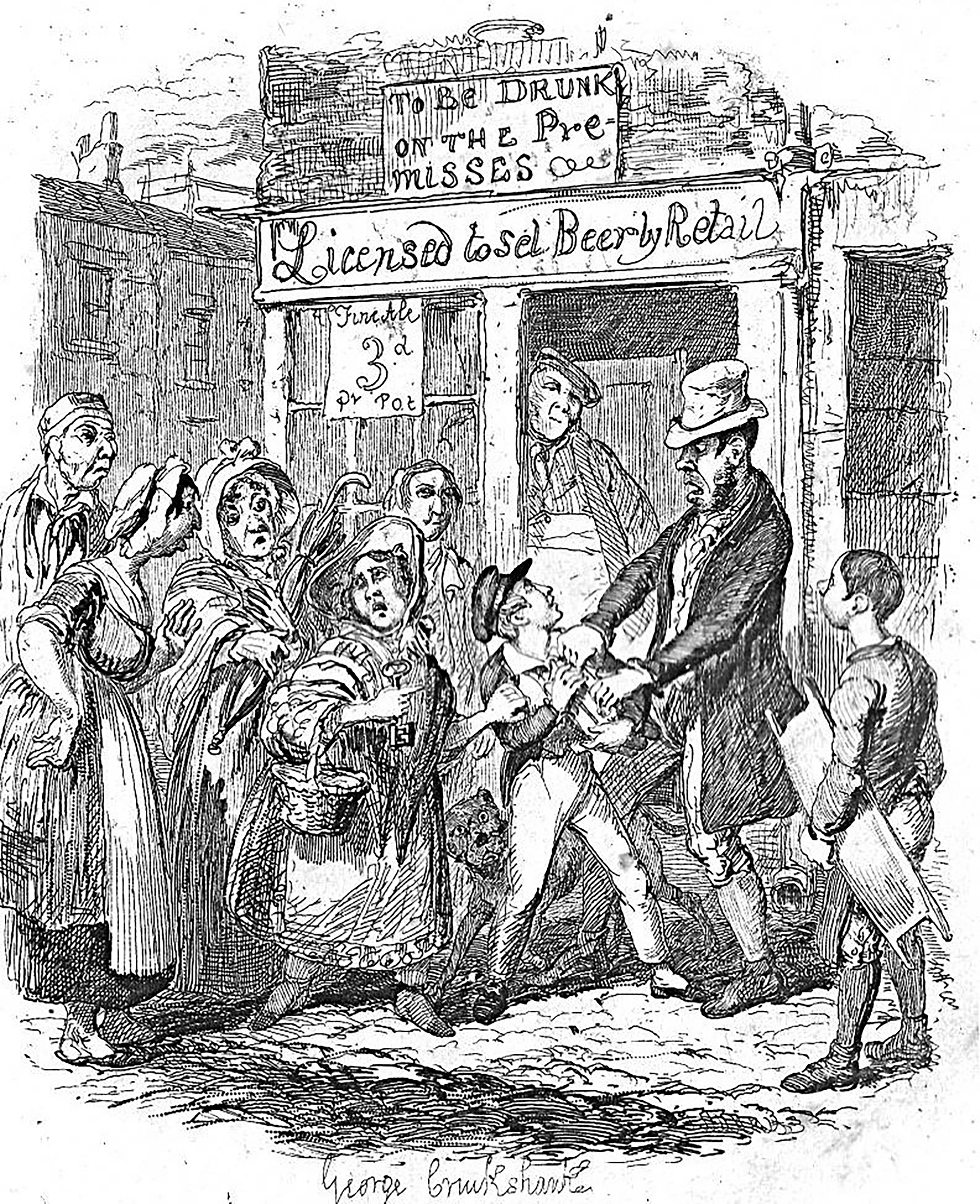
George Cruikshank, ‘Oliver claimed by his affectionate friends’, illustration to the first publication of Oliver Twist, 1837. Nancy is disguised as a respectable girl to capture Oliver.
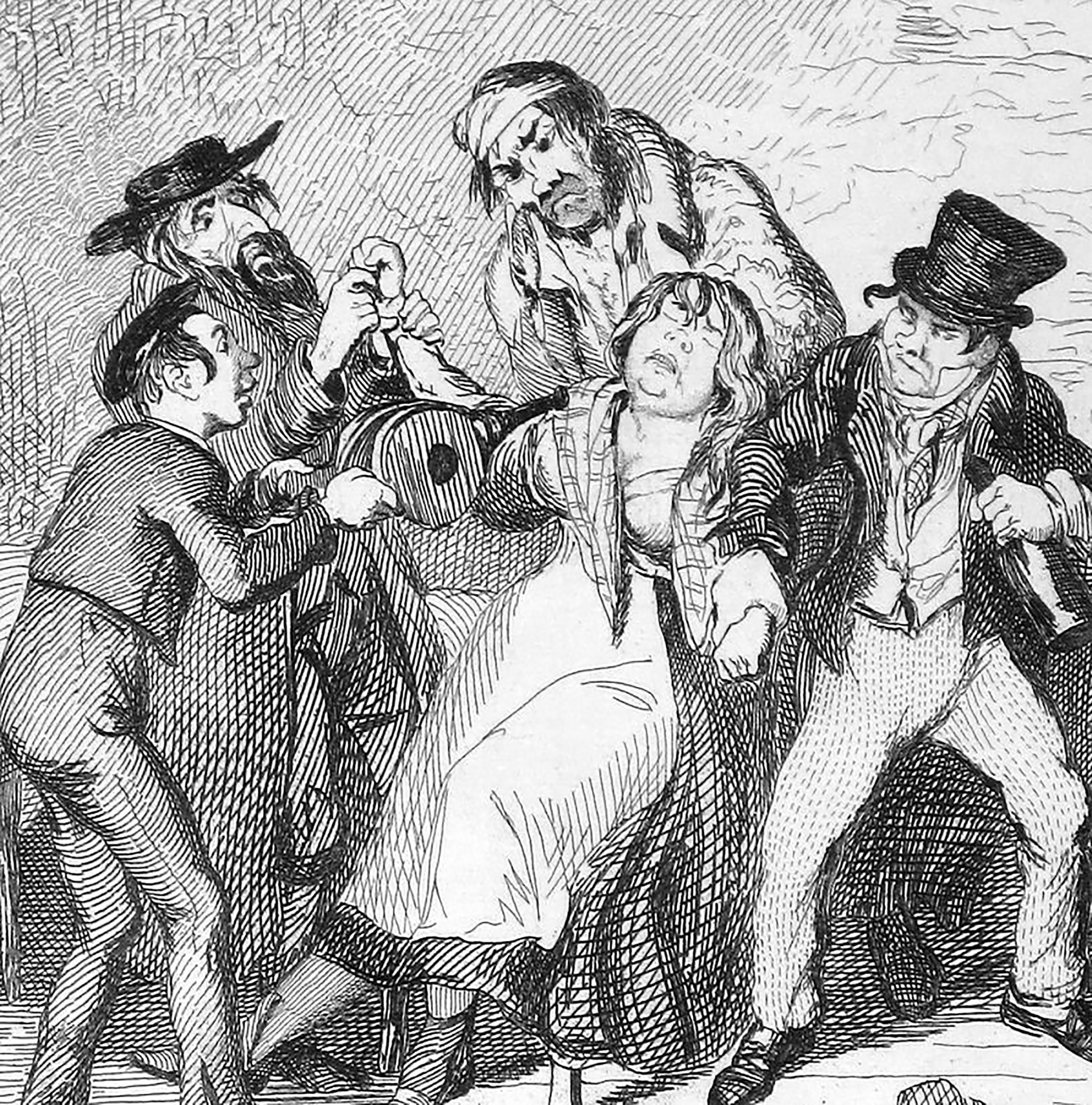
George Cruikshank. “Fagin's pupils reviving Nancy” (detail), illustration to the original publication of Oliver Twist, 1837.
The year Oliver Twist began to appear in print, Bulwer Lytton's play The Duchess de la Vallière, an innocuous drama of the moral reformation of one of Louis XIV's favourites, was so lambasted by the critics and the public that it lasted barely eight weeks. The Spectator animadverted, ‘We cannot pass uncensored the dramatist who calls upon us to sympathize with the woes of a discarded mistress and a disappointed voluptuary. It is the pathos of the stews’. 9 Given such a censorious attitude to a historical courtesan as well as to the jolly strumpets in Ainsworth's Jack Sheppard on stage, the reception of Nancy by the theatrical public might raise apprehensions. 10
The first two dramatisations of Oliver Twist were made before Dickens had completed the novel, so Nancy's importance as Oliver's protector and her murder were not available as dramatic material. In the first version at the St James's Theatre (27 March 1838), although she was played by the respectable Mrs Stirling, she disappeared after recovering Oliver from Brownlow's. The play was denounced by the Literary Gazette as ‘unfit for the stage’ and lasted only one performance. 11 In C. Z. Barnett's version performed at the Royal Pavilion Theatre (21 May 1838), an effort was made to soften and excuse Nancy: she was listed in the playbill as ‘Nancy (Sikes’ wife)’ and her fall was attributed to having been seduced and abandoned by Monks. 12
The most durable of these early efforts appeared a month after the October instalment, containing Nancy's murder, was published.
13
George Almar's dramatisation at the Surrey Theatre, 19 November 1838, attempted to elicit sympathy for her from the start with lines such as ‘I had a brother who looked like him’. She appears throughout in the disguise of ‘a respectable serving maid’ used to abduct Oliver; this annoyed the reviewer for the Literary Gazette. The only female of interest is Nance [sic], in which Miss Martin displayed considerable talent. Why she is dressed like a pretty lady's maid, with roses in her hair, & c., instead of the character, – the dweller in a ruffian's dirty garret and the debased street-walker, we cannot tell. It helped marvellously to destroy the illusion of the scene.
14
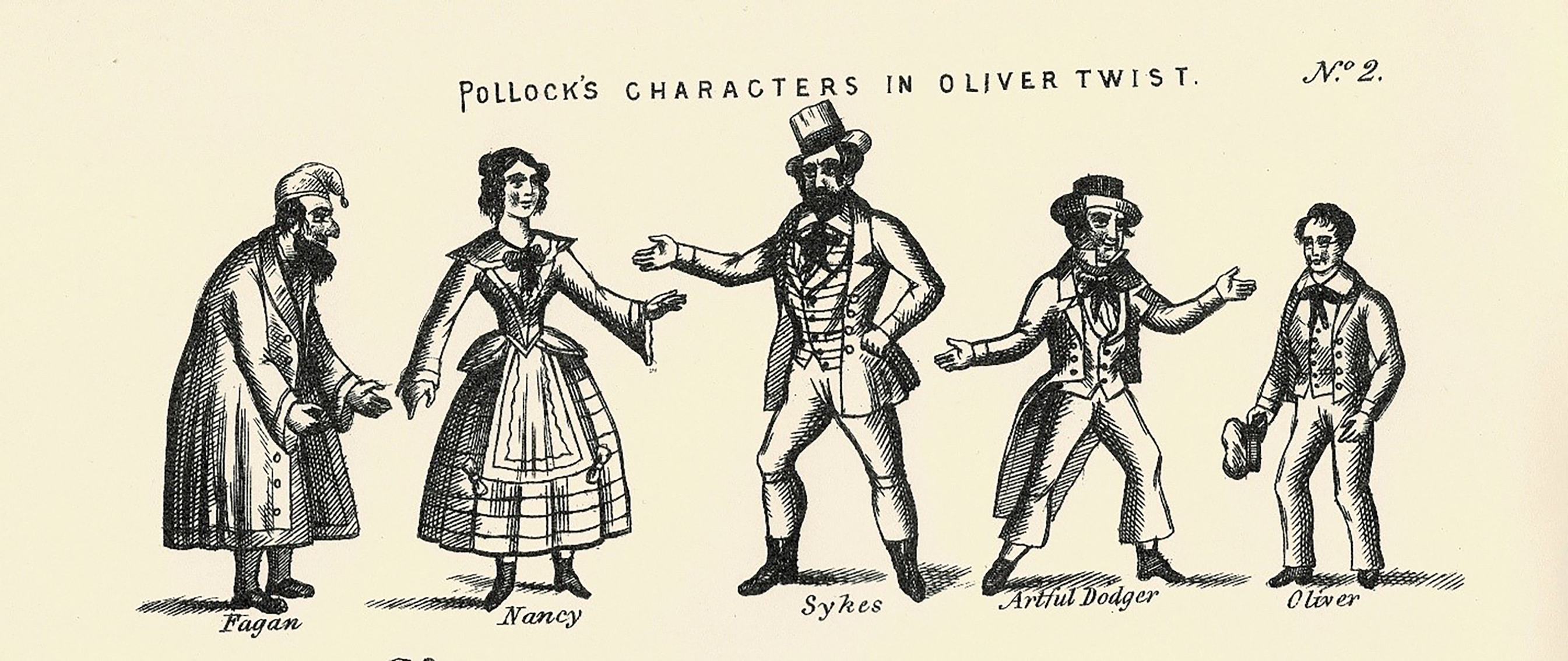
Redington's (later Pollock's) Juvenile Drama Oliver Twist. Plate 2 of characters (detail).
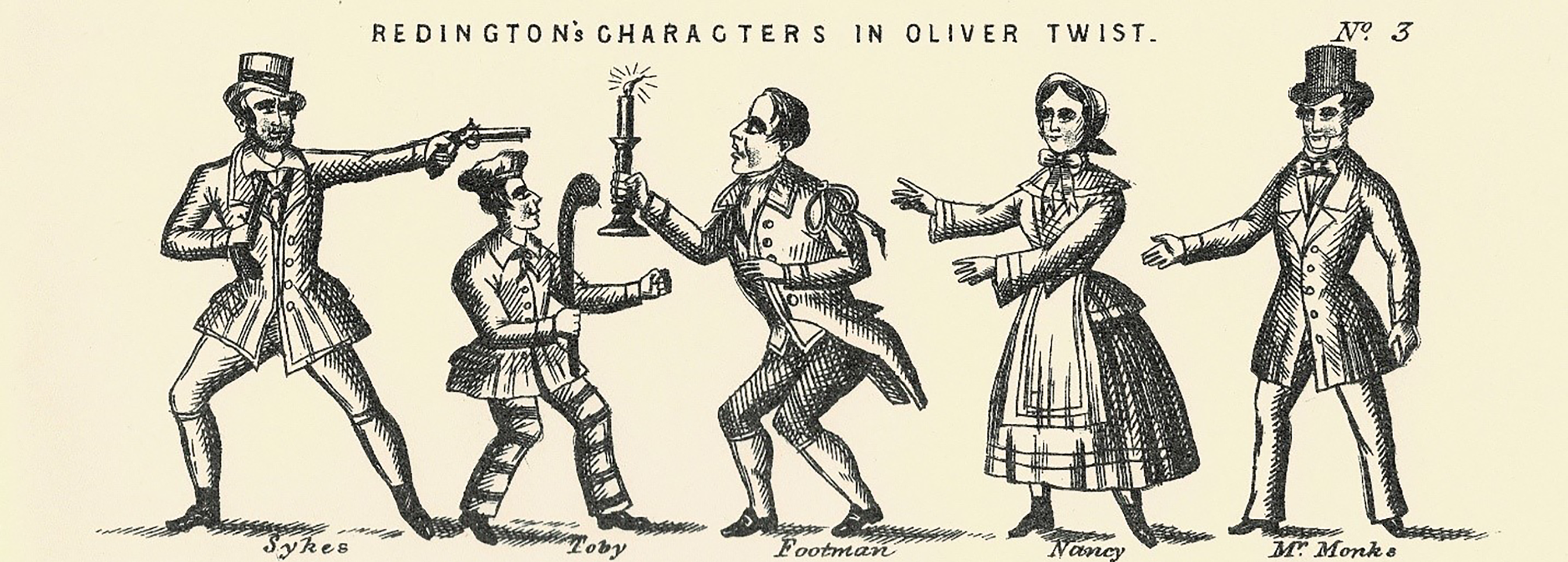
Redington's Juvenile Drama, plate 3 (detail).
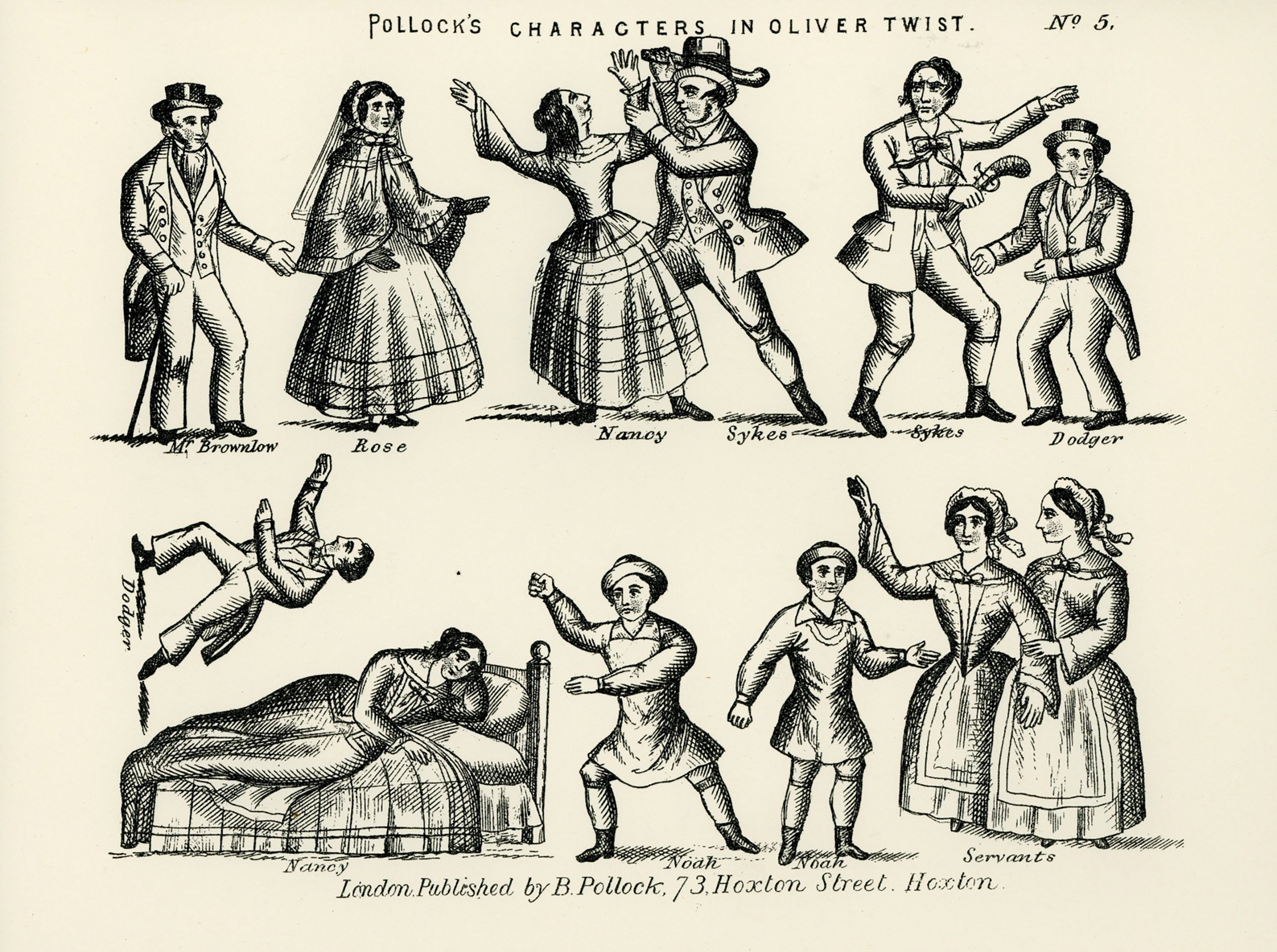
Redington's Juvenile Drama, plate 5.
Other adaptations appeared over the next few years (1838: Adelphi, Sadler's Wells, 17 City of London; 1839: Adelphi; 1840: Theatre Royal Edinburgh) with the performers of Nancy listed as both Mrs and Miss. The need to include Nancy's later attempts to help Oliver and her subsequent murder, even when kept offstage, thrust the character into greater prominence. 18 This echoes the novel, for once Oliver is under the protection of the Maylies, Dickens is free to lavish attention on Sikes and Nancy. 19 With her stage role more in evidence, a stronger performer had to be cast as Nancy at a time when leading British actresses were protective of their respectability. So the first important portrayal of Nancy took place across the pond.
Our American Cousin
In early 1839, the fashionable Park Theatre in New York advertised its imminent staging of Oliver Twist, a specially commissioned script but probably a variant of Almar. In the company was the twenty-three-year-old Charlotte Cushman, who was relegated chiefly to utility roles and walking gentlewomen (Figure 7).
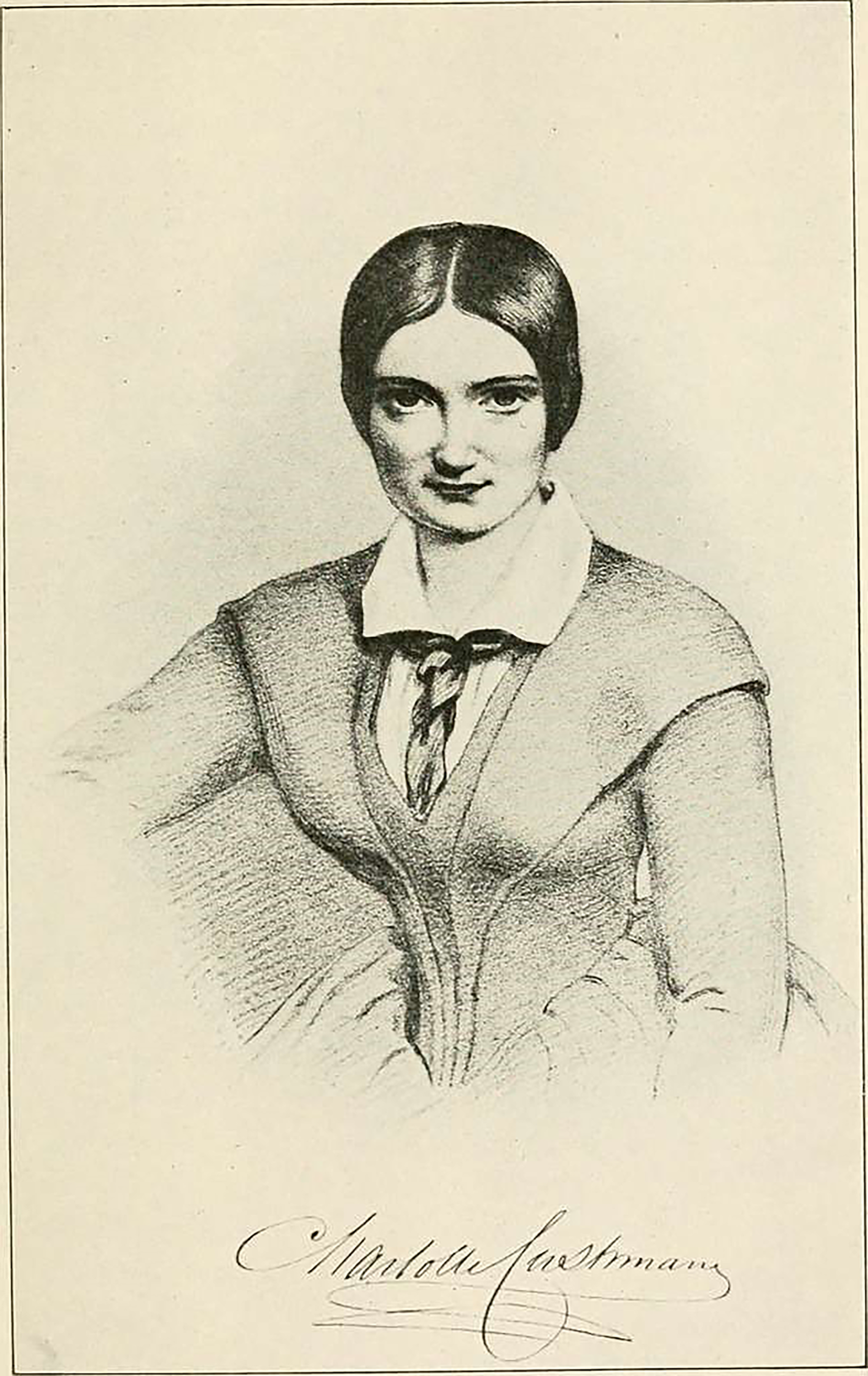
Charlotte Cushman, anonymous crayon drawing, c. 1823.
The co-manager, Stephen Price, disliked her and, to humiliate her, cast her as ‘Nancy Sykes’.
20
Even this early in her career, the austere Bostonian had resisted the public perception that actresses were prostitutes, familiar as she was with such women in the infamous ‘third tier’ of playhouses and in the neighbouring streets.
21
Cushman decided to turn the ignominy into a creative experiment. Dressed in threadbare cast-offs, she went down to the notorious slum of Five Points, observed and listened, and collected used clothing. She gave away nothing in rehearsal, but made her entrance on 7 February in an old dirty bonnet and dirt-colored shawl, a shabby gown and shabbier shoes, a worn-out basket with some rags in it, and a key in her hand. She entered swinging the key on her fingers, walked stealthily to the outside of the crowd, doubling her steps; looked with sharp cunning at the boy; attracted his attention, winked one eye and thrust her tongue into her cheek.
22
She dragged herself on the stage in a wonderful manner, and, keeping her face away from the audience, produced a feeling of chilly horror by the management of her role as she called for Bill and begged him to kiss her… it sounded as if spoken through blood.
23
Although it was a tremendous success with the audience, Cushman's Nancy polarised the critics and connoisseurs. Even Barrett had to admit ‘it is yet one of a class of characters not generally approved when seen upon the stage’. 25 The gaslit drama still presented a highly conventionalised and romanticised view of life. Cushman's ‘realism’ was regarded by some as inopportune and inappropriate. The sporting journal The Spirit of the Times might speak of the ‘immense truth and great power’, of her performance, 26 but the conservative critic William Winter sniffed at it as ‘exceeding literal’. 27 Aficionados of acting were put into a moral quandary: they had to appreciate and esteem Cushman's skill and affect while deploring the use they were put to.
Typical was the actor-manager Francis Courtney Wemyss. In his 1847 memoir, he called Nancy ‘her best performance’. ‘In all her future career she never surpassed the excellence of that performance’.
28
A year later, in a revised edition published in Glasgow, he tempered his praise: ‘as a portrait of female depravity it was powerfully correct…a painful, nay, a disgusting, representation of nature’, and the stage was not beneficially served by ‘such low illustrations of character, however truthful’.
29
Another American critic, while agreeing that her performance offended his taste, suggested a reason for the great popularity the role achieves. Miss Cushman's performance is of the Anatomical Museum style. Her effects are thrilling, and vulgar. Her poses are awkward, and her pictures unfinished and coarse in outline. She has an unpleasantly pre-Raphaelite death scene, and is dragged off, stiff and stark. … The secret of her attraction is vigor. The masses like vigor. If they can have a little art with it, very well. But vigor they must have.
30
Artists, on the other hand, had no qualms about lauding Cushman's Nancy to the skies. Walt Whitman called her acting ‘the most intense ever seen in the Park’.
31
The English tragedian George Vandenhoff, who partnered her at the Park, called it her greatest part, fearfully natural, dreadfully intense, horribly real. It was too true, it was painful, this actual presentation of Dickens's poor abandoned, abused, murdered outcast of the streets – a tigress with the touch, and but one of the woman's almost deadened nature, blotted and trampled underfoot by man's cruelty and sin.
32
it was characteristic of her that she shrank from nothing in it, and was able to descend into the depths of its abasement as thoroughly and potently as she ascended to the highest range…In poverty, in degradation, in despair, in the bare plain dress of the people, with no accessories of beauty or refinement to blunt the keen edge of the naked truth, she presented a picture worthy to live […] for it shone with the pure light of Divine truth, piercing through all the gloom and darkness which surrounded it. […] Miss Cushman's representation of this character was its own best excuse for being.
33
Nevertheless, when Cushman sailed for England in 1845, Nancy was not stowed with her baggage; she never played the role again. 34 Cushman was eager to make a career as a tragedian, specifically in Shakespeare, and the character's baseness was out of keeping with the decorum of the Victorian stage.
In America, however, Cushman had blazed a trail for others to follow. Tall, lanky, hard-featured, she had acted Nancy as a character role, a genre painting of moral degradation redeemed by virtuous actions. Her successors, who capitalised on their physical attractions, saw the fallen woman as a star part featuring a sensational scene. Cushman's portrayal had some facets of spiritual betterment; later, Nancys were merely slumming. Dumas fils’ play of modern life La Dame aux camélias (1848), had been introduced to the American stage as the ‘chaste and elegant’ Camille, or The Fate of a Coquette, by Jean Lander Davenport in 1853 and was taken up by Matilde Heron two years later. Although the public was initially ‘repelled by the story’, this account of sin in high society became a perennial. 35 The same actresses who toured as the consumptive courtesan also assumed the role of Nancy. Heron, Fanny Wallack, who played ‘Nancy Sykes’ ‘with a fidelity of purpose and a pathetic abandon that made it painful to witness’, 36 Lucille Western, Fanny Davenport, Kitty Blanchard, Clara Morris, and Grace Hawthorne had no qualms about adding the downtrodden harlot to their repertoires (Figure 8). 37
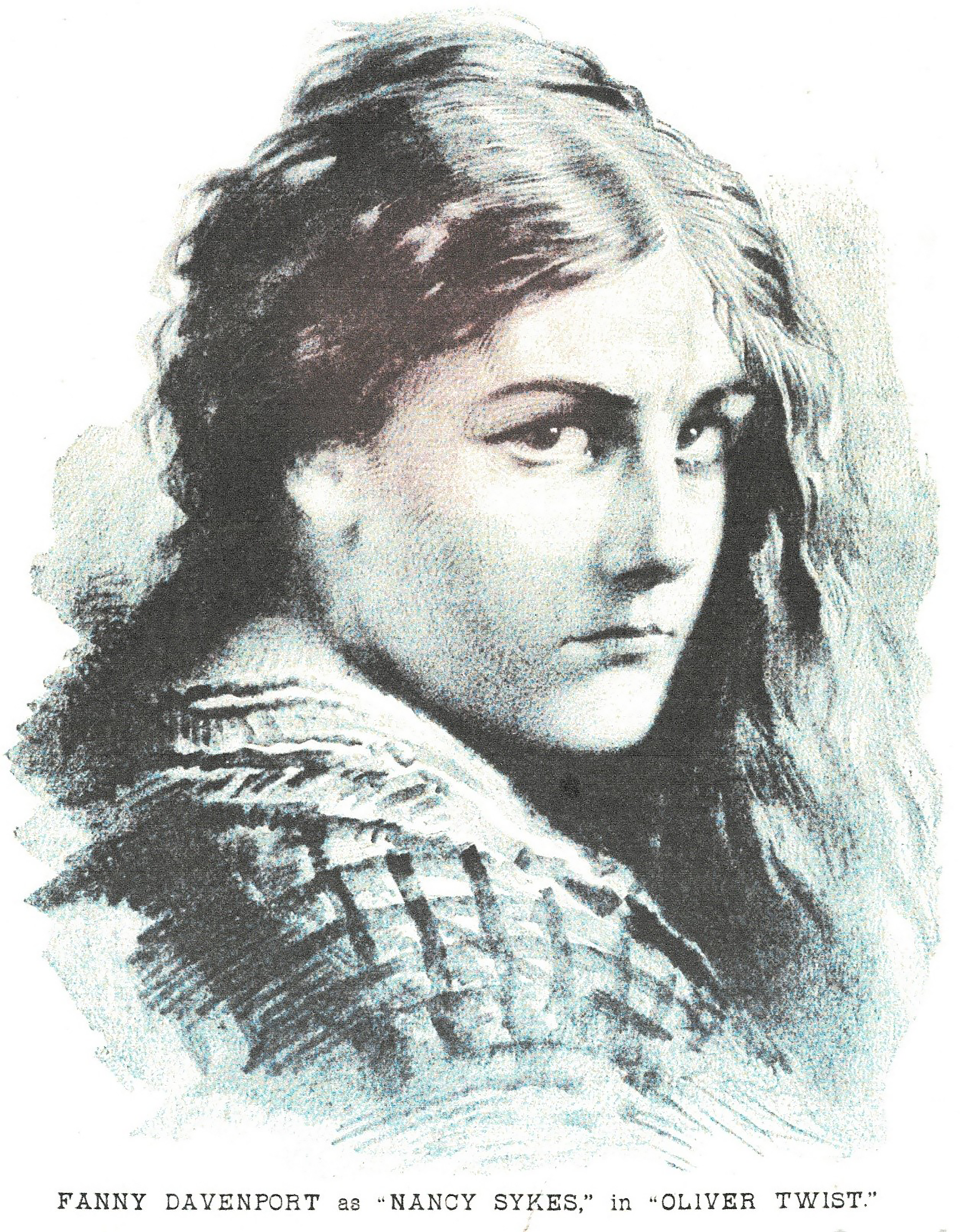
Fanny Davenport as Nancy Sykes, from Music and Drama (New York, 1882).
Marguerite Gautier and Nancy Sykes were two rewarding extremes in the portrayal of the whore with the heart of gold. Just as Camille's deathbed was the long-awaited consummation of that drama, Nancy's murder was the much-anticipated scene à faire for Oliver Twist. Playwrights and managers may have surmised its attraction from the vast popularity of the various melodramas based on contemporary crimes, in which the commission of a homicide took place in plain sight of the audience. In particular, the Red Barn murder of Maria Marten in 1827 had been hustled on to the boards even while the murderer's trial was underway. The scene of the murder was particularly graphic and, over time, developed an intricate choreography between assailant and victim. One major difference with Nancy, however, is that Maria was always depicted as a betrayed innocent, unlike her real-life model (Figures 9 and 10). 38

Phiz (Hablôt K. Brown), “Corder Shooting Maria Marten”, from Camden Pelham, The Chronicles of Crime; or, The New Newgate Calendar, 1887.

F. W. Pailthorpe, “A Foul Deed”, hand-tinted illustration, Robson & Kerslake edition of Oliver Twist, 1886.
In Almar's version, Sikes is allowed to brutalise Nancy on stage, before he drags her offstage, usually by her hair, and kills her there. ‘A scream is heard, then a fall’ (Act IV, sc. 2). (In Pollock's Juvenile Drama script, a pistol shot is heard.) Sikes staggers back ‘pale and trembling’. Once Nancy became a star part, an offstage death was out of the question. In proto-Grand-Guignol fashion, following Cushman's innovation, she drags herself back on stage, forgives her murderer, and then expires. Audience thrilled to these moments, so that Nancy's return for a last gasp became traditional (Figure 11). 39

Generic woodcut for posters of productions of Oliver Twist, Specimen Book of Theatrical Cuts, 1882.
The Nancy of Lucille Western, an unrestrainedly passionate actress outstanding in melodrama, was described as as truthful and as ghastly a piece of acting as has ever been on the American stage. […] In her fight with Bill Sikes (Jos. Herne) she was often terribly in earnest […] and Herne had as much as he could do to overcome her.
40
To carry out the realism of the beating a pad was made of a number of wet towels; these Herne struck with a piece of board, making a sickening thud which Lucille accompanied with a scream, each one growing fainter, until it became a groan, then Bills steals across the stage and off at an outer door and Nancy, almost dead, drags herself on till she gets to the centre of the stage, her face completely hidden by her dishevelled hair when she gets to position centre she turns her face which has been covered from the audience, throws her hair back and reveals her face covered with stage gore.
41
Strictly Forbidden
Whether imported from the States or spontaneously generated, Nancy's death throes began to appear on the non-legitimate English stage as well. At the Old Vic in September 1842, the blood-and-thunder actor E. F. Saville, reprising his Bill Sikes (now ‘Sykes’), spared no brutality in bashing Miss Martin (the original Almar Nancy): The ‘murder of Nancy’ was the great scene. Nancy was always dragged round the stage by her hair, and after this effort Sikes always looked up defiantly at the gallery, as he was doubtless told to do in the marked prompt copy. He was always answered by one loud and fearful curse, yelled by the whole mass like a Handel Festival chorus. The curse was answered by Sikes dragging Nancy twice around the stage, and then, like Ajax defying the lightning. The simultaneous yell then became louder and more blasphemous. Finally, when Sikes, working up to a well rehearsed climax, smeared Nancy with red-ochre, and taking her by the hair (a most powerful wig) seemed to dash her brains out on the stage, no explosion of dynamite invented by the modern anarchist, no language ever dreamt of in Bedlam could equal the outburst.
42
Any further development in the acting of Nancy was foreclosed by the banning of Oliver Twist from the English stage. Just as Dickens's prose fiction had been condemned with Jack Sheppard as a ‘Newgate novel’, so its stage versions were castigated as corrupting to susceptible minds. Even before he became Examiner of Plays, William Bodham Donne, adjunct to the censor James Mitchell Kemble, attempted to ban them in 1844. Significantly, this was a year after the new Act for Regulating Theatres, which both enabled minor playhouses to stage drama and specified the Lord Chamberlain's mandate to be ‘for the preservation of good Manners, Decorum or of the public Peace’. Beginning in 1848, several Olivers were closed while they were still running (Figure 12). 44

William Bodham Donne, about 1860. Frontispiece to Catherine Bodham Johnson, ed., William Bodham Donne and his friends, London: Methuen, 1905.
Once Donne succeeded to the post in 1852, he remained adamant on this point. 45 In 1860, J. H. Cave, manager of the Royal Marylebone Theatre, argued that he had gone to great expense to mount Twist; Donne allowed him to play it for two nights, but then banned it forever from the Marylebone and Victoria Theatres, melodrama houses catering to the working class. 46 When a Parliamentary Select Committee on Theatrical Licences and Regulations questioned Donne on this prohibition, he explained that he was acting on complaints from parents and masters who had noticed ill effects on their sons and apprentices. He characterised Oliver Twist as ‘a particularly repulsive play’. The novel might pass muster, but not the drama, for ‘the eye cannot bear all that the imagination can master, and so it is in Oliver Twist’. 47
Nevertheless, Donne issued a special license to John Oxenford's three-act version, produced at the New Queen's Theatre; it featured a remarkable cast – Henry Irving as Bill Sikes, J. L. Toole as the Artful Dodger, and the inoffensive Nelly Moore as Nancy – and drew large audiences. (The theatre's co-owner was Henry Labouchere, a junior M.P., who may have elicited the permission.) Subsequently, another member of parliament sarcastically inquired if Oliver Twist was normally banned because it was offensive to parish beadles, and the Secretary of State was asked if he approved of the Lord Chamberlain's consideration of the feelings of parish authorities. The floodgates opened, and performances took place at the Surrey, Victoria, Pavilion, and other theatres catering to a plebeian audience. 48 Perhaps, given the profusion of sensation dramas on the English stage in the 1860s, Oliver Twist was regarded merely as an old-fashioned, rather crude variant.
A contributory factor to this tolerance may have been the artistic and social trend in the late 1840s and 1850s to regard the prostitute as a redeemable ‘magdalen’.
49
Earlier depictions of bedraggled and gin-soaked ‘unfortunates’ with sunken eyes, painted cheeks, hollow coughs, and suicidal tendencies gave way to portrayals of ‘soiled doves’, wayward sisters and daughters capable of reclamation. They were seen sentimentally as ingenuous victims of heartless seducers or martyrs to economic and social hardships. As Eric Trudgill has put it, In 1850 the fallen woman in fiction was a wretched wanderer of the night, a figure of squalor and pathos. By 1853 she was establishing herself as a feminine archetype almost equal to the Madonna, almost equally motherly, pure and inspirational.
50
Whatever their newfound elevation in literature and painting, the organs of public morality still considered professional sex workers to be persona non grata when portrayed on the stage, particularly after ‘pretty horsebreakers’, celebrity courtesans grown rich and famous on the wages of sin, became prominent in the 1860s. 51 When Dion Boucicault's sensation drama Formosa, or The Railroad to Ruin opened at Drury Lane in August 1868 it was immediately attacked because of its central character, a high-class demi-mondaine based on the notorious Mabel Gray. The Times fulminated, ‘Not only is a harlot the heroine of the piece, but her harlotry is made one of its most prominent features’. 52 The Lord Chamberlain was recriminated for licensing the work, and it was suggested that young women and girls be prevented from seeing it. As usual, such moral protestations in the press were belied by the public's response. Formosa had the longest run of any play at Drury Lane to date and was moved to another theatre only to make room for another of Boucicault's works (Figure 13). 53

The prostitute as social celebrity. A scene from Formosa, in a generic woodcut poster, Specimen Book of Theatrical Cuts, 1882.
La Dame aux camélias had been banned for decades 54 and even Verdi's operatic version La Traviata had to be reset in 1700. 55 When the Lord Chamberlain finally granted the play a license in 1873, it appeared in James Mortimer's adaptation as Heartsease, its heroine now an actress. It was so anodyne that the Daily Telegraph compared it to a patent stain remover that ‘sacrific[es] the colour and texture of all material subjected to the treatment’. 56 That same year, Wilkie Collins's The New Magdalen presented a street-walker turned nurse, whose striving for respectability is constantly thwarted, until, under a stolen identity, she attempts to wed an upright youth, sends his fiancée to a madhouse, but then makes a full confession. A clergyman proclaims her ‘the noblest of Heaven's creatures’ and offers her a fresh start and his own hand in marriage (Figure 14). 57
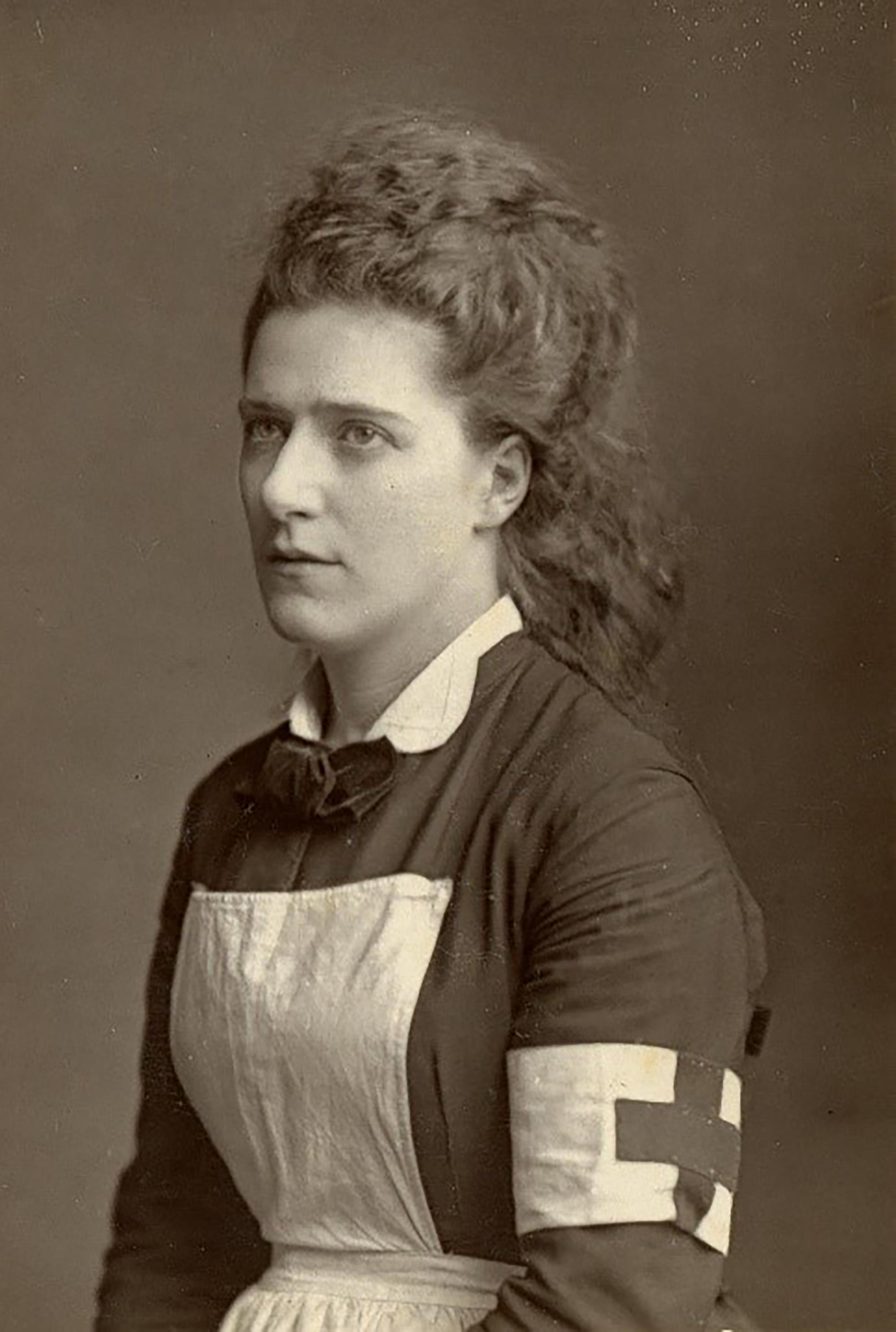
The prostitute as angel of mercy. Ada Cavendish as Mercy Merrick in The New Magdalen, London Photographic and Stereoscopic Co.
The conservative press was outraged and found it ‘opposed to all one's sense of justice and moral right’. 58 The English public could still not square its moral righteousness with what seemed to be an over-generous dose of forgiveness.
Consequently, despite emphasis on Nancy's maternal protection of Oliver, stage presentations of Oliver Twist were still regarded with suspicion by the authorities. In 1878, an English actor, Cyril Searle (né Joseph Seale), submitted an allegedly new adaptation (actually the Almar/Jefferson variant) to the Lord Chamberlain, to feature his partner, the American Rose Eytinge. Described by the manager Daniel Frohman as ‘a black-eyed, black-haired Jewess’, 59 the hyper-temperamental Eytinge had been leading lady to Lester Wallack, and was best known as the heroine of Augustin Daly's After Dark, in which she saved the comic man tied to the rails from being crushed by an oncoming train. Since her speciality was romantic heroines and betrayed wives in adaptations of French salon drama, her desire to play Nancy was derided by her colleagues and later questioned by the critics. Wallack agreed only if she acted in a one-act high comedy the same evening so that the audience could see her as herself and ‘not take away with them the ghastly picture of Nancy in her death throes’. 60 The fear that an actress might be tainted by the role was still operative (Figure 15).
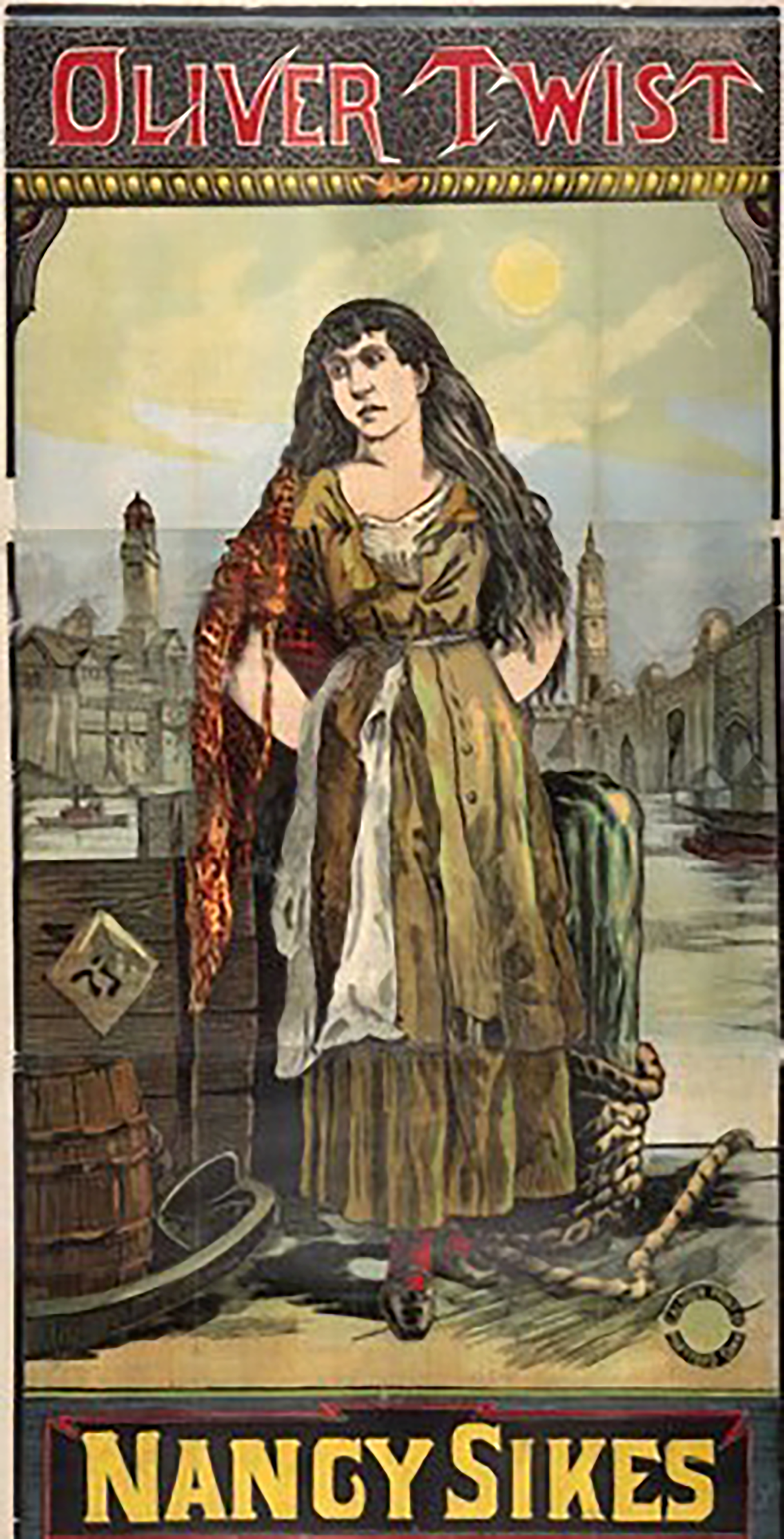
Generic wood-engraving poster for Nancy Sikes, Hartford, Conn.: Calhoun Printing Co., c. 1880. She is posed against the Thames, perhaps because drowning in the river was a traditional death for ‘unfortunates’.
One observer opined, ‘More hideous and degraded Nancys than the portrayal by Miss Eytinge may have been given, but in none was the tenderness of woman interwoven with the repulsiveness of untutored depravity’. 61 Refinements to the murder scene involved Sikes dragging Nancy the length of the entire stage by her hair, the hem of her skirts remaining visible in the doorway, and the thud of an axe, rather than a bludgeon. As Sikes cowered in terror, Eytinge ‘was seen to drag her mangled face and matted hair across the threshold of the door. With one wild pleading look […] and murmuring “Bill,” she died […]’ (Figure 16). 62

The arrest of Sikes immediately after the murder, in Nancy Sikes, Olympic Theatre, from the Illustrated Sporting & Dramatic News, 20 July 1878.
The new Examiner of Plays, Edward Piggott, who had succeeded to the post four years earlier, deplored the subject's ‘bad influence’, but grudgingly licensed it because Nancy and Sikes were advertised as man and wife.
63
Nancy Sikes, as this version was entitled, opened at the reputable Olympic Theatre on 9 July. The top billing made it clear where the attraction lay, although the play's title was taken to be so outlandish that it was recalled mockingly twelve years later when Grace Hawthorne was billed as ‘Nancy Sikes’ in yet another revival at the New Olympic.
64
The newly founded magazine Theatre was not amused by Searles’ adaptation; it found it a play, aiming to interest the lowest class of audience…[which] by reason of its utter imbecility, [would] be soundly hissed at the Victoria or the East of London… [the role is] offensive were it not ridiculous. […] Nancy, who has received brevet-rank as Mrs. Sikes, bears no resemblance to the half-wild, hysterical, loving, hating woman whose unselfish passion alone raises her above the level to which she is dragged by her sordid life.
The graphic violence of the murder scene caused an outcry, leading to the play's closure. Piggott inserted a ‘Confidential Memo’ into his official correspondence files on 5 August 1878 to justify what some considered a dereliction of duty in licensing it: Such pieces as these founded on ‘Oliver Twist’ are, to my sense, profoundly repugnant, and repulsive. But the Examiner of Plays has not to consult his own personal tastes and feelings; he has to consider on what grounds a licence for the representation of such and such a piece can be refused. Now it might be contended, with something more than plausibility, that, however revolting to the sensibilities of the better portion of an audience may be certain scenes, incidents, and persons in ‘Oliver Twist’, neither the general tendency, nor the ultimate effect, of their representation can be considered as opposed to the interests of public morality; inasmuch as vice and crime are presented under a hideous, and by no means seductive mien, and are punished in the end; […] There is absolutely nothing in the degradation and redemption of […] ‘Nancy’; to tempt the imaginations of young members of the dangerous classes sitting in the gallery …
66
An Edwardian Nancy
By this time, continental plays of the demi-monde and the incursion of Ibsen had altered the dramatic presentation of the fallen woman, often characterised as an adventuress, the woman with a past, the femme fatale who operated within the precincts of high society. Wilde's Mrs Erlynne, Pinero's Second Mrs Tanqueray and Sudermann's Magda are prime examples and paved the way for depictions of the New Woman. Yet the influence of Oliver Twist was indelible. In her campaign to popularise Ibsen, Mrs Fiske followed A Doll's House with an afterpiece, a one-act shocker about lowlife in Louisiana in which a Creole slattern is killed by a Sikes surrogate. 67
Why London's leading actor-manager Herbert Beerbohm-Tree chose in 1905 to produce a new version of Twist by J. Comyns Carr is unclear; perhaps he wanted to add Fagin as a pendant to his other villainous Jew, Svengali. This version begins with Oliver already at Mr Brownlow's. Sikes intends to murder the boy for ‘blabbing’, giving Nancy a double motive for informing the Maylies and intensifying her role as Oliver's guardian angel. Tree conceived the three leading roles as a tripartite entity: Fagin the mind, Sikes the body, and Nancy the heart. 68 In practice, however, this philosophic concept was overridden by the sensational aspects.
Constance Collier recalled that, although she was the leading lady at His Majesty's Theatre, Tree did not want her for the part. ‘I had never acted a character with a cockney accent. I had always played goddesses or empresses or romantic heroines at His Majesty's’. 69 With her Grecian profile and opulent figure, for Tree she had appeared as Minerva in Ulysses, Roma in The Eternal City, and Portia in Julius Caesar; the following year she would queen it as Shakespeare's Cleopatra. Her Nancy could only be imbued, in the audience's memory, with the nobility of such roles.
Carr's script called for Nancy to be murdered in sight of the audience, but Tree found dead bodies onstage unconvincing. As Almar had done in the 1840s, he placed the crime offstage. Nevertheless, the visible brutality was graphic: Bill was to fell her with a blow to the chin, and rehearsals were strenuous; once Lyn Harding actually knocked Collier out. In the wings, for realism's sake, the two actors continued to play the scene as Fagin watched through the door, cuing the public with his reactions: Nancy's screams would be ended by a loud thud followed by low moaning, which so frightened the audience ‘We were always having people fainting or being carried out’. 70 Collier never took a curtain call lest it spoil the illusion (Figure 17).
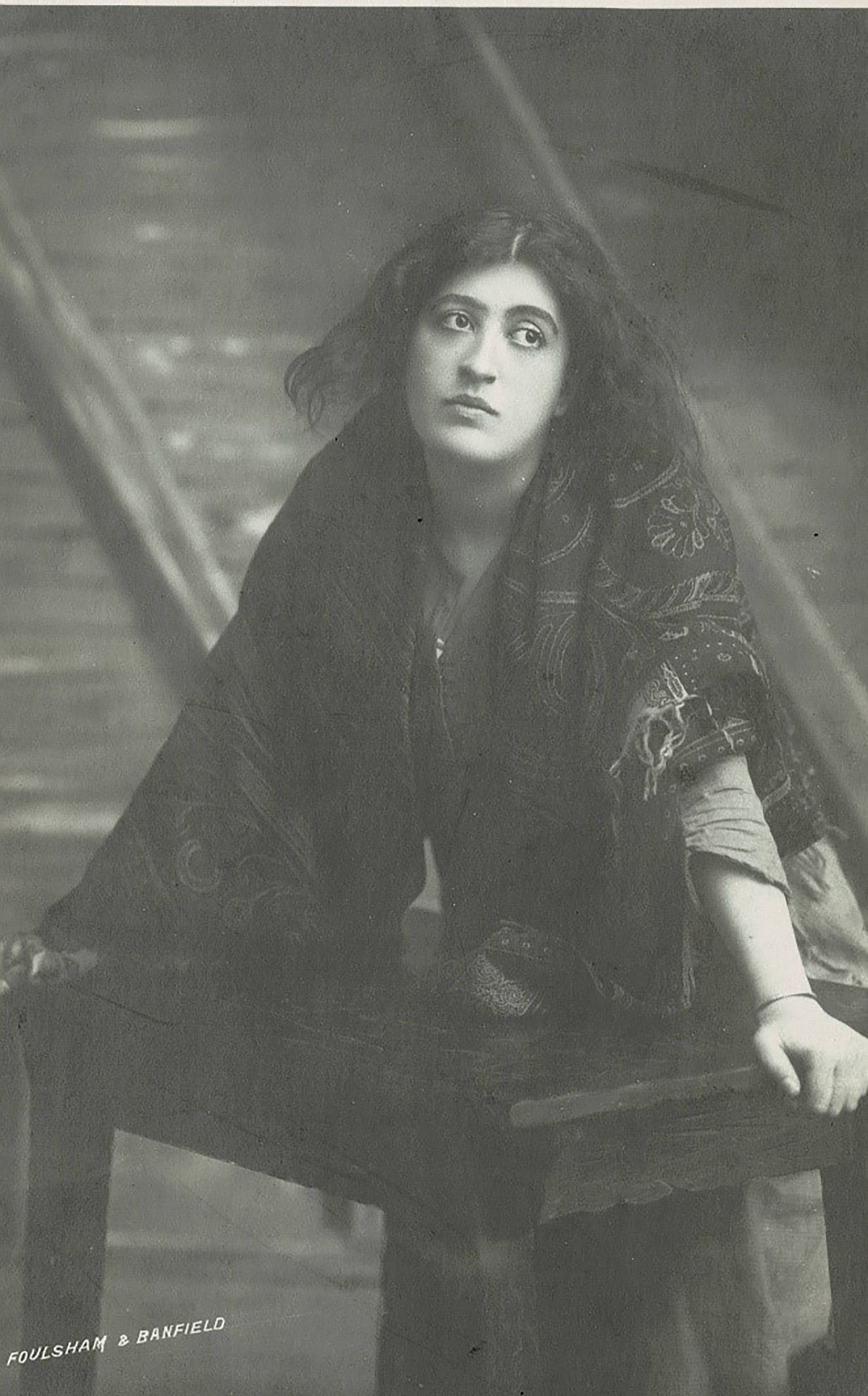
Constance Collier as Nancy. Photo: Foulsham & Banfield, London, 1905.
Although the whole show was a hit which ran for months, enjoying frequent revivals, it was Collier's Nancy that spectators remembered best. Her performance ‘was unusually powerful and well sustained’ was one professional opinion.
71
The Dickensian scholar B. W. Matz approved: But far and away the most striking performance of all is Miss Collier's Nancy. It is undoubtably the most difficult of the whole cast, with no distinctiveness in the outward appearance to help the artist as in the cases of Sikes and Fagin. Yet Miss Collier made Nancy the most real and live character of the play. It was a wonderful performance, full-bodied yet reticent, pathetic without being maudlin, rugged yet artistic to a degree. Her scene with Rose Maylie in the hotel was one of the finest pieces of acting in the play exhibiting that side of a woman's nature which sooner or later comes out in a woman, whatever her position in the grades of life, with masterly naturalness, whilst her last exit from the stage at the bidding of Sikes created a great impression on the audience.
72
(Figure 18)

Constance Collier as Nancy and Herbert Beerbohm Tree as Fagin. J. Beagles & Co., London, 1905.
As Matz's appraisal makes clear, Collier's interpretation in the leading theatre in the capital ennobled Nancy, adding her to the gallery of redeemed magdalens. The melodramatic elements had been sublimated in a figure that suited the more refined taste of the time. Collier's gentility and her Shakespearian credentials made whether or not she was married to Sikes a complete irrelevance in the age of Mrs Ebbsmith and Mrs Warren.
Oliver Twist continued to appear on stage: Nancy was bludgeoned in full view of the audience when those masters of melodrama, the Melville Brothers, produced it at the Lyceum in 1912. 73 But her further development has to be traced in the cinema and on the musical stage. The Victorian and Edwardian actresses had been instrumental in effacing Nancy's status as a depraved adolescent; she was now portrayed as a fully maternal adult and even a robust torch singer, as in the musical Oliver! 74 In every case, however, the realia of her profession, like her murder, would be kept offstage and off-screen. When fifty-year-old matronly Elita Proctor Otis repeated her Nancy in one of the earliest filmings of Oliver Twist in 1909, she is first seen mending Bill's coat and feeding him medicine in wifely fashion; her character is introduced in the intertitle as Nancy Sykes (Figure 19). 75
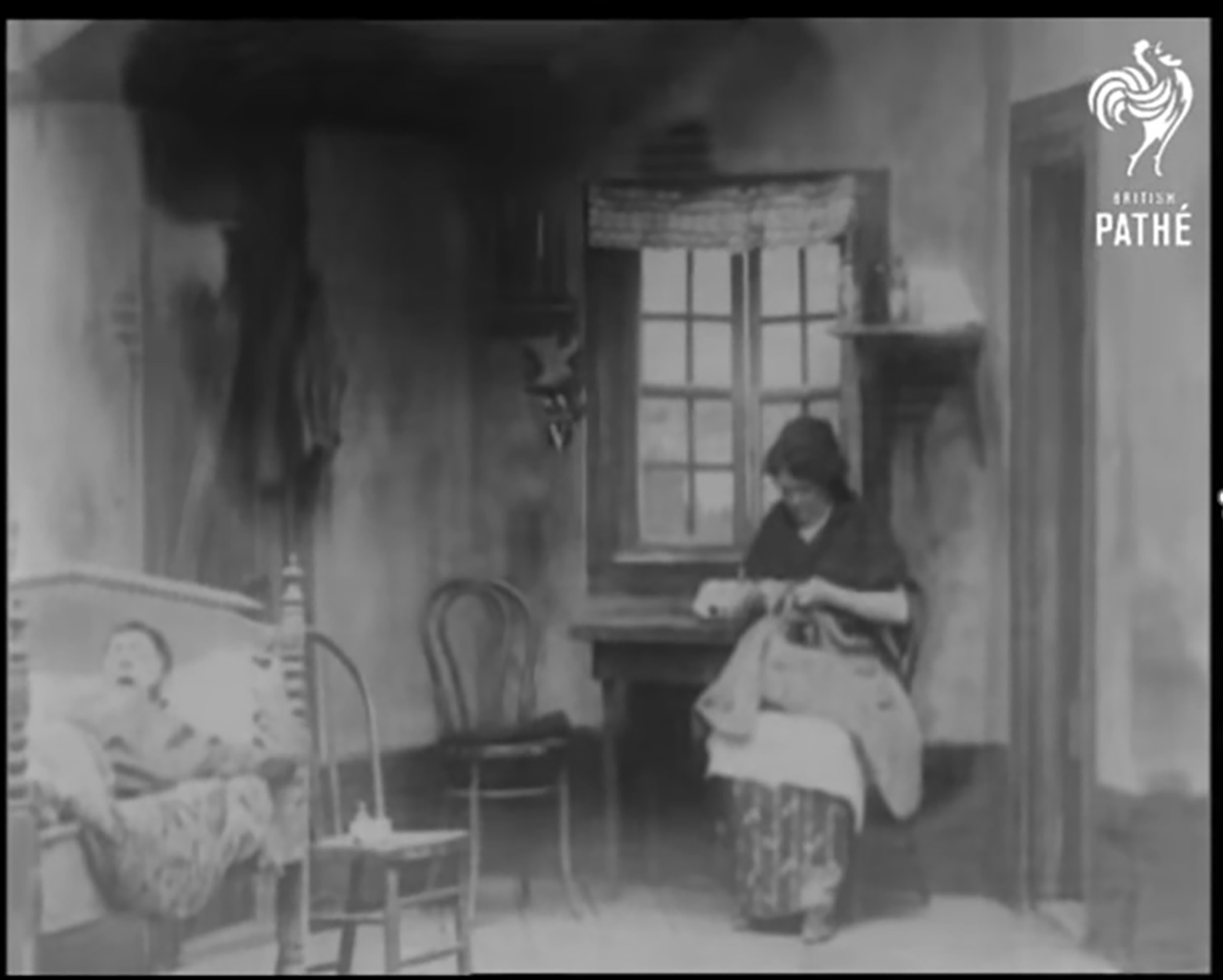
Elita Proctor Otis as Nancy in one of the earliest film versions of Oliver Twist, American Vitagraph Company, 1909.