






Abstract
The flying matinée was a regular feature of the British theatrical scene from the 1880s. Made possible by the railway network and particularly the introduction of dining cars on trains, the practice originally involved London dramatic companies travelling out from the capital in the morning, giving a performance in another city or town in the afternoon and then returning in time to give the evening show at their London base. Despite the fact that flying matinées were widely adopted by eminent actor-managers such as Herbert Beerbohm Tree, George Alexander and Charles Wyndham, the phenomenon has been virtually ignored in theatre histories. In this article, I examine the development of such visiting performances and analyse the personal, financial and reputational repercussions for audiences, performers, managers and the wider theatrical industry. Particular attention is paid to a newspaper debate of 1896 that aired the arguments of supporters of the system as well as the fears of pecuniary disadvantage held by some within the profession, especially those in regular touring companies. In recovering the phenomenon, I argue flying matinées played a significant part in maintaining the interconnectivity of West End and regional theatres and in the circulation of dramatic works, performers and production values.
In June 2009 the inaugural NT Live transmission to cinemas across Britain was heralded as a means of widening access to London theatre productions and of increasing the revenue of the National Theatre. This successful initiative can be seen as a latter-day successor to the late-nineteenth-century flying matinée. Made possible by the establishment of the railway network and particularly the introduction of dining cars on trains, 1 the Victorian practice originally involved London dramatic companies travelling out from the capital in the morning, giving a performance in another city or town in the afternoon and then returning in time to give the evening show (usually the same production) at their London base. Host venues included theatres in Brighton, Bristol, Birmingham and Manchester. On occasion, the destination was nearer, being playhouses in suburbs such as Ealing or Crystal Palace. Flying matinées became popular in the 1880s at a time when large-scale touring was in vogue and continued into the 1910s. Despite the fact that they were widely adopted by eminent actor-managers such as Herbert Beerbohm Tree, George Alexander and Charles Wyndham, the phenomenon has been virtually ignored in theatre histories. Confusingly, the same term was also used to describe tours whereby stars repeated a pattern of giving a matinée at one town, then moving on to another where they performed the next day, thereby enabling them to play six places in a week. 2 This was the model adopted by Sarah Bernhardt in 1898 and Mrs Patrick (Stella) Campbell in 1901. Wyndham undertook such a flying tour in 1902 while awaiting the completion of the construction of his new London theatre. Starting at the Devonshire Park Theatre in Eastbourne and visiting thirty-one towns and cities in six weeks, he is said to have covered around five thousand miles and taken £10,000. 3 Regional centres also developed their own versions of the flying matinée. For example, in 1895 a company performing the Gaiety burlesque The Shop Girl at Plymouth Theatre Royal journeyed to Exeter and back for a single afternoon performance. In this article I concentrate on matinées originating from and returning to London, examining specific instances and analysing the effects of the phenomenon on audiences, performers, managers and the wider theatrical industry. In so doing, I reveal an important element of the interconnectivity of the West End with regional performance centres.
History and Logistics
There is a dispute over who pioneered the flying matinée. In his 1904 biography of Sir Charles Wyndham, T. Edgar Pemberton claims the actor-manager was the inventor. 4 Although Wyndham was certainly an early adopter, he was not the first. Another contender was Gloster Armstrong at the Strand and Comedy Theatres, working on behalf of W. Duck and Charles Hawtrey. 5 Likewise, H. H. Morell was said to have ‘perfected’ it while working for Tree at the Haymarket in 1894. 6 Arguably, a more significant role in establishing the phenomenon was taken by Ellen Nye Chart at Brighton's Theatre Royal. 7 In 1883 she inaugurated ‘morning’ or ‘special’ matinées on a Thursday, for which she engaged London companies. 8 Figure 1 shows a typical example. Presented by Tree's Haymarket company on 16 April 1896, the performance of Paul Potter's Trilby was given during a week when Frederic Atherton's touring company was engaged for the evenings and the Saturday matinée. Chart's establishment unquestionably received the most regular flying visits of any other British theatre. I have, for example, identified twenty-eight in 1888, though there may have been more. 9 The visiting London companies in that year included those from Terry's, the Criterion, Gaiety, Globe, Princess's, Opéra Comique, Toole's, Prince of Wales's, Strand, Haymarket, Olympic and Vaudeville Theatres. Some played twice in quick succession; for example, Edward Terry brought his adaptation of David Lloyd's farce The Woman Hater in both February and March, and J. L. Toole did likewise with Herman and Elizabeth Merivale's comedy The Don in May and June. The following year, for which I have evidence for thirty-nine flying matinées at Brighton, Wyndham's Criterion company appeared for five Thursdays in a row, repeating the revival of Tom Taylor's Still Waters Run Deep three times and always playing to crowded houses. Many of the plays brought to Brighton were comedies, but they were not exclusively so. Of particular interest, the Novelty Theatre's production of Ibsen's A Doll's House starring Janet Achurch played on 20 June 1889, less than two weeks after its London premiere. This was the only performance outside of the capital during its initial run. Although the play did not attract a full house in Brighton those that did attend were reported to be ‘unusually attentive and critical, and thoroughly appreciated the performance’. 10

Detail of the back of a programme for Brighton Theatre Royal detailing a flying matinée by Herbert Beerbohm Tree’s Haymarket company on 16 April 1896. Author’s collection.
Due south of London, the Sussex seaside town of Brighton was ideally situated for quick visits, being only around fifty miles away by train (see Figure 2). Unsurprisingly, other places at a greater distance from the capital were slower to adopt the flying matinée, but prompted much media coverage when they did. Birmingham's first was not until 8 March 1894 when Tree's Haymarket company starred in Robert Buchanan's drama The Charlatan at the city's Theatre Royal. This was quickly followed by a visit from Wyndham's Criterion company in May. No sooner had one long distance been successfully covered than another enterprising London manager decided to beat the record by undertaking a longer journey. Hence Arthur Bourchier's visit to Bristol's Prince's Theatre on 15 January 1896 with The Chili Widow, Alfred Surto's adaptation of a French hit. Bourchier's Royalty Theatre company had already taken the comedy on flying visits to Brighton (four times), Eastbourne (twice), Portsmouth (twice), Boscombe, Crystal Palace, Hastings and Reading or, as one journalist remarked, ‘every well-known place within two hours of London’ (see Figure 3). 11 The Bristol appearance broke the record for takings at the theatre, with hundreds unable to obtain even standing room. 12 As critic Clement Scott quipped in the Daily Telegraph, after this escapade ‘there is now nothing left for the manager of the future but Dublin by parachute and New York by balloon.’ 13

Map of the extensive late-nineteenth-century railway network from J. G. Bartholomew’s The Royal Atlas of England and Wales (1898). Places reached by a direct line from London were more likely to receive flying matinées. Author’s collection.

Arthur Bourchier and Violet Vanbrugh in the Royalty Theatre production of The Chili Widow, which was repeatedly taken on flying matinées, from the Sketch, 28 October 1895. Author’s collection.
Bourchier (pronounced Bowcher) was one of the most consistent exponents of the flying matinée. 14 In 1896 he proposed to play one in Paris and sent his agent, Arthur Bertram, out to arrange it, but the fixture did not transpire. 15 It was not until 1903 that American impresario Charles Frohman took the Duke of York's company to the French capital for a flying performance of J. M. Barrie's The Admirable Crichton (Figure 4). The company left London on the Monday morning, performed in the Théâtre de la Renaissance in the evening, and were back acting on the Duke of York's stage on Tuesday night. The logistics of the arrangement, under the direction of Dion Boucicault, were impressive, particularly since the Renaissance's stage was only half the size of the London one, so movements needed to be reblocked. Immediately after the curtain came down on Saturday, stage carpenters sawed the scenery from the four sets into 6½ ft sections so that they would fit on the cross-channel boat. These, plus the effects and costumes, were transferred to a fleet of lorries that took them to Charing Cross station. There they were loaded into five railway carriages, with two others being commandeered for working staff. The train departed at 4 a.m. for the journey to Folkestone Harbour. The company, consisting of twenty-five principals, eleven dressers and thirty-four stage hands, including fly-men, electricians and even the call-boy, left on the 10 a.m. train. 16
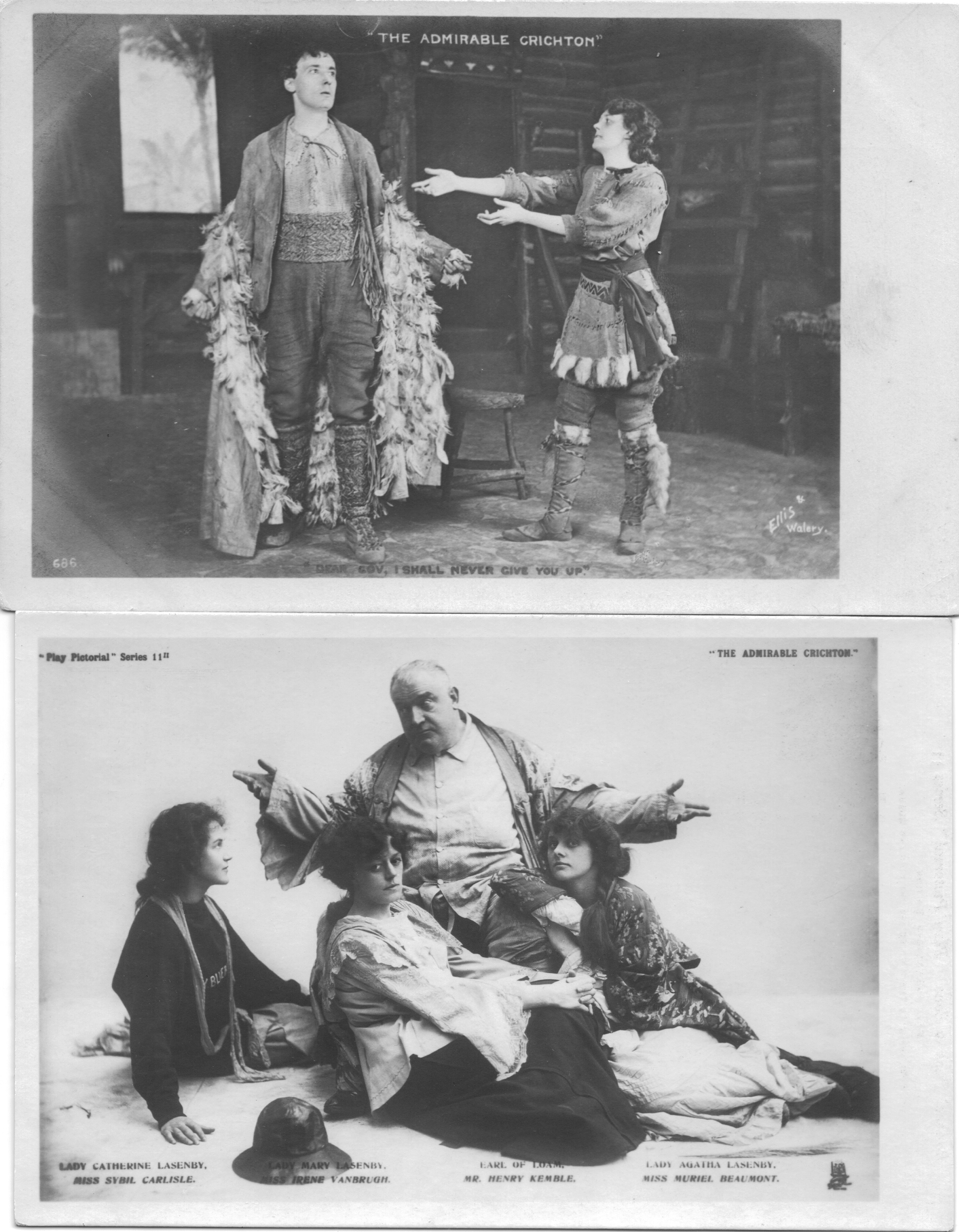
Postcards depicting H. B. Irving, Irene Vanbrugh and members of the Duke of York’s company in J. M. Barrie’s The Admirable Crichton. The production was taken to Paris for a flying visit in 1903. Author’s collection.
For the return trip the timing was even tighter. The performance finished at midnight and the special train was due to leave from Paris's Gare du Nord at 3 a.m. This meant that the stage hands had to begin removing some of the scenery for the second act while the play was in progress. 17 Despite delays caused by a missing lorry, all the cargo was successfully transferred to a special boat leaving Bologne at 9 a.m. The company reached London at 4.30 p.m., giving a small window to refresh and prepare for the evening show.
Not everyone was impressed by the endeavour, though some responses were coloured by national bias. The Parisian critics were largely underwhelmed by the production and a scathing journalist in the American Register failed to see why such ‘an idiotic play’ was chosen ‘unless as an exhibition of the degenerate art of the English stage and the degree of inanity which English playgoers will support.’ 18 The trip lost Frohman money, reportedly between £1,200 and £1,500, but he was untroubled, saying he undertook the visit because it had not been achieved before. 19 He claimed it also raised the possibility of establishing an English theatre in Paris. 20 Moreover, all the publicity surrounding the trip led to a boost in ticket sales of the London show and must have been helpful when Frohman sent the play out around the British regions with two touring companies in August. 21
The transporting of full stage sets, as occurred with The Admirable Crichton, was exceptional. In 1915, H. B. Irving, who performed in Frohman's Paris jaunt and later led his own Savoy Theatre company on flying matinées, told the Observer: ‘You can only give … a play which can be “set” out of the stock scenery of the theatre to which you are going. If you had to take your scenery you could not trust, when you are playing again the same evening, to get it back in time for your next performance.’ However, unusual items such as fountains needed to be taken as the receiving theatre would not necessarily have one in the stock scenery. 22
A novel variation of the flying matinée was introduced by Frederick Mouillot in 1905: the ‘flying audience’. He chartered a train to bring people from Manchester to attend a performance of What the Butler saw at the Savoy in London. 23 For two guineas (less than the usual return train fare), purchasers received first-class travel, were served meals on both the inbound and outbound journeys, were conveyed directly from and back to the station and enjoyed reserved stalls or dress-circle seats at the theatre. Only between fifty and sixty people took up the opportunity and the experiment does not appear to have been repeated. 24 Equally innovative, a reverse flying matinee was undertaken by Annie Hughes’ touring company, who while engaged to play Tommy for a week at the West Pier, Brighton, made a flying afternoon visit to His Majesty's Theatre in London on 5 July 1907. 25 But the ultimate literal flying matinée was not attempted until September 1921 when Michael Faraday planned to fly the Duke of York's Theatre company to Manchester by aeroplane for a performance of Harriet Ford and Harvey O’Higgins's farce The Wrong Number. Unfortunately, fog put paid to this and the journey was made by train instead. 26 By this time the golden age of the flying matinée was over, at least for visits that originated and returned to London in a single day. The term lived on but was generally applied to variations of normal touring where matinées were given at a series of regional theatres over successive days. A notable exception occurred on 20 September 1926 when John Drinkwater's adaptation of Thomas Hardy's The Major of Casterbridge was taken from the Barnes Theatre in south-west London for a flying matinée at the Pavilion Theatre on Weymouth Pier, especially so that the eighty-six-year-old novelist could see the production. 27
Industry Opinions of the Practice
On 18 January 1896 the growing popularity of flying matinées prompted the Era to publish a long article on the topic describing how they ‘have become quite a feature of latter-day theatrical enterprise.’ The author anticipates the practice will prove ‘fashionable’ now that it has been shown that the quality of the performances is not impaired ‘at either end of the journey’. The piece also mentions some associated drawbacks and concludes with an invitation for readers to write in with their thoughts on such ‘scratch matinées’. 28 Over the next month, thirty-four letters were published in response. Few correspondents had anything positive to say, though dramatist and actor F. A. Scudamore thought it would make little difference to theatrical business but might attract people who do not normally attend the theatre. 29 Similarly, William Calvert, manager of Muncaster Theatre in Bootle, was not keen but suggested the matinées might ‘elevate the taste for high-class fare, and increase the resident manager's receipts’. 30 Scudamore′s and Calvert's views are symptomatic of the assumption that the attractions being brought from London have higher production values and will appeal to a superior class of playgoer.
The majority of respondents to the Era article were touring managers who believed they would be disadvantaged if a London company performed in the week they were engaged at a regional theatre. For example, A. Gifford Stacey argues that the well-to-do usually go to the theatre only once a week and will choose the performance of the London company over that of the touring company. 31 Arthur Bearne recounts his negative experience when touring with James Hurst's Aesop's Fables, a play that had been much matinéed, since some managers then refused to book the piece. Yet Bearne suggests that if the local manager ‘uses discretion’ and ensures sufficient contrast between the afternoon and evening shows the touring company need not be impacted. 32 Walter Reynolds, actor-manager of theatres in Leeds and Bradford, claims ‘I have suffered in my two theatres heavy losses through the policy … and I flatly accuse London touring company managers of all classes of having by these fatuous methods almost ruined many towns on Monday nights for London attractions, particularly the No. 2's.’ 33 He concludes: ‘I submit that the “Snatch Matinée” of a genuine London organisation may be a very showy advertising expedient, but the country manager who contracts for it commits financial suicide.’ 34 Ida Millais, leading the No Man's Land company, argues that touring managers pay high prices for country rights of a play and book their dates in advance, but their box office receipts are damaged by the flying matinées playing the same piece. She believes the practice will lead to local managers decreasing the percentage given to touring managers, causing them to cut salaries. 35 J. Hermann Dickson, heading a touring company in Colchester, declares that flying matinées get unfair coverage in terms of advertising and press. He estimates the matinée takes between £80 and £120, depending on the weather, while the evening performance that day is lucky to draw £30. 36 Actor Reginald Stockton warned against complacency for those who were comforted by thinking the phenomenon would only affect towns within easy reach of London, correctly prophesying that London managers on regional tours will attempt matinées in neighbouring towns while they are there. 37 A. E. Percival, business-manager of the Shadows of a Great City company, contends authors will want double royalties since provincial managers will not pay as much for pieces once they are no longer novelties. 38 Several letter-writers also thought the practice detrimental to the performers themselves.
In an interview the same year, F. H. Trevalion, who brokered deals between touring and local managers, is outspoken against flying matinées because of the ‘injurious effect’ on touring business. He advises his clients against accepting them and states that he is ‘adding a clause prohibitive of the flying matinée to all the agreements that I approve.’ 39 Interviewed in the Idler magazine, actor E. S. Willard also condemned the practice, claiming ‘Manchester will speedily learn to imitate Brighton – which practically has but one day (Thursday), the day of a London company's visit, to go to the play upon’. 40 Further proof that flying matinées were bad for touring companies seems to be offered in a 1900 article in the Umpire entitled ‘Stage Whispers’. The anonymous author contends: ‘We have the example of Brighton to judge by: the weekly flying matinée visits of West End companies with up-to-date West-End successes have simply ruined Brighton as a touring town. The playgoing public save their money for the star visit, and the ordinary evening troupe, without sensational attraction, find themselves abandoned to uncongenial and unremunerative solitude.’ 41 Yet despite these reservations, Brighton's Theatre Royal continued to attract touring companies, many of whom also visited with flying matinées, suggesting that the financial disadvantage was not as prohibitive as supposed. In other cases, hosting a flying matinée brought benefits to suburban and regional theatres whose lessees often shut their premises in the summer because of the limited number and quality of touring companies in June and July. 42 For example, Standon Triggs, managing director of the Devonshire Park Theatre in Eastbourne, is reported in the Stage to have scheduled flying matinées only during vacation weeks. 43
Discontent with flying matinees rumbled on and came to a head in 1902 when legal action was taken against Clarence Sounes, licensee of the Grand Theatre, Woolwich. Wilfred Cotton and Ralph Le Butt, the managers of the Haymarket, had sent a company there to play Justin Huntley McCarthy's comedy My Friend the Prince for a week's run in April 1901. On Thursday, a local half-holiday, George Alexander and the St James's company gave a flying matinée performance of H. V. Esmond's comedy The Wilderness. Cotton and Le Butt sought to recover damages from Sounes, alleging breach of contract. The case hinged on whether it was customary only to have such matinées if the touring manager gave permission. Various managers gave testimony in support of the contention. The jury found in favour of the plaintiffs and Sounes had to pay £30 damages plus court costs. 44
Performers’ Perspectives
Accounts of performers’ feelings about flying matinées and the strain it placed upon them are elusive. Frustratingly, the autobiographies of stars who regularly performed in them fail to give an insight into the arrangements. For example, Violet Vanbrugh, who was married to Bourchier from 1894 to 1917, was for many years the leading lady in his company and undertook numerous flying matinées, does not mention them at all. She does, however, discuss a comparable engagement that provides evidence of the physical and mental strain of performing and travelling on the same day. While on a tour with Bourchier of George Playdell Bancroft's Teresa in May 1898 she was asked by George Alexander to perform in a new play at the St James's in only a fortnight. She thought rehearsals would be impossible because she was acting in Camberwell for the first week and in Birmingham for the second, where Bourchier's company were committed to two matinée performances as well as the evening ones. Alexander persuaded her that she could travel to rehearse on the non-matinée days, returning to Birmingham in time for the evenings. She recalls: As I look back, I can still feel the rush and bustle of those days. I rehearsed in London by day and played in Birmingham by night, and it was no easy part I was playing in ‘Teresa,’ […] It was, I think, the most exacting emotional part I ever acted. But, in spite of that, I welcomed the matinée days, when I had to play twice, as a rest from the early call and rush to the station, the drive to St. James's Theatre, the concentrated rehearsal, with my scenes taken one on top of the other, with no rest between while the stage manager held his watch in his hand to see that I left the theatre in time to catch my train back to Birmingham. Still, I was able to go through with it, although it was at the cost of very nearly losing my voice on the first night.
45
Julia Neilson, who undertook a number of flying matinées while working with Tree's Haymarket company between 1889 and 1894, mentions just one in her autobiography. The occasion was a performance at the Crystal Palace, which was memorable only because a poultry show was taking place in an adjoining part of the building and the noise from the birds ‘completely drowned’ the efforts of the acting company. 46
Unfortunately, Bourchier did not write an autobiography, but a newspaper report recalls an anecdote of his about when he was returning to London from a matinée of The Queen's Proctor at Bournemouth in 1897. At Bournemouth station, he was greeted by the train guard who had recognised the actor. Since there was only a scheduled fifteen minutes from the time the train was due to arrive at Waterloo and the commencement of the evening performance of Dr. Johnson at the Strand Theatre, Bourchier's dresser helped him transform into the evening's character during the journey. When the guard opened the carriage door at Basingstoke, he was astonished to find ‘that fat, very fat testy old gentlemen’ in place of the actor. Bourchier, sensing that fun was to be had, terrified the railway employee by pretended to be the ghost of Dr Johnson. When he disembarked in London, he was amused to find the guard telling everyone about the terrible vision he had encountered. 47
Another anecdote, perhaps apocryphal, relates to a visit to an unnamed regional playhouse by Alexander's company. When attempting to buy a ticket, a prospective theatregoer was told prices were high because it was a flying matinée. She therefore declined, declaring ‘I don’t greatly fancy these aerial shows’. 48
As in autobiographies, flying matinées receive scant mention in interviews. An exception is a report of Wyndham's visit to Birmingham in 1906. The actor-manager admitted ‘Hard work – well, perhaps it is’, but claimed ‘If I only had the time, and the geography of England were more amenable, I would give a matinée at a different town daily.’ 49 Yet some actors must have found the process exhausting, particularly if they had leading parts in both venues. For example, Tree performed Hamlet for the opening of Cambridge's New Theatre on 29 January 1896 in the afternoon and returned to the Haymarket to act as Svengali in Trilby in the evening. Cambridge was a relatively quick train journey, just one hour and ten minutes by the Great Northern Railway, so the endeavour was not too taxing for the actor. However, the same week Lewis Waller and company travelled farther, giving a performance of Charles Brookfield's A Woman's Reason at the Shaftesbury Theatre a few hours after a matinée at Manchester Theatre Royal. On this occasion, immediately after the previous night's performance the actors travelled north by railway sleeping cars, leaving Euston at midnight. They arrived back at the London terminal at 20.06 the following night, having dined on the train. They were then ready to perform at the Shaftesbury after the opening farce had been played. 50 Incidentally, despite encountering fog, the journey by the London and North-Western Railway Company train took 1 hour 54 minutes, faster than any service you could get today!
In 1907, B. W. Findon, writing in the Morning Advertiser, was concerned about ‘the abnormal strain on the constitution’ of Lena Ashwell when she took her Kingsway Theatre company on the first flying matinée to Cardiff. Findon thought that the five or six hours of travelling involved in covering the 153-mile journey was too much to ask of Ashwell, considering the trying role in Anthony P. Wharton's drama Irene Wycherley that she had to undertake twice in the one day. 51 The Daily Graphic wrote of the record-breaking attempt ‘The fourteen artists and five assistants will change dresses and makeup in a specially fitted saloon while travelling at sixty miles an hour. It will be one long, nerve straining, strenuous struggle which only the highest physiques could endure.’ 52 Nevertheless, Ashwell was undaunted, having previously taken the production on flying visits to Eastbourne, Birmingham and Richmond and subsequently to Coventry. 53
Financial Considerations
One actor who expressed his misgivings about flying matinées was W. G. Elliot. A member of Bourchier's The Chili Widow company, he felt aggrieved enough to write to the Era in December 1896. He complained that ‘seven performances a-week’ contracts for provincial tours were unfair, especially for those on small salaries since they stipulated the manager has the right to insist the week's work included a flying matinée to another town. He argues it costs the individual more than it would if they were at home and so on a salary of £2 10s. a week he or she might make a loss on the day. 54 His grievance was specific to touring companies as for the matinées originating from London, it was usual for the management to provide the refreshments.
While evidence for the financial arrangements of performers involved in the matinées is scarce, 55 there is some documentation about other monetary matters. Newspaper reports reveal that resident theatres frequently put up the ticket prices for flying visits. For Tree's matinée of The Charlatan at Birmingham Theatre Royal on 8 March 1894 advertisements announced: ‘Owing to the great demand for seats, a Portion of the Upper Circle and the Greater Portion of the Pit will be Reserved as Dress Circle and Stalls.’ 56 Likewise, for Bourchier's 1896 second matinée in three weeks at Portsmouth prices were raised all round. 57 When Tree's Trilby was played at Portsmouth on 25 February 1908 seats in the stalls and dress circle, which normally cost 2s., were sold for 6 or 5s., while the price of the cheapest seats in the gallery leapt up from 4d. to 6d. 58 This was as nothing compared with when Trilby mania was in full swing in 1896 and stall seats at the Brighton matinée ‘were sold at the exceptional price of twelve shillings and sixpence each, and the dress-circle seats at half a-guinea’. 59
A surviving Treasury Book for the St James's Theatre under the management of George Alexander allows a more nuanced analysis of the economics of flying matinées. 60 In 1890 while managing his first theatre, the Avenue, Alexander had organised flying visits to Brighton, Portsmouth and Reading (see Figure 5). He continued with the practice at the St James's and in the period covered by the accounts, i.e., from 11 June 1892 until the summer of 1895, there are twelve such performances – ten at Brighton and two at Crystal Palace. The pieces played are R. C. Carton's comedy Liberty Hall (put on once at Brighton and for both the Crystal Palace performances), Arthur Wing Pinero's The Second Mrs Tanqueray (with four Brighton showings), Henry Arthur Jones's play The Masqueraders (twice), Henry James's historical drama Guy Domville (twice), Oscar Wilde's comedy The Importance of Being Earnest (once) and Jones's comedy The Triumph of the Philistines (once).

Programme for George Alexander’s flying visit to the Royal County Theatre, Reading on 30 April 1890. Author’s collection.
The Treasury Book gives details of expenditure, e.g., the costs for wardrobe, salaries, electric lights, bill posters, and advertising, etc., but unfortunately does not document incoming money. The only way of ascertaining how much profit was being made was by looking at the figures recording the author's fees, which were calculated as a percentage of receipts. The percentage varied according to the specific agreements made with the playwright. 61 The Treasury Book's individual entries present the aggregate figures for the expenses either for the whole of a week or for a specific matinée performance (occasionally given as a total for two matinées at the St James's). By comparing the data for a Brighton matinée with that for one given within a few days at the London theatre, we can make some tentative conclusions about profitability.
The St James's company appeared in a London matinée of The Importance of Being Earnest on 13 March 1895 and one at Brighton the following afternoon. The recorded figures reveal that the flying matinée cost £48.8.5 including railway fares, wages, payments to stage men and front staff, guards and porters, stage carpenters and prompter. 62 This is less than the comparable St James's performance at £59.7.9, presumably because many of the costs usually borne by Alexander, such as advertising, salaries for front of house staff and for the attendance of the police, became the responsibility of the Brighton management. 63 The fees paid to the author, in both cases ten per cent of the house takings, reveal Wilde received £94.7.6 for the London matinée and £145.18.9 for that in Brighton, showing the box office takings were higher for the latter. The first Brighton matinée for The Masqueraders on 15 November 1894 likewise produced more revenue than that for the average of the two London matinées held on 17 and 21 November. 64 The expenses were high (£71.16.9 compared to a total of £112.3.9 for the two), but the receipts for the Sussex theatre were impressive at £257.11.0 versus a total of £179.10.0 for the London performances.
The situation for the visits with The Second Mrs Tanqueray is not so clear-cut. Each year the St James's was closed for a long vacation period between early August and November. Lucie Sutherland argues that the Treasury Book reveals how pausing London performances of Lady Windermere's Fan in 1892 and The Second Mrs Tanqueray in 1893 because of the extended vacation negatively impacted the theatre's income, with the post-break weeks failing to match the takings of the earlier weeks. 65 It is therefore significant that Alexander chose to make four visits to Brighton with The Second Mrs Tanqueray after the vacation, once each in the months of November, December, January and February. The expenses for the first one in Brighton on 30 November 1893 were virtually the same as those for the St James's matinée on 25 November (£56.15.0 versus £56.19.2), but more money was taken at the latter (£193.6.0 versus £138.19.4). 66 The second appearance on 14 December 1893 produced a similar pattern though the receipts for both venues were lower (£115.11.5 in Brighton and £174.13.0 in London on 16 December). 67 The financial balance was reversed for the third flying matinée on 11 January 1894, which brought in £124.12.2 compared to the St James's £113.2.0 on 6 January, and the expenses for Brighton were less. The fourth occasion on 22 February 1894 banked £120.6.1, which is very similar to the average of the two London performances on 17 and 21 February, £119.19.0. 68 Thus, although all four Brighton matinées made profits, only one made substantially more than the comparable London shows. Clearly, Alexander's decision to undertake the flying visits as opposed to just playing at the St James's was not necessarily driven by the anticipation of substantial financial gain.
Conclusion
What conclusions can be drawn from the development of the regular flying matinée? First, it testifies to the operation of an enviably reliable railway service. In searching newspaper accounts between 1885 and 1910, I have found only one report of a minor delay to the evening's performance (caused by the train encountering fog) and no accidents. 69 The railway companies that facilitated the endeavours were undeniable beneficiaries of the vogue for flying matinées, as the detailed press reports of the travel arrangements when new cities were visited provided valuable publicity. For example, when Wyndham and company took Lady Violet Greville's comedy An Aristocratic Alliance to Birmingham Theatre Royal on 3 May 1894, a local paper printed a separate article about the journey alongside the dramatic review. It recorded how the return leg achieved a new record time for travelling the 113 miles from Birmingham New Street to London in two and a quarter hours (including a stop at Rugby), ten minutes quicker than the previous record. 70 By demonstrating the feasibility of undertaking day trips to the capital, such accounts may have prompted potential travellers to buy rail tickets.
Undoubtedly, the appearance of flying matinées in regional theatres did make it easier and cheaper for people living at a distance from London to get to see West End shows, a point often lauded in press reports. For example, in 1908 a local newspaper reported that the visit of The Chili Widow to the Portsmouth Theatre Royal attracted playgoers from the Isle of Wight, Winchester, Chichester and the surrounding area. 71 The occasions could also be useful for the management of the visiting London companies as they were able to establish if it would be profitable to book a longer engagement at selected regional theatres. Such was the case at the Opera House, Cheltenham in 1907 when, after successful flying visits, Wilson Barrett and company subsequently arranged to play for three successive nights and Johnstone Forbes-Robertson returned for a six-night engagement. 72 It is noticeable that these, as with the majority of flying matinées, were led by actor-managers, who were themselves a considerable part of the attraction for audiences. In monetary terms, the takings of some touring managers whose week-long bookings were interrupted by flying matinées must inevitably have been adversely affected, though regrettably, how much incomes were reduced is unquantifiable. In contrast, London managers such as Alexander, Bourchier and Wyndham must have reaped considerable financial rewards from the matinées. Although financial data to support this assertion is limited, it is inconceivable that such astute entrepreneurs would have instigated so many if they were consistently running at a loss. 73 The benefits for individual performers in the companies are less easy to ascertain. Some might also have welcomed the excitement of the visits as a novelty during long runs. Lesser-known actors may have extended their theatrical networks and boosted their fan bases by visiting diverse regional venues. Equally, some performers will have found the experience physically challenging or difficult because of family responsibilities. For the industry overall, flying matinées provided welcome publicity for the theatres at a time of increased competition with the attractions of syndicated variety halls and the cinema. Moreover, in bringing West End products to a wider regional audience, they contributed to the dynamic circulation of dramatic works, performers and production values.
