







Abstract
The movement towards localism, partnerships and governing ‘networks’ has renewed academic interest in the voluntary sector role in multi-agency work in criminal justice fields. This article argues that strategic partnerships which service systems for managing offenders are organizing into more complex formations which are poised to alter academic understanding of power relationships and roles among partners. Using Adelbart Evers’ (2005) concept of ‘hybridization’, the complexity of service delivery partnerships and the varying interchanges among participating agencies is discussed. The analysis focuses on the start-up and first year of operation of the ‘Chestnut Centre’, a community-based project for diverting women from custody based in a city in the midlands of England. The results are presented as a case study of participants’ reflections on power and legitimacy in the partnership; experiences of collaborative working; approaches towards service users; and perceptions of multi-agency partnerships.
Keywords
Introduction
Following developments in other areas of social policy, strategies for dealing with offending have been increasingly devolved to crime and safety partnerships comprising local authorities, voluntary and statutory agencies and community groups. The growing political interest in involving citizens and non-governmental actors in partnerships reflects a desire to engage locally informed, legitimate and accountable solutions to crime and insecurity, as well as bolstering communitarianism by directly engaging citizens in solving problems on their doorstep (Norman, 2010). Additionally, harnessing the expertise of local groups and service users in identifying their priorities is intended to address some of the practical limitations of state-institutionalized responses to the complex insecurities or unmet needs of disenfranchised communities, including offenders (Mills, 2009). But whereas the ‘community’ has been the most obvious locus for operationalizing crime and offender management partnerships in recent decades (Crawford, 1999; Spalek, 2008), governments have simultaneously pursued programmes for integrating voluntary and charitable organizations into consultative, advisory and eventually operational partnerships in criminal justice at national as well as local levels.
Since the 1990s, governments have promoted a greater role for voluntary sector and for-profit organizations as direct public services providers. While statutory–voluntary sector involvement is not new (Gill andMawby, 1990), funding and political reforms under the previous and present governments have generated an unprecedented growth in new spaces for voluntary–state partnership (Gojkovic et al., 2011). As the composition of such partnerships working directly with offenders, victims and community groups becomes more diverse, significant questions emerge about their roles, levels of accountability and possible legal constraints that might govern ‘public’ and ‘private’ agencies working in the statutory domain (Corcoran, 2011; Shapland, 2007). 1
While scholarly interest in the role of voluntary sector actors in criminal justice is growing there are empirical gaps in understanding how statutory–voluntary partnerships are operationalized (Bryans et al., 2002; Vennard and Hedderman, 2009). This article addresses some lacunae by examining local, multi-agency responses to supporting women offenders and former prisoners, focusing on the start-up and first year of operation of the Chestnut Centre, a ‘Women’s Community Centre’ or ‘one-stop shop’ based in an English midlands city. 2
The analysis draws on research on multi-agency working among statutory criminal justice agencies, although this literature scarcely references the role of non-state agencies, even as peripheral actors. Furthermore, the extant literature on voluntary sector involvement in criminal justice is largely predicated on bilateral models of partnership based on ‘purchaser–provider’ or grant aided models involving (usually) statutory funders and voluntary contractors. In this context, past research has been concerned with disparities between funders and contractors in what Wolch (1990: 221) defined as a ‘dynamic of interdependency’, wherein voluntary organizations were functionally drawn into the orbit of their statutory paymasters. Two decades later, scholars were still commenting that ‘to engage with the state is to work within the rules, organisational cultures and discourses determined by state agencies, whereas disengagement would lead to a withdrawal of resources’ (Harvie and Manzi, 2011: 91).
Without proposing that such critiques are redundant, this article argues that the extant research largely predates policy initiatives such as commissioning and the furtherance of ‘mixed economies’ in public service delivery which are transforming the contemporary environment for forging partnerships (Gibbs, 2001; Gill and Mawby, 1990; Poole, 2007). Given the paucity of research on ‘mixed economy partnerships’ (McSweeney and Hough, 2006) in the current criminal justice scene, we map some distinctive characteristics of the partnership structure supporting a diversionary project for women offenders. Among these attributes were the number and diversity of organizations in the service partnership, which opened up questions about relationships and organizational mixes involving private, statutory and voluntary interests. Second, unlike earlier statutorily led partnerships, the primary responsibility for initiating and co-ordinating the Chestnut Centre was exercised by the trustees of the voluntary sector ‘lead’ organization. This article thus considers the work of forming and sustaining partnership in the complex circumstances of multi-agency mixes as well as the challenges involved in co-ordinating interactions across several sectors and agencies.
Making partnerships work: Lessons from the literature
Past research has found certain conditions to be more amenable than others for bringing practitioners from several occupational sectors together (Maguire et al., 2001; Mawby and Worrall, 2004; Nash, 1999). In their analysis of joint working among police, probation and prison services, Mawby et al. (2007: 127) noted the importance of obtaining a ‘conducive framework’ for facilitating co-operation across several agencies: ‘the extent to which this is achieved … will determine the degree to which partners can blend different agendas and roles’. The sustainability of partnerships was contingent on: (a) the existence of clearly defined performance management regimes, otherwise too many clashing performance indicators render it difficult to reconcile different organizational objectives within a multi-agency project; (b) perceived or actual equality in allocating personnel and resources, especially when different participants contribute at different levels; (c) the clear delineation of operational territory and respect for jurisdictional boundaries among agencies.
Consistent with critiques of power differentials within statutory–voluntary sector collaborations of the 1990s, Sarkis and Webster (1995: 3–10, emphases added) found that the disposition of the statutory partner was the determining factor in forging ‘reluctant’ or ‘committed’ partnerships. The former arose from the tendency to regard ‘partnership as [an] imposition’ such that statutory partners adopted a ‘minimalist and grudging approach’ towards collaboration and were resistant to ‘innovation from outside’. By contrast, ‘committed’ probation areas approached ‘partnership as [an] opportunity’, characterized by ‘outward looking’ and ‘creative’ attitudes. The most likely determinants of robust partnerships, especially at local level, occurred where partners: (a) were able to adapt the imperatives of policy ‘from above’ to local conditions; (b) were constructively disposed towards the idea of partnership; (c) had clear and mutually agreed roles and responsibilities; and (d) where projects were underwritten by the joint commitment of resources in terms of cash or staff without exposing voluntary organizations to all the risk. Taken together, these literatures identify a common orientation to a shared work objective; relative parity in decision making; equality and ‘respect’; commitment of resources; and the clear division of responsibilities as important factors determining the robustness of partnerships. These determinants are explored in terms of:
Building the partnership.
Dispositions towards partnership.
Role allocation in pursuing ‘seamless, end to end’ services for women offenders with complex needs.
Provisional reflections on multi-agency working.
Data for the analysis draw on interviews with 28 personnel from statutory agencies, service providers and voluntary sector organizations associated with the Chestnut Centre. Interviewees included senior managers from the probation trust and ‘lead’ voluntary sector agencies that set up and co-ordinated the project; operational and executive staff from statutory and charitable agencies which had seconded staff to the Centre; and personnel from police, prison, local authority, probation, health, family intervention services and housing associations. 3
The Voluntary Sector Turn in Penal Partnerships
The recent voluntary sector turn in criminal justice, begun under New Labour and continuing under the Coalition government, occurred at a juncture of several policy initiatives. This entailed placing state–voluntary sector relationships on a formal footing through the Compact on Relations between Government and the Voluntary and Community Sector (1998) (now The Compact). The Compact set out a series of principles and commitments ‘for mutual advantage and community gain’ (HM Government, 1998/2010: foreword). Government agreed to recognize the sector’s independence, reform funding arrangements and consult on policy affecting the voluntary sector. In exchange, the sector undertook to operate to higher standards of openness, accountability and to engage diverse social groups. In 2002 (Social Exclusion Unit, 2002), the Government signalled its interest in the voluntary sector as an additional resource for delivering public services and issued several clear indications that voluntary bodies wishing to secure public service contracts would have to adopt more professionalized outlooks and corporate practices, as well as demonstrate their capacity to report and evaluate their activities according to funding criteria (HM Treasury, 2004: 55).
While state–voluntary sector relationships have become closer, some aspects have also become more turbulent. The past decade has ushered in radical legislative changes to the frameworks governing partnerships. These changes prioritize new forms of client-centredness arising from Lord Carter’s (2003) proposition that offenders should be able to access services from multi-agency partnerships that operate holistically, collaboratively and cost-effectively, co-ordinated by the National Offender Management Service (NOMS). The Five Year Strategy for Protecting the Public and Reducing Re-offending (Home Office, 2006) subsequently devised ‘pathways’ of support which would be provided by commercial and voluntary sector providers alongside existing public services. The Offender Management Act (2007) radically opened up areas of community- and prison-based work to marketization and competitive tender. Expanding the supply-side of the penal services market initially functioned to stimulate ‘innovation’ and raise standards through competition. Under the current government, it is also intended to enlarge the capacity for more community-based treatment and supervision places to be created in line with the ‘rehabilitation revolution’ (Ministry of Justice, 2010a).
Mechanisms for procuring services and steering partnerships have also added greater complexity to the scale, scope and constitution of partnerships in offender management. Service delivery is increasingly secured through procurement, subject to performance and target cultures, risk assessment and managerialism (Clarke et al., 2000; Power, 1997). The trend towards attracting bids from combined groups or consortia is intended to allow contractors to undertake projects on a larger scale than they might ordinarily have solely embarked on. Consequently, commissioning favours a mix of voluntary, statutory and for-profit organizations (Audit Commission, 2007). In order to level out imbalances within bidding groups, commissioners can stipulate that the voluntary sector partner acts as the lead contractor. Based on the premise that expertise ought to be procured from where the market produces it, commissioning is also intended to encourage participation from non-traditional providers. Tenders for large scale projects involving multiple partners could facilitate the involvement of small agencies providing bespoke and specialist services, such as drugs and alcohol treatment, counselling or other supports. Sustaining partnerships in these circumstances requires complex strategic and organizational management. Partners can find themselves in multi-agency relationships involving several levels of interaction and co-working with agencies with different operational cultures, each forming ways of working within legislative and contracting frameworks while negotiating divisions of specialist labour and separate legal responsibilities. Contemporary partnerships are thus de facto susceptible to volatility and transience, compelling organizations to become highly responsive to discontinuities in funding climates as well as changes in direction in criminal justice policies (Macmillan and Townsend, 2006: 29).
Complexity and change
In apprehending the complexity of the world which service providers now inhabit, Adelbert Evers’ (2005) theory of organizational ‘hybridization’ is helpful for focusing on the challenges facing partnerships in constantly changing and uncertain policy environments. Evers (2005: 738) contends that the ‘traditional clear-cut separation of market based, state-based, and civil society … service units has become increasingly insufficient’ for understanding contemporary inter-organizational relationships. Rather, after decades of public and private interaction in public service contracting, the transformation of partner agencies is already underway in the context of ‘an increasing intertwining of components and rationales as they are linked with the state, the market and civil society and its networks’ (2005: 741). As such, we need to conceptualize all ‘service systems and institutions’ as undergoing greater or lesser degrees of ‘hybridisation’, inasmuch as their relationships are ‘shaped simultaneously by all three possible sectors, their values and their steering mechanisms’ (2005: 741).
As social providers collaborate ever more closely, Evers continues, voluntary organizations invariably renegotiate the balance they wield between their roles as campaigners and service providers, and between their ‘social justice’ and ‘commercial’ prerogatives. Such renegotiation leads to ‘new and different corporate identit[ies] that reflect the multiple roles and purposes of an organisation’ (Evers, 2005: 742). Evers is not postulating that the appearance of quasi-corporate/charitable entities is either desirable or inevitable. Instead, his theoretical focus is directed towards processes of adaptation on the part of voluntary organizations which might evolve into different organizational forms or ‘hybrids’ in the longer term. Our analysis utilizes Evers’ concept in its essential sense to propose that hybridization is a useful concept for analysing formative partnerships because his proposition is sensitive to exogenous shifts in the penal and economic contexts which are shaping organizational behaviours. This approach recognizes that partners from different sectors are observably engaged to some degree in attitudinal and organizational adaptation to emerging conditions. 4 Finally, it allows us to reassess extant critiques which have hitherto implied static relationships or irreversible inequalities between voluntary and statutory partners by reflecting on the potential for influences to flow across partner organizations, including those from putatively weaker to more influential parties.
As the research informing this article was gathered in the project’s first year of operation, ‘partnership’ is viewed as a series of negotiated processes which are ongoing, unfinished and contested (Schwartz, 2001). This approach acknowledges that multi-agency working is complex and messy, often determined by inherited institutional frameworks and local collaborative histories, and frequently entailing unforeseen outcomes which only unfold in the course of collaborative work. Additionally, as problems and potentialities for future development may be more evident with newly constituted partnerships than established ones, it was important to capture relationships in the making and from participants’ vantage points. The approach allows participants to explain how they understood central policy goals as well as operationalized them in specific socio-demographic environments. Finally, participants could reflect on how they mediated conflicting demands while maintaining their organizational values and practices.
The Chestnut Centre and the Diversion Programme
From 2004, the Home Office (and later the Ministry of Justice) instituted several initiatives in England and Wales for reducing women’s offending and addressing gaps in support which perpetuated their involvement with the criminal justice system (Home Office, 2004). One strategic answer was the Diverting Women from Custody Programme (hereafter the Diversion Programme) which was set up following the Corston (2007) Review of Women with Particular Vulnerabilities in the Criminal Justice System.
In 2009, the Diversion Programme funded 36 projects, including 13 women’s community centres in England and Wales, of which the Chestnut Centre was one (Ministry of Justice, 2010b). These centres operate as ‘one-stop-shops’, or single-site hubs where women ‘at risk’ of offending can access services relating to finance, housing, drugs and alcohol support, health services and several other facilities. The Chestnut Centre received a non-recurrent grant for 14 months, after which it was obliged to seek alternative sources. The Ministry of Justice (2009: 2), funded the centre to create ‘additional and enhanced one stop shop services in the community’ for women who were offending or were ‘at risk’ of offending, and who were ‘not serious or violent offenders who pose[d] a risk to the public’ and provide the courts and probation services with credible and constructive alternatives to custody.
Putting the Partnership in Place
The Chestnut Centre did not evolve from an existing project for women (Ministry of Justice, 2010b). Rather, the proposers responded to a call to tender issued by the Ministry of Justice to establish centres. The principal (‘lead’) agency was the largest social housing provider in the city which submitted a joint tender with a nationwide legal advisory charity and a nationwide family support charity. In line with the Ministry’s procurement rules (Ministry of Justice, 2009: 3), the proposal had to secure the support of the local Probation Service as the statutory ‘guarantor’ for the programme.
The Chestnut Centre employed paid staff to assess clients, take on case work, identify needs and refer women on to specialist services, co-ordinate the several agencies involved in working with individual service users and provide aids such as life skills classes. Statutory providers such as the Primary Health Care Trust and later the Probation Service seconded staff to the project. Not-for profit agencies working in the fields of social housing, alcohol and drugs treatment, domestic violence, street workers or employment and skills, entered into service-level agreements to provide services on a pro bono or paid basis, while other services were subcontracted or ‘spot purchased’ as and when required.
Table 1 depicts the Chestnut Centre as a co-ordinating and operational hub for several providers involving different contractual relationships. Within partnership frameworks, individual organizations are positioned in ‘horizontal’ networks by virtue of their place in a ‘sector of ownership’ (voluntary, public or private) while also inhabiting an ‘industry’ with its own specific policy environment (Kendall, 2003: 7), such as criminal justice. The Chestnut Centre was vertically integrated into policy making and governance frameworks by virtue of the project’s relationships with government and funders. These vertical relationships are depicted through hierarchical structures of accountability to governmental and statutory bodies in relation to the centre’s attainment of targets, outcomes and outputs. This group included the Ministry of Justice (the initial capacity building funder), the Regional Offender Management Service (ROMS), the Safer City Partnership, the Probation Service and the Trustees of the lead consortium.
A mixed economy partnership: Participating agencies by sector, relationship to the Chestnut Centre and role.
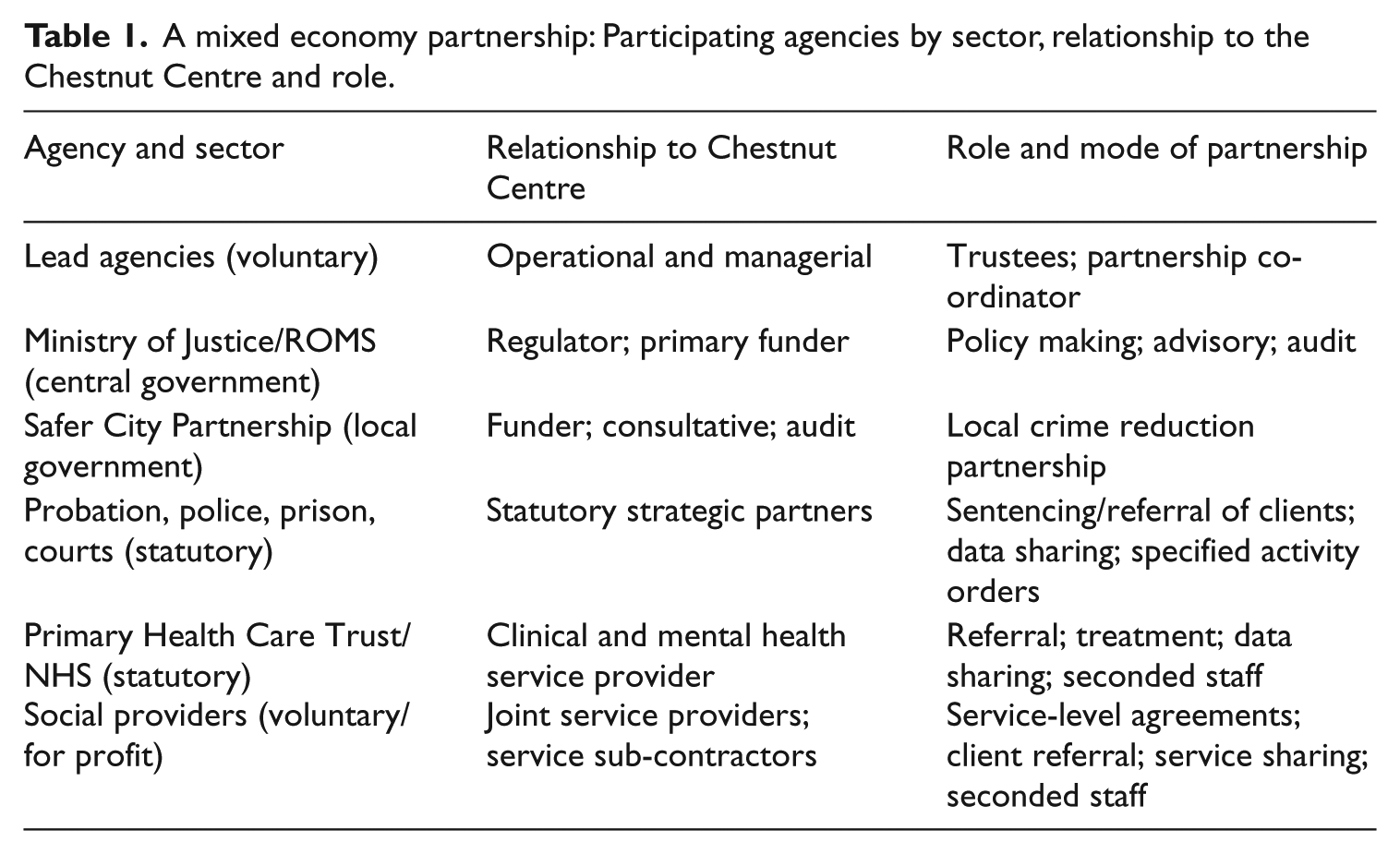
The centre was horizontally integrated with stakeholders via operational interactions among personnel from several agencies including employees of the Chestnut Centre, seconded staff from statutory and voluntary services, key workers from referral agencies and personnel providing subcontracted services either at the centre or in other premises. Health professionals, housing associations, social services or employment and training agencies could refer clients to the centre, and women could self-refer. However, for reasons relating to future funding and the need to develop the profile of the Chestnut Centre as a non-custodial sentencing option, its managers focused on fostering referral streams from statutory criminal justice agencies, such as the police, prison services, probation and the courts. Overlaps between governmental (vertical) and operational (horizontal) levels occurred in the course of developing systems of referral to the centre, information- and data-sharing and working jointly across service providers and referral agencies.
Dispositions towards Partnership among Managers: Partnership as Opportunity
As previous research indicates, several factors facilitate the optimal conditions for creating committed partnerships, not least of which are the clarity and flexibility of policy frameworks for allowing participating agencies from different sectors to respond clearly to their remit. Dispositions towards partnership among senior management and workers in the key voluntary and statutory bodies supporting the bid for the Chestnut Centre resembled what Sarkis and Webster (1995) identified as ‘opportunistic’ partnerships. Several elements of such opportunistic partnership could be seen in the convergence of pragmatism, ideology and strategic common interest in supporting women offenders. The first involved a widely held recognition among stakeholders that there was a serious lack of facilities for women offenders in the area. Second, interviewees involved in supporting the bid for the Chestnut Centre agreed that responding to the multiple complex needs of vulnerable and at risk women were beyond the capacity of any one sector, thus requiring the intervention of several providers. Interviewees also reported that the lack of services for women, or their fragmentation, had compounded the fact that many women fell out of reach of providers, which research shows exacerbates women’s disengagement from criminal justice or social services (Gelsthorpe et al., 2007).
An important part of collaboration, therefore, involved the mutual recognition of shared responsibility where neither state nor market had adequately provided for women offenders. In combining their response to unmet need and gaps in services, the Chestnut Centre and its trustees reflected pragmatic motivations in blending the ‘business’ as well as ‘social’ cases for creating the Chestnut Centre. A senior manager explained:
We actually spotted an opportunity, in terms of the Ministry of Justice announcing their second round of funding to develop the women’s community projects agenda, and so we bid for that. [But] in terms of our organization, we’ve been around for 35 years. (Senior manager, lead voluntary organization)
To its founders, setting up the Chestnut Centre carried a number of risks in terms of committing staff and resources to a pilot project as well as sustaining it after the initial funding from the Ministry of Justice ended. It was also essential to persuade potential statutory partners that the programme at the Centre was viable:
The Ministry of Justice was … very, very clear that [the bid] needed to be led by the third sector … and we had to submit supporting bids. Probation was a must. Your application wouldn’t go anywhere if you didn’t have support from Probation. (Senior manager, consortium)
Perhaps unsurprisingly, while senior managers found common ground in collaborating, they tended to rationalize their motivations from their respective institutional vantage points. Although trustees discussed the Chestnut Centre as an example of innovative social enterprise, statutory partners attributed the existence of the centre to the strength of support the bid received from local statutory bodies such as the Safer City Partnership and the Probation Trust. A senior probation manager said:
Acting singly as a service we’ve never been able, in terms of our direct provision [and] based on the level of need we were aware of, to justify taking a specialist approach to work with women offenders. But we were happy to support [the Chestnut Centre] in terms of ensuring that the sorts of services that we were commissioning were appropriately sensitive to the needs of women offenders, and delivering better services at the end of the day. (Probation manager)
Frontline workers welcomed the focus on ‘at risk’ women as offenders or partners of (male) offenders, but were critical that provision for women had previously been sidelined. Echoing this from above, a policy maker contended that the gender gap in provision for women offenders locally was underlined by the fact that women were ‘disadvantaged in policy’ nationally. Crime reduction programmes operating at citywide level were supposedly universal, but were operationally divorced from initiatives for addressing the needs of marginalized groups, including women. Consequently, supports for women relied on the level of commitment and discretion of service providers in different localities. Up to the creation of the Chestnut Centre, local agencies still operated according to normative assumptions about perpetration which led to the disproportionate allocation of resources to men:
I did actually say, ‘[s]o what happens to provision for women in the City?’, and then that was when I was actually given some information about the work that had gone into the Chestnut Centre … I want to increase the capacity for women because I think we’ve got if for men at the moment. We need to start thinking very, very differently about how we deal with future people who’ll be coming through the process. (Reducing Reoffending stakeholder)
Legitimacy and ‘Expertise’
The prospect of voluntary sector entry into non-traditional domains brought all participants into uncharted territory. While voluntary sector work with offenders was relatively uncontroversial while they were performing ‘complementary’ roles in niche areas of care, their involvement became more controversial when charities sought to undertake more substantial work (Corcoran, 2011). Debates about the legitimacy of the voluntary sector’s role in working with offenders, victims or communities are occasionally elevated to questions about their competence, ‘qualifications’, experience and legal accountability for outcomes (Jonsson and Zakrisson, 2005). One of the trustees for the Chestnut Centre asserted their credentials as legitimate actors in working with vulnerable women and women who offend by emphasizing the parent organization’s established presence and reputation as a social provider in the area. Consequently, the Chestnut Centre was simply an extension of the work already being undertaken by them:
To some people I think it looked as though we were suddenly launching into an area of work that we’d never been in before, and we had to do quite a bit of convincing to some of the statutory services … because I don’t think we were necessarily recognized as being expert in that area, although obviously we have worked with offenders for a long, long time. (Senior manager, charitable partnership)
The backdrop to this narrative was the respondent’s awareness of the wider context within which the encouragement of voluntary and commercial participation in offender management is seen as part of a broader project to utilize voluntary groups as ‘relatively inexpensive ways to supplement, complement and potentially replace, restructured welfare services’ (Macmillan and Townsend, 2006: 28). Here, the respondent balanced a wider acknowledgement of concerns about the exploitation of the sector against the greater urgency of getting things done given the lack of a dedicated service for vulnerable and ‘at risk’ women in the locality:
It was a natural progression for us … We had been advocating for a long, long time that women had very, very different needs from men … based on our experience through our alcohol services, Women’s Project, hostel and a whole range of stuff really, so this fit very, very well in to what we wanted to develop [as] an area of work we wanted to do. (Senior Manager, charitable partnership)
Staff Dispositions toward Partnerships
Partnerships also place considerable expectations on paid staff and voluntary workers to make numerous operational, attitudinal and behavioural changes. Statutory and voluntary sector workers have had to resolve conflicts relating to authority, jurisdiction and roles (Delaney and Milne, 2002; Vennard and Hedderman, 2009). Similarly, research on the responses of statutory and voluntary workforces to joint enterprises reveals concerns about power, organizational loyalty, the erosion of occupational identities as well as traditional demarcations in roles and ‘territory’. ‘Traditional’ occupational values among criminal justice public servants have turned out to be surprisingly resilient despite the imperatives of official partnership discourse, ‘driven by managerialist pressures’, which threaten to subsume the ‘cultures of the involved agencies and the working personalities of individual offenders’ (Mawby et al., 2007: 123). Findings about statutory officers’ attitudes to voluntary sector workers are ambiguous and probably specific to context: for example, there is some evidence that probation officers have resisted referring clients to voluntary agencies because of job protectionism (Hedderman et al., 2008: 15). On the other hand, good working relationships across the sectors have been ‘linked to the extent to which [Probation] officers perceive voluntary workers as enhancing the overall service to offenders, but not substitut[ing] for the relationship between officers and their clients’ (Rumgay and Cowan, 1998: 130, emphases added):
We’ve had partnerships in the Probation Service now, or we’ve been expected to have partnerships, for quite a few years, and it’s always been an issue that part of the Probation budget has actually gone towards partnerships. I don’t think it’s completely alien to marry the two together, and the people that we work with … already have at least a basic understanding of how offenders also come into their category (sic). (Probation staff)
Similarly, police officers in prolific and priority offender teams asserted that they were already constructively disposed towards multi-agency working (although implicitly revealing an expectation that any input from voluntary partners would be subordinate to policing styles and priorities):
We’re a joint agency located here anyway, because we’re Police/Probation (sic), so it is that outward facing. It’s not just the police banging on the door, it’s the PPO unit and a representative from the Chestnut Centre. We work together as opposed to their working for us or whatever. It’s very much a team approach that we bring people in to do something who is the best person to do that job (sic). (Police Officer, Prolific and Priority Offenders Unit)
Voluntary Workers: Between Lay and Professional Standpoints
In the past, conventional criminal justice approaches, based on prioritizing legal and statutory responsibilities, have clashed with voluntary sector understanding or philosophy with regards to clients, advocacy, privacy and the importance of voluntary engagement by service users, including offenders (Rumgay and Cowan, 1998; Vennard and Hedderman, 2009). Voluntary sector partners have been obliged to manage voluntary workforces who may resist viewing offenders through a criminogenic or risk-based lens. (See Haney, 2010 and Maurutto and Hannah-Moffat, 2006 for the grounds on which concepts of ‘risk’ and ‘need’ are subject to fluid and contested interpretation by voluntary sector and ‘professional’ criminal justice agencies respectively.) Statutory and voluntary partners may have to negotiate problems relating to adherence to sentencing requirements and reporting possible breaches of sentence where clients fail to attend or engage with programmes (Delaney and Milne, 2002). Engagement in statutory work has advanced trends towards requiring ‘professional-like’ responsibilities and protocols relating to confidentiality, information sharing and public accountability. Additionally, voluntary organizations are increasingly engaged in managing risks relating to working conditions, malpractice or discrimination on the part of voluntary workforces as well as paid staff and service users.
Voluntary sector discourse contains narratives which express and uphold ontological distinctions between ‘voluntaristic’ and state agencies with respect to their roles, approaches and relationship with service users. As one worker from a charity noted of statutory workers:
They’ve got their knowledge and expertise from text books rather than real life. I think that’s probably why we are taken a bit more seriously by the clients … I think when you’re sent to Probation, somebody’s preaching at you who hasn’t got a clue about what you’ve been through and I think here [at the Chestnut Centre] people will listen to you a bit more ’cos I think we’ve got more of a sense of understanding about where they come from.
The articulation of a distinctive voluntary sector occupational standpoint, which operates at organizational as well as individual levels, is evident in a number of dialogical forms. It is found in concepts of lay, authentic and non-compulsory approaches to social problems as well as claims that the sector’s workforces are ‘closer to’ clients, sometimes in mutual resistance to massed ranks of professionals. This claim to a more personalized approach is found in the tendency to contrast voluntary workers’ own street credibility and grounded knowledge with putatively rule-bound and inflexible state functionaries. Other respondents viewed themselves as mediators or interlocutors between clients and other agencies. There were subtle and less subtle variations of these arguments. Tensions arose between the demand for respect as ‘another professional’ for the quality and skills of the job being performed, while distancing oneself from institutionalized concepts of professionalism. One interviewee acknowledged the conflicts between these claims to authenticity while at the same time positioning Chestnut Centre staff as having equivalent legitimacy and expertise as their statutory counterparts.
I find a lot of the women are very hostile towards social services … So, they can’t really have a conversation with the social workers because they get angry, they don’t know how to assert themselves properly. So I find that I do that work. It saves any hostility. Also social workers are a lot more forthcoming when it’s a professional on the other end of the phone. (Chestnut Centre staff, emphasis added)
Working Together? Establishing Seamless Service Delivery
The move to increased multi-agency work has not occurred in a vacuum but is underpinned by changing political, social and working cultures and interest in this form of practice has increased dramatically over the past two decades (Wilson and Pirrie, 2000). Drivers for multi-agency practice include a desire to meet the needs of a target group, to provide a more comprehensive and effective service for clients and to address any gaps in this provision. There is an increasing focus on the ‘end-user’, which in the Chestnut Centre’s case concerns those women who had offended or were at risk of doing so. While this growing shift has had the greatest impact on health and social care sectors to date (Wilson and Pirrie, 2000), there is a corresponding interest in providing effective services for groups involved in the criminal justice system (Pycroft and Gough, 2010). Underpinning all of this are the key drivers of effectiveness, economy and efficiency which have largely encouraged the move towards greater multi-agency working (Pirrie et al., 1998). Such principles have become all the more imperative in the current financial climate.
These drivers were being realized through the work at the Chestnut Centre. Multi-agency working brought several benefits for organizations involved in the service. Skills were shared and information pooled to help provide a holistic service for each service user and common challenges could be addressed together. As the project evolved, operational managers worked closely with managers of other related voluntary projects to ensure continuity in services and in monitoring clients as they moved between several services:
[Other local projects] come up as well and sit in on [Chestnut Centre meetings] and we sit on theirs, because there is quite a big crossover between our customers. (Chestnut Centre management) So there’s a lot of cross-working, I guess, between schemes and scheme managers to make sure that we are doing as much as we should do to make sure that that person is on track. (Chestnut Centre staff)
The Chestnut Centre was also nested within the structures of a prominent and long-standing social provider which had extensive reach in the city and outlying areas. Hence, staff at the centre were able to refer clients to sister providers within the larger organizational framework, as well as to establish referral and support lines to outside agencies with which the parent organization had already developed links. In a number of cases, women leaving prison in housing need were found suitable accommodation within days at one of the organization’s hostels. Although these providers were separate and autonomous projects, the lead consortium was in a position to respond with impressive speed and volume of provision which was an advantage over stand-alone organizations.
Challenges to Seamless Multi-Agency Working
Clark (1993: 218) asserts that ‘[s]imply “putting people together” in groups representing many disciplines does not necessarily guarantee the development of a shared level of understanding’. Although multi-organizational partnerships fostered by the Chestnut Centre had demonstrable benefits, they also encountered barriers which themselves were reflections of the complexities generated by working with clients with multiple needs. Broadly speaking, the barriers to seamless co-ordination largely centred on fiscal and non-fiscal constraints, differences in working practices as well as differing procedures, cultures and attitudes.
Fiscal problems were related to the wider uncertainties that are generated by short-term and insecure public funding for partnerships, which had implications for the sustainability of projects and the relationships and networks which have been painstakingly built up. Staff observed that uncertainties surrounding future funding for the centre after the initial grant expired deterred sentencers from referring women to them because of doubts that the project would be in existence for the lifetime of a sentence. All respondents reported that their income was predicted to contract and that they were likely to become more risk-averse in committing resources to ‘non-essential’ work. Organizations also had their own fiscal concerns over funding, staff retention and perceived costs of engaging with the centre, despite acknowledging the benefits to their own services. Staff at the centre perceived that ‘a lack of conviction that there was a need for women-specific services’ was pervasive among many social providers from different sectors.
Not all participating agencies were willing or able to engage to the same extent nor move with the same speed to institute procedures for referring, sharing information or monitoring service users. One source of frustration for staff at the centre was the delays in approving protocols which would facilitate the referral of offenders and prisoners to the programme by probation, the prisons and courts. This was acknowledged as arising from an operational dichotomy between deliberative statutory services and flexible voluntary organizations:
I suppose it was with some regret that we probably feel that we haven’t been able to get things up and running as quickly as perhaps Chestnut would have wanted. I think there is perhaps a sense of frustration sometimes that things are quite slow to get going. And also it involves quite a bit of liaison with management and senior management in terms of getting [the] protocols [in place]. (Probation officer) We’re a very big institutional statutory agency, very cumbersome! But it’s demonstrated to me one of the values of working with third sector organizations, and I don’t think that’s been lost on our Trust Board, the fact that … with organizations like [the Chestnut Centre], one of the things that they bring to the table very clearly is that flexibility and that ability to really move quickly and make a reality out of plans very quickly. (Manager, Probation)
An as yet unmeasured impact of competition relates to the behaviours of organizations operating in the same market territory, with consequent implications for creating incentives to share or hold on to clients. For some agencies, the reluctance to engage with the centre was largely underpinned by anxieties about retaining their market share in a competitive social contracting environment:
We went to quite a big organization in the area … did our networking, told them what we could do and they seemed very enthusiastic … When we phoned up to see if they had any [referrals] for us, they turned round and said, ‘well, actually “no”, because we do that and we’ve got our targets’. And it was like, ‘ok, but you don’t specifically work with offenders’, and in actual fact because they’re funded differently to us anyway, it wouldn’t have an impact on them but they weren’t willing to acknowledge that. (Chestnut Centre staff)
Conclusion
This article suggests that the increasing division of labour and hybridization in offender management generates complex and uncertain effects (Atkinson et al., 2002). While devolving services to local consortia can lead to improvements there remains uncertainty as to whether the conditions for creating such partnerships are pervasive or easy to create (Wilson and Pirrie, 2000). This uncertainty partly derives from the tacit expectations of localization policies whereby local agencies are assumed to absorb any inequitable distribution in services that arise from the creation of marketized zones in offender management. The fate of partnerships is therefore contingent on situated and relational circumstances such as the health of the local service economy, the resources of local agents or the capacity of different sectors to collaborate. Located in one of the most deprived cities in England, for example, the gestation of the Chestnut Centre relied on a combination of initial Ministry of Justice funding, the social entrepreneurialism of local charities and the support of strategic statutory agencies, notably the Probation Trust and Safer City Partnership. Indeed, after the expiration of the initial grant from the Ministry, the funding which allowed the centre to continue in operation was assumed by the lead voluntary agency with additional funds from the Corston Coalition and statutory partners.
Secondly, the partnership itself came about because voluntary and statutory agents accommodated their interests to the political measures and funding regimes presented under the Diversion Programme. Consistent with Sarkis and Webster’s (1995) findings, their collaboration resembled a ‘constructive partnership’ which offered opportunities to address the marginalization and substantial unmet needs of vulnerable women. The opportunity to create bridges between providers converged on the consensus that the paucity of supports for women offenders and the failure to address their significant unmet needs merely deferred the consequences to the future, as well as to other local services. Furthermore, decision makers subscribed to a nascent discourse of cultural adjustment on the part of their respective organizations and sectors. Managers cast the partnership in terms of the creative adaptation of central policy goals to specifically regional contexts and local environments, in the process legitimizing their local standing and reach in the city and hinterland. In this context, they reasoned that voluntary and statutory sector organizations could be advantageously deployed in making the ‘business’ as well as ‘social’ case for dedicated supports for vulnerable women.
Yet, as Mawby et al. (2007) found, the potential for conflict in voluntary–statutory hybrids can focus on spatial or jurisdictional boundaries between organizations. This is exemplified by the police officer who envisaged the appearance of Chestnut Centre staff as entering an area of practice which was already culturally defined as policing territory. Voluntary and statutory workforces demonstrated that their occupational identifications, sectoral values and situated knowledges were resilient as well as relational and open to change. Equally, there was evident symmetry where voluntary and statutory workers insisted on occupational distinctions but articulated their work in terms which denoted confidence in their expertise and proprietorial relationships with clients. These narratives are resonant of Rumgay and Cowan’s (1998) finding that the division of labour and roles between workforces are equivocal and subject to continual negotiation.
Finally, the division of roles discussed here occurred in the last days of the New Labour era, when spending on community-based programmes was relatively high. The Big Society discourse being promoted by the Conservative–Liberal Democrat government seems set to continue the drive in favour of hybrid partnerships. Such developments raise further important questions regarding the loci of power and responsibility within service networks. It is difficult to predict how the future distribution of influence may shift within them. What is certain is that the state–voluntary dichotomy is giving way to state–private–voluntary hybrids of different types, with all the prospects that implies for conflict as well as constructive relationships. This article highlights the need for greater precision in academic analysis about state and non-state roles in criminal justice. Given the lack of research on voluntary sector-led networks in criminal justice, this article has mapped one such example. Our conclusions are tentative and qualified by the observation that they refer to one partnership. A more substantial picture is contingent on future research findings as well as policy developments.
Footnotes
Acknowledgements
The authors thank Anne Worrall for her intellectual contribution and role as researcher in the project informing this article.