







Abstract
Victim statement policies are a controversial topic inspiring several decades of debate. Criminal justice systems internationally have implemented diverse types of victim statement policies; however, regardless of the type of policy, literature supports that victims seldom provide statements. Despite these findings, few studies have explored the notification and utilization of these policies. The current study selects the Victim Personal Statement (VPS) policy in England and Wales to evaluate what factors influence whether victims are informed of the VPS, and what factors influence one’s decision to provide a VPS by using British Crime Survey (BCS) data. The findings support that several victim, offender, offense, and jurisdictional characteristics influence both notification and utilization of victim statements. The implications for these findings regarding victim statement policies are discussed.
Introduction
Criminal justice systems globally have debated victims’ roles in the system, and more specifically, victim statement policies. The victim statement policy debate is an active one, sustaining over several decades and occurring across international jurisdictions. Although victim statement policies vary among jurisdictions inspiring research and debate, one finding has been generally consistent: victims seldom provide statements. Despite these internationally consistent findings, few studies have focused on why this underutilization occurs.
The current article selects the Victim Personal Statement Scheme (VPS policy) in England and Wales to explore this issue using four years of British Crime Survey (BCS) data (later renamed the Crime Survey for England and Wales). In addition to addressing the general paucity of knowledge regarding statement notification and use, to date this study is the first to use a regression analysis to specifically analyze notification and utilization of the VPS policy. Understanding these issues can inform how to improve victim knowledge and use of this victim resource which is important as it provides victims the opportunity to be heard. It is also important to assess whether this victim resource is equally accessible to all victims (Moore and Blakeborough, 2008). These findings extend beyond the United Kingdom in being relevant to victim statement policies in general.
Victim Statement Debate
Before discussing the notification and utilization of victim statement policies, it is important to present an overview of the victim statement debate to provide a context for this research. Extensive literature exists regarding the victim input debate (see Erez, 1990; Erez and Roberts, 2007; Kelly and Erez, 1997; Roberts, 2009). Although policies vary among jurisdictions, 1 generally a majority of the debate focuses on: the victim’s role in the system; the impact of statements on the victim (e.g. victim satisfaction); and the influence of statements on the process (e.g. sentencing outcome).
The role of the victim
Victim input in the criminal justice process is a theoretical concern because it challenges the role of the victim in the system (see, for example, Orvis, 1998; Rubel, 1986). Specifically, in an adversarial system where the crime is understood as an offense against the State and not the victim, victim input is seen as inappropriately establishing the victim as a formal charging party in the case. Some argue this elevated victim role is deserved and empowering, allowing victims to be heard (see, for example, Erez, 1999) without upsetting the balance of legal systems or defendants’ rights (see, for example, Erez, 1991). Conversely, others note participation can introduce subjectivity into court proceedings (see, for example, Sarat, 1997), infringe on defendants’ rights (see, for example, Hellerstein, 1989), and result in unfair or harsher sentencing (see, for example, Ashworth, 2000; Henderson, 1985). Scholars have also expressed concern about victim participation schemes not meeting victims’ needs and expectations (Sanders et al., 2001).
The influence of victim input
Research has focused on whether providing input can improve victim satisfaction. While some research supports providing a statement has a positive relationship with satisfaction (Chalmers et al., 2007; Leverick et al., 2007), other research finds no effect (Campbell Research Associates, 1990; Davis and Smith, 1994b; Erez et al., 1997; Research and Development Directorate, 1990) or a possible negative relationship (Erez and Tontodonato, 1992). Other work has focused on whether victim input can affect sentencing outcomes, finding little, if any, impact on sentencing (Davis and Smith, 1994a; Eisenberg et al., 2003; Erez and Rogers, 1999; Erez et al., 1994; Karp and Warshaw, 2006; Wood, 2005). Notably, one study found once incarceration was selected, there was no relationship between providing a statement and an increased sentence (Erez and Tontodonato, 1990).
Statement Notification and Utilization
Literature across jurisdictions has consistently revealed few victims provide statements (see Roberts, 2009, for an overview; Roberts and Manikis, 2011). The existing statement notification and utilization research often supports that victim input policies are neither clearly understood (Graham et al., 2004) nor are victims likely to provide input (Hoyle et al., 1998; Moore and Blakeborough, 2008). Furthermore, research internationally has found that a substantial number of victims who reported not having made a statement, did in fact provide one (Erez and Tontodonato, 1992; Erez et al., 1997). Amid these findings no study to date has employed a regression analysis to assess what factors influence whether victims are informed of statement resources, and few studies examined what factors predict the decision to make a statement (see Erez et al., 1997). The current study addresses these concerns by evaluating the VPS policy.
The Victim Personal Statement Policy
England and Wales nationally implemented the Victim Personal Statement (VPS) policy in 2001. 2 This policy allows victims the opportunity to provide a statement to the police when reporting their victimization detailing the physical, financial, and emotional consequences and needs resulting from the incident (Home Office, nd). The statement allows victims to state what information they desire as their cases progress through the system (Home Office, nd). This statement is separate from the reporting statement and becomes a part of the case file. Police instruct victims that the statement is not to be used as a vehicle to comment on sentencing preferences. The VPS may be considered in bail decisions, but any comments the victim provides regarding sentencing or sentencing preferences will not be considered (Home Office, nd; The Right Honourable Lord Justice Woolf, 2001). This policy is most notably unique from other input policies in (1) not allowing victims to express their sentencing opinions, and (2) being provided early in the criminal justice process (i.e. when reporting as opposed to before sentencing). Ideally because the police notify the victim about the VPS early in the process, regardless of case developments (e.g. whether the offender is apprehended), it is possible that a substantial number of victims are notified about the VPS and given the opportunity to provide one; however, the policy is not mandated.
Victim Personal Statement Research
Notification of the Victim Personal Statement policy
Few studies have assessed whether victims recall the opportunity to make a VPS. One qualitative study (N = 28), found victims commonly reported being informed of the opportunity to provide a VPS (Graham et al., 2004), and often varied in their understanding of the VPS (Graham et al., 2004). Victims noted differing explanations of the VPS; however, many victims understood the statement was used in court and that it allowed victims to discuss the impact of the crime (Graham et al., 2004). Confusion about the policy often centered on who would have access to the statement and the erroneous understanding that statements were required (Graham et al., 2004). The research concluded that while victims appreciated the opportunity to provide a statement, they wanted more information about the purpose and use of the statements (Graham et al., 2004).
Other studies employed a larger sample, Witness and Victim Experiences Survey (WAVES) data, to examine notification of the VPS (Franklyn, 2012; Moore and Blakeborough, 2008; Roberts and Manikis, 2011). Franklyn (2012) found that 43 percent of victims recalled the opportunity to make a statement. Moore and Blakeborough (2008) found that 36 percent of victims recalled being informed of the opportunity, and of those, 54 percent of victims reported providing a statement. 3 Additionally, victims of violent crimes were more likely than other types of victims to report being notified of the VPS resource (Moore and Blakeborough, 2008). Franklyn (2012) also found that the proportion of victims who recalled being offered the VPS opportunity was the highest for victims of violent crime and burglary compared to other offenses.
Utilization of the Victim Personal Statement policy
Few studies have examined the implementation of the VPS policy; however, many of these studies illustrate it is an underutilized resource. A study conducted during the policy’s pilot phase found 30 percent of eligible victims provided a statement (Hoyle et al., 1998). Studies done during the national implementation of the VPS scheme report an inconsistent percentage of victims providing statements, ranging from 36 percent (Moore and Blakeborough, 2008) to 79 percent (Graham et al., 2004). Additionally, research surveying legal actors about statements during the pilot phase found few cases included statements (Morgan and Sanders, 1999). Research evaluating statement policies in various countries has reflected consistent findings (see Erez et al., 1997; Leverick et al., 2007; Roberts, 2009; Roberts and Edgar, 2003).
Data and Methods
Data
The current study utilized four years of British Crime Survey (BCS) data: 2003–2004; 2004–2005; 2005–2006; 2006–2007 (Home Office, 2007a, 2007b, 2008a, 2008b). 4 Worth noting, the BCS no longer includes these questions of interest. The BCS asks respondents about various topics regarding crime and the criminal justice system, and questions about recent victimization experience. Those who report having experienced a crime, regardless of whether they reported it to the police, are then asked a series of questions from a supplemental Victim Form. The Victim Form includes questions about the incident and the criminal justice system’s response. Victims who state they experienced more than one crime in the reference period (the past year) are asked to complete a Victim Form for each incident. 5 Victims who report a series crime, defined as several incidents that seem related and executed by the same perpetrator(s), are only asked to complete one Victim Form giving an overview of all of the incidents, as opposed to a form for each incident.
The BCS dataset has several subsets, including non-Victim Form person level data (e.g. demographics), and Victim Form incident level data discussing each incident and the criminal justice system’s response. The demographic information from the non-Victim Form data was matched with the Victim Form incident level data to create an incident level dataset. The BCS data also oversample non-White respondents to create a ‘boost sample’ for both the non-Victim Form data and the Victim Form data. The current study uses the boost samples in addition to the main datasets for 2003–2007 to create a more representative sample.
The first question for this study tests whether victim, offender, offense, and jurisdictional characteristics influence whether the police provide the victim the opportunity to make a VPS (also referred to hereinafter as informing the victims of the VPS). Only cases reported to the police were included in the analysis. Additional exclusion criteria for this sample were: duplicate cases; crimes that occurred outside the reference period; and crimes that occurred outside of England and Wales. The unit of analysis was incidents, rather than victims, with the sample for this question consisting of 27,238 incidents. 6 The second question tests whether victim, offender, and offense characteristics influence whether victims decide to provide a statement. The sample for this question only includes incidents where the police informed the victim of the opportunity to make a statement (N = 1694 incidents).
Variables
Notification of the Victim Personal Statement policy
The first hypothesis employs a dichotomous dependent variable based on the following question: Since October 2001, victims of crime have had an opportunity to say if they would like to make a formal statement to the police about how the crime affected them financially, physically or emotionally. This is called a Victim Personal Statement. Did the police give you this opportunity?
The independent variables used to assess notification related to victim, offender, offense, and jurisdictional characteristics build on previous research examining statement notification (Moore and Blakeborough, 2008) and utilization (Erez et al., 1997; Moore and Blakeborough, 2008).
Moore and Blakeborough (2008) noted that victim age influenced being notified about the VPS, where 44 percent of victims between 16 and 24 years old recalled being notified of the VPS; therefore, age is included in the current analysis. Their study also included gender in the analysis, a variable in the current study. Due to general concerns about minority populations having barriers and less access to justice, services, and legal advice (Mason et al., 2009; Muscat and Walsh, 2007), victim ethnicity was included in the analysis to assess whether victim ethnicity influences notification about this victim resource. Ethnicity is categorized as White, Black, Asian, and Mixed or Other, as an attempt to differentiate among ethnic groups. The socioeconomic status (SES) of the victim involved in the incident is included in the analysis to assess whether one’s SES influences if the police inform the victim of the resource. The BCS measures one’s SES based on occupation level, detailing the level of supervisory power ranging from not working to being in a higher managerial occupation.
The current study includes whether the victim knew at least one of the offenders involved in the incident. Due to previous research (Moore and Blakeborough, 2008) supporting that victims recall being notified about the VPS more often for violent crimes than theft and stolen goods, and for incidents perceived as more serious (Franklyn, 2012), the type of incident (measured as violent/personal or property) and the seriousness of the incident (measured by a scale of increasing seriousness from one to 20) 7 were included in the analysis. Because the VPS is a vehicle for victims to discuss the consequences of the crime, this study included four dichotomous variables to represent seriousness of the crime and impact of the crime: weapon use; injury to victim; property stolen; and property damage. Additionally, due to concerns about limited access to services in rural jurisdictions (Muscat and Walsh, 2007), a dichotomous variable for jurisdiction was included (inner-city/urban or rural).
Finally, the analysis controlled for series incidents, the data year (which dataset the incident is from), and the Police Force Area. Series incidents, multiple incidents that seem related and perpetrated by the same offender(s), were controlled for to differentiate between victims providing an overall response regarding multiple incidents compared to victims providing a response regarding a single incident. The data year is controlled for because the dataset is comprised of various years of data. Additionally, because the VPS is not mandated, this study controlled for each of the Police Force Areas. Table 1 lists the variable description and coding table, as well as the mean and standard deviation for each variable. 8
Variable description and coding: Whether victim, offender, offense, and jurisdiction characteristics influence if victims are informed of the opportunity to provide a Victim Personal Statement.
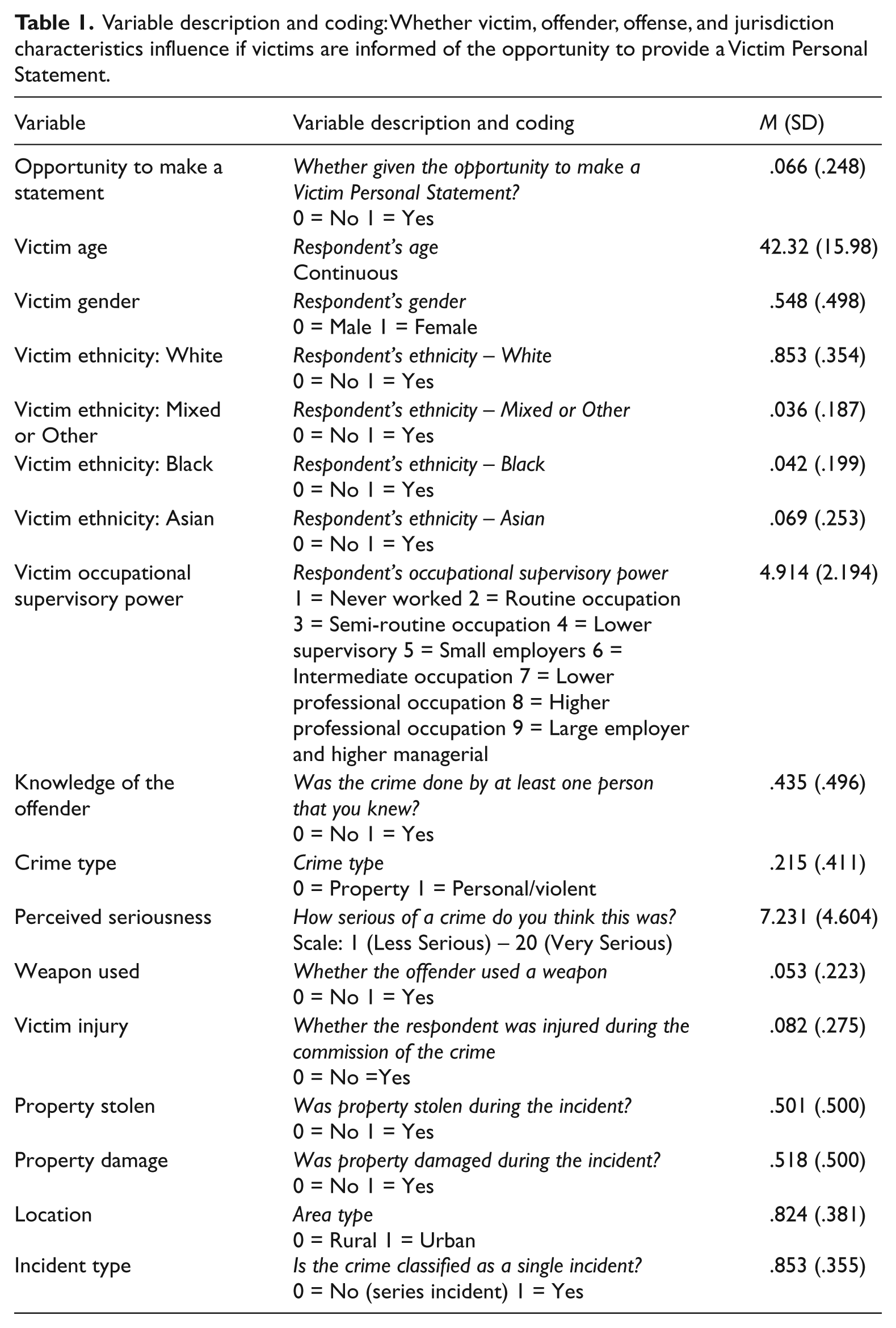
Utilization of the Victim Personal Statement policy
The second hypothesis tested employs a dichotomous dependent variable based on the following BCS question: ‘Did you make a Victim Personal Statement?’ Of the incidents involving victims who were notified of the VPS, approximately half of these cases included a VPS (based on victim report). The variables selected build on research assessing the factors that relate to victims providing information for a statement (Erez et al., 1997; Moore and Blakeborough, 2008). Victim characteristics, offender characteristics, and offense characteristics were included in the analysis.
Related work included victim age (Erez et al., 1997; Moore and Blakeborough, 2008), which was incorporated into the current study. Whether gender influences one’s decision to provide a statement is inconclusive in the literature (Erez et al., 1997; Moore and Blakeborough, 2008), and was included in the analysis. Based on concerns about minority victims’ access to services (Mason et al., 2009; Muscat and Walsh, 2007), the victim’s ethnicity is included in the study and categorized into four ethnic groups. Consistent with earlier work (Erez et al., 1997), victim education and prior victimization are included. Additionally, Erez et al. (1997) included a dichotomous variable for whether the victim was employed; therefore, the current study incorporates the socioeconomic variable described in the first question.
Knowledge of the offender is included in the analysis (Erez et al., 1997) to assess whether victims are less likely to provide a statement in incidents where they know the offender, possibly due to retaliation concerns. Based on earlier work (Erez et al., 1997), crime type and seriousness of the offense were included, as defined in the first analysis. Moreover, several dichotomous variables representing additional aspects of the crime were included because they may influence a victim’s decision to provide a statement in order to discuss them: racially motivated incident, sexual offense, weapon use, injury, property stolen, and property damage. Whether the victim used Victim Support was included, in the event a victim’s later interactions with Victim Support regarding the crime could influence one’s decision to make a statement. 9 Control variables included were series incidents, data year, and Police Force Area for the same reasons noted for the first analysis. Variable descriptions and coding are presented in Table 2, in addition to the mean and standard deviation for each variable.
Variable description and coding: Whether victim, offender, offense, and jurisdiction characteristics influence if victims provide a victim personal statement.

Methodology
The dependent variable was dichotomous for each question. Due to these variables, a logistic regression was estimated for each analysis.
Analysis
Notification of the Victim Personal Statement Scheme
The logistic regression estimated for the first question was significant (χ = 295.35, p ≤ .001), and the results are presented on Table 3. 10 The results support that several victim, offender, offense, and jurisdiction characteristics of the incident influence whether victims report that the police informed the victim of the opportunity to make a VPS.
Logistic regression analysis: Whether victim, offender, offense, and jurisdiction characteristics influence if victims are informed of the opportunity to make a Victim Personal Statement.
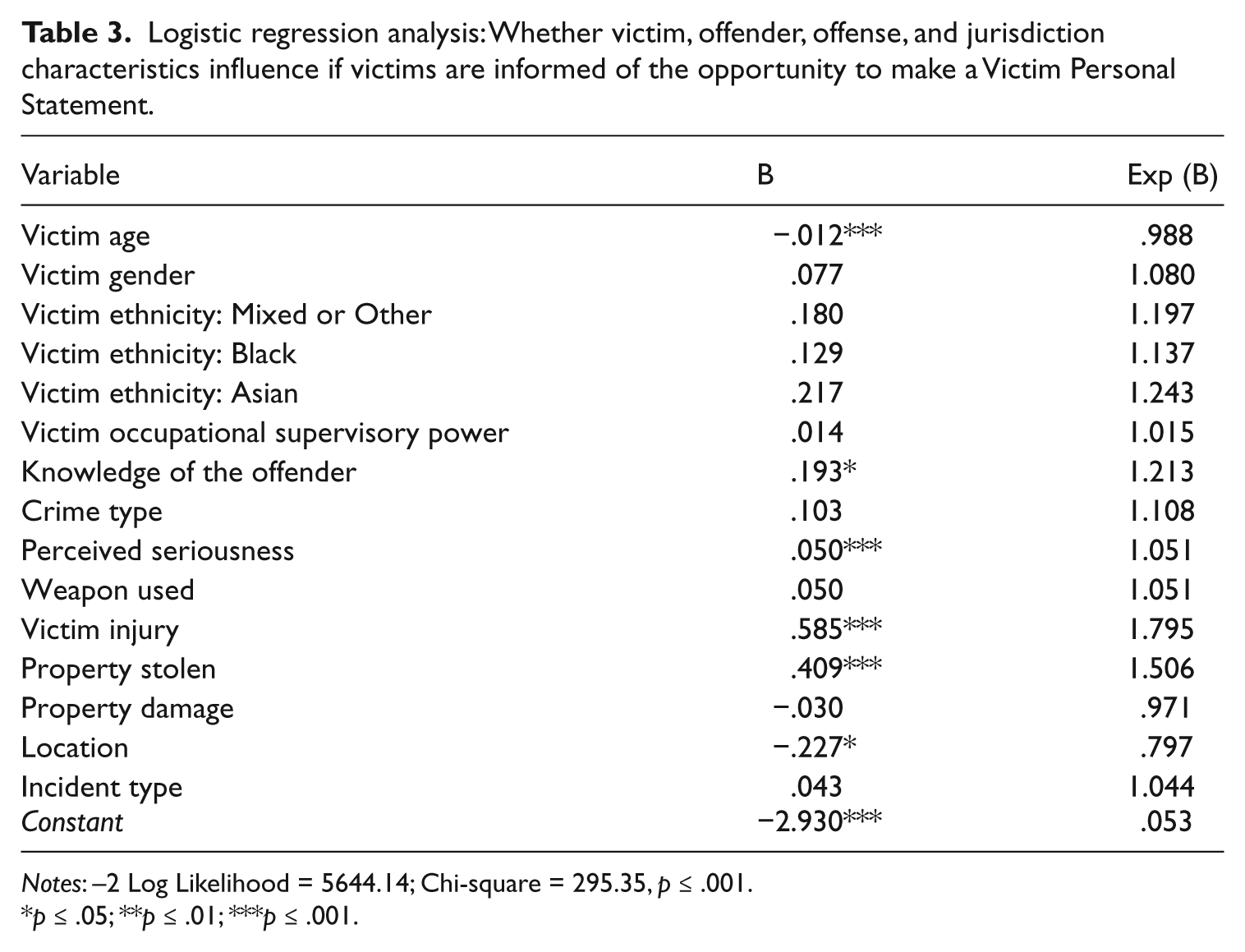
Notes: –2 Log Likelihood = 5644.14; Chi-square = 295.35, p ≤ .001.
p ≤ .05; **p ≤ .01; ***p ≤ .001.
Several victim characteristics influenced whether victims reported the police informed them of the opportunity to provide a VPS regarding the incident. A one year increase in victim age decreased the odds of reporting being told about the opportunity to make a statement regarding the incident by 1.2 percent. 11 Ethnicity and socioeconomic characteristics of the victim involved in the incident did not have a significant effect on whether victims stated being informed of the opportunity to provide a VPS. The odds that victims reported being informed about the VPS were 21.3 percent higher in incidents where the victim knew at least one offender (β = .193, p ≤ .05), than in incidents where the victim did not know the offender(s).
Regarding offense characteristics, the type of incident (personal or property) did not have a relationship to victims reporting notification about the VPS; however, the more serious the victim perceived the incident, the greater the likelihood victims reported being informed of this resource (β = .050, p ≤ .05). A one unit increase in how serious the victim perceived the incident increased the odds that victims reported being informed about the VPS by 5.1 percent. Although there was no relationship between weapon use and reporting being told about the VPS, the odds of being informed were 79.5 percent higher in cases resulting in injury than in cases not resulting in injury (β = .585, p ≤ .001). Additionally, there is a relationship between stolen property and notification of the VPS (β = .409, p ≤ .001); in cases involving stolen property the odds of victims reporting being informed of the VPS were 50.6 percent higher compared to cases without stolen property. Moreover, the odds of victims stating the police informed them of the opportunity to make a statement were 20.3 percent higher for incidents involving respondents living in rural areas compared to urban areas (β = –.227, p ≤ .05).
The additional control variables revealed that whether the incident was a single incident or a series incident did not affect victim notification. Additionally, in comparison to 2003–2004, the odds were increased that victims reported the police informed them of the VPS in 2004–2005 (β = .240, p ≤ .05) and 2006–2007 (β = .217, p ≤ .05).
Utilization of the Victim Personal Statement policy
The second logistic regression tested the hypothesis that victim, offender, and offense characteristics of incidents influence whether a victim decides to provide a VPS (Table 4); the model estimated was significant (χ = 133.498, p ≤ .001). These results, based on self-report data, support that several victim, offender, and offense characteristics of the incident influence a victim’s decision to provide a VPS.
Logistic regression analysis: Whether victim, offender, and offense characteristics influence if victims provide a Victim Personal Statement.
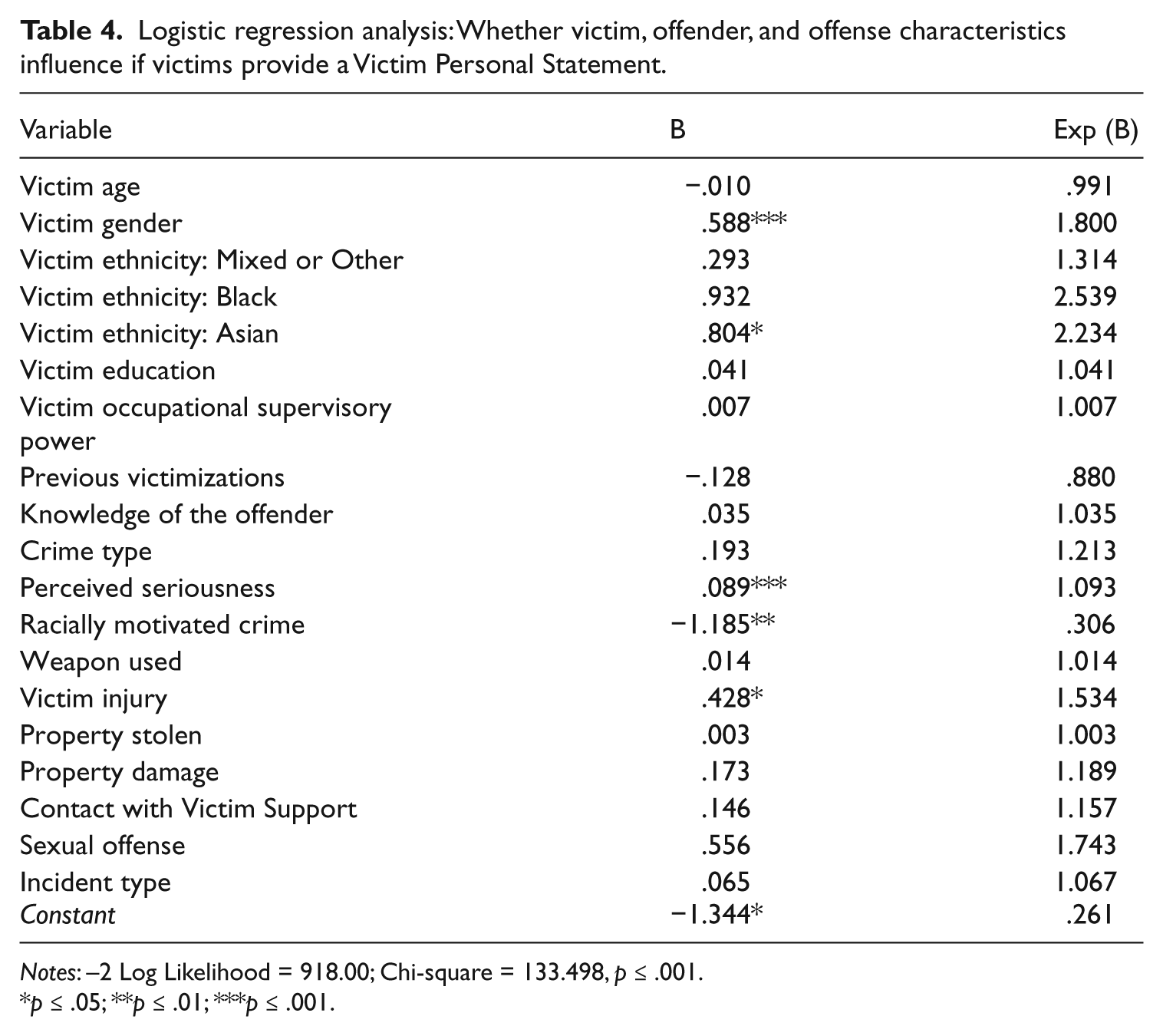
Notes: –2 Log Likelihood = 918.00; Chi-square = 133.498, p ≤ .001.
p ≤ .05; **p ≤ .01; ***p ≤ .001.
Victim characteristics influenced whether the victim provided a statement regarding the incident. The odds a female victim provided a VPS regarding the incident were 80 percent higher than the odds a male victim provided one (β = .588, p ≤ .001). Additionally, in incidents where the victim involved was Asian, the odds the victim provided a statement were 1.23 times higher than in incidents involving a White victim (β = .804, p ≤ .05).
Offender characteristics did not have a significant effect on whether a statement was provided; specifically, knowing the offender did not influence providing a VPS. Conversely, several offense characteristics influenced whether the victim provided a statement. A one unit increase in how serious the victim perceived the crime increased the odds of a victim making a statement by 9.3 percent (β = .089, p ≤ .001). Additionally, in incidents the victim believed were racially motivated, the odds were 69.4 percent lower that a victim provided a statement than in incidents not believed to be racially motivated (β = −1.185, p ≤ .01). Moreover, the odds that a victim provided a VPS were 53.4 percent higher in incidents involving victim injury compared to incidents without an injury (β = .428, p ≤ .05). Finally, it is interesting to note that for incidents occurring in 2006–2007, the most recent data year, the odds that an incident included a VPS were 97 percent higher than in the first data year: 2003–2004 (β = .678, p ≤ .01).
Study Limitations
The current study has several limitations. First, this study utilized a subsample of cases that were reported to the police, which could bias the sample; however since the police are the actors who inform the victim of the VPS, the incident must first be reported. Second, as with all victim response surveys, the BCS data are based on victim recollection, which is a limitation of self-report data (see, for example, Skogan, 1975). More specifically, the limitations of victims correctly recalling whether they provided a statement have been documented in literature (see Erez and Tontodonato, 1992). Finally, respondents are asked about personal crimes against themselves and property crimes against the household; therefore, victims could live in a household where a property crime occurred and a member of the household aside from the respondent provided a statement. In this situation, the respondent would be noted as a victim who did not make a VPS. The current study attempted to address this limitation by categorizing crime type into personal/violent crime or property crime.
Discussion
As Moore and Blakeborough (2008: 20) stated, ‘The Victim Personal Statement is intended to apply to all victims. It is, therefore, useful to consider whether the statement is being made available equally to all.’ This study supports victims are rarely informed of the VPS policy, and that once informed, victims commonly do not provide a statement. Victims report being informed of the VPS in less than 7 percent of the incidents, and after being informed, victims provided a VPS in approximately half of the incidents. It is important to note that these data are based on victim recall. Overall, the results suggest that several victim, offender, offense, and jurisdictional characteristics of the incident influence whether victims are being informed of the opportunity to provide a VPS and, once informed, also influence whether victims decide to provide one.
One conclusion is that older victims are less likely to recall being informed of the VPS policy. This finding could potentially reflect limited service provision to older adults; however, additional research would be able to explore this finding in greater depth. After being informed of the VPS, there is no relationship between victim age and the decision to provide a statement regarding the incident.
Additional victim characteristics (gender, ethnicity, socioeconomic status) did not have a relationship with whether victims reported being informed of the VPS regarding the incident. This finding supports that police inform victims of the VPS resource regardless of the characteristics of the victim involved in the incident. Although all of these factors are important, a special emphasis should be placed on there being no relationship between ethnicity and being informed of the VPS, in light of concerns of minority victims’ potentially limited access to victim resources. In other words, victims are reporting police information regarding the VPS regardless of the ethnicity of the victim involved in the incident. Additionally, the gender and socioeconomic status of the victim did not influence whether victims reported the police informed the victim of the VPS for that incident. Therefore, apart from age, other victim characteristics – gender, socioeconomic status, and ethnicity – do not influence whether victims report being informed of this resource.
Although this study is an incident level analysis, the results support the odds are greater that a statement is made in crimes involving Asian victims compared to incidents involving White victims. Notably, there is no significant negative relationship for any non-White population, indicating that incidents involving non-White victims did not result in victims being less likely to use the VPS resource.
Several offense characteristics influence whether victims report the police informed them of the VPS and whether victims provide a statement. The results support that when the victim perceives the crime as more serious, when property is stolen, and when the victim suffers injuries, the odds increase that the victim will be informed of the VPS. It is understandable that the police would be more likely to inform victims in these incidents, given the VPS is a vehicle to discuss the extent of injuries, medical needs, financial consequences, and increased emotional effects which are highly likely in incidents involving injury and stolen property.
The odds are also higher that victims provide a VPS in incidents they perceive to be more serious, and when the incident results in an injury. These results are consistent with the VPS being a vehicle to discuss consequences of an incident, and that being involved in more serious and/or injurious incidents would positively influence the decision to provide a statement. These findings also relate to Roberts’s (2009) work noting that victims could be reluctant to provide statements because they feel the incident was not serious enough to warrant a statement or further participation with the system, as opposed to reflecting a failure of statement policies.
Interestingly, although the odds are greater that victims report the police informed victims of the VPS in incidents involving stolen property, this incident characteristic does not influence a victim’s decision to provide a VPS. This finding might be due to victims preferring to go through insurance companies to discuss the property loss as opposed to the police, and feeling filing a report with the police is sufficient. It is also possible that the stolen property was of minimal value, or that victims are not confident the property will be recovered. Further exploration of specific incident details (e.g. stolen property value) would inform these findings. Finally, a significant negative relationship exists between whether the incident was racially motivated and providing a statement regarding the incident. This relationship could be explained by fear of retaliation; victims are to be informed statements are accessible to all criminal justice actors, and may be less inclined to provide a VPS for racially motivated offenses.
In addition to victim, offender, and offense characteristics, the results lend support that the odds are higher that victims report being informed of the VPS for incidents involving respondents living in rural as opposed to urban areas, which could reflect resource allocation or limitations in urban areas. This finding could potentially reflect a police resource focus on crime prevention or crime response in urban areas, where crime is often concentrated. Moreover, there is a significant positive relationship between victims reporting the police providing the opportunity to make a VPS and later BCS data years (2004–2005 and 2006–2007) compared to 2003–2004. Furthermore, there is a significant positive relationship between the data year and the victim providing a VPS for the incident, in that the odds a victim provided a VPS for the incident were higher in 2006–2007 compared to 2003–2004. Together these findings suggest that the police are improving in informing victims of the VPS opportunity, as the policy was only nationally implemented in 2001; therefore it is possible several years must pass before the policy is practically implemented. This concern is especially relevant given this policy is not officially mandated. Additionally, victims could be more inclined to utilize the resource as it continues to be implemented and publicized.
Future Research
This research is an incident based study, and would be further informed by an individual level analysis of the BCS data. An individual level analysis would also allow for an exploration of how repeat victimization could influence a victim’s decision to make a statement. In addition, a UK study replicating Erez and Tontodonato’s (1992) US study, which included assessing how accurate victims were in recalling whether they provided a statement, would add to the literature. Concluding that a relatively small percentage of victims accurately recalled this information, they commented: If the purpose of filling out a victim impact statement is to provide the psychological gratification of being heard, this procedure should be conducted in a more ceremonial fashion so that the victims remember it clearly as the occasion on which they voiced their feelings, concerns, and wishes. (Erez and Tontodonato, 1992: 410)
Because the VPS is uniquely explained to victims, it would be interesting if its presentation makes the resource, and its use, more notable and memorable for victims. Further research should also examine police policies on informing victims of the VPS, the rationale, or consequences to not informing victims of the VPS (including potentially needed financial support to implement the policy), and why few victims decide to provide a statement when informed.
More globally, future work replicating this work using other jurisdictional policies would inform victim statement policies beyond the UK. The current work supports that victims are less likely to provide statements in racially motivated crimes, and because this finding could be due to retaliation concerns, it would be interesting to evaluate whether this finding is supported in other statement policies. Further understanding this finding would better inform whether retaliation is a concern and whether this finding is different in jurisdictions based on how the statement is used and who has access to the statement (e.g. the offender).
An additional finding was that victims were more likely to provide statements in incidents resulting in an injury. Based on past work discussing that victims may not provide statements because they feel the incident was not serious enough, future work looking into the consequences of the incident and the decision to make a statement would inform these findings. Furthermore, it would be important to confirm that victims understand statement policies are often a vehicle to discuss consequences of the crime beyond physical injuries. Finally, the finding regarding urban areas being less likely to inform victims of the resource warrants additional research. Resource availability in urban areas should be more fully examined to potentially inform resource allocation. This finding could also be explored further with a similar analysis controlling for crime.
Conclusion
While the victim input debate has largely focused on the role of the victim in the system and the effect of input on victims and sentencing outcomes, limited research has explored why few victims provide a VPS. The current research contributes to the field by examining whether certain aspects of the incident influence notification and utilization of the VPS. While the limited number of victims providing a statement should not be interpreted as a policy failure (see Roberts, 2009), understanding the dynamics of notification and utilization can potentially inform implementation of the policy. Additional quantitative and qualitative research can also provide a more complete understanding of victims’ perspectives, including victims’ views, concerns, and decision-making processes regarding the VPS policy.
Footnotes
Acknowledgements
This manuscript was extracted from the author’s dissertation work, Victim Statements and Satisfaction: An Analysis of Victim Personal Statements (University at Albany, 2010). The author expresses sincere gratitude to dissertation committee members Drs James R Acker, Deborah Chard-Wierschem, Alan Lizotte, David McDowall, and Janet P Stamatel, for comments and suggestions incorporated into this research. Additional thanks to Dr Catherine Cerulli for comments on earlier drafts of this article.
Preliminary findings from this research were presented at the American Society of Criminology Annual Meeting in St Louis, MO in November 2008. This work was supported by the Initiatives for Women Presidential Award (SUNY Albany), and the National Research Service Award NIMH T32 MH 18911 (PI: Caine).