






Abstract
This study empirically examines the everyday problem of corrupt policing and other related abuses in Nigeria, and how these deviant behaviours engender public cynicism towards the law. In any democratic society, police officers are expected to be accountable for their actions and inactions. But the perennial problem in Nigeria is that the police are not accountable to anyone. The history of Nigeria policing is littered with accounts of deviance, malevolent attitudes towards the public and failures of the police organization in detecting or disciplining errant officers. Using a sample of 462 participants from a cross-sectional survey, this study examines whether actual or vicarious experiences of police deviance are likely to predict public cynicism towards the law. This current study corroborates previous assertions that the relationship between the police and the public in Nigeria is poor and that police deviance engenders cynicism towards the law. Implications for policymaking and law-abiding behaviour are discussed.
Keywords
Introduction
Nigeria police vehicles conspicuously display decals proclaiming ‘to protect and serve with integrity’. The question from the average Nigerian is ‘do the Nigeria police really protect and serve citizens with integrity?’ The answer for most is unambiguous: the Nigeria police protect and serve no ‘bloody civilian’! Unless you count as an influential citizen or have a connection with the political elites, you have no fundamental human rights in the eyes of the police (see Agbiboa, 2015; Alemika, 2013; Pierce, 2006; Smith, 2007). This is often mentioned sarcastically in pastime jokes that, ‘the police are not your friend’. Unfortunately, the jokes accurately reflect a harsh reality, and anyone who reassures one to the contrary has arguably had little, if any, first-hand experience of the policing situation in Nigeria (Akinlabi, 2011).
Police protection in Nigeria is a luxury denied to the general public (Alemika, 2010; Orole et al., 2014). Justice is like an auction, it goes only to the highest bidder. The amount of evidence presented to the police has little or no effect on the fair course of justice. The question that begs an answer is that, ‘when police services become a luxury that the general public cannot afford, to whom should the people go? Or when the police consistently abuse their power, how should the public respond?’ Going by documented evidence, current police behaviour calls radically into doubt the functions of the police and the relevance of its codes of conduct or of any existing accountability mechanism (see Agbiboa, 2015; Akinlabi, 2013; Orole et al., 2014).
The relationship between the police and the public in Nigeria is perhaps one of the most troublesome in sub-Saharan Africa (Hills, 2008; Pierce, 2006; Smith, 2007). Policing in Nigeria deviates from normative expectations and it is done with little or no regard for procedural fairness (Agbiboa, 2015; Akinlabi, 2013, 2015; Alemika, 2010). Public order maintenance is achieved at a great cost; mostly through intimidation, violence, lack of fair procedures and through violating people’s rights (Agbiboa, 2015; Oluwaniyi, 2011). The potential consequences of such police actions are also alarming. It has been confirmed that if the public judge the police to be: using fair procedures; treating people with respect; and giving people the opportunity to voice their opinions, then the public will most likely comply with the law (Hough et al., 2013; Murphy et al., 2009; Tyler, 2006). However, if the public perceives or experiences unfairness, abysmal disrespect, corrupt practices and abuse of power during the exercise of police authority, then they are likely to become alienated, defiant, cynical and non-compliant with the law (Jackson et al., 2012a, 2014; Murphy et al., 2016; Sunshine and Tyler, 2003).
Police deviance as stated in the title of this article is used within the contextual definitions of Punch (2000). Punch suggested that due to a large amount of behaviours that constitute what can be termed as ‘corrupt’ in the police force, it may be more useful to use ‘police deviance’ as the broad term when studying police corruption. He argued that police deviance is all-encompassing of all negative police behaviours and it can be broadly categorized into three sub-categories. The first being, corruption – this is when police demand or collect inducements, either money or service, from an external corruptor or the public during the course of duty, in exchange for a favour. The second sub-category is police misconduct – that is, deliberate attempts or actions that are geared towards the breaking of internal rules and procedures. The third is police crime; that is, when an officer of the law steps beyond the bounds of the law, breaking laws in a grievous manner such as using excessive violence on citizens. This, as explained by Punch (2000), not only helps to identify specific police behaviours that can be classified as corrupt but a combination of behaviours that can be recognized as deviating from the normative expectation of policing. In this study, however, police deviance represents three recurring types of police misconducts in Nigeria – police abuse, police corruption and procedural injustice.
Although there are widespread reports of police deviance in Nigeria’s news and social media platforms (e.g. Gistmania, 2010; Makinde, 2013; Usman, 2016; Winsor, 2015), most of these cases are undoubtedly based on anecdotal evidence. It is important therefore to empirically assess the relative effects of this police behaviour on citizens’ perceptions of the law. This empirical analysis will give a robust opportunity to examine public perceptions and experiences of police deviance and the likelihood of its impact on the law. Specifically, this study provides the necessary tools to test whether perceptions of police deviance affect public cynicisms towards the law. For the purpose of this study, police abuse and corruption are used interchangeably to denote police deviance.
Using a sample of 462 respondents from a cross-sectional survey of Lagos residents conducted in the last quarter of 2011, this article explores whether public experiences and perceptions of police abuse, perceptions of police corruption and procedural (in)justice translate to public cynicism towards the law in Nigeria. Drawing on these data, this study assesses whether public experiences and perceptions of police abuse and corruption capture the dynamics of cynicism towards the law. This study, I hope, will contribute to police reform in Nigeria with specific consideration for police accountability, elimination of human rights abuses, improvement of the police–public relationship and the promotion of normative and democratic policing.
Policing in Nigeria
The modern police in Nigeria date back to over a century, from the Hausa Constabulary of 30 ex-slaves from Sierra Leone (Ahire, 1991; Alemika, 2010; Tamuno, 1970). As asserted by Tamuno (1970), the main purpose of the constabulary was the enforcement of colonial laws and gunpoint extraction of resources. In other words, the Hausa constabulary was formed to protect the colonial interest in Lagos colony and not to serve the citizens (Onyeozili, 1998). The police were totally alien to the customs and traditional values of the local people; as they were Hausa-speaking ex-slaves from Sierra Leone and non-indigenes of Lagos colony (Ahire, 1991; Onyeozili, 1998). This first foundation of policing ingrained in the citizens a police force that could not be trusted and should be avoided at all cost (see Ahire, 1993; Alemika, 2010; Oluwaniyi, 2011; Otu, 2012).
The burden of colonial policing was arbitrary subjugation of the cultural values of the people to the political and socio-economic interests of the colonialists (Ahire, 1991; Tankebe, 2008). This was done through armed patrols, raids, arrests and detention of any opposition to the British establishments. The colonial police protected mainly the interest of the Crown by ensuring the creation and supply of a proletarian labour force required for the colonial economy to grow (Onoge, 1993; Tamuno, 1970). As the people had no control over the arbitrariness of the police, they devised means to avoid any contact with the police or the colonialists (Alemika, 1993; Onoge, 1993). Some authors have argued that such attitudes have been transferred from one generation of Nigerians to another generation through the process of enculturation, thereby encouraging further alienation from the police (Ahire, 1991; Tamuno, 1970).
At independence in 1960, Nigerians anticipated a national police force that would provide just, universal and effective protection for its citizens (Francis, 2012; Hills, 2008; Onyeozili, 2005). Unfortunately after 55 years of independence, successive Nigerian administrations have not been able to provide democratically accountable and publicly supported policing for its citizens. They have simply chosen to protect narrow sectional interests and regime stability over police reform (Francis, 2012). Even when police reform is discussed, it is mostly with a view to benefiting the government, for instance with reform improving the countries’ international human rights rating or defusing media and political criticisms (Baker, 2010; Hills, 2008). It might be appropriate to conclude that successive government administrations in Nigeria are guilty of wilful indifference through their continuous neglect of the police force (Alemika and Chukwuma, 2003; Smith, 2007).
Other researchers have argued that Nigerians have been encouraged not to trust the government, and by extension, the police as the visible representatives of the state (Agbiboa, 2015; Akinlabi, 2015). This has led to a situation where people are cynical about the morality of the law and the police enforcing it (Meagher, 2007). When there is cynicism towards the law or when people do not believe in the morality of the law, they tend to seek alternative measures to resolve their crises, crime rates may increase and citizens may be less likely to comply with the law (Baker, 2010; Tankebe, 2009b).
Abuse of Power, Corruption and Cynicism towards the Law
The police’s historical role and its modern repertoire of belittling the public continue to play crucial roles in explaining public cynicism towards the law and the besmirching of police image. The Nigeria police have strong historical records of corruption, abuse of power, criminal conduct and the use of excessive force (Hills, 2008). As a result, they are widely regarded as oppressors and not protectors of the people (Akinlabi, 2013; Alemika and Chukwuma, 2000; Smith, 2007).
Drawing from the ‘bad apple’ hypothesis, some scholars assert that police deviance is a function of a few ‘bad apples’ within the system and not necessarily an institutional problem (see Lersch and Mieczkowski, 1996; Punch, 1985). It is argued that a few toxic individual police officers may be the stimulus for group-level or institutional dysfunction (Bowling et al., 2004; Punch, 2000). This is a perspective echoed by scholars, especially those from relatively stable and wealthier societies where the police are a well-established part of the democratic governance (e.g. Porter and Warrender, 2009; Punch, 1985, 2000). However, this may not be the case in the Nigerian context, where there is a high level of police and political corruption, human rights abuses and economic strain. In Nigeria, the bad apple hypothesis may not gain traction. With the exemption of a few officers, the entire system seems to be immersed in a pool of organizational corruption. It seems not to be an episodic or individualistic problem, but a systemic and collective group failure (see Agbiboa, 2015; Akinlabi, 2013, 2015; Hills, 2008; Smith, 2007).
The Nigeria police have an impressive record for the ruthless suppression of the citizens and on many occasions have been accused of committing extrajudicial killings, undertaking arbitrary arrests and detention, beating detainees and colluding with criminals (Agbiboa, 2015; Alemika, 2013; Human Rights Watch, 2010). Within the ranks and files of the police, there is overwhelming evidence of kickbacks, opportunistic thefts, bribe taking, case fixing, predatory policing and extortion (Makinde, 2013; Orole et al., 2014). It is not uncommon to see the police mount roadblocks on highways; not for safety or security reasons, but to effectively extort money from motorists (Agbiboa, 2013; Alemika and Chukwuma, 2003). The police are known for double-dealing, by demanding bribes from victims of crimes to start investigations while at the same time, demanding bribes from crime suspects to drop investigations (Orole et al., 2014).
Studies have shown that where there are strong indications of police abuse, procedural injustice and negative perceptions of its activities, people tend to be cynical about the law (Jackson et al., 2014; Tankebe, 2009b; Tyler, 2000). Police abuse, it has been noted, undermines public support for the police while providing individual citizens with a sense of cynicism towards the law and the police enforcing the law, and a lack of cooperation with the police (Jackson et al., 2014; Tankebe, 2009a). Although it has been confirmed that police abuse and brutality are commonplace in Nigeria, accurate and verifiable statistics to reach a scientific conclusion are difficult to find.
The high-handedness of some officers during their daily routines sometimes result in police extra-judicial killings and this often leads to violent confrontations between the police and the public (Ojedokun, 2014). It is commonplace for members of the public to build up counterstroke and reprisal attacks on police officers or to vent their frustration on police vehicles and stations, in response to perceived injustice from the police (Oluwaniyi, 2011). They also act without decorum and momentarily become ‘lawless’, most especially when the Nigerian government take sides with the police (Smith, 2007).
In general, the Nigeria police have a poor relationship with the community, and policing activities can hardly be seen as positive because of incessant police abuse and corrupt practices. The police do not see themselves as the agents for meeting citizens’ needs (Ojedokun, 2014). They perceive themselves as closely aligned to the people in power, and in most cases act as political instruments to suppress any opposition to influential individuals or groups (Smith, 2007).
There is a gross disparity between how police treat influential members of the society and how they respond to the general public (Akinlabi, 2013; Alemika, 2010; Smith, 2001). It is not an overrated assertion to say that the Nigeria police lack both the capacity to protect or any of the real integrity it conspicuously proclaims to possess (Akinlabi, 2013). Certainly most Nigerians recognize this, and many resent the police (Smith, 2007). The fact that extortion at police checkpoints often ends in violent confrontations reinforces the assertion that police do not protect anyone (Agbiboa, 2015; Smith, 2007). If encounters with the police do not result in violence this is often because people acquiesce to their corrupt demands (Akinlabi, 2013).
The purpose of this study, therefore, is to ascertain whether people will be cynical about the law if they have had actual or vicarious experiences of police abuse, police corruption and procedural (in)justice. In the next section, the method and data collection procedures behind the study are discussed.
Method
Data
The data for this study were collected through a cross-sectional survey of participants in Lagos East Senatorial District during the last quarter of 2011. The data were collected by this author with support from two field research assistants who were paid for their participation.
A multi-stage sampling technique was used in the selection of research participants. The first stage involved simple random sampling from the three Lagos Senatorial Districts (i.e. Lagos West, Lagos Central and Lagos East) with Lagos East Senatorial District being randomly selected. The next stage involved a list of the Local Government Areas (i.e. Shomolu, Kosofe, Ikorodu, Ibeju/Lekki and Epe) in Lagos Senatorial Districts being compiled with the Ikorodu Local Government Area being drawn through a simple random sampling technique.
Using the 2006 Population Census Enumeration Area Data, 268 residential houses in Ikorodu were randomly selected for this study. Due to poor house numbering or demarcation in the Census Enumeration Area, 14 houses were omitted. Nevertheless, a total of 254 houses were identified and contacted for the study. In each residential house, two adults from 20 years and above were selected to participate in this study. The questionnaires were administered to 508 participants but the researcher was able to retrieve 462 questionnaires making for a 90.1 per cent response rate.
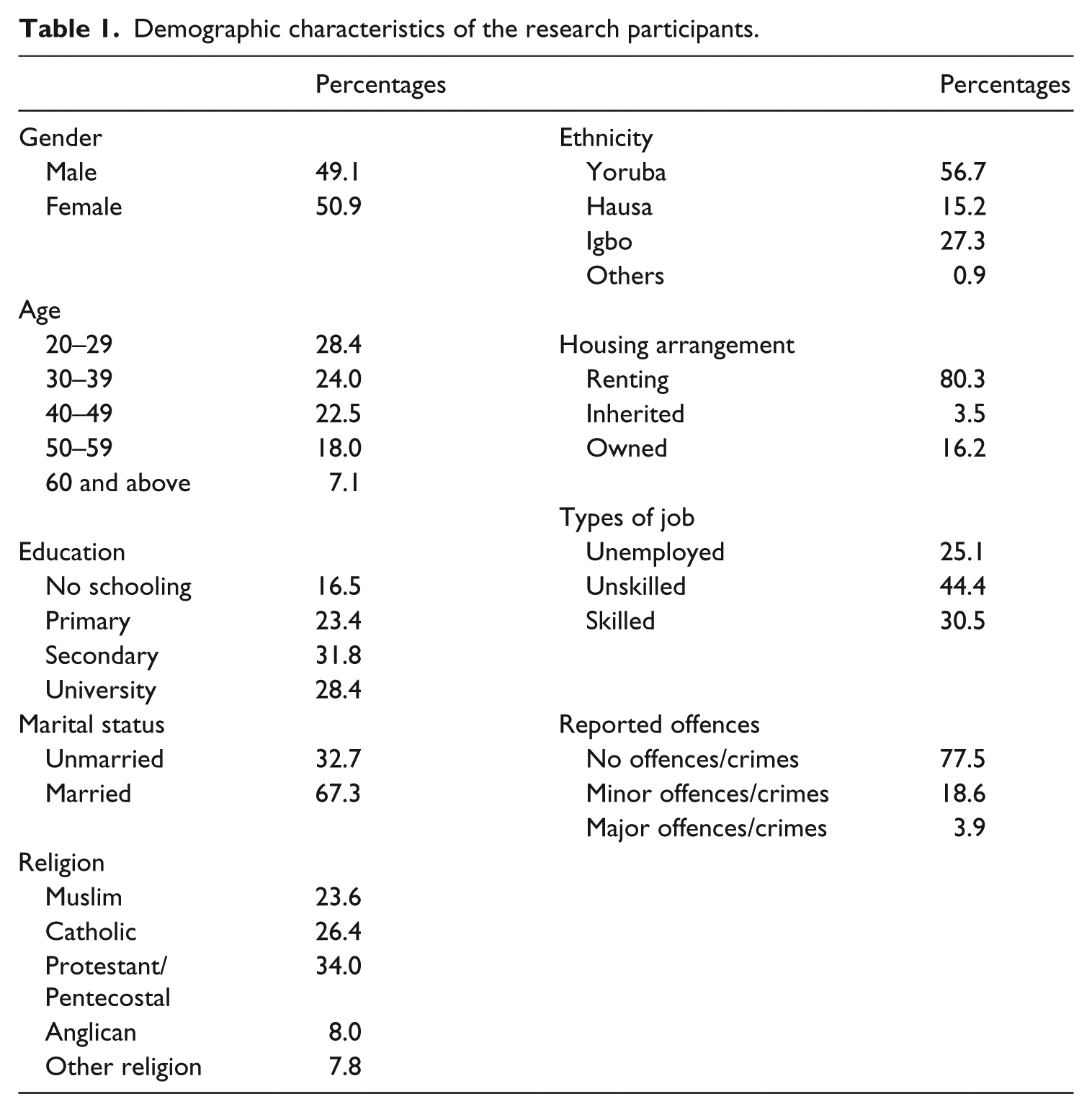
The research was conducted in accordance with article 4 (i.e. researchers’ responsibilities towards research participants) of the British Society of Criminology’s Statement of Ethics (http://www.britsoccrim.org/new/?q=node/22), which upholds: avoidance of harm, confidentiality, informed consent, among many other criteria during data collection. Accordingly, participants’ identities were de-individualized and protected. After the data were entered into SPSS software, the survey instruments were destroyed to prevent any unauthorized access or breach of confidentiality in the future. The socio-demographic structures of the sample are presented in Table 1.
Demographic characteristics of the research participants.
Measures
This study utilized a range of instruments to address the research questions in this study. These instruments and their relevance to this study are described below. Also, the full wordings of the instruments, showing mean values and standard deviations, are presented in Table 2.
Means and standard deviation of each variable items.
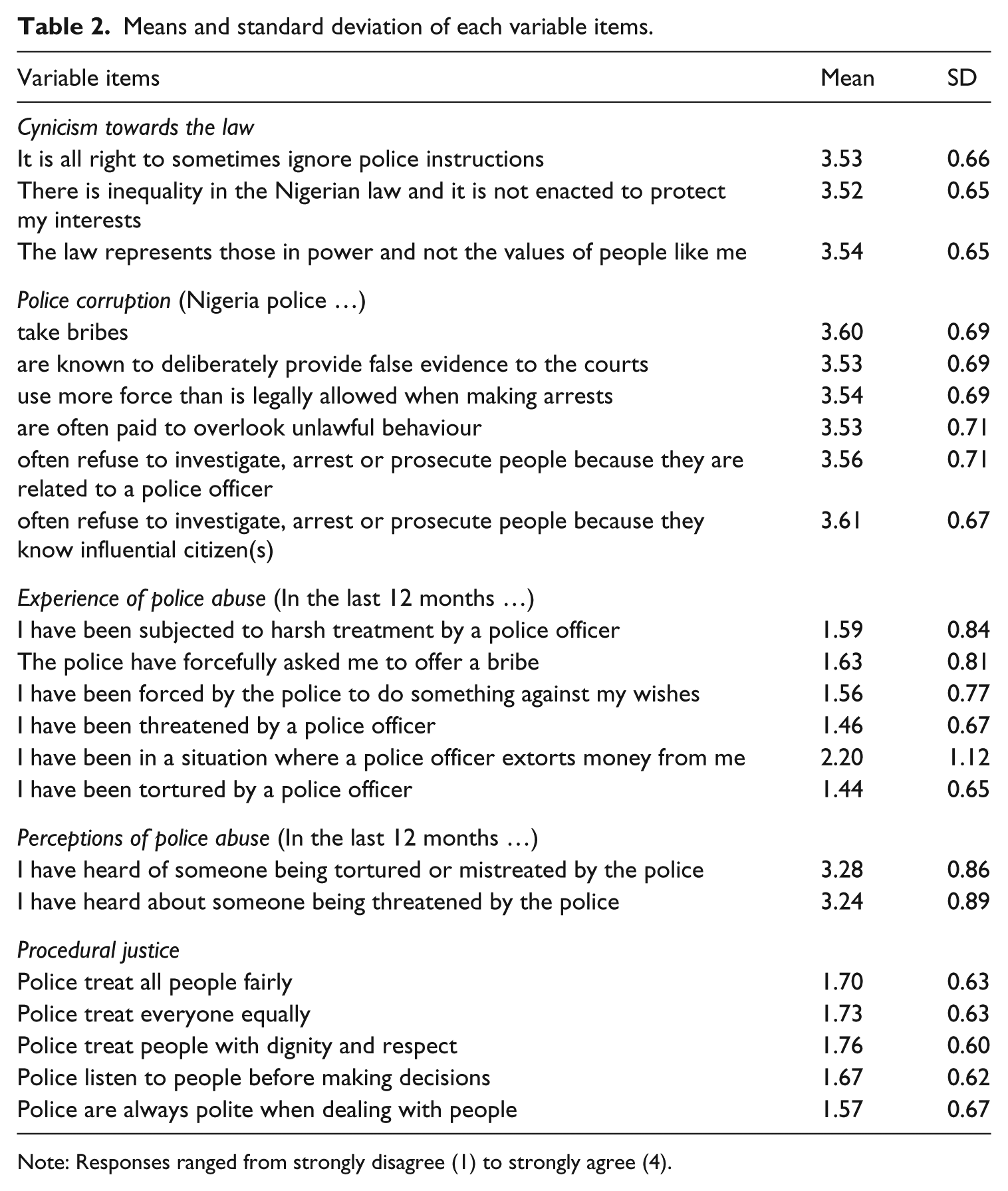
Note: Responses ranged from strongly disagree (1) to strongly agree (4).
Cynicism towards the law
Cynicism towards the law was measured using a three-item scale. It assessed the inclination that the police and the law, in general, are motivated purely by self-interest. This instrument is adapted from the work of Sunshine and Tyler (2003). It has a Cronbach alpha of α = 0.88; Mean = 3.53; SD = 0.59 and was measured on a four-point Likert-type scale ranging from 1 – strongly disagree to 4 – strongly agree. A high score on this scale reflects greater perceptions of cynicism towards the law.
Police corruption
Police corruption was measured using a six-item scale adapted from Akinlabi (2015) and Tankebe (2010). The instrument assessed vicarious experiences of police corruption and not actual experiences of corruption. It has a Cronbach alpha of α = 0.93; Mean = 3.56; SD = 0.60 and was measured on a four-point Likert-type scale ranging from 1 – strongly disagree to 4 – strongly agree. On this scale, a high score indicates greater perceptions of police corruption.
Experiences of police abuse
This is a component of a police abuse and brutality scale developed by this author. The full scale has three sub-scales, namely: experiences of police abuse; perceptions of police abuse; and witnesses of police abuse. The result of the previous analysis showed that each sub-scale can be used separately to test the specific underlying construct or as a combined scale to test for police abuse and brutality. The combined scale yielded a Cronbach alpha of α = 0.84 with all items in the three components loading above 0.7 respectively. Individually, the three sub-scales yielded Cronbach alphas as follows: experiences of police abuse (α = 0.91); perceptions of police abuse (α = 0.90); and witnesses of police abuse (α = 0.72). However, for this current study, experiences of police abuse and perceptions of police abuse sub-scales were used. In this study, experiences of police abuse is a six-item scale with a Cronbach alpha of α = 0.77; Mean = 1.65; SD = 0.56 and a four-point Likert-type measurement ranging from 1 – strongly disagree to 4 – strongly agree. A high score on this instrument indicates greater experiences of police abuse.
Perceptions of police abuse
Perception of police abuse is also a sub-scale of the police abuse and brutality scale. It is a two-item scale with a Cronbach alpha coefficient of α = 0.96; Mean = 3.25; SD = 0.86 and a high score on this scale means greater perceptions of police abuse. The scale was measured on a four-point Likert-type ranging from 1 – strongly disagree to 4 – strongly agree.
Procedural justice
Procedural justice was measured using a five-item scale adapted from Sunshine and Tyler (2003) and (Tankebe, 2009a). For this current study, the scale yielded α = 0.89; Mean = 1.69; SD = 0.52 and it was measured on a four-point Likert-type scale ranging from 1 – strongly disagree to 4 – strongly agree. The scale was developed to ask the participants about their views on police use of fair procedures. A high score on this instrument indicates that police use procedures that are perceived as fair by the participants; however, a low score indicates a lack of perceived procedural fairness.
Results
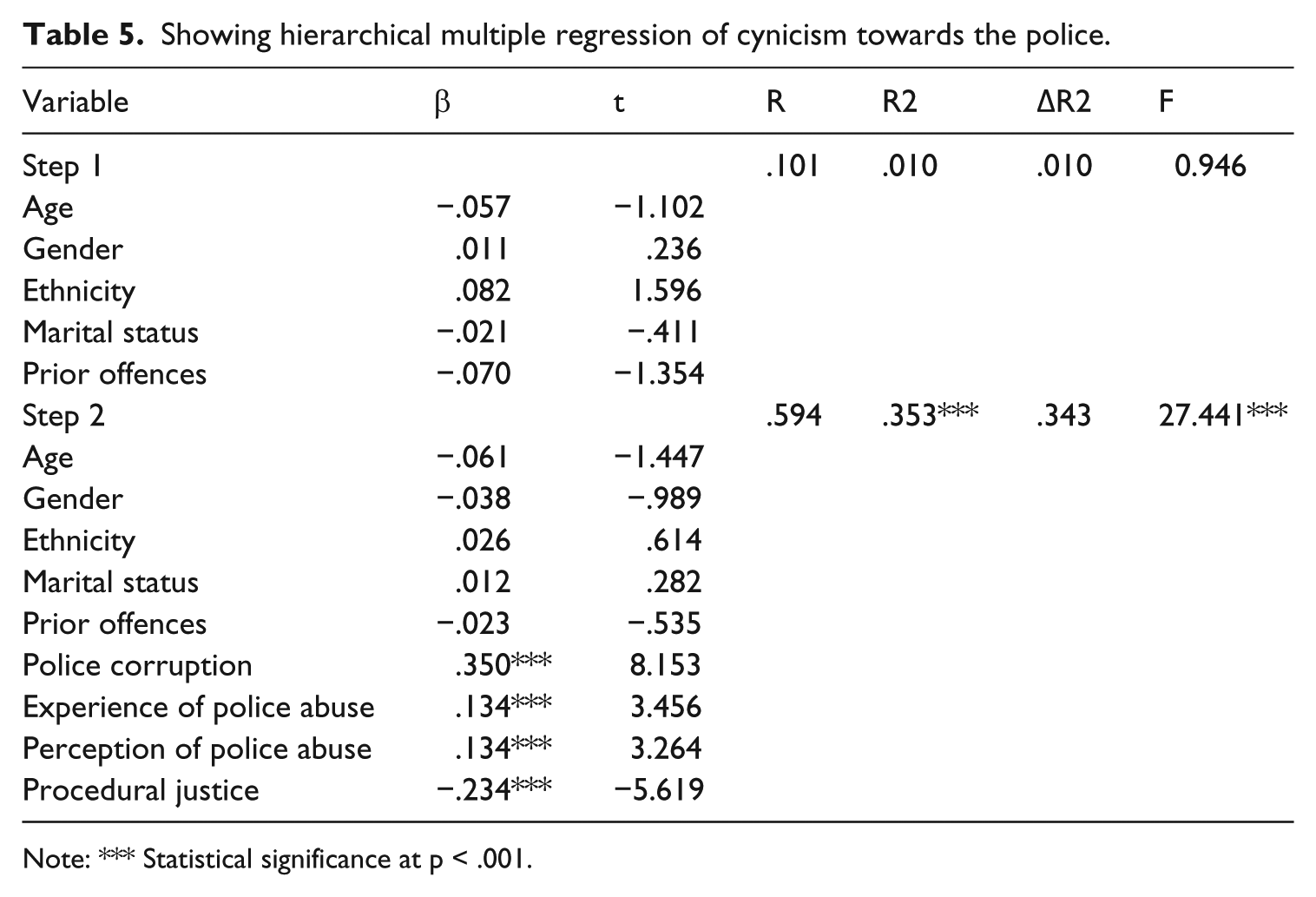
The central focus of this study is to explore whether public experiences and perceptions of police abuse, perceptions of police corruption and procedural (in)justice translate to public cynicism towards the law in Nigeria. Table 2 shows the univariate analysis of the variables; depicting the mean and standard deviation of the individual items in each variable. Table 3 presents percentages of each item, Table 4 presents the Pearson’s bivariate correlation analysis and Table 5 shows the hierarchical multiple regression analysis of the study.
Percentages of each item in the variables.
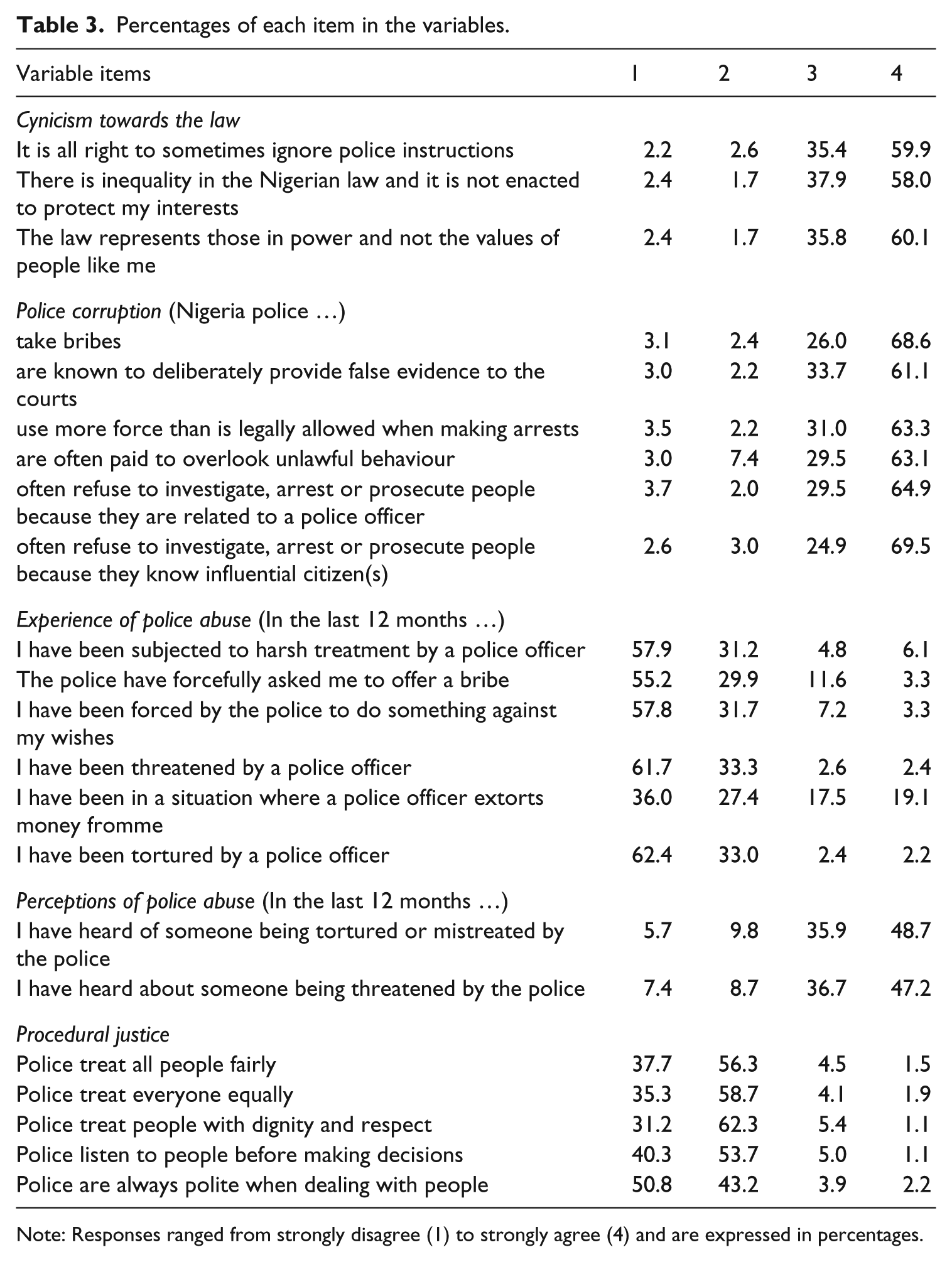
Note: Responses ranged from strongly disagree (1) to strongly agree (4) and are expressed in percentages.
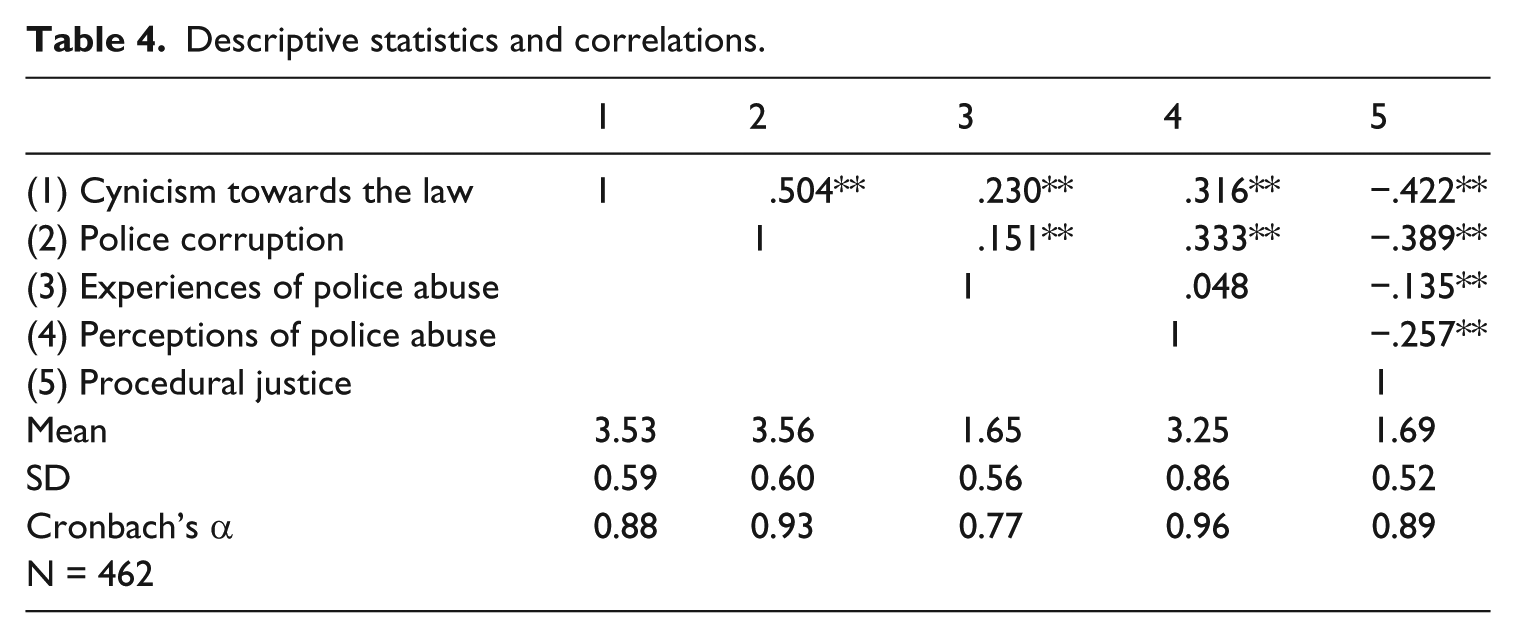
Descriptive statistics and correlations.
Showing hierarchical multiple regression of cynicism towards the police.
Note: *** Statistical significance at p < .001.
Looking at the univariate analysis in Table 2, it is evident that cynicism towards the law, perceptions of police corruption and perceptions of police abuse are positively skewed. This indicates that the mean of each item in these variables is greater than the median score and it is also greater than the mode of the distribution. In simple terms, it means that the response on each item demonstrates that the public are very cynical about the law, and that there are high perceptions of police corruption and police abuse among the citizens. Although items on perceptions of procedural justice showed negatively skewed scores, it has a negative implication on how people perceive encounters and the quality of treatment received from the police. The result indicates that the public perception of police procedural justice is poor.
Except for an item, ‘I have been in a situation where a police officer extorts money from me’ that is slightly above the median score on the public experiences of police abuse scale, the scale is also negatively skewed. The skewness of this scale connotes that ‘experience of police abuse’ is not too extreme or above the mean score. This is not to conclude that the people did not experience police abuse, it only indicates that the number of people who reported their experiences were lower in comparison to those who did not report or who had not experienced police abuse. To give a clearer overview of the distribution, a percentage score of each item is presented in Table 3. The percentage distribution corroborates the result in Table 2. In the next section, a bivariate correlation will be discussed to shed more light on the patterns and directions of association that exist between the variables in this study.
Bivariate correlation
In Table 4, a Pearson product-moment correlation was conducted to assess the relationship between the variables in the study. A significant bivariate correlation was established between most of the variables and the results were also in the expected directions. Specifically, police corruption (r = 0.504, p < .01) has the highest correlation coefficient and it was positively correlated with cynicism towards the law. Other variables with a significant correlation with cynicism towards the law are as follows: procedural justice (r = −0.422, p < .01), perceptions of police abuse (r = 0.316, p < .01) and experiences of police abuse (r = 0.230, p < .01). These results show that those who had experienced police abuse, who perceived police abuse, who see the police as procedurally unfair and/or corrupt, are more likely to be sceptical or cynical towards the law.
Interestingly, this study also showed that those who are cynical about the law, who perceived the police as corrupt and who experienced and perceived police abuse, will be more likely to perceive that the police do not use fair procedures.
Hierarchical multiple regression
Preliminary analyses confirmed that no assumptions were violated. The correlation analysis in Table 4 revealed that correlations were within acceptable limits without violating singularity assumptions. The highest correlation value was 0.5 which is lower than the recommended value of 0.7 (see Pallant, 2010: 158). The multi-collinearity assumptions using, Tolerance and Variance Inflation Factor, were within acceptable limits (see Field, 2013; Pallant, 2010). In addition, assumptions for sample size adequacy were also met. For a large sample size above 200 participants or being able to multiply 15 participants per predictor variables to achieve the sample size, minor violations of certain assumptions will not make a substantial difference to the result of the analysis (see Stevens, 2009: 117; Tabachnick and Fidell, 2013).
In Table 5, a two-stage hierarchical multiple regression analysis was performed to investigate whether experiences and perceptions of police abuse, perceptions of police corruption and procedural (in)justice will influence public cynicism towards the law in Nigeria. In the first step of the analysis, five socio-demographic variables (age, gender, ethnicity, marital status and prior offences) were entered in the model. The first stage of the model was not statistically significant.
In the second step of the analysis, four independent variables (police corruption, experiences of police abuse, perceptions of police abuse and procedural justice) were entered into the model. The four independent variables were statistically significant, but no demographic variables predicted cynicism towards the law. The result indicated that the nine variables in the second step of the model accounted for 35.3 per cent [F(9, 451) = 27.441; p < .001] total variance in the analysis, but the newly added independent variables accounted for 34.3 per cent (R2 change = 0.343). Individually, the four independent variables that predicted cynicism towards the law were as follows: perceptions of police corruption (β = 0.350; p < .001), procedural justice (β = −0.234; p < .001), experiences of police abuse (β = 0.134; p < .001) and perceptions of police abuse (β = 0.134; p < .001) respectively.
These results show that those who perceived the police as corrupt, procedurally unfair or who had experienced and/or perceived police abuse, are more likely to be cynical towards the law. That is, public experiences and perceptions of what the police do and how the police treat the public promote cynicism towards the law.
Discussion
The most significant purpose of this article was to test the research question posed in the first section of this study. Will experiences and perceptions of police abuse, perceptions of police corruption and procedural (in)justice influence public cynicism towards the law in Nigeria? This question was statistically tested and the results showed that cynicism towards the law is predicted by experiences of police abuse, perceptions of police abuse, perceptions of police corruption and procedural justice. Undoubtedly, this result calls radically into scrutiny the current ways of thinking about policing and the policed in Nigeria.
What the police do in Nigeria predicts public cynicism towards the police. This study corroborates that the relationship between the police and the public is very problematic and that order maintenance is achieved through intimidation, abuse of power, corruption and a general disregard for procedural justice (Agbiboa, 2015; Alemika, 2010). This study also supports the arguments that negative perceptions of police activities, involvement in abuses of power and other forms of misconduct, often engender cynicism towards the law and the police enforcing it (Akinlabi, 2013; Bradford, 2014; Sunshine and Tyler, 2003). Corruption and abuses of power undermine public confidence in the police and the legitimacy of the institution (Newburn, 1999; Tankebe, 2009a, 2010).
The association between cynicism towards the law, police abuse of power and corruption were entirely in the positive direction. That is, higher levels of police corruption and police abuse predicted higher levels of cynicism towards the law. In contrast, the association between cynicism towards the law and procedural justice was in the negative. Even though this latter comparison was bonded in the negative, it still connotes that a higher level of cynicism towards the law was associated with a lower level of procedural justice. In other words, procedural justice is relevant in building positive perceptions of the police and the legal system in Nigeria.
Given the policing situation in Nigeria, the results were in the expected and hypothesized directions. They revealed that whenever Nigerians have actual and vicarious experiences of police abuse and corruption, their affective links with the police, in terms of procedural justice, are eroded; thereby resulting in public cynicism towards the law and the police enforcing it. It makes sense, therefore, to argue that as police undermine the importance of treating people fairly, they rely more on brute force and corrupt practices.
This current research extends the geographical focus of the procedural justice model into an under-explored post-colonial African context where procedural fairness is not a routine aspect of police practice. The study reveals the ‘dynamics’ of the procedural justice model under conditions of social and political strain, indicating that a lack of procedural fairness portends legal cynicism and a lack of respect for the police. While a full consideration of the police legitimacy and procedural justice framework is beyond the scope of this article, the study however, aligns with a growing number of findings in the developed western societies that reveal that perceptions of procedural justice may be relevant in fostering police legitimacy and other law-abiding behaviours (Jackson et al., 2012b; Murphy et al., 2009; Tyler, 1990). Further, this study has shown that, even in a society like Nigeria, citizens might find procedural justice relevant to their law-abiding behaviour.
Public perception of police corruption was the strongest predictor of cynicism towards the law in the model. The higher level of police corruption associated with cynicism towards the law is expected and noteworthy for several reasons. Corruption is one of the most common types of police deviance in Nigeria. It is very easy to hear stories of intractable cases of corruption about Nigeria or Nigerians in the media or popular discourse. Nigerians recognize that most of the problems confronting their country are due to corruption and that no state agency is more affected and popularly criticized than the police force. Certainly, most Nigerians recognize this societal anomaly, and by and large, they resent the law, and by extension, the police enforcing the law. As depicted in the results, both perceptions and experiences of police abuse were reported in the Nigerian data. It is important to note that, where corruption thrives, abuse of power and procedural injustice will dominate.
Despite the poor relationship between the police and the public in Nigeria, the respondents did appear to care about procedural justice. The public appeared sensitive to the way they perceived policing or how they were treated by the police. Interestingly, public responses in this study are not different to that of other jurisdictions, when police practices and affective links deviate from societal expectations (see Bradford et al., 2014; Punch, 2000; Tankebe, 2010). For example, Punch (2000) in his comparative review of experiences of police corruption in four countries – the USA, Great Britain, Belgium and the Netherlands – argued that a ‘corruption-free’ police is of a great importance to a healthy society and that corruption and other police deviance undermines police, and by extension, state legitimacy.
To this end, it is important to propose a set of ideas that may be relevant to policymakers in reforming the Nigeria police. The police need to become a democratically accountable institution, where the objective of policing is to serve the public in a procedurally fair manner and without prejudice. To do this, the Nigerian government needs to establish national, state and local government stakeholders’ accountability structures, such as forums where public deliberation about police abuse, corruption and other matters concerning policing are discussed.
Conclusion
This study began with an assumption that if police behaviour deviates from normative expectations, public response will be commensurate with cynicism towards the law. The current research findings support this hypothesized argument and by extension, other related studies in the literature. This study in particular points to the consequences of police corruption, police abuse and procedural injustice in Nigeria. If police behave in manners that undermine affective links with the people, in return, the public will be cynical about the law. If the police wish to encourage public trust and respect for the law, the current police practices in Nigeria must become citizen-focused. The police need to develop an understanding that the basis for strong democratic policing is serving, and relatedly, treating the public with respect. Since this study is one of the first empirical pieces of research to address these issues in Nigeria, more work is clearly needed to flesh out questions not addressed in this study, and in particular to generate evidence and ideas that can help guide future police reforms.
Footnotes
Declaration of Conflicting Interests
The author(s) declared no potential conflicts of interest with respect to the research, authorship, and/or publication of this article.
Funding
The author(s) received no financial support for the research, authorship, and/or publication of this article.