







Abstract
Non-fatal strangulation is commonly reported by women who have experienced intimate partner violence and it has been identified as both an immediate risk to health and life but also a risk for future serious harm and even death. While some Australian states and Canada have followed the lead of American states in introducing criminal offences of non-fatal strangulation the United Kingdom is yet to do so. Non-fatal strangulation offences have come with challenges of definition and identification. The success of criminal justice responses requires an understanding of the ways in which women understand and describe their non-fatal strangulation victimisation. We analyse 24 women’s experiences of non-fatal strangulation as a basis for considering how to ensure that jurisdictions considering introduction of a new non-fatal strangulation offence or reform of an existing offence do not reproduce obstacles to prosecution and legal recognition and suggest a model definition of non-fatal strangulation for an offence.
Introduction
Women who have experienced intimate partner violence (IPV) commonly report being subjected to non-fatal strangulation (NFS) by their partners. Evidence shows that a majority of women escaping IPV and residing in shelters report experiences of NFS from a previous partner (Joshi et al., 2012; Wilbur et al., 2001). Research shows that NFS is common in relationships where there is IPV with studies reporting rates between 3% and 68% depending on the sample (Bendlin and Sheridan, 2019: 1529). Whether carried out with hands or feet, by squeezing or pushing on the neck, with arms used in chokehold or with a ligature, strangulation is highly dangerous. A variety of clinical symptoms are associated with NFS, including sore throat, changes to vision, vocal cords, hearing and breathing, loss of sensation, memory loss, anxiety, loss of consciousness, paralysis, and pregnancy miscarriage (Foley, 2015; Funk and Schuppel, 2003). Even where there are no immediate visible injuries, some victims have died several weeks or months after the attack because of blood clots, stroke and brain damage caused by the strangulation. Strangulation can cause unconsciousness within seconds and death within minutes (Strack and Gwinn, 2011), and is the cause of death in at least 8% of IPV related homicides in Australia (Australian Institute of Health and Welfare, 2018: 77) and 17% of deaths in the United Kingdom (Long and Harvey, 2020, 28). There is also evidence that strangulation in the context of IPV is a risk factor for future serious harm and death. Glass et al. (2008) found that the odds of experiencing some additional form of life-threatening violence in the time after being strangled by a partner increased by 700%. IPV death reviews have identified that an incident of NFS often precedes IPV homicide (Websdale, 2019).
In the United Kingdom, there have been calls for the introduction of a stand-alone NFS offence (Bonham and Ktena, 2019; Edwards, 2015). One by one, Australian states began to introduce discrete NFS offences since 2014 (Douglas, 2019). Canada introduced an NFS offence in 2019 (section 267 Criminal Code 1985 Ca) and most American jurisdictions have introduced NFS offences (Battered Women’s Justice Project, 2014). Some of the key aims of stand-alone NFS offences include recognising the high degree of danger and risk associated with NFS, clear identification of NFS on the criminal record and addressing the obstacles that exist to prosecuting NFS under traditional forms of offences such as assaults and attempted murder (Douglas and Fitzgerald, 2014: 236). In the context of IPV, NFS is often part of an on-going pattern of coercive control (Stark, 2007).
In this article, we argue that many of the NFS offences that have been introduced may not be drafted appropriately to respond to the risks associated with NFS and the safety needs of victims of IPV that have been identified in existing research. We begin with a review of the literature to situate NFS within the framework of coercive control, before analysing current offences, and their definitions, of NFS in the United States, Canada and Australia. We then turn to an explanation of our methods and results, which draw on in-depth interviews with survivors of NFS to assess themes emerging from their experiences that bear on the appropriateness of current approaches to the drafting of NFS offences. Based on our analysis, we then suggest a model NFS offence.
Strangulation through the lens of coercive control
Increasingly, law, policy and research define and understand IPV as a pattern of behaviour aimed at coercively controlling the victim rather than a discrete incident or set of discrete incidents (Australasian Institute of Judicial Administration, 2020, [3.1]; Barlow et al., 2020; Crown Prosecution Service, 2020; Stark, 2007). Research has demonstrated that an abuser’s exercise of coercive control usually involves the use of a variety of methods including physical violence, threats, deprivation of basic needs, surveillance and degradation to hurt, degrade, intimidate, exploit, isolate, and control their victims (Crossman and Hardesty, 2018: 203; Stark, 2007: 209). The tactics, or technologies, of abuse underpinning coercive control develop and change over time and are specific to the woman’s circumstances, they are often routine, and their effects are cumulative rather than incident specific (Stark, 2007). Stark and Hester (2019) argue that coercive control is gendered, relying on vulnerability arising from sexual inequality (p. 88). Reflecting these understandings, England and Wales, and Scotland have introduced offences that encapsulate coercive control (Barlow et al., 2020; Bishop and Bettinson, 2018; Scott, 2020) and in Australia there has been debate about introducing a similar offence (McMahon & McGorrery, 2016).
Critiques have been levelled against the precision and use of the concept of coercive control (Walby and Towers, 2018), and its application by criminal justice practitioners (Tolmie, 2018), nonetheless, coercive control has ‘made its presence felt within the criminal justice system in different ways in different jurisdictions’ (Barlow et al., 2020: 160). Some have argued that coercive control can be useful to situate NFS, providing a broader account of the meaning and implication of the offence. For example, NFS has been described as an extreme form of controlling behaviour (Stansfield and Williams, 2018) and as ‘an exceptionally effective way to gain and maintain control’ as it shows perpetrators literally hold victims’ lives in their hands (Thomas et al., 2014: 29). Similarly, empirical observations suggest that many women who are strangled report feeling that they were close to death when they were strangled (Thomas et al., 2014; Vella et al., 2017). Moreover, in the context of IPV, NFS has been associated with other behaviours that are identified as high-risk for future serious harm including sexual assault (McQuown et al., 2016; Zilkens et al., 2016) and stalking (Bendlin and Sheridan, 2019).
While introducing an NFS offence requires focussing the criminal law response on a discrete incident rather than a pattern of behaviours, this has been argued to be justified given the risk and danger associated with NFS and the difficulties associated with prosecuting it under traditional criminal offences (Stansfield and Williams, 2018). Jurisdictional approaches to the criminal law have varied, but they have historically shared challenges with respect to definition and identification of NFS. Across Australia, the United Kingdom, Canada and the United States, the act of NFS may constitute an existing offence such as common assault, serious bodily harm or attempted murder (Douglas and Fitzgerald, 2014). In the United Kingdom, NFS may also be part of an offence of ‘coercive control’ (McGorrery and McMahon, 2019). However, in the absence of a stand-alone offence of NFS (with a clear definition of NFS), the application of these offences may fail to reflect the seriousness of the harm and risks levelled by NFS (Douglas and Fitzgerald, 2014: 240; Gombru et al., 2016: 15). Scholars have shown that in the absence of a specific law, strangulation is typically charged as common assault (Gombru et al., 2016) and this offence does not reflect the seriousness of NFS. In addition, some of these traditional offences can be extremely difficult to prove when NFS itself is the alleged criminal act. For example, in the United Kingdom, attempted murder requires the prosecution to prove that the perpetrator intended to kill the victim (Mirfield, 2015), while in Australia the prosecution must prove the accused intended to kill or cause very serious harm to the victim (Gans, 2018, (7.2). Similarly, serious assaults typically require the prosecution to prove some form of injury (Douglas and Fitzgerald, 2014: 240) and often NFS-related injuries are not visible, not reported or become apparent days, weeks or months after the NFS has taken place (Vella et al., 2017: 172). Using strangulation for the specific purpose of incapacitating a person so that another serious offence can be carried out such as burglary or assault is also a recognised offence in the United Kingdom, Canada and several Australian states (Douglas and Fitzgerald, 2014: 236). However, this offence requires that the prosecution prove the strangulation was done to further some other serious offence, and this will often be difficult (Douglas and Fitzgerald, 2014: 243). Furthermore, these alternative charges do not identify a history of NFS on the criminal record, and this may have implications for future decisions about support and safety for victims including protection orders, bail, parole, and sentences.
Offences of NFS
Most American states, Canada and several Australian jurisdictions have introduced NFS offences. There is no consistent approach to the language of the offences or the definitions of NFS they include. We review key legal developments in this section.
Over 30 American states have introduced specific NFS offences since the early 2000s (Verdi, 2013). To date, there have been several reviews of states’ legislation, including in Massachusetts (Maalouf, 2017), New York (Strack and Gwinn, 2011), Minnesota (Francis, 2008) and Rhode Island (Verdi, 2013). These reviews have generally been positive about the introduction of NFS laws in closing a gap in the law, improving awareness of the seriousness of NFS and positively impacting on victim safety (Pritchard et al., 2017). For example, in their review of NFS offences in 50 states, Laughon et al. (2009) pointed out that most state laws do provide a broad definition of strangulation that includes ‘occluding blood flow to the brain and/or interfering with the victim’s ability to breathe’ (p. 365). Laughon et al. (2009) highlight that the NFS offence in Idaho does not require proof of injury from NFS, which, they argue, simplifies prosecution (p. 364). However, there have been criticisms of some aspects of American laws. For example, in Minnesota, Nath (2007) has identified that the legislative requirement for the perpetrator to ‘intentionally’ impede normal breathing in the course of NFS is difficult to prove (p. 272). Maalouf (2017) has identified a similar issue under the Massachusetts law, recommending the law in that state be amended to include ‘recklessness’ as a culpable state of mind in carrying out NFS. She argues that many abusers strangle a victim to gain control and assert power, without intending to cause an injury (Maalouf, 2017: 312). Notably the requirement of non-consent to NFS (without an allegation of sexual assault) is not an element of NFS laws in any American state.
A recent amendment to Section 267 of Canada’s Criminal Code (1985) states that ‘every person is guilty of an indictable offence . . . who in committing an assault . . . chokes, suffocates or strangles the complainant’. The penalty is a maximum of 10 years. Similar to some Australian states considered below, there is no definition of NFS included in the Canadian criminal code and to date no published cases have considered the provision.
To date five of the eight Australian states and territories have introduced an NFS offence. The Australian Capital Territory (ACT) and Western Australia (WA) introduced an NFS offence in 2015 and 2020 and to this point, they are the only Australian jurisdictions to include a definition of NFS. The ACT offence, titled ‘Acts endangering health’, states: ‘a person who intentionally and unlawfully chokes, suffocates or strangles another person so as to render that person insensible or unconscious . . . is guilty of an offence’ (s28(2)(a) Crimes Act 1900 (ACT)) with a 10-year maximum penalty. ACT law added a definition of NFS to the offence in 2019. In the ACT ‘choke’ and ‘strangle’ are defined as to ‘apply pressure, to any extent, to the person’s neck’ and ‘suffocate’ includes obstructing or interfering, to any extent, with the person’s respiratory system (s27 (1) & (3) Crimes Act 1900 (ACT)). The WA offence titled ‘Suffocation and Strangulation’ has a maximum penalty of 7 years and states,
A person commits a crime if the person unlawfully impedes another person’s normal breathing, blood circulation, or both, by manually, or by using any other aid – (a) Blocking (completely or partially) another person’s nose, mouth, or both; or (b) Applying pressure on, or to, another person’s neck. (s298 Criminal Code Compilation Act 1913 (WA)).x
As yet, there have been no published legal cases that have interpreted the definition provisions of the ACT or WA legislation.
In New South Wales (NSW) alternative standalone NFS offences were introduced in 2014. Section 37(1A) Crimes Act 1900 (NSW) states ‘a person is guilty of an offence if the person intentionally chokes, suffocates or strangles another person without the other person‘s consent’. This offence has a maximum penalty of imprisonment for 5 years. Notably, it requires the prosecution to prove that the accused intended to strangle the victim and that the victim did not consent. The second offence, section 37(1A) Crimes Act 1900 (NSW) that ‘a person is guilty of an offence if the person either ‘(a) intentionally chokes, suffocates or strangles another person so as to render the other person unconscious, insensible or incapable of resistance’ and (b) ‘is reckless as to rendering the other person unconscious, insensible or incapable of resistance’. In this second context, the maximum penalty is imprisonment for 10 years. This second offence requires the prosecution to prove the accused’s intent both to strangle the person with the purpose of rendering the victim unconscious, insensible or incapable of resistance and that the accused was reckless (i.e. the person foresaw the possible outcome) about whether the victim was rendered unconscious, insensible or incapable of resistance. While there are no published cases that have interpreted the NSW legislation, there are potentially several obstacles to prosecution. Notably for both forms of the offence, there is no definition of NFS.
The NFS offences introduced in Queensland in 2016 and South Australia (SA) in 2019 are explicitly applicable, and limited, to the domestic context. The maximum penalty in both jurisdictions is 7 years imprisonment. The Queensland and SA offences also use the same drafting of the offence stating it is a criminal offence when the person ‘chokes, suffocates or strangles’ another person, ‘without the other person’s consent’ and the accused is in a domestic relationship with the victim (Criminal Code Act 1899 (Qld), s. 315A; Criminal Law Consolidation Act 1935 (SA), s20A). The Queensland and SA offences both require that the prosecuting authority prove that the victim did not consent to being choked, suffocated or strangled. There is no statutory definition of strangle or choke in either state, and there are no published cases discussing the SA provision. In a recent Queensland decision, the Court of Appeal determined that ‘in order to amount to choking, there must be some pressure that results at least in the restriction of the victim’s breathing’ (R v HBZ [2020] QCA 73).
The relatively recent introduction of NFS legislation in the Canadian, Australian and American contexts illustrate jurisdictions’ awareness of the danger and risk associated with the NFS offence, but also point to the challenges of drafting NFS offences. Some appear to include significant obstacles to prosecution including requiring prosecution authorities to prove the victim’s lack of consent 1 to NFS (NSW, Queensland and SA) and the requirement that the prosecution prove intent or particular forms of injury (NSW, some American states, for example, Minnesota). Further without a clear definition of NFS in the legislation there is a risk that NFS will be interpreted narrowly, for example, to require complete stoppage of breath or that unconsciousness results (R v AJB [2019]). To assess these challenges, we turn to an empirical study of NFS from the perspective of women as victims. We consider how women describe their experiences of NFS, in what contexts these experiences occur, and how women perceive the results and implications of their experiences. Based on these findings, we then turn to a discussion of an appropriate approach to drafting an NFS offence.
Method
The perspectives of survivors continue to be critically important to informing appropriate responses to IPV (Kelly and Westmarland, 2016). This article draws on a sub-sample of 24 participants from a qualitative study of 65 women in Brisbane, Australia, who had previously experienced IPV from a male intimate partner and had engaged with the legal system in response to that partner’s abuse in the 12 months prior to the first interview. The subset of participants includes women who referred to experiences of strangulation, choking or grabbing around the neck in the first interview.
In-depth interviews were conducted with each participant at three time-points over a roughly 3-year period from 2014 to 2017 to capture their evolving engagement with the legal system in response to IPV. Participants were recruited from a range of organisations including key legal services, IPV support services and family law firms. Within those organisations, recruitment procedures involved potential participants being initially approached by their IPV support worker or lawyer who discussed the study with them and arranged interview times if women decided to participate. The women’s understanding of the study and their consent to participate was discussed again at the first interview and at each subsequent interview. First interviews usually took place at the recruiting services, but subsequent interviews often took place in other locations selected by the participants. As a token of recognition of their contribution, participants were given a shopping voucher (value AUD40 (GBP20) for the first interview and a shopping voucher valued at AUD60 (GBP30) for the second and third interviews.
For the purposes of this study, data are limited to the first interview in which women were asked about their experience of IPV from their partner and any legal matters they were involved in. When asked about previous IPV, women were not prompted specifically about NFS, in the interviews, however, 24 (36%) women used a variety of terms to describe the NFS they experienced, for example, being ‘strangled’, ‘choked’, ‘pushed on the neck’, ‘grabbed by the neck’ or ‘held around the throat’. The interviews were recorded and transcribed. Characteristics of the strangulation subsample as compared to the full study sample are shown in Table 1.
Sample characteristics.
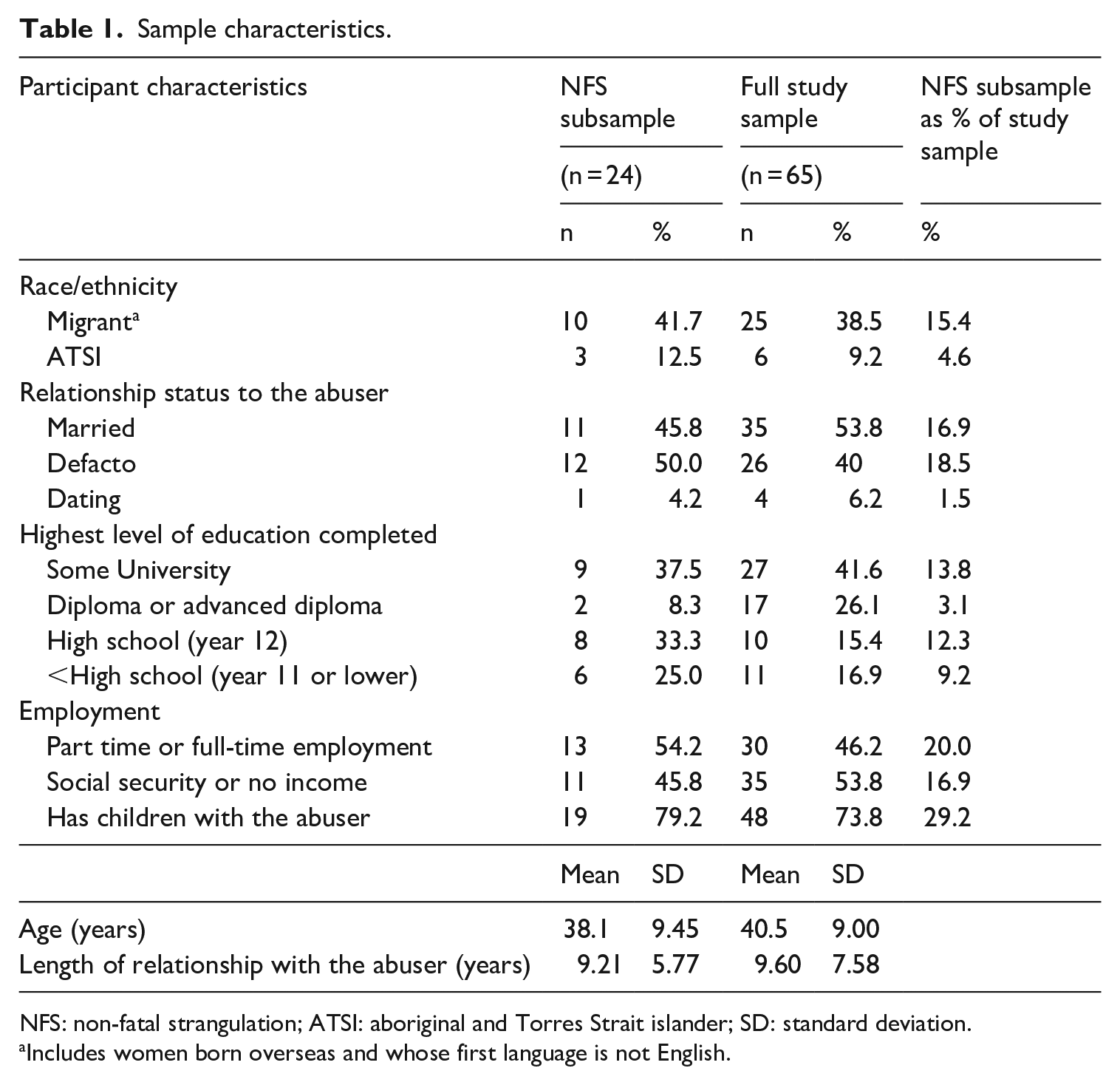
NFS: non-fatal strangulation; ATSI: aboriginal and Torres Strait islander; SD: standard deviation.
Includes women born overseas and whose first language is not English.
At each stage of interviews, transcripts were thematically analysed (Braun and Clarke, 2006) both manually and using the NVivo qualitative software package. In the context of the women’s re-construction of experiences of NFS three themes emerged that may be relevant to how an offence of NFS should be drafted. The themes were (a) NFS as part of the experience of coercive control, (b) the invisible injuries of NFS and (c) the woman’s immediate response to NFS. The study received ethical approval from the University of Queensland Human Ethics Committee (approval number 2014001243). In this article, pseudonyms are used, and identifying details are excluded to protect the participants’ anonymity.
Limitations
This study involved a small subsample of 24 women from one area. Interviewees in the sample had already identified they had been in a violent intimate relationship and were working with services and engaged in some way with the legal system. Women’s experience of NFS were elicited through broad questions about their experience of IPV. More women may have disclosed NFS if they had been asked directly about it.
Findings
NFS as part of a pattern of coercive control
Consistent with other research NFS was described by all of the women interviewed as part of a larger pattern of control, fear and intimidation that they experienced in the relationship (Stansfield and Williams, 2018; Vella et al., 2017). For example, Doya’s story illustrates her partner’s use of NFS on multiple occasions as part of a strategy to maintain control over her. During her relationship with Bob, Doya felt that she had to ‘tiptoe around Bob so as not to make him angry’. When he was angry, he would yell at her calling her a ‘slut’, ‘whore’ and ‘bad mother’. Doya had overstayed on her tourist visa and was illegally living with Bob. Bob was the father of her two children who were born in Australia, and he routinely threatened to report her to authorities if she called the police. She feared she would be deported and would lose contact with her children. He smashed her phone so she could not call for help. Doya relied on Bob to provide her with money to purchase food and public transport, and he sporadically supplied her with funds. Doya commented that Bob often kicked and punched her and sometimes put his hand over her mouth and squeezed her neck. During her time with Bob, she always had bruises on her body. Ultimately, an incident of NFS resulted in Doya leaving Bob in fear of her life. Bob had ‘pushed’ Doya’s daughter, leading Doya to scream at him:
. . . Then he was push my neck. I was angry and screaming to him. . . . I said no, you hurt my daughter . . . Then he come to me and grab my neck, pull me up, up high. Then, when he put me down . . . just leave me on the ground.
Like other women in the sample, Doya’s story reflects a cumulative experience of abuse that is common to victims’ narratives coercive control (Stark, 2007). In this case, NFS is both part of Doya’s routine encounters with violence, and an extreme fear-inducing and controlling behaviour (Stansfield and Williams, 2018; Thomas et al., 2014) leading to her final decision to leave the relationship.
Recognising and proving the invisible injuries of strangulation
How do women understand and describe their experiences of NFS? Several challenges to the prosecution of criminal offences in the domestic violence context have been noted in the literature including a lack of recall about the specific details, uncorroborated evidence and no evidence of injury (Douglas, 2015). The women in the sample used a variety of terms and did not use consistent terminology to describe the NFS they experienced, for example, while they did use words like being ‘strangled’ or ‘choked’, they also used terms like, ‘pushed on the neck’, ‘grabbed by the neck’ or ‘held around the throat’.
Despite findings that NFS represents an extreme form of abuse leading to serious internal injuries (Faugno et al., 2013; McClane et al., 2001), leaving some victims very close to death (Stellpflug et al., 2020), earlier research indicates that NFS often leaves no visible trace (Nath, 2007; Strack and Gwinn, 2011). Consistent with this observation, women in the sample did not commonly describe visible injuries associated with their experiences of NFS. To the contrary, Trisha recalled that despite her clothing being ‘. . . grabbed and tightened around [her] neck until [she] became dizzy’, there were no bruises or marks on her neck as a result of the NFS. Only 6 of the 24 women described visible physical evidence of strangulation, referring to ‘marks’ (Carol, Trisha), to ‘red marks’ (Lyn), ‘finger-marks’ (Sandra), ‘scratch marks’ (Anna) and ‘bruising’ (Gillian) on their necks. While visible evidence of NFS was not always present, obstruction of air flow was reported in some cases. Eight women reported that they could not breathe or that their breathing was cut off. Five of the eight women reported a loss of consciousness after NFS, and only one, Anna, reported both loss of consciousness and marks on her neck resulting from NFS.
Some women in the sample felt that avoiding visible marks was a deliberate tactic. For example, Monica noted that her abusive partner was ‘clever’ in choosing strangulation because it resulted in injury that was invisible. Some women who had police contact as a result of an incident of NFS believed that visible marks were important in ensuring that the police identified their victimisation. For example, in Sandra’s case:
. . . when police arrived, [the abuser] turns it all around and says look what she’s done. . . . She’s broken my finger or – all this sort of thing. He turns around that I did the attack on him, when there is still physical evidence of finger marks on my neck. (Sandra)
Beyond visible marks on the neck, women reported invisible injuries that are associated with strangulation in the literature; however, women did not always make the connection to NFS in their description of those injuries. For example, Shuang described an incident of NFS during which her partner had also threatened to kill her and burn down the house. In her description of the incident during the interview, she provided a copy of her hospital record showing a diagnosis of post concussive syndrome, an injury associated with NFS (Campbell et al., 2018). Shuang did not connect the NFS to the diagnosis of post-concussive syndrome. Another common invisible injury associated with NFS, that victims may only become aware of in the longer term, is memory loss (Funk and Schuppel, 2003; McClane et al., 2001; Strack et al., 2001). Three women who experienced NFS described ongoing memory loss. Kim reported having lost consciousness several times during the relationship as a result of NFS. She described her distress that memory loss had affected her work:
I have really bad problems with my short-term memory. At work I have to have a notepad and I have to write down . . . if I don’t when I get back to my desk two minutes later, I can’t remember what they asked for. (Kim)
Even when women indicated that they were hospitalised following an NFS incident, NFS was not always disclosed to health workers at the time, a finding consistent with other studies (e.g. Pritchard et al., 2018: 171). As a result, NFS may not be considered or noted in victims’ medical treatment meaning there is no corroborating evidence of injury. While six women in total said they had medical attention after experiencing NFS, four of those women did not connect their injuries to NFS at the time of hospitalisation. For example, Faith reported going to hospital after being strangled because of pregnancy miscarriage. Much later she reflected that it was a result of the strangulation: ‘. . . he choked me . . . and I was kicking him and got him off . . . I was pregnant at the time without realising, but I miscarried that and I’m pretty sure that’s related’. Similarly, Euni was strangled by her partner and a few weeks later gave birth prematurely. She did not make any connection between the strangulation and early birth and did not tell health workers about being strangled. Research has demonstrated that strangulation is associated with both miscarriage and premature birth (Messing et al., 2018).
Women’s defensive actions
Women’s immediate responses to NFS varied, but several described defensive actions, for example, stabbing their partner, ‘kicking’ or ‘struggling hard’ to get away. Some women described their defensive responses as drawing on a basic survival instinct. Sandra’s strong sense of self-preservation kicked in when she was strangled:
He came around, because I wasn’t answering the telephone and everything else. So, then he got very violent and he had me around the throat. I could hardly breathe. It was like survival of the fittest. When you’re in flight mode, you’ll do whatever you need to do to try and get away. . . . All the times previous to the violence I always ran away, locked myself in a room, always ran. But this time I was cornered and trapped, where I couldn’t get away from him strangling me. I was trying to get some air. I grabbed his hand and twisted it in defence. . . . I thought I was a dead ducky that night. By having your oxygen airways, gasping for air . . . (Sandra)
Sandra’s experience shows that her defensive response was an automatic response to fear of death. When women do act in self-defence there is a risk their response will be characterised as abuse and then they will be blamed (Goodmark, 2018: 20). This happened to Janet. She described gasping for air, after being strangled by her partner, and grabbing a kitchen knife to try to defend herself:
Like he had me – he was strangling me, so I pulled a knife out to try to defend myself, and I copped it . . . the police [took out a protection order against me] and I told [the officer] the reason there was a knife there . . . is because he tried to strangle me, and I couldn’t breathe, and I had to get a knife out to try and protect myself.
Janet could not recall who called the police but when police arrived, they initially arrested her and charged her with assault, although she still held the knife, she had not actually used it. While the charge was eventually withdrawn, Janet’s partner was not charged with any offence. Police took out civil protection orders against both Janet and her partner requiring them to be of good behaviour to each other.
Informing the drafting of criminal offences of NFS
In this section, we draw on findings emerging from women’s experiences of NFS to highlight the potential weaknesses in some legislative approaches to the drafting of NFS offences that reproduce obstacles to prosecution identified in traditional offences. Our aim here is to take a victim-centred approach in analysing the stories of women who have experienced NFS and the relevance to legislation. The women’s descriptions of their experiences raise two important issues for consideration with respect to framing a criminal offence of NFS, lack of consent should not be an element of the offence and both the act and effect of NFS should be clearly defined.
Coercive control, NFS and consent
Consistent with other research, we found that, in the context of IPV, NFS was experienced as part of a pattern of coercive control. This raises concerns about the requirement in some jurisdictions for the prosecution to prove the victim’s lack of consent to NFS. While it is generally not possible in the criminal law to consent to serious levels of violence (Tolmie, 2018: 56), the inclusion of lack of consent in NFS offences in Queensland, SA and Canada suggests a lower level of seriousness of the offence which is at odds with the literature about its risks (Strack and Gwinn, 2011). The requirement for the prosecution to prove lack of consent may also create significant obstacles for its prosecution. NFS may be perpetrated on multiple occasions within a relationship of coercive control, and the woman may not have left the relationship on those previous occasions, or in response to the most recent incident of NFS. Either way, this history may provide an opportunity for the perpetrator to claim consent to NFS and generally consent to the controlling dynamic within the relationship (Tolmie, 2018: 58). Essentially the inclusion of a requirement of lack of consent opens the way for cross-examination on the victim’s willingness to be strangled within a coercive and controlling relationship (Tolmie, 2018: 56).
The need for a clear definition of the act of NFS
NFS is carried out in different ways. Women in this study reported that it was common for abusers to place their hands around the victim’s throat, but also described other means. It is important in defining NFS offences to ensure that the range of ways in which NFS occurs is reflected in legislative definitions. For example, in Queensland, where NFS legislation does not include a definition of ‘chokes, suffocates or strangles’ (Criminal Code Act 1899 (Qld) s. 315A), there have been questions raised about whether the offence encompasses ‘pushing’ on the neck (Inquest into the Death of Tracy Beale, 2018). The Queensland definition can be contrasted with many of the definitions in American states where NFS is defined more broadly. For example, in Connecticut, strangulation is defined as: ‘restrains another person by the neck or throat and impedes the ability of such other person to breathe or restricts blood circulation of such other person’ (Conn. Gen. Stat. ch. 952, § 53a-64cc, 2011). A definition that focusses on the broader behaviour of ‘restraint’ may more appropriately reflect the range of ways in which NFS occurs.
The need for a definition of the effect of NFS
The women’s experiences highlight that injuries may not be apparent even when the woman has lost consciousness and loss of consciousness is not always reported even though there are visible injuries. Even when women have experienced the NFS as a traumatic event and feared for their lives they may report neither loss of consciousness nor visibleinjury as a result of NFS. Importantly also, most women in this study did not attend a doctor or a hospital after their experience of NFS, so medical records of the event may not be available. A lack of medical evidence is not uncommon in prosecutions of IPV crimes (Bishop and Bettinson, 2018: 8).
The diversity of experiences of the effects of NFS outlined by the women in this study are consistent with other studies (Strack et al., 2001) and underline the need to ensure that the successful prosecution of a strangulation offence should not require consequences such as visible injury, stopping breath or unconsciousness. Rather, it is the act of restraint of the neck and restriction to circulation of blood and breathing that is the mischief at the heart of the offence. Laughon et al. (2009) recommend that an NFS offence might be defined as: ‘the act of occluding blood flow to the brain and/or interfering with the victim’s ability to breathe’ (p. 365).
The US Connecticut statute takes this approach requiring that the act of restraint on the person’s neck ‘impedes the ability of such other person to breathe or restricts blood circulation of such other person’ (Conn. Gen. Stat. ch. 952, § 53a-64cc, 2011). Importantly, the Connecticut statute refers to impeding, not necessarily stopping a person’s breathing, and restricting, not necessarily stopping blood flow. A narrow construction and interpretation of an NFS offence may undermine its role in criminalising the risky behaviour of pushing on, or squeezing the neck, in the context of IPV, causing restriction of breathing or blood circulation of the victim.
Connected to the problem of proving both that an incident of NFS occurred and specific injuries (or effects such as stopping breathing or blood circulation) were associated with NFS, is that the emotionally traumatic and physical effects of an NFS incident may affect the victim’s memory of events (Strack et al., 2001). Problems with memory have implications for prosecution, from the initial police statement to the later requirements to give evidence in court. This points to the need for interview and evidence giving practices to be trauma informed (Herman, 2003). Survivors may need a longer time, breaks in interviews and evidence giving and a safe and supportive environment in order to recall the incident and give the best evidence.
Previous research has drawn attention to the importance of police identification of the primary aggressor in situations involving IPV (Hester, 2013). Several study women reported fighting back to protect themselves. Sandra reported that she kicked her partner fearing her life was at stake. Janet armed herself with a knife. Victims may be particularly likely to respond in self-defence to the life-threatening act of strangulation to avoid loss of consciousness and death. Just because a woman fights back and avoids loss of consciousness does not detract in any way from the high risk of the behaviour of strangulation. Thus, definitions should avoid any requirement for loss of the ability to breathe or unconsciousness.
Conclusion
NFS affects a large proportion of women who experience IPV (Bendlin and Sheridan, 2019; Joshi et al., 2012; McQuown et al., 2016; Pritchard et al., 2018; Thomas et al., 2014; Wilbur et al., 2001). In this study 24 of the 65 (36%) women interviewed in a large study reported they had experienced NFS. It is well known that it carries with it a high risk of serious violence (Funk and Schuppel, 2003) and death (Glass et al., 2008). As the introduction and reform of NFS is being discussed in the United Kingdom and Australian states (Bonham and Ktena, 2019; Douglas, 2019), our study provides a timely reminder that offences designed to address IPV must take into account the lived experiences of the victims they are designed to protect. While NFS may be encapsulated within the offence of coercive control, NFS is an extreme form of coercive control (Stansfield and Williams, 2018: 13) deserving of attention from the criminal law. Like previous research, our study shows that NFS often takes place within a coercive and controlling relationship. Given the context of coercion and its seriousness, lack of consent should not be an element of the offence. Furthermore, our research highlights the importance of NFS offences including a clear definition of NFS that captures the broad range of actions that underpin it and its central danger, that it impedes breathing or restricts blood flow. Women who fight back and avoid breathlessness and unconsciousness should not be viewed as less at risk than others who experience NFS in the context of IPV. The approach taken in the Connecticut statute is to define NFS as ‘restrains another person by the neck or throat and impedes the ability of such other person to breathe or restricts blood circulation of such other person’ (Conn. Gen. Stat. ch. 952, § 53a-64cc, 2011). We argue that this may provide a useful model.
Footnotes
Declaration of Conflicting Interests
The author(s) declared no potential conflicts of interest with respect to the research, authorship, and/or publication of this article.
Funding
The author(s) disclosed receipt of the following financial support for the research, authorship, and/or publication of this article: This research was supported by an Australian Research Council Future Fellowship (FT140100796).
