






Abstract
The commonly cited connection between peer influence and peer selection effects was explored in an effort to understand whether cognitive distortion, as represented by neutralization beliefs and cognitive impulsivity, plays a role in linking the peer influence and peer selection effects to each other. Participants were 3568 children (51.3% female) enrolled in the longitudinal portion of the Gang Resistance Education and Training study. Data from five waves of Gang Resistance Education and Training were organized into a series of paths and subjected to multilevel multiple regression longitudinal analysis, where data were clustered by classroom. Two principal analyses were performed. In the first analysis, peer delinquency and participant delinquency were cross-lagged to form four prospective peer selection paths (delinquency → peer delinquency) and four prospective peer influence paths (peer delinquency → delinquency). These paths were then subjected to multilevel (complex sampling design) multiple regression analysis, controlling for age, sex, race, group status, and the most proximal prior measure of the outcome variable. Seven of the eight paths proved significant. In the second analysis, neutralization beliefs and cognitive impulsivity were included in the middle wave of the five-wave model, controlling once again for age, sex, race, group status, and the proximal autoregressive path of the outcome variable. The results of this second analysis revealed that both neutralization beliefs and cognitive impulsivity mediated the connection running from peer selection to peer influence, although neither mediated the peer influence-to-peer selection chain. The direct effects for delinquency and peer delinquency across the five waves were also significant. These findings suggest that the peer selection and influence effects are interdependent, reciprocal, and linked, in part, by cognitive distortion.
The association between youthful offending and peer delinquency is one of the most replicated findings in criminology (Agnew and Brezina, 2018). So much so that it rivals age (Hirschi and Gottfredson, 1983) and gender (Durrant, 2019) as the most frequently cited correlate of crime (Ellis et al., 2019). Whereas most criminologists agree that youth offending and peer delinquency are strongly connected, there is less consensus as to why they are connected. Hence, while some criminologists contend that associating with delinquent peers can lead to youth offending (Akers, 1998), other criminologists adopt the converse position, that is, that youth offending leads to delinquent peer associations (Gottfredson and Hirschi, 1990). Still others believe that the relationship between youth offending and perceived peer delinquency is spurious, driven in large part by misperceptions of friend delinquent behavior by child respondents who project their own level of delinquency onto that of their friends and peers (Young and Weerman, 2013). The purpose of the current investigation was to determine whether peer influence and selection accounts of the well-documented relationship between youth offending and peer delinquency form a unified chain, and if so, whether cognitive distortion serves as a link in this chain.
The peer influence and selection effects
There are two principal theoretical interpretations of the youth offending–peer delinquency relationship. These are commonly referred to as the peer influence and peer selection effects. According to those who advocate for a peer influence interpretation of the youth offending–peer delinquency relationship, delinquent peer associations encourage youthful offending through socialization and peer pressure. This, in fact, is how peer influence is normally measured, by examining the effects of peer associations and pressure on youthful offending. One of the first socialization theories of peer influence was Sutherland’s (1947) differential association theory in which he asserted that youth learn definitions favorable to violation of the law in their interactions with peers and others currently involved in delinquent behavior. Warr (1993) subsequently discovered that when peer influences were controlled, the effect of age on self-reported delinquency disappeared, and while the nature of peer relationships may change with age, delinquent friendships often persist over time. Peer pressure, another facet of peer influence, was found to correlate moderately with delinquency in a cross-sectional study by Chadee et al. (2019). Finally, in a review of developmental research on peer effects and delinquency, Gifford-Smith et al. (2005) concluded that peer influence plays a prominent role in delinquency development, a sentiment echoed in a more recent review by McGloin and Thomas (2019).
Whereas the peer influence effect flows from delinquent peer associations to youth offending, the peer selection effect precedes in the opposite direction, from youth offending to delinquent peer associations. Peer selection is typically studied by examining friendship networks (Weerman et al., 2018). According to those affiliated with the peer selection school of thought on youth offending and peer delinquency, early-stage delinquent and antisocial youth are drawn to delinquent and antisocial peers with whom they share common interests and experiences. In presenting their general theory of crime, Gottfredson and Hirschi (1990) argued that the youth offending–peer delinquency relationship was the result of a peer selection effect or homophily. In at least one study, the peer selection effect provided a significantly better explanation for youth offending–peer delinquency crossover than the peer influence or socialization effect (Schwartz et al., 2019). What is more commonly reported in the literature, however, is that peer selection and peer influence operate simultaneously and potentially complement one another (Gallupe et al., 2019; Jose et al., 2016; Sijtsema and Lindenberg, 2018). Additional research is required using a methodology capable of assessing both the peer influence and peer selection effects simultaneously, to determine whether these two effects are connected and, if so, whether there is a mechanism that connects them.
Cognitive mechanisms for peer influence and selection
It would seem unwise to label someone’s thinking criminal before they have actually committed a crime, particularly if that person is a child or adolescent. An alternative would be to employ related measures that do not necessarily reference criminal or antisocial acts. In youth, proactive (planned, calculated) cognitive distortion has been effectively assessed with scales measuring neutralization (Sykes and Matza, 1957) and moral disengagement (Bandura et al., 1996), whereas reactive (impulsive, irresponsible) cognitive distortion has been effectively assessed with measures of cognitive impulsivity (Walters, 2022). Analyzing data collected on 1027 British youth from the Offending, Crime and Justice Survey (OCJS; Hamlyn et al., 2003), Walters (2015) discovered that neutralization mediated the peer influence effect (peer delinquency → participant delinquency). A second study, conducted a year later on male youth from the Pathways to Desistance study (Mulvey, 2012), determined that scores on a moral disengagement (MD) scale mediated the peer influence effect but not the peer selection effect (participant delinquency → peer delinquency); a measure of cognitive impulsivity from this same study did just the opposite, mediating the peer selection effect but not the peer influence effect (Walters, 2016a).
Besides mediating components of the peer influence and peer selection effects (i.e. peer delinquency and participant delinquency), neutralization/MD and cognitive impulsivity may also play a role in binding one effect to the other. Although the possibility that peer influence and selection are linked by neutralization/MD, cognitive impulsivity, or some other mechanism has yet to be investigated, it would make sense for youth who choose to associate with a delinquent peer group to be at heightened risk for future delinquent involvement as a result of these associations, and that being induced by friends and associates to commit crimes might increase opportunities for future contact with delinquent peers. The point of contact between the two effects is the second variable of the first effect and the first variable of the second effect. For example, in the peer selection (participant delinquency → peer delinquency) to peer influence (peer delinquency → participant delinquency) model, peer delinquency is the point of contact, whereas in the peer influence-to-peer selection model participant delinquency is the point of contact. Research is required to determine whether these connections hold up and whether neutralization/MD and cognitive impulsivity facilitate these connections above and beyond what can be achieved without an intervening variable. The latter has been demonstrated in research on psychological inertia in which cognitive impulsivity has been found to mediate the relationship between past and future delinquency, but neutralization/MD has not (Walters, 2016b).
Present study
Although prior research has shown that neutralization/MD and cognitive impulsivity mediate the peer influence and selection effects, respectively, the current study is the first to the author’s knowledge to test whether facets of one or both forms of cognitive distortion are capable of linking the peer influence and peer selection effects. In this study, neutralization beliefs and cognitive impulsivity were examined as possible mediators of the peer influence-to-peer selection and peer selection-to-peer influence chains. Also, a longitudinal methodology was used to study the peer influence and peer selection effects simultaneously. Peer influence was defined for the purposes of this study as a path in which peer delinquency preceded participant delinquency, controlling for prior participant delinquency. In the case of peer influence, peer delinquency should predict a change in participant delinquency (peer delinquency → participant delinquency). Peer selection was defined as a path in which participant delinquency preceded peer delinquency, controlling for prior peer delinquency. In the case of peer selection, participant delinquency should predict a change in peer delinquency (participant delinquency → peer delinquency).
Two research hypotheses were tested in this study. The first hypothesis predicted that peer influence and peer selection effects would be found in the database used in this study. This hypothesis was tested by conducting a cross-lagged analysis of all four prospective peer influence and all four prospective peer selection relationships present in five waves of data. The second hypothesis predicted that two cognitive variables, neutralization and cognitive impulsivity, would mediate the connection between the peer influence and peer selection effects when positioned in the middle (third) wave of five longitudinal waves. It was further predicted that because cognitive impulsivity is particularly sensitive to delinquency (Walters, 2016a, 2016b, 2017), it would mediate the peer influence-to-peer selection connection (given that the mediator would be predicted by the second part of the peer influence effect; that is, delinquency). Alternately, because neutralization beliefs have been shown to be a product of peer delinquency (Walters, 2015, 2016a, 2017), neutralization beliefs should mediate the peer selection-to-peer influence connection (given that the mediator would be predicted by the second part of the peer selection effect; that is, delinquent peers). The peer selection-to-peer influence and peer influence-to-peer selection chains, along with the proposed mediating effect, are depicted in Figure 1.
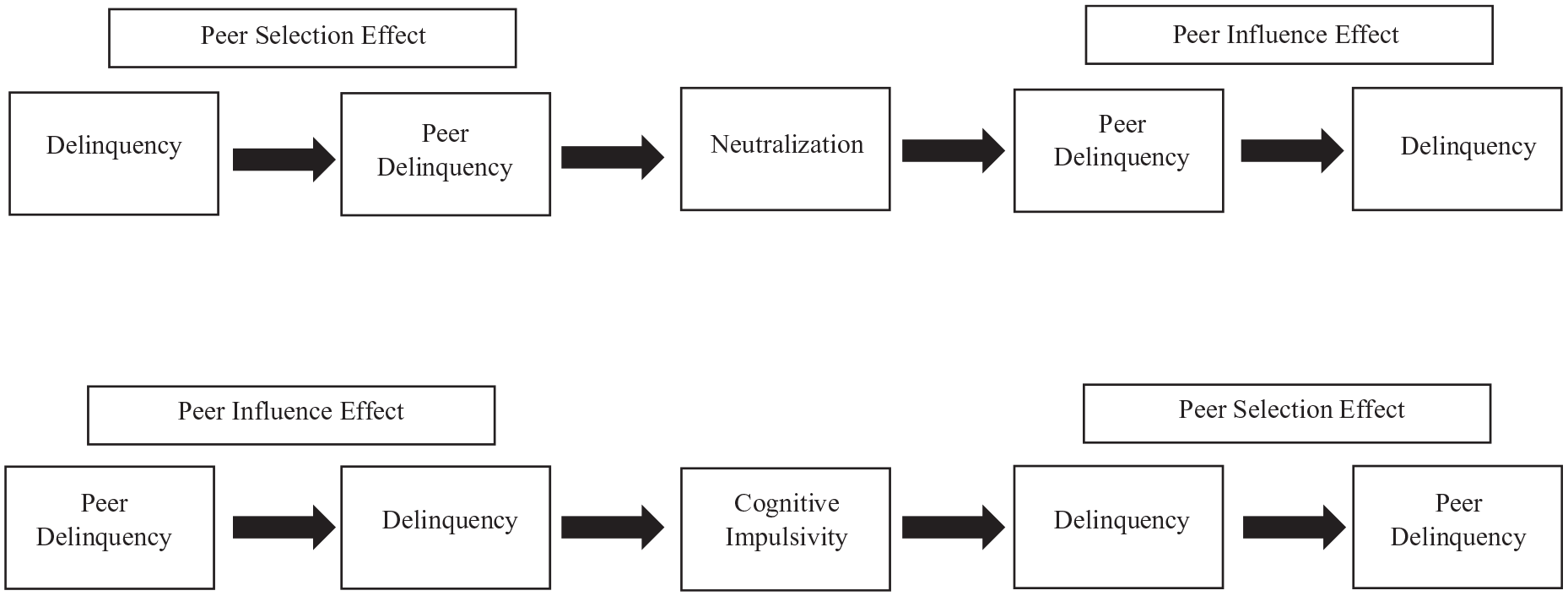
Proposed mediated effect of neutralization on the peer selection-to-peer influence chain (upper panel) and of cognitive impulsivity on the peer influence-to-peer selection chain (lower panel).
Method
Participants
The sample for this study consisted of all 3568 members (51.3% female) of the longitudinal portion of the Gang Resistance Education and Training (GREAT; Esbensen, 2002) study. Participants ranged in age from 10 to 15 (M = 12.15, SD = 0.65) years at Wave 1 of the GREAT study and the racial/ethnic distribution of the sample was 46.1% White, 17.4% Black, 20.5% Hispanic, 3.7% Native American, 3.6% Asian/Pacific Islander, and 8.6% mixed/other.
GREAT study
The GREAT study began in 1995 with a sample of 5935 eighth-grade students from 11 US cities, 42 schools, and 315 classrooms. Approximately half of the classrooms were exposed to the GREAT curriculum and the other half served as controls. Data were collected through survey questionnaires administered to students in their classrooms. The current investigation restricted itself to the longitudinal portion of the GREAT study, which took place in six US cities (Phoenix, Arizona; Lincoln, Nebraska; Omaha, Nebraska; Las Cruces, New Mexico; Portland, Oregon; and Philadelphia, Pennsylvania) and included 22 schools, 153 classrooms, and 3568 students. The longitudinal branch of the GREAT study was conducted between 1995 and 1999 and organized into six waves. The first and second waves were separated by 9 weeks and all subsequent waves were separated by a year. The first wave served as the starting point for the current study instead of the second wave because there were over 700 fewer missing data points for delinquency and peer delinquency at Wave 1 (Delinquency1 and Peer Delinquency1) than there were for delinquency and peer delinquency at Wave 2 (Delinquency2 and Peer Delinquency2).
Measures
Participant delinquency
As one of two variables responsible for the peer influence and selection effects, delinquency assumed a central role in the current investigation. Delinquency was measured with participant self-report. Using a 7-point scale (0 = no times, 1 = 1 or 2 times, 2 = 3 to 5 times, 3 = 6 to 10 times, 4 = 11 to 15 times, 5 = 16 to 20 times, 6 = more than 20 times), participants were asked to indicate how often they had engaged in the following 14 delinquent acts in the past 12 months: destroyed property, carried a weapon, spray painted a building, stole < $50, stole > $50, went into a building to steal, stole a motor vehicle, hit someone, attacked someone with a weapon, committed armed robbery, involved in a gang fight, shot someone, sold marijuana, and sold other drugs. The scores were then summed to create a score that could range from 0 to 84. The 1-year stability (r) of the delinquency score ranged from .38 to .61.
Peer delinquency
The other key variable in the peer selection and peer influence effects is peer delinquency. In this study, peer delinquency came from participant reports and so the variable was labeled perceived peer delinquency. Participants were asked to estimate the number of friends (1 = none of them, 2 = a few of them, 3 = about half of them, 4 = most of them, 5 = all of them) who had participated in the following 10 delinquent acts: “destroyed property,” “stole < $50,” “stole > $50,” “entered building to steal,” “stole a motor vehicle,” “hit someone,” “attacked someone with a weapon,” “committed armed robbery,” “sold marijuana,” and “sold other drugs” over the past year. The internal consistency of the perceived peer delinquency scales for Waves 1, 3, 4, 5, and 6 of the GREAT study was excellent (α = .90–.94).
Neutralization
The neutralization (Neu) scale used in Wave 4 of the GREAT study was composed of 11 items (“a small lie is okay if no one is hurt”; “it is okay to lie to keep friends out of trouble”; “it is okay to lie to keep yourself out of trouble”; “it is okay to steal from the rich who can replace the item”; “it is okay to take little things from stores”; “it is okay to steal if that is the only way you can get it”; “it is okay to physically fight if you are hit first”; “it is okay to physically fight to protect your rights”; “it is okay to fight if someone threatens your friends or family”; “it is okay to beat up someone if they do not show respect”; and “it is okay to beat up someone if they threaten you”). Participants then rated each item on a 5-point Likert-type scale (1 = strongly disagree, 2 = disagree, 3 = neither agree nor disagree, 4 = agree, 5 = strongly agree) and the results summed to create a score that could range from 11 to 55. The same scale was also administered during Wave 3 of the GREAT study. With both measures, higher scores indicate greater use of neutralization techniques. Neutralization scales and items with content similar to the neutralization scale used in the current study have been found to load significantly on a proactive criminal thinking latent factor (Walters and Yurvati, 2017). Internal consistency was excellent for the Wave 3 and 4 administrations of the neutralization scale (α = .90).
Cognitive impulsivity
The measure of cognitive impulsivity (CI) used in this study consisted of eight items designed to reflect impulsive, irresponsible, and reckless attitudes, thinking, and behavior (“I act on the spur of the moment”; “I make no effort to prepare for the future”; “I do what brings pleasure now”; “I am more concerned with the short run”; “I test myself by doing something risky”; “I take risks for fun”; “I find the possibility of getting in trouble exciting”; “Excitement is more important than security”). Measures with item content similar to these items have been found to load significantly onto a reactive criminal thinking latent factor (Walters and Yurvati, 2017). Each item was rated by the participant on the same 5-point Likert-type scale as was used with the previously described neutralization scale (1 = strongly disagree, 2 = disagree, 3 = neither agree nor disagree, 4 = agree, 5 = strongly agree). Item scores were summed to produce a scale that could range from 8 to 40. The scale achieved good internal consistency at Waves 3 and 4 of the GREAT study (α = .84).
Control and precursor measures
The current investigation included four control variables: group status, age, sex, and race. Group status denoted whether the participant’s class had received the GREAT curriculum (2) or been assigned to a control condition (1), age was measured in years, sex was coded 1 for males and 2 for females, and race was dichotomized as White (1) versus non-White (2). As recommended by Cole and Maxwell (2003), prior levels of each predicted variable were controlled to form lagged outcome measures. These precursor measures were assessed during the most recent prior wave.
Research design
A longitudinal fixed panel research design was implemented. For the first analysis, the control variables were assessed at Wave 1, the precursor and independent (participant delinquency and peer delinquency) variables were assessed at Waves 1–5, and the dependent variables were assessed at Waves 3–6. In this analysis, four prospective peer influence effects (peer delinquency → participant delinquency) and four prospective peer selection effects (participant delinquency → peer delinquency) were examined, controlling for prior levels of the predicted or outcome variable. For the second analysis, the control variables were measured at Wave 1, the initial peer selection/influence effect was measured at Waves 1–3, the mediating variables (neutralization, cognitive impulsivity) were measured at Wave 4, the final peer selection/influence effect was measured at Waves 5–6, and precursor measures for each outcome variable were assessed one wave prior to the outcome. There were four paths tested in this second analysis: the a path (from independent variable to first mediator), the d path (from first mediator to second mediator), the e path (from second mediator to third mediator), and the b path (from third mediator to dependent variable). Because having participants nested within classrooms violated the independence assumption of standard linear regression, classroom assignment was included as a cluster variable in a multilevel (complex sampling design) multiple regression analysis. A complex model computes standard errors and chi-square tests of model fit taking non-independence of observations and/or unequal probabilities of selection into account.
Data analytic plan
Descriptive statistics, correlations, and multicollinearity were calculated with SPSS, Version 16 (IBM, 2019). Regression analyses, on the contrary, were performed with MPlus 8.3 (Muthén and Muthén, 1998–2017) using a maximum likelihood with robust standard errors (MLR) estimator. Both direct (Delinquency1 → Delinquency6; Peer Delinquency1 → Peer Delinquency6) and indirect effects were calculated. Whereas bootstrapping is the preferred method for assessing the significance of indirect effects in a mediation analysis (Preacher, 2015), it is incompatible with multilevel model multiple regression (Model = Complex) and could not be included in the current investigation. The Monte Carlo Method for Assessing Mediation (MCMAM), a procedure that generates results known to be comparable to those obtained with bootstrapping (Preacher and Selig, 2012), was used instead. MCMAM was performed with 20,000 repetitions and significance was determined by a 95% confidence interval that did not include zero. Overall model fit was evaluated using the goodness-of-fit index (GFI) and the root mean square error of approximation (RMSEA) procedure.
Kenny’s (2013) “failsafe ef” procedure—(rmy.x) × (sdm.x) × (sdy.x) / (sdm) × (sdy)—was used to test for omitted variable bias. The coefficient created by this procedure indicates how highly an unobserved covariate confounder would need to correlate with the mediating and dependent variables, controlling for the mediator and independent variables in the case of the latter, to completely eliminate the coefficients along the d, e, and b paths of a significant indirect effect. It has been demonstrated that conditioning on the precursor to an outcome variable, as was done in the current study, can create endogenous selection bias, also known as a collider effect, with the power to inflate path coefficients (Elwert and Winship, 2014; Greenland, 2003). A second sensitivity analysis was accordingly performed in which the precursor measures for each predicted outcome in the cross-lagged and cognitively mediated analyses were removed from their respective regression equations. Path coefficients that increase or remain the same when precursor measures are removed imply the absence of a collider effect.
Missing data
Missing data were a significant problem in this study. In an effort to minimize this problem, the starting point for the study was Wave 1 instead of Wave 2 (which were only separated by 9 weeks) because Wave 1 had more than 700 fewer missing data points than Wave 2 for Wave 1/2 delinquency and peer delinquency. Even with this, fewer than a quarter of participants (24.8%) had complete data on all 18 variables. Another 7.8% were missing data on one or two variables, 11.3% were missing data on three to five variables, 6.8% were missing data on six to nine variables, 35.5% were missing data on 10 to 14 variables, and 12.8% were missing data on 15 to 17 variables. Of the 18 variables, 17 had more than 10% missing data: age (18.3%), sex (10.5%), race (11.2%), Delinquency1 (21.2%), Delinquency3 (51.4%), Delinquency4 (57.5%), Delinquncy5 (61.2%), Delinquency6 (55.7%), Peer Delinquency1 (21.5%), Peer Delinquency3 (51.5%), Peer Delinquncy4 (57.7%), Peer Delinquency5 (60.9%), Peer Delinquency6 (61.7%), Neu3 (50.9%), Neu4 (57.0%), CI3 (50.9%), and CI4 (56.8%). The total proportion of missing data points in the GREAT longitudinal study for these 18 variables was 41.2%.
Missing data were handled with full information maximum likelihood (FIML), a procedure that estimates model parameters and standard errors from non-missing data. Research indicates that FIML delivers results that are significantly less biased than those produced by traditional missing data procedures (Allison, 2002). Besides being less biased than listwise deletion and simple imputation, FIML is highly robust to violations of its basic assumptions (Collins et al., 2001). To further enhance the precision of FIML (Collins et al., 2001), 34 auxiliary variables (Wave 2 participant delinquency, Wave 2 peer delinquency, Wave 1 neutralization, Wave 2 neutralization, Wave 5 neutralization, Wave 6 neutralization, Wave 1 cognitive impulsivity, Wave 2 cognitive impulsivity, Wave 5 cognitive impulsivity, Wave 6 cognitive impulsivity, Waves 1–6 prosocial peers, Waves 1–6 parental knowledge, Waves 1–6 parental support, and Waves 1–6 unsupervised routine activities) were added to the FIML analysis but only in support of FIML. Thus, while the auxiliary variables were used to calculate parameters and standard errors in FIML using the saturated correlates approach, they were not included in the regression analyses themselves.
Results
Preliminary analyses
Table 1 lists the means, standard deviations, and ranges for each of the 18 variables included in this study. A correlational matrix involving these 18 variables is also provided in this table. Nearly 80% of the zero-order coefficients in the correlational matrix were statistically significant using a Bonferroni-corrected alpha level (p < .00033). Multicollinearity was tested with SPSS and there was no evidence of collinearity between predictor variables in any of the eight regressions included in the main analyses (tolerance = .455–.995, variance inflation factor = 1.006–2.199).
Descriptive statistics and correlations for the 18 independent, dependent, mediating, control, and precursor measures included in this study.
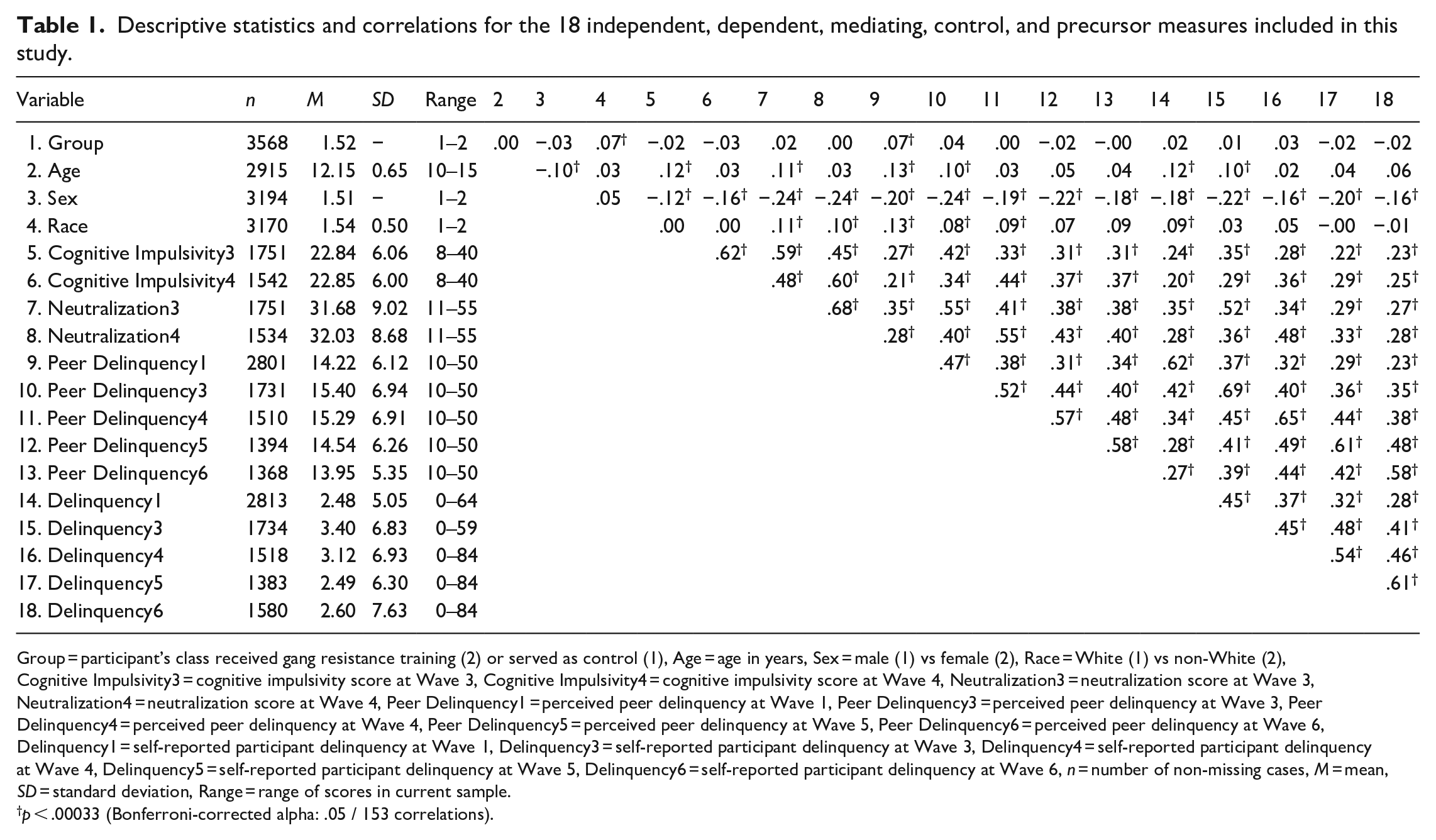
Group = participant’s class received gang resistance training (2) or served as control (1), Age = age in years, Sex = male (1) vs female (2), Race = White (1) vs non-White (2), Cognitive Impulsivity3 = cognitive impulsivity score at Wave 3, Cognitive Impulsivity4 = cognitive impulsivity score at Wave 4, Neutralization3 = neutralization score at Wave 3, Neutralization4 = neutralization score at Wave 4, Peer Delinquency1 = perceived peer delinquency at Wave 1, Peer Delinquency3 = perceived peer delinquency at Wave 3, Peer Delinquency4 = perceived peer delinquency at Wave 4, Peer Delinquency5 = perceived peer delinquency at Wave 5, Peer Delinquency6 = perceived peer delinquency at Wave 6, Delinquency1 = self-reported participant delinquency at Wave 1, Delinquency3 = self-reported participant delinquency at Wave 3, Delinquency4 = self-reported participant delinquency at Wave 4, Delinquency5 = self-reported participant delinquency at Wave 5, Delinquency6 = self-reported participant delinquency at Wave 6, n = number of non-missing cases, M = mean, SD = standard deviation, Range = range of scores in current sample.
p < .00033 (Bonferroni-corrected alpha: .05 / 153 correlations).
Main analyses
The four prospective peer influence and four prospective peer selection effects were evaluated simultaneously by computing a series of cross-lagged correlations in the total sample of 3568 GREAT participants. This analysis included the four control variables (group status, age, sex, and race) and the precursor to each predicted variable. Hence, each predictor variable was designed to predict a change in the outcome variable. Overall model fit was moderate—comparative fit index (CFI) = .90, RMSEA = 0.062 (90% CI = [0.056, 0.068])—and seven of the eight cross-lagged path coefficients were significant (p < .05). The single nonsignificant coefficient was the peer influence path (delinquency → peer delinquency) running from Wave 3 to Wave 4.
A path analysis composed of eight regression equations was then performed for the purpose of determining whether neutralization and/or cognitive impulsivity mediated the peer influence-to-peer selection and peer selection-to-peer influence chains. Model fit was moderate to good: CFI = .91, RMSEA = 0.056 (90% CI = [0.052, 0.060]). The results of this analysis revealed that while both neutralization and cognitive impulsivity mediated the peer selection-to-peer influence connection, neither cognitive dimension mediated the peer influence-to-peer selection connection. Table 2 and Figure 2 provide information on the individual path relationships and Table 3 displays the total indirect effects for each pathway using MCMAM. It should also be noted that both direct effects were significant.
Results of a path analysis organized into 10 regression equations.
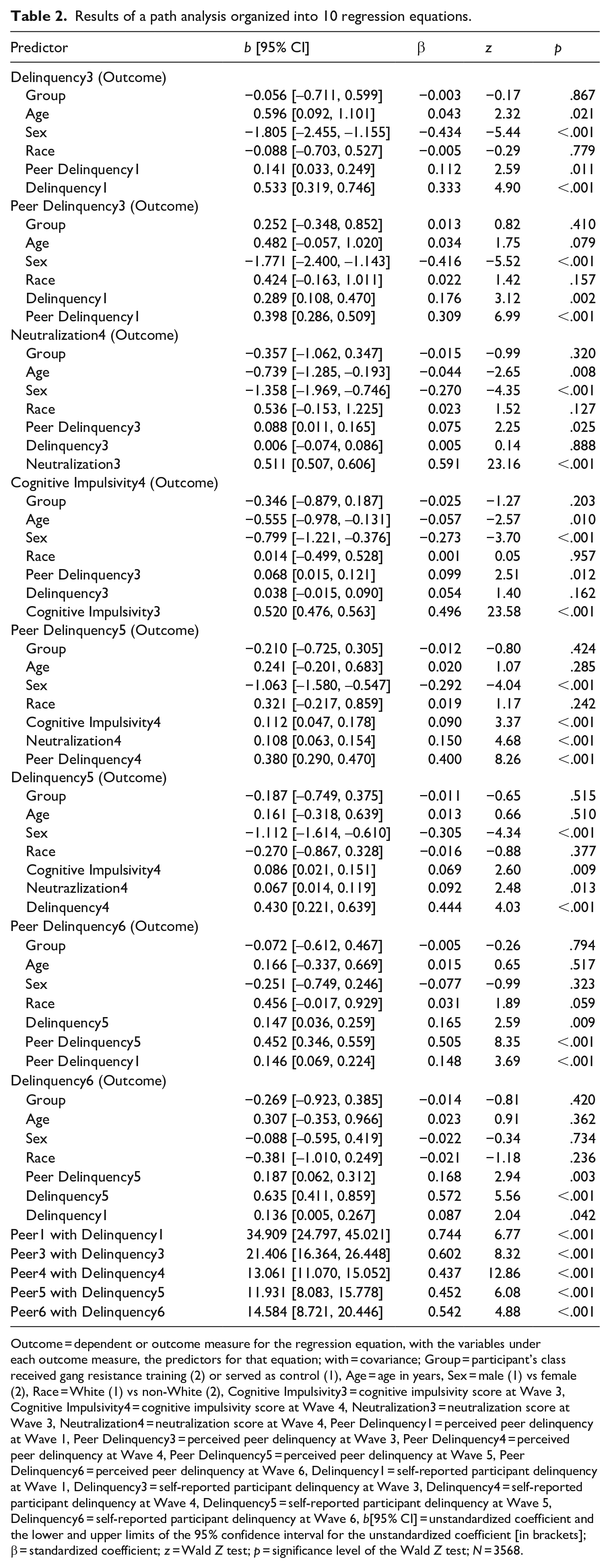
Outcome = dependent or outcome measure for the regression equation, with the variables under each outcome measure, the predictors for that equation; with = covariance; Group = participant’s class received gang resistance training (2) or served as control (1), Age = age in years, Sex = male (1) vs female (2), Race = White (1) vs non-White (2), Cognitive Impulsivity3 = cognitive impulsivity score at Wave 3, Cognitive Impulsivity4 = cognitive impulsivity score at Wave 4, Neutralization3 = neutralization score at Wave 3, Neutralization4 = neutralization score at Wave 4, Peer Delinquency1 = perceived peer delinquency at Wave 1, Peer Delinquency3 = perceived peer delinquency at Wave 3, Peer Delinquency4 = perceived peer delinquency at Wave 4, Peer Delinquency5 = perceived peer delinquency at Wave 5, Peer Delinquency6 = perceived peer delinquency at Wave 6, Delinquency1 = self-reported participant delinquency at Wave 1, Delinquency3 = self-reported participant delinquency at Wave 3, Delinquency4 = self-reported participant delinquency at Wave 4, Delinquency5 = self-reported participant delinquency at Wave 5, Delinquency6 = self-reported participant delinquency at Wave 6, b[95% CI] = unstandardized coefficient and the lower and upper limits of the 95% confidence interval for the unstandardized coefficient [in brackets]; β = standardized coefficient; z = Wald Z test; p = significance level of the Wald Z test; N = 3568.
Upper and lower bounds of the Monte Carlo method for assessing mediation 95% confidence intervals for peer selection-to-peer influence and peer influence-to-peer selection chains.
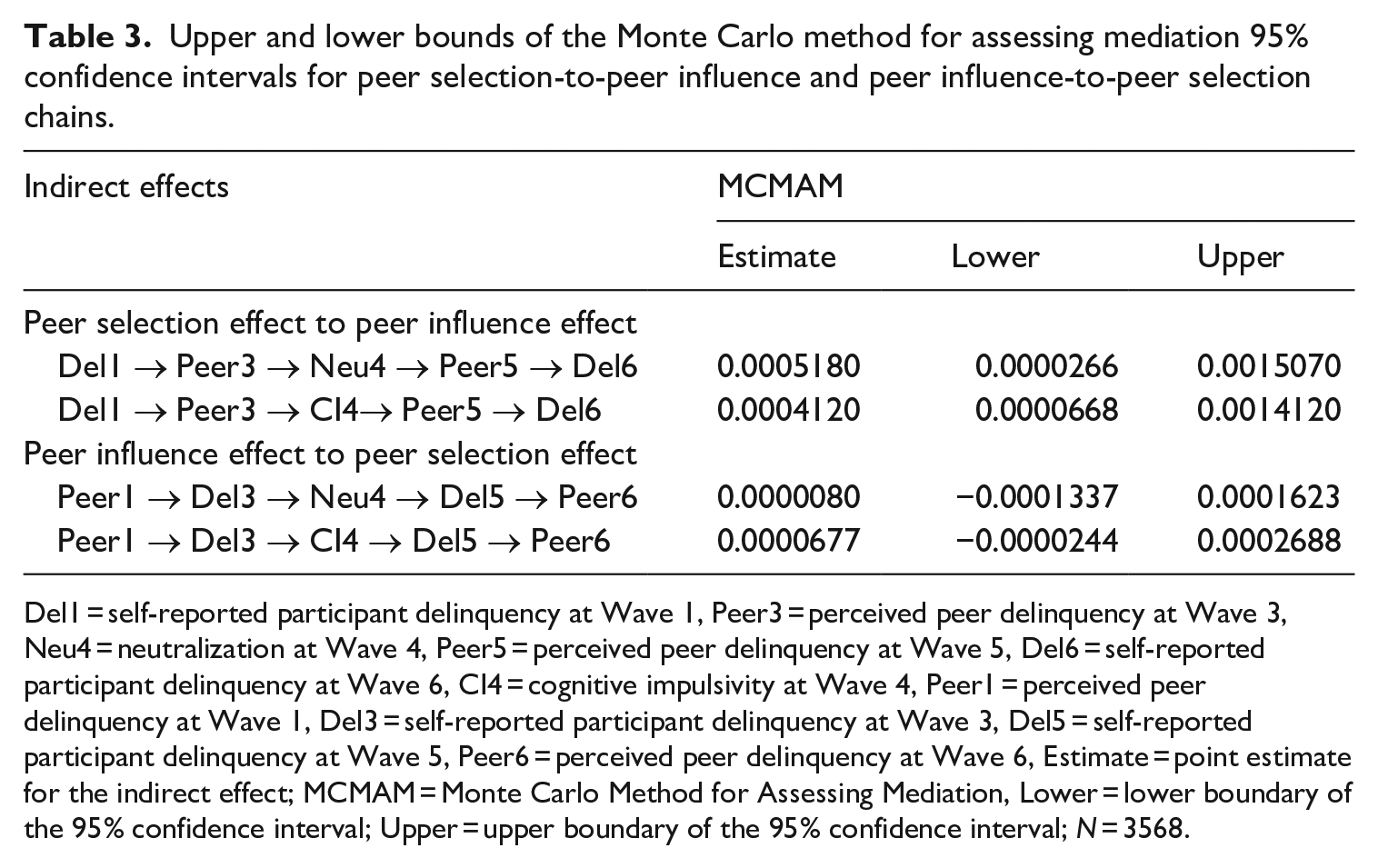
Del1 = self-reported participant delinquency at Wave 1, Peer3 = perceived peer delinquency at Wave 3, Neu4 = neutralization at Wave 4, Peer5 = perceived peer delinquency at Wave 5, Del6 = self-reported participant delinquency at Wave 6, CI4 = cognitive impulsivity at Wave 4, Peer1 = perceived peer delinquency at Wave 1, Del3 = self-reported participant delinquency at Wave 3, Del5 = self-reported participant delinquency at Wave 5, Peer6 = perceived peer delinquency at Wave 6, Estimate = point estimate for the indirect effect; MCMAM = Monte Carlo Method for Assessing Mediation, Lower = lower boundary of the 95% confidence interval; Upper = upper boundary of the 95% confidence interval; N = 3568.
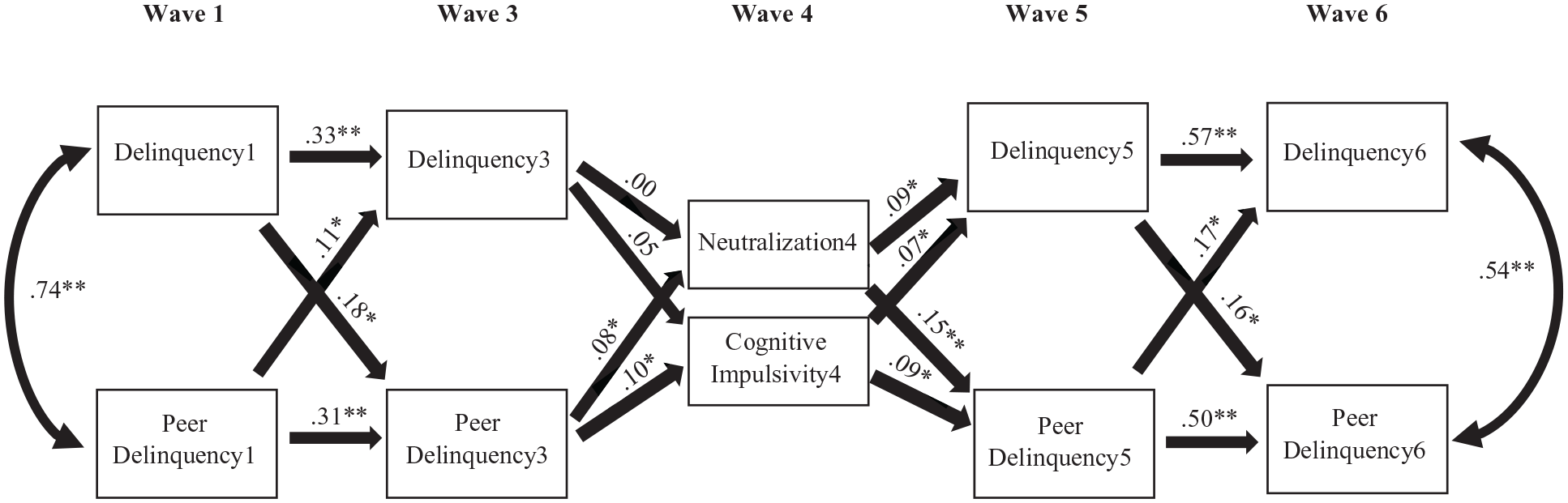
Peer selection-to-peer influence (chain starting with Delinqueny1) and peer influence-to-peer selection (chain beginning with Peer Delinquency1) pathways, with cognitive distortion (neutralization and cognitive impulsivity) linking these chained effects.
Sensitivity testing
Results from Kenny’s (2013) “failsafe ef” procedure indicated that an unobserved covariate confounder would need to correlate .30 with the second variable in the d path (Peer Delinquency3 → CI4), .25 with the second variable in the e path (CI4 → Peer Delinquency5), and .35 with the second variable in the b path (Peer Delinquency5 → Delinquency6) of the neutralization-mediated peer selection-to-peer influence chain to completely eliminate the respective mediating effects. The minimum coefficients to do the same with the cognitive impulsivity-mediated peer selection-to-peer influence chain were .27, .22, and .37, respectively. Endogenous selection bias was ruled out by recomputing the analyses without precursor measures and observing increases in all of the relevant path coefficients.
Listwise deletion
Listwise deletion was used to create a subsample of 886 participants with complete data on all 18 variables. Subjecting these data to cross-lagged analysis produced five of eight significant effects—the non-significant effects being the Delinquency1 → Peer Delinquency3, Delinquency3 → Peer Delinquency4, and Peer Delinquency5 → Delinquency6 paths. It should be noted, however, that model fit was poor: CFI = .88, RMSEA = 0.103 (90% CI = 0.092, 0.115). There were no significant peer selection-to-peer influence or peer influence-to-peer selection indirect effects when neutralization and cognitive impulsivity were added to the model and 4 of the 12 individual paths were non-significant: specifically, Delinquency1 → Peer Delinquency3, Delinquency3 → Neutralization4; Delinquency3 → Cognitive Impulsivity4; and Peer Delinquency5 → Delinquency6). Model fit was again poor: CFI = .87, RMSEA = 0.101 (90% CI = 0.093, 0.109).
Discussion
A number of researchers who have studied the peer influence and selection effects have speculated that the processes may be complementary (Gallupe et al., 2019; Jose et al., 2016; Sijtsema and Lindenberg, 2018). Yet, there has apparently been no published research on the mechanisms potentially responsible for this alleged complementarity. Therefore, in addition to probing the connection between the overall peer influence and selection effects, this study sought to determine whether neutralization and cognitive impulsivity were at least partially responsible for linking these two effects. It had previously been demonstrated that neutralization/MD mediates the peer influence effect and that cognitive impulsivity mediates the peer selection effect (Walters, 2015, 2016a). The goal of the current investigation was to ascertain whether neutralization and cognitive impulsivity partially mediated the connection between the two effects. The purpose for testing the first hypothesis was to establish the presence of links between the peer influence and peer selection effects and the goal of the second hypothesis was to corroborate whether neutralization beliefs and cognitive impulsivity facilitated these links. Analyses designed to address the first hypothesis revealed that with one exception (Delinquency3 → Peer Delinquency4), the peer influence and selection effects were significant, linked, and reciprocal (i.e. running from peer influence to peer selection and from peer selection to peer influence). The one failed path, Delinquency3 → Peer Delinquency4, can be conceptualized as a break in the chain of both hypotheses.
Whereas the first hypothesis received near unanimous confirmation, the second hypothesis garnered only mixed support. Based on the fact that neutralization has been found to mediate the peer influence effect (Walters, 2015, 2016a), the effect is initiated by delinquent peer associations, and delinquent peers connect the peer selection effect to the peer influence effect, the second hypothesis held that neutralization would mediate the peer selection-to-peer influence chain. Conversely, because cognitive impulsivity has been found to mediate the peer selection effect (Walters, 2016a), the effect is initiated by delinquency, and delinquency connects the peer influence effect to the peer selection effect, it was predicted that cognitive impulsivity would mediate the peer influence-to-peer selection chain. The results of a complex multilevel modeling regression analysis in which the peer influence and selection effects were modeled at Waves 1 and 3, neutralization and cognitive impulsivity were modeled at Wave 4, and peer influence and selection were again modeled at Waves 5 and 6 verified the presence of a cognitively mediated peer selection-to-peer influence effect but not a cognitively mediated peer influence-to-peer selection effect. As predicted, neutralization beliefs mediated the peer selection-to-peer influence chain but not the peer influence-to-peer selection chain. Contrary to predictions, cognitive impulsivity did not mediate the peer influence-to-peer selection chain but did mediate the peer selection-to-peer influence chain. Hence, neutralization beliefs and cognitive impulsivity mediated the connection between peer selection and influence by correlating with Waves 3 and 5 peer delinquency.
Why and how peers matter
Whereas neutralization and cognitive impulsivity appear to serve different functions as mediators of the peer influence and selection effects, with neutralization mediating the former and cognitive impulsivity the latter (Walters, 2015, 2016a), the current results suggest that certain of their facets may serve a common function when it comes to connecting the two effects. Hence, neutralization and cognitive impulsivity were equally capable of linking peer selection to peer influence, but neither was capable of linking peer influence to peer selection. The salient factor, therefore, was not which of the two cognitive distortion dimensions (proactive, reactive) was doing the linking, but which of the two behaviors was being linked (i.e. peer delinquency vs participant delinquency). In the peer influence-to-peer selection pathway, where participant delinquency at Waves 3 and 5 was mediated by Wave 4 neutralization beliefs and cognitive impulsivity, the neutralization and cognitive impulsivity scales were largely ineffective in merging or connecting the two effects. In the peer selection-to-peer influence pathway, however, neutralization and cognitive impulsivity at Wave 4 mediated peer delinquency at Waves 3 and 5. This would seem to suggest that delinquent peer associations have the power to stimulate cognitive distortion, perhaps by altering attitudes (neutralization) or encouraging dyscontrol (cognitive impulsivity), both of which have been found to influence delinquent peer associations (Akers, 1998).
The fact that cognitive distortion served as a link between Waves 3 and 5 peer delinquency, but not Waves 3 and 5 participant delinquency provides further evidence that peers matter. Several groups of investigators have asserted that perceptual indicators of peer delinquency are largely the consequence of youth projecting their own delinquency onto their peers (Young and Weerman, 2013). If this were the case, however, one would expect the prospective relationship between peer delinquency and participant delinquency to be non-significant once prior levels of participant delinquency are controlled and for peer delinquency and participant delinquency to correlate comparably with the same variable. The first proposition was tested in 22 gender-homogeneous US and British samples (N = 154 to 4098) and rejected in 21 of the 22 instances in which peer delinquency predicted participant delinquency after prior participant delinquency was controlled (Walters, 2019a). The second proposition was assessed in this study and was likewise rejected after peer delinquency and participant delinquency were found to achieve divergent associations with cognitive distortion. If perceived peer delinquency was simply a matter of respondents projecting their own offending onto their peers, then controlling for prior participant delinquency should have eliminated the peer–participant correlation in the Walters’ (2019a) investigation and cognitive distortion should have correlated similarly with peer delinquency and participant delinquency in this study.
A further consequence of the weak results obtained with the peer influence-to-peer selection chain is that these results failed to support prior research on psychological inertia. Reactive criminal thinking (RCT), but not proactive criminal thinking (PCT), has been found to mediate the relationship between past and future delinquency (Walters, 2016b), a process referred to as psychological inertia. Although participant delinquency displayed continuity between Waves 3 and 5 of the GREAT longitudinal study, neither neutralization beliefs nor cognitive impulsivity mediated this continuity in participant delinquency. Peer delinquency, on the contrary, showed evidence of continuity and analyses performed on the peer selection-to-peer influence chain revealed that this continuity was mediated by both neutralization beliefs and cognitive impulsivity. One possible explanation for these results is that continuity in peer delinquency is more sensitive to cognitive factors and the formation of psychological inertia than offending. This, of course, requires further study, although, if true, it could mean that cognitive distortion is particularly relevant to research looking at past and future peer delinquency and attempting to make sense of the peer influence and selection effects. The preliminary conclusion that can be drawn from this study is that selecting a delinquent peer group with which to interact can lead to a peer influence effect by stimulating proactive cognitive distortion of the neutralization type and reactive cognitive distortion of the cognitive impulsivity type.
Limitations
This study may have been limited by a high degree of missing data. Over 40% of the data points were missing in the total sample and the majority of variables were missing more than half their data. Efforts to minimize the impact of missing data on the current results included using Wave 1 data instead of Wave 2 data because there were significantly fewer missing data points in Wave 1 than there were in Wave 2, calculating the parameters and standard errors with FIML, and enhancing FIML with auxiliary variables. Although FIML can ordinarily handle large amounts of missing data (Allison, 2002), the precision of which was enhanced in the current study by including auxiliary variables, it could still be argued that FIML is not up to the task of managing this amount of missing data. A supplemental analysis was performed on a subsample of 886 participants with complete data on all study variables, although this failed to produce any significant four-path indirect effects.
The individual path coefficients of the significant peer selection-to-peer influence pathways were in the small to modest range (β = .08–.18), the total indirect effect was very small (Estimate = .0004–.0005), and many of the effects were no longer significant when sample size was reduced by three-quarters to accommodate listwise deletion. Even so, there are several factors that need to be taken into consideration before concluding that these results are too small to be meaningful or clinically significant. First, the model used to conduct the listwise deletion analysis achieved poor fit, thereby raising questions about how well the results of this analysis accorded with reality. Second, mediation effects are almost always small (Kenny and Judd, 2014; Walters, 2019b). This is particularly true when multiple serial mediation is performed with consecutive mediators, of which there were three in the current study. The total indirect effect may seem small but it is the product of four coefficients. Third, the coefficients obtained with Kenny’s “failsafe ef” procedure revealed that each of the paths achieved moderate to moderately high robustness against the prospect of omitted variable bias.
One could also take issue with the author’s decision to use an impulsivity scale to approximate RCT or measure cognitive impulsivity, although the fact that the items on this scale assessed attitudes as much as they did behaviors (e.g. “I make no effort to prepare for the future”; “I do what brings pleasure now”; “Excitement is more important than security”) suggests that this scale was assessing more than just impulsive behavior. A fourth potential limitation of this study is that nearly all of the variables were based on participant self-report. The use of a single data source, in this case self-report, can lead to inflated path coefficients through mono-operational bias and shared method variance (Shadish et al., 2002). The problem of mono-operational bias could be remedied in future research by including official data and performance measures and ratings from observers and family members to supplement the self-report measures that served as the sole source of information in the current study. Finally, it has been shown that including a lagged dependent variable in a regression analysis can bias the coefficient estimate downward (Achen, 2000). It has also been argued that lagged dependent variables are appropriate when testing dynamic models like the one in the current study in that a change in outcome from Time 1 to Time 2 was being investigated (Keele and Kelly, 2006).
Conclusion
The results of this study indicate that facets of PCT and RCT, which have been shown to mediate the peer influence and peer selection effects, respectively, may play a role in merging these two effects in situations where peer selection precedes peer influence. When a series of neutralization items were used to assess proactive cognitive distortion and a measure of cognitive impulsivity was used to assess reactive cognitive distortion, participant delinquency was found to stimulate a youth’s interest in delinquent peers (peer selection effect), leading to a rise in cognitive distortion, which subsequently reinvigorated these delinquent peer associations. In turn, these associations gave rise to more delinquency (peer influence effect). Thus, a five-variable/four-path chain was identified that underscored an ability to connect the peer selection effect to the peer influence effect via cognitive distortion. The next order of business will be to determine exactly how delinquent peer associations facilitate neutralization beliefs and cognitive impulsivity. There is evidence that delinquent peer associations stimulate the antisocial attitudes and amoral thinking association with proactive forms of cognitive distortion (Walters, 2015, 2016a) and it could also be argued that delinquent peer associations interfere with a person’s ability to think rationally and follow a consistent life plan, cardinal features of reactive cognitive distortion, although the latter requires a great deal more study.
Footnotes
Declaration of Conflicting Interests
The author(s) declared no potential conflicts of interest with respect to the research, authorship, and/or publication of this article.
Funding
The author(s) received no financial support for the research, authorship, and/or publication of this article.
