







Abstract
Recent research on the effectiveness of public defenders vis-à-vis private attorneys in criminal cases has not exhaustively analyzed trial avoiding mechanisms and other pretrial outcomes and expanded beyond the United States. This article addresses these gaps using a novel data set from the Mexican criminal justice system, where trial avoiding mechanisms have been recently introduced. We show that both private and public defenders avoid trials, but at different costs. Cases with private attorneys are more likely to end in dismissals, especially via alternative procedures (dispute resolution mechanisms and diversion), while cases with public defenders are more likely to end in convictions through abbreviated procedures (guilty pleas). Resource constraints and their membership to the courtroom workgroup might incentivize or pressure public defenders to cooperate with the prosecution to secure a guilty plea, thus facilitating the conviction of defendants in administrative procedures that lack the full due process protections of trials.
Introduction
Research on the quality and effectiveness of the legal services provided by public defenders vis-à-vis private defenders in criminal cases has a long lineage in American socio-legal studies. The prevailing conclusion suggests that public defenders’ insufficient resources, large caseloads, and cooperative disposition toward other criminal justice actors (i.e. the courtroom workgroup) undermine their ability and willingness to fully and vigorously represent their clients (Alschuler, 1975; Bibas, 2004; Blumberg, 1967). The role of public defenders in plea bargaining has been particularly scrutinized, with critics contending that due to the same reasons public defenders are too willing to “bargain away” (Albert-Goldberg and Hartman, 1983: 67) their defendants’ rights or to “meet and plead” (American Civil Liberties Union (ACLU), 2013).
Despite this rich tradition and the topic’s continued relevance in legal scholarship, there is little recent empirical research that has exhaustively analyzed and compared the influence of public defenders across trial avoiding mechanisms and other pretrial outcomes, including dismissals, guilty pleas, and alternative procedures such as diversion and dispute resolution mechanisms (Hartley et al., 2010; Lee and Richardson, 2020). There is considerably more flexibility and discretion, less transparency and oversight, and fewer due process protections in these decisions compared to the trial and sentencing phases (Johnson et al., 2016; Langer, 2021; Lee and Richardson, 2020). Moreover, the majority of cases in most jurisdictions end before reaching the trial stage, with guilty pleas accounting for most dispositions in the United States and elsewhere (Fair Trials, 2017; Johnson et al., 2016). Thus, defense quality prior to the trial stage is not only important for each individual defendant but also for the legitimacy of the criminal justice system as a whole. Indeed, if public defenders do not provide legal services comparable to those rendered by privately retained lawyers, then the right to effective assistance of counsel and the principle of legal fairness that underpin the criminal justice system of democratic governments and justify the punishment of individuals are put into question (Hartley et al., 2010).
The lack of research on public defenders and pretrial outcomes is even more troublesome outside the United States. In the last couple of decades, numerous jurisdictions have introduced adversarial elements to traditionally inquisitorial systems across Latin America and the world. These reforms have typically included trial avoiding mechanisms and other pretrial forms of disposition to deal with backlogs (Fair Trials, 2017), but little research has analyzed how cases are processed under these new guidelines (Langer, 2021), much less so how the type of legal defense influences disposition.
In this article, we address these two limitations by leveraging a novel data set and focusing on the relationship between type of counsel and every post-filling case processing outcome in the State of Mexico. 1 Importantly, the State of Mexico has recently introduced trial avoiding mechanisms and other pretrial outcomes. As such, this study builds toward a comprehensive understanding of the effectiveness of public and private counsel in criminal cases, which can only emerge if multiple forms of case disposition, as well as jurisdictions outside the United States, are analyzed.
Public defense and case disposition
Scholars have argued that public defenders’ ability and willingness to adequately and zealously defend their clients is shaped by resource constraints and their membership to the courtroom workgroup. Public defenders’ offices typically face financial limitations that translate to low pay and high workloads (Alschuler, 1975; Bibas, 2004). The lack of resources often precludes assigning multiple public defenders or staff members to cases, spending enough time on case preparation or discovery, and hiring expert witnesses. Moreover, as members of the courtroom workgroup, public defenders are salaried government officials working in the same organizational field as prosecutors and judges (Alschuler, 1975; Bibas, 2004; Blumberg, 1967; Casper, 1971; Feeley, 1979). This setting creates a non-adversarial and cooperative mind-set and a common goal, namely, the efficient functioning of a taxed criminal justice system. Coupled with high workloads and insufficient resources, this mind-set could undermine public defenders’ ability and/or willingness to vigorously defend their clients.
Overall, private defense attorneys are less likely to face these financial and institutional constraints. They can control their workload more easily and are more likely to have sufficient resources to build a stronger defense. Although private defenders interact often with other court actors, they are not as closely connected to the courtroom workgroup as public defenders (Hartley et al., 2010; Henderson and Levett, 2019; Stover and Eckart, 1975). All of this suggests that private attorneys could be stronger client advocates than public defenders.
Empirical research supports these theoretical ideas and expectations, as it has generally shown that defendants with public defenders are at a disadvantage compared to those with private attorneys. Defendants with public defenders are less likely to have their charges dismissed or dropped (Williams, 2013) and to be released prior to trial (Holmes et al., 1996; Kutateladze et al., 2014; Williams, 2013), as well as more likely to be denied bail (Williams, 2017), to be convicted (Williams, 2013), and, once convicted, to receive incarceration sentences (Kutateladze et al., 2014; Kutateladze and Leimberg, 2019) and harsher prison sentences (Hoffman et al., 2005; Holmes et al., 1996) than defendants with private attorneys.
However, scholars have also argued that public defenders’ position as insiders might actually allow them to secure similar or better outcomes for their clients than private attorneys (Alschuler, 1975; Skolnick, 1967; Stover and Eckart, 1975). There is some evidence in support of this position, too. For instance, some research has found that having a public defender does not significantly predict sentence type and length (Spohn and Holleran, 2000; Stover and Eckart, 1975; Williams, 2002) or bail decisions (Turner and Johnson, 2007). This is largely consistent with other work that has analyzed several case processing outcomes (Cohen, 2014; Hartley et al., 2010). Research has even uncovered better outcomes for public defenders, especially in early stages (screening, filing charges) (Chiricos and Bales, 1991; Kutateladze and Leimberg, 2019; Lee and Richardson, 2020). In Latin America, there is evidence that public defenders and private attorneys secure conditional release for their clients in approximately the same percentage of cases (Fondevila and Quintana-Navarrete, 2021).
Resource availability and courtroom workgroup membership also influence how public and private defenders advise their clients in relationship to trial avoiding mechanisms, such as plea bargaining (Alschuler, 1975; Bibas, 2004; Blumberg, 1967; Feeley, 1979; Henderson and Levett, 2019). Critics have argued that public defenders are too willing to accept plea bargains, and some research in the United States has indeed found that defendants with public representation are more likely to plead guilty (Kutateladze and Lawson, 2018; Kutateladze and Leimberg, 2019; Lee and Richardson, 2020) and less likely to go to trial (Kutateladze and Lawson, 2018). A large-scale evaluation of the Scottish Public Defence Solicitors’ Office reached similar conclusions. Specifically, the authors found that public defenders’ clients are more likely to plead guilty at earlier stages and have higher conviction rates than those represented by private attorneys (Goriely, 2003; Goriely et al., 2001). In line with the theoretical framework outlined above, these results could be due to public defenders’ interest in reducing their workload by achieving quick and non-contentious outcomes and maintaining their good standing in the courtroom workgroup. Their membership to the courtroom workgroup can also make defendants more distrustful, which can translate to a conflictual attorney–client relationship and lower levels of satisfaction. In this scenario, public defenders might be less responsive to clients’ demands to fight charges at a trial and more insistent on pleading (Casper, 1971; Clair, 2020; Goriely, 2003; Goriely et al., 2001).
Private attorneys might also be pressured to end cases as early as possible (Blumberg, 1967; Skolnick, 1967). However, their position outside the courtroom workgroup could help them withstand that pressure more easily. Even if this pressure were effective, they might be more able to pursue trial avoiding mechanisms that rely on the collaboration of outsiders (e.g. victims) than public defenders, such as dispute resolution mechanisms. Moreover, private attorneys’ hiring and fees depend upon their reputation, having a satisfactory relationship with defendants, the outcome of the case, and the amount of time or work spent on it (Bibas, 2004; Blumberg, 1967; Casper, 1971; Clair, 2020). In addition to potentially having more resources, this provides a powerful incentive to build a more vigorous defense and avoid any type of conviction (especially through a guilty plea), even if it means going to trial.
Despite the mixed results for different case disposition outcomes, the weight of the evidence suggests that defendants with public defenders are more likely than those with private attorneys to avoid a trial and plead guilty. The evidence on dismissals is scarcer and mixed. Although some research has analyzed multiple decision-making points in the criminal procedure (e.g. Cohen, 2014; Hartley et al., 2010), trial avoiding mechanisms and other pretrial outcomes beyond plea bargaining—such as dispute resolution mechanisms and diversion—have been mostly neglected (Lee and Richardson, 2020). This scarcity is particularly problematic in international research because numerous jurisdictions have adopted these mechanisms in the last few decades (Fair Trials, 2017).
Criminal justice in Mexico
Case disposition and trial avoiding mechanisms
In 2008, a constitutional reform replaced the traditional criminal procedure in Mexico—largely based on an inquisitorial model—with an oral, adversarial procedure influenced by the common law tradition (Ingram and Shirk, 2010). A key aspect of the reform was the introduction of trial avoiding mechanisms and pretrial outcomes designed to decompress the system and reach an outcome earlier in the procedure (Ingram and Shirk, 2010; Quintana-Navarrete and Fondevila, 2019; Shirk, 2010). These mechanisms included abbreviated procedures or guilty pleas and alternative procedures like diversion and dispute resolution mechanisms (mediation and conciliation). The reform also expanded the legal reasons under which the prosecution could drop—and judges dismiss—cases. These new forms of disposition furnished criminal justice actors—particularly prosecutors and judges—with more flexibility and discretion at key decision-making points in the criminal procedure.
These additions raise important fairness concerns. Criminal justice scholars in the United States have shown that the added flexibility and discretion in pretrial outcomes and trial avoiding mechanisms can create unwarranted punishment disparities among defendants and undermine due process protections, partly because some of these cases are resolved in nonpublic proceedings (Johnson and Dipietro, 2012; Johnson et al., 2016; Lee and Richardson, 2020; Lynch, 2016). Particular emphasis has been placed on guilty pleas, responsible for the “administratization” of justice, or the trend toward reaching criminal convictions and punishing defendants through parallel administrative procedures instead of trials (Feeley, 1979; Langer, 2021; Lynch, 2016). Legal scholars have warned that the introduction of guilty pleas and plea bargaining-like mechanisms to criminal justice systems with a history of systematic due process and human rights’ abuses could reinforce these bad practices and jeopardize rights that were already vulnerable (Alkon, 2010). This is a concern in Mexico, where historically prosecutors and police would investigate crimes with little judicial oversight, routinely using coercion, often violating human rights, and ultimately producing information that would be accepted as evidence in a trial (Ingram and Shirk, 2010; Schönteich and Varenik, 2014; Shirk, 2010).
The reform sought to curb these abuses and restore the trial’s central place in the procedure, which is why the information collected during the investigation is no longer accepted as evidence in a trial. However, this information can be invoked in any other decision (e.g. arrest warrant, pretrial detention, guilty pleas) (Código de Procedimientos Penales para el Estado de México (CPPEM), 2008: art. 249). 2 Trials are rare in many systems where trial avoiding mechanisms and other pretrial outcomes exist, and in Mexico, the reform explicitly introduced these mechanisms to make the criminal justice system more efficient (Ingram and Shirk, 2010; Shirk, 2010). This means that for the majority of cases, the information obtained during the prosecutor’s investigation can still be used, undermining the goal of curbing due process and human rights’ abuses. The little information available about how the system has operated since the reform supports this claim. Although there is some evidence that the reform has disincentivized the use of torture (Magaloni and Rodriguez, 2020), a large percentage of those who face a criminal procedure continue to be subjected to threats or torture by the police or prosecutors (Bergman et al., 2014; Instituto Nacional de Estadística y Geografía (INEGI), 2016; Magaloni and Rodriguez, 2020).
Public defense: Theory and practice
The Mexican Constitution (article 20, part B, section VIII) establishes the right to adequate and gratis legal representation in criminal procedures, and every Mexican state (and the federal government) has appropriate regulation and public defenders to comply with this requirement (CPPEM, 2008: art. 8). Any defendant can request to be represented by a public defender, regardless of socioeconomic status. In fact, defendants are assigned a public defender if they fail or refuse to designate a private attorney for whatever reason. Pro se legal representation is prohibited. Moreover, the practice of appointing private counsel to represent indigent defendants—known as assigned counsel in the United States—is nonexistent in Mexico, and pro bono work by private defenders or legal aid organizations is extremely rare (Suárez Ávila and Fix-Fierro, 2018).
Thus, the public defense system in Mexico is concurrently the only indigent defense system and much more than only an indigent defense system (Suárez Ávila and Fix-Fierro, 2018). Because every defendant has to be represented by a lawyer and has access to—and only to—the public defense system for gratis legal aid, public defenders represent the vast majority of people facing criminal charges. It has been estimated that anywhere between 60% and 80% of defendants are represented by public defenders at some point in the criminal procedure (Bergman et al., 2014; Fondevila and Meneses-Reyes, 2016; Pásara, 2006; Suárez Ávila and Fix-Fierro, 2018).
The theoretical framework that has been discussed in the United States (resource constraints and courtroom workgroup) is applicable to Mexico’s public defense system. Public defenders in Mexico are dramatically underfunded and belong to the courtroom workgroup (Suárez Ávila and Fix-Fierro, 2018). They are salaried government officials assigned to specific district attorney’s offices and courts, facilitating continuous interaction with these actors. This results in a common mind-set that places trial avoiding mechanisms and other pretrial outcomes at the core of the system’s goals and efficiency. In a recent survey, 97% of judges and 98% of prosecutors and public defenders supported the use of these mechanisms and outcomes, while similar majorities expected their use to speed up proceedings (Cortés et al., 2017). For these reasons, there is general suspicion about the quality of services that public defenders provide and their effectiveness (Shirk, 2010). The fundamental right to an adequate legal representation has often been interpreted as a formality that is fulfilled almost exclusively by assigning public defenders to those defendants that have not retained a private lawyer (Magaloni Kerpel and Ibarra Olguín, 2008). Public defenders rarely—if at all—leave their own offices to prepare cases, offer evidence, or file tailor-made motions (Fondevila et al., 2016; Pásara, 2006). It typically falls on the defendant or their family members to secure the testimony of witnesses and other pieces of information or evidence (e.g. pay expert witnesses, gather relevant documents).
Empirical implications
Based on the existing literature and the conditions in the Mexican criminal justice system regarding public defense and case disposition, we expect defendants with public defenders to go to trial less often than those with private representation, partly because we also expect them to plead guilty more often. We also hypothesize that cases with public defenders will be dismissed less often than cases with private attorneys. The sparse evidence available about dismissals is mixed and does not take into account dismissals through diversion or dispute resolution mechanisms, but our expectation conforms to the general understanding prevalent in both the United States and Mexico that public defenders are unwilling or unable to vigorously represent their clients.
Data and Methods
Data
We draw on a novel data set of 1145 criminal cases collected in a joint effort by researchers from American (University of California, Los Angeles (UCLA)), Mexican (Center for Economic Research and Teaching/CIDE), and Argentinian (University 3 de Febrero/Untref) universities (Fondevila et al., 2016). These cases are representative of the population of concluded cases processed under the new adversarial rules in the State of Mexico between 2010 and the summer of 2014. A formal instrument was designed to collect relevant information from case files, a procedure that was carried out manually in court archives. The information obtained from the files includes demographic characteristics of the defendant, legally relevant characteristics, and case processing outcomes. This is the only data set of its kind in Mexico and most likely Latin America, since gaining access to the files and collecting the information was a difficult and time-consuming process. Details about the data collection and sampling procedures, as well as the information collected, can be found in Fondevila et al. (2016).
Variables
Independent and dependent variables
The independent variable is defense counsel (1 = private; 2 = public; 3 = both). The “both” category captures those cases that had public and private representation at different points in time. We mostly focus on the comparison between the first two categories because the specific influence of each type of representation in a single case is nearly intractable. In terms of the dependent variables, we focus on three main case processing outcomes: (1) dismissed, (2) abbreviated procedure (guilty plea), and (3) trial. These outcomes are exhaustive as they include every way a case can end after the prosecution has filed charges. Furthermore, outcomes (1) and (2) comprise all the ways a case can be disposed of before reaching the trial stage. We further distinguish between cases dismissed (outcome 1) as a result of an (4) alternative procedure or (5) other dismissals.
Alternative procedure includes two categories grouped under the heading of “restorative justice” in the CPPEM (Title 4): (1) alternative dispute resolution methods (mediation or conciliation) and (2) diversion. Both require restitution to the victim or a restitution plan to the victim’s satisfaction and are allowed for misdemeanors or felonies punishable by up to a mean of 5 years in prison (CPPEM, 2008: arts. 116, 117, 121). In addition, alternative dispute resolution methods are generally allowed for involuntary and nonviolent crimes (CPPEM, 2008: art. 117). Diversion is allowed in all the cases where alternative dispute resolution methods are allowed, but only if the defendant has not been previously convicted of a felony (CPPEM, 2008: art. 121). The judge decides on the length of diversion (1–3 years) and other requirements depending on the case, such as attending rehabilitation or mental health care; abstaining from consuming drugs, contacting the victim(s), traveling abroad, or owning guns; or obtaining and maintaining a job or learning a job-related skill (CPPEM, 2008: art. 126). The case is dismissed once the victim has been restituted and any obligations set by the judge are fulfilled (CPPEM, 2008: arts. 120, 130).
Other dismissals include cases that were dismissed by the judge or dropped by the prosecutor (CPPEM, 2008: arts. 113, 305). The justifications for these dismissals are numerous, including the defendant’s death, disability, incurable sickness or extradition; the passage of the period established in the statute of limitations; the lack of actus reus/mens rea or sufficient evidence to support the indictment; the lack of participation of the defendant in the criminal act or its social or public insignificance; and double jeopardy (CPPEM, 2008: arts. 110, 302, 315).
The prosecution or the defense can petition the judge for an abbreviated procedure (guilty plea) when the defendant admits to having committed the criminal act (CPPEM, 2008: art. 388). The judge then approves this request after making sure that the defendant is aware that they are pleading guilty, waiving their right to a regular trial, and accepting to be sentenced summarily (CPPEM, 2008: art. 390). Abbreviated procedures automatically trigger a minimum sentence for some serious felonies (e.g. homicide, kidnapping, extorsion, rape) or a reduced sentence (minimum sentence minus a third) for the rest of felonies and misdemeanors (CPPEM, 2008: art. 389). The judge cannot depart—either upward or downward—from this sentence and the law does not contemplate fact, charge, or sentence bargaining beyond the statutory reductions. Finally, a trial takes place when none of the previous disposition outcomes materialize (CPPEM, 2008: art. 364).
It is important to distinguish between dismissals through alternative procedures and convictions through abbreviated procedures. Although sometimes treated and conceptualized jointly as trial avoiding mechanisms, this conflates mechanisms that have different philosophical underpinnings, goals, and legal and extra-legal consequences (Langer, 2021: 387). In alternative procedures, the defendant has not been convicted and no judicial determination of guilt has been reached. This makes an alternative procedure more similar to deferred adjudication in some US jurisdictions (Agan et al., 2021) than to intermediate sanctions (Johnson and Dipietro, 2012) or any other form of conviction achieved through plea bargaining-like mechanisms, such as abbreviated procedures (Langer, 2021).
Controls
Following previous work, we control for offender characteristics and legal factors. In the first group, we add gender (0 = female; 1 = male), age (interval), and education (1 = none or elementary school; 2 = middle school; 3 = high school or college). In the second group, we first include the defendant’s criminal record (1 = no; 2 = yes; 3 = not recorded). Using a separate category for “not recorded” is important in this context because most files do not contain information on whether the defendant has a criminal record or not. This may be due to a combination of defective information systems and the fact that a criminal record does not impact most case dispositions, since it does not factor into decisions regarding abbreviated procedures and most dismissals. 3 We also include crime type (1 = property; 2 = violent; 3 = drug; 4 = other). Given that most drug crimes are prosecuted at the federal level in Mexico, this category might not be as relevant in this context, but we add it due to its prevalence in the literature. Crime seriousness (1 = less serious; 2 = serious; 3 = more serious) is also included as a control. Less serious crimes include theft, counterfeiting, and drug possession. Serious crimes include robbery and other property crimes, crimes against personal freedom (excluding kidnapping), tax evasion and other tax-related crimes, smuggling, bribery, and other crimes against the public administration. More serious crimes include homicide, sex crimes, kidnapping, and human and drug trafficking (production and crop growing). 4 Finally, we control for arrest warrant (reverse coded: 0 = yes; 1 = no). The CPPEM establishes two situations in which police can detain a suspect without an arrest warrant. The first—and most common—is when the suspect is caught red-handed (art. 188). The second one is in an emergency situation, when the district attorney cannot request an arrest warrant and the suspect can flee (art. 190).
Methods
We model the different case processing outcomes as binary dependent variables with defense counsel as the main predictor. We employ Linear Probability Models (LPMs), an approach that has been recently used in criminal justice research (e.g. Agan et al., 2021). We adopt it here not only for ease of interpretation, but also because most of our models include judicial district and year fixed-effects, which can create computational issues with logistic regression (Magaloni and Rodriguez, 2020). Moreover, we use LPM because our goal is to estimate the regression coefficients on type of lawyer and not specific predicted values (Wooldridge, 2010: 562–564). The most comprehensive specification can formally be expressed as such

where
Judicial district and year fixed-effects capture the correlation of time-invariant district characteristics and year-to-year changes with type of attorney and case outcomes. Stable district characteristics like the judges, prosecutors, and public defenders who operate in the same courts are absorbed in these fixed effects. This is important because our data set lacks information on these courtroom actors who might approach and deal with cases differently across judicial districts, partly due to local cultures and practices. These differences could in turn impact case outcomes. Also absorbed are yearly system-wide budgetary, operational, and procedural changes.
Results
Descriptive statistics
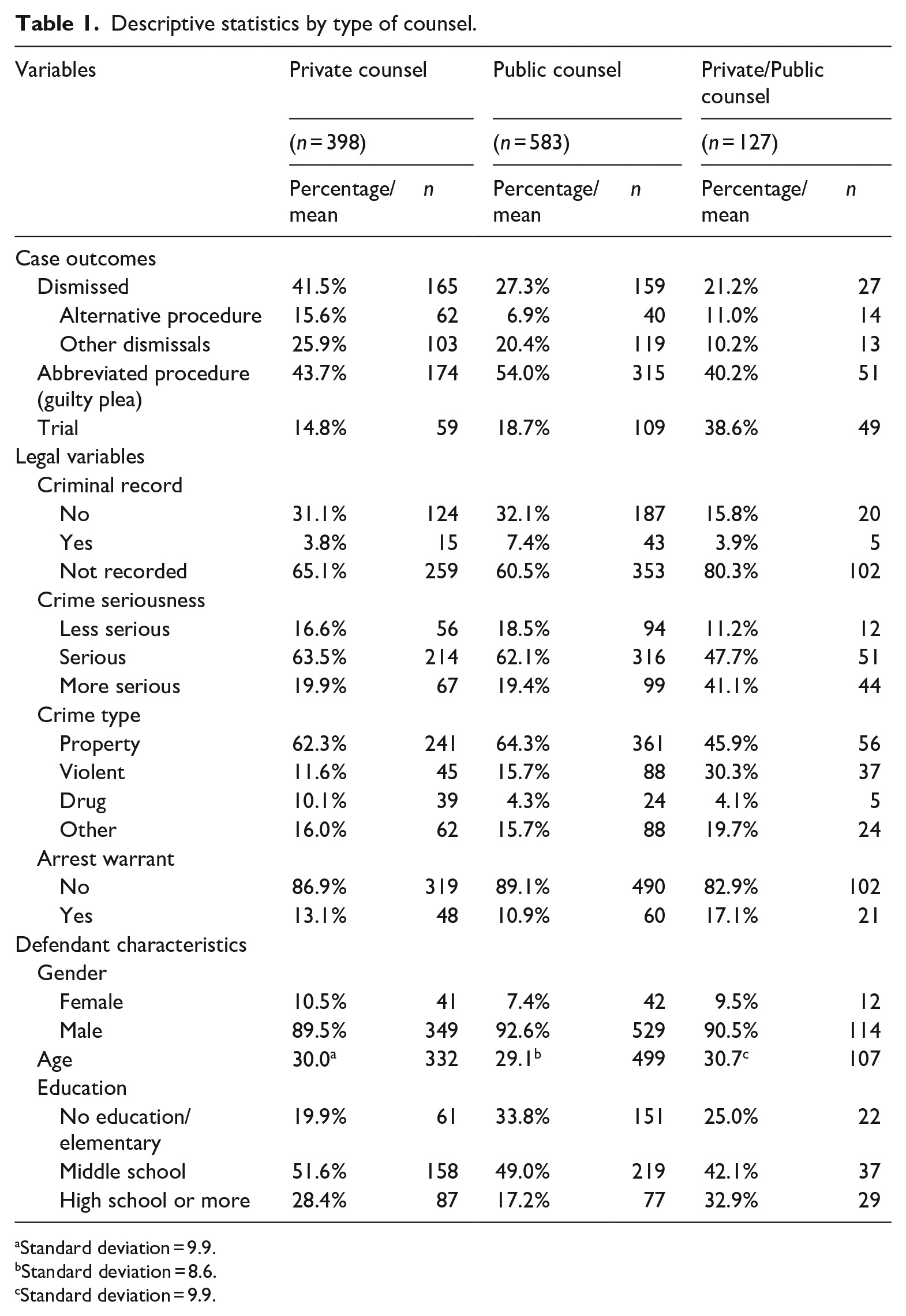
Table 1 provides descriptive statistics for the analytical sample by attorney type. Public defenders exclusively represented over half the cases in the sample and, at some point, represented 64% of the cases. A higher percentage of cases with public defenders end in a guilty plea, while a lower percentage of cases are dismissed, particularly through alternative procedures. Cases with public representation are also more likely to go to trial, although only slightly. Overall, a guilty plea is the most common form of case disposition, while trials are rare. When sampling weights are used, guilty pleas and trials account for 57% and 5% of the total cases, respectively. These data conform to previous findings suggesting that most defendants have public representation and plead guilty.
Descriptive statistics by type of counsel.
Standard deviation = 9.9.
Standard deviation = 8.6.
Standard deviation = 9.9.
Most control variables are similarly distributed across private and public counsel. However, defendants with private attorneys are, on average, more educated and are more often charged with a drug crime, while defendants with public representation are less educated and are more often charged with a violent crime. In general, these variables also reflect a well-known pattern. Most defendants are young males with little or no formal education (middle school or less) who are charged with serious property crimes (robbery) after being arrested without a warrant (Bergman et al., 2014; Ingram and Shirk, 2010).
Models
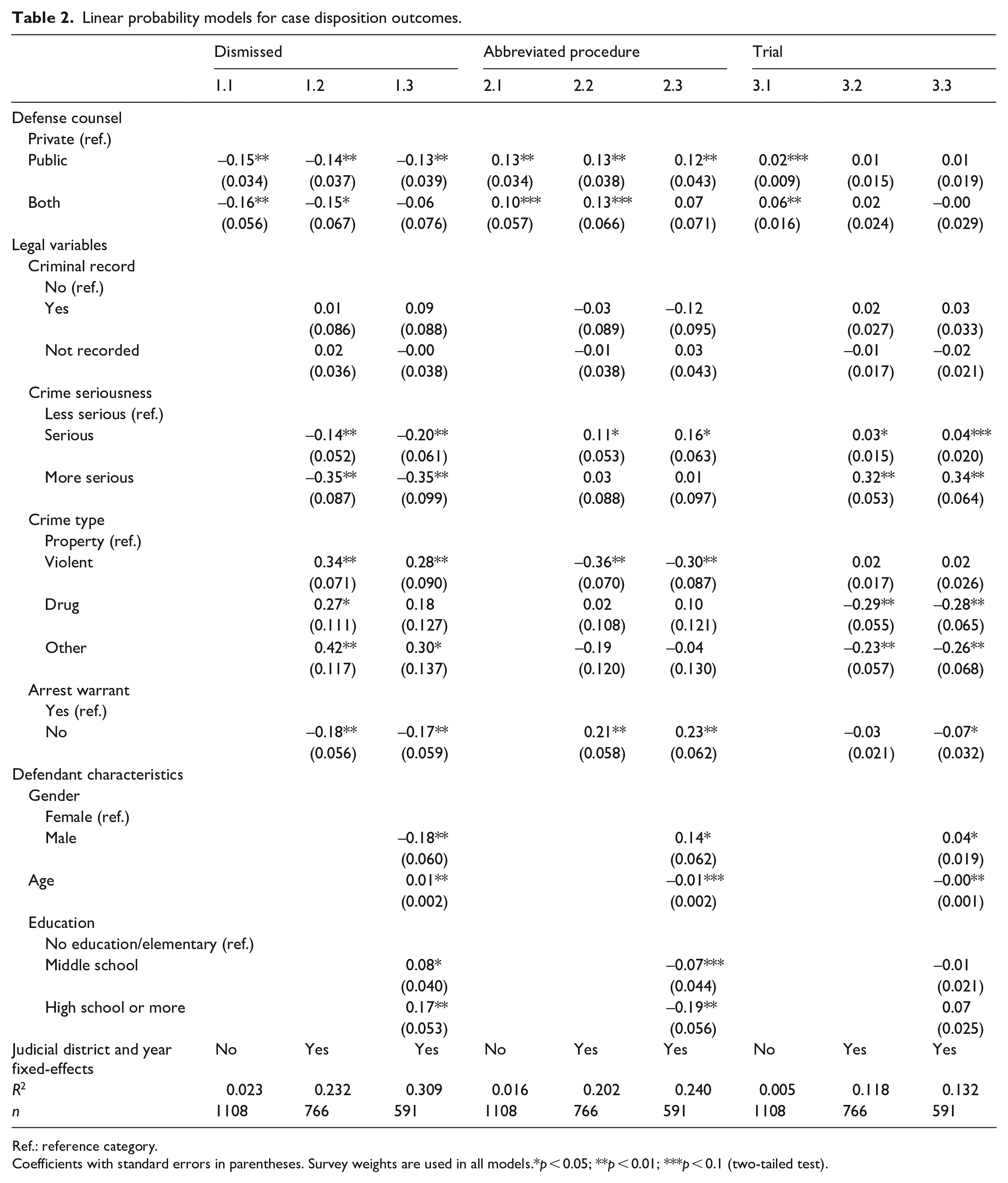
Tables 2 and 3 present the unconditional and conditional estimates of the association between public defender and case disposition outcomes. Table 2 suggests that public representation has a statistically significant association with dismissals (p < 0.01) across all our specifications (Models 1.1–1.3), with the full model (1.3) indicating a decrease of 13 percentage points on average in the probability of the case being dismissed, holding the controls constant. These results also show that there is a statistically significant association (p < 0.01) between public defense and pleading guilty (Models 2.1–2.3). In this case, the full model (2.3) suggests that having a public defense increases the probability of pleading guilty by 12 percentage points. Public defense is marginally associated with a lower probability of going to trial in the unconditional analysis (Model 3.1), too, although the coefficient is smaller and insignificant in the conditional models (Models 3.2–3.3). Based on these results, we can conclude that there is suggestive evidence that a public defense is negatively related to case dismissal and positively associated with pleading guilty (as expected), while there is little evidence that it is associated with going to trial (contrary to expectations). Similarly, having both public and private representation is significantly associated with dismissals and going to trial in the unconditional models, but these results do not hold up when controls are added.
Linear probability models for case disposition outcomes.
Ref.: reference category.
Coefficients with standard errors in parentheses. Survey weights are used in all models.*p < 0.05; **p < 0.01; ***p < 0.1 (two-tailed test).
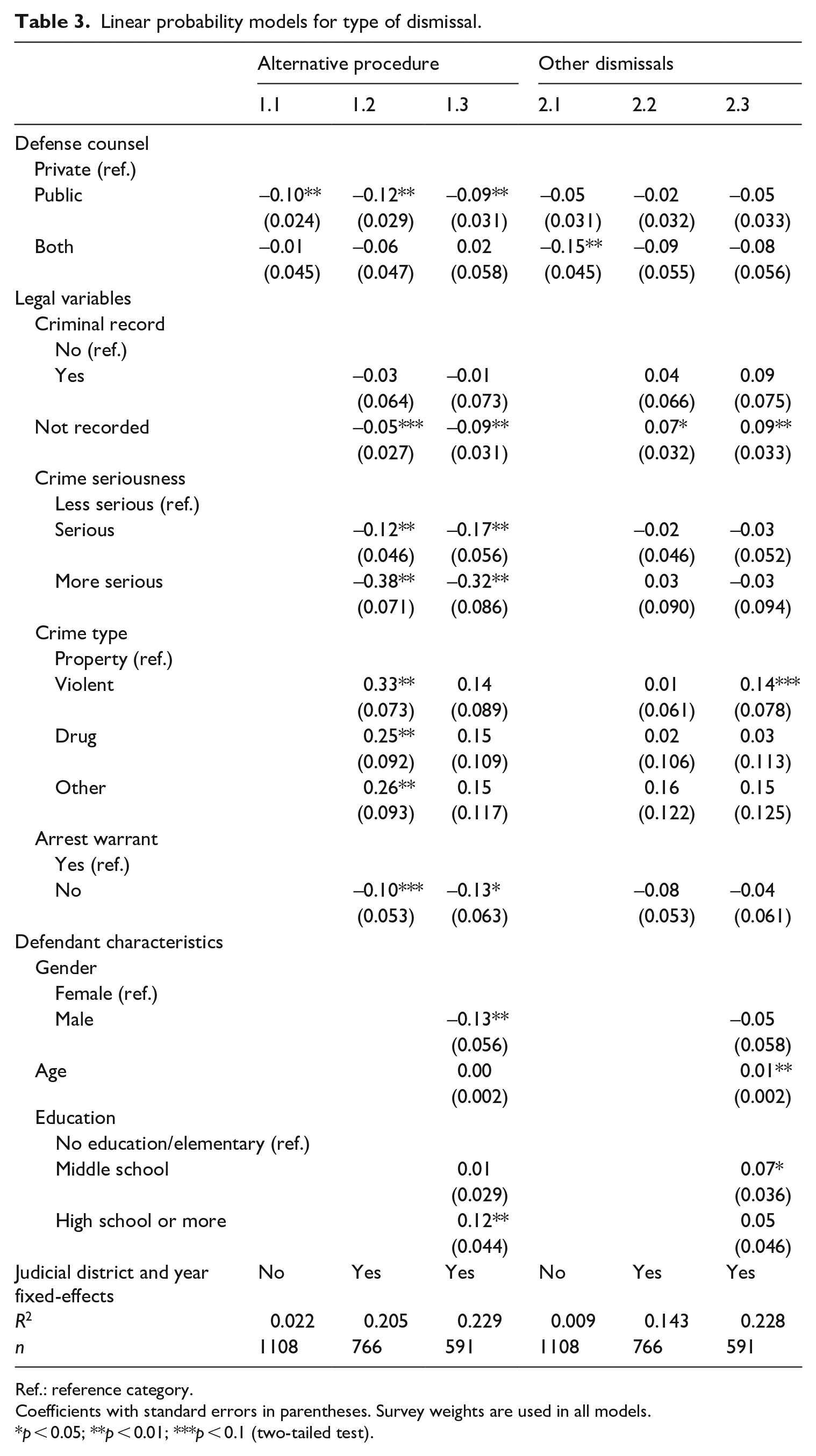
Linear probability models for type of dismissal.
Ref.: reference category.
Coefficients with standard errors in parentheses. Survey weights are used in all models.
p < 0.05; **p < 0.01; ***p < 0.1 (two-tailed test).
Table 3 shows the results of the models that investigate the relationship between type of attorney and the two categories of dismissal: alternative procedure and other dismissals. Public defense is not statistically related to other dismissals (Models 2.1–2.3), but it is related to alternative procedures across all specifications (Models 1.1–1.3). In the full model (1.3), public defense lowers the probability of an alternative procedure by an average of 9 percentage points (p < 0.01).
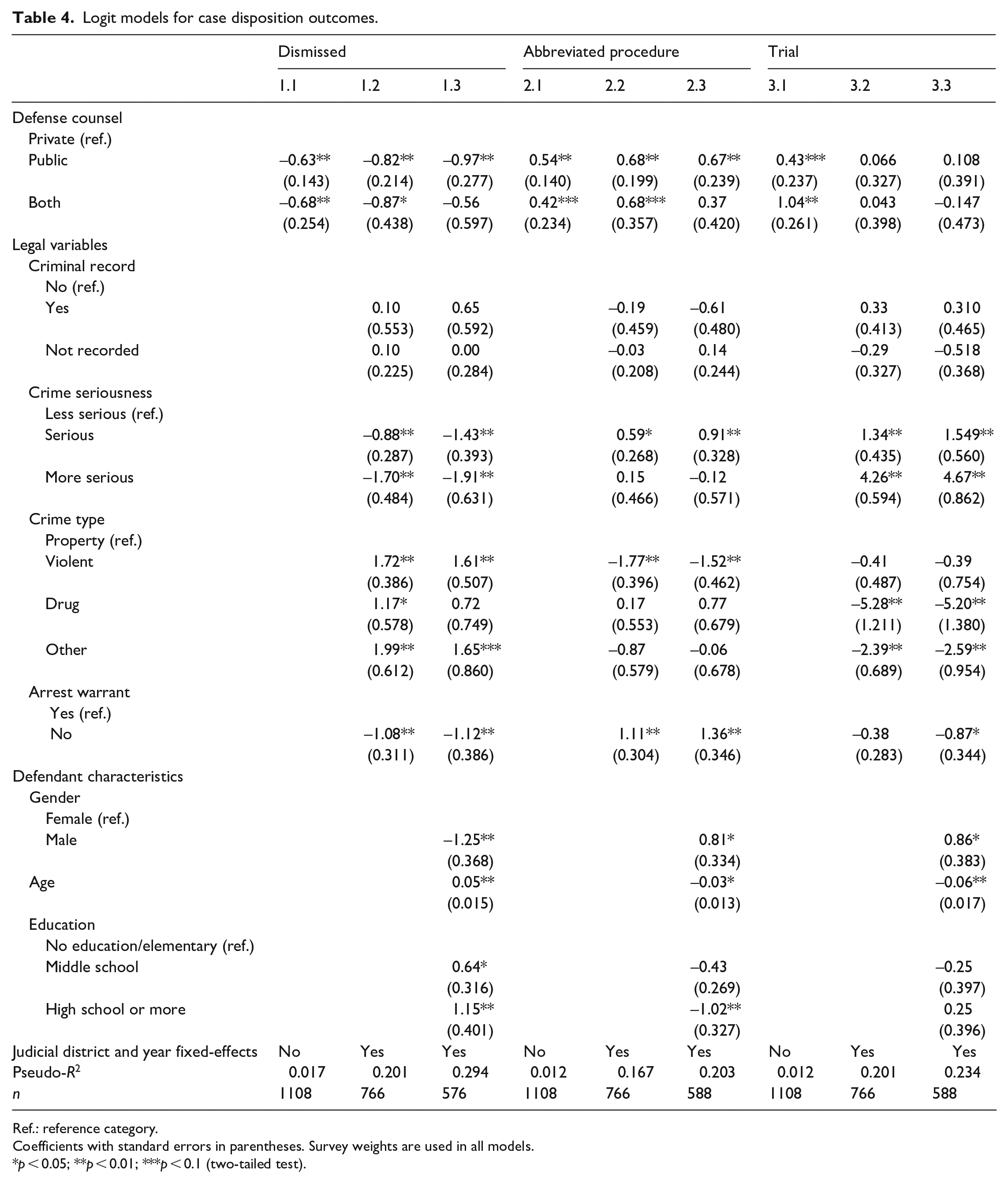
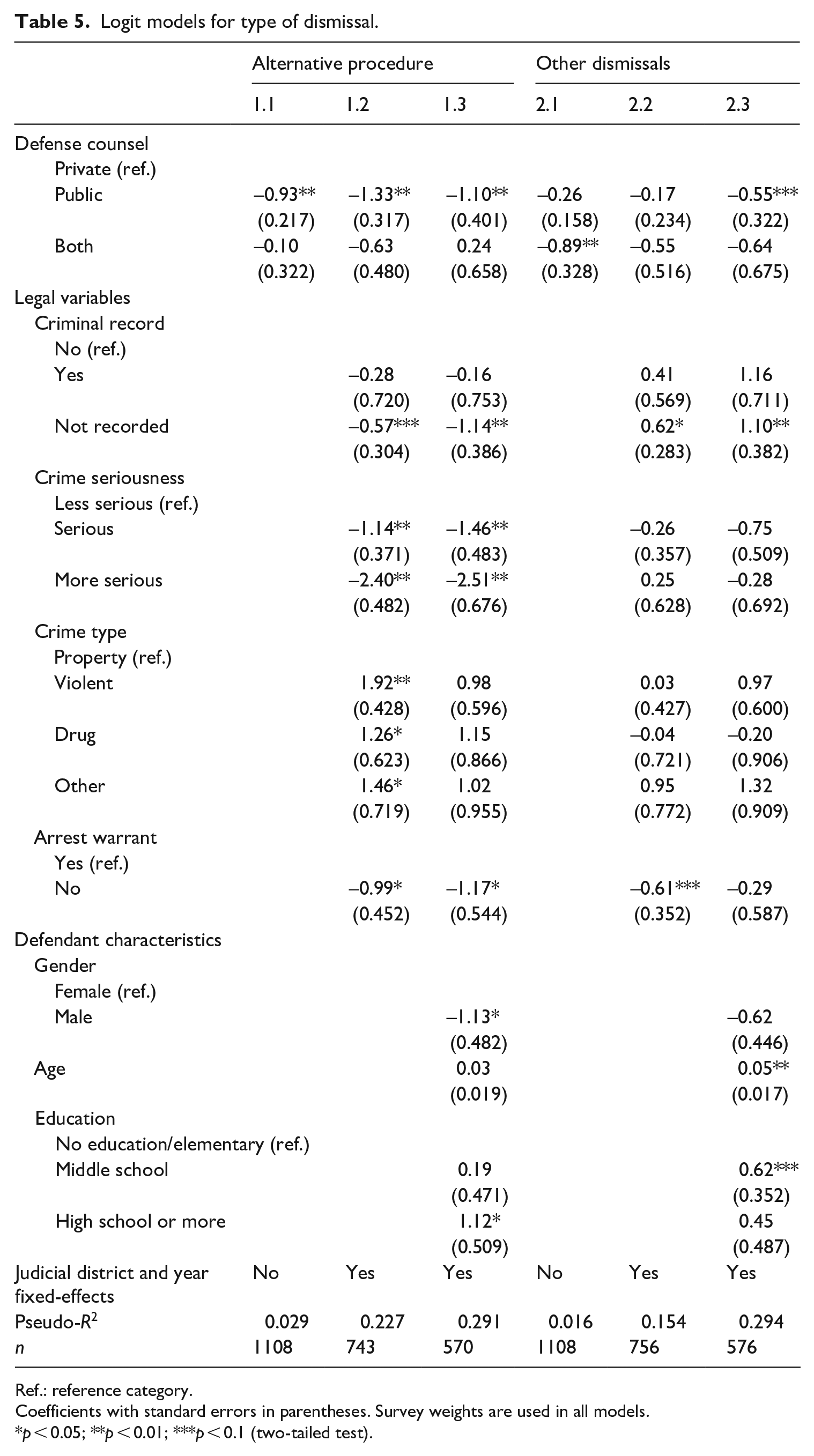
We perform additional analyses to make sure that our results are robust. We re-estimate the full main models using separate logistic regressions for each of the outcomes. The results from these models are substantially the same (Tables 4 and 5). We also estimate a multinomial logistic regression model with case disposition as the dependent variable (1 = dismissed; 2 = abbreviated procedure; 3 = trial) and calculate the average marginal effects from this model, or the change in the probability associated with having public representation for each outcome, using private counsel as the baseline. Again, these analyses confirm that public legal representation is associated with a lower probability of dismissal and a higher probability of an abbreviated procedure, while it is not significantly associated with going to trial (Figure 1). These probabilities are quite similar to those obtained with LPM (–0.129 vs –0.134 for dismissals; 0.121 in both cases for abbreviated procedure).
Logit models for case disposition outcomes.
Ref.: reference category.
Coefficients with standard errors in parentheses. Survey weights are used in all models.
p < 0.05; **p < 0.01; ***p < 0.1 (two-tailed test).
Logit models for type of dismissal.
Ref.: reference category.
Coefficients with standard errors in parentheses. Survey weights are used in all models.
p < 0.05; **p < 0.01; ***p < 0.1 (two-tailed test).
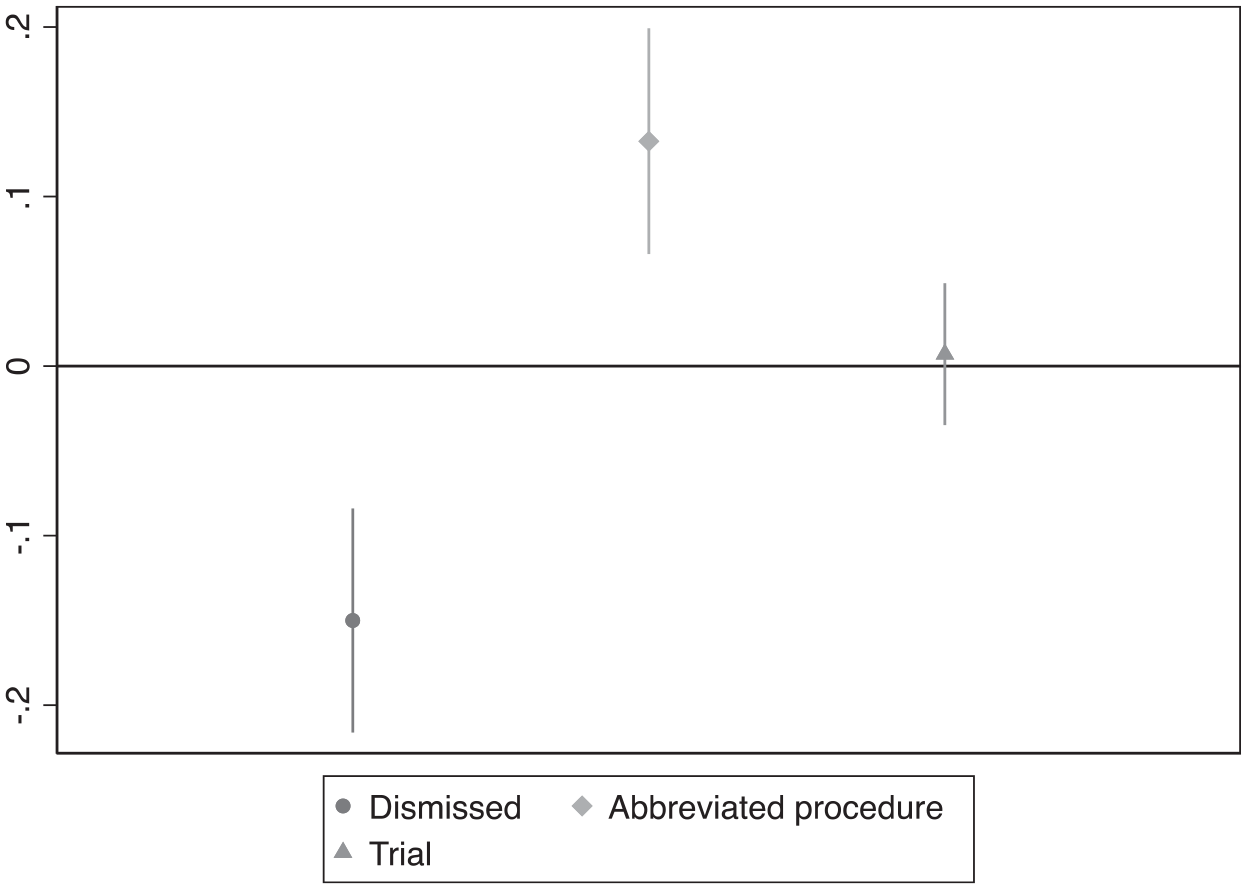
Average marginal effects of public defense for criminal case disposition outcomes.
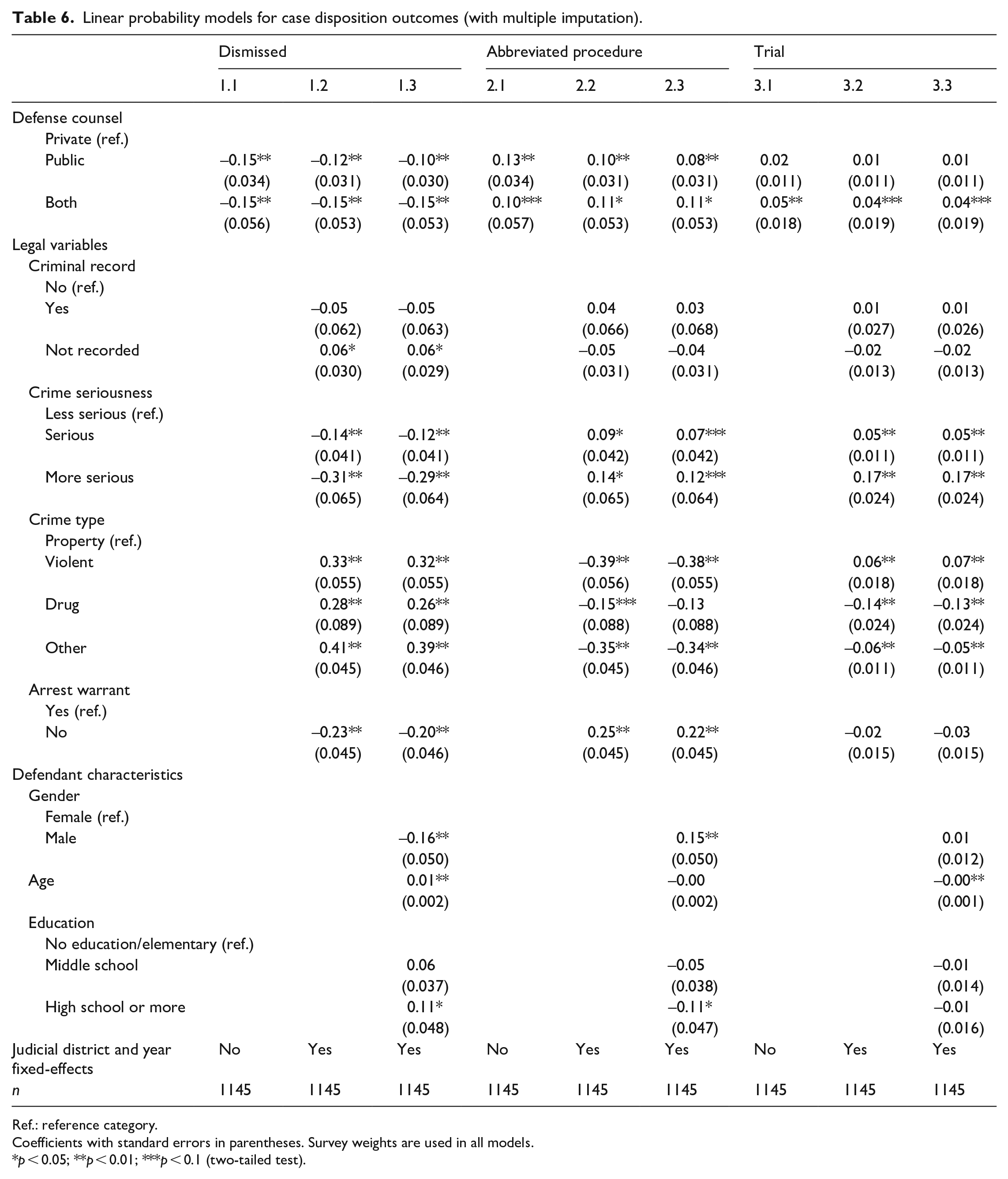
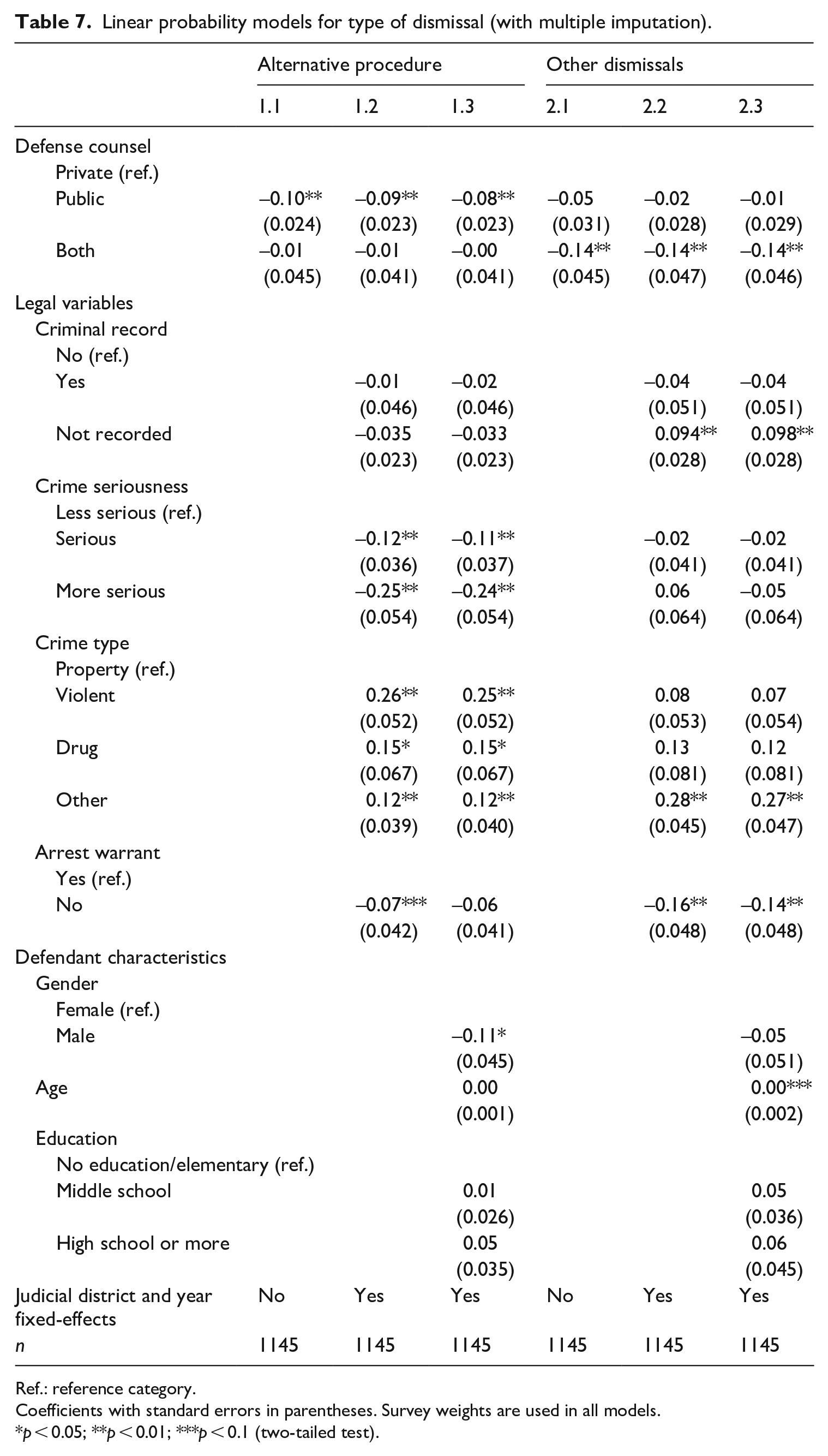
We also re-estimate our models after performing multiple imputation. We impute our data 50 times using a Markov chain Monte Carlo (MCMC) model that includes all the variables in the analyses, even our dependent and independent variables (Allison, 2002; Graham et al., 2007). The model to generate the imputations is multivariate normal, whose assumptions are flexible enough to accommodate binary and ordinal variables (Lee and Carlin, 2010). We obtain the final results by carrying out our analyses on all of these imputed data sets and then averaging the parameter estimates and calculating standard errors using both the within- and between-data set variance (Allison, 2002). The results are substantially the same (Tables 6 and 7).
Linear probability models for case disposition outcomes (with multiple imputation).
Ref.: reference category.
Coefficients with standard errors in parentheses. Survey weights are used in all models.
p < 0.05; **p < 0.01; ***p < 0.1 (two-tailed test).
Linear probability models for type of dismissal (with multiple imputation).
Ref.: reference category.
Coefficients with standard errors in parentheses. Survey weights are used in all models.
p < 0.05; **p < 0.01; ***p < 0.1 (two-tailed test).
Discussion
The literature on public counsel and its connection to criminal case disposition has a rich tradition, but there is no recent empirical research that has exhaustively analyzed case processing outcomes and expanded beyond the United States. This article addresses this gap by leveraging a novel data set to focus on the influence of public defense on case disposition in the Mexican criminal justice system. Our findings suggest that there is little or no difference across attorney type in how often cases go to trial and that both private and public lawyers manage to avoid trials. But the cost at which they do differs. Defendants with public defenders are more likely to avoid a trial by pleading guilty (abbreviated procedure), while defendants with private attorneys are more likely to avoid a trial through a dismissal, especially via an alternative procedure. This distinction has important practical implications. As any other form of conviction, a conviction through an abbreviated procedure triggers punishment (e.g. prison or jail time, fines), a criminal record, and potential legal obstacles to employment, housing, and the exercise of political rights (voting and running for office), among others (Langer, 2021). These far-reaching consequences are absent when a case is dismissed.
Some scholars have suggested that pleading guilty is a reasonable strategy for public defenders, since they might be able to get better deals from the prosecution than private attorneys as members of the courtroom workgroup, while also avoiding their clients’ exposure to harsher penalties at trial (e.g. Lee and Richardson, 2020). Regardless, pleading guilty is worse than avoiding a trial through an alternative procedure and public defenders too often follow this route, in the process facilitating the “administratization” of justice (Langer, 2021). Conversely, private defenders do not seem to go to trial more often than public defenders, contrary to expectations (Kutateladze and Lawson, 2018). Instead, they exploit alternative procedures, avoiding their clients’ exposure to potentially stiffer punishment at trial. These findings are only possible because we incorporate all forms of trial avoidance and pretrial disposition into our analyses, including alternative and abbreviated procedures.
Despite their novelty, our findings are consistent with criticisms in the United States that public defenders are too willing to “bargain away” (Albert-Goldberg and Hartman, 1983: 67) their defendants’ rights or to “meet and plead” (ACLU, 2013; see also Blumberg, 1967; Henderson and Levett, 2019), as well as with prior work on guilty pleas and trial avoidance in the United States (Kutateladze and Lawson, 2018; Kutateladze and Leimberg, 2019; Lee and Richardson, 2020) and Scotland (Goriely, 2003; Goriely et al., 2001). More broadly, our results are also consistent with the speculation—in Mexico and the United States—that public defenders provide legal representation of lower quality than private lawyers (Hartley et al., 2010; Magaloni Kerpel and Ibarra Olguín, 2008).
We argue that public defenders face powerful institutional and cultural pressures or incentives to cooperate with the prosecution to end cases through an abbreviated procedure. In a context of high caseloads, public defenders, judges, and prosecutors agree that ending cases as efficiently as possible before reaching the trial is a key priority (Cortés et al., 2017). Reaching quick and non-contentious decisions through abbreviated procedures is the most efficient way to achieve this. Because victims are not involved in abbreviated procedures, convincing, inducing, or coercing the defendant to plead guilty is the only obstacle, one which prosecutors are generally well-equipped to overcome in Mexico and elsewhere (Ingram and Shirk, 2010; Johnson et al., 2016; Lynch, 2016). Either by action or omission, public defenders seem to be instrumental in achieving this result, as qualitative research in the United States has also suggested (Casper, 1971; Clair, 2020).
Generally, private attorneys can manage their workload more easily and might have more resources at their disposal. They are also financially incentivized to build a strong and effective defense. Private attorneys’ weaker relationship with the courtroom workgroup also limits the pressure that judges and prosecutors can exert on them to reach quick decisions. Even when pressured, private attorneys’ position as outsiders can both restrict collaboration with court actors and facilitate case disposal mechanisms that rely on collaboration with other outsiders (e.g. victims), such as alternative procedures.
Our research contributes to our knowledge of trial avoiding mechanisms and case disposition in jurisdictions outside the United States, a scarcely addressed issue despite the growing worldwide relevance of these mechanisms (Fair Trials, 2017; Langer, 2021). We show that the tendency to avoid trials extends beyond the United States and that public defenders facilitate this process in ways that disadvantage their defendants. Given the history of human rights and due process violations in Mexico’s criminal justice system, our findings also suggest that the introduction of abbreviated procedures in the 2008 reform has probably allowed these violations to continue by enabling criminal justice actors to sidestep the protections established for the trial. This aligns with concerns expressed by legal scholars about these types of reforms (e.g. Alkon, 2010).
This article has a few limitations, two of which we flag here for future work to address. First, despite the inclusion of theoretically motivated controls and fixed effects in our models, we cannot fully preclude the possibility that public defenders draw less defensible cases than private defenders on average, which could be biasing our results due to self-selection (Hoffman et al., 2005). Specifically, some defendants represented by public defenders might have been more able or willing to retain a private attorney had the charges against them been more serious or their cases perceived to be more winnable. In this situation, worst outcomes by public defenders might be partly explained by this selection process instead of a lower quality of service. This is a common limitation in observational studies of criminal justice outcomes and more research should be conducted to fully understand the factors that can shape this self-selection. But in terms of our research, if such bias, existed it would mean that defendants are more likely to resort to a public defender when they see their case as unimportant and/or a lost cause. If this is mostly what public defenders are used for (unimportant/indefensible cases), how can they provide a service of quality to society in general or an adequate and effective defense to specific defendants? This substantive interpretation is aligned with our conclusion that public defenders facilitate administrative convictions, by either omission or action.
Second, the institutional and cultural mechanisms that we theorize explain our results are not directly measured in our analyses. Specifically, we lack data on the processes that link cases with public and private defenders to abbreviated procedures and dismissals, respectively. We do not observe the tactics that different types of counsel deploy nor how resource constraints play out in day-to-day interactions between defendants, private and public lawyers, and other members of the courtroom workgroup. Thus, the findings could be explained by other mechanisms and processes, besides those theorized here (resource constraints and courtroom workgroup). Nevertheless, these mechanisms have a rich tradition in socio-legal studies of public defense and conform to our expectations based on the specific context. Neither this nor the previous shortcoming is exclusive to our research, but they remain potentially fruitful areas for future work.
One of the main tenets of modern legal systems is that criminal procedures should be fair to all the parties involved. The Mexican Constitution establishes the right to an adequate legal representation to those that need it as a key mechanism to ensure this fairness, but our results suggest that this goal has not been fully realized in practice. The public defense system in the State of Mexico—and most likely elsewhere in the country—must be strengthened to offer adequate legal representation, at least comparable to that of privately retained attorneys.
Footnotes
Declaration of Conflicting Interests
The author(s) declared no potential conflicts of interest with respect to the research, authorship, and/or publication of this article.
Funding
The author(s) disclosed receipt of the following financial support for the research, authorship, and/or publication of this article: This work was supported by the University of California’s Institute for Mexico and The United States (UC MEXUS) and the National Council of Science and Technology (CONACYT, Mexico) under a 2013 collaborative research grant for the project “Mexican criminal justice in action: An empirical study of its cases, actors and verdicts.” 