







Abstract
Analyzing survey data from 1037 college students in China, a country with the world’s largest number of Internet users and the world’s largest e-commerce market, the current study demonstrates that consistent with previous research, some routine telecom/cyber activities of Chinese college students predict higher odds of being targeted for telecom/cyber fraud, but online routines do not seem to predict the odds of completed victimization resulting in a financial loss. In contrast, the perceived presence of effective formal guardianship and target suitability exert a greater influence. These findings suggest that those previously and commonly used measures of routine activity theory are better suited for explaining attempted telecom/cyber fraud victimization, whereas completed victimization is chiefly predicted by target suitability such as risky/deviant online behaviors and low self-control.
Introduction
The Internet has radically transformed our daily lives during the past two decades. With the advent of smart devices, e-commerce, and social media, an increasingly greater proportion of our daily activities, including banking, payment, and social interactions, take place online (Auxier and Anderson, 2021; Cramer-Flood, 2021a; Federal Deposit Insurance Corporation (FDIC), 2021). Informed by routine activity theory (RAT for short) in criminology (Cohen and Felson, 1979), scholars have argued that the rapid growth of our routine online activities has created new opportunities for offenders to commit crimes in the cyberspace (e.g. Clarke, 2004; Newman and Clarke, 2013; Pratt et al., 2010). In particular, this study focuses on the crime of telecommunication and cyber fraud. Telecommunication fraud refers to the abuse of telecommunications products (mainly telephones and cell phones) or services to illegally acquire money from a communication service provider or its customers, whereas cyber or Internet fraud refers to fraudulent activities where the Internet is abused to illegally extract financial gains from Internet service providers or their customers (Europol, 2021; Federal Bureau of Investigation (FBI), 2022). While these two types of crimes target different technological devices for criminal predation, they are intimately connected. For example, personal information stolen on the Internet is frequently used to identify potential victims and carry out subsequent telecommunication or cyber frauds (Internet Crime Complaint Center (IC3), 2022). Therefore, telecommunication fraud and cyber fraud often co-occur, warranting further discussion and studying them together. Hereafter, they will be referred to as telecom/cyber fraud.
Consistent with the prediction of RAT, official statistics from the United States (IC3, 2022), the United Kingdom (Elkin, 2022), and Europe (Kemp et al., 2020) have indeed reported exponential growth in telecom/cyber fraud in the past decade. RAT has also been applied to explaining telecom/cyber fraud victimization at the individual level. While some of these studies found evidence supporting RAT, many of these studies focused on the outcome of being targeted for telecom/cyber fraud (e.g. Pratt et al., 2010) or the fear of victimization (e.g. Choi et al., 2021). Previous empirical studies testing elements of RAT were also conducted primarily on fraud victimization in the United States (Pratt et al., 2010) and other Western countries (Leukfeldt and Yar, 2016; Reyns, 2015; Van Wilsem, 2013), with relatively little research attention to developing countries that have a rapidly growing share of Internet users.
To fill these knowledge gaps in the existing literature, the current study investigates telecom/cyber fraud in China, a country with the world’s largest number of Internet users and the world’s largest e-commerce market (Von Abrams, 2021). As in the United States, China also battles the growing prevalence of telecom/cyber fraud. In 2020, the country recorded 927,000 telecom/cyber fraud cases, resulting in 35.37 billion Chinese yuan (roughly 5.44 billion US dollars) of losses (Wang, 2021). However, unlike in the United States, where most of the victims were older adults (IC3, 2022), the majority of those targeted for victimization in China were in their 20s and 30s (China Academy of Information and Communications Technology (CAICT), 2020).
The current study analyzes survey data from 1037 college students in China and explores whether findings from previous studies on RAT and telecom/cyber fraud can be generalized to the college-aged population in China. It also tests whether RAT can adequately explain completed telecom/cyber fraud victimization, in addition to accounting for attempted victimization as documented in previous research. Furthermore, we extend beyond previous research by operationalizing and evaluating the effect of perceived institutional guardianship, such as the police, on telecom/cyber victimization, besides examining the effects of personal guardianship (e.g. using anti-virus software) and deviant online behaviors.
Literature review
RAT and telecom/cyber fraud
As a criminological theory, RAT (Cohen and Felson, 1979) starts with the general observation that the structuring of contemporary society gave rise to a large number of aggregate routine activities. When engaging in these routine activities, individuals are generally exposed to likely offenders (i.e. those who have the means and motive to commit violent or economic crimes). Where capable guardians (i.e. public law enforcement or private security personnel and measures) are absent, these exposed individuals are at greater risk of being targeted by the offenders for victimization (Cohen and Felson, 1979). In addition, not everybody shares the same risk of victimization, even if they are equally close in physical, social, or virtual distance to the offenders. Certain demographic, psychological, economic, social, and behavioral characteristics render some individuals more suitable targets for offenders and thus make them more vulnerable to victimization (Cohen and Felson, 1979).
There are a couple of arguments that justify the application of RAT to telecom/cyber fraud victimization. First, the technological advancement of the Internet has generated a staggering number of new routine activities that are now commonplace across the entire population and on all levels and facets of society. For instance, online retail sales made up 52.1% of total retail sales in China in 2021 (Cramer-Flood, 2021a), and it reached 37.8% in the United Kingdom in January 2021 (Lewis, 2022). Social media use has also skyrocketed in the past decade. The Pew Research Center (Auxier and Anderson, 2021) has recently documented that 81% of Americans interviewed said they used YouTube, and 69% said they used Facebook. In 2019, a third of Americans who had a bank account chose to use mobile app banking, and 23% used online banking (FDIC, 2021). These new online routine activities have afforded offenders greater capabilities and opportunities to prey on their victims. As a result, we are more likely to be exposed to latent offenders than ever before.
Many empirical studies have tested the connections between elements of RAT and cybercrime victimization (see Leukfeldt and Yar, 2016, for a systematic review). Pratt et al.’s (2010) study was one of the first to empirically assess the linkages between routine activity factors and attempted Internet fraud using a representative sample from a state-wide survey in the United States. They found that indicators of routine online activity fully mediated the effect of sociodemographic characteristics on the likelihood of being targeted for fraud online, providing support to RAT. Using data from Canada’s General Social Survey, Reyns (2015) examined three types of online victimization (phishing, hacking, and malware infection victimization) and found that particular online behaviors, including booking/making reservations, social networking, and having one’s information posted online, were consistently and positively related to being targeted for all three types of online victimization. A more recent study by Partin et al. (2022) collected data on a sample of US young adults and found that the association between low self-control and a variety of cybercrime victimization operated entirely and indirectly through risky online behaviors. Although many other studies have also examined the relationship between routine activities and cyber victimization, they focused on such cybercrimes as identify theft (Choi et al., 2021; Reyns, 2013; Reyns and Henson, 2016), virus or malware attacks (Bossler and Holt, 2009; Choi, 2008), and the online threat or harassment (Van Wilsem, 2011). In addition, many of these studies emphasized victimization targeting (Milani et al., 2022; Pratt et al., 2010) or fear of victimization (Choi et al., 2021), rather than completed victimization of telecom/cyber fraud where the victim suffers a financial loss.
Two studies conducted in the Netherlands have directly analyzed the applicability of RAT to explaining completed cyber fraud victimization. Using a representative sample of the Dutch population, Van Wilsem’s (2013) study tested whether variables reflecting routine activity and self-control theories were predictive of online consumer fraud victimization. He found that people who were active online shoppers, participated in online fora, and had low self-control ran substantially higher victimization risk. Furthermore, routine online activities partially mediated the link between self-control and victimization. Leukfeldt and Yar’s (2016) study also utilized a representative sample from the Netherlands, and they found that routine online activities and weak personal guardianship predicted higher odds of consumer fraud victimization. We extend this line of research by testing whether routine activity variables can predict both attempted and completed telecom/cyber fraud victimization in China, which has the largest population of Internet users globally.
Telecom/cyber fraud in China
As discussed previously, telecom/cyber fraud is prevalent in China. Most of China’s telecom/cyber frauds targeted victims in the most populous and economically developed eastern provinces (CAICT, 2020; Chen, 2021). In terms of the offenders’ physical locations, cross-border offending and victimization have become increasingly common. Many telecom/cyber frauds against Chinese residents were initiated outside of China by offenders in countries such as Myanmar and Vietnam (CAICT, 2020). In contrast to cyber fraud victims in the United States, most of whom were chiefly adults 40 and older (IC3, 2022), victims of telecom/cyber fraud in China were primarily from the younger population, with 63.7% of those recently defrauded born after 1990 (CAICT, 2020). This demographic pattern is more similar to that of cyber fraud in the United Kingdom where those aged 20 to 39 were the primary target for victimization (National Fraud Intelligence Bureau (NFIB), 2022).
The preponderance of youthful victims in telecom/cybercrime victimization in China may reflect the rapidly shifting landscape of routine activities, principally driven by young Internet users. A recently published report shows that in 2021, retail e-commerce sales constituted 52.1% of total retail sales in China, up from only 34% in 2019, and is projected to reach 58.1% in 2024 (Cramer-Flood, 2021b). This is to be contrasted with only 15% of e-commerce to all retail sales in the United States in 2020 (US Census Bureau, 2022). The fast adaptability of young Chinese consumers regarding online behaviors is also illustrated by their willingness to try out new modalities of online shopping. For instance, customers of retail e-commerce featuring livestreaming (on platforms such as Douyin, the Chinese version of TikTok) represented 38.8% of all digital buyers in 2021, up from only 19% in 2019 (Cramer-Flood, 2021b). Over 40% of those who shopped by watching livestreamed advertisement were young people born after 1990 (Zhuang, 2020). As “natives” of cyberspace, the younger population in China is especially exposed to offenders on the Internet. Offenders have developed strategies that cater to the cyber needs of the youthful population, such as offering interest-free credit for online shopping and phishing via erotic video chats targeting men who are desperate for a romantic or sexual partner (Xu, 2022). Indeed, findings from a nationally representative survey (Fan and Yu, 2021) suggest that those between 18 and 34 are at the greatest risk of being targeted for telecom/cyber fraud. However, their risk of completed victimization is not necessarily higher than that of other age groups, underscoring the need to compare the experiences of attempted versus completed telecom/cyber fraud victimization among Chinese people.
Over the past few years, there has been a growing body of literature on telecom/cyber fraud in China. For instance, Chen (2021) analyzed 20 fraudulent conversations intercepted by law enforcement and found repeated patterns of conversation skills used by the fraudsters to trigger the victims’ psychological panic. Xu and Xu (2021) examined 18 court adjudications in Zhejiang Province and found that cross-border telecom fraud is not simply a low-risk-high-return endeavor; the risks and potential return vary noticeably across different groups of offenders. Research on telecom/cyber fraud victimization is relatively sparse. A recent empirical study of telecom/cyber fraud victimization was conducted by Xu (2022), who interviewed 30 telecom/cyber fraud offenders and 23 fraud victims. He found that most victims’ personal information has been stolen and used to construct a tailored “con script” against them. However, his qualitative study did not explore why certain types/groups of individuals were targeted for victimization, nor the social, economic, and behavioral characteristics of the targeted victims that may explain completed victimization with financial losses. Lee’s (2021) study of Baidu Tieba, a Chinese version of Craigslist, revealed that the methods and virtual platforms for perpetrating online fraud in China had evolved over the years, reflecting the rapid technological transformation of Chinese society in the past decade. Although insights from Lee’s study resonate with the tenets of RAT, it did not directly test constructs in the RAT vis-à-vis online fraud in China.
The current study
The current study is intended to contribute to the existing literature in several ways. First, as was discussed in the previous section, while RAT has been proposed as a potential explanatory framework for telecom/cycler fraud, much of the research has applied it to attempted, rather than completed fraud victimization resulting in financial losses. Although a growing number of studies have begun to apply RAT to study telecom/cyber fraud in non-Western countries such as China (e.g. Nguyen, 2020), quantitative research directly testing elements of RAT remains limited. The current study contributes to the literature by directly testing elements of RAT on completed telecom/cyber fraud victimization compared to attempted victimization among college students in China.
Second, many studies measure exposure to likely offenders in the cyberspace as more frequently engaging in routine online activities, such as browsing the Internet, streaming entertainment, using social media, and making online payment (e.g. Leukfeldt and Yar, 2016; Pratt et al., 2010; Van Wilsem, 2011). This study argues that while engaging in ordinary online activities is a prerequisite for cybercrime victimization, it does not sufficiently reflect exposure to offenders, which requires more than simply having an online presence. The potential victims must also fall on the offenders’ radar of victimization (Taylor et al., 2006). For example, their personal information may have already been stolen and could be used by the offenders to commit fraud. Thus, previous encounters with attempted telecom/cyber fraud may suggest that critical personal information of the victims has been made available to multiple offenders, exposing these individuals to potential offenders. This study, therefore, treats prior attempted victimization as an important correlate of completed victimization, in addition to including online routine activities measured in previous studies.
Third, while previous studies have highlighted the role that personal guardianship (i.e. one’s ability to detect and neutralize online threats) plays (Leukfeldt and Yar, 2016; Milani et al., 2022; Reyns, 2015), the effect of formal, institutional guardianship, such as the police, on telecom/cyber victimization warrants further evaluation. This study thus assesses the connection between perceptions of police competence and telecom/cyber fraud victimization. In addition, this study includes measures of personal guardianship that indicate the conscious, defensive measures that people take to prevent online victimization.
Finally, target suitability is an equally important consideration in telecom/cyber fraud victimization as in traditional crime victimization. Potential victims must appear to be attractive or vulnerable to potential offenders, and individuals who engage in deviant or illegal online activities may appear to be suitable targets for cyber predators. Furthermore, individuals with lower levels of self-control may also be appealing targets. Low levels of self-control can lead to a host of victimogenic risky behaviors contributing to higher odds of telecom/cyber fraud victimization (Partin et al., 2022; Pratt et al., 2014; Vazsonyi et al., 2017; Van Wilsem, 2013). Our study thus incorporates both deviant online activities and low levels of self-control as key signals of target suitability.
Methodologically, this study operationalized exposure to offenders, perceptions of effective guardianship, and target suitability in the telecom/cyber victimization context and examined their connections to both attempted and completed telecom/cyber fraud victimization. It should be noted that the boundaries of the aforementioned elements of RAT are not necessarily clear-cut. For example, deviant/illegal online activities are viewed as indicators of target vulnerability/attractiveness in this study, but they can also be deemed as increased exposure to potential offenders. Similarly, taking defensive online measures signals personal guardianship, but it can also be categorized as target (in)vulnerability. Therefore, this study categorizes different measures under exposure to potential offenders, lack of capable guardianship, and target vulnerability mainly to organize the key antecedents embedded in routine activities theory rather than representing a specific canon. With these nuances in mind, the current study seeks to test the following hypotheses:
H1: All elements of RAT (i.e. exposure to potential offenders, lack of capable guardianship, and target vulnerability) predict higher odds of completed telecom/cyber fraud victimization.
H2: All elements of RAT (i.e. exposure to potential offenders, lack of capable guardianship, and target vulnerability) predict higher odds of attempted telecom/cyber fraud victimization.
Methodology
Data
The target population of the current study is college students in China, and the data for this study were collected from students at two universities in the Guizhou Province of China. As one of the country’s least developed yet most rapidly developing provinces, Guizhou is an important strategic location for the national government’s western development program and has made significant progress in its digital economy (China Daily, 2022). This study collects data from college students, as young adults born after 1990 who have wide access to, and frequently use telecom/cyber technology are a high-risk population for telecom/cyber fraud victimization in China. The first university is a major national research university in China with an enrollment of over 34,000 undergraduate students and over 13,000 graduate students. The second university is a smaller provincial university specializing in finance and economics and has an enrollment of 16,000 undergraduate students and 2800 graduate students. Students enrolled in these universities come from all over the country, with the proportion of local (Guizhou) students much higher in the second than the first university.
Data collection was conducted in December 2021. Seven undergraduate classes were selected at the first university, and 12 undergraduate and graduate classes were selected at the second university to participate in the study. These classes were chosen mainly because the research team had professional connections with the instructors of these classes, and they were contacted to see if they were willing to partake in the project. After receiving permission from these instructors, the research team came to the classes and solicited participation from the students. The researchers explained to the students the purpose of the study and how to participate in the study. They also clarified the voluntary and anonymous nature of the students’ participation and ensured that data would be analyzed and reported in an aggregated manner. Then, the research team distributed the surveys in class and answered any questions that the students may have while filling out the survey. The instructors were asked to leave the classroom during the data collection process. A total of 635 surveys were administered at the first university, and 632 were returned. After removing two invalid responses (i.e. large quantities of missing answers), a sample of 630 valid surveys was rendered, with an effective response rate of 99.7%. At the second university, 493 surveys were administered, and 491 were returned. After removing eight invalid responses, a sample of 483 valid surveys with an effective response rate of 98.4% was rendered. This resulted in a combined sample of 1113 from both universities. After selecting the relevant variables and removing missing cases of these variables, a final sample of 1,037 was used for the current analysis. We found no significant differences in the demographic characteristics between the cases included in the final sample and those excluded, suggesting that these missing responses are likely missing at random (MAR). As is shown in Table 1, 33% of the respondents in the final sample were male, and the average age was about 21.
Descriptive statistics of all variables (N = 1037).
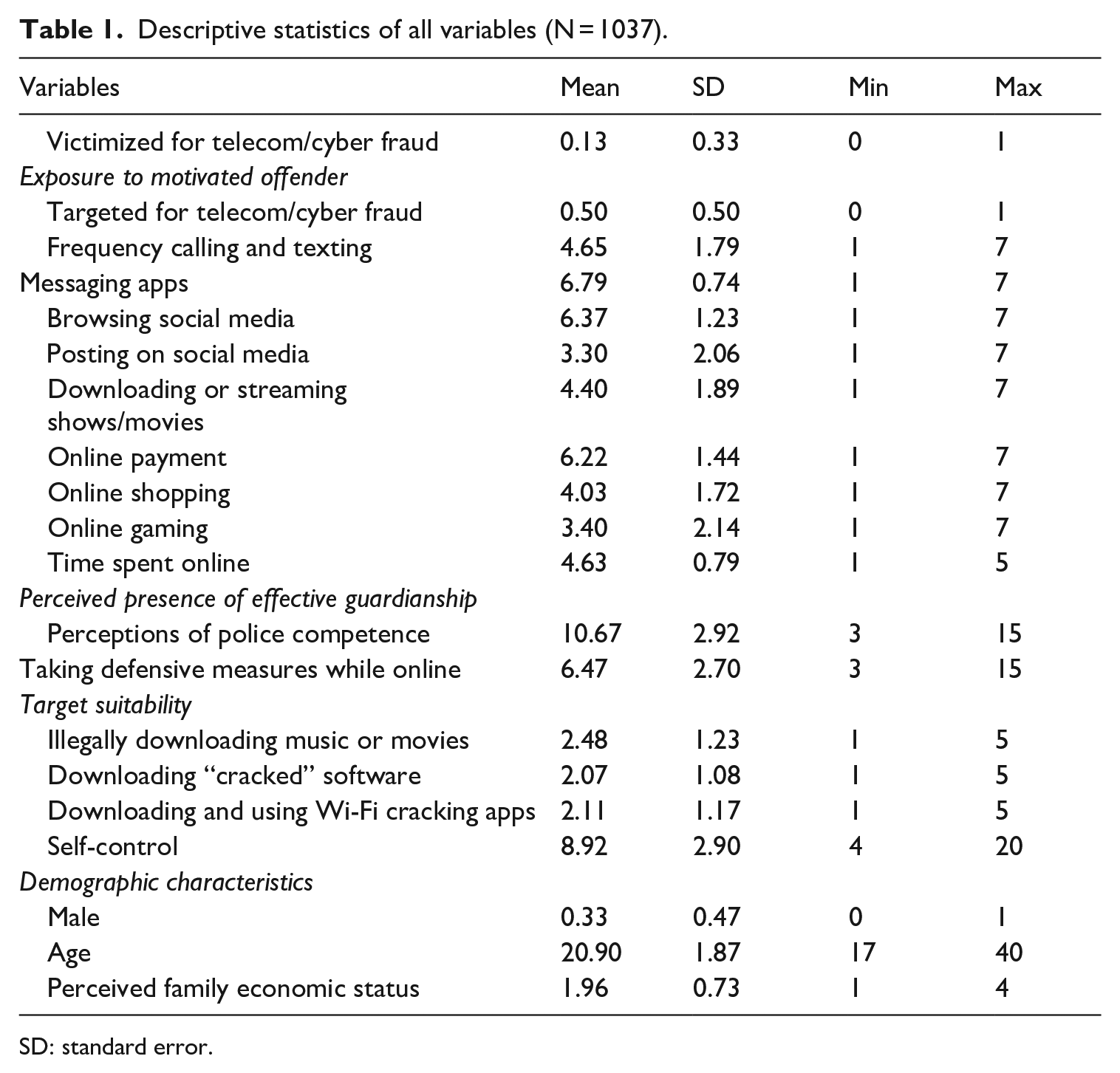
SD: standard error.
Measures
The first dependent variable, Completed Victimization of Telecom/Cyber Fraud, was measured by the following survey item: “Have you ever suffered financial losses due to telecommunication or cyber fraud?” The response categories were “yes” (= 1) and “no” (= 0). The second dependent variable, Targeted for Telecom/Cyber Fraud, was measured by the students’ responses to the following survey question: “In the past three months, has anyone attempted to defraud you via telecommunication or the Internet (using your phones, computers or other electronic devices)?” The response categories ranged from “never” (= 1) to “4 or more times” (= 5). To ensure consistency with the other dependent variable, this variable was dichotomized into a dummy variable with 0 representing having never been targeted for telecom/cyber fraud and 1 representing having been targeted in the past 3 months. Targeted for telecom/cyber fraud was also treated as a predictor of completed victimization as it suggests that the victim was not only exposed to potential offenders but also already on their radar.
Besides attempted victimization, additional correlates of telecom/cyber victimization indicating exposure to potential offenders include the respondents’ frequency of using different telecom/cyber technologies and the amount of time spent online daily in the past 3 months. The respondents were asked to report their frequency of calling and text messaging, using instant messaging apps, browsing social media, posting on social media, downloading or streaming movies, TV shows, videos, and music, making online payments, shopping, or ordering food online, and gaming online. The response categories ranged from “never” (= 1) to “3 times a day” (= 7). These items were analyzed individually as exploratory factor analysis did not support constructing an index of these variables. Time Spent Online was measured by a single survey item: “in the past three months, how long do you spend online every day?” The response categories ranged from “less than half an hour” (= 1) to “3 hours or more” (= 5)
Regarding guardianship, Perceptions of Police Competence was an index of three survey items asking the respondents how satisfied they were (1 = “very dissatisfied”; 5 = “very satisfied”) with the police in preventing telecom/cyber fraud, solving telecom/cyber fraud cases, and recovering the financial losses of the victim. The measure of guardianship using policing variables (i.e. viewing the police as formal guardians), although not common, has also been used by previous research, such as Stahura and Sloan (1988) and Groff (2007). Factor analysis showed that these items loaded onto the same dimension with excellent inter-item reliability (Cronbach’s alpha = .90). Taking Defensive Measures while Online was also an index of three survey items assessing how often (1 = “never,” and 5 = “always”) the respondent installs defensive software, updates defensive software, and runs applications of unknown sources on their devices. Factor analysis revealed that these items loaded onto the same dimension with acceptable internal consistency (Cronbach’s alpha = .60).
Target suitability includes several variables. The respondent’s frequency of engaging in risky online routine activities was measured. These routine activities include illegally downloading music or movies, downloading “cracked” software, and downloading and using Wi-Fi cracking apps. Response categories to these items ranged from “never” (= 1) to “all the time” (= 5). Self-Control was measured by four survey items taken from the Impulsivity Subscale of the Low Self-Control Scale (Grasmick et al., 1993), which has been validated in multiple empirical studies (e.g. Delisi et al., 2003; Piquero et al., 2000). The respondent was asked the extent to which they agree (1 = “strongly disagree” and 5 = “strongly agree”) to the following statements: (1) “Sometimes I will take risks just for the fun of it.” (2) “Excitement and adventure are more important to me than security.” (3) “I often act on the spur of the moment without stopping to think.” (4) “I often do whatever brings me pleasure here and now, even at the cost of some distant goal.” These specific items were selected as exploratory factor analysis indicated that they loaded onto the same dimension with acceptable internal reliability (Cronbach’s alpha = .70). Finally, demographic variables representing sex (0 = female and 1 = male), age (measured in years), and perceived family economic status (1 = not so great, 2 = getting by, 3 = about average, and 4 = above average) were also included as control variables in the analysis. Specifically, perceived family economic status was measured by the following survey item: “What do you think your family economic status is?” These covariates were included as they are documented predictors of cyber fraud victimization in multiple studies (e.g. Milani et al., 2022; Partin et al., 2022; Pratt et al., 2010; Reyns, 2015; Van Wilsem, 2013). It should be noted that preliminary analysis indicated that students at the two universities do not differ in both victimization measures. We thus did not include a variable to control for the university in the analysis. Table 1 summarizes the descriptive statistics of all variables used for analysis in this study. Given that many predictors were employed in this study, we assessed the possible multicollinearity concern by checking the matrix of two-variable correlations among the independent and control variables. The highest correlational coefficient is .39 (between using social media and browsing social media), which is acceptable. We also examined the variance inflation factors (VIFs), which were below 2, much lower than the generally accepted limit of 10. In order to test linearity in the logit for the continuous variables, Box–Tidwell tests were performed, and all the continuous variables showed that the assumption of linearity was not violated. No extreme outliers were detected.
Analytic strategy
Binary logistic regression with maximum likelihood estimation was selected as the primary analytic strategy for this study. Two sets of regression models were run using Stata 17. In the first set of models, completed victimization was the dependent variable. In the second set, attempted victimization was the dependent variable. In both sets of models, the predictors were entered in blocks (i.e. nested regressions) to explore any potential mediation effect. Chi-square and McKelvey & Zavoina pseudo R2 were used to assess model fit. Multiple simulation studies in economics (DeMaris, 2002; Hagle and Mitchell, 1992; Veall and Zimmermann, 1992, 1994; Windmeijer, 1995) have suggested that McKelvey & Zavoina pseudo R2 is the best one to assess the fit of binary and ordinal logit models in comparison with other fit statistics such as the McFadden R2 which tends to underestimate the “true” R2.
Results
As shown in Table 1, 13% of the students reported having financial losses from telecom/cyber fraud victimization. About 50% of the students reported being targeted for telecom/cyber fraud. Telecommunication and Internet use is frequent among this group, especially for using messaging apps (mean of 6.79 within a range of 1–7), browsing social media (mean of 6.37 out of a range of 1–7), and making online payments (mean of 6.22 in a range of 1–7). Thirty-three percent of the respondents were male. The average age of the respondents was about 21, and most reported a perceived family economic status of “not so great” (27.19%) and “getting by” (51.01%).
Nested regression models were conducted to assess whether adding a block of routine activity variables into the analysis improves the theoretical model’s ability to predict completed and attempted victimization. Table 2 summarizes the results from the binary logistic regression models on the dependent variable of completed telecommunication/cyber fraud victimization. Model 1 only included the demographic variables, and as demonstrated, neither the model nor any of the variables were statistically significant (χ2 = 5.14, p > .05). In Model 2, the variable “having been targeted for telecom/cyber fraud” was included, along with measures of routine online activities. While being targeted for victimization was statistically significant, the overall model was not (χ2 = 11.62, p > .05). In Model 3, guardianship measures (i.e. perceptions of police competence in handling telecom/cyber fraud victimization and defensive online behaviors) were added to the previous model. The model exhibited robust goodness of fit (χ2 = 28.79, p < .05), and perceived police competence was significantly and strongly related to lower log-odds of completed victimization. Specifically, with each additional unit of increase in perceived police competence, the log-odds of completed victimization decreased by 12%. Being targeted for victimization, however, was no longer statistically significant. In Model 4, which is the final or full model, measures of target suitability (i.e. illicit online behaviors and self-control) were added to the previous model. The model exhibited robust goodness of fit (χ2 = 42.38, p < .01). Perceived police competence was associated with lower log-odds of completed victimization while having low self-control and using “cracked” software were associated with higher log-odds of completed victimization. Specifically, higher perceived police competence reduced the log-odds of completed victimization by 11%; with each additional unit of decrease in self-control, the log-odds of victimization increased by 9%; with each additional unit of increase in using “cracked” software, the log-odds of victimization increased by 25%, while with each additional unit of increase in illegally downloading music and movies, the log-odds of victimization decreased by 18%.
Binary logistic regression on completed telecom/cyber fraud victimization (N = 1037).
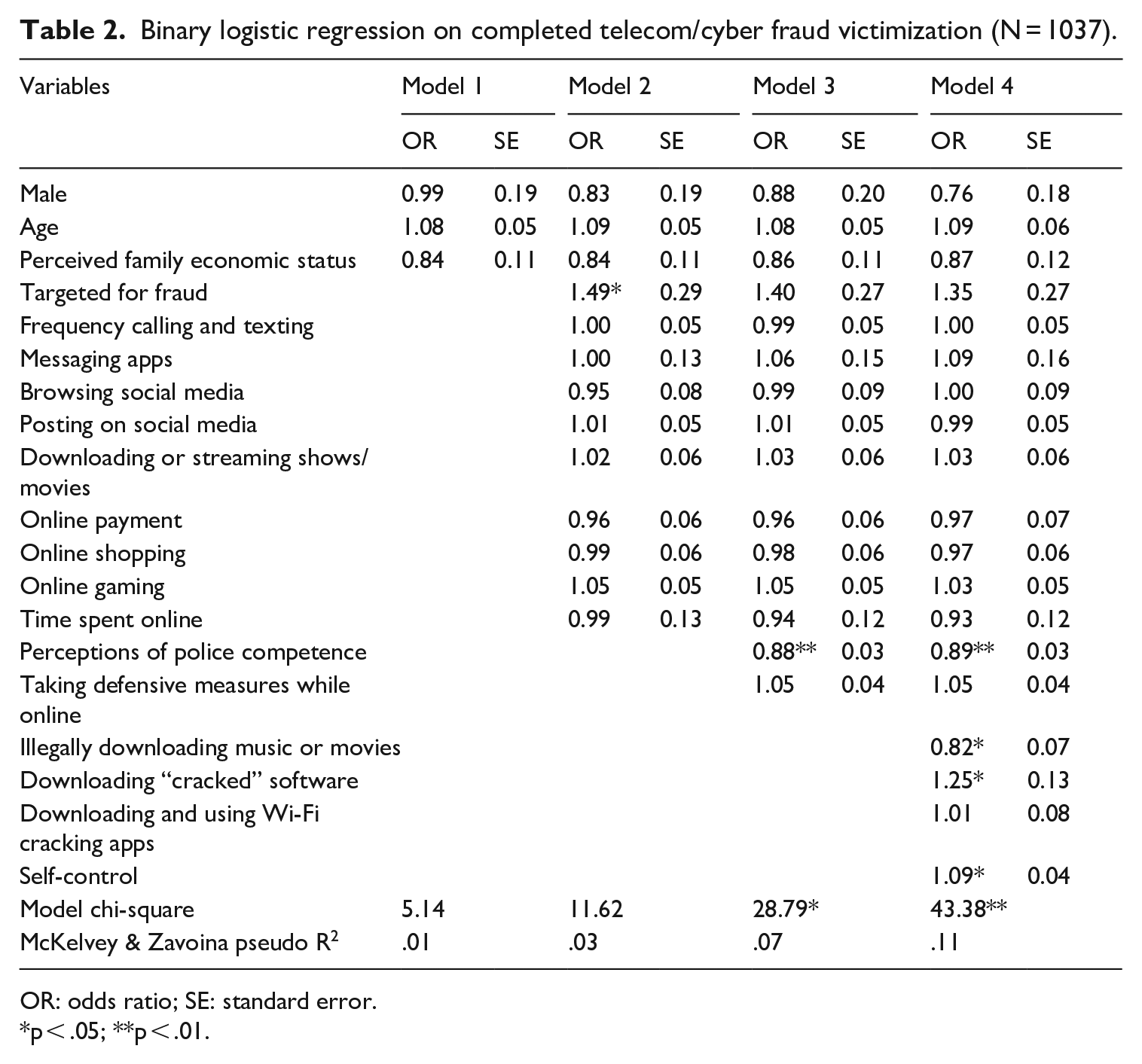
OR: odds ratio; SE: standard error.
p < .05; **p < .01.
Table 3 summarizes the results from the binary logistic regressions on the outcome of being targeted for victimization. According to the chi-square tests, Models 1 through 4 were all statistically significant. In Model 1, only demographic and socioeconomic variables were included, and the model exhibited robust fit (χ2 = 16.38, p < .01). Being male predicted 35% lower log-odds of being targeted for telecom/cyber victimization and coming from families with a higher economic status predicted 25% lower log-odds of being targeted for telecom/cyber victimization. In Model 2, variables of online routines were added to the model, and several of them were statistically significant along with the overall model (χ2 = 40.57, p < .01). Specifically, each additional unit of calling and texting and posting on social media predicted 8%–10% higher log-odds of being targeted while streaming music or video online predicted 12% lower log-odds of being targeted. In Model 3, guardianship variables (i.e. perceived police competence and taking defensive measures while online) were added to the previous model. The model exhibited robust fit (χ2 = 50.14, p < .01). Perceived police competence was statistically significant and did not substantially change the other estimates in the model. Finally, measures of target suitability (i.e. illicit online activities and self-control) were added in Model 4. The model exhibited robust fit (χ2 = 71.07, p < .01). Downloading and using Wi-Fi cracking apps predicted 13% higher log-odds of being targeted.
Binary logistic regression on attempted telecom/cyber fraud (N = 1037).
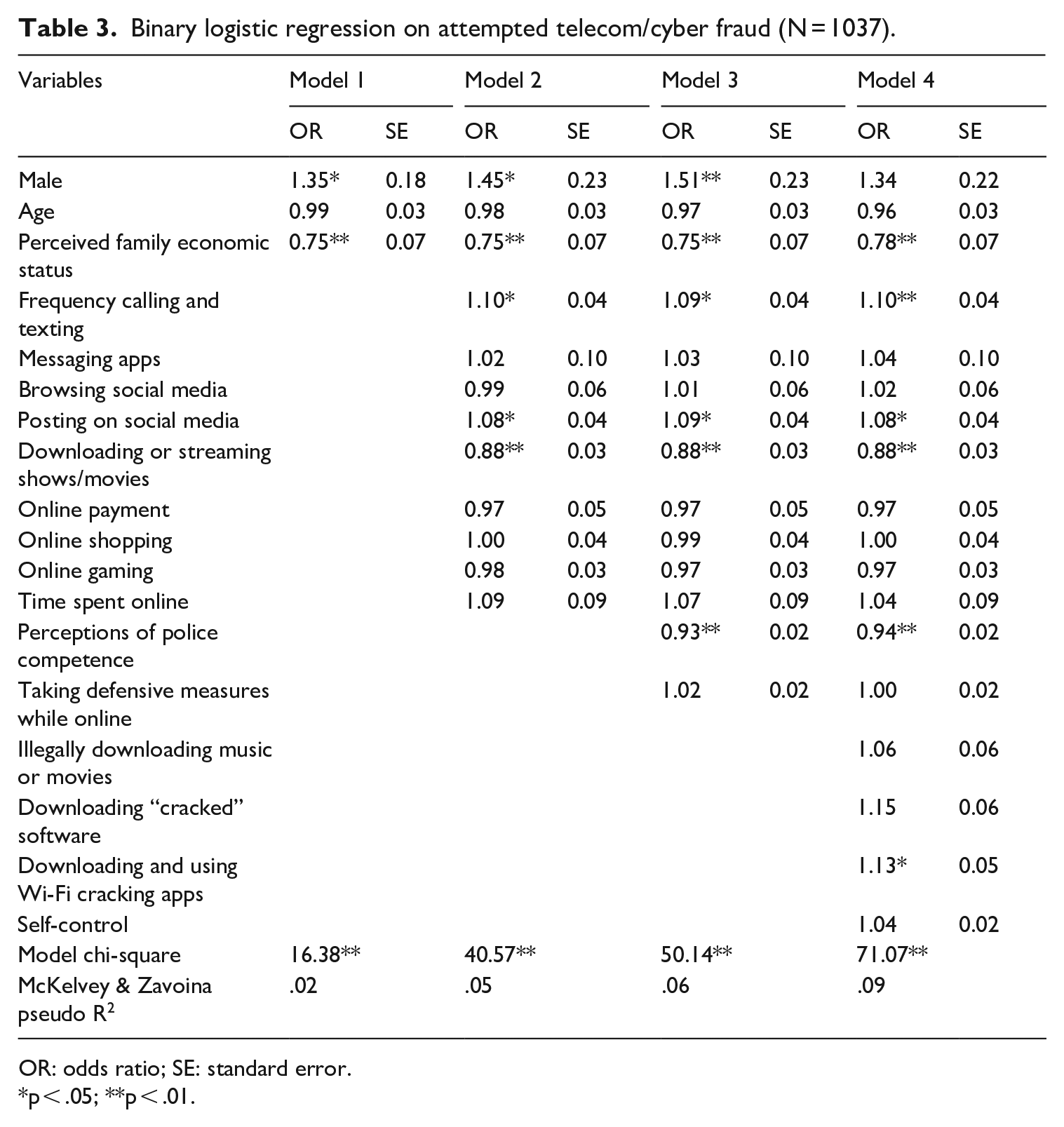
OR: odds ratio; SE: standard error.
p < .05; **p < .01.
Discussion
The current study represents one of the first quantitative studies to apply RAT to both attempted and completed telecom/cyber fraud victimization in China, the country with the largest number of Internet users and the largest e-commerce market in the world. Our findings provide a timely update to the understanding of RAT and telecom/cyber fraud in a rapidly changing cyber landscape. The analytic results of this study have demonstrated both convergences and departures from previous research on telecom/cyber fraud following the routine activity framework. The current study did find that some routine telecom/cyber activities of Chinese college students (i.e. calling, texting, streaming entertainment, and posting on social media) predicted higher odds of being targeted for telecom/cyber fraud along with demographic variables such as gender and perceived family economic status, resonating with previous research (Reyns, 2015). However, other online routine activities such as online purchasing and time spent online did not emerge as significant predictors as documented in previous research (Pratt et al., 2010; Reyns, 2015). When it comes to completed victimization, the current study found that mere exposure to offenders via conventional telecom/cyber routine activities seems to matter very little, contrasting findings from previous research (Leukfeldt and Yar, 2016; Van Wilsem, 2013). In comparison, the perceived presence of effective formal guardianship and target suitability (measured as illicit online behaviors) exerted a greater influence in predicting both attempted and completed victimization. Therefore, Hypothesis 1 is rejected while Hypothesis 2 is accepted. Considering these findings as a whole, it seems that those previously and commonly used measures of RAT (i.e. routine online and telecom activities) are better suited for explaining attempted telecom/cyber fraud victimization, whereas completed victimization is chiefly predicted by target suitability reflected in risky online behaviors and low self-control.
Why conventional online routine activities predicted attempted victimization but not completed victimization deserves further discussion. Telecom/cyber fraud is a “numbers game.” Offenders typically cast a wide net in the initial stage of their criminal operation, targeting a large number of potential victims using tactics such as “robocalls” and phishing. From there, they select the most vulnerable individuals (i.e. suitable targets) in whom they invest a greater deal of effort to illegally extract financial gains. Therefore, attempted victimization is a common occurrence that seems to be more heavily influenced by how much an individual is exposed to the offender by merely being online, whereas completed victimization is more closely related to inherent victim vulnerabilities. It should also be noted that attempted victimization in the current study was indicated by any fraud attempt in the past 3 months, whereas completed victimization was measured as ever suffering a financial loss from a fraud attempt. The two variables are not significantly correlated at the bivariate level (see Online Appendix 1), which explains the non-significant link between attempted and completed victimization in the regression models.
A couple of findings from the current study contrast findings from the West and may potentially reflect the specific social and cultural characteristics of China. First, digital piracy is still very common in China due to both lax regulations and the traditionally justifying view on intellectual property theft (Shi, 2008). This may explain the high prevalence of illicit downloading activities (45% of the students) and using “cracked” software (32% of the students) documented in the current study, as well as their salience in predicting telecom/cyber victimization: malware is especially easy to penetrate the cyber defensive system when these illegal downloads and installations occur. At first glance, it may be somewhat perplexing that illegally downloading music and movies online predicts lower odds of attempted victimization. It may be the case, however, that if consuming entertainment is the primary online activity, an individual may spend less time doing other online activities (such as using social media) that may be associated with greater risks of attempted victimization. It may also be the case that websites providing illegal downloads of movies and entertainment rely primarily on ads for revenue and consequently may be incentivized to guarantee basic security and customer privacy. Future research is warranted to further investigate these speculations, which have the potential of providing more tailored policy recommendations for law enforcement.
In completed victimizations, the victims’ low self-control was one of the significant predictors, although its effect size was much smaller than that of making illicit software downloads online. In attempted victimization, no significant link to self-control was found at the multivariate level. It could be that low self-control is linked to more frequent engagement in illegal online activities, making these individuals vulnerable to cyberattacks, although there is not enough evidence in the current study to confirm such a mediation effect. Findings from a US study of college students (Partin et al., 2022) reported that the effect of self-control on attempted cybercrime victimization was mediated by risky online behaviors (indirect effect = .85, 95% confidence interval (CI) = 0.49–1.24). Given that data analysis in the current study is insufficient to inform any definitive conclusion, future research should further explore the mechanism between self-control, illicit online behaviors, and victimization (both attempted and completed) in the Chinese context.
Students’ self-perceived family economic status was a strong predictor of attempted victimization. In a recently published Swiss study (Milani et al., 2022), the researchers found that computer literacy is associated with a lower risk of malware victimization. It could be that students from families of higher socioeconomic status possessed a greater level of computer literacy that protected them from cyber and telecom predation. Future research should further explore this connection. The strong effect of perceived law enforcement competence on lower odds of both attempted and completed victimizations affirms the importance of institutional guardianship above and beyond personal guardianship such as installing anti-virus software. It should be noted that these perceptions could be influenced by the individuals’ experience with the police in handling telecom/cyber fraud rather than simply reflecting their general impressions of police competence. Regardless, this finding weakens the view that telecom/cyber fraud is insensitive to law enforcement given the low cost of committing the crime and the relatively high cost of law enforcement. Instead, it is only sensitive to quality law enforcement that is timely and effective in the apprehension of suspects and restoration of losses.
Concededly, a few limitations associated with the current study warrant discussion. First, the sample of this study came from college students at two southwestern universities in China. Our findings shed light on the patterns of telecom/cyber fraud victimization among the younger Chinese population who makes up the majority of the victims. Nonetheless, these findings are not generalizable to the entire Chinese population or the entire college student population in China. Related to this point, while the operation of most educational institutions in China remained largely uninterrupted in 2021, the special circumstance of COVID-19 may have also limited the external validity of the current study given the students’ potentially longer hours of online activities. Some measures in the study, such as time spent online and engagement in various online routines, may not be precise enough to differentiate the multiple levels of online activity. Future research on the younger population should improve these measures by, for example, gauging the exact amount of time spent online overall and on different online routines. We also only measured impulsivity as a proxy of self-control; future research should strive to operationalize other dimensions of self-control as well. Despite measuring and testing several elements of RAT, this study remains largely exploratory; more research is needed to bolster the findings from this study. For instance, future research should examine the potential mediating relationships between the variables of this study: low self-control may reduce people’s effective self-protective capacity and skills against victimization while increasing their participation in risky telecom/online behaviors conducive to victimization. Finally, in addition to a subjective measure of family economic status, future research should also use more objective measures such as parents’ education and income to measure this concept.
Our findings carry some policy implications. We found that college students who downloaded cracked software are the highly vulnerable group of completed and targeted telecom/cyber fraud. School officials should implement policies and programs to strengthen the awareness and understanding of college students’ potential risks of using cracked software among college students. Similarly, students with low self-control are more likely to become victims of completed and targeted telecom/cyber fraud. College health and counseling units should provide professional assistance and training services to enhance students’ self-control by, for example, setting specific educational goals, learning stress and anger management, avoiding temptations from peer groups, and engaging in healthy and confidence-building extra-curriculum activities. Our findings also link college students’ perceptions of police competence to their victimization experience with telecom/cyber fraud. Although it is not fair to blame the police for such victimization, police agencies need to work closely with school officials to improve college students’ knowledge and alert them about some common and evolving cons, scams, and fraud schemes. A competent police force in preventing and handling fraud victimization is likely to garner trust among college students, which in turn can reduce such victimization.
Supplemental Material
sj-docx-1-crj-10.1177_17488958221146144 – Supplemental material for Telecommunication and cyber fraud victimization among Chinese college students: An application of routine activity theory
Supplemental material, sj-docx-1-crj-10.1177_17488958221146144 for Telecommunication and cyber fraud victimization among Chinese college students: An application of routine activity theory by Kai Lin, Yuning Wu, Ivan Y Sun and Jia Qu in Criminology & Criminal Justice
Footnotes
Declaration of Conflicting Interests
The author(s) declared no potential conflicts of interest with respect to the research, authorship, and/or publication of this article.
Funding
The author(s) disclosed receipt of the following financial support for the research, authorship, and/or publication of this article: This research was supported by funding from Guizhou University of Finance and Economics in 2022 (2022KYQN09). This article was based on data collected by the project “Research on the Practice Dilemma and Mode Innovation of the Telecom/Cyber Fraud.”

Supplemental material
Supplemental material for this article is available online.
Author biographies
References
Supplementary Material
Please find the following supplemental material available below.
For Open Access articles published under a Creative Commons License, all supplemental material carries the same license as the article it is associated with.
For non-Open Access articles published, all supplemental material carries a non-exclusive license, and permission requests for re-use of supplemental material or any part of supplemental material shall be sent directly to the copyright owner as specified in the copyright notice associated with the article.
